The 100-Year-Old Man Who Climbed Out the Window and Disappeared Summary, Characters and Themes
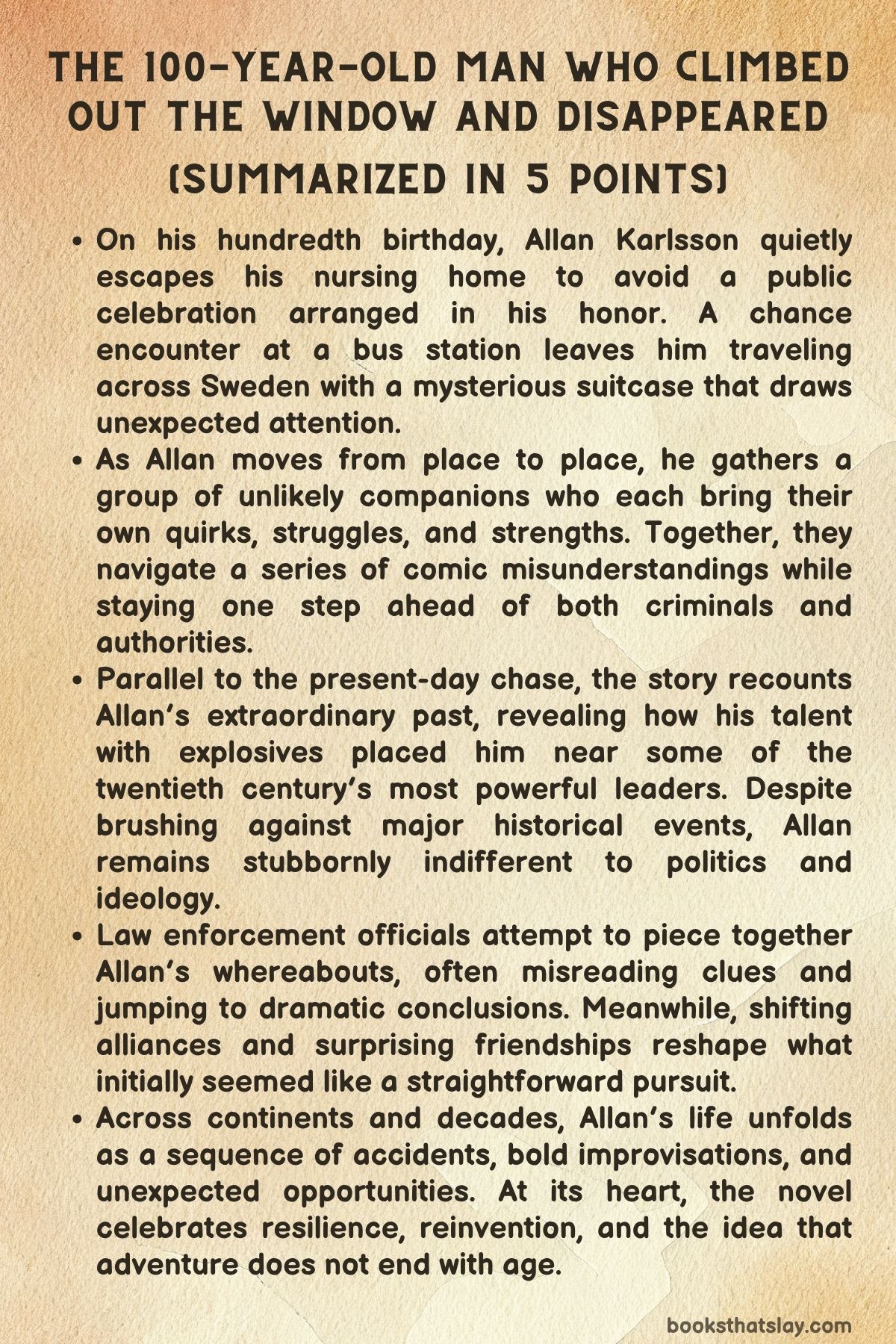
The 100-Year-Old Man Who Climbed Out the Window and Disappeared by Jonas Jonasson (translated by Rod Bradbury) is a comic adventure that begins with a simple act of rebellion: a centenarian decides he’d rather skip his own birthday party than sit politely through speeches and cake. Allan Karlsson’s escape from a Swedish nursing home turns into a fast-moving chase involving criminals, police, unexpected friends, and a suitcase that should never have been left unattended.
Along the way, the story also looks back over Allan’s improbable life, where his talent with explosives keeps placing him near world-shaping events.
Summary
On the morning of his hundredth birthday, Allan Karlsson is expected to smile through a celebration arranged by the nursing home’s director, the mayor, the press, and the other residents. Allan has no interest in being the guest of honor.
He opens his bedroom window, climbs out, and walks away with the calm certainty of someone who has decided that a quiet escape is more appealing than forced festivities.
He reaches the local bus station with little money and no real plan beyond getting farther from the party. While he waits, a rough young man named Bolt orders Allan to watch a large suitcase while he goes to the restroom.
Allan tries to refuse, warning that his bus is about to leave, but Bolt is aggressive and disappears into the restroom anyway. When Bolt doesn’t return in time, Allan boards the bus—and in the confusion and impatience of the moment, he brings the suitcase with him.
Bolt realizes what happened too late and swears revenge.
Allan gets off at a small rural stop and meets Julius, an older man living in the run-down station. Julius is lonely, disliked by locals because of past trouble, and eager for company.
Allan tells him the truth: he escaped the nursing home and accidentally took a gangster’s suitcase. Julius, instead of panicking, invites him in.
Their brief refuge ends when Bolt tracks them down, breaks in, and attacks Julius. Allan responds with practical force, knocking Bolt unconscious with a plank.
Unsure what to do, the two men lock Bolt in a meat freezer that isn’t running and decide to open the suitcase.
Inside are bundles of cash—an enormous sum. Suddenly, Allan’s escape becomes something much bigger than a missing-person story.
They argue over what to do, then choose the simplest option: split the money and leave before anyone catches up. Unfortunately, in the morning they realize they made a fatal mistake.
The freezer had been turned on to keep Bolt quiet, and they forgot to switch it off. Bolt is dead.
Allan reacts with his usual blunt steadiness; Julius is shaken, but the situation forces them forward.
Meanwhile, the authorities scramble. The nursing home director wants Allan found immediately.
The mayor tries to manage the public embarrassment. A police inspector named Göran Aronsson begins the search, following small clues: Allan’s path to the bus station, witness reports from the bus, and hints pointing toward the rural stop.
Aronsson is careful and observant, but he’s also trapped in a system that prefers dramatic headlines to methodical investigation. The press runs wild stories, and the case grows messier by the hour.
The stolen cash belongs to the Never Again gang, led by Per-Gunnar “Pike” Gerdin, a massive, violent man who built a criminal enterprise through intimidation. The money was earned through a major drug deal, and Pike cannot afford to lose it.
He sends another henchman, Bucket, to recover the suitcase and deal with whoever has it.
Allan and Julius attempt to erase evidence by placing Bolt’s body into a steel container at a foundry. The container is shipped abroad, taking the problem far from Sweden.
Then they recruit help almost by accident. They meet Benny, a hotdog vendor with some veterinary training, and persuade him to drive them south in his Mercedes.
As if their situation isn’t strange enough, they soon arrive at a farmhouse owned by Gunilla Björklund, a confident red-haired woman Benny nicknames “The Beauty.” She takes them in, suspicious but curious, and quickly becomes part of the group when she learns about the money and decides she’s tired of living by other people’s rules.
Gunilla also has an unexpected resident: a circus elephant named Sonya, believed dead after a mishap but very much alive on the property. When Sonya is in pain, Benny uses his vet knowledge to help.
Gunilla is impressed. The elephant becomes both a responsibility and, later, a crucial advantage.
Bucket locates them and confronts Allan with a gun, demanding the suitcase. Allan handles danger in an almost casual way.
He tricks Bucket into stepping back, and then orders Sonya to sit. The elephant obeys, crushing Bucket.
It’s brutal, absurd, and decisive. The group now has another body to worry about—and more reason to flee.
They leave in a purchased school bus modified to hide both people and elephant. Pike, angry and desperate, arrives and pursues them.
Aronsson, now aware that his earlier dismissal of a witness tip was a mistake, tails Pike, hoping to reach the suspects. The chase ends with a crash: the heavy bus smashes Pike’s car and wrecks it completely.
Pike survives, badly injured, and the group assumes at first that he might be dead. Aronsson arrives to find the aftermath and reaches his own conclusions based on blood and debris.
The travelers end up at Bellringer Farm, owned by Benny’s estranged brother Bosse, a wealthy businessman with a talent for selling odd products and a habit of explaining his success as if it were ordinary. Benny and Bosse reunite after decades, and Bosse, surprisingly, chooses hospitality over judgment.
The group rests, eats, and tries to decide what to do next.
Pike, discovered alive, confronts them with a gun—but the confrontation turns in an unexpected direction. Pike and Bosse recognize each other from past business dealings.
The tension collapses into something close to camaraderie. With Bolt and Bucket gone and Pike’s criminal operation collapsing, Pike begins to see that the suitcase might not be his future anymore.
He and Allan talk frankly, and Pike—who expected betrayal—finds himself drawn into the group rather than set against it.
The legal case also shifts. Bodies start turning up in strange ways: one ends up discovered overseas and discarded into the sea; another is found in Latvia after a stolen car is crushed.
Prosecutor Ranelid, who had loudly accused the group of multiple murders, watches his case fall apart. Needing to save face, he drops charges and later invents flimsy explanations for the press, including blaming a police dog’s tracking for misleading conclusions.
Aronsson, who has spent weeks pursuing the truth, finds himself pulled into a compromise between reality and public narrative.
When the pressure from media and authorities becomes unbearable, Allan decides the best solution is distance. He contacts someone from his past: Amanda Einstein, connected to Allan through the long chain of events that followed his earlier travels.
Arrangements are made, not neatly but effectively, and the group flies to Bali through a loosely regulated flight operation that doesn’t ask too many questions. In Bali, Amanda welcomes them into her hotel, treating their arrival as a grand reunion rather than an international complication.
Life in Bali becomes comfortable, even joyful. Gunilla and Benny deepen their bond.
Sonya settles into a warmer, easier existence. The group enjoys what feels like a second chance, built not on virtue or planning but on survival, luck, and shared secrecy.
Allan and Amanda grow close, and eventually they marry, surprising even themselves with how naturally it happens.
Running alongside the present-day chase is Allan’s own life story, told through key moments that explain why he responds to chaos with such calm. Born in 1905, Allan grows up poor and largely unschooled, becomes skilled with explosives, and spends much of his life drifting from one place to another.
His talent and blunt honesty repeatedly place him near major historical figures and turning points—often without Allan intending to be involved. He helps build and understand powerful weapons, travels through war zones, survives imprisonment, and stumbles into international politics while insisting he has no interest in ideology.
He simply follows the next practical step, and history keeps tripping over him.
In old age, Allan lives quietly in Sweden until an accident destroys his home. He ends up in the nursing home he later escapes, convinced he’s ready to die—until he wakes up one morning still alive.
That small surprise leads to his decision to leave and see what happens next.
In the closing moments, Allan’s new life in Bali continues with the same pattern: comfort arrives, trouble doesn’t fully vanish, and opportunity reappears. A government official approaches Allan with a request for help acquiring an atomic bomb.
Allan agrees, as casually as if he’s being asked to fix a fence, suggesting that even at one hundred, his accidental involvement with world affairs is not finished.
Characters
Allan Karlsson
Allan Karlsson stands at the center of the book as both a comic figure and an unlikely witness to world history. At one hundred years old, he is physically frail but mentally alert, guided less by ideology than by practicality.
His defining trait is detachment: he refuses to be drawn into political loyalties, moral crusades, or grand emotional reactions. Whether facing gangsters, presidents, or prison guards, he responds with the same calm logic.
Allan’s expertise with explosives becomes the thread that connects his life to major historical events, yet he treats these encounters as accidents rather than achievements. He neither seeks power nor fears authority, which paradoxically gives him freedom.
His moral compass is unconventional—he shows little visible guilt over the deaths that occur around him—but he is not cruel. Instead, he prioritizes survival, simplicity, and forward movement.
Allan embodies the novel’s philosophy that life is best handled by accepting events as they come rather than trying to control them.
Julius Jonsson
Julius serves as Allan’s first true companion after the escape and represents second chances in old age. A petty criminal with a tarnished reputation, Julius has lived on the margins of society, distrusted and dismissed by his community.
Yet beneath his opportunistic instincts lies a deep loneliness and desire for connection. His quick decision to shelter Allan shows both recklessness and generosity.
Julius is more openly anxious than Allan, especially when confronted with dead bodies and police investigations, but he adapts quickly. His willingness to split the money and commit fully to the adventure reveals loyalty and a hunger for meaning.
Through Julius, the narrative suggests that even those labeled as failures can rediscover purpose when given companionship and opportunity.
Benny Ljungberg
Benny enters the story as a directionless hotdog vendor with partial veterinary training and lingering insecurities about his life choices. He feels overshadowed by his successful brother and uncertain about his own worth.
However, Benny proves dependable and emotionally perceptive. His practical skills, especially in caring for Sonya the elephant, give him confidence and earn Gunilla’s admiration.
Unlike Allan, Benny is more sensitive and reflective, particularly in matters of love and belonging. His reconciliation with his brother Bosse shows growth and maturity.
Benny’s development illustrates how courage often appears not in grand gestures but in the quiet decision to move forward with unfamiliar people toward an uncertain future.
Gunilla Björklund
Gunilla, nicknamed “The Beauty,” is strong-willed, pragmatic, and unapologetic about her past. Living independently on her farm, she has little patience for foolishness and quickly demands honesty from Allan and the others.
Her decision to join the group is not driven by greed alone but by a desire to break free from disappointment and stagnation. Gunilla’s maternal instinct appears in her care for Sonya, yet she is far from sentimental.
She balances warmth with assertiveness, especially when confronting authority figures like the prosecutor. Her relationship with Benny brings out a softer dimension in her character, suggesting that stability and affection can coexist with independence.
Gunilla grounds the group emotionally, providing both shelter and moral firmness when needed.
Per-Gunnar “Pike” Gerdin
Pike begins as the primary antagonist, a physically imposing gang leader accustomed to control through fear. His obsession with recovering the stolen money reflects his identity as a man whose authority depends on dominance.
However, Pike’s character shifts significantly after his injury and confrontation with Allan’s group. Stripped of his power structure—his henchmen dead and his operation compromised—he reveals vulnerability and even a capacity for reflection.
His eventual handshake with Allan marks a transformation from vengeance to reluctant camaraderie. Pike represents the collapse of rigid masculinity and criminal ego when confronted with absurd circumstances.
His integration into the group underscores the novel’s recurring idea that enemies can become allies once pride loses its grip.
Inspector Göran Aronsson
Inspector Aronsson is one of the few consistently rational figures in the law enforcement narrative. Unlike the grandstanding prosecutor, Aronsson values evidence and logic over spectacle.
He is patient, observant, and quietly skeptical of dramatic conclusions. Throughout the investigation, he senses inconsistencies in the official narrative but remains constrained by institutional pressures.
His growing familiarity with Allan’s group softens his stance, and he gradually shifts from adversary to almost participant. Aronsson’s moral struggle lies in balancing professional duty with human understanding.
His character highlights the tension between justice as procedure and justice as fairness.
Prosecutor Conny Ranelid
Prosecutor Ranelid embodies vanity and ambition within the legal system. He is more concerned with public image and career advancement than with truth.
His eagerness to label Allan’s group as murderers reveals a preference for sensational cases. When evidence undermines his accusations, he resorts to damage control, shifting blame and manipulating the narrative.
Ranelid’s character serves as satire of bureaucratic pride and the fragility of authority when exposed to incompetence. Unlike Aronsson, he never experiences meaningful growth, remaining fixated on reputation over responsibility.
Bolt
Bolt is aggressive, impulsive, and emblematic of small-time criminal bravado. His initial interaction with Allan at the bus station sets the entire modern plot in motion.
He relies on intimidation rather than intelligence and underestimates both Allan and Julius. His death, caused by carelessness and stubbornness, reflects the consequences of arrogance.
Bolt functions less as a complex individual and more as the spark that ignites chaos.
Bucket
Bucket, though dangerous, is characterized by confusion and limited intellect. His misguided attempts at leadership in the past and his loyalty to Pike show a man desperate for validation.
His fatal encounter with Sonya underscores the absurdity that defines the novel’s violence. Bucket’s inability to follow instructions or think strategically contrasts sharply with Allan’s steady improvisation.
He represents the incompetence that often undermines criminal ambition.
Bosse Ljungberg
Bosse, Benny’s brother, is a successful entrepreneur with a flair for unconventional marketing. Despite his wealth, he remains surprisingly open-minded and generous.
His reconciliation with Benny suggests that success has not hardened him emotionally. Bosse’s willingness to host the fugitives without judgment reflects confidence and a sense of humor about life’s unpredictability.
He symbolizes stability and reconciliation within the broader chaos.
Amanda Einstein
Amanda is intelligent, ambitious, and highly adaptable. Emerging from Allan’s past adventures, she demonstrates a talent for navigating political and social systems to her advantage.
Her ascent to influence in Indonesia shows strategic thinking and resilience. Unlike Allan, Amanda actively shapes her circumstances rather than drifting with them.
Their eventual marriage suggests compatibility rooted in shared unconventional experiences. Amanda brings long-term stability to Allan’s life while matching his tolerance for unpredictability.
Herbert Einstein
Herbert, Albert Einstein’s half-brother, is naive and intellectually limited but deeply human. His insecurity and dependence make him vulnerable, yet he forms a genuine bond with Allan during their imprisonment.
Herbert’s survival depends largely on Allan’s calm guidance. His later life, shaped by Amanda’s ambition, shows how proximity to stronger personalities can redefine one’s trajectory.
Herbert represents innocence caught in geopolitical machinery.
Yury Borisovich Popov
Yury is a Soviet physicist torn between national loyalty and personal survival. Initially part of the Russian nuclear effort, he becomes entangled with Allan in a web of espionage.
Yury is intelligent but cautious, aware of the dangers surrounding him. His eventual cooperation with American intelligence reflects pragmatic self-preservation rather than ideological conversion.
Through Yury, the narrative highlights the fluid loyalties of the Cold War era.
Sonya
Sonya the elephant is more than comic relief; she is a symbol of displaced innocence and unexpected strength. Presumed dead yet alive, she mirrors Allan’s own refusal to disappear quietly.
Sonya’s presence complicates the group’s escape but also saves them, most notably in her confrontation with Bucket. Her calm obedience contrasts with human impulsiveness.
As a silent participant, she reinforces the absurd balance between danger and humor that defines the story.
Themes
The Absurdity of Politics and Ideology
Throughout The 100-Year-Old Man Who Climbed Out the Window and Disappeared, political ideology is treated not as sacred doctrine but as a source of irony, contradiction, and human folly. Allan’s life repeatedly intersects with some of the most significant political movements and figures of the twentieth century—fascism, communism, democracy, Cold War espionage—yet he remains consistently indifferent to ideological loyalty.
His apolitical stance exposes the fragility and theatricality of political systems. Leaders who command nations are shown as insecure, impulsive, or vain in private settings.
Stalin, Truman, Mao, and others appear less as distant historical icons and more as flawed individuals driven by pride, paranoia, or self-interest.
Allan’s neutrality acts as a quiet critique of extremism. He does not argue against ideology in speeches or manifestos; instead, his refusal to commit reveals how arbitrary political divisions can seem when viewed from a distance.
He helps both communists and anti-communists, not because he believes in either cause but because circumstances require it. His assistance in developing nuclear weapons for opposing powers underscores how political conflicts are often fueled by personal ambition and miscommunication rather than moral clarity.
The novel also portrays bureaucracy and public authority as prone to absurd misjudgment. Prosecutors rush to accusations, governments manipulate narratives, and intelligence agencies construct half-truths to satisfy shifting agendas.
Through humor and exaggeration, the narrative suggests that systems claiming rational control are frequently chaotic beneath the surface. Politics becomes less about principle and more about performance, where appearances matter more than truth.
Allan’s quiet survival amid these forces suggests that detachment may be a form of wisdom in a world driven by ideological noise.
Chance, Fate, and the Role of Accident
Events in the novel unfold less through calculated ambition and more through coincidence and unintended consequences. Allan’s entire centennial adventure begins not with a grand plan but with a simple desire to avoid a birthday party.
From that minor act grows a chain of encounters involving gangsters, police, international travel, and unexpected fortune. The pattern mirrors his earlier life, where seemingly small decisions lead him into proximity with world-changing events.
A job in a dynamite factory leads to explosive expertise. A casual conversation leads to involvement in atomic research.
A misplaced suitcase triggers a criminal pursuit.
This emphasis on accident challenges traditional narratives of destiny. Allan does not chase greatness, yet greatness keeps brushing against him.
The story repeatedly implies that history is shaped as much by randomness as by deliberate strategy. Fires start because of oversight, governments rise and fall because of miscommunication, and powerful individuals depend on chance meetings.
Even deaths often result from carelessness rather than design, reinforcing the unpredictability of existence.
Allan’s response to chance is neither panic nor ambition. He accepts developments as they arise and adjusts accordingly.
This acceptance forms a philosophy: life rarely follows a linear path, and resistance to unpredictability creates unnecessary suffering. Instead of attempting to control every variable, Allan moves with circumstances.
The narrative therefore proposes that adaptability matters more than foresight. Fate is not portrayed as mystical destiny but as the accumulation of unpredictable events.
Human control is limited, and those who survive best are those who remain flexible. By presenting coincidence as a central engine of both personal and global change, the story reframes history as something far less orderly than official accounts suggest.
Aging, Reinvention, and the Refusal to Disappear
Allan’s escape from the nursing home is not merely an act of rebellion; it is a declaration that life does not expire at a predetermined age. At one hundred years old, he rejects the passive role assigned to him by society.
The celebration arranged in his honor represents a symbolic burial before death, as though his story has already concluded. Climbing out the window becomes an assertion of autonomy, a refusal to let others define the final chapter of his existence.
Throughout the narrative, aging is presented not as decline but as continuity. Allan’s physical frailty contrasts with his undiminished curiosity and problem-solving ability.
He does not seek nostalgia or regret. Instead, he treats each new situation with the same pragmatic mindset he used decades earlier.
His friendships with Julius, Benny, Gunilla, and even Pike demonstrate that companionship and transformation remain possible late in life. The group itself consists largely of individuals who feel overlooked or stalled in their circumstances.
Together, they reinvent themselves through shared risk.
The theme extends beyond Allan to suggest that identity is never fixed. Julius sheds the stigma of petty crime.
Benny moves beyond insecurity. Gunilla steps out of isolation.
Even Pike reconsiders his role as a criminal leader. Aging in this context becomes an opportunity to shed old labels rather than accumulate limitations.
The novel challenges cultural assumptions that old age equals irrelevance. Instead, it proposes that vitality is linked to willingness rather than youth.
Allan’s centennial adventure affirms that reinvention is not bound by chronology; it is a matter of perspective and courage.
The Banality of Violence and Moral Relativity
Violence occurs frequently in the narrative, yet it is often treated with surprising understatement. Deaths result from explosions, accidents, misunderstandings, and the literal weight of an elephant.
Instead of dramatic moral reckoning, reactions are muted and practical. Allan rarely expresses anguish over fatalities that occur in the course of events.
This tone does not glorify violence but reframes it as part of the absurd unpredictability of life.
By presenting violent outcomes alongside humor, the novel invites reflection on moral relativism. Allan does not operate according to conventional hero or villain categories.
He assists world leaders in developing devastating weapons while simultaneously expressing no ideological allegiance. His decisions are guided by immediate necessity rather than long-term ethical calculation.
This pragmatic morality can appear unsettling, yet it reflects the broader atmosphere of the story, where institutions themselves behave questionably. Prosecutors manipulate truth.
Governments distort information. Criminals display loyalty while officials pursue vanity.
The casual handling of violence also mirrors historical reality, where massive destruction is often rationalized as strategic necessity. The atomic bomb, espionage, and warfare are discussed in ordinary conversation, highlighting how extraordinary harm becomes normalized within political structures.
Individual deaths in the present-day storyline echo the larger historical violence Allan witnesses. In both cases, the narrative suggests that moral certainty is elusive.
Rather than delivering explicit judgment, the story presents a world where survival often depends on quick decisions in morally ambiguous situations. Allan’s philosophy is not about righteousness but about continuation.
Life moves forward regardless of ethical neatness. By softening the dramatic weight typically attached to violence, the novel questions how societies assign meaning to harm and whether moral clarity is ever fully attainable.