The 15 Invaluable Laws of Growth Summary and Analysis
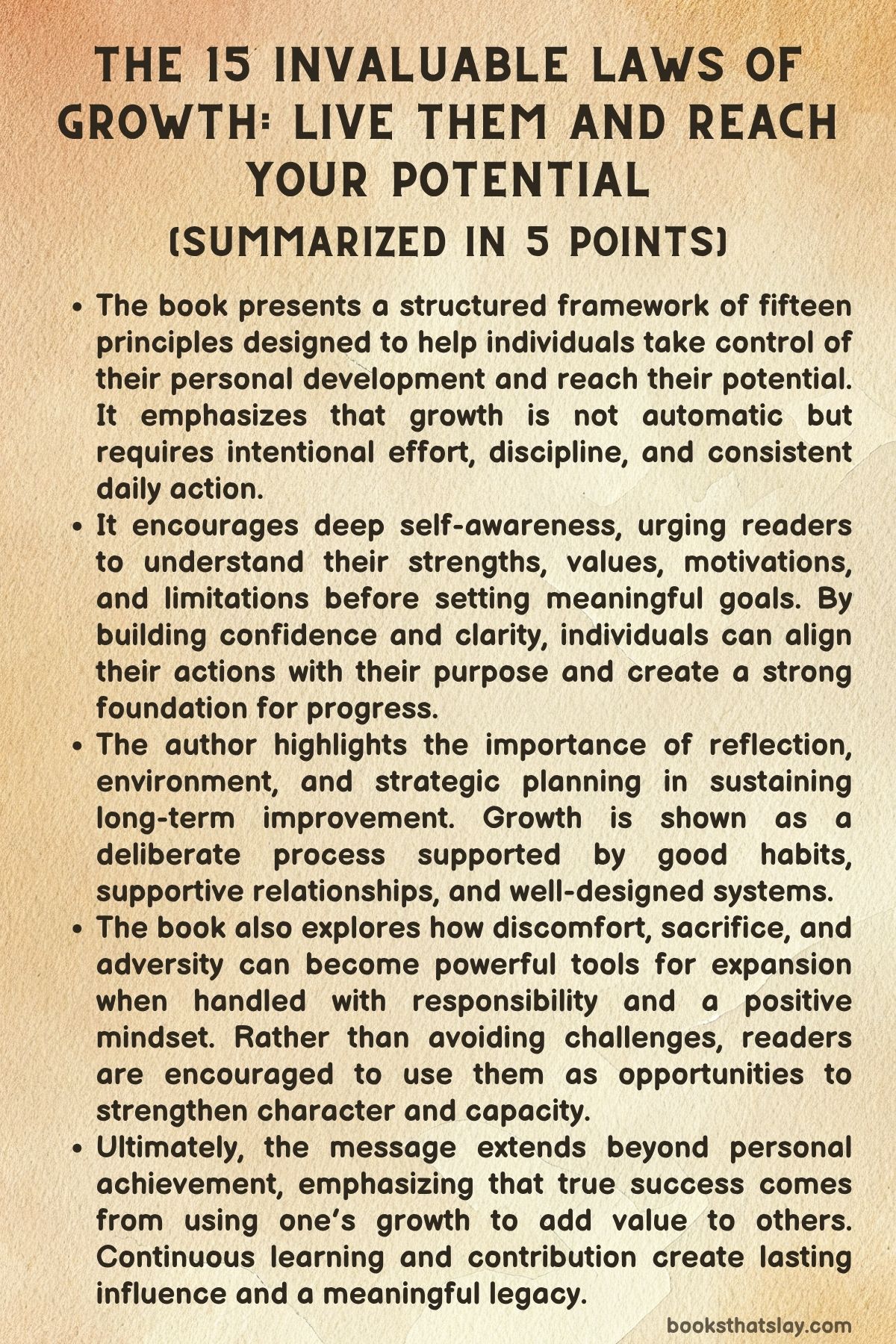
The 15 Invaluable Laws of Growth: Live Them and Reach Your Potential by John C. Maxwell by John C. Maxwell is a practical guide to personal development built around fifteen core principles designed to help individuals reach their potential. Maxwell argues that growth is not automatic; it must be intentional, disciplined, and sustained over time.
Drawing from personal experience, leadership lessons, and real-life examples, he presents growth as a lifelong process that touches every area of life—career, character, relationships, and purpose. The book provides both mindset shifts and actionable strategies, encouraging readers to take responsibility for their development and to pursue growth not just for personal success, but to positively impact others.
Summary
John C. Maxwell begins with a powerful premise: potential is one of the most hopeful words in the human vocabulary, yet it is also one of the most tragic when left unrealized. He insists that growth is the bridge between where a person is and where they could be.
However, growth does not occur by accident. It requires choice, discipline, and sustained effort.
The first principle, The Law of Intentionality, establishes that growth does not simply happen with time. Many people assume they will improve naturally, but Maxwell identifies several “growth gap” traps that prevent progress.
Some people believe growth will occur automatically. Others do not know how to start.
Many wait for the perfect time, fear making mistakes, compare themselves to others, or expect quick results. Maxwell argues that motivation alone is unreliable.
Progress begins when individuals take deliberate action, schedule development into their lives, and commit to learning consistently.
Next, The Law of Awareness emphasizes that people must know themselves in order to grow. Self-awareness is foundational.
Without understanding one’s strengths, weaknesses, passions, and motivations, effort becomes scattered and ineffective. Maxwell explains that some people have no direction, others know what they want but fail to act, and a smaller group actively pursues their goals.
Growth accelerates when individuals align their skills and passions with meaningful purpose. This requires honest self-examination, guidance from mentors, and a willingness to sacrifice comfort for fulfillment.
In The Law of the Mirror, Maxwell argues that self-worth directly affects growth. People who do not value themselves will not invest in themselves.
Through the story of a woman who overcame a painful upbringing to pursue education and achievement, he demonstrates how changing one’s self-image can transform a life. He outlines practical steps for building self-esteem, such as monitoring self-talk, avoiding unhealthy comparison, practicing integrity, serving others, and creating a clear personal vision.
When individuals believe they have value, they begin to act accordingly.
The Law of Reflection teaches that experience alone is not the best teacher; evaluated experience is. Maxwell stresses the importance of pausing to think.
Without reflection, lessons are lost. By asking intentional questions—about strengths, weaknesses, successes, and failures—individuals turn daily events into meaningful insight.
Reflection involves investigation, allowing ideas to develop, recognizing moments of clarity, and applying lessons to future action. Growth deepens when people create space for thoughtful evaluation.
Consistency becomes the focus in The Law of Consistency. Motivation may start the journey, but discipline sustains it.
Maxwell highlights that small, repeated actions over time create significant results. He urges readers to determine what they need to improve, how to improve, why improvement matters, and when to begin.
The answer to the last question is always now. Consistent habits, not occasional effort, form the backbone of personal development.
Environment plays a decisive role in The Law of Environment. Growth thrives in supportive surroundings.
Maxwell explains that if someone is always the most advanced person in the room, it may be time to change rooms. People should seek environments that challenge, inspire, and stretch them.
He introduces the idea of spending time with those who lift energy and stimulate progress rather than drain it. Changing both personal behavior and surroundings creates momentum.
Leaders, in particular, carry the responsibility of building growth-centered environments for others.
Planning becomes central in The Law of Design. Maxwell explains that growth requires strategy.
Drifting through life without structure leads to regret. He encourages readers to create systems that align daily habits with long-term goals.
Growth plans should be simple, repeatable, and realistic. Since personal development often takes longer than expected, patience and organization are critical.
Designing life intentionally allows each experience to contribute to a broader vision.
Pain is addressed directly in The Law of Pain. Adversity is unavoidable, but response determines outcome.
Maxwell shares stories of individuals who turned tragedy and hardship into opportunities for growth. Pain can either cause bitterness or maturity.
By choosing a positive outlook, taking responsibility, and extracting lessons from difficulty, individuals transform setbacks into stepping stones. The difference between surviving hardship and growing from it lies in attitude and action.
Character stands at the center of The Law of the Ladder. Maxwell argues that personal growth rises only as high as one’s character allows.
Talent may open doors, but integrity keeps them open. Through examples of leaders who built success on strong values, he emphasizes that honesty, humility, and ethical consistency form the foundation for lasting achievement.
Growth that ignores character eventually collapses. Developing inner strength must precede outward success.
Stretching beyond comfort zones defines The Law of the Rubber Band. Just as a rubber band is useful only when stretched, people grow when they feel tension between where they are and where they could be.
Comfort breeds stagnation. Maxwell describes moments in his own life when taking risks led to expanded influence and new opportunities.
Continuous stretching prevents complacency and keeps ambition alive. Without tension, growth halts.
Sacrifice becomes unavoidable in The Law of Trade-Offs. Growth requires giving up something in the present for something better in the future.
People must evaluate whether they are willing to exchange comfort, security, or immediate pleasure for long-term progress. Strategic trade-offs differentiate successful individuals from average ones.
However, Maxwell cautions that values and integrity should never be sacrificed. Wise trade-offs move a person forward without compromising character.
Curiosity drives discovery in The Law of Curiosity. Growth is stimulated by asking why.
Maxwell encourages cultivating a mindset of exploration and lifelong learning. Curious individuals look beyond easy answers, embrace failure as a teacher, and surround themselves with other learners.
Curiosity prevents stagnation and sparks creativity. By developing a habit of questioning and seeking better answers, people expand their thinking and opportunities.
Mentorship becomes central in The Law of Modeling. It is difficult to improve without someone to follow.
Maxwell stresses the importance of learning from those who have walked the path ahead. While books and seminars provide knowledge, personal mentors offer insight, correction, and encouragement.
Choosing mentors wisely—those with character, experience, and genuine investment—accelerates growth significantly. No one succeeds alone.
Capacity expands through The Law of Expansion. Maxwell explains that most people operate below their potential due to limiting beliefs.
By shifting thinking from “Can I?” to “How can I?” individuals unlock greater ability. Growth increases capacity when people challenge assumptions, pursue multiple paths to success, and exceed expectations.
Consistent focus on important priorities enlarges influence and effectiveness.
Finally, The Law of Contribution concludes the journey. Personal growth reaches its highest purpose when it benefits others.
Maxwell reflects on his realization that self-improvement is not solely about personal success but about adding value to people. He encourages readers to see themselves as channels through which growth flows outward.
Gratitude, generosity, prioritizing relationships, and ongoing learning allow individuals to multiply their impact. True fulfillment comes from helping others grow.
Throughout the book, Maxwell returns to a central theme: growth must be intentional, continuous, and others-focused. Each law builds upon the previous one, forming a comprehensive framework for lifelong development.
From self-awareness and discipline to environment, character, sacrifice, curiosity, and contribution, the message remains consistent. Growth is a choice.
When individuals commit to applying these principles daily, they move closer to realizing their potential and helping others do the same.
Key People
John C. Maxwell
John C. Maxwell is the central “character” of The 15 Invaluable Laws of Growth because the book is built around his voice, his philosophy, and his lived leadership experience. He presents himself as a guide rather than a distant expert, someone who has tested ideas through years of teaching, speaking, and leading organizations.
His personality comes through as structured, encouraging, and strongly action-oriented. He values responsibility and dislikes passivity, which is why he repeatedly pushes the reader to choose growth on purpose instead of hoping life will improve on its own.
He also reveals a reflective side—someone who pays attention to patterns, learns from mistakes, and adjusts his approach when a situation demands it. Across the laws, Maxwell’s defining trait is his belief that growth is teachable and that ordinary daily choices create extraordinary long-term outcomes.
Henry M.
Henry M. appears as a real-world case used to clarify the importance of self-awareness and the ability to learn. His role in the book is symbolic: he represents what happens when a person cannot form new memories and therefore cannot adapt, revise behavior, or build on experience.
Maxwell uses Henry’s situation to highlight that growth depends on awareness of self and the capacity to connect past learning to present action. As a “character” in the narrative structure, Henry is not there to drive a storyline but to act as a vivid contrast—someone who is intelligent yet unable to progress because learning cannot take root.
His presence makes the point that growth requires more than time passing; it requires the ability to process, remember, and apply insight.
Johnnetta McSwain
Johnnetta McSwain functions as one of the book’s strongest examples of personal transformation through changed self-perception. She is introduced as someone shaped by early deprivation, abuse, and neglect, conditions that created a damaging inner story about her worth.
What makes her significant in Maxwell’s framework is that her turning point is internal before it becomes external: she begins to see herself differently, and that shift fuels the courage to pursue education and long-term improvement. Her progress from survival to achievement illustrates the practical side of believing in one’s value—once she accepts that she is capable and worthy, she starts taking actions that match that belief.
In the book’s larger message, she embodies the idea that self-image influences behavior, and that rebuilding a sense of worth can unlock disciplined effort, persistence, and bigger life choices.
Nathaniel Branden
Nathaniel Branden appears as an influential supporting figure through his ideas about self-esteem and self-worth. In the book’s character landscape, he represents intellectual authority—someone Maxwell draws on to strengthen the argument that self-perception affects every area of life.
Branden’s relevance is not about personal narrative but about conceptual weight: he stands for the psychological reality that people act consistently with what they believe about themselves. His inclusion helps Maxwell move beyond motivational encouragement into a more grounded claim: confidence and self-respect are not decorative traits; they shape decisions, relationships, and resilience under pressure.
The Ukraine Translator
The translator in Ukraine is presented briefly, yet they play an important role because they trigger one of Maxwell’s most practical lessons about reflection and adjustment. This person becomes a catalyst by sharing a blunt insight: leaders are not trusted when they do not add value to others.
Maxwell responds by pausing, reassessing what his audience needs, and reshaping his message. As a “character,” the translator represents the value of outside perspective—someone who sees the cultural mood clearly and speaks it plainly.
Their function is to demonstrate how a single honest comment can shift a leader’s thinking and improve impact, especially when the leader is humble enough to listen.
The Buggy-Whip Company
The buggy-whip makers serve as a cautionary “character,” almost like a parable rather than a person. Maxwell uses them to show what happens when people or organizations obsess over improving the wrong thing while ignoring changes in the wider world.
They become a symbol of unexamined habit: technical excellence without strategic awareness. In the context of growth, this example warns that activity is not the same as progress and that reflection is necessary to ensure effort matches reality.
Their “character trait,” in Maxwell’s framing, is misplaced focus—an attachment to refining a fading model instead of adapting to a new future.
John Williams
John Williams is used as an example of disciplined consistency and professional reliability. In Maxwell’s structure, he represents the type of person who does not wait for the perfect mood or sudden inspiration; he shows up and works.
That commitment becomes a model for anyone trying to grow: progress is often the result of repeated practice rather than emotional intensity. Williams is portrayed as a craftsman with a schedule, someone whose habits protect his output.
His character function is to support the idea that discipline outlasts motivation and that daily work builds mastery.
Cheryl McGuinness
Cheryl McGuinness appears as a figure shaped by profound loss, and her role emphasizes the law that growth can come from well-managed hardship. She is presented as someone forced into a life transition she never asked for, yet she chooses a response that gradually expands her capability and courage.
What stands out in her portrayal is not that she avoids grief, but that she continues moving forward while carrying it. Her development illustrates that adversity can change a person’s path, but it does not have to destroy their future.
In Maxwell’s message, she represents resilience guided by responsibility—a person who learns to act, adapt, and even serve others through experiences that could have left her permanently stuck.
Jerry Anderson
Jerry Anderson is presented as someone whose ambition and effort were not enough until he addressed character and values. His earlier failures help frame him as a learner rather than a natural winner, which makes his later success feel earned through internal change.
Maxwell uses Jerry to show that growth is not only about skills or strategy; it is also about becoming trustworthy, principled, and consistent. The turning point in Jerry’s arc is his shift toward intentional personal growth, which then stabilizes his leadership and decisions.
Through his later work helping others adopt values-based leadership, he becomes an example of how personal change can multiply outward into community impact.
Herman Cain
Herman Cain appears as a representative of strategic sacrifice and bold career decisions. His story is used to illustrate that growth often requires giving up comfort, status, and predictable security to gain new learning and future opportunity.
Cain’s defining “character element” in the book is willingness—he is willing to start lower, learn faster, and move through discomfort because he is aiming for a bigger long-term future. Maxwell’s use of Cain is meant to make trade-offs tangible: growth is not just a mindset shift; it shows up in concrete decisions that may look risky or illogical in the short term.
Richard Feynman
Richard Feynman is included as a model of curiosity, playfulness in learning, and constant questioning. Maxwell highlights him to show that curiosity is not only academic; it is a life posture that keeps a person mentally alive and expanding.
Feynman represents the joy of understanding, the habit of asking better questions, and the courage to look foolish while learning. As a “character,” he reinforces the idea that curiosity can be trained and that sustained growth is often powered by genuine interest rather than external pressure.
Zig Ziglar
Zig Ziglar is referenced as an influential example of a person whose teaching and modeling can shape another’s development. In Maxwell’s framework, Ziglar represents accessible mentorship—someone a reader may learn from even if they never meet him personally.
He functions as proof that role models can transfer not just information but energy, standards, and a way of thinking. The presence of Ziglar also supports Maxwell’s argument that personal growth accelerates when you intentionally learn from people who are further along.
John Wooden
John Wooden is positioned as a model of leadership built on strong values and disciplined habits. Maxwell references him to illustrate how high achievement can coexist with humility, consistency, and character.
Wooden’s significance in the book is that he represents credibility that lasts—someone respected not only for results but for the principles behind those results. As a “character,” Wooden supports the idea that personal growth should strengthen inner quality, not just external performance.
Maxwell’s “Disappointing Leaders”
Although not always named individually, Maxwell includes the idea of leaders who appear impressive from a distance but fail to match that image up close. This “character category” matters because it adds realism to the mentorship message: not every successful person is safe to follow.
These figures represent the risk of confusing visibility with integrity. Their role is to sharpen the reader’s discernment—encouraging people to look for mentors with character, availability, and genuine wisdom rather than just status.
Maxwell’s Parents
Maxwell’s parents serve as quiet but foundational figures in the values side of the book. They are presented as examples of generosity, service, and living to add value to others, shaping Maxwell’s belief that growth should lead to contribution.
Their influence appears most clearly when Maxwell argues that success is not simply what you achieve, but what you give. As “characters,” they represent lived principles rather than theory—people whose everyday choices taught Maxwell that character and generosity are central to meaningful growth.
Benjamin Franklin
Benjamin Franklin is used as a symbol of living usefully and giving to others through ideas, innovation, and service. Maxwell draws on Franklin to highlight that fulfillment comes from contribution rather than accumulation.
Franklin functions as a “character model” of significance—someone who aimed to improve life for others and whose legacy is tied to usefulness. In the context of the book, he strengthens the final movement from self-growth toward others-growth, reinforcing Maxwell’s argument that the highest form of growth is impact.
Jim Rohn
Jim Rohn appears as an example of someone who transformed his life through ongoing personal development and then influenced millions by teaching what he learned. Maxwell uses him to show that growth creates a cycle: learning improves the individual, and the improved individual becomes capable of lifting others.
Rohn’s character role is that of a multiplier—someone whose commitment to learning did not end with personal stability but expanded into mentorship and influence. He reinforces the book’s conclusion that to keep giving, you must keep growing.
Themes
Intentional Growth as a Lifelong Discipline
Growth in The 15 Invaluable Laws of Growth is presented as a conscious decision rather than a passive outcome of aging or experience. The text challenges the widespread assumption that maturity, skill, or wisdom automatically increase with time.
Instead, it argues that personal development requires planning, reflection, discipline, and repeated action. The idea of intentionality runs through the framework of the laws, suggesting that without structure and deliberate effort, people drift into stagnation.
Time alone does not improve character, talent, or understanding; only focused effort does.
This theme emphasizes the contrast between accidental living and designed living. Accidental growth depends on circumstances, inspiration, or crisis.
Designed growth depends on habits, schedules, systems, and priorities. The insistence on discipline over motivation reinforces the idea that feelings are unreliable guides.
Enthusiasm fades, but routines sustain progress. By encouraging readers to create growth plans, reflect regularly, and commit to daily improvement, the book positions self-development as a craft that must be practiced consistently.
Intentional growth also demands self-examination. Awareness of strengths, weaknesses, and values becomes essential for directing effort wisely.
Without self-knowledge, energy is wasted on goals that do not align with purpose. The emphasis on structured reflection ensures that experience is transformed into learning rather than repeated mistakes.
In this way, intentionality is both proactive and corrective. It initiates action and refines direction.
The long-term nature of growth is another crucial element of this theme. The laws collectively reject quick fixes and promise no instant transformation.
Instead, they highlight patience, trade-offs, and steady improvement. By framing growth as lifelong, the book removes the illusion that development ends after formal education or early career success.
It calls for continuous stretching, learning, and recalibration. Intentional growth becomes not an event but a sustained commitment to becoming better each day.
Character as the Foundation of Sustainable Success
Personal advancement in The 15 Invaluable Laws of Growth rests on the stability of character. Skills, ambition, and opportunity may create upward movement, but integrity determines how high that movement can safely go.
The theme insists that growth detached from moral grounding is fragile. Without honesty, humility, and consistency, success collapses under pressure or temptation.
The development of character is portrayed as internal work that often goes unseen. It involves daily decisions, ethical boundaries, and the discipline to act in alignment with values even when no one is watching.
This internal alignment builds trust, and trust sustains influence. Leaders who lack character may achieve visibility, but they struggle to maintain credibility.
The text reinforces the idea that reputation is built slowly and destroyed quickly, making character a long-term investment rather than a cosmetic trait.
Humility appears as a central dimension of this theme. Growth requires the willingness to admit limitations, learn from others, and accept correction.
Arrogance blocks improvement because it resists feedback and discourages self-reflection. By contrast, humility creates space for learning.
It allows individuals to seek mentors, acknowledge mistakes, and revise their approach. This humility is not weakness; it is a recognition that development is ongoing.
The relationship between character and trade-offs also deepens this theme. Growth demands sacrifice, but certain sacrifices are unacceptable.
Compromising integrity for advancement undermines the very foundation growth is meant to strengthen. The book argues that ethical consistency protects long-term fulfillment.
Character, therefore, is not merely supportive of growth; it defines its boundaries. Sustainable success emerges when ambition and integrity operate together.
Discomfort and Adversity as Catalysts for Expansion
Comfort is portrayed as a subtle enemy of development. Progress requires tension between current reality and future potential.
This tension creates pressure, and that pressure forces adaptation. Without it, complacency settles in.
The theme suggests that discomfort signals opportunity rather than danger. Stretching beyond familiar limits expands capacity, resilience, and confidence.
Pain occupies a significant role within this framework. Difficult experiences are inevitable, but their outcome depends on response.
Hardship can produce bitterness or maturity. When individuals choose responsibility, reflection, and action, adversity becomes instructional.
Instead of defining identity through loss or failure, they extract lessons and apply them. Growth emerges not from the pain itself but from the decision to manage it constructively.
Trade-offs reinforce this dynamic. Advancement often requires giving up security, familiarity, or immediate reward.
These sacrifices create temporary instability, but they also create room for expansion. Choosing long-term development over short-term comfort reflects a forward-looking mindset.
It requires courage to release what is known in order to pursue what is possible.
The stretching process also cultivates confidence. Each successful navigation of discomfort strengthens belief in one’s ability to handle future challenges.
As capacity increases, so does impact. The tension between present ability and future aspiration keeps momentum alive.
By framing adversity and discomfort as necessary components of growth, the book reframes struggle from an obstacle into a pathway. Growth does not occur despite difficulty; it often occurs because of it.
Growth as a Pathway to Contribution and Influence
Personal development is ultimately directed outward. The final movement of emphasizes that self-improvement reaches its highest value when it benefits others.
Growth is not intended to end in personal achievement alone. It increases one’s ability to serve, mentor, and uplift.
This theme shifts the focus from accumulation to generosity. Knowledge, experience, and skill are portrayed as resources meant to flow outward rather than remain stored.
Individuals who invest in themselves without sharing their growth limit their impact. Contribution creates multiplication.
When one person grows and then helps others grow, influence expands exponentially.
Gratitude strengthens this outward orientation. Recognizing that personal success is rarely solitary encourages a spirit of giving back.
Mentors, teachers, family members, and colleagues all shape development. Acknowledging this interconnectedness fosters humility and generosity.
Growth becomes a communal process rather than an isolated pursuit.
The emphasis on relationships further reinforces the theme. Achievements and possessions are temporary, but influence through people endures.
By prioritizing people over status or wealth, growth gains deeper meaning. The consistent practice of learning ensures that contribution does not stagnate.
Continuous self-improvement equips individuals to remain relevant and effective in helping others.
Through this lens, growth becomes cyclical. The more a person develops, the more they can give.
The more they give, the greater their impact. Fulfillment arises not only from reaching potential but from enabling others to reach theirs.