The 5th Wave Summary, Characters and Themes
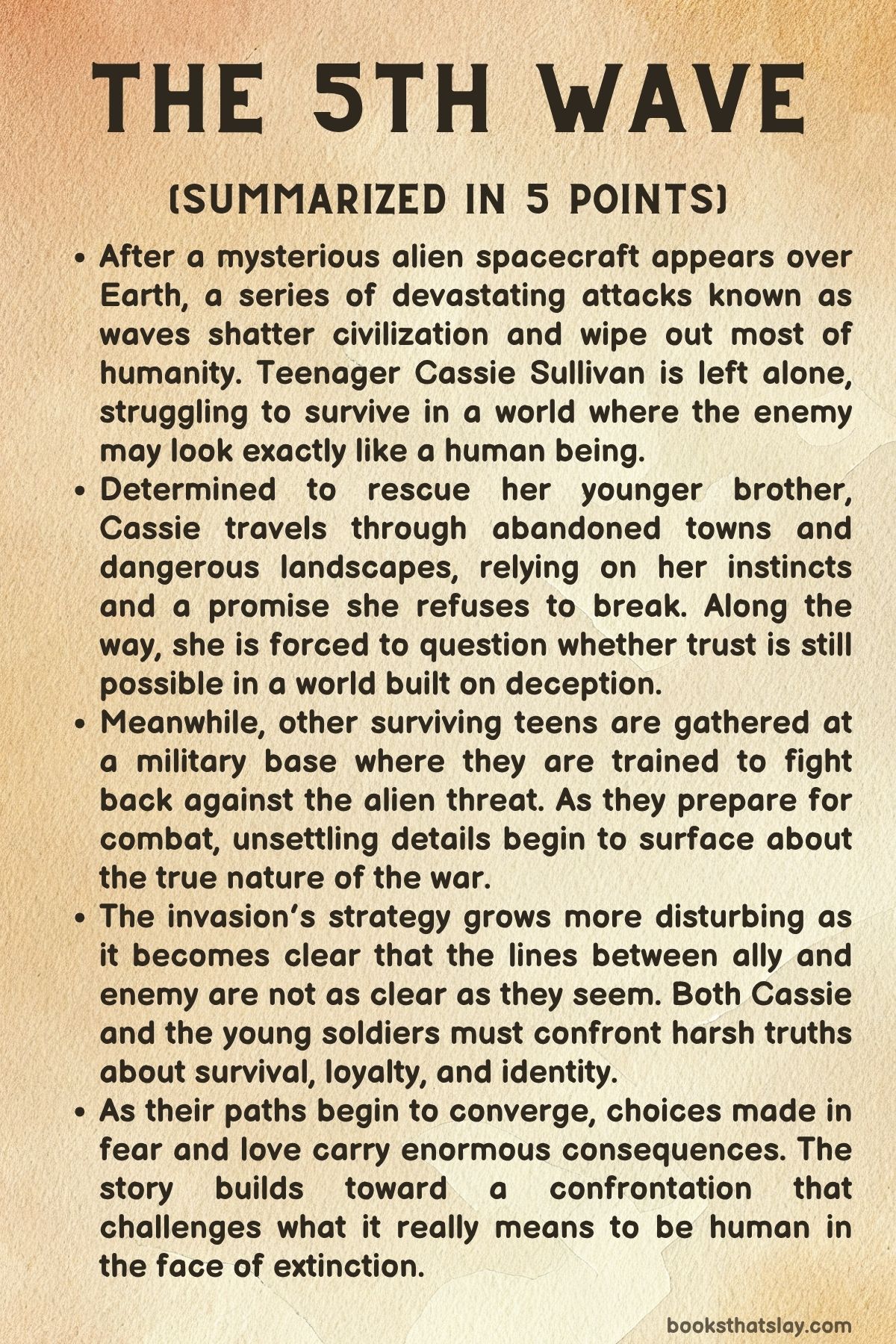
The 5th Wave by Rick Yancey is a young adult science fiction novel set in a world shattered by an alien invasion. The story follows Cassie Sullivan, a teenage girl trying to survive after a series of devastating attacks—called waves—nearly wipe out humanity.
As society collapses, trust becomes more dangerous than hunger or cold, because the enemy may look exactly like a human being. Through shifting perspectives, the novel explores fear, loyalty, identity, and what it means to remain human when survival demands cruelty. At its center is a sister’s promise to rescue her little brother, even if it means facing the end of the world alone.
Summary
The novel opens years before the invasion, with a quiet and unsettling image: something enters unborn children without their mothers ever knowing. The presence lies dormant, hidden inside human hosts.
This silent beginning hints that the destruction to come has been carefully planned.
Years later, alien ships appear above Earth. For ten days they hover, doing nothing.
Humanity debates whether the visitors come in peace. Then the attacks begin.
The first wave arrives as an electromagnetic pulse that wipes out power across the globe. Planes fall from the sky, cars crash, hospitals fail, and society collapses overnight.
The second wave follows with catastrophic natural disasters triggered by the aliens, destroying coastal cities through earthquakes and tsunamis. Survivors flee inland in search of safety.
The third wave comes through disease. Birds carry a deadly virus that spreads rapidly, killing most of the remaining population.
Cassie Sullivan loses her mother to this plague. She, her father, and her five-year-old brother Sammy barricade themselves in their home until they hear about a refugee camp set up by the military.
They travel to Camp Ashpit, where a small community of survivors tries to maintain order under the leadership of a Marine. Cassie feels suffocated there but stays for Sammy’s sake.
Drones begin flying overhead, watching. Soon afterward, soldiers arrive in armored vehicles and claim to be rescuing survivors.
They say only children can be taken to a secure base. Cassie’s father insists she go with Sammy, but she is forced off the bus at the last moment.
Sammy is driven away.
The remaining adults are ordered into a barracks. Cassie notices that one boy from camp is missing and volunteers to help find him.
A soldier accompanies her to the ash pit, where the missing boy is shot without hesitation. Realizing something is wrong, Cassie shoots the soldier and runs back to camp.
She witnesses her father being gunned down. The soldiers massacre the adults and plant a bomb to destroy the evidence.
Cassie barely escapes the explosion.
Alone and wounded, Cassie vows to find Sammy. She survives by scavenging supplies and avoiding both drones and humans.
She believes the fourth wave has begun: the enemy now looks human. Trust is impossible.
At one point, she encounters a wounded soldier in a convenience store. When he hesitates to raise his hands, she shoots him, only to discover he was holding a crucifix.
The experience reinforces her belief that hesitation means death.
Meanwhile, the story shifts to Ben Parish, Cassie’s former crush. He survived the plague and is taken to Wright-Patterson Air Force Base after falling ill.
There, doctors implant a device in his neck and connect him to a program called Wonderland. Through simulations, he relives traumatic memories, including the murder of his family during the invasion.
The military claims the aliens have infiltrated humans and that the implant allows them to identify infected individuals. Ben is shown his friend hooked into the system and is told the friend contains an alien presence.
He is given the chance to press a button that kills him. Driven by anger and grief, Ben does.
Ben joins a child soldier training program. The recruits are children and teenagers given nicknames and trained harshly.
Ben becomes “Zombie.” Among the youngest recruits is a five-year-old boy called Nugget—Sammy. Zombie grows protective of him, unaware at first that Nugget is Cassie’s brother.
Sammy believes his sister will come for him. Zombie doubts this but admires the boy’s hope.
The children are sent on missions to eliminate supposed alien hosts. They use devices that mark targets as infected.
During one mission, Zombie’s squad encounters a sniper. Amid chaos and casualties, Zombie and a skilled sharpshooter named Ringer begin to suspect the truth.
Ringer convinces Zombie to remove her implant. Once it is out, she appears as infected through their detection system.
They realize the implants themselves create the illusion of infection. The fifth wave is revealed: the aliens have manipulated human children into killing uninfected survivors.
Humanity is destroying itself.
Back in the wilderness, Cassie is shot by a sniper and nearly dies from infection. She is rescued by a young man named Evan Walker, who takes her to a farmhouse and nurses her back to health.
Evan is kind, attentive, and skilled. Cassie slowly lowers her guard, though suspicion lingers.
She notices inconsistencies in his story and his unusual abilities.
Eventually, Evan admits the truth: he is one of the alien consciousnesses downloaded into a human body before the invasion. He was the sniper who shot her.
However, he did not finish the job. Spending time observing her changed him.
He claims he was part of a minority who wanted coexistence rather than extermination. Cassie is devastated but conflicted.
She needs his help to infiltrate the base and save Sammy.
They travel together toward Wright-Patterson. Cassie is eventually captured and processed like the other children.
She knocks out a doctor during her implant procedure and escapes. Navigating through vents and corridors, she searches for Sammy.
At the same time, Zombie fakes loyalty after discovering the truth about the fifth wave. He injures himself to gain access back to the base, intending to rescue Nugget.
He removes his own implant before he can be reconnected to the system.
Cassie and Sammy are reunited inside the facility. Sammy at first rejects the teddy bear she carried across miles of devastation but then embraces her.
They attempt escape but are captured by Colonel Vosch, who reveals his cold logic: humanity must be erased to make room for a more efficient species. He threatens Sammy’s life to force Cassie to reveal her accomplice.
When Vosch attempts to activate the kill switch in Cassie’s implant, nothing happens. Evan has infiltrated the system.
Cassie and Zombie overpower the guards. Evan appears and guides them toward escape while he sabotages the base’s power systems.
He stays behind, intending to destroy the facility and prevent further deployment of child soldiers.
Cassie, Sammy, and Zombie fight their way upward through collapsing corridors. Explosions tear through the structure as Evan triggers the base’s destruction.
Outside, drones fall from the sky. The trio reunites with Ringer and other surviving squad members in a Humvee and escape just as the base is consumed.
From a distance, Cassie sees a glowing object streak into the sky. Evan’s fate remains uncertain, but his sacrifice gives them a chance.
The novel ends with the small group of survivors together, aware that the invasion is not over. The aliens have not been defeated entirely.
Yet they have uncovered the truth about the fifth wave and reclaimed something vital: the ability to choose loyalty over fear. Cassie keeps her promise to Sammy.
In a world built on deception, that promise becomes an act of resistance.
Key People
Cassie Sullivan
Cassie is the emotional center of The 5th Wave, and her defining trait is how quickly she is forced to grow up. Before the invasion, she is an ordinary teenager with school routines, friendships, and a quiet crush on Ben Parish.
After the waves begin, her inner life becomes dominated by vigilance and grief, and the book tracks how that vigilance hardens into a survival code: stay hidden, stay armed, trust no one. What makes Cassie compelling is that her toughness is never presented as natural bravado—it’s built from repeated betrayals and loss, especially the massacre at Camp Ashpit and the separation from Sammy.
Her narration often shows a mind that’s sharp, suspicious, and exhausted, yet still anchored by one promise: to find her brother. That promise keeps her from becoming fully numb.
Even when she makes morally brutal choices, her guilt remains present, which is part of what keeps her recognizably human. Cassie’s arc is a fight to hold onto empathy without letting empathy get her killed.
Sammy Sullivan
Sammy is young enough to interpret horror through a child’s logic, which makes his chapters quietly devastating. He is observant, sensitive, and far more perceptive than adults expect, especially when it comes to recognizing patterns of false safety.
He has learned, even at five, that reassurance often precedes catastrophe, so he questions “safe places” with a blunt clarity that older characters resist. His bond with Cassie is the story’s moral engine: he believes in her promise because he needs to believe in something stable.
At the base, Sammy adapts by attaching himself to Zombie, finding a protector where he can, but he never stops measuring adults by whether they keep their word. He represents what the invasion threatens to erase—innocence, trust, and the right to be a child—and his survival becomes symbolic, not because he is special in a heroic sense, but because he remains emotionally intact enough to still want family, comfort, and truth.
Ben Parish (Zombie)
Ben begins as the “crush” in Cassie’s memory, but he becomes one of the novel’s sharpest portraits of identity under pressure. When he is taken to the base and shaped into Zombie, his new name is more than a nickname—it’s a label designed to strip away the person he used to be and replace him with a weapon.
Ben’s strength is not that he becomes fearless; it’s that he becomes responsible. He accepts leadership because someone has to keep the younger kids alive, and his growing protectiveness toward Sammy reveals a steadier moral core than his violent training is meant to produce.
Ben’s biggest internal conflict comes when the base’s logic collapses and he realizes he has been used as part of a system meant to turn humans against humans. The moment he chooses to remove the implant and act against Vosch is the moment he stops being Zombie and starts being Ben again, even if he continues using the name as armor.
His arc is about reclaiming agency—moving from manipulated rage to deliberate choice.
Evan Walker
Evan is written as both a romantic figure and a moral problem, and the tension between those two roles is what makes him interesting. On the surface, he is the rescuer who saves Cassie from infection and gives her a rare pocket of safety, warmth, and food.
Underneath, he is also the sniper who shot her and an Other consciousness living in a human body. Evan’s struggle is not simply “alien versus human”; it is the conflict between programming and lived experience.
He is trained to be efficient and lethal, yet his time watching Cassie—her stubbornness, grief, and refusal to quit—awakens something that resembles conscience. His love for her is tangled with guilt because he is drawn to what he is helping destroy.
Evan also represents the invasion’s most frightening idea: that the enemy can occupy a human life so perfectly that even tenderness can be real. By choosing to protect Cassie and sabotage the base, he breaks from his intended role and proves that personhood, in this story, can form through choices rather than origins.
Lieutenant Colonel Alexander Vosch
Vosch is the cold architect of the base’s operations and functions as the novel’s most direct face of the invasion. He is persuasive rather than openly monstrous, and that’s part of his danger: he understands how to recruit people through grief, especially children who have lost families and want their pain to mean something.
Vosch’s power comes from his control of information—he doesn’t just command troops; he controls the story the troops believe about what they’re doing. His interest in children reflects strategic cruelty: children are easier to shape, easier to weaponize, and less likely to challenge the system’s assumptions.
Vosch embodies the idea that extermination can be carried out through bureaucracy, training schedules, and carefully designed lies. Even when confronted with resistance, he remains committed to process and outcome, treating individual lives as pieces on a board.
Dr. Pamela “Pam” (Dr. Pam)
Dr. Pam is one of the novel’s most unsettling characters because she is a caretaker figure who uses the language of healing to do harm. She presents Wonderland and the implant system as medical necessities, turning clinical authority into a tool of control.
Whether she is fully loyal, coerced, or ideologically convinced matters less than what she represents: the corruption of trust in institutions. In a normal world, a doctor is a symbol of safety; in this world, she becomes the gateway to manipulation and death.
Her calm demeanor while demonstrating the kill mechanism shows how violence can be normalized when it is framed as procedure. Dr. Pam also reflects how the invasion exploits human systems—medicine, diagnosis, quarantine—to create obedience.
Her death, triggered by her own action with the kill switch, reads like a grim consequence of working inside a machine built to erase the very people she claims to protect.
Hutchfield
Hutchfield is a pragmatic leader in the early camp setting, defined by his belief in weapons, structure, and readiness. He stands in contrast to Cassie’s father, who initially believes guns are useless against the Others.
Hutchfield’s role is important because he shows how quickly leadership becomes contested after collapse: people look for certainty, and the person who can organize food, patrols, and defenses becomes a lifeline. Yet his faith in the “rescue” at Camp Ashpit also shows how hope can be weaponized.
He wants to believe in the military because believing in it keeps the camp’s morale intact and keeps his own leadership meaningful. His downfall is less personal failure than a reminder that competence does not protect you when the enemy controls the narrative.
Cassie’s Father (John Sullivan)
Cassie’s father is the story’s early moral compass, and his influence persists long after his death through Cassie’s memories and instincts. He is gentle, thoughtful, and tries to interpret the invasion through reason rather than panic, which is why he initially dismisses guns as ineffective.
That stance is not cowardice; it’s a belief that fear-driven violence can destroy people faster than the enemy can. Yet he is also capable of decisive action when the threat becomes clear—arming Cassie, instructing her to stay with Sammy, and making choices under impossible pressure.
His death at Camp Ashpit becomes one of Cassie’s defining traumas because it marks the moment she stops expecting adults to fix anything. What he leaves her is not a strategy for winning, but a memory of dignity and care that Cassie struggles to preserve while doing what she must to survive.
Lizbeth
Lizbeth represents Cassie’s “before,” and her presence in Cassie’s recollections highlights what the waves stole beyond lives: normal adolescence. She is candid, bold, and speaks with the kind of teenage urgency that feels trivial once the world ends, yet that triviality is exactly the point.
Lizbeth’s comments about love, fear, and missed chances give Cassie a snapshot of who she used to be—someone worried about crushes, friendships, and embarrassment rather than infection and execution. Even when Lizbeth is not physically present for much of the main action, she functions as a contrast that makes Cassie’s loneliness sharper and her transformation clearer.
Chris
Chris begins as a familiar human presence for Ben, which makes his use within the base’s system especially cruel. He is positioned as a friend, a tent mate, and a link to a shared struggle against the disease, and then he becomes a demonstration object—proof that the Others can be “inside” anyone.
His role is designed to break trust and to push Ben into complicity by making him participate in killing someone he knows. Chris is less developed as a person than as a turning point, but that is intentional: the system doesn’t care about his individuality; it cares about what his death produces in Ben—obedience, rage, and the feeling that violence is necessary.
Sergeant Reznik
Reznik is the face of cruelty inside the training program, and he embodies how violence becomes normalized through discipline. He humiliates, provokes, and breaks kids down under the claim that he’s building soldiers.
What makes him especially disturbing is the later reveal that he is not simply a harsh instructor; he is also part of the mechanism designed to ensure compliance, tracking squads and acting as a failsafe executioner if they hesitate or disobey. Reznik represents enforced obedience: the idea that the system anticipates doubt and has already prepared punishments for it.
His presence shows that the fifth wave does not rely on belief alone—it relies on fear, surveillance, and instant consequences.
Ringer (Cassie in disguise within the squad)
Ringer is one of the novel’s most important catalysts because she is the first inside the base’s child-soldier program to fully articulate the truth. She is sharp, private, and intensely self-controlled, and her talent as a shooter makes others respect her even before they understand her.
Her insistence on removing the implant is a turning point that shifts the story from survival to resistance. Ringer’s clarity is not just intellectual; it is moral.
She is willing to face what the others avoid—that they have been killing humans—and she forces Zombie to confront it too. She also complicates Cassie’s relationship with Ben, not primarily through romance, but through shared trauma and shared leadership; Ringer understands Ben’s world in a way Cassie doesn’t, and that creates tension even as the group’s survival depends on cooperation.
Parker
Parker is the soldier who interacts with the children on the bus, using friendliness and small comforts to keep them calm. His most striking feature is how ordinary he appears while participating in something horrific.
By offering snacks, explaining “safety,” and assigning colors, he turns transportation to a processing center into something that resembles routine. Parker shows how evil can operate through politeness and procedure.
Whether he is controlled, convinced, or simply following orders, he functions as a bridge between the children’s fear and the system’s control, making compliance feel easier than resistance.
Kistner
Kistner is a minor character, but his role highlights the everyday people who keep institutions running even during catastrophe. As an orderly, he is not a mastermind or a soldier; he is part of the base’s machinery in a quiet, practical way.
His encounter with Zombie matters because it shows Zombie’s own moral strain: Zombie needs to escape and act, but he hesitates to kill someone who seems more like a worker than an enemy. Kistner’s presence emphasizes that once truth is obscured, it becomes difficult to know who deserves mercy, and that uncertainty is exactly what the invasion exploits.
Crisco
Crisco is a teenager at Camp Ashpit who tries to connect with Cassie but is also shaped by the camp’s desperation. His habit of scavenging valuables from the ash pit makes him both pitiful and disturbing—someone trying to barter his way into security while surrounded by death.
He reflects how trauma distorts normal boundaries, turning grief into currency. His sudden murder is one of the story’s early shocks, not because he is deeply beloved, but because it confirms that the “rescue” is a trap and that the enemy’s violence is casual and precise.
Flintstone
Flintstone is one of the older kids in Zombie’s squad, and he represents the kind of confidence that can slide into denial. He relies on toughness, jokes, and group status to stay stable.
When confronted with evidence that the implants are a lie, he cannot tolerate the implication that he has been murdering innocent people, so he rejects it outright. His reaction becomes tragic because it shows how denial can be lethal; the truth is not just painful, it threatens a person’s entire self-image.
Flintstone’s fate underlines that the fifth wave succeeds by making the truth psychologically unbearable.
Dumbo
Dumbo is the medic of the squad, and his importance comes from his steadiness. In a unit trained to kill, he is trained to heal, and that difference shapes how he moves through the world.
He is practical, capable, and quietly compassionate, often focusing on the next necessary action rather than the fear surrounding him. Dumbo’s willingness to remove implants and tend to the group afterward shows that bravery in this story often looks like calm competence rather than grand speeches.
He helps keep the group alive physically, which allows them the space to rebuild trust and think beyond immediate survival.
Oompa
Oompa’s role is to show the cost paid by children forced into combat. His injury and death are not framed as heroic sacrifice but as a blunt reminder that these kids are being used and discarded.
Oompa’s loss hits because it happens amid decisions being made by teenagers who should never be responsible for life-and-death choices. He represents the many young lives erased not only by the aliens, but by the system engineered to turn children into disposable weapons.
Poundcake and Teacup
Poundcake and Teacup represent the youngest edge of the base’s program—children who should be in school, protected from violence, instead learning routines of training, fear, and obedience. Their presence intensifies the horror of the fifth wave because they make it impossible to pretend this is a normal war.
They are not explored as deeply as Cassie, Ben, or Ringer, but they matter as living evidence of what the invasion has achieved: it has turned childhood into a military resource.
Megan
Megan appears in Sammy’s early bus experience and functions as a mirror to his loneliness and fear. Her grief over losing her family and her need for connection make her cling to Sammy, and her separation from him shows how the system splits children apart quickly, using color codes and “illness” labels as excuses.
Megan’s brief presence emphasizes how many children are processed without understanding what is happening, and how quickly bonds are formed and broken in a world where stability is gone.
The Silencer (as a role)
The Silencer identity matters beyond Evan as an individual because it represents the invasion’s strategy of turning killing into routine and making death impersonal. The Silencer watches, tracks, and executes with patience, embodying the idea that humans can be studied like prey.
Even after Evan breaks from his mission, the Silencer concept remains a shadow over the story: the sense that someone might be observing you, learning you, waiting for the moment you make yourself visible. It is a role designed to destroy trust in the open air, pushing survivors toward isolation and paranoia, which is exactly where the Others want them.
Themes
Trust and Paranoia
Survival in The 5th Wave depends less on strength or intelligence and more on the terrifying question of whom to trust. After the first three waves devastate the planet, the fourth wave introduces a far more destabilizing threat: the enemy looks human.
This shift alters the psychological landscape of the story. Cassie’s instinct becomes radical isolation because connection now equals vulnerability.
The massacre at Camp Ashpit is not just an act of violence; it is a systematic destruction of communal trust. The soldiers arrive under the banner of rescue, and that betrayal forces Cassie to conclude that safety itself is a trap.
This breakdown of trust extends beyond strangers. Ben is manipulated into killing his friend through a system that frames murder as duty.
The implants, the Wonderland program, and the glowing eyepieces create a false sense of certainty, convincing children that they can visually confirm who is alien. In reality, the technology manufactures paranoia and weaponizes it.
The children are trained to see infection everywhere except within the institution commanding them. The tragedy lies in how thoroughly suspicion replaces empathy.
Evan complicates the theme further. He is both the hunter and the protector, both alien and human.
Cassie’s struggle to decide whether to trust him is not just romantic tension; it reflects the central fear of the novel. Trust becomes an act of rebellion.
When Cassie chooses to believe Evan despite his confession, she is not naïve; she is asserting that suspicion cannot be the only rule left. The story argues that paranoia may keep someone alive temporarily, but permanent isolation erodes the very humanity survival is meant to preserve.
The Manipulation of Childhood
The invasion’s most disturbing strategy lies in its use of children as instruments of extermination. By the time the fifth wave is revealed, the reader understands that the Others have identified childhood as the most efficient entry point for control.
Children are traumatized, displaced, and desperate for structure. Wright-Patterson offers routine, food, purpose, and a clear enemy.
In exchange, it demands obedience.
Ben’s transformation into Zombie demonstrates how identity can be stripped away through renaming, discipline, and collective training. The squads are structured like competitions, turning survival into a game with rankings and points.
This gamification disguises the horror of what the children are actually doing. They are not defending humanity; they are unknowingly eliminating it.
The implants create a technological illusion of moral clarity, which spares the children from confronting ambiguity. As long as the eyepiece glows green, they believe their actions are justified.
Sammy’s presence intensifies this theme because of his age. A five-year-old participating in a military program is inherently unsettling.
His attachment to Zombie reveals how children seek emotional anchors even within violent systems. The invasion exploits this instinct by replacing family bonds with squad loyalty.
The authority figures at the base frame their program as protection, reinforcing the idea that violence is necessary for safety. The corruption of childhood is not chaotic; it is systematic.
The fifth wave is not merely about killing humans; it is about ensuring that the next generation carries out that killing willingly.
Identity and What It Means to Be Human
The novel repeatedly questions whether humanity is defined by biology, memory, emotion, or choice. The Others inhabit human bodies, blending seamlessly into society long before open warfare begins.
This blurring destabilizes any simple definition of “us” and “them.” Evan’s existence embodies this ambiguity. He carries alien consciousness, yet he feels guilt, affection, and doubt.
If he can choose to protect Cassie and sabotage his own kind, then humanity cannot be reduced to species alone.
Ben’s journey also reflects this crisis of identity. The name Zombie symbolizes emotional numbness and obedience.
His training is designed to suppress hesitation and individual reflection. However, when he confronts the truth about the implants, he faces a moral crossroads.
Continuing as Zombie would mean embracing a false identity built on manipulation. Removing the implant is both a physical and symbolic act of reclaiming selfhood.
Cassie’s identity is shaped by memory. She holds onto the version of herself who once worried about school and crushes.
Those memories become proof that she was more than a weapon or a fugitive. The Others attempt to erase such continuity by replacing family with institutions and replacing personal judgment with technological certainty.
The resistance in the novel is not only military; it is existential. To remain human means retaining the capacity for empathy, doubt, and choice, even when those qualities complicate survival.
Love and Loyalty as Resistance
In a world engineered to fracture relationships, love becomes a radical act. Cassie’s determination to rescue Sammy is not strategic; it is emotional.
That emotional commitment defies the invasion’s logic. The Others rely on isolation, fear, and mistrust to dismantle cooperation.
By refusing to abandon her brother, Cassie resists the narrative that survival must be solitary.
Ben’s loyalty to Nugget operates on a similar level. His protection of Sammy is not required by orders; it grows from empathy.
That empathy ultimately helps him question the system he serves. When he risks his life to return to the base for Sammy, he is rejecting institutional loyalty in favor of personal connection.
The same dynamic shapes Ringer’s alliance with Zombie. Trust among the squad emerges only after the implants are removed, suggesting that genuine loyalty cannot coexist with enforced surveillance.
Evan’s sacrifice underscores this theme most dramatically. His affection for Cassie drives him to betray his own species and destroy the base.
Love becomes transformative rather than sentimental. It forces characters to choose people over ideology, relationships over efficiency.
Even small gestures—Sammy’s belief in his sister, Cassie carrying the teddy bear across miles of devastation—carry symbolic weight. They represent continuity in a world determined to erase it.
Through these bonds, the story suggests that affection is not weakness but strength. The Others attempt to eliminate humanity by isolating individuals and manipulating their fear.
What ultimately disrupts their system is not superior firepower but loyalty that refuses to be engineered away.