The Obsession by Nora Roberts Summary, Characters and Themes
The Obsession by Nora Roberts is a romantic suspense novel that follows a woman shaped by a childhood steeped in violence and secrecy. Naomi Carson grew up as the daughter of a notorious serial killer, a truth she uncovered herself as a child.
Years later, determined to live anonymously and define herself on her own terms, she renovates a house in a quiet coastal town. But when new murders echo the horrors of her past, Naomi must confront both an external threat and her deepest fears. The novel blends psychological tension, community bonds, and a love story centered on trust, resilience, and the fight to claim a future unshadowed by inherited darkness.
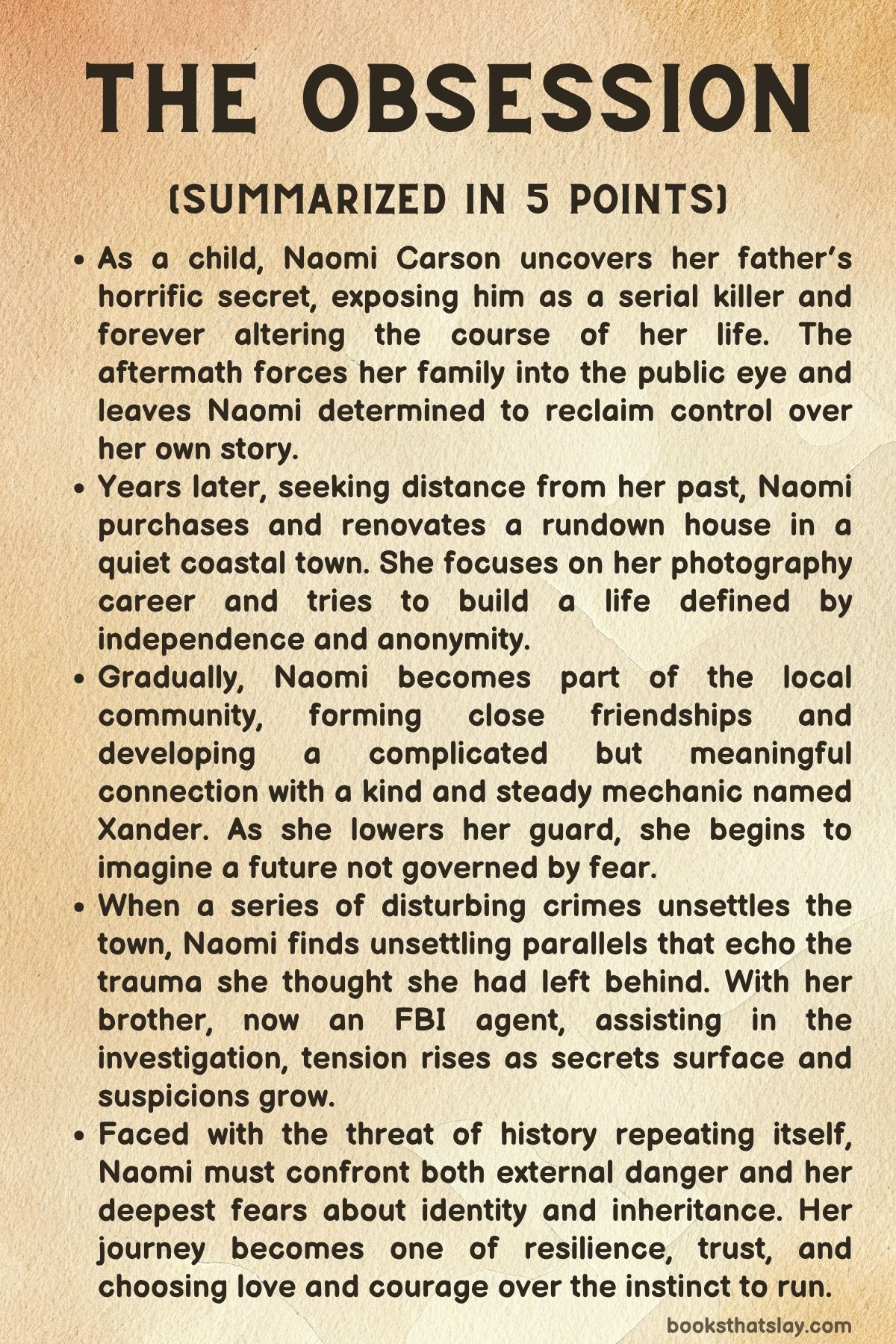
Summary
On a stormy night in rural West Virginia in 1998, nearly twelve-year-old Naomi Bowes wakes to the sound of her father leaving the house. Thomas David Bowes is a rigid, authoritarian man who rules his family through control and fear.
Sensing something secretive and wrong, Naomi follows him into the woods to a burned-out cabin. There, she watches him unlock a concealed underground door and descend into a hidden cellar.
After he leaves, Naomi gathers her courage and investigates. Inside, she finds a bound and injured young woman named Ashley McLean.
Horrified but resolute, Naomi frees her and helps her escape through the forest. By dawn, they reach the sheriff’s department, exposing Thomas as a serial kidnapper and murderer responsible for numerous deaths.
The revelation shatters Naomi’s family. Her mother, Susan, refuses to accept the truth at first, accusing Naomi of lying.
When Thomas is arrested and later confesses to killing more than twenty women, the family becomes the focus of intense media scrutiny. They move in with Susan’s brother, Seth Carson, and his partner, Harry Dobbs, in Washington, DC, taking the surname Carson to shield themselves.
Naomi and her younger brother Mason begin therapy and try to rebuild their lives.
Susan, however, struggles under the weight of betrayal and humiliation. She secretly visits Thomas in prison and, manipulated by him, sells Naomi’s story to tabloids.
A book and film deal follow, further exposing the family. The attention damages Seth and Harry’s business and deepens Susan’s depression.
Eventually, the family relocates to New York City in search of distance from the scandal.
As a teenager, Naomi develops a talent for photography and keeps others at arm’s length emotionally. On her twenty-first birthday, Ashley visits her, a reminder that Naomi’s courage saved a life.
But the trauma lingers. When a film based on her father’s crimes is released, Naomi suffers a panic attack in a theater.
Mason, who has researched their father extensively, becomes increasingly protective.
Susan’s mental health deteriorates. One afternoon, Naomi returns home to find her mother dead from an overdose.
The discovery echoes the violence of her childhood. Soon after, a former friend, Anson Chaffins, attempts to blackmail Naomi by threatening to expose her identity.
Refusing to be exploited again, Naomi writes her own account of events, which is published in a major newspaper. By telling her story herself, she reclaims some control over her narrative.
Fourteen years later, Naomi seeks a fresh start in Sunrise Cove, Washington. She purchases a large, dilapidated former bed-and-breakfast overlooking the water, determined to restore it.
The project represents independence and permanence. She hires local contractor Kevin Banner, whose practical warmth helps her navigate the overwhelming renovation.
In town, she meets Xander Keaton, a mechanic and musician with an easy confidence and steady kindness. Their first encounter occurs when he helps her after she blows a tire on a dark road.
Though drawn to him, Naomi resists emotional involvement, wary of attachment and exposure.
As renovations progress, Naomi gradually integrates into the small community. She befriends Kevin’s wife, Jenny, and begins bartering photography services for furniture refinishing and landscaping.
She adopts a stray dog she names Tag, who becomes both companion and protector. Xander grows closer to her, respecting her boundaries while making clear his interest.
During a dinner at Xander’s apartment, Naomi notices a true-crime book about her father on his shelf. The sight sends her into panic, and she flees before explaining.
Xander later realizes her identity but does not confront her immediately. Their connection deepens through shared meals, laughter, and creative collaboration, including a photo shoot for his band.
Tension rises when a local woman, Marla Roth, publicly confronts Naomi at a bar. Shortly afterward, Marla disappears.
Days later, Naomi discovers Marla’s body on the beach while walking Tag. The finding triggers memories of her father’s crimes and places her at the center of another murder investigation.
Police Chief Sam Winston assures her she is not a suspect but advises transparency.
A second woman, Donna Lanier, goes missing. Naomi’s brother Mason, now an FBI agent specializing in profiling, arrives to assist the investigation.
He and Chief Winston determine that the killer is an experienced sexual sadist. Naomi confesses her identity to Xander, only to learn he already knows and accepts her completely.
His steady support challenges her instinct to withdraw.
The investigation takes a disturbing turn when Mason uncovers a pattern: the locations where recent victims were found match scenes from Naomi’s published photographs. Further research reveals similar murders in other cities she has visited over the past decade.
The killer has been stalking her, using her images as inspiration and leaving bodies in places she captured through her lens. The implication is chilling: the murders are tied to her.
Overwhelmed, Naomi considers running again, as she has done all her life. Xander refuses to let her retreat.
He declares his love and insists they face the threat together. Strengthened by his commitment and the support of her friends, Naomi chooses to stay.
As police narrow their search, Naomi recalls a man watching her during a college photography trip. Mason develops a suspect profile, and a person of interest emerges: Lucas Spinner.
Meanwhile, the killer attempts to break into Naomi’s house but is thwarted by Tag’s aggressive barking. The close call confirms that she is his primary target.
Naomi finally reveals her past to Kevin and Jenny, who respond with compassion. Xander moves into the house, deepening their bond.
Mason visits their father in prison for insight, seeking patterns in his psychology that might illuminate the current killer’s motives.
The climax unfolds when the murderer, revealed to be Anson Chaffins, Naomi’s former classmate, sets his final plan in motion. Obsessed with her since adolescence and warped by resentment and fantasy, Anson has modeled his crimes on her father’s and on Naomi’s life.
He lures Xander away with a fake emergency call and assaults him, then drives to Naomi’s house before dawn.
Inside her kitchen, Anson confronts Naomi, revealing his fixation and blaming her for shaping his path. When Tag charges toward him, Anson raises his gun.
Naomi shields her dog, and a single bullet passes through her and into him. She collapses but survives.
Xander, having regained consciousness, arrives in time to subdue Anson until police take him into custody.
Naomi and Tag undergo surgery and recover. At the police station, she faces Anson and tells him he has failed.
He sought to define her life through terror, but she refuses to let him succeed. Back home, surrounded by family and friends, Naomi embraces a future no longer dictated by fear.
On the deck of the restored house overlooking the water, Xander proposes marriage. Naomi accepts, choosing love, stability, and community.
The house she rebuilt becomes a symbol of her reclaimed identity. No longer running from the past, she claims her own name and future, proving that while she cannot erase her history, she can decide what comes next.
Characters
Naomi Carson
Naomi Carson stands at the emotional and psychological center of The Obsession. As a child, she displays extraordinary courage and moral clarity when she rescues Ashley McLean, fully aware that she is exposing her father and destroying her family’s fragile stability.
That early act defines her life. Trauma shapes her into a guarded, hypervigilant adult who relies on discipline, independence, and self-sufficiency to maintain control.
Photography becomes both profession and therapy, allowing her to frame the world on her own terms. Her decision to renovate the bed-and-breakfast in Sunrise Cove reflects a desire for permanence and rootedness after years of relocation and reinvention.
Naomi’s greatest internal struggle is the fear that she carries something dark within her because of her father. She worries that intimacy may expose others to danger or that she may be somehow tainted by association.
This fear drives her pattern of emotional withdrawal and her instinct to flee when threatened. Yet she is not fragile.
She is intelligent, capable, physically brave, and morally grounded. When confronted by blackmail, by local suspicion, and finally by a killer obsessed with her, she chooses confrontation over escape.
Her evolution lies in learning that her identity is defined not by her father’s crimes but by her own choices, love, and resilience.
Xander Keaton
Xander Keaton functions as both romantic partner and stabilizing force in Naomi’s life. A mechanic and musician, he embodies steadiness, competence, and emotional maturity.
His attraction to Naomi is immediate, yet he approaches her with patience rather than pressure. He senses her caution and respects it, allowing their relationship to build gradually through shared experiences, humor, and collaboration.
His mechanical precision and artistic side suggest a balance of strength and sensitivity.
When he discovers Naomi’s true identity, his reaction becomes a defining moment. He does not recoil or romanticize her trauma; instead, he accepts it as part of her history without letting it redefine her in his eyes.
His love is rooted in who she is now, not in the notoriety of her past. During the investigation, he refuses to let Naomi run away from danger, insisting on facing the threat together.
His physical courage during the final confrontation underscores his loyalty, but his most significant contribution is emotional: he offers Naomi a model of partnership built on trust, transparency, and shared resolve.
Mason Carson
Mason Carson, Naomi’s younger brother, evolves from a frightened child into a composed FBI profiler. As a boy, he copes with their father’s crimes by immersing himself in research, trying to understand the mechanics of evil.
This analytical approach foreshadows his professional path. Unlike Naomi, who seeks anonymity and creative expression, Mason confronts violence directly by studying and combating it.
His career choice suggests both a need for mastery over his past and a desire to protect others from similar harm.
Mason’s relationship with Naomi is marked by protectiveness and deep mutual loyalty. He trusts her strength but remains alert to the ways trauma affects her.
When the new murders emerge, he balances professional objectivity with personal investment. His profiling skills drive the investigation forward, yet he never reduces Naomi to a case study.
Mason embodies rationality and structure, serving as a counterpoint to the emotional chaos their father unleashed. His presence reinforces the theme that trauma can produce different but equally powerful responses: withdrawal, as in Naomi’s case, or direct confrontation, as in his.
Thomas David Bowes
Thomas David Bowes is the embodiment of predatory control. Outwardly, he presents as a strict, orderly family man, but beneath that façade lies a calculated serial killer.
His crimes are not impulsive; they are methodical, ritualistic, and sustained over years. His ability to conceal his violence within the routines of domestic life reveals his manipulative intelligence.
He maintains dominance over his household through fear and rigid authority, creating an atmosphere in which questioning him feels dangerous.
Thomas’s psychological cruelty extends beyond his murders. Even after imprisonment, he continues to exert influence, manipulating Susan into selling Naomi’s story and maintaining emotional control over his family.
He lacks remorse and sees others as objects to possess or destroy. His legacy casts a long shadow, not only through public notoriety but through the internalized fear he instills in Naomi.
Yet the novel ultimately undermines his power by demonstrating that his children reject his values entirely. Thomas represents inherited darkness, but the narrative insists that lineage does not determine destiny.
Anson Chaffins
Anson Chaffins begins as a seemingly ordinary classmate but is ultimately revealed as the antagonist whose obsession drives the central threat. His fixation on Naomi originates in adolescence, when he becomes fascinated by her trauma and notoriety.
Unlike Thomas, whose violence is rooted in domination and sadism, Anson’s crimes are fueled by envy, resentment, and delusional identification. He constructs a narrative in which he and Naomi are bound together by shared history, twisting her pain into justification for his actions.
Anson’s decision to model his murders after Naomi’s photographs demonstrates both calculation and theatricality. He seeks to implicate her symbolically, to force her into complicity in his mind.
His stalking over years reveals patience and escalating fantasy. When he finally confronts Naomi, he attempts to claim authorship over her life story, positioning himself as the inevitable conclusion of her past.
His defeat underscores a central theme: obsession thrives on imagined intimacy and distorted grievance, but it collapses when confronted with courage and collective resistance.
Susan Bowes
Susan Bowes is a tragic figure whose weakness and denial contribute significantly to the family’s suffering. Initially unable to accept Thomas’s guilt, she clings to illusions of normalcy.
Her refusal to acknowledge the truth isolates Naomi and deepens the emotional fracture within the family. Susan’s later decision to profit from the story reveals both financial desperation and a craving for validation, but it also constitutes a betrayal of her children’s privacy.
After the arrest and media frenzy, Susan spirals into depression. She cannot reconcile the man she married with the monster he proves to be.
Her suicide reflects accumulated shame, grief, and psychological exhaustion. Unlike Naomi and Mason, who transform trauma into action, Susan is overwhelmed by it.
She represents the collateral damage of Thomas’s crimes and highlights the generational cost of violence within a family system.
Seth Carson
Seth Carson, Susan’s brother, provides refuge and stability when Naomi’s world collapses. As a successful, pragmatic adult with a supportive partner, he models a healthier version of family life.
He immediately believes Naomi and prioritizes her safety, relocating the family and changing their surname to shield them from public scrutiny. Seth’s protective instincts are unwavering, yet he avoids smothering control.
His conflict with Susan over selling the story demonstrates his moral clarity. He understands the long-term harm of exposure and consistently advocates for Naomi and Mason’s well-being.
Seth’s presence in Naomi’s adult life, including his generous gestures and emotional support, reinforces the theme of chosen family and sustained commitment. He acts as a paternal counterbalance to Thomas, proving that authority can coexist with kindness.
Harry Dobbs
Harry Dobbs, Seth’s partner, contributes warmth, humor, and emotional steadiness. While Seth often handles logistical decisions, Harry provides day-to-day comfort.
He offers Naomi reassurance during moments of panic and encourages openness rather than secrecy. His nurturing demeanor helps normalize life for Naomi and Mason during upheaval.
Harry’s significance lies in his quiet reliability. He does not dominate scenes but consistently reinforces the family’s cohesion.
In adulthood, his continued support affirms that Naomi’s foundation extends beyond romantic love. Harry exemplifies compassion without intrusion, strengthening the network that ultimately protects Naomi.
Kevin Banner
Kevin Banner serves as Naomi’s contractor and one of her first meaningful connections in Sunrise Cove. Practical, hardworking, and perceptive, he recognizes Naomi’s competence and treats her as a partner in the renovation process.
His straightforward demeanor and loyalty anchor her integration into the community.
Kevin’s role expands during the investigation, as he becomes part of the informal protective circle around Naomi. He does not judge her past once revealed.
Instead, he reacts with solidarity. Through Kevin, the novel emphasizes the importance of communal bonds and the way trust can be built through shared labor and everyday interactions.
Jenny Banner
Jenny Banner embodies warmth and creativity. As Kevin’s wife, she initially appears in a social context, inviting Naomi into friendship through shared interest in décor and restoration.
Their barter arrangement, exchanging furniture refinishing for photography, symbolizes mutual respect and balanced exchange.
When Naomi reveals her true identity, Jenny responds with empathy rather than fear. Her reaction reinforces the idea that Naomi’s past does not define her present relationships.
Jenny’s friendship offers emotional refuge and helps Naomi move from isolation toward belonging.
Chief Sam Winston
Chief Sam Winston represents institutional authority tempered with fairness. As the head of local law enforcement, he approaches Naomi with professionalism and sensitivity.
Upon learning her identity, he neither sensationalizes nor stigmatizes her. Instead, he provides clear communication and practical advice.
His collaboration with Mason bridges local and federal efforts, demonstrating coordinated justice rather than chaotic panic. Winston’s calm demeanor and steady investigation contribute to the atmosphere of measured tension.
He reinforces the idea that systems, when guided by integrity, can protect rather than exploit.
Tag
Tag, the stray dog Naomi adopts, functions symbolically as both companion and guardian. Initially vulnerable and injured, he mirrors Naomi’s own wounded state.
Their bond forms through mutual rescue. As Tag regains strength, he becomes fiercely protective, alerting Naomi to danger and thwarting the killer’s attempted intrusion.
Tag’s loyalty during the final confrontation, when Naomi shields him from gunfire, underscores the depth of their connection. His survival alongside Naomi signifies resilience and renewal.
Beyond symbolism, Tag also grounds Naomi in daily routines and affection, anchoring her emotionally in a present that is safer and more hopeful than her past.
Themes
Trauma and the Long Shadow of Violence
Violence in The Obsession is not confined to physical acts; it lingers as memory, fear, and psychological residue that shapes identity over decades. Naomi’s discovery of her father’s crimes during childhood fractures her sense of safety at its foundation.
Home, which should represent protection, becomes the site of horror. This early rupture creates a pattern of hypervigilance that defines her adulthood.
She carefully controls her environment, limits emotional risk, and relies on structure to guard against chaos. Even years later, nightmares and panic attacks surface unexpectedly, revealing that trauma is not erased by time or geographical distance.
The theme also explores how trauma radiates outward. Susan’s depression and eventual suicide illustrate the corrosive effect of betrayal and public humiliation.
Mason channels his pain into a career that confronts violent offenders directly, while Naomi initially copes through avoidance and self-reliance. Each family member embodies a different psychological response.
Importantly, trauma is shown as both isolating and connective. It threatens to trap Naomi in secrecy, yet it also forges powerful bonds with those who respond with empathy rather than fear.
The repeated emergence of a new killer who echoes her father’s crimes reinforces the idea that trauma can feel cyclical, as though history is determined to repeat itself. However, the narrative ultimately rejects inevitability.
By confronting the new threat instead of fleeing, Naomi transforms her trauma from a defining wound into a source of hard-earned strength.
Identity and the Fear of Inherited Darkness
Naomi’s greatest internal conflict centers on whether she is defined by her father’s monstrosity. Growing up as the daughter of a serial killer creates a public identity she never chose.
Media attention, sensational books, and films reduce her to a label rather than recognizing her individuality. Even after adopting a new surname and building a private life, she fears that the truth will contaminate her relationships.
Her reluctance to commit to Xander reflects not only fear of danger but also anxiety that she carries something irreparably damaged within herself.
The novel questions the notion of inherited evil. Thomas Bowes represents calculated cruelty and domination, yet Naomi and Mason embody compassion and moral courage.
Their lives directly contradict the assumption that blood determines character. Anson Chaffins provides a disturbing contrast.
He chooses to model himself after Naomi’s father, using her history as a blueprint for his own violence. His actions highlight that obsession and cruelty arise from personal decisions, not lineage.
Naomi’s eventual refusal to run away marks a turning point in her self-conception. She stops seeing herself as an extension of her father’s narrative and begins to assert authorship over her own life.
Identity becomes something constructed through deliberate choices rather than inherited shame. The community’s acceptance once her past is revealed further reinforces that identity can be reshaped through honesty, trust, and integrity.
Obsession, Control, and the Desire to Possess
The title signals a central psychological force that drives both past and present antagonists. Thomas Bowes exerts absolute control over his victims, deriving power from confinement and domination.
His crimes are rooted in ownership; he views women as objects to be captured, documented, and destroyed. Anson Chaffins mirrors this impulse in a modern form.
His fixation on Naomi begins as adolescent fascination but escalates into a violent fantasy in which he imagines himself inseparable from her story. By staging murders in locations Naomi photographed, he attempts to claim symbolic partnership in her identity.
His crimes are theatrical gestures designed to implicate her and force her into proximity with his distorted narrative.
Obsession is contrasted with healthy attachment. Xander’s love for Naomi is intense, yet it respects her autonomy.
He does not attempt to define or control her. Instead, he supports her decisions and challenges her only when she retreats into fear.
The difference between obsession and love lies in intention. Obsession seeks possession and domination, reducing the other person to an extension of oneself.
Love, as depicted in the novel, allows for independence and mutual strength. By placing these dynamics side by side, the narrative exposes the destructive core of obsession.
It also suggests that control born of fear is fundamentally unstable, whereas connection built on respect fosters resilience. Naomi’s ultimate victory over Anson represents not only survival but the rejection of being owned, defined, or claimed by someone else’s fixation.
Home, Restoration, and Reclaiming Stability
The renovation of the dilapidated bed-and-breakfast in Sunrise Cove operates as more than a subplot; it symbolizes Naomi’s effort to construct permanence after years of upheaval. The house is initially worn, neglected, and structurally compromised, much like Naomi’s internal landscape shaped by trauma.
Through steady labor, collaboration with Kevin and Jenny, and careful design choices, the building is transformed into a functional and welcoming space. This process mirrors Naomi’s gradual emotional rebuilding.
Restoration requires patience, trust in others’ expertise, and acceptance that progress occurs in stages rather than instant transformation.
Community plays a crucial role in this theme. Unlike her childhood home, which concealed horror behind closed doors, the Sunrise Cove house becomes a place of openness and shared life.
Friends gather for meals, celebrate milestones, and offer protection when danger approaches. Even Tag’s presence reinforces the sense of domestic security.
The attempted break-in threatens this newfound stability, but it does not destroy it. Instead, it strengthens Naomi’s resolve to defend what she has built.
By the end, the house stands as a symbol of choice rather than inheritance. It is not a structure imposed upon her but one she selected, restored, and filled with love.
Stability is no longer an illusion maintained through denial, as it was in her childhood, but a conscious creation supported by transparency and mutual care.