Zia by Scott O’Dell Summary, Characters and Themes
Zia by Scott O’Dell is a historical novel for young readers set in Spanish California during the early nineteenth century. It serves as a companion to Island of the Blue Dolphins and follows Zia, a teenage girl of Native heritage who lives at the Santa Barbara Mission and dreams of finding her lost aunt, Karana.
Through Zia’s voice, the novel explores family, freedom, survival, and the pressures placed on Native people under mission rule. The story combines adventure with a close look at belonging, cultural memory, and the difficult choices people make when they are caught between worlds.
Summary
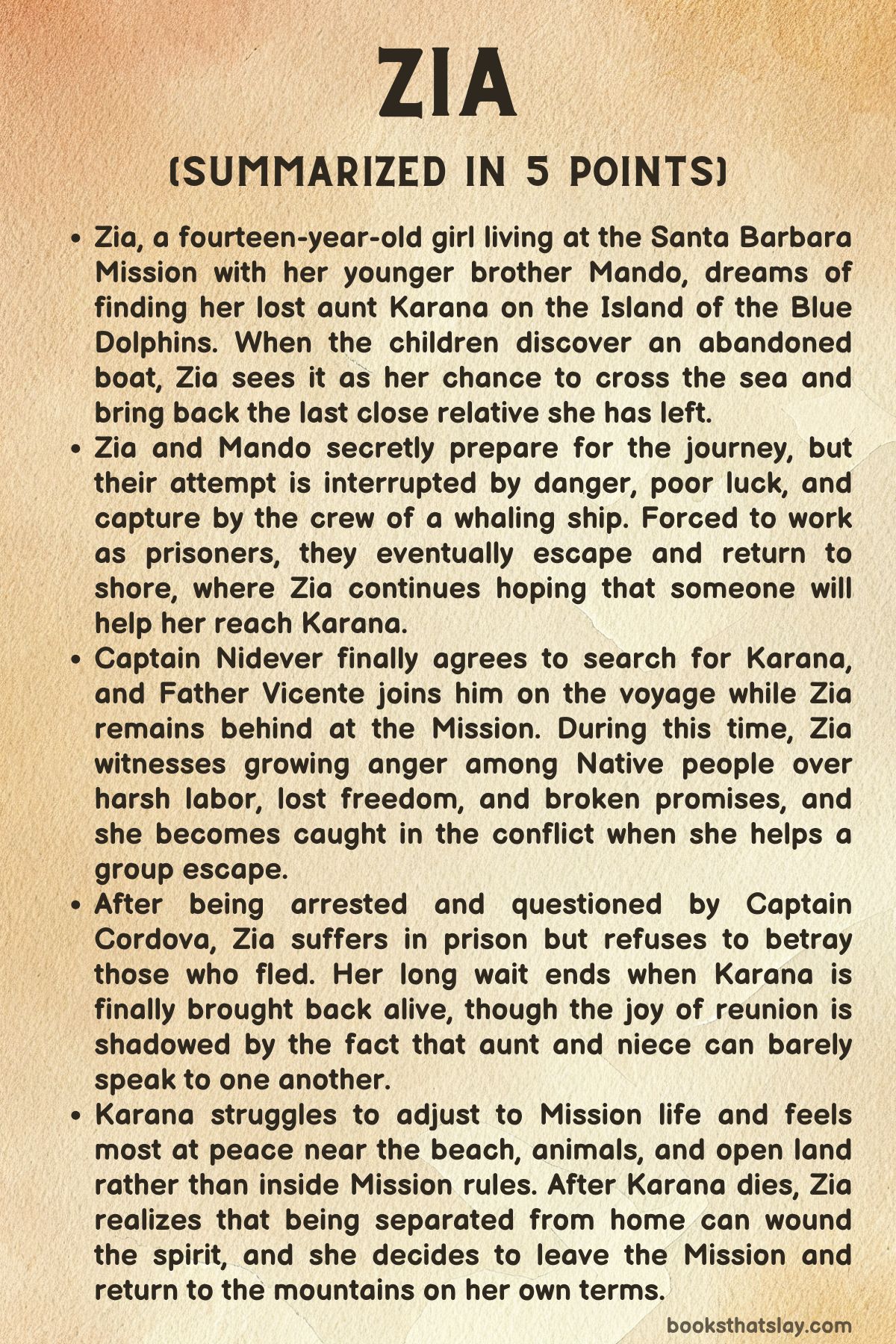
Zia is a fourteen-year-old Nicoleño girl living at the Santa Barbara Mission with her younger brother, Mando. Although they do the daily work expected of them, Zia’s mind is often fixed on one hope: finding her aunt Karana, the last close relative she has left.
Karana was left alone years earlier on the Island of the Blue Dolphins when the ship carrying their people to the mainland sailed away without her. Ever since Zia learned that Captain Nidever once saw footprints on that island, she has believed Karana may still be alive.
One day, Zia and Mando discover a stranded boat on the shore. Instead of bringing it back to the Mission, they hide it in a cave near San Felipe Lagoon.
After learning that the law of the sea may allow them to keep it, they begin to repair it and make plans. Mando names the boat Island Girl for Zia.
For Zia, the boat is not simply a prize or a way to fish. It is a chance to cross the water and bring Karana home.
Her wish is shaped by loss and displacement. Zia remembers how priests persuaded Native people to move to the Mission with promises of food, safety, and a better life.
She also remembers how often such promises were broken. Her own family had already been pushed from place to place.
Her mother died, disease spread by white settlers damaged Native communities, and the memory of land taken from Indigenous people remains painful. These memories strengthen Zia’s feeling that Karana must not be left alone.
Zia asks Captain Nidever about the route to the island. He warns her that the sea is dangerous, but he gives the children advice and even a compass.
At last, Zia and Mando set out in secret. The journey quickly shows how unprepared they are.
Mando becomes distracted by fishing and hooks a giant marlin that pulls the boat far off course. While Mando sees the fish as a triumph, Zia sees its suffering.
After watching it struggle for a long time, she cuts the line and frees it. The moment shows how differently the two children view the world.
Zia remains focused on her purpose, while Mando is often pulled toward excitement, praise, or dreams of a different life.
Their troubles grow when they encounter the whaling ship Boston Boy, whose crew claims the boat. The white sailors ignore the children’s protests and force them aboard.
Zia and Mando are treated as captives and put to work. Zia is sent to the kitchen, and Mando is made to labor among the whale blubber and smoke.
Zia learns that the crew may take them all the way to Boston to display them as curiosities. This threat hardens her resolve.
She refuses to accept the sailors’ power over them and insists that they must escape.
After an accident kills one of the crewmen, the confusion aboard the ship creates an opening. Zia urges Mando to flee with her.
He hesitates because part of him is curious about Boston and tempted by the idea of another future, but he finally agrees. During the night, they cut the boat free and drift away.
They manage to reach shore rather than the island, and there Captain Nidever finds them. Zia immediately asks him again to help her search for Karana.
He says he will soon go north to trade and hunt sea otters, and Zia begins to hope once more.
Through the summer, Zia keeps pressing Captain Nidever to take her, even offering to weave a sail for his canoe. She also persuades Father Vicente, a kind priest she trusts, to go with the captain if she herself cannot.
Father Vicente agrees because he understands how lonely Karana must be. Though Zia wishes to go herself, Captain Nidever refuses to take her, and she must remain behind while the expedition leaves.
Back at the Mission, Zia waits and works. She spends long days in the fields and watches the treatment of Native people around her.
Not everyone sees Mission life as she does. A man called Stone Hands, also known as Gito Cruz, speaks openly against the Mission system.
He reminds others that they have lost their freedom, their labor is taken from them, and their land has been stolen. Zia does not reject the priests completely; she believes some of them care sincerely.
Still, she understands the truth in Stone Hands’s anger. He organizes a group to leave the Mission and head north.
Although Zia does not go with them because she is waiting for Karana, she helps them escape by using a key to open the doors.
Her involvement leads to terrible consequences. Captain Cordova, who commands the garrison, suspects her of aiding the runaways.
He has her arrested and locked in a freezing cell. He questions her again and again, trying to make her betray Stone Hands.
He threatens her with torture and uses fear to pressure her, but Zia refuses to give him what he wants. Even in captivity, she remains steady and guards what little freedom she still has: the freedom not to speak.
At last, the long-awaited boat returns. From her cell, Zia sees Captain Nidever coming ashore, and with him is Karana.
The sight is almost more than she can bear. Karana reaches through the bars and holds Zia’s hand, but the reunion is not simple.
They cannot speak to one another. Karana does not understand Spanish, and Zia has forgotten most of her own earlier language.
Their love is immediate, but words fail them. Father Vicente argues with Captain Cordova, and Zia is released.
Karana comes to live at the Mission, but peace never fully arrives. She is gentle, observant, and more at ease with animals and the shore than with Mission routines.
She sleeps on the floor, wants her dog beside her, and learns almost no Spanish except a few words. Zia tries to make her happy and longs to hear about the island and the years Karana spent alone, but the gap in language keeps so much hidden between them.
Even so, they build a bond through gestures, shared work, and quiet companionship.
When Father Merced dies and Father Vicente briefly gains more authority, conditions improve. Native people work less, keep part of what they earn, and live with a little more dignity.
But this change does not last. A new superior, Father Malatesta, takes control and restores stricter rules.
Father Vicente is sent away. Once again, the Mission becomes a place of hard labor and less mercy.
Karana suffers under these demands more than anyone. She cannot bear being forced into the dormitory away from her dog and away from the life that feels natural to her.
Karana leaves the Mission and hides in the cave by the lagoon, taking injured birds and small animals with her. Zia visits her there, bringing food and trying to persuade her to return.
For a time Karana seems content in the cave, closer to the open world she understands. But she grows ill.
Zia seeks help from the Mission, yet the response is limited and cold. Karana weakens, and one day, after giving Zia her necklace and smiling at her, she dies.
Zia knows that others may blame sickness or cold, but she believes the deeper cause is homesickness. Karana had survived alone for years, yet she could not truly live cut off from the island that shaped her.
Her death forces Zia to face the same truth in herself. She too has been living between worlds, trying to belong where she does not fully belong.
She has respected some of the priests and accepted parts of Mission life, but she has never stopped missing home.
After Karana’s death, Zia makes her choice. She leaves the Mission at night with Karana’s dog and a few supplies.
Father Malatesta confronts her at the gate and asks who gave her permission to go. Zia answers that she decided to come to the Mission and now decides to leave it.
She thanks the priests for what kindness they gave her, but she insists on her right to return home. By dawn, she is on the road toward the mountains.
The journey is long, but this time it feels right. As she recognizes the land near her birthplace, she begins to run, and the dog runs behind her.
The story ends not with captivity or waiting, but with movement toward home, chosen freely at last.
Characters
Zia
Zia is the emotional and moral center of Zia, and nearly every important conflict in the story becomes meaningful through her perspective. She is young, but she is not naive.
She sees the hardship of Mission life, understands the losses that shaped her family, and carries a strong private sense of purpose. Her deepest motivation is to find Karana, not simply because Karana is a missing relative, but because bringing her home would restore a broken family line and fulfill a promise Zia has made to herself.
This longing gives her unusual steadiness. Even when other people dismiss her hope, she keeps moving toward it.
What makes Zia especially strong as a character is the way determination and tenderness exist together in her. She can be bold enough to steal away by boat, face dangerous white sailors, endure imprisonment, and resist threats from Captain Cordova, yet she is also deeply compassionate.
Her decision to cut the marlin free shows that she cannot separate survival from mercy. She refuses to treat suffering as ordinary, whether that suffering belongs to an animal, her aunt, or the Native people around her.
That moral instinct shapes many of her choices.
Zia also represents a life lived between worlds. She has Indigenous roots, a Spanish surname, knowledge of Mission customs, and memories of tribal traditions.
She respects some priests, especially Father Vicente, but she also knows the Mission system has taken freedom from many people. This inner tension gives her complexity.
She is not written as someone who simply accepts or rejects one side. Instead, she tries to hold together faith, family memory, gratitude, anger, and grief.
By the end, her journey becomes one of self-recognition. She understands that love and survival are not enough if a person is separated from home for too long.
Her final choice to leave the Mission feels earned because it grows from everything she has witnessed in herself and in Karana.
Karana
Karana carries enormous symbolic and emotional force, even before she physically enters the story. For much of the novel, she exists in Zia’s mind as an absent figure shaped by memory, longing, and legend.
She is the lost aunt left behind on the island, the last close family connection, and the person who gives direction to Zia’s life. Because of this, Karana first appears not as an ordinary character but as a destination, a hope, and a test of endurance.
Her absence creates the story’s central pull.
When Karana finally arrives, she is both real and unreachable. She is alive, but language stands between her and everyone else.
This inability to communicate fully becomes one of the saddest parts of her character. She and Zia love one another immediately, yet they cannot share the memories, stories, and feelings that should have come naturally between them.
Karana’s silence is not emptiness. It suggests a life so different, and so deeply rooted in another place, that the Mission cannot easily contain it.
Her habits show this clearly. She prefers the ground to the bed, wants her dog near her, notices shells, horses, and the shore, and moves through the world with instincts formed outside the structures of Mission discipline.
Karana’s presence exposes the limits of forced civilization. Other people may see her as odd, but the reader can sense that she has kept something essential intact.
She has survived alone, remained close to nature, and preserved a way of being that the Mission cannot understand. At the same time, she is not presented as invincible.
Once she is removed from the island and expected to adjust to a system that ignores her needs, she begins to fade. Her death is tragic because it suggests that survival depends on more than food and shelter.
Karana can live through isolation and hardship, but she cannot live without the place that gave shape to her identity. In that sense, she becomes the clearest expression of what displacement can do to a human spirit.
Mando
Mando begins as Zia’s companion in adventure, but he gradually develops into a figure of contrast. He shares her energy and courage, especially in the early plan to take the hidden boat and search for Karana.
He is practical, restless, and often excited by action. He can build, row, fish, and improvise, and these qualities make him useful in dangerous situations.
At first, his youthful confidence gives the story movement and even moments of humor.
As the narrative continues, however, Mando’s priorities begin to drift away from Zia’s. He is more easily distracted by immediate rewards, whether that means catching a great fish, imagining praise, or thinking about opportunity among white men.
His reaction to the marlin, his uncertainty about escaping the whaling ship, and his curiosity about Boston all reveal that he does not feel the same clear loyalty to one goal that defines Zia. This does not make him cruel or weak.
It makes him believable. He is a boy trying to imagine a future in a world that offers few honorable choices to someone like him.
Mando also reflects the pressure to adapt to dominant culture. He becomes impatient with what he cannot understand, especially in relation to Karana.
He dislikes her difference, and his discomfort with her language suggests a broader problem: he has started to value what is familiar to the Mission world more than what lies outside it. Later, when he leaves with Stone Hands and speaks of finding work that suits him, he seems pulled by pride, ambition, and the wish to define himself apart from Zia.
His path is uncertain, and that uncertainty is central to his role. He shows how colonized spaces shape young people in uneven ways.
While Zia moves toward home, Mando moves toward motion, chance, and self-invention.
Father Vicente
Father Vicente is the most humane priest in the story and one of the few authority figures who consistently treats Zia with dignity. He listens to her seriously, answers her questions without mockery, and recognizes the depth of her wish to find Karana.
Unlike others who dismiss Native fears or hopes, he does not reduce Zia to a child or a laborer. His kindness matters because it gives the novel one of its strongest examples of moral responsibility exercised within a flawed institution.
What makes Father Vicente compelling is that he is neither a perfect rescuer nor a representative of pure goodness. He remains part of the Mission system, yet he works against some of its harsher tendencies.
He is willing to risk himself by traveling to search for Karana, arguing with Captain Cordova, and later confronting danger in order to speak with Stone Hands instead of allowing violence to decide the matter. He believes in faith, but he also understands loneliness, fear, and the need for mercy in practical terms.
This gives him credibility as a character. He acts according to conscience, not merely position.
Father Vicente’s temporary leadership also reveals what the Mission might look like under more just guidance. When he gains authority, work conditions improve and Native people are allowed a measure of economic dignity.
His removal therefore carries emotional and political weight. The change shows that individual goodness can ease suffering, but cannot by itself overcome a larger system built on control.
Father Vicente remains admirable because he tries anyway. He stands as a reminder that decency is meaningful, even when it is limited, and that compassion is strongest when it respects other people’s humanity rather than trying to rule it.
Captain Nidever
Captain Nidever occupies an important middle ground between danger and help. He is a white man of the coastal world, experienced in the sea and familiar with Native communities, yet he is not immediately placed in the same moral category as the whalers or soldiers.
From Zia’s point of view, he is cautious, knowledgeable, and more trustworthy than most white men in the story. He does not mock her desire to find Karana, though he often doubts her plans.
His practical warnings about the sea come from experience rather than contempt.
His role is shaped by limits. He gives Zia information, a compass, and some encouragement, but he does not fully trust her ability to make the crossing herself.
Later, he agrees to search for Karana and becomes the one who finally brings her back. In this sense, he is essential to the plot, yet his help is always partial.
He can assist Zia, but he cannot fully understand what Karana means to her or what the island represents. He acts with relative fairness, but still from a position of power.
Captain Nidever is useful because he complicates the novel’s portrayal of white authority. He is not as brutal as Captain Cordova or as exploitative as the whaling crew, but neither is he entirely free from the assumptions of his world.
He decides who may travel, what risks are acceptable, and when action will be taken. Even his kindness carries control.
That complexity makes him more than a simple ally. He is a man capable of decency, but still shaped by a colonial order in which Native people often remain dependent on white permission.
Stone Hands
Stone Hands is the strongest political voice in the story. Where Zia often responds to injustice through private feeling and personal loyalty, Stone Hands speaks openly about labor, stolen land, broken promises, and freedom.
He names what many others feel but fear to say. Because of this, people admire him and are also uneasy around him.
He is a leader formed by anger, intelligence, and refusal. His presence forces the story to confront the Mission not only as a place of religion and routine, but as a system of control.
He is persuasive because his criticism is grounded in history. He remembers other missions, forced labor, and the repeated theft of Indigenous land.
His speeches are not abstract. They connect daily work to a larger pattern of dispossession.
For Zia, Stone Hands is both impressive and uncomfortable. She understands the truth in his words, yet she does not fully share his outlook.
This tension makes him effective as a character. He is not there simply to be admired or rejected.
He represents a path of resistance that the story takes seriously.
Stone Hands also has limitations. His authority among the runaways can become rigid, and his plans are shaped by urgency more than stability.
The people with him grow hungry, and the dream of freedom in the canyon is threatened by practical hardship. Still, the novel does not reduce him to failure.
He remains a figure of dignity because he refuses to accept captivity as normal. His importance lies in making visible a truth that others would rather soften: survival without freedom comes at a cost, and silence can become another form of surrender.
In Zia, he stands as the character who most openly insists that Native people have the right to choose their own lives.
Captain Cordova
Captain Cordova embodies state violence and the cruelty of colonial power. He does not pretend to care for justice in any honest sense.
His language may refer to law, order, or stolen goods, but his actual methods reveal a man committed to intimidation and punishment. He arrests Zia on weak grounds, isolates her in a freezing cell, pressures her for information, and threatens torture.
His treatment of her shows how easily official authority can turn suspicion into abuse when the victim is Indigenous and powerless.
He is also important because he exposes the tension between military and religious authority. He clashes with Father Merced and Father Vicente, and through those clashes the story shows that even within the colonial system there are rival forms of control.
Yet Cordova’s brutality is more direct. He does not hide his contempt or his desire to break resistance.
His questions are rarely about truth; they are about submission. He wants Zia to betray Stone Hands and to accept the terms he sets for reality.
As an antagonist, Captain Cordova is effective not because he is subtle, but because he is believable in the world the novel creates. He represents the machinery behind fear: prison, soldiers, confiscated freedom, and the assumption that Native people can be coerced into obedience.
He lacks the emotional depth of Zia or Karana, but that flatness is part of his meaning. He has made power the center of his identity.
The story uses him to show what institutions become when they are stripped of compassion and left in the hands of men who value control above humanity.
Father Merced
Father Merced is a more complicated figure than a simple villain or saint. He is stricter than Father Vicente and more closely tied to the daily labor system of the Mission, yet he is not presented as wholly heartless.
Zia believes that he does care in his own way, even though he demands hard work and represents a structure that limits Native freedom. This tension matters because it prevents the story from reducing all priests to one type.
Father Merced is paternal, disciplined, and certain of his role, but his certainty does not erase the suffering that occurs under his authority.
His significance lies partly in how others respond to him. Stone Hands sees him as part of the machinery of oppression, while Zia continues to believe that the fathers, including him, want to guide people toward God.
This difference in perspective shows how one figure can be experienced in sharply different ways depending on where one stands in the system. Father Merced may not intend cruelty in the same way as Captain Cordova, but intention does not remove consequence.
Under his leadership, young girls work heavily in the fields, Native labor remains unpaid, and dissatisfaction grows.
His death marks a turning point. Once he is gone, Father Vicente briefly reshapes conditions in more humane ways, and that contrast helps define Father Merced more clearly in retrospect.
He represents a familiar kind of authority: not openly monstrous, but so committed to order, work, and spiritual mission that he cannot fully see the human cost of what he oversees.
Father Malatesta
Father Malatesta represents the return of harsh discipline after a brief period of hope. When he arrives, he undoes the improvements made under Father Vicente and restores a stricter order centered on labor, obedience, and Mission wealth.
He justifies these demands by claiming poverty and necessity, but his leadership feels colder and less humane. Unlike Father Vicente, he shows little interest in individual needs.
He sees people primarily through what they should do, not who they are.
His effect on Karana is especially revealing. He insists that she conform to Mission rules even though it is obvious that she cannot live comfortably within them.
Her wish to sleep near her dog and outside ordinary routines is treated not as a sign of difference or trauma, but as disobedience to be corrected. This failure of understanding contributes directly to her retreat from the Mission and, in a larger sense, to her decline.
Father Malatesta does not physically harm her, yet his refusal to make room for her humanity becomes its own form of damage.
He also serves as the final figure pushing Zia toward departure. When he questions her right to leave, he reveals the underlying assumption of the institution: that Native people do not fully belong to themselves once inside it.
Zia’s answer to him is therefore deeply important. By leaving under his watch, she rejects the authority he represents.
Father Malatesta matters less as an individual personality than as the face of rigid power at the end of the novel.
Señora Gomez
Señora Gomez plays a smaller role, but she adds an important human detail to the scenes of imprisonment. As the woman in charge of Zia’s cell, she is not warm in any expansive way, yet neither is she as openly cruel as Captain Cordova.
She performs her duties, brings food, gives Zia clothing, and communicates the captain’s wishes. Her behavior suggests someone accustomed to the routines of punishment without fully questioning them.
This ordinary quality is what makes her memorable. She shows how systems of oppression are maintained not only by brutal men at the top, but also by people who carry out instructions, regulate bodies, and normalize suffering as daily work.
At moments, there seems to be a trace of practical sympathy in her actions, especially when she gives Zia warmer clothing, but she never truly challenges the injustice of the imprisonment. She remains part of the mechanism.
Señora Gomez therefore functions as a quiet example of moral passivity. She is not the source of violence, yet she helps sustain the conditions in which violence operates.
Her presence broadens the novel’s portrayal of power by showing that cruelty can depend as much on obedience and habit as on hatred.
Gito Cruz
Gito Cruz appears as a source of explanation and local knowledge, and his role, though limited, helps build the social world around Zia. He is the one who speaks casually about the world being round, and his presence offers small glimpses of how ideas, beliefs, and observations move through Mission life.
He helps show that Native people at the Mission are not a faceless group. They have their own conversations, histories, and ways of thinking about what they see.
He also contributes to the atmosphere of waiting and uncertainty in the period before Karana’s return. Characters like Gito Cruz matter because they make the Mission feel populated by distinct minds rather than background figures.
Even brief remarks can reveal a person shaped by contact, adaptation, and curiosity.
Though he does not dominate the plot, Gito Cruz supports one of the novel’s larger achievements: the creation of a community filled with different reactions to change, religion, labor, and the outside world. He helps complete the social setting in which Zia’s story unfolds.
Themes
Home as Identity Rather Than Location
In Zia, home is not treated as a simple place on a map. It is tied to memory, language, kinship, daily habit, and the feeling that one’s life belongs within a certain landscape.
This theme appears most clearly in the contrast between physical safety and spiritual belonging. The Mission offers food, shelter, and structure, yet for many Native characters it cannot replace what was lost.
The pain of removal lingers beneath daily routine, and even those who adapt still carry another idea of where they belong. Zia lives inside this tension for much of the story.
She works, prays, and survives at the Mission, but her imagination remains fixed on the island and the mountains linked to family memory. Karana makes the theme even more powerful.
She survives years of isolation, yet once separated from the island and placed within a world that does not understand her, she weakens. Her death suggests that the deepest form of exile is not physical hardship but disconnection from the place that shaped one’s inner life.
By the end, Zia’s decision to leave becomes an act of reclaiming identity.
Freedom, Control, and the Right to Choose
The struggle over freedom appears again and again through work, movement, speech, and the body. Native people at the Mission are expected to labor, obey, and remain where they are placed.
Some characters accept these limits more than others, but the question of who has the right to decide one’s life never disappears. Stone Hands expresses this openly when he condemns unpaid labor and calls for escape.
Zia approaches the issue in a quieter but equally serious way. She may not always speak like a rebel, but she resists whenever others try to claim ownership over her choices.
She crosses the sea in secret, refuses to submit to the whalers, resists Captain Cordova’s interrogation, and finally leaves the Mission on her own terms. The theme gains force because control is exercised by different kinds of power.
Sailors, soldiers, and priests all try in different ways to define what is allowed. Even benevolent figures such as Captain Nidever or Father Vicente still operate within structures where Native people often need permission to act.
The novel insists that dignity depends on more than kind treatment. It depends on self-determination.
Freedom is shown not as an abstract ideal, but as the right to choose one’s path, even at great risk.
Cultural Loss and the Fragility of Connection
One of the saddest tensions in the novel lies in what cannot be fully recovered. Separation has not only scattered families; it has interrupted language, memory, and inherited knowledge.
Zia and Karana are linked by blood and longing, yet when they finally meet they cannot truly speak to one another. That barrier carries enormous emotional weight because it reveals the damage done by displacement.
A family can survive in fragments, but those fragments may no longer fit together with ease. The same pattern appears more broadly in Mission life, where Native people are pushed away from older traditions while being absorbed into a system that does not respect the fullness of their cultures.
Zia herself stands at the edge of this loss. She remembers tribal gods and older stories, yet she has also absorbed Spanish, Christian teaching, and Mission discipline.
She is not empty of heritage, but she is marked by interruption. Karana’s character sharpens the theme because she seems to preserve an older world that others can no longer access.
Her silence, habits, and attachment to the natural world all suggest a continuity that the Mission cannot translate. The novel shows cultural loss as gradual, intimate, and deeply painful, often felt most sharply in moments of love.
Compassion as a Form of Strength
The story values courage, but it refuses to separate courage from empathy. Zia’s strongest moments are not only the daring ones.
Her moral strength is often revealed through acts of care, restraint, and refusal to become hardened. When she frees the marlin, she chooses mercy over pride.
When she waits for Karana, defends the runaways without betraying them, or tends to her aunt in the cave, she shows that compassion is not softness but endurance shaped by love. This theme also appears through Father Vicente, whose decency sets him apart from others in authority.
He does not simply preach kindness; he risks himself for lonely, hungry, or endangered people. His actions suggest that real moral authority comes from seeing others clearly and responding to them as human beings rather than duties, sinners, or laborers.
The novel also shows the absence of compassion with equal force. Captain Cordova uses fear instead of understanding.
Father Malatesta values order over human need. The whalers reduce Native children to curiosities and workers.
These contrasts make compassion feel active rather than sentimental. It becomes a way of resisting systems that depend on indifference.
By presenting care as something that requires sacrifice, patience, and moral clarity, the story argues that tenderness can be one of the strongest answers to cruelty.