Abel’s Island Summary, Characters and Themes
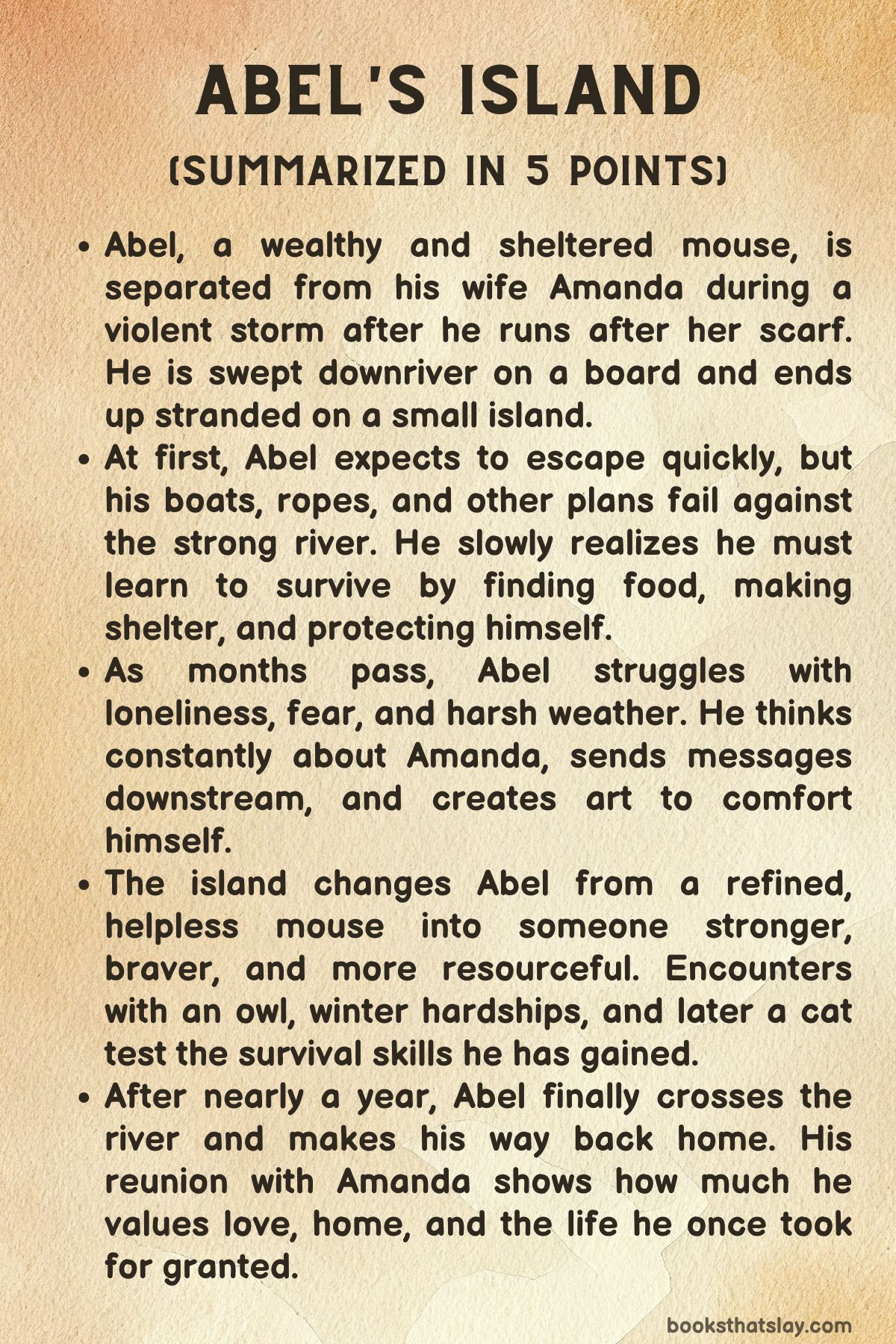
Abel’s Island by William Steig is a classic children’s adventure novel about survival, self-discovery, and the meaning of courage. The story follows Abel, a refined and somewhat sheltered mouse who becomes stranded on a small island after a violent storm separates him from his wife, Amanda.
Forced to live alone in the wilderness, Abel must learn skills he never needed before, such as finding food, building shelter, and protecting himself from danger. Over the course of a year, his experiences change him deeply. The novel shows how isolation, nature, and hardship can transform a comfortable life into a journey of growth, resilience, and renewed appreciation for home and love.
Summary
The story begins in 1907 with Abel and his wife Amanda celebrating their first wedding anniversary with a picnic in the woods. They enjoy their afternoon playing croquet and relaxing together.
While Amanda rests beneath a fern, Abel wanders off and returns with a daisy, presenting it to her playfully as a parasol. Suddenly a fierce storm approaches.
Wind and rain arrive with great force, and the couple rush to take shelter inside a nearby cave where other animals have already gathered.
While they wait inside, a strong gust of wind blows Amanda’s scarf out of the cave. Abel immediately runs after it despite her warning.
He manages to catch the scarf, but the storm is too powerful. The wind lifts and tosses him around until he grabs onto a wooden board with a nail sticking out of it.
The rising floodwater carries the board along the rushing stream, turning it into a small raft. Abel clings to it as it rushes downstream and even over a waterfall.
Exhausted and frightened, he eventually drifts to a stop when the board lodges in a fallen tree. Abel falls asleep thinking about Amanda and hoping she is safe.
The next morning Abel discovers that he has been carried to a small island below the waterfall in the middle of a swollen river. He assumes someone will eventually come looking for him, but the island appears difficult to escape from.
Hungry and tired, he eats a small branch to satisfy himself and rests again.
When he explores the island further, Abel realizes that the river still runs too strongly for him to cross. Confident that he can rescue himself, he begins building a small boat from the board that saved him.
However, his rudder fails, and the current overturns the boat, forcing him to swim back to the island. Determined not to give up, he builds another boat using driftwood, grass bindings, and his jacket as a sail.
Although he feels proud of the craft, the strong current smashes it against rocks and destroys it.
Abel keeps trying different ideas. He attempts to build a catamaran and later considers tunneling under the island or building a bridge across the river.
Each plan proves too difficult or dangerous. Gradually he realizes that he may have to survive on the island for a long time.
He surveys the island carefully and estimates its size. Though the environment interests him, he misses the comfort of home and his life with Amanda.
At night he sleeps in a birch tree and often gazes at a particular star that brings him comfort. During this time he begins to question why this misfortune happened to him and wonders about his worth and the meaning of his life.
Abel begins adapting to island life. He weaves a rope from grass in hopes of throwing it across the river and pulling himself over, but this also fails.
Another plan using stepping stones is washed away by the current. After nearly a month on the island, he improves his living situation by finding better food sources and building a hammock.
He still thinks constantly about Amanda and keeps her scarf with him as a reminder of home.
As autumn arrives, Abel continues experimenting with new ways to escape. He attempts to launch himself across the water using a bent tree limb but cannot make it work.
He learns to start a fire using a technique he once learned in school. With fire he cooks food and bakes small clay bowls.
In some of these bowls he places letters addressed to Amanda, hoping they will travel downstream and reach her. He also keeps a signal fire burning in case someone nearby might see it.
During lonely evenings he imagines sending thoughts to Amanda through what he calls mind messages. He even builds a glider in hopes of flying across the river, but the attempt fails and leaves him bruised.
As time passes he grows more connected to the island’s natural beauty. He sometimes dances alone among the trees, enjoying the freedom of the wild landscape.
Knowing winter will come, Abel begins preparing carefully. He gathers seeds and stores food.
Inspired by the surroundings, he also begins making art. He creates statues of his family from clay and wood, including Amanda, his mother, and his father.
During one exploration he discovers two objects left behind by someone long ago: a large pocket watch and a worn book. The book becomes important to him, and he reads a chapter each day.
The ticking watch reminds him of his orderly life at home.
As winter approaches the river begins to freeze along the edges. Abel wonders if the ice might eventually allow him to cross.
However, danger appears when an owl swoops down and nearly captures him. Abel escapes by cutting the owl’s claws with his knife.
Terrified, he hides inside his log shelter and becomes much more cautious.
Winter grows harsh. Snow covers the island, and Abel feels increasingly lonely.
He begins talking aloud to himself and continues imagining conversations with Amanda. To protect himself from the owl, he makes a spear and carries it everywhere.
Eventually the owl attacks again, and Abel fights it off during a fierce struggle. Though he survives, the constant threat leaves him uneasy.
During the long months of winter Abel rarely leaves his shelter. He focuses on keeping warm and finding enough food to survive.
At times he falls ill and becomes discouraged. The endless cold and darkness make him question whether he will ever return home.
Memories of Amanda both comfort and trouble him. Eventually he falls into deep sadness and begins losing hope.
When spring finally arrives, Abel slowly recovers his strength and spirit. Flowers bloom across the island, and he spends time enjoying the sunlight and fresh air.
One day, while relaxing near the water after drinking some homemade wine, he meets a frog named Gower Glackens. Gower had been washed onto the island after waking from winter hibernation.
Abel is delighted to speak with another creature after so long alone. He invites Gower to stay with him, and the frog lives on the island for about a month.
During this time they share stories about their lives. Abel even creates a statue of Gower, who praises his artistic ability and suggests that sculpting could become his profession someday.
Eventually Gower decides to return to his family by swimming across the river. Abel asks him to carry a rope across so that he might escape, but Gower believes the task would be too difficult.
He promises instead to inform Amanda that Abel is alive once he reaches home. Abel watches sadly as Gower leaves.
Weeks pass with no rescue. Abel fears the frog may have forgotten his promise.
Still, he continues making art and sending messages down the river. During the dry summer the river becomes shallower, and Abel realizes that he may finally be able to cross on his own.
After saying farewell to the island that sheltered him for a year, Abel enters the water and swims across the river. His time surviving in the wild has made him much stronger, and after a difficult effort he reaches the opposite shore.
However, his journey is not finished. A cat soon captures him, but Abel escapes by tricking the animal and fighting back.
Continuing his journey through the woods, Abel begins recognizing familiar landmarks. At last he returns to the place where he and Amanda had their picnic before the storm.
He travels quietly into his hometown of Mossville. Seeing Amanda sitting in a park fills him with emotion, but he decides not to approach her immediately.
Instead he sneaks into his house using his keys. After washing and putting on clean clothes, he waits quietly.
When Amanda arrives home and sees him, she rushes to him with overwhelming joy. Abel simply tells her that he has returned her scarf, marking the end of his long and difficult journey.
Characters
Abelard Hassam Di Chirico Flint (Abel)
Abel is the central figure of Abel’s Island and his character undergoes the most significant transformation throughout the story. At the beginning, Abel is a refined and comfortable mouse who has never experienced hardship.
His life has been supported by inherited wealth, and he is used to leisure, order, and social life rather than physical labor. This sheltered upbringing makes his sudden isolation on the island especially difficult, as he must learn practical survival skills that he never needed before.
His early attempts to escape show both his confidence and his inexperience, as many of his plans fail due to the power of nature.
As time passes, Abel gradually develops resilience and resourcefulness. He learns to build shelter, gather food, make tools, and even start fires.
The island forces him to become creative and self-reliant. This experience also leads him to deep reflection about his identity, his purpose, and the meaning of his life.
His loneliness causes him to question why Amanda loves him and whether he has truly earned the comforts he once enjoyed. These thoughts reveal a sensitive and introspective personality.
Abel’s character also shows emotional depth through his constant devotion to Amanda. Her scarf becomes a powerful symbol of his connection to home and love.
Even when he feels hopeless during the harsh winter months, his thoughts often return to her. This emotional attachment helps him maintain the will to survive.
At the same time, the island awakens new interests within him, especially artistic creativity. His sculptures and paintings demonstrate how solitude encourages self-expression and imagination.
By the end of the story, Abel has become stronger both physically and mentally. His survival through storms, cold winters, predators, and loneliness transforms him into someone far more capable than he once was.
The experience teaches him humility, patience, and appreciation for the simple comforts of life. His return home marks not only a physical journey completed but also the completion of a personal transformation shaped by the challenges he endured in Abel’s Island.
Amanda
Amanda is Abel’s loving wife and an important emotional presence throughout the narrative, even though she appears directly only at the beginning and the end. She represents the warmth, stability, and affection of home.
During the opening picnic scene, Amanda is portrayed as gentle, trusting, and devoted to Abel. Their playful interaction shows the closeness of their relationship and the happiness of their marriage.
After the storm separates them, Amanda becomes a symbol of hope and motivation for Abel. He constantly imagines her searching for him or worrying about his safety.
These thoughts keep him emotionally connected to the world beyond the island. Her scarf becomes one of the few possessions Abel has with him, and he keeps it close as a reminder of her love.
The scarf also carries symbolic meaning, as it is the object that led to his separation but also the item that preserves his connection to her.
Although Amanda does not directly influence events on the island, her presence remains powerful in Abel’s thoughts. He imagines sending her letters through the river and even attempts to communicate through what he calls mind messages.
These imagined conversations reflect both his longing for companionship and his need to maintain emotional balance during long periods of isolation.
When Abel finally returns home, Amanda’s reaction confirms the strength of their relationship. Her joyful response shows that she has never forgotten him or replaced him in her life.
Her presence at the end of Abel’s Island restores the sense of belonging and affection that Abel has missed throughout his year of survival.
Gower Glackens
Gower Glackens is the frog who becomes Abel’s first real companion after months of complete solitude. His arrival marks an important turning point because it allows Abel to experience conversation and social interaction again.
Gower appears somewhat absent-minded and relaxed, often forgetting details or becoming distracted. Despite this, he is friendly and open, which immediately comforts Abel after so long alone.
The frog’s personality contrasts with Abel’s thoughtful and reflective nature. Gower lives in a more instinctive and carefree way, often catching flies with his tongue and speaking casually about his large family.
This difference highlights Abel’s background as a cultured and somewhat sheltered mouse. Through their conversations, Abel learns about Gower’s experiences and begins to appreciate the variety of lives that exist beyond his own social circle.
Gower also plays an important role in recognizing Abel’s artistic abilities. When Abel creates a statue of him, the frog praises the work enthusiastically and suggests that Abel should become a sculptor.
This encouragement helps Abel realize that his time on the island has allowed him to discover a talent he never explored before. In this way, Gower serves as a catalyst for Abel’s realization that hardship can lead to unexpected personal growth.
Although Gower promises to contact Amanda after leaving the island, his forgetful nature creates uncertainty about whether he will remember. His departure returns Abel to solitude, but the friendship still has a lasting impact.
The brief companionship reminds Abel of the importance of community and conversation, reinforcing how deeply isolation has affected him.
The Owl
The owl represents one of the greatest physical dangers Abel faces on the island. Unlike the other characters, the owl is not portrayed as malicious but as a natural predator following its instincts.
Its presence introduces constant tension and fear into Abel’s daily life, especially during the winter months when resources are scarce and survival becomes more difficult.
The owl’s attacks force Abel to become more cautious and strategic. His first encounter with the bird nearly results in his capture, but he manages to escape by using his knife.
This moment demonstrates how quickly Abel must adapt to protect himself. Later encounters with the owl lead him to create weapons and develop defensive strategies, including the spear he carries with him.
The owl also has a psychological effect on Abel. At one point he keeps its feathers and imagines they give him a form of power over the bird.
This belief reveals how deeply the stress of isolation and danger influences his thinking. The owl therefore becomes both a real threat and a symbol of the fear that surrounds him during the harsh winter.
Despite the danger it represents, the owl ultimately plays a role in Abel’s development. Facing this predator strengthens his courage and determination.
Surviving these encounters helps transform him from a sheltered mouse into someone capable of defending himself in a harsh natural environment.
The Cat
The cat appears near the end of Abel’s journey after he finally escapes the island. This encounter represents one last obstacle before he can return home.
When the cat captures him, Abel initially believes that all his efforts to survive have been in vain. However, his response shows how much he has changed.
Instead of panicking, Abel remains calm and looks for an opportunity to escape. His quick thinking allows him to trick the cat by pretending to be dead and then running when she loosens her grip.
When the chase continues into a tree, Abel uses his understanding of balance and movement to throw the cat off the branch and save himself.
This confrontation highlights Abel’s newfound confidence and strength. The mouse who once struggled to build simple tools on the island now possesses the courage and skill to outwit a dangerous predator.
The cat therefore serves as a final test of the survival abilities he developed during his year of isolation. Through this encounter, the narrative confirms that Abel has truly transformed into someone capable of facing the dangers of the world beyond the island in Abel’s Island.
Themes
Transformation Through Adversity
Life on the island forces Abel to undergo a profound transformation. At the beginning of Abel’s Island, Abel is a mouse who has lived a life of comfort and security.
He has inherited wealth, has never needed to work, and enjoys refined activities rather than practical labor. When he suddenly becomes stranded, he lacks the skills necessary to survive in the wild.
The island becomes a place where his assumptions about life are challenged. Instead of relying on servants, wealth, or social connections, Abel must depend entirely on his own effort.
During the early part of his isolation, Abel repeatedly attempts to escape through elaborate plans such as building boats, bridges, or ropes. Many of these attempts fail because he underestimates the strength of the river and overestimates his own abilities.
These failures are important because they teach him humility and patience. Gradually he begins to focus less on immediate escape and more on adapting to the environment around him.
He learns how to build shelter, find food, and protect himself from predators. Each new skill represents a step in his personal growth.
This transformation also occurs internally. Abel begins questioning his identity and the meaning of his life.
He wonders whether he deserves the comfortable existence he once enjoyed and whether he has ever truly earned anything through effort. These reflections suggest that adversity forces him to confront deeper questions about purpose and character.
The island becomes a place of reflection where he develops self-awareness.
By the time Abel finally leaves the island, he is no longer the same sheltered mouse who chased after Amanda’s scarf during the storm. He has become stronger, more capable, and more thoughtful.
His experiences teach him endurance and self-reliance, qualities he never needed before. The hardship he faced ultimately reshapes his understanding of himself and the world around him, turning a frightening accident into a period of profound personal change.
Isolation and the Human Need for Connection
Isolation shapes much of Abel’s experience on the island and strongly influences his emotional state. Being separated from his home and from Amanda removes him from the social world that once defined his life.
In the beginning he assumes that someone will quickly rescue him, but as days turn into weeks and then months, he begins to understand that he may be alone for a very long time. This realization creates an intense sense of loneliness that affects his thoughts and behavior.
To cope with the absence of companionship, Abel begins creating substitutes for human interaction. He talks aloud to himself, imagines conversations with Amanda, and sends messages downstream in hopes that someone might find them.
These actions reveal how deeply he needs communication and emotional connection. Without other voices around him, he invents ways to maintain a sense of dialogue with the outside world.
Even the objects he creates, such as statues of his family, serve as reminders of relationships that once shaped his life.
The arrival of the frog Gower highlights how powerful this need for connection has become. Abel’s excitement when hearing another voice after so many months alone shows how much he has missed ordinary conversation.
Their friendship is brief, yet it brings Abel great comfort. Through their discussions about family, work, and art, Abel briefly experiences the social life that had disappeared from his world.
Even nature itself becomes a form of companionship for him. He watches the stars, observes the changing seasons, and forms a sense of connection with the landscape.
These experiences help him endure the long periods of solitude. However, the emotional pull of home and loved ones never disappears.
His constant thoughts of Amanda remind him that personal relationships give life meaning. The period of isolation therefore emphasizes how deeply individuals depend on community and affection to maintain emotional balance.
The Relationship Between Civilization and Nature
Abel’s experience on the island reveals the contrast between a life shaped by civilization and one governed by the natural world. Before the storm, Abel’s existence is defined by order, comfort, and social customs.
He enjoys leisure activities such as picnics and croquet, and he takes pride in refined clothing and polite behavior. These elements represent the structured environment of society where needs are easily met and life follows predictable patterns.
Once he is stranded on the island, this orderly world disappears. Nature operates according to its own rules, which are often harsh and unpredictable.
The river’s current destroys his carefully constructed boats, storms threaten his safety, and predators such as the owl remind him that survival depends on constant awareness. Abel quickly realizes that the habits and expectations he learned in civilization offer little protection in this environment.
Over time, however, his relationship with nature begins to change. At first he sees the island only as an obstacle that prevents him from returning home.
Later he begins noticing its beauty and complexity. The blooming flowers of spring, the movement of the stars, and the changing colors of the seasons create moments of wonder.
These observations show that nature is not only dangerous but also rich and inspiring.
Abel gradually learns to live within this natural environment rather than fighting against it. He gathers food from plants, builds shelters using fallen wood, and studies the behavior of animals around him.
Through these experiences he gains respect for the balance and power of the natural world. The island becomes both a challenge and a teacher.
This shift in perspective suggests that civilization and nature are not completely separate. Instead, the story shows that individuals can learn valuable lessons by stepping outside the structured world of society.
Abel returns home with a deeper appreciation for the natural forces that shape life, carrying with him a new awareness of how fragile comfort can be.
Creativity and the Discovery of Purpose
Time spent alone on the island leads Abel to discover creative abilities that he never explored before. His earlier life provided comfort but little opportunity for meaningful work.
Because his financial security came from inheritance, he never needed to develop a profession or cultivate specific talents. The isolation of the island removes these conveniences and creates space for personal discovery.
Abel begins experimenting with art almost accidentally. Using clay, wood, and other natural materials, he starts making statues of people he remembers from home.
These sculptures represent more than simple hobbies. They allow him to express emotions that he cannot share with anyone else.
Creating the figures helps him feel connected to his family and gives him a sense of accomplishment that he rarely experienced before.
Later he expands his creativity by painting with crushed flower petals and using pages from a damaged book as a surface. The act of transforming natural materials into art shows how his surroundings inspire imagination.
What began as an attempt to pass time becomes a meaningful activity that provides structure and purpose during long periods of solitude.
Gower’s reaction to Abel’s statue further reinforces this discovery. The frog’s admiration for the sculpture encourages Abel to consider the possibility that art could become his true vocation.
This idea is significant because it suggests that hardship has revealed a hidden talent that might otherwise have remained unnoticed.
Creative work also helps Abel maintain emotional stability. The process of shaping clay or painting colors allows him to focus his energy in a productive way rather than surrendering to despair.
Through creativity he transforms isolation into an opportunity for growth. His artistic discoveries suggest that individuals often uncover their deepest abilities when removed from familiar routines and forced to explore new ways of expressing themselves in Abel’s Island.