Abuela, Don’t Forget Me Summary and Analysis
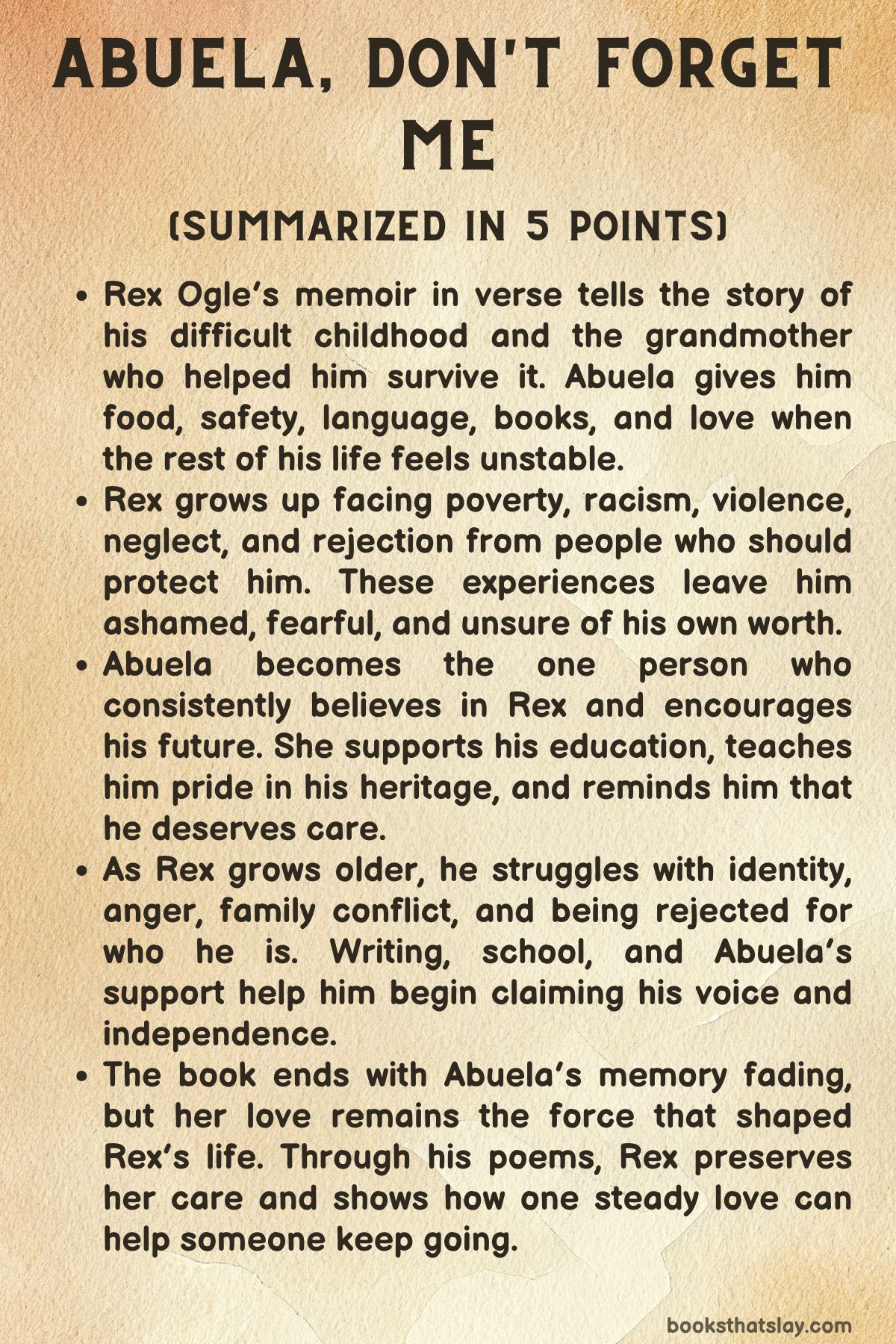
Abuela, Don’t Forget Me is a memoir in verse by Rex Ogle about survival, memory, and the life-changing power of one steady love. Told through short poems, it follows Ogle from childhood into early adulthood as he grows up amid poverty, racism, violence, and rejection.
At the center of the story is his grandmother, Abuela, whose care gives him food, language, books, safety, and belief in his future. The book is not only about hardship; it is also about what it means to be seen by someone who refuses to stop loving you. In spare, vivid scenes, Ogle shows how that love helped keep him alive.
Summary
Rex Ogle tells the story of his life through memories shaped by his bond with his grandmother, the person he trusts more than anyone else. In the present, she is living with dementia and often forgets who he is, which gives the entire book an added layer of loss.
To hold on to her and to the life she gave him, he writes poems that preserve moments from the past. These memories become his way of honoring the person who protected him when almost no one else did.
As a child, Rex spends much of his time at his grandmother’s house. Her home feels calm, warm, and dependable in a way his mother’s home never does.
One early memory captures this clearly: he hides inside a laundry hamper to escape screaming, and it is Abuela who finds him. That moment becomes a quiet pattern for the rest of his life.
Whenever he feels frightened, abandoned, or overwhelmed, she is the one who comes looking for him.
Abuela fills his world with small lessons that carry large meaning. She teaches him Spanish words and phrases, and through them teaches identity, respect, and affection.
She calls him mijo, explains gratitude, and insists on manners because everyone deserves dignity. Her background in Mexico, where food was scarce and work was hard, shapes everything she does.
She feeds him generously and reminds him that as long as she is alive, he will not go hungry. In her backyard, pecan trees become a symbol of patience, provision, and care.
She gathers food from them and later mails him shelled pecans, a practical gift that also stands for her constancy.
She also opens the door to reading and writing. She takes him to the library, shows him books, and teaches him to write his name.
For Rex, language begins as wonder. Letters become a kind of magic, and that wonder grows into ambition.
Long before he can name what writing will mean to him, Abuela sees it.
Against this tenderness is the instability of his life with his mother. She struggles financially, resents Abuela’s help, and moves often.
Her relationships add more chaos, especially once Sam enters their lives. Sam is violent, and Rex grows up surrounded by shouting, slammed doors, fear, and confusion.
He sees bruises on his mother, and he himself becomes a target of physical abuse. At home he is told he is in the way, bad, or burdensome.
At Abuela’s he is treated as worthy.
As he gets older, he begins to understand that the world judges him in ways he cannot fully explain at first. He is biracial, and his appearance becomes a source of ridicule and alienation.
At a swimming pool, boys mock his skin and use a racist slur. The encounter leaves him ashamed and unable to put language to what happened.
Later he studies himself in the mirror, trying to see what others think is wrong with him. He begins to internalize the idea that difference makes him unacceptable.
That pressure spills into his feelings about Abuela. Other children mock her accent, and instead of defending her with full understanding, he turns some of his shame against her.
He starts calling her Grandma instead of Abuela and feels embarrassed by the very heritage she has tried to pass on to him with pride. These moments are painful because they show how cruelty from the outside can distort love on the inside.
Even so, Abuela remains patient with him.
The family continues moving from place to place, each move bringing more instability. Rex becomes a latchkey child, left to care for himself after school while his mother cashes checks Abuela sends for childcare.
A new baby, Ford, arrives, and Rex’s feelings are complicated. He is not immediately excited, but he grows to care deeply for his brother.
Through all of this, Abuela keeps showing up with groceries, clothing, money, and practical help. She buys furniture for their apartment when they have almost nothing.
Instead of gratitude, his mother responds with suspicion and anger, and one fight over Abuela’s help turns violent, leaving Rex injured.
Abuela’s sacrifices are enormous. Rex learns that she works multiple jobs and volunteers widely, all while helping her children, grandchildren, and relatives in Mexico.
She does not build comfort for herself; she spends her energy and resources keeping others afloat. Even when her own neighborhood becomes less safe, she stays in her home because she is saving money for Rex’s education.
She praises his grades, encourages his effort, and tells him that he is worth investing in. When his mother belittles him, Abuela answers with belief.
Writing becomes one of the clearest expressions of that belief. Rex wants a journal because he feels his words matter and because writing might help him become more than the labels forced on him.
When Abuela buys him the journal, his mother again reacts violently. Yet this time the meaning of the moment is different.
Rex recognizes that writing is no longer just an interest. It is a claim to selfhood.
He continues writing even through pain, holding to the voice Abuela helped awaken.
In high school, he takes Spanish despite his mother’s orders not to. The choice is about more than a class schedule.
It is a way of reclaiming a part of himself that he has been taught to reject. He also faces homophobic slurs and mounting confusion about his identity.
School becomes a place where his academic talent is obvious, but his anger and hurt still surface in fights and disciplinary trouble. Adults tell him he has potential, but potential alone does not heal damage.
A turning point comes when Abuela helps him apply to a college summer program. Away from the violence of home, Rex experiences a different kind of life.
He sees what it feels like to live without daily fear. He makes friends, explores the town, discovers new pleasures, and senses hope beginning to form.
The program shows him that his future can be larger than survival. Afterward, Abuela guides him toward a scholarship program that could pay for college if he finishes high school in Abilene.
Moving in with her feels like a rebirth. For the first time, home becomes a place where he can build rather than simply endure.
His senior year is difficult but transformative. He works long hours, studies hard, and tries to become responsible for his own future.
He still makes mistakes, including a kitchen fire that badly damages Abuela’s home and injures him, but her response is revealing. She is angry, yet she does not hit him or destroy him.
She helps him. That contrast matters.
He begins to understand that mistakes do not have to lead to violence.
Even after moving in with Abuela, his mother’s control does not fully end. She arrives with Sam and other men, falsely claiming concern while really trying to take his car.
The confrontation turns physical, and Abuela, frightened, enables it by giving up the spare keys. Rex is furious, and for a while distance grows between them.
But eventually they speak honestly. Abuela admits fear, he softens, and their relationship survives because it is built on something stronger than one betrayal.
He is accepted into the college scholarship program, and graduation should be a moment of triumph. Yet even then, his mother tries to reshape the story around herself, announcing plans that would keep control over him.
Rex finally says what he has carried for years: she has made his life miserable, and he will not let her define his future. It is one of the clearest moments of self-assertion in the book.
After graduation he spends time with his father in Alabama, hoping perhaps for another version of family. Instead, he finds emotional distance and conditional acceptance.
When his father learns that he is gay, he rejects him unless he agrees to change. Rex refuses.
With little money and nowhere to go, he ends up in New Orleans, living in extreme hardship and reaching a point of despair so deep that he considers ending his life. Starving and alone, he finally calls Abuela.
Her response is immediate and simple: come home. She does not interrogate him or shame him.
She receives him. When he returns, he is once again the frightened child waiting to be found, and she once again opens the lid, so to speak, and brings him back into safety.
Home is still home because she is still there.
In the end, time has passed and Abuela’s memory is fading, but her love has not vanished. She may forget details, scenes, and names, yet she still says she loves him.
The book closes with the understanding that while memory can erode, the care that shaped a life can remain. Rex survives abuse, rejection, hunger, and loneliness, but the force that carries him through is not toughness alone.
It is the lasting truth that Abuela loved him, believed him, and kept making room for him to come home.
Characters
Rex Ogle
Rex is the emotional and narrative center of the book, and his character is shaped by two opposing forces: the cruelty and instability of the homes he is forced to survive, and the steady love that keeps him from breaking completely. As a child, he is observant, sensitive, hungry for affection, and deeply alert to danger.
He learns early how to read moods, avoid conflict, and hide parts of himself in order to stay safe. That vigilance becomes part of his personality.
He is not presented as a flawless victim, but as a real child who is sometimes angry, embarrassed, defensive, and reactive. This makes him feel fully human.
He absorbs shame from racism, class insecurity, family violence, and later homophobia, and these pressures affect how he sees his body, his heritage, and his own worth.
One of the most striking things about Rex is how often he doubts himself even when he is clearly gifted. He is intelligent, imaginative, and academically capable, yet he has been raised in an environment that teaches him to expect rejection.
That contradiction drives much of his inner life. He wants to believe in a future for himself, but he has also been trained by experience to think survival is the most he can hope for.
His love of books, stories, and writing becomes one of the clearest signs of his inner strength. Writing is not merely a hobby for him.
It is how he protects his mind, names pain, and begins to build an identity separate from the people who try to define him through abuse.
Rex also develops in morally complicated ways, which gives the character depth. He sometimes turns shame outward, especially when he feels exposed.
His embarrassment over his grandmother’s accent and culture reveals how thoroughly social cruelty has affected him. These moments are painful because they show him participating in the same rejection that wounds him.
Yet the book does not leave him there. He grows, reflects, and comes to understand both his failures and his need for healing.
By the end, he is still marked by trauma, but he is no longer only reacting to the damage done to him. He begins making choices for himself, claiming his education, his voice, and his right to live honestly.
His arc is not one of becoming perfect or fully healed. It is the story of someone learning that he deserves safety, dignity, and love.
Abuela
Abuela is the moral heart of the story and the figure through whom love becomes action. She is not simply kind in an abstract sense.
Her love is practical, disciplined, and sacrificial. She feeds people, teaches them, shelters them, sends money, buys what is needed, works constantly, and still finds time to encourage, comfort, and listen.
Her care is never passive. She is the person who steps in, again and again, when others fail.
This makes her far more than a comforting grandmother figure. She is the one stable structure in Rex’s life, the person whose presence allows him to imagine that goodness is real.
Her character is especially powerful because she combines tenderness with strength. She is affectionate, nurturing, and patient, but she is also disciplined, intelligent, and formidable.
She is highly educated, works multiple jobs, and carries a deep sense of responsibility toward both her immediate family and relatives in Mexico. Her past poverty shapes her values, especially her gratitude, work ethic, and refusal to waste what she has.
She understands hunger, exclusion, and hardship, which is why she responds to others with generosity rather than judgment. She teaches respect not as a performance of politeness but as a way of recognizing human worth.
At the same time, she is not written as a saint without limitations. Her love sometimes leads her to overextend herself for people who exploit her, especially her daughter.
She gives money, furniture, housing, and endless help, even when that help is resented or misused. Her hope that people will do better can make her vulnerable.
There are moments when she does not intervene soon enough or makes choices out of fear that hurt Rex, as when she helps his mother take the car. These moments matter because they keep her from becoming idealized.
She is deeply loving, but still human, still afraid, and still capable of mistakes.
What makes Abuela unforgettable is the consistency of her love. She is the one person in Rex’s life whose care is not conditional on performance, obedience, masculinity, or conformity.
She loves him before he has achieved anything and continues loving him when he is frightened, angry, distant, or broken. Her acceptance becomes even more meaningful when he faces rejection elsewhere.
She may not always fully understand every part of him immediately, but her instinct is always to gather him in rather than cast him out. She represents home in the deepest sense: not a building, but a person whose presence means safety.
Mom
Rex’s mother is one of the most difficult and layered characters in the book because she is both a victim of violence and a perpetrator of it. She is not drawn in simple terms.
Her life appears marked by disappointment, instability, financial struggle, resentment, and repeated bad choices, and these conditions shape the bitterness that defines her. She seems to carry unresolved anger toward her own mother, toward the direction her life took after becoming a parent, and perhaps toward Rex himself as a living reminder of that altered life.
Much of her behavior suggests someone who feels trapped and powerless, yet instead of breaking that cycle, she passes pain downward.
As a mother, she is volatile, neglectful, and often cruel. She withholds affection, lashes out physically, belittles Rex’s intelligence and interests, and treats his needs as burdensome interruptions.
Even her moments of softness are unreliable, which makes her unpredictability part of the harm she causes. Rex never knows when she will be calm, when she will be enraged, or when an ordinary disagreement will turn violent.
That instability creates emotional terror as damaging as the physical abuse. She also refuses help when accepting it would require humility, which places pride over her son’s well-being.
Her resentment of Abuela is especially revealing. She seems unable to bear the fact that her mother provides the care and competence she herself cannot sustain.
Yet the character is painful precisely because she is not empty of feeling. There are hints of injury, humiliation, and dependence under her rage.
She remains attached to abusive men, struggles to create stability, and appears unable to separate her own pain from her treatment of her child. This does not excuse her actions, but it explains why she is such a tragic figure.
She is someone who might have needed help long before the story begins, but instead becomes someone who harms the person most vulnerable to her.
Her relationship with Rex is defined by control. She resists anything that might allow him to grow beyond her influence, whether that is his language choices, his education, his independence, or eventually his future.
Even when he succeeds, she often responds not with pride but with anger or competition. That makes her one of the central obstacles in the book.
She is not just part of the difficult background of his childhood; she is an active force trying to keep him emotionally and materially confined. Her character shows how parenthood without care can become another form of violence.
Sam
Sam represents the ongoing threat of male violence in Rex’s childhood. He enters the family as the mother’s partner, but quickly becomes a source of fear, instability, and harm.
He brings with him physical abuse, intimidation, financial insecurity, and danger from the outside world. His presence expands the chaos of the household.
He is not portrayed as a complex emotional refuge gone wrong, but as someone whose influence makes an already fragile home even more unsafe.
What makes Sam significant is not only what he does directly, but the environment he helps create. Under his influence, the home is marked by shouting, slamming doors, tension, and bodily threat.
Rex sees his mother bruised by him and understands from an early age that violence is woven into daily life. Sam also reinforces Rex’s sense that he is unwanted.
Whether through explicit hostility or the general atmosphere of exclusion, he contributes to the message that Rex is always in the way. This damages the boy’s self-image and sense of belonging.
Sam also stands for failed adulthood. He does not provide real security, yet demands power.
He cycles through instability, debt, aggression, and irresponsibility. Against Abuela’s relentless labor and sacrifice, Sam appears as a sharp contrast: someone who drains rather than sustains.
Even when he briefly tries to seem reformed, the underlying selfishness remains. His role in the attempted seizure of Rex’s car confirms that material control and domination matter more to him than the young man’s future.
He is important as a character because he shows that abuse in the book is not incidental. It is systemic, repetitive, and protected by adult selfishness.
Sam helps define the world Rex must escape.
Ford
Ford, Rex’s younger brother, carries a different symbolic weight in the story. He is both a child Rex sometimes resents and a child he wants to protect.
When the pregnancy is announced, Rex does not respond with simple joy, and that reaction is honest rather than cruel. He already lives in instability and senses, perhaps before he can say it clearly, that a new child will not repair anything.
Once Ford is born, however, Rex’s feelings grow more tender and complicated. He recognizes his brother’s innocence and sees in him another child being raised amid dysfunction.
Ford often appears in ways that highlight Rex’s emerging capacity for care. He shares stories with him, guides him, and in some scenes acts with a protective instinct that echoes Abuela’s influence.
Their bond suggests that Rex, despite all he has endured, has not lost the ability to be gentle. Ford becomes one of the few family relationships not shaped primarily by domination or resentment.
Even when their world is unstable, there are moments of warmth between them.
At the same time, Ford’s presence increases the emotional complexity of Rex’s situation. Rex cannot simply detach from the family without also thinking about what will happen to his brother.
Ford becomes one of the ties that keeps the emotional wound open. He represents innocence inside a damaged family system, and his existence reminds the reader that abuse does not affect only one child at a time.
Though Ford is not as psychologically developed on the page as some of the adults, he matters because he reveals another side of Rex. Around him, Rex is not just a survivor.
He is also a brother capable of affection, memory, and care.
Dad
Rex’s father is defined by absence, emotional distance, and conditional acceptance. Unlike Sam, he is not a constant physical force in Rex’s daily childhood, but that does not make his impact smaller.
His neglect leaves a quieter but still serious wound. He is someone who might have offered an alternative home or a different model of care, yet repeatedly fails to do so.
His presence in the story often arrives through disappointment.
When Rex visits his father’s side of the family as a child, he encounters mixed responses, including warmth from others but little real closeness from his father himself. This pattern continues into late adolescence, when Rex spends time in Alabama hoping, consciously or not, for connection or a fresh start.
Instead, he finds a household that values control, appearances, and emotional restraint more than comfort or welcome. Even a small moment, such as concern over the floor rather than the reunion, reveals his father’s priorities.
The deepest failure comes when Rex’s father rejects him for being gay. This moment confirms what has long been suggested: his love is conditional on conformity.
He frames sexuality as a choice and offers acceptance only through repression, therapy, and religious correction. In doing so, he joins the line of adults who demand that Rex deny himself in order to deserve belonging.
The scene is devastating because it closes off the possibility that this parent might finally become safe.
As a character, Dad represents a different face of family harm than Rex’s mother or Sam. He is less explosive but just as damaging in his refusal to love without terms.
His rejection helps drive Rex to one of the lowest points of his life. He matters not because he is always present, but because each time he might choose love, he does not.
Grandma June
Grandma June is one of the few figures on Rex’s father’s side who offers him real comfort. Her role in the story is relatively brief, but emotionally important.
She receives him with warmth, physical affection, and reassurance. When neighborhood children taunt him, she does not dismiss his pain.
Instead, she comforts him and tells him there is nothing wrong with being different. In a book where many adults either ignore his pain or intensify it, that response matters a great deal.
She also helps reveal that Abuela’s love is visible even across family lines. Through her, Rex learns that his grandmothers have communicated and that support has traveled behind the scenes in ways he did not fully realize.
This broadens the emotional landscape of the story. It shows that care can sometimes exist in quiet networks, even when the immediate household is fractured.
Grandma June functions as a secondary mirror to Abuela. She is not as central, powerful, or transformative, but she offers a glimpse of what family tenderness can look like elsewhere.
Her presence keeps Rex from experiencing his father’s side as entirely loveless and gives him at least one memory of being valued there.
Aunt Lora, Aunt Frannie, Donald, and the Extended Family
The extended family members do not all receive the same level of development, but together they help define the broader world around Rex. Aunt Lora appears in scenes that place Rex within family and community life, while Aunt Frannie and Donald help show the texture of family gatherings and trips.
Their presence can make the story feel wider than one child and one grandmother, yet they also underline how isolated Rex often remains even within family spaces.
Donald, as a cousin, sometimes brings childlike bluntness and humor into tense situations. He helps show how children respond differently to instability, sometimes with innocence, selfishness, or casual cruelty that comes from not fully understanding the stakes.
The aunts, meanwhile, suggest a family network that exists, but does not consistently intervene in the way Abuela does. Their roles are less about individual transformation and more about context.
These relatives matter because they prevent the story from becoming emotionally flat or overly closed. They remind the reader that Rex grows up inside a multigenerational family system shaped by migration, economic strain, cultural memory, resentment, and obligation.
Yet for all these connections, very few people truly see him. That contrast makes Abuela’s unique devotion stand out even more.
Teachers, Principals, and Peers
The teachers, school administrators, and classmates in the book often function as social forces rather than fully individualized characters, but they are still important to the overall character landscape. They shape the pressures Rex faces outside the home.
Some peers bully him with racist and homophobic slurs, making school another place where difference is punished. Their cruelty feeds his shame, especially around his body, race, language, and sexuality.
At the same time, school is also where Rex’s abilities become visible. Principals and teachers notice his intelligence, his grades, and his promise, even when they are frustrated by his anger or behavior.
These adults do not always know how to help him, but they mark an important truth: his life contains evidence of brilliance even when his home life tries to erase it. The tension between achievement and pain becomes especially clear in their responses to him.
Certain peers in his later school years and summer program also help him imagine another version of life. Friends, classmates, and fellow students provide acceptance, companionship, and ordinary teenage experiences that had long been missing from his world.
They do not replace family, but they broaden the horizon of possibility. Through them, Rex starts to see that connection does not have to be built on fear.
Tom
Tom appears later in the story but has a meaningful role in Rex’s developing sense of self. He is associated with possibility, attraction, and a more honest recognition of desire.
Their connection at work grows through ordinary conversation, which is important because it allows affection and interest to emerge in a setting that feels unforced. For someone whose life has been shaped by secrecy and judgment, this kind of quiet mutuality has special significance.
Tom is not developed as a life-changing partner, nor is he idealized. His importance lies more in what he awakens in Rex than in a long-term relationship arc.
The kiss between them is a moment of recognition. It confirms something Rex has long known internally but has not been able to live openly.
This makes Tom part of Rex’s movement toward self-knowledge.
Because that movement is followed so quickly by rejection from his father, Tom’s role also highlights the tragedy of timing. A moment that could have opened into freedom instead becomes entangled with danger and exile.
Even so, Tom remains an important figure because he is linked to truth rather than denial.
Stepmother and Stepsister
Rex’s stepmother and stepsister are relatively minor figures, but they help create an important contrast inside his father’s household. They greet him with more warmth than his father does, which immediately signals that coldness is not simply the nature of the home.
It is tied especially to his father. Their friendliness briefly suggests that his visit might offer some form of belonging.
The stepsister’s later role in exposing his sexuality leads to painful consequences, which shows how fragile that sense of safety really is. Whether her action comes from immaturity, carelessness, betrayal, or some mix of these, the result is catastrophic for him.
The stepmother, though kinder in manner, does not become a protective force capable of overriding the father’s rejection.
These characters are important because they deepen the emotional complexity of Alabama. Rex is not surrounded only by hostility there.
He is instead given a partial, unstable welcome that makes the ultimate rejection even sharper.
Jason and Other Childhood Boys
Jason and the various boys Rex encounters during childhood help mark the social world of boyhood, belonging, and exclusion. Jason represents the ordinary play and neighborhood freedom Rex wants but does not always get to keep.
Other boys, especially those who mock his grandmother or insult his ethnicity, reflect the early policing of identity that shapes his shame. They teach him, long before adulthood, that difference can become a target.
These boys matter because childhood cruelty has lasting effects. Their mockery does not remain at the level of playground insult.
It changes how Rex sees his family, his language, and himself. In that sense, they function as early agents of social conditioning.
They help explain why he sometimes turns against what he most loves.
Themes
Unconditional Love as a Lifeline
At the center of Abuela, Don’t Forget Me is the idea that one consistent source of love can sustain a person through enormous hardship. Rex grows up in an environment defined by instability, violence, hunger, and rejection.
In such circumstances, emotional survival becomes almost as difficult as physical survival. What allows him to endure is the steady presence of Abuela, whose love functions not simply as affection but as protection, guidance, and validation.
Her care is active rather than symbolic. She feeds him when food is scarce, sends money when his mother cannot provide stability, teaches him manners and language, and encourages his education long before anyone else sees his potential.
Each of these actions reinforces the message that he matters.
This form of love contrasts sharply with the conditional or inconsistent love offered by other adults in Rex’s life. His mother’s treatment fluctuates between indifference and violence, while his father ultimately rejects him because of his sexuality.
Both relationships communicate that love must be earned through obedience or conformity. Abuela’s love operates according to an entirely different logic.
She values him not for his achievements or behavior but for his existence. Even when he is embarrassed by her accent, angry with her decisions, or distant during his teenage years, she continues to treat him with patience and warmth.
The theme becomes especially powerful when Rex reaches his lowest point while living on the streets in New Orleans. At that moment he has lost nearly every form of stability.
He has been rejected by his father, has almost no money, and feels physically and emotionally exhausted. When he finally calls Abuela, her response is simple: come home.
She does not demand explanations or impose conditions. Her immediate acceptance reinforces the idea that unconditional love offers a path back from despair.
In a life marked by trauma, that kind of love becomes the difference between collapse and resilience.
The Lasting Impact of Abuse and Instability
The story portrays how long-term exposure to violence, neglect, and instability shapes a child’s emotional world. Rex’s childhood is filled with shouting, physical harm, and sudden changes in environment.
His mother’s volatile temper and Sam’s abusive behavior create a home where safety is never guaranteed. This constant uncertainty forces him to develop defensive habits early in life.
He learns to anticipate danger, to monitor the moods of adults, and to stay quiet when conflict erupts. These behaviors are survival strategies, but they also affect how he views himself and others.
Abuse in the story does not exist only in isolated moments of physical harm. It also appears in the form of humiliation, neglect, and emotional dismissal.
Rex is told that he is in the way, that he causes problems, or that he is not good enough. Over time these statements shape his internal voice.
Even when he achieves academic success or demonstrates intelligence, he struggles to believe in his own value. Trauma becomes embedded in the way he interprets everyday situations.
For example, when he faces bullying at school or embarrassment about his heritage, those experiences reinforce feelings that have already been planted at home.
Instability compounds the damage of abuse. The family moves frequently, lives in cramped apartments, and experiences financial insecurity.
These disruptions prevent Rex from building a stable sense of place or community. Each move forces him to adjust to new surroundings while carrying the same unresolved pain.
Even when circumstances temporarily improve, the fear of another crisis lingers.
The long-term consequences of this environment become visible in his teenage years. Rex struggles with anger, sometimes fighting at school despite his academic achievements.
He experiences periods of emotional numbness and difficulty trusting others. His later experiences with homelessness and despair reveal how deeply childhood trauma can influence adult vulnerability.
The narrative shows that abuse does not end when the moment of violence passes. Its effects continue shaping identity, relationships, and self-worth long after the event itself.
Identity, Belonging, and the Struggle with Difference
The story explores the difficulty of forming a secure identity while navigating racial, cultural, and personal difference. Rex grows up as a biracial child who often feels out of place in the communities around him.
Encounters with racism during childhood create early confusion about his appearance and heritage. When other children mock his skin tone or use derogatory language, he begins to examine himself critically, wondering what others see that makes him seem wrong.
These moments contribute to a growing sense of alienation.
Language becomes an important symbol within this struggle. Abuela speaks Spanish and uses it to express affection and cultural pride, while Rex’s mother discourages the language and insists on English.
This tension reflects a deeper conflict about cultural identity. Abuela encourages him to embrace his Mexican heritage, but social pressure and bullying make him hesitant to accept it fully.
At times he even directs his embarrassment toward his grandmother, blaming her accent for the ridicule he experiences from peers. These reactions show how external prejudice can lead individuals to distance themselves from parts of their own background.
Identity becomes even more complicated as Rex begins to understand his sexuality. Growing up in environments where homophobia is common, he learns to hide this aspect of himself.
Insults from classmates and later rejection from his father reinforce the idea that difference can result in abandonment. The conflict between his authentic self and the expectations of others creates emotional strain.
When he finally acknowledges his attraction to boys, the response he receives confirms many of his fears about rejection and judgment.
Despite these challenges, the story also illustrates how identity can gradually be reclaimed. Rex’s decision to study Spanish, pursue education, and express himself through writing reflects a growing willingness to define himself rather than accept the labels imposed on him.
The supportive environment he briefly experiences during the summer academic program also shows him that acceptance is possible in other communities. His identity remains complex and evolving, but the narrative demonstrates that belonging does not have to depend on erasing difference.
Education and Self-Expression as Paths to Freedom
Education and creative expression serve as powerful tools for Rex to build a future beyond the limitations of his upbringing. From early childhood, Abuela encourages his curiosity and introduces him to books and libraries.
These experiences provide more than academic knowledge. They create a sense of possibility.
In environments where his daily life is defined by conflict and scarcity, books represent worlds that are stable, imaginative, and expansive. Reading allows him to imagine lives different from the one he currently inhabits.
Writing becomes an especially important form of self-expression. When Rex receives a journal, he recognizes that recording his thoughts might help him understand himself and communicate experiences that others refuse to acknowledge.
Even when his mother reacts violently to this interest, he continues writing because it affirms that his voice has value. The act of writing becomes both emotional release and personal resistance.
Through words, he refuses to let others silence his perspective or define his story entirely through abuse.
Education also provides practical opportunities for transformation. Programs like the Junior Scholars initiative introduce him to academic environments that are calmer and more supportive than his home life.
In these spaces he meets students who share intellectual curiosity and ambition. The contrast between this environment and the chaos he previously experienced helps him realize that a different life is possible.
The possibility of scholarships and college admission strengthens his determination to succeed academically.
The theme culminates in Rex’s acceptance into a scholarship program that will support his university education. This achievement represents more than personal success.
It symbolizes a break from cycles of poverty, violence, and instability that have defined much of his childhood. Education becomes a pathway toward independence and self-determination.
By pursuing learning and creative expression, Rex begins constructing a future that reflects his own aspirations rather than the limitations imposed by others.