After by Morris Gleitzman Summary, Characters and Themes
After by Morris Gleitzman is a historical novel about Felix Salinger, a Jewish boy trying to survive in Nazi-occupied Poland during the final phase of World War II. It follows Felix after years of hiding, as he is forced into the open and drawn into danger, loss, resistance, and responsibility.
Being the 4th book of Felix’s story, it shows war through the eyes of a young person who has already suffered deeply but still tries to protect others. Felix’s voice is direct, brave, and often painfully innocent. After is about survival, moral choice, found family, and the struggle to remain kind in a world built on cruelty. The other three books of the series are Once, Then and Now.
Summary
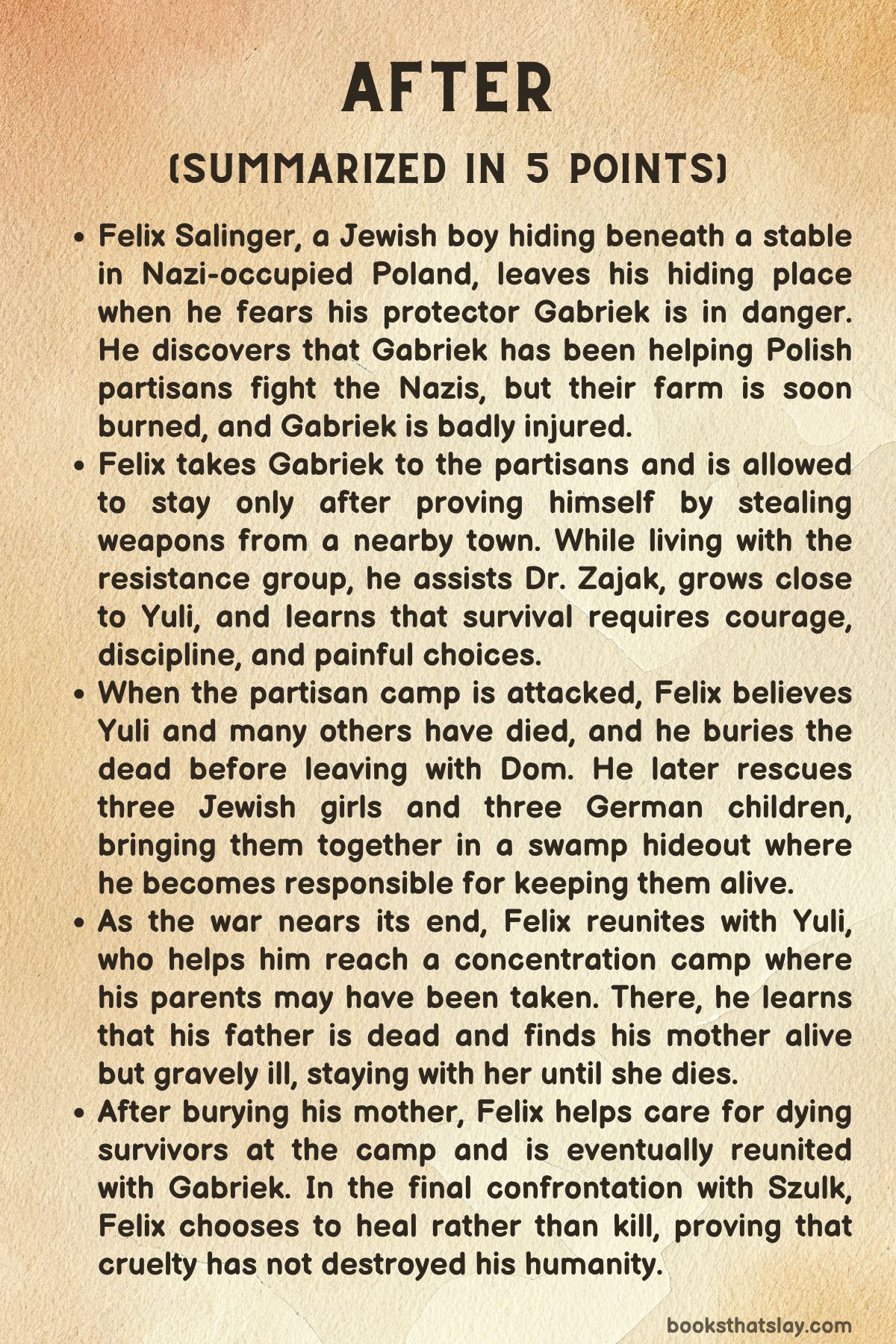
Felix Salinger has spent two years hiding beneath the stable of a Polish farmer named Gabriek Borowski. Gabriek has protected him from the Nazis, bringing him food and keeping him concealed beneath the floor near the horse Dom.
On Felix’s thirteenth birthday, he hears Gabriek speaking with strangers outside. Felix fears that Nazis or Polish collaborators have discovered him and that Gabriek will be punished for hiding a Jewish boy.
When Gabriek comes to the stable and says he must leave for a while, Felix becomes convinced that his protector is in danger.
Although he has been told never to leave his hiding place, Felix crawls out and follows Gabriek and the strangers into the forest. His body is weak from years of confinement, but he keeps going because he believes Gabriek is about to be executed.
Instead, Felix discovers that the men are Polish partisans, resistance fighters who attack Nazi forces. Gabriek has been working with them.
The partisans are preparing to blow up a German train, and Felix’s sudden arrival nearly ruins the operation. The train explodes, and the partisans fire on surviving Nazis.
Gabriek is furious that Felix left the stable, but he is also touched that Felix risked himself to save him.
When Felix and Gabriek return to the farm, they find the house and barn burning. Nazis have attacked the property.
Felix saves Dom from the stable and tries to recover precious things from his hiding place. The house collapses, injuring Gabriek badly.
Felix manages to get him onto Dom’s back and leads him into the forest, following Gabriek’s whispered instruction to find the partisans.
The partisans accept Gabriek for medical treatment, but Felix is not welcomed warmly. A hostile fighter named Szulk hates Jews and wants Felix gone or dead.
The partisan leader, Pavel, agrees to let Felix stay only if he proves himself by bringing back a weapon. Yuli, a fierce woman in the resistance, guides Felix toward a town where he might find one.
Felix is frightened but determined, because staying with the partisans means staying near Gabriek and Dom.
In the town, Felix sees the horror of occupation. Bodies hang in public as warnings.
Jews are marched toward death camps, and a Nazi shoots a man who cannot keep walking. Felix follows a young German boy, steals his boots and bicycle, and finds two bazookas attached to it.
He rides back to the forest with them and is accepted by the partisans. Gabriek undergoes emergency surgery, and Felix is pulled into helping Dr. Zajak, the partisan doctor.
He begins learning how to assist in treating wounds, even though the work terrifies him.
Felix grows close to Yuli, who tells him about her own suffering. She was taken by the Germans, lost her parents, escaped, and joined the fight.
Felix starts imagining that Gabriek and Yuli could become a new family for him. But Gabriek is moved to another camp to recover, and Felix is ordered to stay with Dr. Zajak.
He desperately wants to follow Gabriek but is told he is needed where he is. Gabriek promises to return in a month.
Felix struggles with waiting. He tries to escape with Dom, but Yuli protects him by pretending his attempt was part of an experiment to hide tracks in the snow.
She gives him warm clothing and glasses taken from Nazi supplies, items that once belonged to concentration camp prisoners. Felix is uneasy about using them, but Yuli persuades him that survival matters.
With his glasses, Felix becomes a better medical assistant. He learns to anticipate Dr. Zajak’s needs and begins to feel useful.
When Gabriek does not return as promised, Felix fears he has been abandoned. Yuli tries to comfort him and takes him on a mission to the town.
On the way, they see Nazis murder a woman. Yuli approaches the soldiers as if she is harmless, then kills them.
In town, Allied bombs fall because the place is a Nazi hub. Amid the destruction, Felix finds three Jewish sisters hiding in a damaged building.
Their protector has died, and they are starving. Nearby, he discovers German children, including boys connected to the Hitler Youth, guarding a stash of canned food but unable to open it.
Felix bargains with them and uses stolen rings to show everyone how to open the cans. He gives food to the Jewish girls, but Yuli returns with urgent news: the Germans have found the partisan camp.
Yuli and Felix race back, but as they near the camp they hear gunfire. Yuli orders Felix to hide with Dom in the swamp.
He waits through the night, but she never comes. In the morning, he returns to the camp and finds many partisans dead.
Dr. Zajak has been killed, and Pavel has been hanged. Felix believes Yuli is among the dead when he sees her red scarf near the burned supply bunker.
Overwhelmed with grief, he buries the bodies himself. He decides he will stop trying to find replacement parents, because losing people hurts too much.
Now alone with Dom, Felix returns to the town to search for food. He finds the three Jewish sisters still alive beneath the floor.
He also discovers the German children trapped under rubble next door. Felix rescues them too.
He takes all six children, Jewish and German, to the swamp. At first, they argue bitterly because of who they are and what they have been taught.
Felix forces them to share warmth, food, and hygiene routines. Slowly, the children begin to act less like enemies and more like ordinary children in terrible circumstances.
They admit that Hitler and the Nazis have destroyed their lives. Felix realizes that, though he had decided to live without parents, he has now become responsible for others.
As supplies run low, Felix plans to derail a train and steal food. The children prepare carefully, but before they can act, the Nazis destroy their own railway bridge.
Felix understands that the Germans must be retreating and that the war may be nearly over. On the way back to the swamp, he sees Yuli alive.
She explains that she had been knocked unconscious and taken to another camp. She also tells Felix that his parents may have been moved to a concentration camp in Germany.
Felix wants to search for them immediately. Yuli arranges for Russian soldiers to take him.
Felix says goodbye to the children, Dom, and Yuli, then travels in a Russian ambulance. His hopes of finding his parents are shaken when he witnesses Russian soldiers committing violence against German women at a farm.
Soon after, news comes over the radio that Germany has surrendered and the war is over. Felix reaches the concentration camp where he believes his parents may be.
The gates are open, but the place is filled with death. Russian soldiers are dealing with piles of bodies.
Felix searches the sheds, calling for his parents and his hometown.
He finds Mr. Rosenfeld, a man from his town, who tells him that his father has died but that his mother may still be alive. Felix is taken to her and sees that she is extremely weak, sick, and close to death.
She recognizes him at once. Felix lies beside her and tells her everything, then asks a Russian doctor to help.
The doctor explains that his mother cannot survive the damage caused by starvation and disease. Felix returns to his mother and comforts her with a gentle invented story about how he has been cared for.
She dies while he is with her.
Felix carries his mother to her grave himself and covers her with earth by hand. Afterward, he stays at the camp and helps the sick as a nurse.
He washes people, feeds them, talks to them, and holds their hands as they die. He learns that helping others also means letting grief pass through him.
After sitting with another dying man, Felix turns and finds Gabriek alive.
Felix and Gabriek return to the old partisan camp and recover hidden keepsakes. There they encounter Szulk, still filled with hatred.
Szulk threatens them, saying Poland does not need Jews or those who help them. Gabriek fights him, and Felix wounds Szulk with a scalpel.
For a moment, Felix could kill the man who has hated him all along. Instead, he chooses not to become a killer.
With Gabriek’s help, he stitches Szulk’s wound, destroys his gun, and leaves with Gabriek. After ends with Felix choosing healing over revenge, even after everything war has taken from him.
Characters
Felix Salinger
Felix Salinger is the emotional and moral centre of After. He is a Jewish boy who has spent years hiding from the Nazis, yet his personality is not defined only by fear.
Felix is imaginative, loyal, observant, and deeply compassionate. His habit of inventing stories begins as a survival tool: it helps him make sense of terror, loss, and uncertainty.
At first, these stories soften reality for him, allowing him to believe that adults can still protect him and that the people he loves may return. As the story continues, Felix is forced to recognize that imagination cannot prevent death or betrayal, but it can still help him comfort others.
This is clearest when he speaks gently to his dying mother, giving her a version of his life that protects her from further pain.
Felix grows from a hidden child into someone who takes responsibility for others. He risks his life for Gabriek, saves Dom, helps Dr. Zajak, protects Jewish children, rescues German children, and later cares for the sick in the concentration camp.
His growth is not simple bravery; it is the painful development of moral courage. He is often terrified, confused, angry, and lonely, but he keeps choosing care over cruelty.
By the end, Felix’s decision not to kill Szulk shows how far he has come. He has seen murder, hatred, and revenge everywhere, yet he chooses to heal even an enemy.
Felix’s strength lies in his refusal to let suffering turn him into the kind of person the war has tried to create.
Gabriek Borowski
Gabriek Borowski is Felix’s protector, father figure, and model of quiet resistance. He risks his own life by hiding Felix beneath the stable, and his care is practical rather than sentimental.
He feeds Felix, shelters him, protects him, and gives him rules that are meant to keep him alive. Gabriek can be stern, especially when Felix disobeys him, but his anger comes from fear and love.
He knows the danger of discovery and understands that one mistake can destroy them both.
Gabriek is also more active in resistance than Felix first realizes. He is not simply a farmer hiding a child; he is connected to the partisans and helps them fight the Nazis.
This gives him a larger moral role in the story. He represents ordinary people who choose danger rather than passive obedience.
His injury after the farm burns removes Felix’s main source of safety and forces Felix to grow up quickly. Even when Gabriek is absent for much of the story, his influence remains powerful.
Felix measures loss, loyalty, and hope through his attachment to him. When Gabriek returns near the end, he becomes proof that not every bond is destroyed by war.
His final act with Felix, helping stitch Szulk instead of leaving him to die, confirms that Gabriek shares Felix’s belief that humanity must survive even after terrible suffering.
Yuli
Yuli is one of the strongest and most complex figures in the story. She is a partisan fighter shaped by trauma, loss, and rage, but she is also protective, perceptive, and capable of tenderness.
She has lost her parents, survived captivity, escaped German control, and remade herself as a fighter. Her decision to take her father’s name shows how deeply grief has changed her identity.
She carries her dead with her, not as memory alone but as motivation.
Yuli often appears hard because the world has forced hardness upon her. She teaches Felix how to kill, threatens him when necessary, and acts decisively in moments of danger.
Yet she also sees Felix’s emotional needs more clearly than many others do. She protects him from Szulk, helps him adjust to partisan life, gives him clothing and glasses, and understands his longing for Gabriek.
Her relationship with Felix becomes almost parental, though she does not soften the truth for him. She wants him to survive, and survival in her world requires discipline.
Her injury and later disappearance bring Felix deep grief because he has allowed himself to love her. When she returns alive, she restores a sense of possibility.
Yuli represents both the damage caused by war and the fierce human will to keep fighting against evil.
Dr. Zajak
Dr. Zajak represents healing in the middle of violence. As the partisan doctor, he works under brutal conditions with limited supplies, constant danger, and little rest.
He is impatient, sharp, and demanding, especially with Felix, but his harshness comes from urgency. In his treatment room, mistakes can cost lives.
He expects Felix to learn quickly because wounded people depend on them both.
Through Dr. Zajak, Felix discovers that helping others requires more than good intentions. Compassion must be joined with skill, attention, and discipline.
At first, Felix misunderstands instructions and feels useless, but Dr. Zajak continues to use him because he sees potential in him. The doctor becomes one of Felix’s teachers, not through comforting speeches but through the difficult work of saving lives.
His death is devastating because it removes another adult who gave Felix purpose. Yet his influence continues after he is gone.
When Felix later helps survivors in the concentration camp, he carries forward what Dr. Zajak taught him: that care can be simple, physical, and immediate. Washing someone, feeding someone, holding a hand, or staying with the dying can be acts of great dignity.
Pavel
Pavel is the leader of the partisan group and represents practical wartime authority. He is not gentle with Felix, but he is not cruel in the same way Szulk is.
Pavel must think first about the survival of the group. When Felix discovers the partisans’ activities, Pavel could treat him as a threat, yet he allows him a chance to prove himself.
His decision to demand that Felix bring a weapon reflects the harsh logic of resistance life: everyone must contribute, and trust must be earned.
Pavel’s leadership is shaped by danger. He commands people who live under constant threat from Nazi forces, and his choices are often severe because hesitation can kill.
His acceptance of Felix after the bazookas shows that he values courage and usefulness, even in a child. Pavel’s death, especially the way his body is displayed, reveals the cost paid by resistance fighters.
The Nazis do not merely kill him; they turn his body into a warning. For Felix, burying Pavel becomes an act of respect.
Pavel may not be emotionally close to Felix, but he stands for organized resistance and the heavy burden carried by those who fight back.
Szulk
Szulk is one of the clearest examples of hatred surviving inside a world already damaged by hatred. Although he fights against the Nazis, he is deeply antisemitic and repeatedly threatens Felix.
His presence complicates any simple division between good and evil. Being anti-Nazi does not automatically make him humane.
He opposes German occupation, but he still shares the poisonous prejudice that makes Felix unsafe.
Szulk’s hostility shows Felix that danger does not come only from official enemies. Even among people fighting the Nazis, Felix can be hated for being Jewish.
This makes the story’s moral world more painful and more realistic. Szulk’s threats toward Felix and Dom reveal his cruelty, but his final confrontation with Felix is the most important moment in his character’s role.
When Felix wounds him, the power shifts. Felix has the chance to kill someone who has long wanted him dead.
Instead, Felix treats his injury. Szulk does not become redeemed in that moment; rather, Felix refuses to let Szulk define the terms of his own morality.
Szulk exists as a test of Felix’s values, and Felix passes by choosing mercy without excusing hatred.
Dom
Dom, the workhorse, is more than an animal companion. He is a symbol of endurance, loyalty, and practical survival.
Felix spends years hidden beneath the stable where Dom lives, so the horse is part of his small world before he is forced back into the larger one. When the farm burns, Felix’s decision to save Dom shows his instinct to protect the vulnerable, even while his own life is in danger.
Dom also becomes essential to Felix’s survival after Gabriek is injured. He carries Gabriek, helps Felix move through the forest, pulls the cart, and later helps transport the children.
In a world where adults vanish, homes burn, and camps are destroyed, Dom provides continuity. He is steady, physical, and dependable.
Felix often speaks to him as if he is a trusted friend, which shows Felix’s loneliness and need for connection. Dom does not judge, betray, or hate.
His presence gives Felix comfort during some of the story’s hardest passages. He represents the ordinary living world that continues despite human cruelty.
Yuli’s Lost Family
Yuli’s parents never appear directly in the main action, but they shape her character. Their deaths explain the depth of her anger and her refusal to remain powerless.
By taking her father’s name, Yuli keeps his memory alive and makes it part of her resistance identity. Her family’s absence is not passive background; it is a force that drives her choices.
Their loss also connects Yuli to Felix. Both have been separated from parents, both carry grief, and both understand what it means to have childhood stolen by violence.
Yet they respond differently. Felix initially turns to stories and hope, while Yuli turns to action and revenge against the Nazis.
Her parents’ deaths help explain why she can kill without hesitation when she faces German soldiers. They also make her relationship with Felix more meaningful.
She cannot have children because of her wounds, and he longs for parental love. Their bond grows in the space left by destroyed families.
Hannah
Hannah is one of the three Jewish sisters Felix finds hiding in the bombed town. She represents the many children forced into silence, hunger, and invisibility during the Holocaust.
Her situation mirrors Felix’s earlier life in hiding, but unlike Felix, she is part of a small group of siblings who must survive together after their protector dies. Her fear when Felix first approaches is understandable because trust has become dangerous.
Hannah’s role becomes important after Felix brings her and her sisters to the swamp. She is part of the fragile new family Felix unexpectedly forms.
Her presence reminds him that he is no longer only a survivor; he is responsible for others who are younger, weaker, and just as frightened. Through Hannah and her sisters, Felix begins to act as a guardian.
The girls’ conflict with the German children also shows how war teaches children to fear one another before they even understand the full reasons. Hannah’s survival depends not on armies or politics but on small acts: food, shelter, warmth, and Felix’s determination.
Beryl
Beryl, like her sisters, is a child shaped by hiding, hunger, and fear. She does not need a large individual storyline to matter; her importance comes from what she represents within the group of rescued children.
She is one of the lives Felix chooses to protect when he could have focused only on himself. Her vulnerability pushes Felix into a new role, one that resembles parenthood.
Beryl’s presence also contributes to the gradual change among the children in the swamp. At first, the Jewish girls and German children are separated by suspicion and inherited hatred.
Over time, their shared needs become stronger than the labels forced onto them. They need food, warmth, safety, and guidance.
Beryl’s survival alongside the German children shows that children can move beyond the divisions adults have created, especially when survival depends on cooperation. She helps reveal one of the story’s central moral ideas: innocence can still exist in children, but it must be protected carefully.
Faiga
Faiga is part of the hidden Jewish sibling group, and her character adds to the story’s portrait of children living under extreme danger. She has already learned to hide, distrust, and endure hunger.
When Felix finds her, she is not simply waiting to be saved; she has survived as long as she can in impossible circumstances. Her emergence from beneath the floor shows both fear and hope.
She responds to Felix because he proves he understands danger and because he offers food and help.
Faiga’s role becomes more meaningful once she joins Felix’s swamp refuge. She becomes part of a mixed group that should not work according to the hateful logic of the war: Jewish girls and former Hitler Youth children sharing the same shelter.
Her presence helps transform Felix from a boy searching for lost adults into a caretaker of children. Faiga also helps show the physical realities of survival.
The children do not need grand speeches; they need tins of food, warmth at night, clean teeth, and someone willing to think ahead.
Axel
Axel is one of the German boys Felix encounters in the bombed town. As a Hitler Youth child, he initially stands on the opposite side of Felix’s identity and experience.
He has been shaped by Nazi ideology, uniforms, weapons, and obedience. Yet he is also a hungry, frightened child trapped in a ruined town.
This contrast makes him an important character. He is not presented as equal to the adult perpetrators, but neither is his background ignored.
Axel’s movement from threat to uneasy companion shows how children can be trained into hatred but also pulled away from it. At first, he and the other German children guard food and threaten Felix.
Later, when Felix rescues them and brings them to the swamp, Axel must live alongside Jewish children. The forced closeness strips away some of the false certainty created by propaganda.
Hunger, cold, and fear make the children face one another as people. Axel’s presence allows the story to examine whether young people taught hateful beliefs can change when they are placed in direct human contact with those they were told to despise.
Helmut
Helmut is another German child connected to the Hitler Youth, and he is especially important because of his relationship with his little sister, Bug. His identity at first is tied to Nazi symbols and childish militarism, but his role as a brother complicates him.
He is not only a boy repeating ideology; he is also a child trying to protect someone younger. This makes him a useful contrast to adult Nazis, whose cruelty is deliberate and powerful.
When Helmut joins Felix’s group, he is forced into a moral education that no speech could provide. He must share space with Jewish children and depend on Felix, a Jewish boy, for survival.
The swamp refuge becomes a place where the old categories begin to weaken. Helmut’s gradual shift away from Nazi loyalty reflects the possibility that children can unlearn hatred when experience challenges what they have been taught.
His care for Bug also gives Felix another reason to see him as human, even when Felix has every reason to distrust anyone connected to the Nazi world.
Bug
Bug is Helmut’s younger sister and one of the most vulnerable children Felix rescues. Her youth makes the absurdity of Nazi ideology even more visible.
She is too young to fully understand the political hatred surrounding her, yet she is still endangered by the war created by adults. Her presence softens the German side of the children’s group because she cannot be viewed only through the lens of enemy identity.
Bug also helps bring out Felix’s caretaker instincts. He has lost his own childhood in hiding and fear, but when he looks after Bug and the others, he behaves with the tenderness he once needed from adults.
Her dependence contributes to the strange family structure that forms in the swamp. Bug’s role shows that war harms children on every side, though not in identical ways.
She benefits from the system that persecutes Felix, yet she is also abandoned, frightened, and hungry because that same system is collapsing. Through Bug, the story separates childhood vulnerability from adult guilt without erasing the danger of Nazi teaching.
Felix’s Mother
Felix’s mother is central to his emotional life even though she appears directly only near the end. For much of the story, she exists in Felix’s hope, memory, and imagination.
He wants to believe she may still be alive because that belief gives him a reason to keep moving through unbearable loss. When he finally finds her in the concentration camp, the reunion is both beautiful and devastating.
She recognizes him, which gives Felix the gift of being known by his mother again, but she is too damaged by starvation and illness to survive.
Her final moments reveal Felix’s deep compassion. He does not burden her with the full horror of his suffering.
Instead, he tells her a comforting version of his life, allowing her to die with some peace. She also gives Felix the knowledge that his father thought of him before dying.
Her death forces Felix to face the end of one of his strongest hopes. Yet it also gives him a form of closure.
He finds her, holds her, carries her, and buries her with his own hands. In a world where so many victims are denied dignity, Felix gives his mother a personal act of love.
Felix’s Father
Felix’s father is physically absent, but his importance is felt through Felix’s memories and through the news of his death. He represents the family life Felix has lost: the bookstore, parental love, safety, and a world where stories belonged to ordinary childhood rather than survival.
Felix’s fantasy of helping rebuild the family bookstore shows how strongly he clings to the idea of returning to a life before persecution.
The information that Felix’s father died while saying Felix’s name is deeply significant. It gives Felix pain, but it also gives him proof of love.
His father did not forget him. In a story filled with separation, this matters greatly.
Felix’s father becomes a symbol of the murdered past, but not an empty symbol. He remains personal, intimate, and beloved.
His death confirms that Felix cannot recover the family life he longs for, yet his memory continues to guide Felix’s moral sense. The kindness Felix shows others can be read partly as an inheritance from the parents who loved him.
Mr. Rosenfeld
Mr. Rosenfeld is a fragile survivor from Felix’s hometown who becomes the link between Felix and the truth about his parents. His appearance in the concentration camp connects Felix’s present search to his earlier life.
He is physically weak, close to death, and damaged by the camp, but he still performs an act of great importance by helping Felix find his mother.
Mr. Rosenfeld’s role is brief but powerful. He shows how even people who are near death can still give something meaningful to others.
His knowledge gives Felix both grief and hope: his father is dead, but his mother may be alive. Later, Felix sits with him as he dies, returning care to the man who helped him.
This exchange reflects the moral pattern Felix develops by the end of the story. People may not be able to save one another from death, but they can keep one another from dying alone.
Mr. Rosenfeld’s dignity lies in this final human connection.
The Russian Doctor
The Russian doctor is one of the few figures near the end who offers Felix honesty and practical compassion. She does not give him false hope about his mother’s condition.
Her explanation that his mother cannot survive is painful, but it is also respectful because it treats Felix as someone strong enough to hear the truth. In a story where adults often lie, threaten, or harm, her directness becomes a form of care.
She also helps Felix understand grief. When Felix cries after sitting with dying patients, she tells him that crying is necessary because it helps him let go.
This guidance matters because Felix has carried so much loss that he cannot simply continue without release. The doctor helps him see that caring for people includes accepting that they may die.
Her presence supports Felix’s development into a healer. She does not replace Dr. Zajak, but she continues the lesson that medicine is not only about curing people.
Sometimes it is about easing pain, preserving dignity, and helping the living survive sorrow.
The Russian Soldiers
The Russian soldiers represent liberation, but they also complicate Felix’s understanding of victory. They help defeat Nazi Germany and transport Felix toward the camp where he hopes to find his parents.
In that sense, they are connected to rescue and the end of the war. Yet Felix also witnesses them committing violence against German women, which deeply disturbs him.
This moment prevents the ending of the war from being shown as simple moral relief.
Through the soldiers, Felix learns that the defeat of one evil does not automatically make every action by the victors good. The world after Nazi surrender is still filled with brutality, revenge, and trauma.
This realization is important for Felix because he must decide what kind of person he will become after surviving. The soldiers’ actions stand in contrast to Felix’s later choice with Szulk.
Felix has seen how easily suffering can become cruelty toward others. His refusal to kill Szulk becomes even more meaningful because he has witnessed revenge taking violent forms around him.
Themes
Survival and Moral Choice
Survival in After is never shown as a simple matter of staying alive. Felix must constantly decide what kind of person he will be while trying not to die.
He steals when he has to, lies when lying protects people, hides when hiding is necessary, and runs when danger becomes too great. Yet the story repeatedly separates survival from selfishness.
Felix survives because others help him, and he continues that chain by helping others. He risks himself for Gabriek, rescues Dom, assists wounded partisans, feeds hidden Jewish girls, saves German children, and later nurses dying camp survivors.
These choices show that survival can become a moral responsibility rather than a private goal. The strongest test comes when Felix wounds Szulk and has the chance to kill him.
Szulk has threatened him, hated him, and treated Jewish life as worthless. Felix’s decision to stitch him instead of killing him proves that survival has not emptied him of conscience.
The book suggests that staying alive matters, but staying human matters just as much. Felix’s courage lies not only in escaping death but in refusing to let cruelty become his normal response to the world.
Childhood Under War
Felix’s childhood has been almost completely stolen by war. Instead of school, family routines, and ordinary friendships, he has hiding places, death marches, burning farms, partisan camps, and concentration camps.
Yet he still thinks and feels like a child in many ways. He speaks to Dom, clings to stories, hopes for his parents, and imagines new adults becoming family.
This mixture of innocence and forced maturity gives the story much of its emotional force. Felix is old enough to witness terrible things but too young to fully carry them without inventing ways to cope.
The other children deepen this theme. The Jewish sisters have learned to hide beneath floors and wait in hunger.
The German children have been shaped by Nazi teaching, uniforms, and weapons, yet they are also frightened, hungry, and dependent. When Felix brings them together in the swamp, the children slowly move from inherited hatred toward ordinary quarrels, cooperation, and shared fear.
This shift shows that children are damaged by adult violence, but they are not fixed permanently in the roles adults assign them. War makes them grow up too quickly, but it does not fully erase their capacity to change.
Found Family and Loss
Felix repeatedly searches for family because he has been separated from his parents and deprived of safety. Gabriek becomes a father figure, Yuli becomes a possible mother figure, Dr. Zajak becomes a demanding teacher, and even Dom becomes a steady companion.
Felix’s longing for replacement parents is not childish weakness; it is a natural response to abandonment, terror, and grief. He needs someone to belong to.
Yet the story keeps showing how dangerous attachment feels in wartime because anyone can vanish or die. Gabriek is injured and disappears for long stretches.
Yuli is believed dead. Dr. Zajak is killed.
Felix’s mother is found only to die soon after. Each loss teaches Felix that love brings pain, and at one point he tries to reject the need for parents altogether.
But life does not allow him to become emotionally closed. Instead, he becomes a caretaker himself.
The six children he rescues turn him into a kind of parent before he is ready. This reversal is important.
Felix begins as a child needing protection and becomes someone who offers protection. The theme does not suggest that found family replaces what was lost completely.
Rather, it shows that care can continue even when original families are broken.
Healing Instead of Revenge
Violence surrounds Felix from every direction, and revenge often appears understandable. The Nazis have murdered, tortured, starved, and destroyed families.
Yuli’s killings of German soldiers come from a place of rage and justice shaped by unbearable loss. The Russian soldiers’ violence after German defeat shows another form of revenge, one that troubles Felix because it harms the vulnerable rather than restoring the dead.
Against this background, Felix’s final choice becomes the clearest statement of the theme. Szulk is not innocent.
He is cruel, antisemitic, and dangerous. Felix has every emotional reason to want him dead.
Yet when Felix has power over him, he chooses to treat the wound he has made. This does not mean forgiveness is easy or that hatred should be ignored.
Felix also destroys Szulk’s gun, making sure he cannot continue threatening them. The act of healing is therefore not passive.
It is a firm moral decision: Felix will stop the danger, but he will not become a murderer. This theme connects to his work as a nurse in the camp.
Healing cannot undo death, but it can resist the logic of a world that treats human bodies as disposable.