After I Do Summary, Characters and Themes
After I Do by Taylor Jenkins Reid is a contemporary romance novel about what happens after the “happily ever after” begins to fall apart. The book follows Lauren Spencer and Ryan Cooper, a couple who once seemed perfectly matched but now find themselves exhausted by resentment, distance, and old disappointments.
Rather than ending their marriage outright, they agree to spend a year apart with no contact, hoping distance will show them whether their love is gone or simply buried. In my view, After I Do is a sharp, honest story about marriage, change, family, desire, and the difficult choice to keep loving someone.
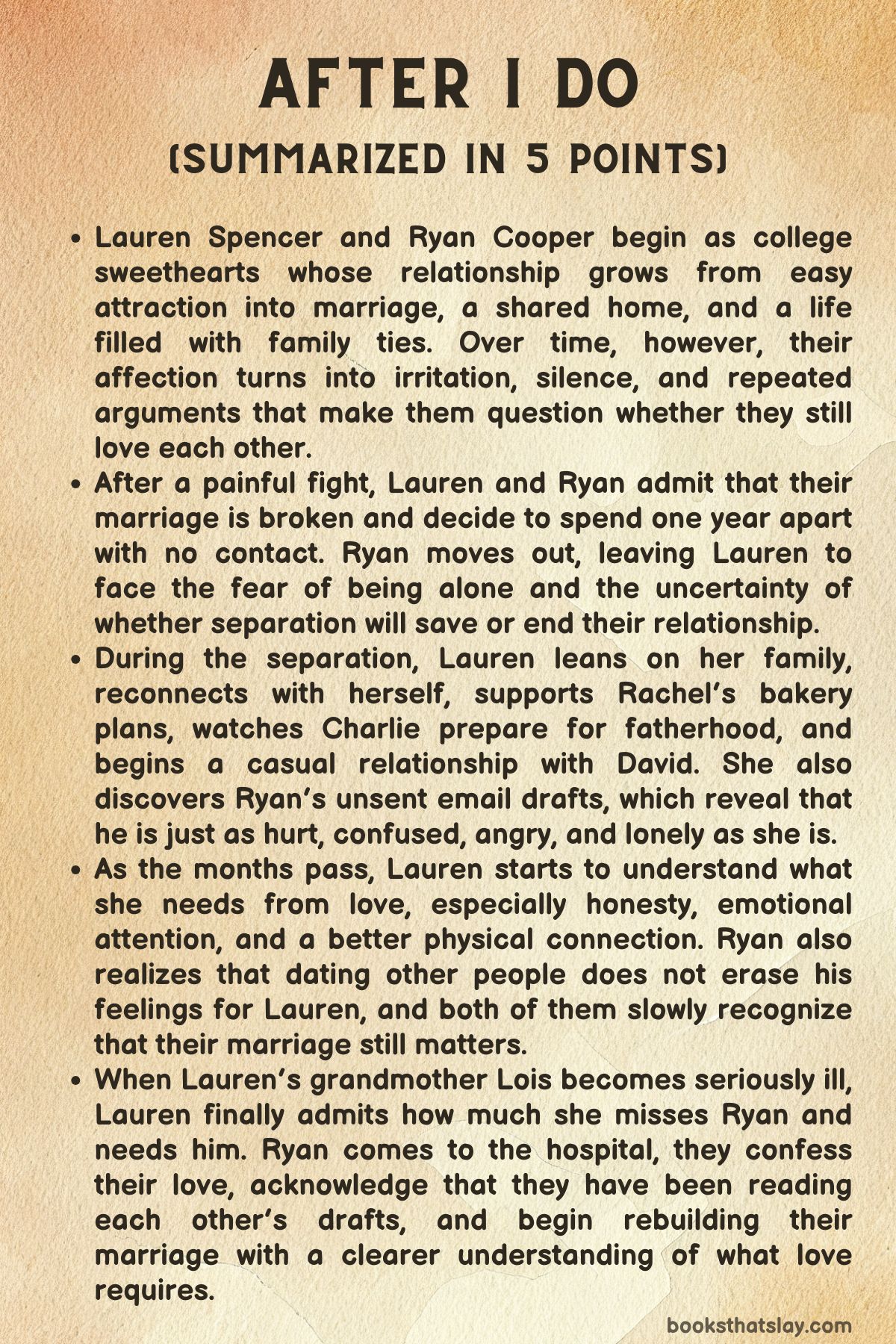
Summary
Lauren Spencer and Ryan Cooper have been together for more than eleven years, and their marriage has reached a painful breaking point. After attending a Dodgers game together, they argue in the parking lot while looking for their car.
The fight itself is ordinary, but the feeling underneath it is not. Lauren realizes that she no longer feels close to Ryan.
Their old warmth has been replaced by irritation, silence, and the certainty that even a small problem can turn into another fight.
The story then looks back at the beginning of their relationship. Lauren and Ryan first meet as students at UCLA.
Lauren has struggled to feel at home in college, but things begin to change when she gets a job in the mailroom and starts meeting people. Ryan enters her life slowly, through repeated encounters on campus.
Their first lunch turns into a dinner date, then a kiss, then the early rush of a relationship that feels easy and full of promise. Lauren is excited but also aware that what they have feels important enough not to rush.
Their relationship grows through college and beyond. Ryan visits Lauren’s family, who quickly accepts him.
Lauren’s mother, Leslie, her sister, Rachel, and her brother, Charlie, all become part of Ryan’s life. Charlie, who is usually guarded, bonds with Ryan, and Lauren sees this as proof that Ryan belongs with them.
After graduating from UCLA, Lauren and Ryan move into a small Hollywood apartment. They argue about furniture and space, but those conflicts still feel like part of building a life together.
Ryan later proposes during a hike in Yosemite, near Vernal Fall. Lauren has expected the proposal at the top and feels disappointed when it does not happen there, but Ryan surprises her on the way down.
She accepts, and the hard hike becomes part of their story. They marry in Los Angeles and take a road trip to Big Sur for their honeymoon.
When their tire blows out, they argue because neither knows how to fix it. Yet they solve the problem together, and the episode becomes another example of how they once believed they could handle anything as a team.
Years pass. Lauren gets a job at Occidental College with help from her former coworker Mila.
She and Ryan buy a house in Hancock Park after Lauren falls in love with it, especially its lemon tree. Ryan somehow makes the purchase possible, though he does not explain exactly how.
They adopt a Lab named Thumper, and for a while, their life seems settled. But beneath the surface, questions begin to form.
They once assumed they would have children at thirty, but when that age approaches, neither is sure. Their sex life fades.
Small frustrations grow sharper. Ryan becomes annoyed by Lauren’s forgetfulness.
Lauren feels unseen and unsupported.
One night, after another argument, everything finally comes out. Ryan complains that Lauren has not dealt with the hot water problem, and the fight turns into a confrontation about their marriage.
Ryan admits he has not wanted to be around her in months. Lauren, hurt and furious, throws a vase at him.
He leaves, and later she lies in bed realizing that they may not love each other anymore.
The next morning, Lauren tells Ryan what she has realized. Ryan admits he has been feeling the same way and has even started noticing other women.
They do not know what to do. They consider different possibilities, including opening the relationship, but finally decide on a year-long separation with no contact.
They hope that time apart will reveal whether their marriage can be saved. Ryan moves out, leaving Lauren in the house with Thumper.
Lauren is devastated but also afraid of being alone.
Lauren goes to Rachel for support. Rachel does not fully understand why Lauren and Ryan are not simply divorcing, but she supports her sister.
Lauren also has to tell the rest of her family. Around her thirtieth birthday, Leslie throws her a surprise party.
Lauren gets drunk, overwhelmed by everyone asking about Ryan, and finally reveals that they are separated. Leslie responds with compassion.
Having been abandoned by Lauren’s father while pregnant with Charlie, she understands that relationships can break in ways outsiders do not see.
Living alone is difficult for Lauren. At first, she barely leaves the house except for work and walking Thumper.
Mila encourages her to enjoy independence, dress differently, and redecorate, but freedom does not immediately comfort her. Lauren misses Ryan and wonders constantly what he is doing.
Then she logs into Ryan’s email, since he has not changed his password. She finds unsent drafts addressed to her.
In them, Ryan admits he is miserable, confused, angry, lonely, and still deeply affected by their marriage. Some drafts are tender; others are bitter.
He writes about their sex life, about feeling unseen, about wanting to see her on her birthday, and about Thumper. Lauren realizes that Ryan still loves her, though their love is tangled with hurt.
Lauren begins drafting emails of her own, knowing Ryan might read them if he checks. This becomes their secret form of communication, though neither admits it at first.
She writes honestly about her anger and frustration, especially about their sex life and how often she felt her needs were ignored. When Ryan writes that he has met someone else, Lauren is crushed.
Still, over time, she begins to recover. She spends more time with Rachel, takes up running, and slowly stops checking Ryan’s email so obsessively.
Lauren’s life expands during the separation. Mila tries to set her up on a blind date with David, a divorced man who is still in love with his ex-wife, Ashley.
Lauren and David quickly realize they are not ready for a serious romance, but they become friends and eventually sleep together. Their relationship gives Lauren companionship without the pressure of building a future.
It also helps her understand what she has missed and what she would need if she and Ryan ever tried again.
Meanwhile, Lauren’s family goes through major changes. Charlie announces that Natalie, a woman he met on a plane, is pregnant.
He plans to move back to Los Angeles, help raise the baby, and marry her. The family is shocked and divided, but Charlie insists that he wants to be present in a way his own father never was.
Lauren gradually accepts Natalie and becomes excited to welcome her into the family. Rachel begins working toward opening a bakery, and Lauren supports her by helping with business plans and agreeing to co-sign a loan.
Leslie continues dating Bill but admits she does not want remarriage; she wants romance without permanent commitment.
Lauren also becomes close to her grandmother Lois, who sends her advice columns from Ask Allie. At first Lauren is skeptical, but she eventually writes to the columnist, explaining her situation and asking whether she should give her marriage another chance.
Lois, with the perspective of a long marriage behind her, believes Lauren’s life is better with Ryan in it.
As the year apart nears its end, Ryan reappears more strongly in Lauren’s life through family ties. Charlie wants Ryan to be his best man because Ryan has become like a brother to him.
Lauren resists at first but understands how much Ryan means to Charlie. Reading Ryan’s newer drafts, Lauren sees that he has been dating but still thinking about her.
Ryan admits he once came by the house and saw David there, which hurt him, though he knew he was also seeing someone. He later breaks up with his girlfriend, Emily, because he wants Lauren back.
Lauren’s feelings become clearer after she goes to a basketball game with David and they lose the car afterward. The situation reminds her of the Dodgers game with Ryan.
She realizes that annoying, ordinary moments will happen with anyone, but she would rather face them with Ryan. She ends things with David kindly, needing room to decide what she wants.
Then Rachel calls with terrible news: Lois is in the hospital and has leukemia. Lauren heads to San Jose with her family.
In the car, she writes a draft to Ryan telling him about Lois and admitting how much she misses and needs him. At the hospital, Lois urges Lauren to repair things with Ryan, saying her life is better with him.
Lauren goes outside to call Ryan and is stunned to see him arriving by cab. They run into each other’s arms and confess their love.
They also admit they have been reading each other’s drafts, and the honesty of it makes them laugh.
Ryan rejoins Lauren’s family just as more change arrives. Lois dies, leaving Lauren heartbroken but grateful that Ryan is beside her.
Around the same time, Natalie gives birth to Charlie’s son, Jonathan Louis Spencer. The family mourns and celebrates at once, facing death and new life within hours of each other.
Lauren sees Charlie, Natalie, and their baby together and recognizes the messy, brave nature of love.
Back in Los Angeles, Lauren and Ryan begin rebuilding. They have dinner with Mila and Christina, and Lauren later puts her wedding ring back on.
At Charlie and Natalie’s wedding in Malibu, the family gathers with a new understanding of love’s limits and possibilities. When Charlie asks for marriage advice, the answer is simple: never give up.
By the end of After I Do, Lauren understands that love is not kept alive by romance alone. It needs attention, honesty, effort, desire, forgiveness, and the willingness to see another person clearly as both people change.
Her year apart from Ryan does not erase their problems, but it teaches them what they lost, what they still want, and what they must do differently. The novel closes with Lauren receiving Ask Allie’s response and placing it in her memento box, alongside the pieces of a marriage that broke, changed, and found its way back.
Characters
Lauren Spencer
Lauren Spencer is the emotional center and narrator of After I Do, and her character arc is built around the painful process of seeing herself clearly. At the start, she is a woman who has spent years inside a marriage that once gave her joy but now makes her feel trapped, lonely, and unseen.
Her frustration with Ryan is real, but Lauren’s journey shows that her unhappiness is not only about him. She has to confront her own habits of silence, avoidance, resentment, and emotional dependence.
When Ryan leaves, Lauren initially defines her life by his absence. She wonders what he is doing, imagines him with other women, and measures her own healing against the time remaining in their separation.
Her loneliness exposes how much of her identity has been attached to being Ryan’s wife.
As the year continues, Lauren begins to build a fuller life outside the marriage. She spends time with Rachel, supports Charlie and Natalie, helps Rachel with the bakery, runs, dates David, and starts to understand what she wants physically and emotionally.
Her unsent emails to Ryan show her growing honesty. She stops trying to sound calm or agreeable and begins naming the things that hurt her.
Lauren’s greatest development comes from realizing that love cannot survive only on history. She still loves Ryan, but she also learns that returning to him must mean returning as a more self-aware person.
By the end, Lauren is not simply choosing marriage again; she is choosing a version of love that demands effort, communication, and personal truth.
Ryan Cooper
Ryan Cooper begins as the husband Lauren no longer knows how to love, but the story gradually reveals him as a man who is also confused, hurt, and deeply lonely. In the early memories, Ryan is warm, attentive, and eager to become part of Lauren’s life.
He bonds with her family, proposes with care, builds a home with her, and helps create the sense of shared history that makes their separation so painful. In the present, however, he has become distant and irritable.
He criticizes Lauren for things he once found charming, avoids time with her, and admits that he has started noticing other women. His honesty is painful, but it also shows that he is no longer able to pretend the marriage is healthy.
Ryan’s unsent emails are crucial to understanding him. In person, he often appears defensive or angry, but in the drafts, he is vulnerable.
He writes about missing Lauren, feeling unseen, wanting to talk to her, and struggling with the idea of dating other people. His anger about their sex life shows how long he has been carrying frustration, but it also reveals his weakness: he has not known how to communicate his needs without letting resentment take over.
Ryan’s connection with Charlie also matters because it proves he is not only Lauren’s husband; he has become part of her family in his own right. By the end, Ryan’s return is not presented as a perfect fix.
Instead, he comes back as someone who has also been changed by absence, grief, and the realization that love requires more than staying in the same house.
Rachel Spencer
Rachel Spencer is Lauren’s sister and one of the novel’s clearest examples of independence. She supports Lauren during the separation without trying to control her choices.
When Lauren first tells her about the split, Rachel questions why she and Ryan are not simply divorcing, but her confusion does not stop her from being loyal. She gives Lauren a place to go, listens to her pain, and remains present without making Lauren’s marriage about herself.
Rachel’s role is important because she represents a different kind of adult life from Lauren’s. She is single, but she is not incomplete.
Lauren initially assumes that Rachel may feel left out because she does not have a romantic partner, but Rachel corrects this misunderstanding. She likes her life, values her freedom, and is open to love without waiting for it to validate her.
Rachel’s dream of opening a bakery also gives her character forward motion outside Lauren’s crisis. She is talented, practical, and brave enough to pursue something uncertain.
Lauren admires Rachel because she keeps trying even when the future is unclear. In that way, Rachel becomes a quiet model of self-trust.
She does not need marriage to give her life structure, but she does believe in family and shows up for the people she loves. Her presence helps Lauren understand that being alone is not the same as being unloved, and that personal ambition can be as meaningful as romantic commitment.
Charlie Spencer
Charlie Spencer is Lauren’s younger brother, and his character is shaped by the absence of their father. He grew up without a stable paternal figure, which makes his bond with Ryan especially meaningful.
Ryan becomes more than a brother-in-law to him; he becomes a brother, a friend, and a male presence Charlie trusts. This explains why Charlie continues speaking to Ryan even during Lauren and Ryan’s separation.
Lauren initially sees this as a betrayal, but Charlie’s reasoning is emotionally honest. He is about to become a father, and he needs support from someone who has become part of his chosen family.
Charlie’s sudden relationship with Natalie and his decision to marry her reveal both his impulsiveness and his sincerity. His family is shocked because he barely knows her, yet Charlie is driven by a serious desire to be present for his child.
He does not want to repeat the pattern of abandonment that shaped his own life. This makes his choices more understandable, even when they seem rushed.
Charlie’s arc is about stepping into responsibility before he feels fully prepared. His wedding and fatherhood mirror Lauren’s marriage crisis by showing that love is always a risk.
Charlie may not have all the answers, but he wants to show up, and in this story, showing up matters.
Leslie Spencer
Leslie Spencer is Lauren’s mother, and her understanding of love is shaped by abandonment, single motherhood, and years of rebuilding. After her husband left while she was pregnant with Charlie, Leslie raised her children on her own and gave them her maiden name.
This act shows her strength and her desire to reclaim stability for her family. She is warm, loving, and sometimes comically imperfect, especially in scenes involving her cooking or her enthusiastic behavior around family events.
Yet beneath that lightness is a woman who has survived real hurt.
Leslie’s relationship with Bill reveals her guarded approach to romance. She enjoys love and companionship, but she does not want to remarry or make promises she cannot trust.
Her position is not cynical; it is protective. She knows that relationships can end, and she has decided that romance does not have to become marriage in order to be valuable.
This makes her an important contrast to Lauren, who is trying to decide whether marriage itself can be repaired. Leslie supports Lauren without forcing her toward divorce or reconciliation.
Her love is practical and steady. She understands that a person can love someone and still be unsure what future is possible with them.
Lois
Lois, Lauren’s grandmother, brings an older and more seasoned perspective on marriage. She believes in commitment, but she is not naïve about it.
Her advice is grounded in lived experience rather than fantasy. She understands that long relationships include disappointment, routine, frustration, and sacrifice.
When she encourages Lauren to repair her marriage, she is not dismissing Lauren’s pain. Instead, she sees that Lauren’s life with Ryan has meaning beyond the current damage.
Lois believes that love can be worth saving when both people still care enough to try.
Her fascination with Ask Allie adds warmth and humor to her character, but it also reflects her belief in reflection and advice. She wants Lauren to think seriously about her choices rather than react only from fear or anger.
Lois’s illness and death arrive at a turning point in the story. Her final encouragement helps Lauren admit how much she misses Ryan, and her death brings the family together in a moment where love, grief, and new life exist side by side.
Lois’s influence remains after she is gone because she helps Lauren understand that marriage is not measured only by ease, but by the willingness to keep choosing each other.
Mila
Mila is Lauren’s coworker and friend, and she often serves as Lauren’s practical outside voice. She encourages Lauren to enjoy her independence after Ryan leaves, suggests that she dress and decorate however she wants, and later pushes her toward the possibility of dating.
Mila’s advice is not always perfect, but it comes from care. She wants Lauren to stop living only in relation to Ryan and to experience herself as an individual again.
Her friendship gives Lauren a space outside her family where she can be messy, confused, angry, and honest.
Mila’s own marriage to Christina adds depth to her role. When Mila admits that she and Christina have been fighting, Lauren sees another marriage under strain.
The difference is that Mila remains determined to work through the trouble because she still feels connected to Christina. This forces Lauren to ask why some couples keep fighting for each other while others pull apart.
Mila also changes through the Ask Allie material. At first, she dismisses advice columns, but later she is moved by them.
This shift suggests that even practical people need emotional language sometimes. Mila represents friendship, humor, realism, and the importance of having someone nearby while life is falling apart.
David
David is Lauren’s blind date, friend, and temporary lover during the separation. His role is not to replace Ryan but to help Lauren understand herself outside the marriage.
David is divorced and still in love with his ex-wife, Ashley, who cheated on him. Because he is also emotionally stuck, he and Lauren connect through shared loneliness rather than grand romance.
Their first date works because neither has to pretend to be ready for something serious. They can admit that being alone is hard and that moving on is not simple.
David’s relationship with Lauren becomes physically intimate, but it remains emotionally limited. This is important because it shows Lauren exploring desire without confusing it with a new life plan.
Through David, she begins to recognize the sexual dissatisfaction she carried in her marriage and becomes more willing to speak openly about what she needs. David is also generous when Lauren decides to stop seeing him.
He does not punish her for still having feelings for Ryan. His presence helps Lauren see that companionship can be comforting, but comfort alone is not the same as choosing a future with someone.
In After I Do, David functions as a mirror for unresolved love and as a step in Lauren’s self-understanding.
Natalie
Natalie enters the story through an unexpected pregnancy, but she gradually becomes a real part of the Spencer family. At first, she is almost a symbol of sudden change.
Charlie barely knows her, yet she is carrying his child and planning to marry him. This shocks Lauren’s family and raises questions about whether love can grow under pressure.
Natalie’s confidence and warmth help soften the family’s doubts. She is not portrayed as careless or manipulative; she wants family, partnership, and belonging.
Her decision to invite Lauren and Rachel to be her maids of honor shows her desire to become part of the family fully, not merely through Charlie. She calls them her new sisters, which signals her openness and emotional generosity.
Natalie’s birth scene also carries major symbolic weight. Her son arrives shortly after Lois dies, placing her at the center of the story’s movement from loss to renewal.
Through Natalie, the novel shows that families are not only preserved through old bonds; they are also expanded through surprising new ones.
Christina
Christina is Mila’s wife, and though she appears less directly than many other characters, she matters because her marriage to Mila gives Lauren another example of long-term partnership. Christina and Mila’s relationship is not shown as perfect.
They fight, struggle, and frustrate each other, but Mila’s determination to repair things suggests that their love still has an active foundation. Christina therefore helps broaden the story’s view of marriage beyond Lauren and Ryan.
There is no single version of commitment, and every couple has private difficulties.
Christina’s presence at dinner with Lauren and Ryan after their reunion also suggests a return to ordinary social life. Lauren and Ryan are not magically isolated in a romantic bubble; they reenter a community of friends and couples who are also figuring things out.
Christina’s character helps support the idea that love survives through daily choices, not dramatic declarations alone.
Bill
Bill is Leslie’s romantic partner, and his importance lies in what he reveals about Leslie’s view of love. He is not developed as deeply as Lauren, Ryan, or the Spencer family members, but he helps show that romance can look different later in life.
Leslie enjoys being with him, talks about him with excitement, and clearly values the relationship. At the same time, she does not want to marry him or bind herself to a permanent structure she no longer trusts.
Bill’s role is therefore less about his individual personality and more about the kind of relationship he represents. Through him, Leslie shows Lauren that love does not have to follow one fixed path.
Some people want marriage, some want companionship, and some want romance without legal or lifelong promises. Bill helps highlight the contrast between wanting love and wanting marriage, a distinction Lauren must consider while deciding what she wants with Ryan.
Ashley
Ashley is David’s ex-wife, and she never needs to appear heavily in the present action to affect the story. She represents the wound David cannot move past.
Her affair ended their marriage, but David’s continued love for her shows that betrayal does not always erase attachment. He is angry, hurt, and unable to trust her, yet he still longs for what they had.
This makes him a useful parallel to Lauren, who is also separated from someone she still loves.
Ashley’s role complicates the idea of reconciliation. Lauren suggests that David might try to work through his feelings with Ashley, but David believes cheating is a line he cannot cross back over.
His position helps Lauren think about her own marriage. Ryan has hurt her, and she has hurt him, but their damage is different from David and Ashley’s.
Ashley’s absence in the story makes her almost like a shadow over David’s choices, reminding readers that some relationships end not because love disappears, but because trust cannot be rebuilt.
Themes
Marriage as a Choice That Must Be Repeated
Marriage in After I Do is shown as something far more demanding than a wedding, a shared house, or a long romantic history. Lauren and Ryan’s relationship begins with ease, affection, and excitement, but the novel is most interested in what happens after those early feelings are no longer enough to carry them.
Their marriage does not collapse because of one dramatic betrayal. It weakens through small disappointments, neglected conversations, sexual frustration, boredom, resentment, and the assumption that love will somehow maintain itself.
This makes the conflict feel realistic because the danger comes from emotional laziness as much as pain. Lauren and Ryan must learn that staying married is not the same as actively loving each other.
Their year apart forces them to decide whether they are together because of habit or because they still want to choose each other. By the end, the idea of commitment becomes less romantic but more meaningful.
Marriage is not presented as constant happiness. It is a repeated decision to listen, forgive, change, and return with greater honesty.
The novel suggests that love can be renewed, but only if both people stop treating it as something that should survive without care.
Distance, Loneliness, and Self-Discovery
Lauren’s separation from Ryan begins as a crisis, but it becomes the space in which she finally learns who she is outside her marriage. At first, solitude frightens her.
She does not know what to do with the quiet house, the empty routines, or the absence of the person who has shaped her adult life. Her first instinct is to keep Ryan close through imagination and surveillance.
She wonders what he is doing, reads his email drafts, and measures time by how much longer the separation must last. Gradually, though, loneliness changes from something that only hurts into something that teaches.
Lauren starts running, spends more time with her family, supports Rachel’s bakery plans, becomes closer to Natalie, and allows herself to have a relationship with David that is comforting without becoming permanent. Through this process, she realizes that her identity cannot depend only on being loved by Ryan.
She has desires, opinions, frustrations, and strengths that she ignored while trying to survive the marriage. The separation matters because it gives both Lauren and Ryan a chance to miss each other honestly.
They cannot rebuild their relationship until they first understand themselves as individuals.
Family as the Place Where Love Is Tested and Expanded
Lauren’s family is not a background detail; it is one of the main forces shaping how she understands love. Leslie, Rachel, Charlie, Lois, and Natalie each offer a different model of attachment.
Leslie shows that a person can value romance while refusing remarriage. Rachel proves that being single can be full, chosen, and meaningful.
Charlie shows that commitment can arise from fear, hope, and the desire to become better than the parent who failed him. Lois represents long-tested devotion and the belief that love is sometimes worth repairing even after deep hurt.
Natalie’s arrival expands the family in an unexpected way, reminding Lauren that belonging can grow quickly when people choose to welcome one another. These family relationships complicate Lauren’s view of marriage because they show that love is not limited to one form.
Romantic love matters, but sibling loyalty, parental care, friendship, grief, and new life matter too. When Lois dies and Jonathan is born, the family experiences loss and renewal almost together.
This contrast helps Lauren see that love is fragile but also persistent. It changes shape, survives damage, and often becomes clearest during moments of crisis.
Communication, Silence, and Emotional Honesty
Lauren and Ryan’s marriage suffers not only because they stop loving each other well, but because they stop speaking honestly before resentment hardens. Their fights are often about practical things: dinner, hot water, lost wallets, forgotten tasks, leftovers, sex, or household frustrations.
Underneath those subjects are deeper needs that neither person expresses clearly. Ryan wants to feel noticed, desired, and understood.
Lauren wants tenderness, patience, and a sexual relationship that includes her needs. Instead of saying these things directly, they criticize, withdraw, or explode.
The unsent email drafts become one of the most revealing parts of the story because they show that both characters are capable of honesty, but only at a distance. They can write what they cannot say aloud.
This indirect communication is flawed, even invasive, but it also opens a path back to truth. Through the drafts, Lauren and Ryan finally hear the anger, longing, jealousy, regret, and love beneath their silence.
The novel treats communication as more than conversation; it is the willingness to be exposed. By the end, reconciliation becomes possible because they no longer have the luxury of pretending.
They know what has hurt, what has been missing, and what must change.