After The First Death Summary, Characters and Themes
After The First Death by Robert Cormier is a dark young adult novel about fear, loyalty, terrorism, and the damage adults can cause when they turn children into tools. The story centers on a hijacked school bus, a teenage girl forced to protect young children, a young terrorist trained to kill, and a boy whose military father uses him in a dangerous operation.
Cormier does not present heroism in simple terms. Instead, After The First Death shows how violence breaks people long after the public event is over, leaving guilt, grief, and moral injury behind.
Summary
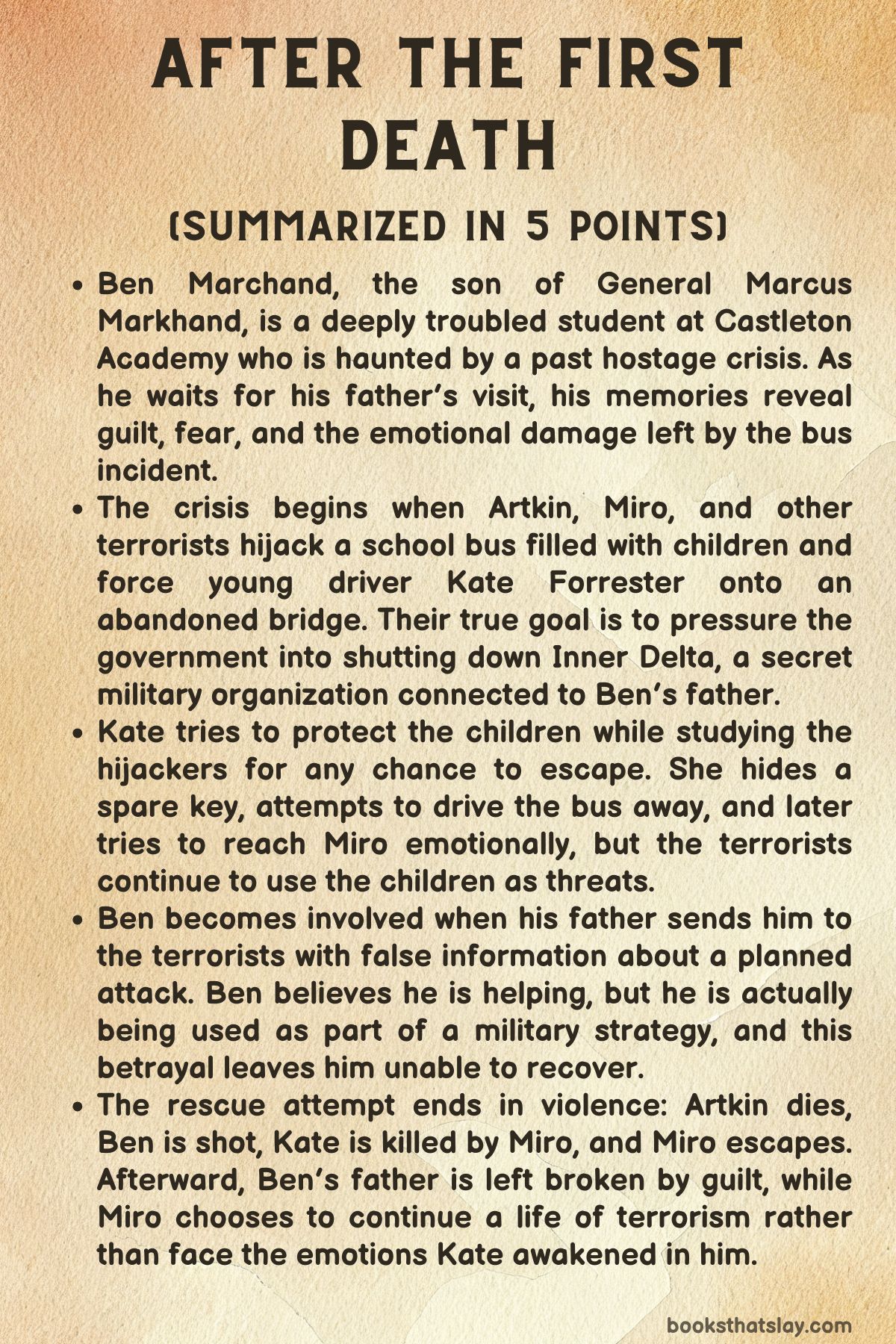
Ben Marchand, a student at Castleton Academy in New Hampshire, begins the story in a state of deep emotional collapse. He is the son of General Marcus Markhand, a powerful military figure connected to a secret government organization called Inner Delta.
Ben lives like a ghost at school, isolated from classmates and haunted by something known as the bus incident. When fireworks explode on campus, the sound brings back memories so intense that he becomes physically sick.
He insists that what he is writing is not a suicide note, yet he also admits that he has already gone to Brimmler’s Bridge and thought about jumping. His father is coming to visit him for the first time since the incident, and Ben is torn between wanting to see him and fearing what that meeting will mean.
The event that shattered Ben began with a planned terrorist operation. A teenage boy called Miro works under the command of Artkin, an experienced terrorist who has trained him to think of violence as duty.
Miro is not his original name, but he rejects his past because his homeland and identity have been destroyed by war. Artkin’s group plans to hijack a school bus carrying children to summer camp, murder the driver, and hold the children hostage until the government meets their demands.
Miro’s role is to kill the driver, which would be his first murder and, in his mind, a rite of passage.
When the bus arrives, the driver is not the old man Miro expected. It is Kate Forrester, a young substitute driver close to Miro’s age.
Artkin and the others take over the bus, distribute drugged candy to the children, and force Kate to follow their van to an abandoned railroad bridge. Kate is terrified and ashamed of her fear, especially when she wets herself.
She sees that Artkin is in command, but Miro frightens her in a different way because his gaze seems cold and measuring.
The plan changes when one of the children dies from the drugged candy. Artkin decides to use the child’s death as part of the threat rather than admit weakness.
Miro is ordered not to kill Kate yet. The hijackers put on black masks with red markings, making them look even more frightening to Kate and the children.
Soldiers, police, helicopters, and snipers soon surround the bridge, but the authorities cannot simply attack because the children’s lives are at stake. Artkin makes a brutal display of the dead child’s body to show that the hijackers do not value life in the way the authorities do.
Kate tries to care for the children while searching for any chance to save them. She realizes the hijackers will probably kill her because she has seen their faces.
The children are kept quiet with more drugged candy, and Kate protests because one child has already died. Artkin does not care.
While tending the children, Kate discovers that one boy, Raymond, is only pretending to be asleep. This gives her a small advantage because she knows something the hijackers do not.
Later, while removing her wet underwear in the back of the bus, she finds an extra bus key in her wallet and hides it in her shoe.
Miro becomes increasingly unsettled by Kate. He was trained to see enemies as targets, not as people, but Kate’s fear, courage, and physical presence stir emotions he does not understand.
Kate senses this and tries to make him see her as human. She asks him about his life, his training, and the cause he serves.
Miro tells her about a world of hidden war, where even civilians are treated as soldiers. Kate challenges him, asking how children can be part of such a war.
Miro repeats the lessons he has been taught, but Kate’s questions begin to disturb the certainty he has built around himself.
Meanwhile, Ben remembers how his own life became linked to the hijacking. Before the incident, he had been absorbed in a small romantic disappointment after a girl he liked rejected him.
When the bus crisis happened, he was ashamed that he was thinking mostly about his own hurt rather than the children trapped on the bridge. His father received evidence that the terrorists knew about Inner Delta, proving that their true goal was not only money or prisoner releases but the destruction of the secret organization itself.
General Markhand’s role becomes central. He is a commander trained to think in strategy, but he is also Ben’s father.
The terrorists demand the shutdown of Inner Delta, and the government refuses to give in. At one point, the authorities claim they have captured the leader behind the operation.
Artkin asks for a specific stone from the leader’s hotel room as proof. Ben is chosen to carry that stone to the terrorists.
His father gives him instructions as if he were both a son and a soldier. Ben, eager to help and desperate to matter, agrees.
Before that exchange, Kate attempts her own escape. She waits until Miro steps outside, locks him out, starts the bus, and tries to drive the children away.
The bus only moves a short distance before it stalls. Artkin and Miro regain control.
Artkin searches Kate, discovers how close she came to succeeding, and rebukes Miro for failing to control the situation. The failed escape deepens the danger for everyone.
Later, a hijacker is accidentally shot by a sniper. Artkin decides there must be a punishment, even if the shot was a mistake.
He selects Raymond to be killed. Kate begs Artkin to take her instead, but he refuses.
Raymond is taken from the bus and shot. Kate is horrified, and she is also ashamed of the relief she feels when she is not chosen.
When Ben reaches the terrorists, he is searched and interrogated. Artkin tortures him for information about the planned attack.
Ben reveals that the assault will come at 9:30, believing that this is true. In reality, his father has arranged for Ben to carry false information without knowing it.
The attack begins earlier, at 8:35. Chemical fog covers the bridge as soldiers and helicopters move in.
Gunfire breaks out. Artkin is shot, but before dying he shoots Ben.
Miro is stunned by Artkin’s death, which he had never imagined possible.
In the chaos, Miro takes Kate hostage and escapes toward the woods. Wounded and shaken, he hides with her in a small enclosure.
Kate makes one last attempt to save herself by attacking the foundation of his identity. She suggests that Artkin may have been his father, pointing to their resemblance and the way Artkin took him in as a child.
Miro cannot bear the thought. Overwhelmed by grief and confusion, he shoots Kate, killing her.
Afterward, Ben’s father waits for him at Castleton and reads the pages Ben has written. He realizes Ben is likely planning to kill himself and rushes toward Brimmler’s Bridge, but it is too late.
Ben appears to his father as a voice or presence in his mind, suggesting that Ben has died and that the general is now haunted by him. The general admits that Ben was used because he needed to believe the false attack time for the terrorists to believe it too.
Ben’s presence forgives him, but the forgiveness does not free the general from what he has done.
Miro survives. He moves through the woods, reaches a highway, and thinks about Kate and Artkin.
The emotions Kate awakened in him make him angry because they threaten the hard emptiness he depends on. He kills a man, takes his car, and sets out to find another terrorist cell.
The ending shows that the public crisis is over, but the damage continues: Kate is dead, Ben is dead, his father is broken, and Miro remains alive, choosing violence again rather than face what he has felt.
Characters
Ben Marchand
Ben Marchand is one of the most damaged figures in After The First Death, and much of his character is shaped by the distance between how others see him and how he sees himself. Publicly, he is treated as a brave young man connected to a national crisis, but privately he feels weak, ashamed, and hollow.
His narration shows a boy who has been trapped inside memory. At Castleton Academy, he moves through life without truly belonging to it.
He avoids people, struggles with ordinary conversation, and reacts violently to sounds that remind him of the hijacking. His emotional state is not presented as dramatic self-pity but as the result of being used in a situation far beyond his strength.
Ben’s relationship with his father is central to his suffering. He wants his father’s approval, but he also knows that his father’s choices helped destroy him.
When General Markhand sends him into danger, Ben is treated less like a son and more like an instrument in a military plan. This betrayal leaves Ben unable to separate love from obedience.
He wants to be useful, brave, and worthy, yet the experience teaches him that his life can be sacrificed for a larger cause. His final collapse comes from this unbearable contradiction.
Ben is not simply afraid of death; he is unable to live with the knowledge that the person meant to protect him used him.
General Marcus Markhand
General Marcus Markhand is a man divided between military duty and fatherhood. As a general, he is disciplined, strategic, and trained to think in terms of national security.
He understands threats, calculations, sacrifices, and consequences. Yet as a father, he is vulnerable, guilty, and emotionally unprepared for the cost of his own decisions.
His tragedy lies in the fact that he can justify his actions professionally but cannot survive them personally. He sends Ben into danger because the mission demands it, but the decision destroys the moral foundation of his life.
Markhand’s character reveals how institutions can reshape human relationships. In the moment he gives Ben instructions, he treats him like a staff member carrying out an assignment.
This does not mean he lacks love for his son. In fact, his later breakdown shows how deeply he loves him.
The horror is that his training allows him to act against that love. After Ben’s death, Markhand is haunted not only by grief but by the knowledge that he crossed a line that can never be repaired.
His imagined conversation with Ben suggests a mind trying to create forgiveness because real forgiveness is no longer possible in ordinary life.
Kate Forrester
Kate Forrester is the moral center of the hostage crisis. At first, she appears frightened, ashamed, and physically overwhelmed by terror.
Her repeated loss of bladder control is important because it strips away any false idea of easy courage. Kate is not fearless.
She is a young girl in an impossible situation, surrounded by armed men, responsible for children, and aware that she will probably be killed. Her courage comes from acting despite fear, not from being free of it.
This makes her bravery more believable and more powerful.
Kate’s intelligence develops under pressure. She observes Miro carefully, notices his uncertainty, hides the spare key, recognizes Raymond’s alertness, and tries to use human connection as a survival strategy.
Her attempt to appeal to Miro is not romantic in a simple sense; it is an act of desperate psychological resistance. She tries to make him see her as a person rather than a target.
Kate’s failed escape also shows her willingness to risk herself for the children. Her death is especially harsh because she does almost everything right, yet still cannot overcome the violence surrounding her.
She represents decency under extreme pressure, but the novel refuses to pretend that decency always wins.
Miro Shantas
Miro Shantas is both victim and killer, and this duality makes him one of the most disturbing characters in the novel. He has been shaped by war, displacement, training, and manipulation.
His original identity has been erased, and his new self is built around obedience, violence, and loyalty to Artkin. He wants his first murder to give his life meaning because he has been taught that killing proves commitment.
This makes him dangerous, but it also reveals how thoroughly he has been conditioned.
Miro’s reactions to Kate expose the cracks in his training. He is unsettled by her fear, her body, her questions, and her attempts to speak to him as a human being.
He wants to remain hard and empty, yet he begins to feel confusion, attraction, shame, and grief. These emotions threaten the identity Artkin has created for him.
Kate’s suggestion that Artkin may be his father breaks through his defenses because it challenges everything he believes about loyalty, belonging, and purpose. His murder of Kate is not only an act of violence against her; it is also an attempt to destroy the feelings she has awakened in him.
By the end, Miro chooses to return to terrorism because he cannot bear the pain of self-recognition.
Artkin
Artkin is the chief architect of the hijacking and the clearest representative of ideological cruelty. He is intelligent, controlled, and skilled at manipulating both enemies and followers.
Unlike Miro, who is still learning how to suppress emotion, Artkin has already mastered that suppression. He treats children, hostages, subordinates, and even death as tools.
His calmness makes him more frightening than someone driven by visible rage. He does not need to shout to control a situation; he uses planning, fear, and symbolic violence.
His treatment of Miro reveals another layer of his character. Artkin is not merely a commander; he is also a father figure, teacher, and emotional owner.
He gives Miro purpose, but that purpose is built on dehumanization. He teaches Miro that the mission matters more than individual lives and that weakness must be cut away.
Artkin’s possible biological connection to Miro is less important than the emotional truth that he has shaped Miro’s entire identity. His death leaves Miro not liberated but shattered, because Miro has depended on him for meaning.
Artkin’s legacy survives in Miro, which makes his influence more terrifying than his physical presence.
Raymond
Raymond is a young child, but his role is deeply important because he represents the innocence caught inside adult violence. Unlike the other children, he becomes briefly active in the story by pretending to sleep and quietly communicating with Kate.
This small act gives Kate hope because it proves that the children are not only helpless bodies being moved around by others; at least one of them is aware and capable of helping in some way. Raymond’s alertness creates a fragile possibility of resistance.
His death is one of the clearest examples of the hijackers’ moral emptiness. Artkin chooses him not because Raymond has done anything wrong, but because a child must be sacrificed to maintain control after the sniper’s mistake.
Raymond becomes a message. That transformation of a child into a political signal is one of the novel’s most brutal acts.
Kate’s response to his death is also psychologically complex. She begs to be taken instead, but when Artkin refuses, she feels relief and then shame.
Through Raymond, the story shows how terror corrupts even the emotions of those trying to do good.
The Children on the Bus
The children on the bus function as a collective presence, but they are not merely background figures. Their vulnerability drives the entire crisis.
They cry, sleep, need comfort, need the bathroom, accept candy, and depend on Kate for care. These ordinary details matter because they remind the reader that the hostages are not symbols in their own lives.
They are children with physical needs and limited understanding, trapped in a conflict created by adults.
Their presence also exposes the moral positions of the other characters. Artkin sees them as leverage.
Miro tries to see them as part of a war. Kate sees them as children who must be protected.
The authorities see them as lives to be saved, but their rescue strategy still places them in danger. Ben sees them partly through guilt, recognizing that while they suffered, he had been absorbed in his own private pain.
The children reveal how easily innocence can be turned into a weapon by people who claim to serve causes, nations, or security.
Ben’s Mother
Ben’s mother appears less directly than the major characters, but her presence helps show the emotional isolation inside the Marchand family. Her conversation with Ben reveals that she wants reassurance, and Ben gives her what she wants to hear.
This exchange shows how damaged Ben is, but it also shows how difficult it is for his family to face the truth. She asks about his life, and he responds with a performance of normalcy.
The result is not real communication but emotional concealment.
Her role also emphasizes the silence surrounding trauma. Ben cannot tell her what he truly feels, and she cannot reach the part of him that is falling apart.
She represents a domestic world that should provide comfort but cannot fully understand the damage caused by military secrecy and political violence. In contrast to General Markhand’s direct responsibility, Ben’s mother represents helpless love.
She is connected to the tragedy not through action but through exclusion. The most important decisions happen outside her reach, yet she still suffers their consequences.
The Terrorist Leader
The terrorist leader, though physically distant from the main hostage situation, shapes the plot through authority and absence. He is the figure whose capture threatens Artkin’s plan and whose stone becomes proof demanded by the hijackers.
His importance lies in the structure of command. The operation is not random violence but part of a larger network with hierarchy, signals, and backup expectations.
This widens the scope of the crisis beyond the bridge.
His absence also highlights Artkin’s dependence on organization and confirmation. When the leader misses a signal, uncertainty enters the operation.
Artkin still behaves with control, but the situation begins to shift. The leader’s role shows that terrorism in the novel is not only a matter of individual anger.
It is organized, disciplined, and sustained by people who may never personally face the victims of their orders. In that sense, he represents hidden power: distant, influential, and morally insulated from the immediate suffering on the bus.
The Sniper
The sniper who accidentally shoots one of the hijackers has a brief but crucial role. His mistake changes the emotional and moral direction of the crisis.
The shot is not part of a planned attack but a reflex, a single moment of human error under unbearable pressure. Yet in the logic of the hijacking, even an accident demands punishment.
Artkin uses the mistake as justification for killing Raymond, proving that violence often grows from moments no one fully controls.
The sniper also reflects the limits of armed rescue. The authorities surround the bus with power, weapons, helicopters, and trained personnel, but their strength is restricted by the presence of children.
One wrong move can make the situation worse. Through the sniper, the novel shows that even those trying to save lives can become part of the chain that leads to death.
His error does not make him equivalent to Artkin, but it does show how fragile control is in situations ruled by fear and weapons.
The Man on the Highway
The man on the highway appears near the end and has no personal connection to the hostage crisis, which is exactly why his death matters. He is an ordinary person who happens to stop in the wrong place at the wrong time.
Miro kills him to take his car and continue his escape. The murder shows that Miro has not been redeemed by loss, fear, or Kate’s attempts to reach him.
Instead, he chooses to harden himself again.
This character’s death also broadens the ending beyond the bus incident. The violence does not stay contained on the bridge.
It moves outward into the world, ready to repeat itself. The man on the highway becomes proof that Miro’s survival is not neutral.
As long as Miro remains committed to the identity Artkin gave him, strangers will continue to be at risk. His brief appearance reinforces one of the bleakest conclusions of After The First Death: trauma may end for some through death, but violence can continue through those who refuse to confront what they have become.
Themes
The Destruction of Innocence
In After The First Death, innocence is not protected by age, goodness, or ignorance. The children on the bus are the clearest example because they have no understanding of the political conflict that has placed them in danger.
They are treated as bargaining tools by adults who know exactly how powerful their helplessness is. Their ordinary needs, such as using the bathroom, eating candy, sleeping, and crying, become part of the horror because they remind the reader how young they are.
Raymond’s death is especially devastating because he is killed not for anything he has done, but to send a message after someone else makes a mistake.
Ben also loses innocence, though in a different way. Before the crisis, his pain is personal and adolescent, centered on rejection and loneliness.
Afterward, he understands betrayal, manipulation, torture, and guilt. His father’s decision to use him in the operation forces him into an adult world of strategy and sacrifice, but Ben does not have the emotional defenses to survive it.
Miro’s innocence has been destroyed even earlier, before the main events begin. War and training have stripped him of his original identity and replaced it with discipline and violence.
The novel shows innocence as something adults repeatedly exploit, damage, or erase.
The Moral Cost of Duty
Duty is presented as a dangerous force when it becomes separated from compassion. General Markhand believes he is serving national security, and from a military perspective, his choices may appear calculated and necessary.
Yet the cost of those choices is unbearable because they require him to treat his own son as a tool. His tragedy comes from the conflict between his public duty and private love.
He does not stop being a father when he acts as a commander, but he allows the role of commander to overrule the obligations of fatherhood. The result is not victory but spiritual ruin.
Artkin also speaks the language of duty, though his cause is violent and extremist. He trains Miro to believe that killing is meaningful when done for a homeland.
This version of duty removes personal responsibility by placing every act under the authority of a mission. Miro follows orders because he wants purpose and belonging, not because he fully understands the moral weight of his actions.
Kate offers a contrast because her sense of duty is rooted in care rather than ideology. She protects the children because they are vulnerable and present before her.
Through these contrasts, the story questions any form of duty that asks people to stop seeing others as human.
Fear, Courage, and Survival
Fear in the novel is physical, humiliating, and constant. Kate’s terror is shown through her body, especially in moments when she wets herself.
This detail is not used to weaken her character; instead, it makes her courage more convincing. She is not brave because she feels no fear.
She is brave because she keeps thinking, caring, and acting while fear controls her body. Her attempt to drive the bus away is a major act of courage precisely because she knows the risks and acts anyway.
Her later attempt to reach Miro emotionally is another survival strategy, built from intelligence rather than force.
Ben’s fear is different. He is afraid of memory, of his father, of his own weakness, and of what survival has made him.
His fear turns inward until life itself becomes unbearable. Miro’s fear is more hidden because he has been trained to deny it.
He fears failure, emotional softness, Artkin’s judgment, and the collapse of the identity he has been given. Even Artkin, who appears controlled, acts from the fear of losing power and credibility.
The novel refuses to make courage simple. Sometimes courage fails.
Sometimes survival belongs to the violent. Sometimes the people who act bravely are not saved.
Identity, Manipulation, and Control
Identity in the story is something shaped, stolen, and performed. Miro’s identity has been deliberately reconstructed.
His real name is rejected, his homeland is gone, and his purpose has been supplied by Artkin and the terrorist cause. He believes he is becoming meaningful through violence because that is the story he has been taught to tell about himself.
Kate threatens him because she makes him feel emotions outside that story. When she suggests Artkin may be his father, she attacks the deepest part of his constructed self: his belief that loyalty and training are enough to explain who he is.
Ben also struggles with identity. Newspapers and outsiders see him as brave, but he knows the public version does not match his inner experience.
This gap between image and truth increases his isolation. General Markhand’s identity is split between soldier and father, and the crisis proves that those roles cannot peacefully exist when one demands the sacrifice of the other.
Kate’s identity is more flexible. She thinks about the disguises people wear and then uses performance as a survival tool, trying to appear calm, appealing, or obedient when necessary.
The novel shows that control over identity can be a form of power, and losing that control can be devastating.