Agricola Summary, Characters and Themes
Agricola is a short but rich work by Tacitus, written as a tribute to his father-in-law, the Roman general Gnaeus Julius Agricola. It is at once a biography, a memorial, and a reflection on public life under imperial rule.
Through Agricola’s career, Tacitus shows what discipline, moderation, and honor looked like in an age shaped by fear and political suspicion. The book also looks beyond one man’s life to examine Roman power in Britain, the cost of conquest, and the damage tyranny does to both rulers and subjects. It stands as both praise for Agricola and judgment on the age around him.
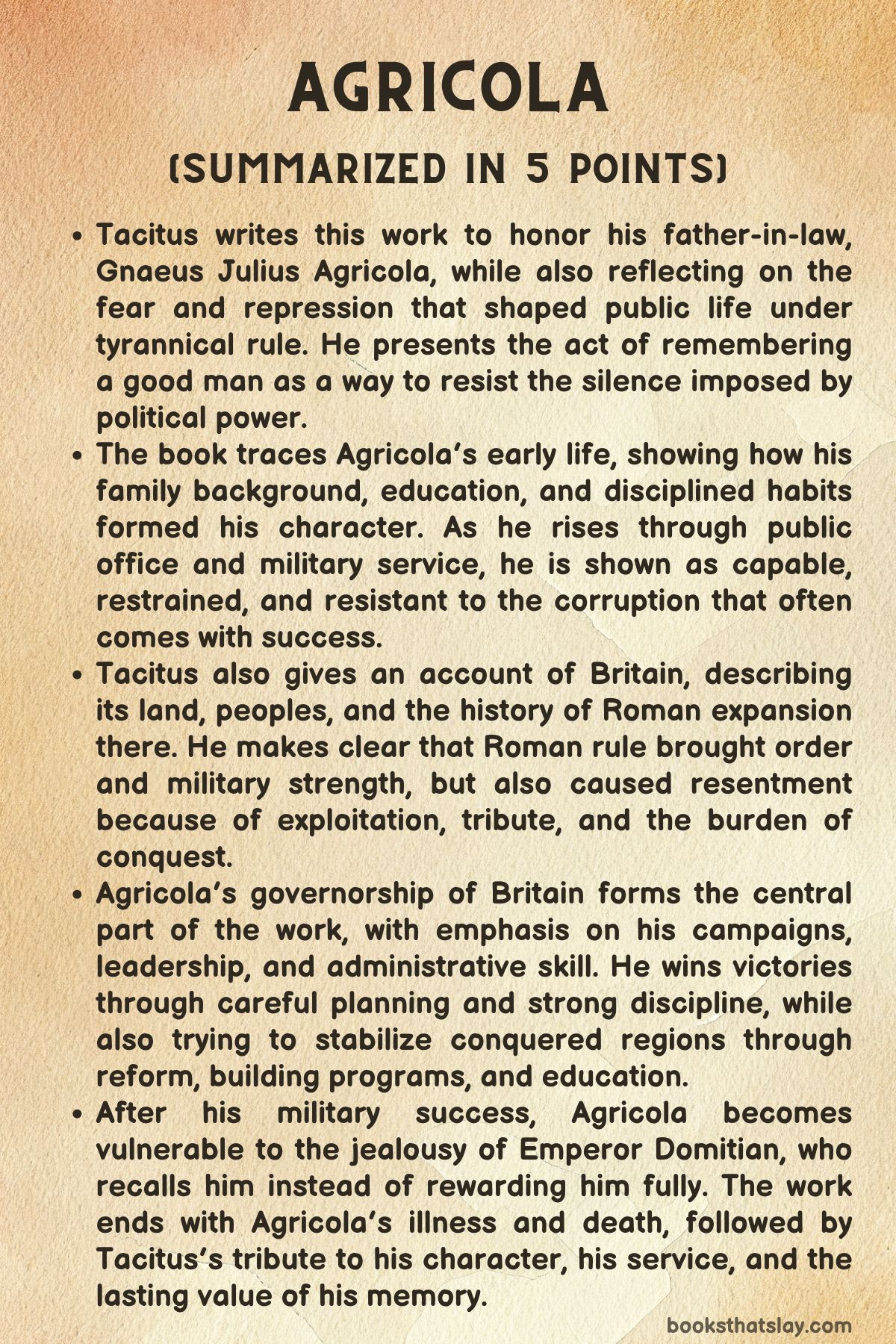
Summary
Tacitus opens Agricola by reflecting on the act of writing about great men. He says that earlier generations freely celebrated virtue, but under recent rulers even honoring honorable people became dangerous.
He recalls how writings that praised men of integrity were treated like crimes and publicly destroyed, as though burning books could erase memory itself. From the beginning, he presents his work not only as a personal tribute, but also as a moral act.
By recording the life of Agricola, he preserves the example of a good man who lived under oppressive conditions. At the same time, he contrasts the fearful past with a better present under a new emperor, while admitting that a society shaped by long servitude does not recover at once.
Tacitus then turns to Agricola’s origins and early life. He presents him as a man born into a respected family with public standing, yet formed not by pride but by good guidance.
His father had distinction in public life, and his mother is described as a model of virtue. Under her care, Agricola received a sound education and learned restraint early.
He showed interest in philosophy, but his mother ensured that he pursued learning with measure rather than excess. This balance became one of his defining qualities.
Tacitus stresses that Agricola developed strong habits when young, avoided corrupt influences, and possessed a seriousness that did not harden into arrogance.
As a young man, Agricola served in Britain during his military apprenticeship. Tacitus uses this period to show the contrast between Agricola and others who treated military service as an excuse for self-indulgence.
Agricola instead studied his duties carefully, worked hard, and learned from experienced commanders. He neither rushed forward recklessly nor remained passive.
He observed, listened, and improved. Returning to Rome, he married Domitia Decidiana, and Tacitus describes their marriage as one of harmony and mutual loyalty.
Agricola then advanced through public office without letting success damage his character. Even under Nero, when public life could be dangerous, he understood the value of caution and avoided drawing harmful attention to himself.
The civil wars of Rome brought violence directly into Agricola’s private life. His mother was murdered and her property looted during unrest.
This personal loss coincided with wider political disorder. Agricola chose to support Vespasian in the struggle for imperial power and was given an important military command.
In charge of a legion with a questionable reputation, he restored discipline without showiness. Tacitus repeatedly returns to this point: Agricola succeeded because he combined firmness with modesty.
He did not boast, provoke jealousy, or make himself larger than the office he held. Later, as governor of Aquitania, he further proved his sound judgment and moral steadiness.
After his successful administration there, he was appointed governor of Britain, placing him at the center of the work’s main action.
Before describing Agricola’s campaigns, Tacitus pauses to present Britain itself. He discusses the island’s location, climate, and natural features, as well as the appearance and customs of its peoples.
The land is fertile, rich in resources, and difficult in weather and terrain. The inhabitants are brave in battle, especially as infantry, but often weakened by internal division.
Tacitus also reviews the earlier Roman conquest of Britain. He notes that Roman authority could be accepted so long as it did not become naked abuse, but resentment grew when imperial rule meant greed, exploitation, and humiliation.
He recounts the rebellion led by Boudicca as an example of what happens when oppression becomes intolerable. The conquest of Britain, as Tacitus presents it, is never a simple story of Roman greatness.
It is also a story of resistance, grievance, and the heavy cost of empire.
Agricola arrives in Britain ready for action. He does not spend his first season settling into routine while enemies gather strength.
Instead, he moves quickly against the Ordovices, defeating them and restoring Roman authority. He then attacks the island of Mona, achieving success through energy and surprise.
Tacitus presents these early victories as proof of Agricola’s ability to act decisively while others hesitated. Yet military success is only one part of his rule.
Agricola also reforms administration. He checks corruption, chooses capable men, and ensures that offices are assigned fairly.
He keeps his household under discipline and avoids the vanity that often accompanies command. Because of this, he gains both fear from enemies and respect from allies.
Tacitus gives particular attention to Agricola’s efforts to stabilize conquered regions. After military action, Agricola works to make peace workable.
He encourages the building of towns, public spaces, and houses, and he promotes education among the sons of local leaders. In Roman terms, this is a civilizing policy, though Tacitus adds a critical edge by noting how people came to admire habits that were also instruments of control.
What looked like refinement could also be another form of subjection. This double vision runs through the book.
Agricola is praised for moderation and intelligence, yet the larger machinery of empire remains morally unsettled.
Over several campaigning seasons, Agricola extends Roman control farther north. Tacitus emphasizes his careful planning.
His forts are well supplied and well defended, allowing Roman troops to hold ground even through winter, when enemies might expect them to weaken. He secures troubled districts, explores unfamiliar territory, and uses both land and naval operations to unsettle opponents.
The use of the fleet is especially important because it shows Rome reaching beyond what local peoples thought possible. Agricola’s enemies are not simply beaten by force; they are psychologically shaken by the range and confidence of Roman operations.
Yet the northern peoples do not surrender easily. Though defeated in some engagements, they continue to regroup and seek opportunities to resist.
A brief episode involving mutinous foreign auxiliaries interrupts the main narrative, but Tacitus soon returns to Agricola’s later years in command. During this period, Agricola suffers a personal blow with the death of his young son.
Tacitus shows him enduring grief with restraint and continuing his duties. The final major campaign then gathers force as northern British groups unite more effectively than before.
Their resistance culminates near Mons Graupius, where the opposing armies prepare for a decisive encounter.
Before the battle, Tacitus presents two speeches, one from the British leader Calgacus and one from Agricola. In Calgacus’s speech, Rome is condemned as a power driven by greed, plunder, and domination.
He speaks for people who have been robbed of land, liberty, and dignity. To him, Rome leaves desolation and calls it peace.
The speech is one of the strongest critiques of empire in the work and broadens the book beyond praise of Agricola. It gives moral and political weight to the resistance.
Agricola’s speech answers with the language of Roman military honor. He reminds his troops of their past successes, their endurance, and the glory that awaits them if they finish the conquest.
Where Calgacus speaks for liberty, Agricola speaks for discipline, loyalty, and victory.
The battle itself is fierce. The Britons hold higher ground and have greater numbers, which gives them an impressive appearance and an initial advantage.
They fight bravely, and Tacitus does not deny their courage. Still, Roman training, organization, and tactics gradually overcome the difficulties of terrain and numbers.
Agricola responds effectively to threats as they arise, and the Roman troops press their attack with determination. The British line eventually breaks.
Many are killed, and many scatter into the landscape. Their defeat is severe, and by the end the Romans hold the field.
Yet even here the result is not presented as complete final closure. The land itself, with its woods and marshes, helps survivors escape, and the war does not end with a simple image of total submission.
After this high point, the tone shifts from military success to political unease. Agricola’s achievements, instead of securing greater honor, expose him to imperial jealousy.
Tacitus suggests that Domitian could not bear the fame of a subject whose merit seemed too visible. Agricola is recalled to Rome.
Although he receives outward signs of favor, Tacitus makes clear that these are hollow and shaped by suspicion. A promising appointment is mentioned but never truly given.
Agricola’s modest behavior leaves room for others to debate the extent of his glory, and this uncertainty itself becomes part of the political climate Tacitus wants to show: under a bad ruler, even excellence becomes dangerous.
In the years after Agricola’s return, the empire suffers setbacks, and many wish he could take command again. But Domitian prefers safety over merit and keeps him from meaningful power.
Agricola, whether by prudence or pressure, does not force a confrontation. He declines further office and lives quietly.
Tacitus presents this not as weakness, but as the difficult wisdom of a good man surviving in corrupt times. Eventually Agricola falls ill and dies.
Rumors spread that he was poisoned, though Tacitus refuses to claim certainty without proof. Even in this, his treatment is measured.
Suspicion surrounds Domitian, but the historian does not say more than the evidence allows.
The work closes as an act of mourning and remembrance. Tacitus reflects on Agricola’s age and the timing of his death.
He suggests that dying when he did spared him from seeing more disgrace and suffering under tyranny. Agricola is presented as a man who kept his integrity in public service, succeeded without vanity, endured danger without complaint, and met death with composure.
Tacitus then speaks directly to him in a deeply personal conclusion, regretting that he and Agricola’s daughter were absent at the end. The final emphasis is on memory.
Since the body perishes, character must be preserved in words. Through this tribute, Tacitus gives Agricola a lasting place not only as a capable general, but as an example of decency and self-command in a damaged age.
Characters
In Agricola, character is never treated as something private or hidden. Public conduct, moral restraint, ambition, loyalty, and courage are all tested under pressure, so each figure is revealed through action, reputation, and response to power.
The people described here matter not only as individuals but as examples of what Roman political life could produce at its best and worst.
Gnaeus Julius Agricola
Agricola stands at the center of the work as the model of disciplined public virtue. He is presented as a man whose strength comes not from theatrical heroism but from steadiness, judgment, and self-command.
From youth onward, he shows balance: he is educated without becoming detached from practical life, ambitious without becoming reckless, and successful without becoming vain. This balance is one of the most important parts of his character because Tacitus wants him to appear neither as a dreamer nor as a brute conqueror, but as someone who understands how to act effectively inside a difficult world.
His intelligence lies in knowing when to push forward, when to remain cautious, and how to preserve dignity in a corrupt political order.
His military character is marked by energy joined to restraint. He works hard, learns from experience, and refuses to use office for personal indulgence.
As a commander, he is decisive in battle, but Tacitus spends just as much time praising his administrative discipline, fairness in appointments, and refusal to claim too much credit. That refusal matters because it separates him from the self-promoting type of Roman leader who courts glory at any cost.
Agricola succeeds because he inspires confidence rather than fear among his own side and respect rather than contempt among subject peoples. Even his efforts to establish peace after conquest show a practical understanding of rule: he knows that victory must be stabilized, not merely celebrated.
At the same time, his greatness is shaped by limitation. He is a good man serving an empire whose expansion is morally complicated and serving emperors who may resent merit.
This makes him a tragic figure in a subtle sense. His excellence cannot fully transform the system he serves.
He can govern well, fight well, and behave honorably, but he cannot remove the jealousy of tyrants or the violence built into conquest. His final image is therefore moving not because he falls dramatically, but because he remains composed in a world unworthy of him.
Tacitus makes him an example of how virtue survives not by purity from history, but by measured conduct within it.
Tacitus
Tacitus is more than the narrator; he is one of the most important characters in the work because his mind shapes everything the reader sees. He writes as a historian, son-in-law, Roman senator, and survivor of political fear.
These roles give his voice its unusual tension. He wants to honor Agricola, but he also wants to explain what it meant to live under emperors who made honorable life dangerous.
That means he is never a neutral observer. His admiration is personal, his grief is genuine, and his political judgments are sharpened by memory.
The portrait he creates is therefore also a self-portrait of a writer trying to preserve moral seriousness in an age that damaged public speech.
His character emerges through tone as much as through direct statement. He is controlled, intelligent, and cautious, but never cold.
He refuses empty praise and often qualifies his claims, especially when evidence is uncertain. That habit gives him credibility and reveals an important part of his personality: he values judgment over exaggeration.
Even when he suspects foul play in Agricola’s death, he does not claim certainty where he cannot prove it. This restraint shows that for Tacitus, truthfulness is itself a moral act.
He opposes tyranny not simply by condemning it, but by writing with precision against distortion and fear.
He is also deeply concerned with memory. His purpose is not only to recount events but to rescue character from silence.
He knows that political systems can punish speech, burn texts, and flatter rulers, yet he believes worthy lives can still be preserved through writing. That conviction makes him a moral historian rather than a mere recorder of facts.
He writes to defend the value of virtue when public culture no longer protects it. Through him, the work becomes both tribute and resistance.
Domitian
Domitian functions as the dark political force against which the nobility of others becomes visible. He is not developed through intimate detail but through atmosphere, rumor, reaction, and effect.
Tacitus presents him as a ruler whose greatest flaw is not simple cruelty alone, but insecurity in the presence of genuine merit. He cannot comfortably tolerate subjects who possess distinction independent of imperial favor.
This makes him especially dangerous because he turns excellence into a political threat. Under such a ruler, achievement invites suspicion, and the best men must learn how to survive being noticed.
His character is shaped by envy disguised as authority. He offers honors that do not feel sincere, stages gestures of approval that conceal hostility, and maintains control through performance as much as force.
That hypocrisy is central to his portrait. A ruler who openly hates virtue is dangerous, but a ruler who imitates justice while quietly undermining it is in some ways worse, because he corrupts the moral language of public life.
Domitian’s world is one in which praise can be a trap, reward can be a method of delay, and favor can hide exclusion.
He is also important because he reveals the limits of Roman success. The empire may conquer distant peoples, yet at its center it can still be ruled by fear and jealousy.
Domitian therefore stands not merely as an individual tyrant but as a test of character for everyone around him. Agricola’s modesty, Tacitus’s caution, and the silence of public life all gain meaning in relation to him.
His presence proves that the corruption of political power does not only destroy bodies or careers; it distorts values, making honor appear dangerous and mediocrity appear safe.
Calgacus
Calgacus represents resistance in its most articulate and morally forceful form. Although he appears chiefly through a speech, he emerges as a powerful character because he gives voice to everything Roman conquest tries to justify or silence.
He is not shown merely as a barbarian enemy facing inevitable defeat. Instead, he becomes the spokesman for political freedom, human dignity, and collective anger against exploitation.
His importance lies in the fact that he sees the empire from below. Where Roman power describes itself as order and civilization, he identifies plunder, humiliation, and domination.
His character is defined by moral clarity. He understands that the empire survives not only by military strength but by taking advantage of the divisions and weaknesses of the peoples it conquers.
He urges unity because he knows disunity is Rome’s greatest opportunity. In this sense, he is also a perceptive political thinker.
He sees how tribute, violence, and coerced dependence work together. His words carry force because they expose the cost paid by those who are ruled.
He makes visible the women violated, the children conscripted, and the wealth extracted. Through him, conquest loses any easy heroic gloss.
At the same time, Calgacus is not simply a mouthpiece for a modern anti-imperial reading. He is also a leader trying to inspire his people in a moment of danger.
His rhetoric turns suffering into purpose. He frames battle not as one more conflict, but as a final defense of freedom itself.
That gives him grandeur even in defeat. Tacitus allows an enemy of Rome to speak with dignity because doing so enlarges the moral world of the narrative.
Calgacus becomes a necessary counterweight to Agricola: one embodies honorable command within empire, the other honorable refusal against it.
Domitia Decidiana
Domitia Decidiana is not described at great length, yet her presence matters because she represents the private stability that supports Agricola’s public life. Tacitus presents their marriage as marked by harmony and mutual loyalty, which is not a decorative detail but a sign of character.
In Roman writing, the household often reflects the moral order of the individual, and Domitia’s relationship with Agricola suggests a life governed by balance rather than excess. She is part of the emotional structure of the work, reminding the reader that public distinction is tied to domestic virtue.
Her importance also lies in what she helps reveal about Agricola. A harmonious marriage suggests constancy, moderation, and respect, all of which fit the larger portrait Tacitus wants to build.
She is not used as a dramatic independent force in the narrative, but she gives shape to the moral world around Agricola. The fact that Tacitus highlights the quality of the marriage indicates that he sees it as evidence of character rather than mere biography.
It is one more sphere in which Agricola proves sound.
At the close, Domitia’s role deepens because she becomes one of the living bearers of memory. Along with her daughter, she belongs to the intimate circle left behind after Agricola’s death.
The work’s elegiac tone makes such figures important even when they are not politically active. They represent continuity, grief, and the duty of remembrance.
Through her, the emotional stakes of loss become more fully felt.
Agricola’s Mother
Agricola’s mother is crucial in shaping his early moral formation. Tacitus presents her as a woman of exemplary virtue whose influence on her son was both affectionate and corrective.
She provides care, supervision, and ethical guidance, ensuring that his education develops into maturity rather than self-display. Her role is especially important because Agricola’s later moderation is traced back to her discipline.
She helps him value learning without becoming impractical or self-indulgent. In this way, she serves as the origin point of his sense of proportion.
She also represents the Roman ideal of domestic virtue operating with real force. Tacitus does not portray her as passive background.
Her influence actively directs Agricola’s development, and that makes her one of the hidden architects of his later greatness. The values she instills become visible in his public life: control, seriousness, and a refusal of corruption.
Through her, the work implies that character is formed long before public honors arrive.
Her murder during civil unrest gives her added significance. She becomes one of the innocent victims of political disorder, and her death links the violence of the wider Roman world to Agricola’s personal life.
This loss is not only biographical detail; it shows that the instability of empire reaches into the household. Her presence in the narrative is therefore brief but powerful, combining nurture, virtue, and the vulnerability of private life under public chaos.
Agricola’s Father
Agricola’s father is described as a man distinguished by eloquence and philosophical seriousness, and this brief portrait helps establish the inheritance from which Agricola emerges. He represents an intellectual and moral lineage rather than simple social rank.
Tacitus makes clear that status alone is not what matters; what matters is the quality attached to it. By describing the father in terms of refinement and thought, he suggests that Agricola comes from a household where cultivation and public worth were already joined.
The father’s importance lies largely in symbolic function. He helps explain why Agricola is neither crude soldier nor shallow office-holder.
There is a family inheritance of dignity, discipline, and seriousness. Yet Tacitus does not allow ancestry to overshadow individual merit.
The point is not that Agricola is great because he comes from good stock, but that he fulfills and enlarges the better possibilities of his upbringing.
He also belongs to the work’s larger concern with memory. By including him, Tacitus places Agricola within a line of honorable people whose value lies in conduct rather than spectacle.
Even a brief mention becomes part of an argument about continuity: character is shaped by what is passed down, protected, and lived out across generations.
Vespasian
Vespasian appears as a stabilizing imperial figure and as an important point of contrast with more destructive rulers. He belongs to the period in which Agricola’s abilities can begin to find proper use.
Tacitus associates him with recovery after civil disorder and with the restoration of Roman strength in Britain. This does not make him an idealized ruler, but it places him on the side of practical renewal rather than corrosive jealousy.
Under Vespasian, Agricola’s talents are recognized and entrusted with serious responsibility.
His character is important because he represents a political environment in which merit can still serve the state with some hope of fair acknowledgment. That alone makes him significant in a work so concerned with the emotional and moral consequences of bad rule.
He is a reminder that imperial power is not presented as identical in all hands. The empire may be morally compromised in expansion, but rulers still differ in their relation to competence and public good.
As a figure in Agricola’s rise, Vespasian helps show how careers depend not only on talent but on the climate of power above them. A capable emperor can create room for worthy service.
A suspicious emperor can close that room entirely. Vespasian’s role, then, is not just historical placement; it is part of the moral architecture of the narrative.
Nerva
Nerva’s appearance is brief but meaningful because he symbolizes release from repression and the possibility of healthier public life. Tacitus invokes him as the sign of a changed atmosphere, one in which memory, speech, and virtue may once again be acknowledged more openly.
His importance lies less in personal depth than in political meaning. He marks a transition from fear toward guarded hope.
This hopeful function matters because the work begins under the shadow of silence. By identifying a new era with Nerva, Tacitus explains why the act of writing has become possible now in a way it was not before.
Nerva thus becomes associated with recovery, not merely in government, but in moral expression. He enables testimony.
He makes remembrance less dangerous.
Even so, Tacitus does not portray renewal as immediate or complete. The damage done by long servitude does not disappear at once.
Nerva therefore represents opportunity rather than full restoration. His presence adds complexity to the political background, showing that history is not flatly bleak.
There are changes in climate, openings for truth, and moments when a writer can look back and finally speak.
Boudicca
Boudicca appears as a major emblem of resistance to Roman abuse. Though her role in the narrative is not extended, she carries enormous symbolic force.
Her uprising is connected to grievances that expose the predatory side of imperial rule: greed, humiliation, and the violation of communities. She stands for the point at which endurance becomes revolt.
Through her, Tacitus acknowledges that rebellion is not born from irrational savagery alone, but from accumulated injury.
Her character is defined by public anger transformed into leadership. As a widow and ruler, she turns private wrong into collective action.
This gives her a dual significance. She is both a historical enemy of Rome and a moral sign that domination creates its own opposition.
Her revolt proves that the conquered are not merely passive recipients of Roman order; they judge, remember, and answer violence with violence.
She also broadens the work’s treatment of power by showing that women, too, can embody political will and national outrage. In a narrative dominated by generals, governors, and emperors, her presence is striking because she becomes the face of a whole people’s refusal.
Even in defeat, she remains a reminder that empire never rules uncontested.
Claudius
Claudius appears chiefly as the emperor associated with the earlier successful invasion of Britain. He is important less as a rounded personality than as a figure of initiating expansion.
Through him, Rome’s presence in Britain takes on official imperial form. He represents the beginning of a project that later governors, including Agricola, will continue and enlarge.
His inclusion helps Tacitus situate Agricola’s achievements within a longer sequence of conquest. No commander acts in a vacuum, and Claudius serves as one of the rulers whose decisions establish the stage on which later men perform.
He is part of the machinery of empire rather than one of the work’s intensely moral portraits, yet that machinery matters. It determines the scale of action available to later figures.
In that sense, Claudius functions as a historical anchor. He reminds the reader that Agricola’s campaigns are not isolated feats but part of Rome’s ongoing movement outward.
His role is foundational rather than emotionally charged, but it contributes to the larger structure of imperial history that frames the work.
Arulenus Rusticus and Herennius Senecio
These two figures appear early as examples of what happens when a state fears the memory of honorable men. Their writings in praise of admired Romans are treated as criminal acts, and that treatment defines their significance.
They are not developed as private individuals, but as witnesses to the danger attached to moral speech under tyranny. By invoking them, Tacitus shows that repression extends beyond action into language itself.
To praise virtue can become an offense when rulers feel accused by excellence.
Their importance lies in what they represent for Tacitus as a writer. They are predecessors in the effort to preserve memory, and their punishment shows the cost of that effort.
In this way, they enlarge the stakes of the narrative before Agricola’s life is even fully introduced. The problem is not simply whether good men exist, but whether their goodness can be remembered without punishment.
They also illuminate the atmosphere of fear that shaped Roman political culture. A regime that burns commemorative writings reveals its insecurity and its hatred of independent standards of value.
Rusticus and Senecio therefore stand as martyrs of memory. Their brief appearance helps explain why writing this life matters.
Paetus Thrasea and Priscus Helvidius
Paetus Thrasea and Priscus Helvidius do not act directly within the narrative, but they are moral reference points. They belong to a tradition of principled opposition and senatorial dignity that Tacitus wants the reader to remember.
Their importance comes through the fact that praising them was treated as dangerous. This alone tells the reader what kind of men they were understood to be: figures whose integrity outlived their deaths and threatened corrupt power simply by being remembered.
They function as shadows behind Agricola’s portrait. Where they suggest open moral resistance, Agricola suggests a different path, one of honorable service without open martyrdom.
Tacitus does not force these models into opposition, but the comparison matters. Roman virtue can appear in more than one form.
Some men confront power directly and perish as symbols. Others survive longer by caution and measured conduct.
Both reveal the poverty of tyranny.
Their presence also deepens the work’s meditation on posterity. They are already examples by the time Agricola’s life is written, and their names remind the reader that moral history is cumulative.
Each remembered figure strengthens the next act of remembrance.
Themes
In Agricola, political history is never separate from moral judgment. The work asks what it means to live well inside a flawed state, how memory resists fear, how conquest can look glorious and brutal at once, and how personal honor survives under rulers who distrust it.
Virtue Under Tyranny
Public virtue in this work is never shown as simple moral purity. It exists under pressure, under surveillance, and often under rulers who feel threatened by the very qualities that should strengthen the state.
That tension gives the theme its force. A good man cannot merely possess courage or integrity in the abstract; he must decide how to preserve them in conditions where direct honesty may lead to destruction and ambitious visibility may attract danger.
The result is a portrait of virtue shaped by discipline, caution, and endurance rather than by dramatic acts alone.
This theme becomes especially powerful through the contrast between worthy service and imperial insecurity. Merit ought to be rewarded in a healthy political order, yet here it is often treated as a rival source of prestige.
The better a man performs, the more vulnerable he may become to jealousy from above. This creates a deeply unstable moral world in which success itself can turn into risk.
Such a condition damages not only individuals but the entire political culture, because it teaches people to distrust excellence and to prefer safety over greatness.
What makes this theme memorable is that it does not reduce virtue to martyrdom. Some honorable figures die for principle, but Agricola survives for years by practicing moderation and refusing vanity.
The work therefore suggests that integrity can take more than one form. Sometimes it speaks boldly; sometimes it remains measured and self-controlled.
In either case, tyranny is shown as a force that distorts the natural relation between goodness and public honor.
Empire, Conquest, and Moral Ambiguity
Roman expansion is presented with admiration for discipline, courage, and skill, but never with complete moral ease. Military success is real, and the narrative gives weight to organization, leadership, and endurance.
At the same time, the conquered are not reduced to faceless obstacles. Their grievances are voiced clearly, and the suffering caused by imperial rule is acknowledged in direct terms.
This creates a complex theme in which conquest appears both impressive and troubling. Power wins battles, builds roads, founds towns, and imposes order, yet it also extracts wealth, humiliates peoples, and calls domination peace.
The moral tension becomes sharper because even intelligent and moderate rule remains part of a larger structure of subjection. Agricola may govern with fairness and practical wisdom, but his achievements still belong to an imperial project that others experience as dispossession.
The policy of encouraging urban development, education, and Roman habits can be seen as constructive, yet it also operates as cultural absorption. Refinement becomes politically useful because it makes rule easier to accept.
Civilization and control begin to look uncomfortably close.
This theme matters because it prevents the work from collapsing into simple praise of victory. It forces the reader to hold two truths together: Roman command can be efficient and admirable in method, and Roman domination can still be morally compromised in purpose and effect.
The enemy’s resistance is not dismissed as irrational, and the language of liberty retains dignity even when those who speak it lose the battlefield. The result is a vision of empire filled with achievement but shadowed by injustice.
Memory as Resistance
Writing here is not merely preservation of facts; it is an answer to repression. The repeated concern with remembrance shows that political power does not control only bodies, offices, and laws.
It also tries to govern reputation, speech, and the afterlife of honorable example. When praise becomes dangerous and commemorative writing is treated like a crime, memory itself turns into a contested space.
That is why the act of recording a life acquires moral seriousness. To remember rightly becomes a form of resistance against fear and distortion.
This theme is especially strong because memory is presented as something more durable than official force. Books can be burned, reputations attacked, and speech suppressed, yet the desire to bear witness persists.
Tacitus writes with the conviction that worthy lives should not vanish simply because the political moment was hostile to them. In that sense, remembrance repairs a broken public world.
It restores standards that tyranny tries to erase. By honoring a good man, the writer also judges the age that made such honor difficult.
Memory is also bound to grief. The work does not preserve Agricola only as an abstract moral example; it preserves him because he was loved, admired, and lost.
This personal dimension deepens the theme, making remembrance both public and intimate. Posterity matters, but so do family, absence, and mourning.
The written life becomes a monument that the state cannot fully control. Through it, the dead continue to instruct the living.
Public Reputation and Inner Character
Reputation in this work is never a simple reflection of truth. It can be earned, manipulated, envied, concealed, or distorted by politics.
This makes the relation between outward honor and inward worth one of the work’s central concerns. Agricola’s greatness is visible in achievement, yet his character is most fully revealed by the way he handles recognition.
He does not chase glory noisily, magnify his own success, or turn command into self-display. His modesty is not weakness but discipline.
He understands that public life rewards performance, yet he refuses to let performance consume substance.
The theme develops further through the political setting, where rulers themselves shape the meaning of reputation. Under a suspicious emperor, fame becomes dangerous because it can look like competition.
Public admiration may attract hostility rather than reward. This changes the moral economy of achievement.
Men must think not only about what is right or effective, but about how visible their excellence can safely become. As a result, inner character acquires even greater importance, because external recognition is unstable and often corrupted by power.
What the work finally suggests is that true worth does not depend entirely on official status or popular noise. Character proves itself in conduct, restraint, loyalty, and judgment over time.
Reputation matters because public life cannot do without it, but it is unreliable unless anchored in moral substance. The tension between appearance and reality is therefore never fully resolved.
Instead, the work asks the reader to become a just judge, to look past shifting honor and see the person beneath it.