Ahimsa Summary, Characters and Themes | Supriya Kelkar
Ahimsa by Supriya Kelkar is a historical middle-grade novel set in India during the Quit India movement of 1942. It follows Anjali, a young Brahmin girl whose life changes when her mother joins Gandhi’s nonviolent fight against British rule.
At first, Anjali sees freedom mainly through the lens of patriotism and family pride, but she slowly learns that true freedom must include justice for Dalits, women, Hindus, Muslims, and anyone treated as lesser. The novel shows a child’s growing moral courage as she confronts caste prejudice, religious hatred, colonial power, and her own mistakes.
Summary
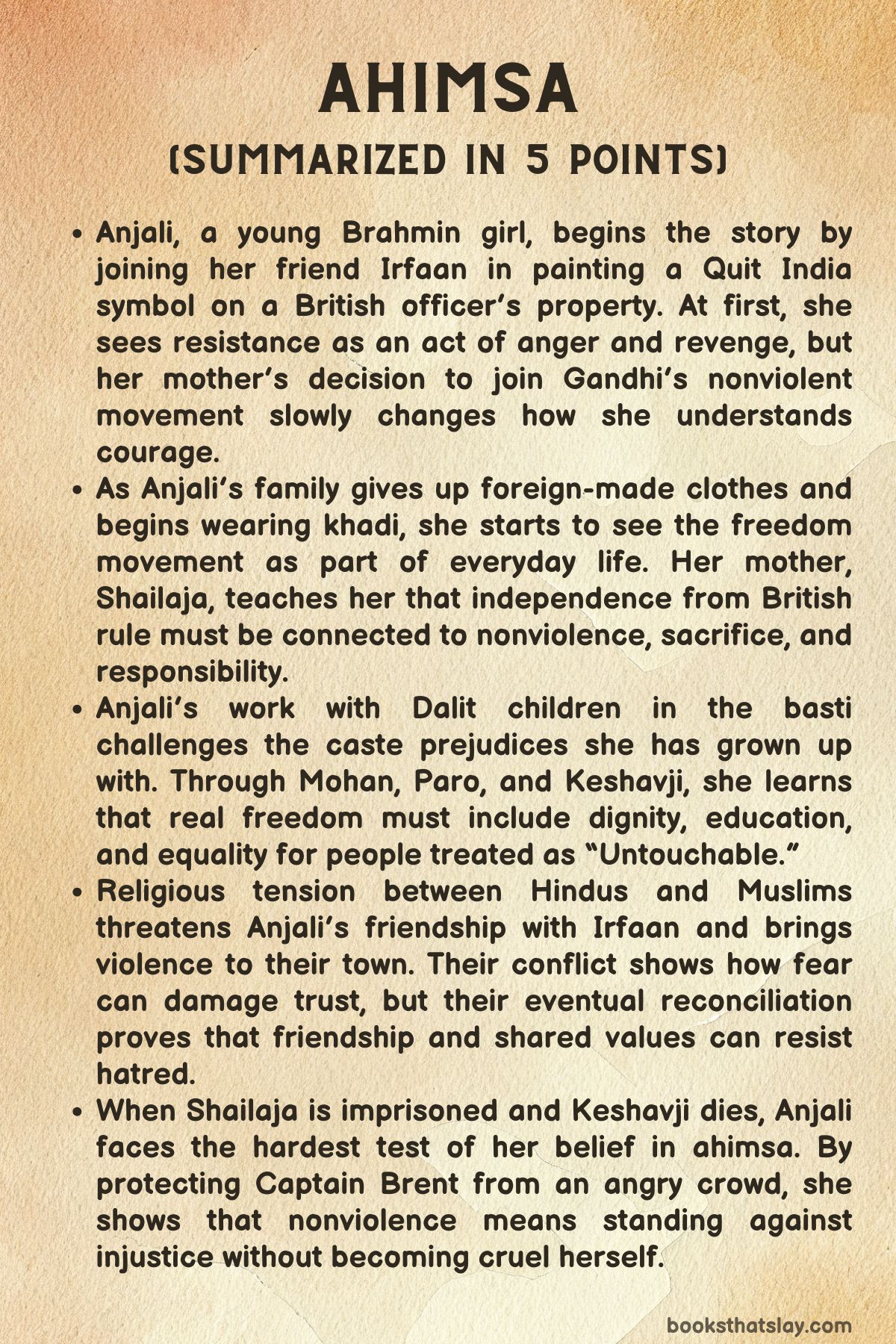
Ahimsa begins with Anjali, a young girl from a Brahmin family, and her Muslim friend Irfaan sneaking out to paint a “Q” on the property of Captain Brent, a British officer. The letter stands for “Quit India,” and Anjali sees the act as revenge because her mother, Shailaja, has recently lost her job working for the captain.
Anjali does not fully understand what happened, but she knows her parents have been arguing, and she believes Captain Brent is to blame. When the two children are caught, they are taken to the captain’s house, where Anjali’s mother is waiting after attending a meeting.
A desperate woman arrives to beg for her son’s life because he has been sentenced to hang for setting fire to a government building. Shailaja tries to defend the boy, then defends Anjali and Irfaan as well.
At home, Anjali begins to learn why her mother has changed. Gandhi’s message of nonviolent resistance has reached their town, and families are being asked to give one member to the freedom movement.
Since Anjali’s father must keep working to support the family, Shailaja decides she will join. This shocks Anjali, especially because her great-uncle Chachaji believes women should stay at home and disapproves of Shailaja’s independence.
Anjali learns that the Quit India movement is not about hurting the British but about resisting unjust rule through ahimsa, or nonviolence.
Shailaja’s commitment soon changes the family’s daily life. The family burns foreign-made clothes and begins wearing khadi, homespun Indian cloth.
Anjali is upset to lose her beautiful clothes, especially with Diwali approaching, but she gradually becomes proud of wearing khadi. Shailaja brings a spinning wheel to Anjali’s school to demonstrate how Indian cotton can be made into cloth at home.
Though Shailaja struggles at first, Anjali discovers that she has a talent for spinning, and the freedom movement starts to feel less distant and more personal.
The family’s activism expands beyond resisting British goods. Shailaja challenges caste prejudice when she treats Mohan, a Dalit boy who cleans their outhouse, with kindness.
Anjali has grown up thinking of Dalits as “Untouchables,” people who must not share food, temples, or space with higher castes. Shailaja explains that Gandhi calls them Harijans, or children of God, and wants society to stop treating them as unclean.
Anjali accompanies her mother to a freedom fighter meeting, where Keshavji Parmar, a Dalit leader and radio announcer, says that the struggle for India’s freedom must include equality among Indians.
Shailaja announces that she and Anjali will help educate Dalit children in the basti. At first, Anjali feels proud, but her visit to the basti challenges her assumptions.
She meets Paro, a friendly girl, and tries to give sweets to the community for Diwali. An older woman explains that she was once punished brutally for using a well meant for higher-caste people, so she fears that accepting help will bring danger.
Mohan is especially angry. He tells Anjali that changing the word from “Untouchable” to “Harijan” does not change the suffering his people face.
Later, he explains that he prefers the word Dalit, meaning oppressed, and that Dr. Ambedkar speaks more truly to his experience than Gandhi does. Anjali begins to understand that good intentions are not enough if she does not listen to the people she wants to help.
Shailaja and Anjali continue teaching in the basti, and they also begin cleaning their own outhouse so Mohan is not forced to do it. The work is difficult and humiliating for Anjali, but it makes her recognize how unfair it is that Dalits have been made to do such work for generations.
She grows closer to Mohan and Paro and starts to imagine real change. She decides that Dalit children should attend her school.
Her teacher supports the idea, but many parents resist. Some threaten to remove their children.
Through persistence, argument, and help from others, Anjali helps secure a small victory: Dalit children will be allowed to attend, though they are still expected to sit at the back.
At the same time, Hindu-Muslim tensions grow in the town. Anjali sees people turn against Irfaan and his family, even though Irfaan has always been like a brother to her.
A shopkeeper insults Irfaan’s father and suggests that Muslims will leave India if the British go. Soon, riots break out.
Anjali sneaks out to find Irfaan and witnesses violence between Hindu and Muslim groups. She tries to save frightened goats from a burning shop and is rescued by Captain Brent.
The next day, Irfaan angrily accuses her of being involved when hateful words against Muslims are painted near his family’s dairy. Anjali is hurt and angry, and for a moment she blames Muslims too.
Her mother reminds her that India needs both Hindus and Muslims, just as grass needs water.
Violence and fear spread. Someone writes “Unclean” on Anjali’s family property because of their work with Dalits.
Young men threaten Shailaja. At a meeting in the Khadi Shop, Keshavji warns that riots are worsening and that the British may use the unrest as an excuse to stop school integration.
Shailaja insists they must continue through nonviolence. Soon after, police arrest Shailaja and Keshavji, accusing them of inciting unrest.
Anjali is devastated. Her father tries to secure Shailaja’s release but fails.
With her mother in prison, Anjali struggles to keep going. She visits the basti, and Mohan tells her more about his life.
His mother died because no one would properly treat her illness, and she had taught him to make necklaces. Anjali encourages him to sell them, believing people may buy them if they see their beauty.
A British woman does buy one, giving Anjali hope. But later, when Suman receives one of Mohan’s necklaces, people attack him.
Mohan is badly hurt and leaves, telling Anjali that she is not changing the world. His words crush her, and she begins to doubt everything.
The situation worsens when the school is looted and destroyed. Anjali feels that every effort has failed: her mother is in prison, Mohan is gone, Irfaan is distant, the school is damaged, and the town is divided.
Still, she keeps searching for a way forward. During Holi, she visits the basti and finds her teacher there.
Together they decide to hold school outside under a peepal tree, where no one will have to sit in the back. Meanwhile, Anjali and Irfaan begin to repair their friendship after Nandini, Anjali’s beloved cow, falls ill and Irfaan’s family helps save her.
Nandini gives birth to a calf, and Anjali names it Ahimsa.
The outdoor school begins with only the children from the basti, Irfaan, and the teacher. Anjali feels discouraged, but then Suman and other classmates arrive, showing that change may be slow but possible.
Soon after, Keshavji dies in police custody. During his funeral procession, Captain Brent orders the Khadi Shop closed, and the crowd turns violent.
People who had once spoken of nonviolence rush toward the police and then toward Captain Brent, who is injured. Anjali sees that he may be killed.
Remembering the meaning of the movement, she stands over him and shouts, “Ahimsa.” Irfaan joins her. Their voices calm the crowd, and people step back in shame.
Captain Brent later comes to Anjali’s home with a pardon for Shailaja. The next morning, Anjali helps paint a new sign for the school, with Paro writing the letters.
When Anjali and her father go to the prison, Shailaja is weak but overjoyed to hear about the school. As they leave, Anjali sees a peacock feather, once a symbol she believed could make bad things better.
This time she steps over it, no longer needing a sign. She has learned that freedom is not a wish or an omen; it is built through courage, truth, listening, and nonviolence.
Characters
Anjali
Anjali is the emotional center of the story and the character through whom the reader sees the shift from childish certainty to moral awareness. At the beginning, she is bold, impulsive, and full of anger at British rule, but her understanding of justice is still narrow.
Painting the Quit India symbol feels brave to her, yet she does not fully understand the meaning of nonviolence or the larger responsibility behind political resistance. She also begins with caste prejudices that she has inherited from society.
She assumes that Dalits are separate from her world and does not immediately question why Mohan and others are treated as unclean. Her growth comes through discomfort.
She loses her fine clothes, faces ridicule at school, cleans the outhouse, teaches in the basti, argues for Dalit children to attend school, and experiences the pain of losing Irfaan’s friendship during communal tension. These events force her to see that freedom cannot be limited to removing British rule.
It must also include equality, dignity, and courage within Indian society itself. By the end, Anjali becomes braver in a deeper way.
She does not simply defy authority; she protects even Captain Brent when the crowd turns violent. Her cry of “Ahimsa” shows that she has internalized the principle her mother tried to teach her.
Shailaja
Shailaja, Anjali’s mother, is one of the strongest moral forces in Ahimsa. Educated, intelligent, and independent, she challenges both British authority and the restrictive expectations placed on women.
Her decision to join the freedom movement changes the entire household, but it is not presented as an easy or perfect choice. She doubts herself, makes mistakes, and learns from others.
At first, she accepts Gandhi’s use of the word Harijan without understanding why Mohan finds it insulting. She also regrets burning the family’s foreign clothes when she later realizes they could have been given to people in need.
These moments make her more human and believable. Her courage lies not in being flawless but in being willing to act, listen, and change.
She rejects caste prejudice by treating Mohan with respect, educating Dalit children, and cleaning her own outhouse. She also resists the idea that women should remain silent or confined to domestic life.
Her imprisonment becomes a painful but powerful symbol of sacrifice. Through Shailaja, the story shows that activism requires conviction, humility, and the willingness to keep working even when the results are uncertain.
Baba
Baba is gentle, patient, and thoughtful, serving as a steady guide for Anjali throughout the story. Unlike Shailaja, he does not join the movement publicly at first because he must support the family, but this does not make him passive.
His strength appears through quiet support, moral storytelling, and emotional steadiness. He often uses tales of Akbar and Birbal or historical figures to help Anjali understand complex situations without simply lecturing her.
These stories teach her about fairness, loyalty, empathy, and shared responsibility. Baba also reveals his own painful family history, explaining why he tolerates Chachaji’s difficult behavior.
This gives Anjali a more mature understanding of gratitude, obligation, and compromise. When Shailaja is arrested, Baba tries to free her and continues caring for Anjali, even while he is clearly frightened and heartbroken.
He does not always have the power to fix what is wrong, but he remains compassionate and principled. His rescue of Mohan from the mob and his support for the school show that his kindness is active, not weak.
Irfaan
Irfaan is Anjali’s closest friend and a vital figure in the story’s treatment of Hindu-Muslim relations. At the beginning, he shares Anjali’s spirit of rebellion, helping her paint the Quit India symbol and standing beside her in small acts of resistance.
Their friendship is warm and sibling-like, especially during Diwali when they exchange gifts despite belonging to different faiths. Through Irfaan, the story shows a version of India where religious difference does not have to create division.
However, the riots place enormous pressure on that friendship. When Muslims are blamed, threatened, and attacked, Irfaan becomes hurt and defensive.
His accusation that Anjali might have painted hateful graffiti reveals how fear can damage even deep trust. Anjali also briefly falls into the same trap by blaming Muslims after she is endangered in the riot.
Their eventual reconciliation is important because it is not presented as automatic. They must move through anger, pain, and suspicion before finding their way back to each other.
Irfaan’s voice joining Anjali’s cry of “Ahimsa” near the end shows that their friendship has regained moral strength and that unity is possible even after fear has divided people.
Mohan
Mohan is one of the most important characters because he challenges Anjali’s assumptions more directly than anyone else. As a Dalit boy forced into cleaning outhouses, he has lived with humiliation, exclusion, and danger since childhood.
He does not accept easy comfort from higher-caste reformers, even when they mean well. His rejection of the word Harijan is especially significant because it teaches Anjali that oppressed people must be allowed to define themselves.
He prefers Dalit because it names the reality of oppression rather than hiding it behind a gentler phrase. Mohan’s anger is not bitterness without cause; it comes from lived experience.
His mother died because caste prejudice helped deny her proper care, and he knows that society sees him as less worthy than even stray animals. His skill in making necklaces shows his creativity and dignity, but the attack on him after Suman receives one of his necklaces proves how dangerous caste prejudice remains.
Mohan’s withdrawal after the attack is heartbreaking because it shows the cost of expecting the oppressed to carry the burden of change. He helps Anjali grow, but he is not simply a lesson for her.
He is a wounded, talented, proud young person trying to survive a cruel social order.
Paro
Paro represents openness, innocence, and the possibility of a different future. As a Dalit child in the basti, she has grown up under the same system that limits Mohan, but she responds to Anjali with more warmth and curiosity.
Her friendship with Anjali develops through small gestures: accepting sweets, learning lessons, offering information, and later giving Anjali a methi plant during Holi. That plant becomes more than a gift; it becomes a symbol of connection between households that society tries to keep apart.
Paro’s eagerness to learn also strengthens Anjali’s commitment to school integration. She shows what is at stake in the fight for education.
If children like Paro are allowed to learn, they may have choices that previous generations were denied. Her role in writing letters on the new school sign near the end is especially meaningful.
It suggests that she is not only receiving help but also helping create the new world the characters are trying to build.
Keshavji Parmar
Keshavji is a principled freedom fighter and Dalit leader whose role deepens the story’s understanding of justice. He supports the struggle against British rule, but he also insists that independence must include equality for Dalits.
His conversations with Shailaja and Anjali are important because he does not flatter their efforts or let them remain comfortable in their good intentions. He explains that privileged people often misunderstand the lives of those they are trying to help.
He also helps Anjali understand that Gandhi can be both admirable and wrong in certain ways, especially regarding Dalit representation and identity. Keshavji’s maturity lies in his ability to support the freedom movement while still criticizing its blind spots.
His death in custody becomes a turning point because it exposes the violence of colonial power and the danger faced by those who speak against injustice. Yet the chaos after his death also tests the very principle he stood for.
When the crowd becomes violent, his teachings are nearly lost until Anjali and Irfaan restore the call for nonviolence.
Captain Brent
Captain Brent is the main representative of British colonial authority in the town. He is dismissive, proud, and often cruel in the casual way of someone who believes his power is natural.
His statement that Indians are replaceable reveals how little he values the people under his rule. He refuses mercy to the young man sentenced to hang and later refuses to pardon Shailaja at first, even when Anjali pleads for her.
However, he is not written as a simple monster. He saves Anjali during the riot, and his reaction when she points out that violence has continued after her mother’s arrest suggests that he is capable of recognizing truth, even reluctantly.
His eventual pardon of Shailaja does not erase his role in an unjust system, but it does show that Anjali’s commitment to nonviolence affects him. When she protects him from the mob, she refuses to become like the violence she opposes.
Captain Brent’s character helps test the meaning of ahimsa: it is hardest, and most powerful, when extended even toward an enemy.
Chachaji
Chachaji represents tradition, fear, and resistance to social change. He disapproves of women working, dislikes Shailaja’s activism, believes in caste boundaries, and often criticizes the family’s choices.
At first, he seems mainly rigid and unsympathetic. Yet the story gives him a painful memory from childhood, when he tried to save a calf and saw it slaughtered in front of him.
This memory explains some of his fear: he believes that standing up against cruelty can lead to worse suffering. His opposition to change is not excused, but it becomes more understandable.
He is shaped by a world where challenging power can be dangerous. Still, he is not entirely fixed.
When Nandini needs methi after giving birth, Chachaji brings the plant Paro gave Anjali, even though he had earlier refused to eat anything connected to it. This action suggests a small but real shift.
He may not transform completely, but he begins to act beyond the prejudices he has defended.
Jamuna
Jamuna, the family’s maid, reflects the views and fears of many ordinary people living through social unrest. She is part of Anjali’s household and is close enough to witness the family’s changes, but she does not always share their ideals.
Her anger toward Muslims after her cousin’s basti is attacked shows how quickly personal fear can become prejudice. She is not a villain; she is frightened, grieving, and shaped by the same divisions affecting the wider community.
Her reactions help show that social hatred does not exist only among political leaders or violent mobs. It enters kitchens, homes, and everyday conversations.
Through Jamuna, the story shows how difficult it is to practice unity when people are scared for their families and communities.
Suman
Suman begins as a classmate whose opinion matters greatly to Anjali. She represents social pressure, especially the fear of being mocked or excluded.
Anjali worries about Suman laughing at her khadi clothes, and Suman’s presence often reminds Anjali of how difficult it is to stand apart from one’s peers. Yet Suman is not entirely closed-minded.
When her mother considers withdrawing her from school to avoid Dalit students, Suman’s desire to remain at the top of the class helps keep her there. Later, her arrival at the outdoor school under the peepal tree becomes a hopeful sign.
Suman may not be driven by the same moral urgency as Anjali, but her choices show that social change can begin for mixed reasons. Even pride, competition, or curiosity can move someone into a space where deeper change becomes possible.
Masterji
Masterji, Anjali’s teacher, represents education as a force for social change. At first, he appears in a traditional classroom setting, correcting Anjali and maintaining discipline.
As the story develops, he becomes an ally in the effort to educate Dalit children and integrate the school. His support matters because institutions do not change through children’s dreams alone; adults with authority must also take risks.
When the school is damaged and he is forced into hiding, the fragility of progress becomes clear. His return to teach under the peepal tree shows resilience.
By agreeing to hold class outside, he helps create a space where the old seating rules lose their power. Masterji’s character shows that education is not only about reading and writing.
It is also about deciding who is allowed to belong.
Farhan
Farhan, Irfaan’s father, is a practical and generous presence. He helps provide supplies for the Dalit children who are preparing to attend school, showing that his commitment to justice extends beyond his own community.
As a Muslim man in a town increasingly filled with suspicion, he also becomes a target of prejudice. The shopkeeper’s insult about Muslims leaving India shows the hostility he faces, but Farhan continues to act with dignity.
His help when Nandini is ill becomes a turning point in repairing Anjali and Irfaan’s relationship. In that moment, care for a living creature becomes stronger than communal anger.
Farhan’s character quietly supports one of the story’s central ideas: people from different religious communities are not threats to one another but neighbors whose lives are connected.
Nandini
Nandini, the family cow, is not a human character, but she has strong emotional importance for Anjali. Anjali turns to Nandini when she is upset, treating her as a source of comfort and understanding.
Since cows are sacred in Anjali’s Hindu household, Nandini also reflects the cultural world Anjali comes from. Her illness brings Anjali back to Irfaan’s family, helping repair a friendship damaged by religious conflict.
The birth of her calf, named Ahimsa, gives the novel a living symbol of renewal. Nandini’s role is quiet but meaningful: she connects Anjali’s private emotions to the larger themes of care, healing, and nonviolence.
Themes
Nonviolence as Courage
Nonviolence in Ahimsa is not shown as softness, weakness, or refusal to act. It is presented as one of the hardest forms of courage because it asks people to resist injustice without surrendering their humanity.
Anjali begins with a childish version of rebellion, believing that vandalizing Captain Brent’s property is a bold patriotic act. Her parents teach her that the Quit India movement is built on ahimsa, which means refusing to harm others even while opposing oppression.
This idea becomes more difficult as the story progresses. British rule is cruel, the police arrest innocent people, Keshavji dies in custody, and Captain Brent represents a system that has harmed Anjali’s family and community.
Under those conditions, anger feels natural. The most powerful test comes when the crowd turns on Captain Brent.
Anjali could have stood aside and allowed revenge to happen, but she protects him instead. Her cry of “Ahimsa” proves that nonviolence is not passive.
It requires moral discipline, physical bravery, and the ability to defend a principle even when hatred feels justified. The theme shows that true resistance is not only about defeating an enemy but also about refusing to become ruled by violence.
Freedom and Social Equality
Political freedom alone is not enough if society continues to deny dignity to its own people. The struggle against British rule runs throughout the story, but Anjali gradually learns that independence must include the destruction of caste prejudice, religious hatred, and gender inequality.
At first, she thinks of freedom mainly as Indians standing against the British. Her mother’s activism widens that view.
Shailaja argues that Dalit children deserve education, that women can work and lead, and that Indians must confront injustice within their own communities. Mohan’s experiences make this theme especially clear.
He is Indian, yet he cannot move freely through the town, attend school, receive respect, or sell his handmade necklaces without danger. His life exposes the hypocrisy of demanding national freedom while accepting caste oppression.
The Hindu-Muslim riots add another layer, showing that a divided India cannot become truly free. Anjali’s changing understanding reflects the story’s deeper argument: freedom must be measured by how the most excluded people are treated.
A country cannot claim liberty while some of its children are still called unclean, denied education, or attacked for their faith.
Listening, Learning, and Correcting Good Intentions
The story treats good intentions as important but incomplete. Shailaja and Anjali want to help Dalits, but they often begin from a place of privilege and misunderstanding.
When they bring prasad to the basti, they believe they are offering kindness and inclusion. The older woman’s story of being punished for using an upper-caste well reveals why accepting such gestures can be frightening.
Mohan’s anger at being called Harijan teaches Anjali an even harder lesson: a respectful-sounding word can still feel insulting if it ignores the way oppressed people understand their own lives. This theme is powerful because the story does not shame the characters for trying; instead, it asks them to listen better.
Keshavji helps Anjali and Shailaja see that the people with privilege are the ones who need to change most. Real allyship means accepting correction without becoming defensive.
Anjali’s growth depends on her willingness to hear Mohan’s pain, respect his preference for Dalit, and recognize that her first ideas may be incomplete. The theme shows that justice is not achieved by simply helping others from above.
It requires humility, attention, and the courage to admit when one has caused harm while trying to do good.
Friendship Across Division
Anjali and Irfaan’s friendship gives the story its most personal view of religious unity and communal conflict. Their bond begins with trust, mischief, shared holidays, and the easy closeness of children who see each other as family.
They exchange gifts during Diwali, and their religious differences are part of their lives without becoming barriers. When riots begin, that trust is damaged by fear.
Irfaan feels wounded by Hindu attacks on Muslim spaces, while Anjali feels threatened after being caught in violence involving Muslims. Both children briefly allow group blame to overpower personal knowledge.
Their conflict shows how communal hatred spreads: it asks people to forget the individuals they love and see only a religious label. The repair of their friendship is therefore deeply significant.
It does not erase the violence around them, but it proves that relationships can resist the logic of division. Irfaan’s family helping Nandini and Irfaan later joining Anjali in calling for ahimsa show that friendship can become a moral force.
Their bond suggests that unity is not an abstract political slogan. It is built in daily acts of loyalty, apology, shared risk, and the refusal to let fear decide who belongs.