Ain’t I A Woman Summary and Analysis
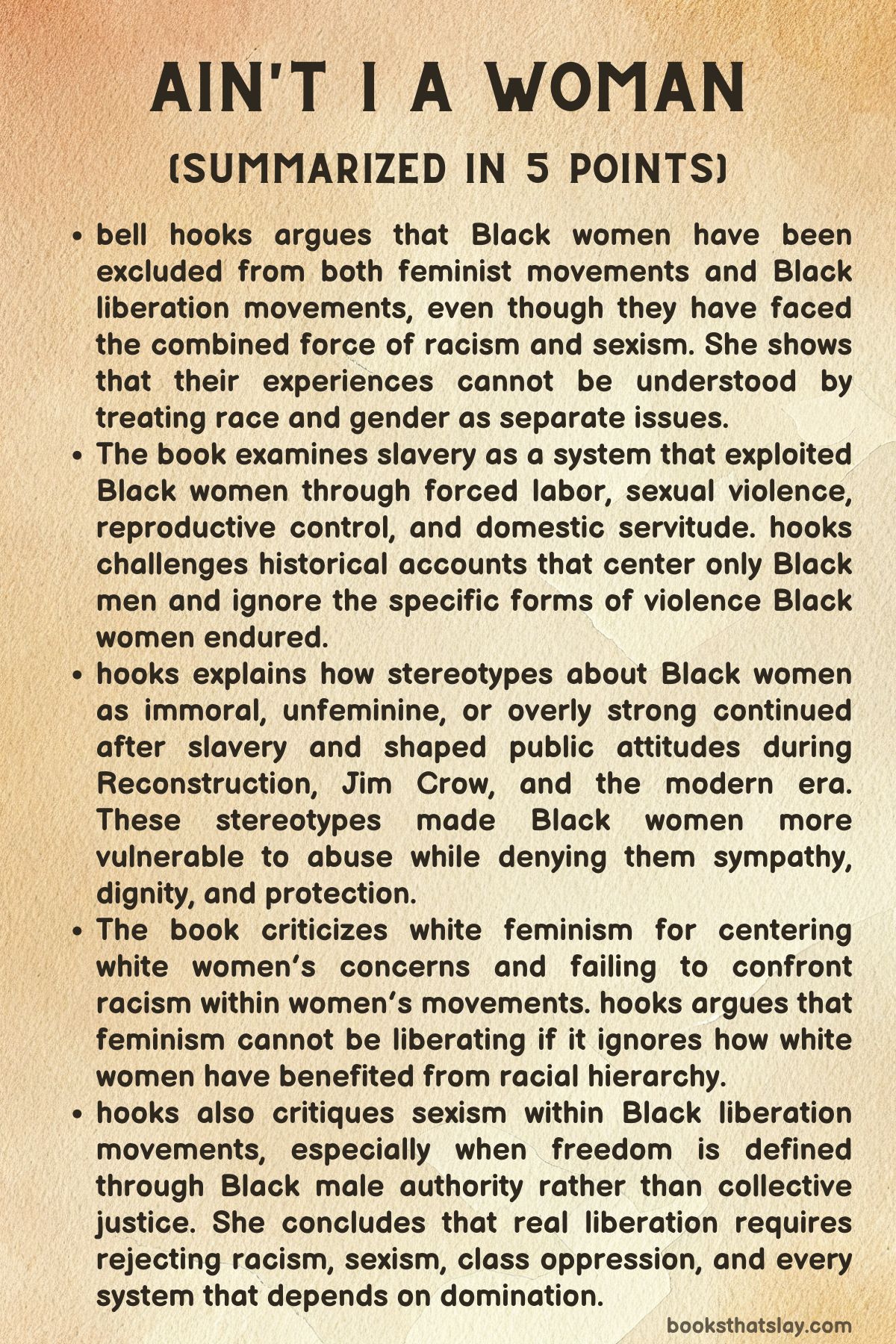
Ain’t I a Woman: Black Women and Feminism by bell hooks is a major work of Black feminist thought that examines how racism and sexism have shaped the lives of Black women in the United States. hooks argues that Black women have often been pushed to the margins of both feminist movements and Black liberation movements, expected to fight for others while their own experiences remain ignored.
The book traces this erasure from slavery through Reconstruction, suffrage activism, civil rights, Black Power, and modern feminism. Its central claim is clear: Black women’s oppression cannot be understood by separating race from gender.
Summary
Ain’t I A Woman studies the long history of Black women’s oppression in the United States and argues that Black women have been made invisible by both racist and sexist systems. bell hooks begins by addressing the women’s liberation movement and its failure to include Black women in any meaningful way.
She explains that Black women were often silent not because they had nothing to say, but because generations of violence, exclusion, and social conditioning had taught them that their pain would not be heard. They were expected to understand oppression mainly through race, while sexism was treated as secondary or irrelevant.
hooks challenges this view by showing that Black women have always faced both racism and sexism at the same time.
The book first places Black women within the history of slavery. hooks argues that discussions of slavery often focus on Black men and describe slavery mainly as an attack on Black masculinity.
She rejects this narrow view. While Black men were brutalized under slavery, Black women faced specific forms of violence because they were both Black and female.
They were forced into hard labor, domestic service, sexual exploitation, and reproduction for the benefit of enslavers. Their bodies were treated as property, labor, and sources of future enslaved children.
hooks emphasizes that sexual violence against enslaved Black women was not accidental or occasional. It was part of the system of domination that supported slavery and white patriarchal power.
She also shows how white society created different myths about white women and Black women. White women were idealized as pure, fragile, and morally superior, though still controlled by patriarchy.
Black women, by contrast, were portrayed as sexually immoral, aggressive, and unfeminine. This contrast allowed white men to defend white women’s supposed purity while abusing Black women without social punishment.
hooks argues that this devaluation of Black womanhood helped make violence against Black women seem acceptable to the wider society. Even abolitionist discussions of rape often focused more on the moral shame of white men than on the suffering of Black women themselves.
After slavery ended, the devaluation of Black women continued. During Reconstruction and the Jim Crow period, racist myths about Black women remained powerful.
Black women tried to claim dignity and respectability, but they were often mocked, attacked, or punished for stepping outside the inferior position white society assigned to them. hooks explains that Black women were still treated as sexually available and morally suspect, which made sexual violence against them easier to ignore.
White supremacist culture used stereotypes about Black women and Black men to maintain racial control, while laws and customs reinforced segregation and racial hierarchy.
hooks also examines interracial relationships and the politics behind them. She argues that white society became more accepting of relationships between Black men and white women than between white men and Black women because these pairings carried different meanings in a racist patriarchy.
A Black man with a white woman could still be seen within familiar ideas about male desire and female passivity. But a white man choosing a Black woman threatened the racial and gender order because it suggested that a Black woman could share in the status of a white man.
For hooks, this reaction reveals how deeply Black women had been denied social value.
The book then turns to patriarchy within Black communities and liberation movements. hooks argues that racism harmed Black men and women, but that Black men could still adopt sexist beliefs from the larger society.
She is careful not to excuse white male violence or white supremacy, but she also refuses to ignore Black male sexism. In her view, true freedom cannot be built on the domination of women.
During the civil rights and Black Power movements, many Black male leaders spoke of liberation in terms of restoring Black manhood, male authority, and patriarchal leadership. Black women often worked, organized, supported families, and sustained movements, yet they were pushed behind men in public recognition and leadership.
hooks criticizes the idea that Black women emasculated Black men by working, leading households, or showing independence. She argues that this belief blames Black women for social conditions created by racism, capitalism, and patriarchy.
Black women’s labor was often necessary for survival, but it was dismissed or devalued because it did not fit the patriarchal ideal of men as sole providers. Some Black women also accepted patriarchal values and judged Black men by impossible standards shaped by white male dominance.
hooks shows that both men and women can absorb oppressive ideas when those ideas are built into society.
A major part of Ain’t I A Woman focuses on white feminism and its failures. hooks argues that many white women understood sexism only in relation to their own lives and refused to confront the racism that shaped their position in society.
White women were oppressed by sexism, but they also benefited from white supremacy. Because of this, they often ignored Black women’s experiences or treated racism as a separate issue that distracted from women’s rights.
hooks insists that feminism cannot be serious about liberation while refusing to address racism, class hierarchy, and the ways white women have participated in oppression.
She traces this problem back to earlier women’s rights movements. In the 19th century, Black women such as Sojourner Truth and Anna Julia Cooper spoke clearly about the combined force of racism and sexism.
Yet white women’s movements often marginalized them. The fight for suffrage became divided when white women objected to Black men receiving the vote before women, while Black men often treated women’s suffrage as a threat to their own political advancement.
Black women were forced into an impossible position: support white women who did not fully support racial equality, or support Black men who did not fully support gender equality. Their own right to vote and their own freedom were rarely centered.
hooks argues that white women’s use of slavery as a metaphor for their own oppression was especially harmful. By comparing marriage or domestic life to slavery, white feminists often erased the actual history of enslaved Black women.
They spoke as if “women” meant white women and “Black people” meant Black men. This pattern left Black women outside both categories.
For hooks, this erasure is not a minor mistake. It shows how racism shaped feminist thought and how white women avoided examining their own racial privilege.
The final sections of the book focus on Black women’s relationship to feminism. hooks rejects the idea that Black women were absent from feminist struggle because they lacked interest.
Instead, she argues that they were often excluded, ignored, or forced to focus on racial survival in a society that gave them little safety. Black women formed their own organizations, protected young women, challenged stereotypes, and fought for education, dignity, and rights.
Figures such as Josephine St. Pierre Ruffin and Anna Julia Cooper recognized that Black women had to speak for themselves because neither white women nor Black men could fully represent their experiences.
hooks concludes that feminism must become a movement against all systems of domination, not simply a movement for white women’s equality with white men. A feminism that ignores racism will repeat the mistakes of the past.
A Black liberation movement that ignores sexism will also fail to create real freedom. The central message of Ain’t I A Woman is that Black women’s lives reveal how race, gender, class, and power work together.
To understand oppression honestly, society must listen to Black women not as symbols of strength or suffering, but as thinkers, workers, leaders, and full human beings.
Key People
Black Women
Black women stand at the center of hooks’s argument, not as fictional characters but as a historical and political group whose lives reveal the combined force of racism and sexism. In Ain’t I A Woman, they are shown as people repeatedly asked to serve movements that did not fully serve them in return.
Under slavery, Black women were treated as laborers, domestic workers, sexual objects, and reproducers of enslaved labor, which meant that their oppression was both racial and gendered. After slavery, the same society continued to mark them as immoral, unfeminine, overly strong, and undeserving of protection.
hooks presents Black women as silenced not because they lacked insight, courage, or political awareness, but because the structures around them made their speech costly and often ignored. They were pushed aside by white feminists who treated womanhood as white womanhood, and by Black male leaders who often defined liberation through male authority.
Their historical role is one of endurance, labor, resistance, and intellectual clarity, but hooks is careful not to romanticize their strength. She argues that survival under pressure should not be mistaken for freedom.
White Women
White women are analyzed as both oppressed by patriarchy and complicit in racism. hooks does not deny that white women have suffered under sexist expectations, domestic restriction, and male dominance, but she challenges the idea that this suffering automatically made them allies of Black women.
Many white women absorbed and repeated racist beliefs, even while speaking the language of women’s rights. In suffrage movements and later feminist movements, they often treated their own advancement as the central goal and viewed racial justice as a distraction or threat.
Their use of slavery as a metaphor for their own oppression is especially important in hooks’s critique, because it shows how easily they erased the actual experiences of enslaved Black women. White women wanted access to rights and public power, yet many did not want to give up the racial advantages granted to them by white supremacy.
hooks presents them as a group whose feminism remained limited when it failed to confront the power they held over Black women.
Black Men
Black men appear in hooks’s analysis as victims of racism who could also become agents of sexism. hooks examines how slavery, segregation, and white supremacy damaged Black men’s lives, but she rejects the claim that this suffering erased their ability to hold patriarchal power over Black women.
In her reading, Black men were often encouraged to define freedom through manhood, leadership, authority, and control of the household. This became especially visible in civil rights and Black Power rhetoric, where liberation was sometimes imagined as the restoration of Black male dominance rather than the freedom of all Black people.
hooks is critical of the idea that Black women were responsible for Black male suffering by being too independent, too strong, or too economically necessary. She argues that such claims misdirect blame away from racist and capitalist systems and place it on women who were already burdened.
Black men are therefore treated with both sympathy and criticism: sympathy for their racial oppression, and criticism for adopting patriarchal values that kept Black women subordinate.
White Men
White men represent the dominant force in the racial and patriarchal order hooks critiques. They hold institutional power through law, labor systems, sexual control, education, politics, and cultural representation.
In the history of slavery, white men treated Black women’s bodies as property and used sexual violence as a tool of domination. In the post-slavery era, they continued to benefit from myths that degraded Black women and elevated white womanhood.
hooks also shows how white male patriarchy shaped the values of other groups, including Black men and white women. White men did not need to be present in every scene of oppression for their power to remain active, because the structures they built continued to organize family life, political movements, labor, sexuality, and social value.
They are not analyzed simply as individual villains, but as the central beneficiaries and architects of a system that ranks people by race and gender.
Sojourner Truth
Sojourner Truth functions as an important figure of Black female resistance and political speech. hooks uses her as an example of a Black woman who understood that racism and sexism could not be separated.
Truth’s presence in women’s rights history is often used to suggest that early feminist movements were inclusive, but hooks challenges that simplified view. Truth’s voice was powerful precisely because she spoke from a position that white women often ignored: she knew that Black women were denied both the protections associated with womanhood and the rights associated with citizenship.
Her famous challenge to narrow ideas of womanhood exposed the false assumption that all women experienced sexism in the same way. In hooks’s analysis, Truth represents the Black women whose ideas were necessary to feminism but whose full participation was often resisted.
She is not merely a symbolic figure; she is evidence that Black women had long been naming the truth about intersecting oppression.
Anna Julia Cooper
Anna Julia Cooper is presented as a thinker who understood the importance of Black women speaking for themselves. Her role in hooks’s analysis is intellectual and political.
Cooper recognized that Black women occupied a distinct position and that their experiences could not be represented fully by white women or Black men. She argued for Black women’s education, self-expression, and leadership at a time when society treated them as inferior and morally suspect.
hooks values Cooper because she insisted that Black women’s voices were not secondary to broader movements; they were essential to any honest struggle for justice. Cooper’s importance lies in her refusal to accept silence as the price of belonging.
Through her, hooks shows that Black feminist thought did not emerge suddenly in the modern era. It had deep roots in the work of Black women who understood that race, gender, respectability, labor, and power were bound together in everyday life.
Josephine St. Pierre Ruffin
Josephine St. Pierre Ruffin represents organized Black women’s resistance to exclusion. When white women’s organizations failed to include Black women as equals, Ruffin helped create spaces where Black women could gather, speak, and define their own political priorities.
Her work shows that Black women were not passive observers of feminist history. They built organizations, addressed racial stereotypes, protected vulnerable women, and argued for a broader vision of women’s advancement.
hooks presents Ruffin as someone who understood that the liberation of women could not be meaningful if it advanced only white women. Ruffin’s activism also reveals how Black women were forced to do double labor: fighting the sexism that affected all women while also fighting the racism that white women’s groups often refused to confront.
She stands for the tradition of Black women creating their own institutions when existing movements denied them full recognition.
Malcolm X
Malcolm X appears in hooks’s analysis as part of a broader discussion of Black male leadership and patriarchal rhetoric. hooks recognizes the importance of Black resistance to white supremacy, but she also critiques forms of Black nationalism that imagined liberation through male dominance.
Malcolm X is presented as one of the figures whose language about gender reflected a desire to restore Black manhood and male authority. In this framework, Black women were often expected to support, serve, and strengthen Black men rather than claim equal leadership.
hooks’s treatment of Malcolm X is not a dismissal of his role in Black political history. Instead, she uses him to show how even powerful movements against racism could carry sexist assumptions.
His significance in the analysis lies in the tension between racial liberation and gender hierarchy. hooks asks readers to see that a movement cannot be fully liberating if women are asked to remain subordinate within it.
Amiri Baraka
Amiri Baraka is analyzed as a cultural and political figure whose work reflected the patriarchal elements of Black Power ideology. hooks critiques his vision of Black masculinity because it often relied on images of male strength, authority, sexual dominance, and female submission.
Baraka becomes an example of how revolutionary language can still reproduce oppressive gender roles. His emphasis on Black male power challenged white racism, but it also reinforced the idea that women’s freedom should be secondary to men’s restoration.
hooks is especially concerned with the way such rhetoric made patriarchy seem like part of racial pride. Baraka’s role in the analysis shows how art, politics, and gender ideology can reinforce one another.
He represents a larger cultural pattern in which Black women were asked to support liberation while being denied equal status within the liberated future being imagined.
Themes
The Erasure of Black Women
The erasure of Black women is central to hooks’s argument because Black women are repeatedly left outside the categories used to discuss oppression. When race is discussed, the focus often shifts toward Black men.
When gender is discussed, the focus often shifts toward white women. This leaves Black women in a position where their experiences are treated as secondary, unusual, or invisible.
hooks shows that this erasure has deep historical roots. During slavery, Black women were subjected to labor, sexual violence, reproductive exploitation, and domestic control, yet many accounts of slavery centered Black male suffering.
In feminist movements, white women often spoke as though their experiences represented all women, while ignoring the different realities created by race and class. In Black liberation movements, Black women were often expected to work for racial justice while staying silent about sexism within their own communities.
The result is a repeated denial of Black women’s full humanity. hooks challenges this by placing Black women’s experiences at the center of analysis and showing that their lives expose truths that single-axis thinking cannot reach.
Racism and Sexism as Connected Systems
Racism and sexism do not operate separately in hooks’s analysis. They support and strengthen each other, especially in the lives of Black women.
Under slavery, racism made Black women property, while sexism made their bodies available for gendered abuse. White society denied them the idealized protection associated with womanhood, yet still exploited them because they were women.
This contradiction shaped later stereotypes as well. Black women were portrayed as immoral, sexually available, aggressive, and unfeminine, which justified violence and neglect.
hooks argues that attempts to discuss race without gender, or gender without race, produce incomplete and misleading accounts of oppression. Black women’s lives cannot be understood by adding racism and sexism together as separate burdens.
Their oppression is formed through the combined action of both. Ain’t I A Woman insists that any movement for justice must address this combined structure directly.
A feminism that ignores racism protects white privilege, while a racial justice movement that ignores sexism protects male dominance. Neither can create real freedom.
The Limits of White Feminism
White feminism is criticized for treating white women’s experiences as universal while refusing to fully confront racism. hooks shows that many white women wanted liberation from male dominance but did not want to surrender the racial power they held over Black women.
This contradiction weakened feminist movements from their earliest stages. In suffrage activism, white women often opposed Black male political advancement because they feared being placed beneath Black men in the social order.
At the same time, they did not consistently fight for Black women’s political rights. Later women’s movements repeated this pattern by centering middle-class white women’s concerns and treating racism as a separate issue.
hooks argues that white women’s oppression under patriarchy did not prevent them from absorbing racist ideas or acting as racist oppressors. This is one of the book’s strongest challenges: suffering in one system does not automatically make a person innocent in another.
For feminism to become a force for liberation, it must require self-examination from white women and must reject any version of equality that leaves racial hierarchy untouched.
Patriarchy Within Liberation Movements
Liberation movements can reproduce oppression when they define freedom through male power. hooks examines how some Black male leaders and thinkers responded to racism by emphasizing manhood, authority, and control of women.
Instead of imagining freedom as collective transformation, they sometimes imagined it as the restoration of patriarchal leadership in the home, politics, and culture. Black women were then expected to serve the race by supporting men, raising families, and suppressing their own objections to sexism.
hooks argues that this model cannot produce freedom because it replaces one form of domination with another. Patriarchy damages women directly, but it also limits men by teaching them to measure power through control.
The book’s critique is not aimed at weakening racial justice movements; it is aimed at making them more honest and complete. A movement that fights white supremacy while accepting male supremacy leaves Black women trapped between loyalties.
hooks insists that genuine liberation must reject domination in all its forms, including the forms that appear inside movements for justice.