AI Superpowers Summary and Analysis
AI Superpowers by Kai-Fu Lee is a clear, urgent look at how artificial intelligence is reshaping global power, business, work, and human purpose. Lee writes from the rare position of someone who has worked inside both Silicon Valley and China’s technology world, and he explains why China and the United States have become the two central forces in AI.
The book is not only about machines, data, and competition. It is also about people: entrepreneurs, workers, families, patients, caregivers, and societies trying to decide what human value means when machines can perform more tasks than ever before.
Summary
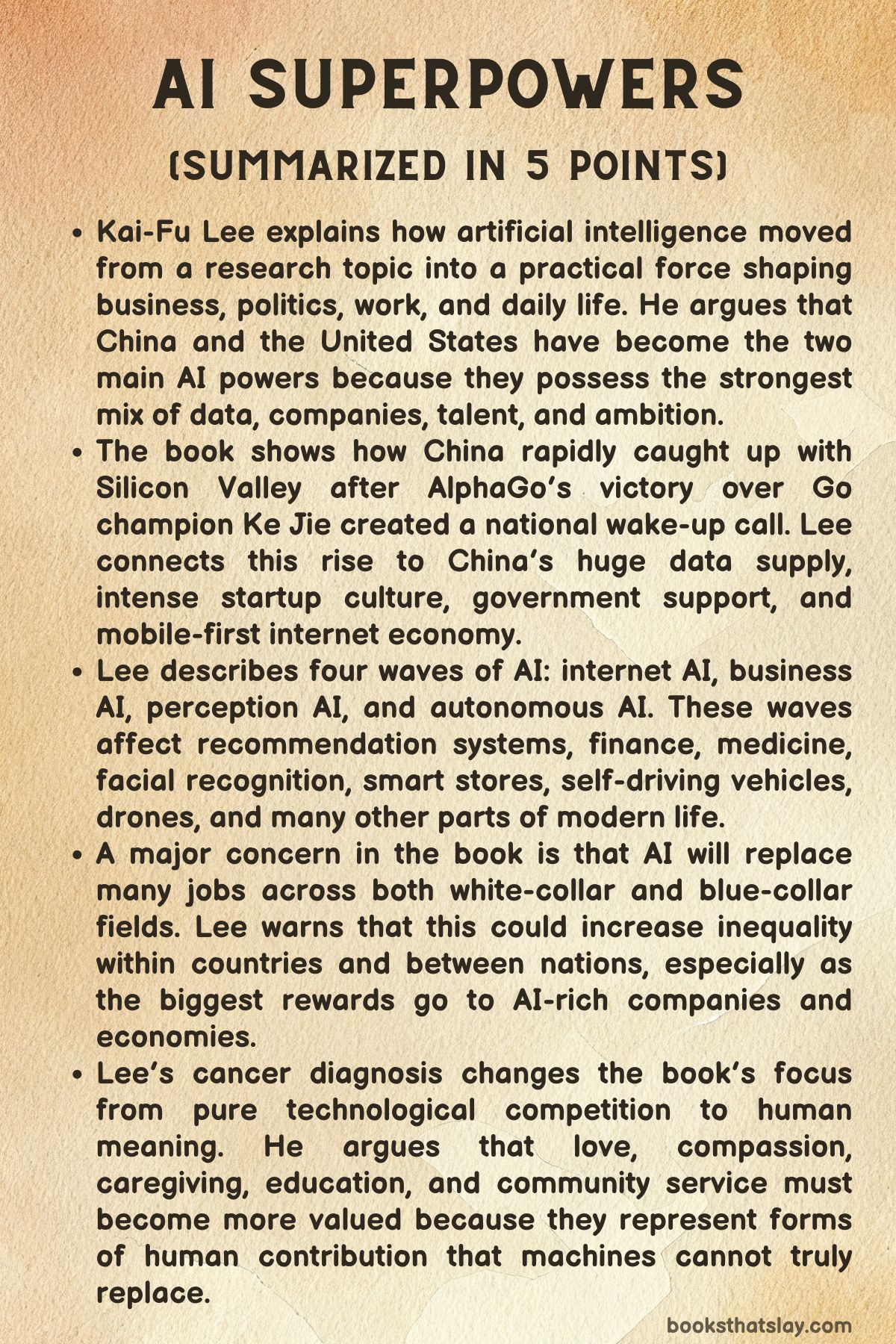
Kai-Fu Lee’s AI Superpowers explains how artificial intelligence moved from a specialized research field into one of the most important forces shaping the modern world. Lee begins by describing his role as a venture capitalist and technology leader who often speaks about AI to business executives, politicians, students, and children.
He notes that people from very different backgrounds tend to ask similar questions: What will machines be able to do? Will humans lose control?
How should society prepare? For Lee, these questions are no longer science fiction.
AI is already part of ordinary life, and its influence is growing quickly.
The book’s central argument is that the age of AI will be defined mainly by two countries: the United States and China. The United States had an early lead because of Silicon Valley, world-class universities, elite researchers, and companies such as Google, Microsoft, Facebook, and Amazon.
China, however, has caught up with extraordinary speed. Lee explains this shift through the example of AlphaGo, Google DeepMind’s Go-playing AI, which defeated the Chinese Go champion Ke Jie.
Go has deep cultural importance in China, and AlphaGo’s victory shocked the country. Lee compares the event to a national wake-up call.
It convinced many Chinese citizens, entrepreneurs, and officials that AI would define the next era of global competition.
Lee then explains how deep learning changed the nature of AI. Earlier approaches depended heavily on human-made rules, but deep learning systems improve by training on huge amounts of data.
This shift favors countries and companies that can gather, label, and use enormous data sets. China has a major advantage here because of its huge population, mobile-first internet culture, dense cities, and rapid adoption of digital payments.
AI no longer depends only on a small group of brilliant researchers. It also depends on engineers, entrepreneurs, policy support, and, above all, data.
A large part of the book examines China’s technology culture. Lee argues that Western observers often misunderstand Chinese companies by dismissing them as copycats.
He does not deny that many Chinese startups began by imitating American websites and apps. Instead, he argues that copying helped Chinese entrepreneurs learn fast, compete hard, and adapt products to local needs.
He uses the career of Wang Xing to show how Chinese founders moved from imitation to innovation. Wang first copied Western platforms, but later created major Chinese services that succeeded because they understood Chinese users better than foreign competitors did.
Lee presents Chinese entrepreneurship as intense, practical, and combative. In his view, Silicon Valley values originality, elegant ideas, and relatively open competition.
China’s internet market, by contrast, has often rewarded speed, toughness, local knowledge, and a willingness to fight for users in every possible way. Chinese companies do not simply build digital platforms and wait for others to provide services.
They often build complete systems: payment tools, delivery networks, customer support, offline operations, and subsidies to accelerate adoption. Lee calls this a “heavy” approach, and he believes it gives China a strong advantage in turning AI into real-world services.
The rise of WeChat is one of Lee’s main examples. WeChat is not just a messaging app.
It handles payments, appointments, transportation, shopping, social media, business communication, and many daily tasks. Its digital wallet became hugely popular partly through the red envelope feature, which adapted a Chinese New Year tradition into a mobile payment tool.
This example shows how Chinese technology companies succeed by building around local customs and habits. Chinese users also moved directly from cash to mobile payments, while many Americans continued using credit cards.
This helped China create a large, data-rich mobile economy that is highly useful for AI development.
Lee identifies four major waves of AI. The first is internet AI, which powers recommendations, feeds, advertising, ecommerce, and entertainment platforms.
Both China and the United States are strong in this area, though China’s massive user base and mobile ecosystem give it an edge. The second is business AI, where algorithms use structured data to make decisions in fields such as loans, insurance, medicine, and legal support.
The United States has an advantage here because many American institutions have long histories of organized data collection. China is catching up, but its business data systems are often less mature.
The third wave is perception AI. This allows machines to process sensory information such as images, speech, faces, and voices.
Lee sees this as the stage where the online and offline worlds begin to merge. Facial payment systems, smart stores, speech recognition, and intelligent sensors are examples.
China’s dense urban environments and openness to rapid deployment may help it lead in this area. The fourth wave is autonomous AI, where machines move through and act in the physical world.
Self-driving cars, drones, robots, and automated warehouses belong to this wave. The United States has a technical lead in some areas, especially autonomous vehicles, but Lee believes China’s ability to redesign infrastructure and support large-scale trials may allow it to deploy these technologies faster.
The book also compares the policy environments of China and the United States. Lee argues that China’s government is highly willing to support AI through funding, infrastructure, national plans, and local experimentation.
He describes this as a techno-utilitarian mindset: the government pushes technology forward for broad economic and social goals, even when some individuals or industries face disruption. The United States, by contrast, has stronger public debate, more legal barriers, and a political system that often punishes waste or failure.
These differences may slow American deployment, even when American companies remain technically strong.
After describing AI’s rise, Lee turns to its dangers. He believes the most realistic crisis is not killer robots or machine consciousness, but mass job displacement.
AI will not only automate factory labor. It will also affect white-collar roles that involve pattern recognition, routine decisions, data analysis, and predictable service work.
Cashiers, drivers, radiologists, loan officers, translators, and many others may face pressure. Lee argues that AI could increase productivity while reducing wages and employment opportunities for many workers.
He predicts serious disruption, though he also believes policy choices can reduce the damage.
Lee’s concern is not only economic. He worries that AI will deepen inequality within countries and between countries.
The biggest gains will flow to the companies and nations that own the best data, algorithms, engineers, and platforms. The United States and China may become far richer and more powerful, while countries without strong AI ecosystems may fall further behind.
Within wealthy countries, highly skilled professionals and tech owners may benefit, while many ordinary workers lose security and dignity. This raises a deeper question: when machines can perform many tasks better than humans, what gives human life value?
The personal answer Lee offers comes from his own experience with cancer. He describes himself as someone who once treated life like an optimization problem.
He worked constantly, measured success by impact, and gave too little attention to family and emotional connection. His lymphoma diagnosis forced him to confront mortality.
While writing his will and reflecting on his regrets, he realized that professional achievement alone could not provide meaning. A conversation with Buddhist master Hsing Yun helped him see that his desire to “change the world” was partly driven by ego.
He came to believe that love, humility, and human connection matter more than status or productivity.
This personal transformation shapes Lee’s proposed solution to the AI age. He argues that humans must build an economy and culture that value what machines cannot truly provide: compassion, care, trust, moral judgment, and emotional presence.
AI may become better than doctors at diagnosis, but patients will still need human caregivers who comfort, explain, and support them. Machines may help teach, but children still need adults who encourage and understand them.
Elderly people may use smart devices, but they still need companionship.
Lee reviews common policy proposals such as worker retraining, job sharing, and universal basic income. He sees some value in all of them but finds them insufficient on their own.
Retraining can help some people but cannot turn everyone into an AI engineer. Job sharing may ease short-term pain but does not solve the larger issue of meaning.
Universal basic income may prevent poverty, but Lee worries that money alone cannot give people dignity, purpose, or belonging.
Instead, he proposes greater social investment in human-centered work. Care work, community service, and education should be treated as valuable careers, not low-status labor or unpaid sacrifice.
People who care for children, the elderly, the sick, and the disabled should receive better pay and respect. Volunteers who strengthen communities should be supported.
Lee imagines venture capitalists, governments, and civic institutions helping build a humanistic service sector that rewards compassion and social contribution.
By the end of AI Superpowers, Lee softens the language of rivalry. Although he uses the idea of an AI race to describe the technological competition between China and the United States, he warns that the future should not be treated only as a battle for dominance.
Different nations have different strengths: American innovation, Chinese execution, Japanese and Swiss craftsmanship, South Korean education, Canadian and Dutch volunteer cultures, and more. The best path forward requires countries to learn from one another.
The book closes with Lee’s belief that AI will force humanity to reconsider its priorities. Machines will become extremely powerful tools, and they will transform business, labor, medicine, transportation, and daily life.
But they will not replace the human need for love, care, and connection. Lee’s final message is that society should not measure people only by economic output.
In a world where machines can do more work, humans must become more human.
Key People
Kai-Fu Lee
Kai-Fu Lee is the central voice and guiding figure of AI Superpowers, and his role is more complex than that of a traditional narrator. He is not only explaining artificial intelligence from the outside; he is speaking as someone who has helped shape the industry from within.
His background as a scientist, executive, venture capitalist, and bridge between American and Chinese technology cultures gives him authority, but the book also shows his limitations and personal evolution. At first, Lee appears as a highly rational, work-driven figure who sees success through measurable achievement, influence, and productivity.
His early self-image is closely tied to ambition: he wants to maximize impact, change the world, and remain at the center of technological progress. This makes him an ideal observer of AI because he understands the mindset of optimization that drives both machines and modern business culture.
Lee’s character becomes more human and vulnerable when he describes his cancer diagnosis. Until that point, he presents himself almost like the systems he studies: efficient, calculating, and focused on outcomes.
His illness interrupts that identity. It forces him to confront the emotional costs of a life built around work and recognition.
The scene of him trying to write his will shows a man who suddenly recognizes the fragility behind his achievements. His memories of his mother, his missed family moments, and his past emotional distance reveal regret, but they also become the foundation for his later philosophy.
By the end, Lee becomes a changed thinker. He still believes AI will transform the world, but he no longer believes productivity should be the highest measure of human worth.
His final position is shaped by both technical knowledge and personal humility. He becomes a witness to two revolutions: the rise of AI and his own rediscovery of love, care, and human connection.
Ke Jie
Ke Jie represents human mastery facing the arrival of a new technological era. As the world champion of Go, he stands for discipline, intelligence, tradition, and the highest level of human strategic thinking.
Go is not just a game in the book’s context; it carries cultural weight, especially in China, where it has long been associated with patience, wisdom, and complex judgment. Ke Jie’s match against AlphaGo therefore becomes more than a sporting defeat.
It becomes a symbolic moment in which a machine surpasses one of humanity’s most admired mental abilities. His loss marks a shift in public imagination.
AI is no longer a distant tool that performs narrow mechanical tasks; it can now challenge human intuition in fields once thought to require almost artistic judgment.
Ke Jie’s role is brief but important because he gives the AI revolution an emotional and cultural face. Without him, AlphaGo’s achievement might seem like an abstract technical milestone.
Through Ke Jie, the reader sees how technological change can unsettle pride, identity, and national confidence. His defeat becomes China’s wake-up call, showing that AI is not simply a Western research project but a force that can affect Chinese culture, ambition, and policy.
He is not portrayed as weak or outdated. In fact, his greatness is what makes AlphaGo’s victory so meaningful.
By defeating someone of his stature, AI announces itself as a serious force. Ke Jie’s character therefore functions as a marker of transition: from human dominance in intellectual competition to a future where humans must rethink what mastery means.
Wang Xing
Wang Xing represents the rise of China’s entrepreneurial class and the shift from imitation to powerful local innovation. His career begins with copying successful Western platforms, but Lee uses him to challenge the simple idea that copying is merely dishonest or unimaginative.
Wang’s development shows that imitation can become a form of training, especially in a fast-moving and highly competitive market. By studying existing models, adapting them, and testing them in China’s unique environment, Wang learns how to build products that are not just duplicates but locally effective businesses.
His success reflects the broader evolution of Chinese technology culture from dependence on Silicon Valley ideas to the creation of a distinct internet ecosystem.
Wang is important because he embodies toughness, speed, and practical intelligence. He is not romanticized as a lone genius with a perfect original idea.
Instead, he is shown as a founder shaped by pressure, competition, and repeated attempts. His character reflects the “gladiator” atmosphere Lee associates with Chinese startups, where survival requires aggression, flexibility, and deep knowledge of consumer behavior.
Wang’s story also reveals one of the book’s key arguments: innovation does not always begin with originality. Sometimes it begins with copying, then improves through localization, execution, and relentless competition.
Through Wang, Lee presents Chinese entrepreneurship as messy, intense, and highly effective. He becomes a symbol of how China’s tech industry learned from the West and then built something that could compete on its own terms.
Jack Ma
Jack Ma appears as a major example of Chinese entrepreneurial adaptation and strategic defiance. As the founder of Alibaba, he represents the ability to take a Western model and reshape it for Chinese realities.
Alibaba may have begun as a counterpart to eBay, but Lee emphasizes that its success came from understanding local users better than its foreign rival did. Jack Ma’s importance lies in his refusal to treat China as a secondary version of the American market.
While eBay relied on its global experience and expected its model to transfer smoothly, Alibaba built itself around Chinese habits, expectations, and business practices. This made Ma a representative of local intelligence defeating imported confidence.
His character also reflects a broader shift in global technology power. Ma is not presented merely as a businessman who wins a market battle; he is a figure who exposes the weakness of companies that fail to adapt.
His success shows that technology is never purely technical. It depends on culture, trust, payment habits, communication styles, and the daily lives of users.
Ma’s victory over eBay demonstrates that China’s technology sector did not rise only because of government support or market size. It also rose because entrepreneurs like him understood how to serve Chinese consumers in ways outsiders did not.
In that sense, Jack Ma stands for confidence born from local knowledge. He helps show why China’s internet world became an alternate center of innovation rather than a copy of Silicon Valley.
Liu Qingfeng
Liu Qingfeng represents the movement from academic promise to applied AI innovation. As one of the students who attended Lee’s lecture on speech and image recognition, he begins as part of the generation that once faced limited access to advanced technology and learning resources.
His later success as the founder of iFlyTek shows how dramatically China’s AI landscape changed within a few decades. Liu’s work in speech technology, especially real-time translation and voice replication, demonstrates the practical power of AI to transform communication.
Through him, Lee shows that China’s rise is not only about data, government policy, or fierce entrepreneurs. It is also about technically trained people who turn research into usable products.
Liu’s character is connected to the theme of gradual transformation. The technology associated with him feels almost futuristic: speeches translated from English into Mandarin while preserving the speaker’s voice.
Yet Lee presents such innovation as part of a slow but steady change in business and daily life. Liu is not portrayed as a dramatic celebrity figure.
Instead, he stands for the serious engineer-founder whose work makes AI visible and useful. His presence also helps connect Lee’s earlier experiences in China with the country’s later achievements.
The students who once lacked access to the best tools eventually became leaders in AI applications. Liu therefore represents both personal accomplishment and national technological maturation.
Guo Hong
Guo Hong represents the role of government planning in China’s technology rise. His connection to the creation of Chuangye Dajie, the Avenue of Entrepreneurs, shows how Chinese innovation is often supported by deliberate policy rather than left only to private market forces.
Guo’s role is important because he stands for a model of state-backed entrepreneurship. In Lee’s description, China does not simply wait for a Silicon Valley-style ecosystem to emerge naturally.
Officials, investors, and founders work together to create physical spaces, incentives, and public messaging around innovation. Guo helps embody this system of organized technological ambition.
His character also highlights one of the clearest differences between China and the United States in the book. In America, startup culture is often described as organic, individualistic, and suspicious of too much government involvement.
In China, figures like Guo show a more coordinated approach, where public authority can actively push entrepreneurship as a national priority. This does not mean the system is free from problems, but Lee presents it as powerful in terms of speed and scale.
Guo’s importance lies less in personal drama and more in what he represents structurally: a government willing to build the conditions for mass entrepreneurship and rapid technological adoption. Through him, the book shows that AI leadership depends not only on brilliant engineers and bold founders but also on institutions that decide where resources and attention should go.
AlphaGo
AlphaGo is not a human character, but it functions as one of the most important presences in the book. It is the machine that turns AI from an expert topic into a public and cultural event.
By defeating Ke Jie, AlphaGo becomes a symbol of machine intelligence crossing a psychological boundary. It does not simply calculate faster than humans; it demonstrates strategic ability in a game associated with intuition and deep thought.
Because of this, AlphaGo has a character-like role as the challenger, the disruptor, and the messenger of a new age.
AlphaGo also helps define the emotional atmosphere around AI. For researchers, it is proof of deep learning’s power.
For Chinese citizens, it becomes a national shock. For entrepreneurs and officials, it becomes a signal that AI must be treated as a strategic priority.
The machine has no personality, but its effect on people gives it narrative force. It exposes the difference between knowing that AI is advancing and feeling that advancement personally.
In AI Superpowers, AlphaGo represents the moment when the future becomes impossible to ignore. It is the silent force that causes humans to reorganize their ambitions, fears, and policies.
Master Hsing Yun
Master Hsing Yun serves as a moral counterweight to the culture of ambition that dominates much of Lee’s earlier life. When Lee visits him after his cancer diagnosis, Hsing Yun does not respond to Lee’s desire to “maximize impact” with admiration.
Instead, he identifies that ambition as connected to ego and vanity. This moment is crucial because it challenges the values that had guided Lee’s career.
Hsing Yun’s role is not to reject achievement entirely, but to redirect Lee toward humility, love, and compassion. He gives the book its clearest spiritual correction.
Hsing Yun matters because he helps transform the book from a study of technological power into a reflection on human purpose. AI rewards efficiency, scale, and optimization.
Modern business often rewards the same things. Hsing Yun introduces a different standard.
He suggests that a meaningful life is not measured only by output or influence but by the quality of one’s relationships and the humility with which one serves others. His presence is brief, but his effect on Lee is lasting.
After this encounter, Lee’s policy ideas and social vision become more focused on care work, community service, and human dignity. Hsing Yun therefore functions as the person who helps Lee see that the answer to the AI age cannot be only technical or economic.
It must also be moral.
Bronnie Ware
Bronnie Ware appears through her work with terminally ill patients and their reflections near the end of life. She is important because her observations give Lee a language for understanding regret.
Her insight that people often wish they had lived more fully, loved more openly, and worked less obsessively directly challenges Lee’s old worldview. Through Ware, the book brings the reader into a space where professional success loses some of its power.
The final measure of life becomes not achievement but whether one has spent enough time on what truly matters.
Ware’s role is not that of a direct actor in the book’s events, but her influence is significant. She helps connect Lee’s personal crisis with a broader human pattern.
His regret is not unique; it is part of a wider experience among people who reach the edge of life and reassess their priorities. Her presence strengthens the book’s argument that AI should push society to rethink value.
If machines take over many productive tasks, humans may be forced to ask questions that people often avoid until illness or old age. Ware’s contribution helps Lee frame love, presence, and emotional honesty as central human needs rather than sentimental extras.
Steve Jobs
Steve Jobs appears as a figure of inspiration and reflection. Lee recalls Jobs’s commencement speech, especially the idea that life’s meaning often becomes clear only when looking backward.
Jobs’s role is important because he represents both technological ambition and personal wisdom gained through hardship. For Lee, the speech resonates because it speaks to uncertainty, mortality, and the inability to control every outcome.
In a book concerned with prediction, strategy, and future planning, Jobs introduces the idea that human life cannot be fully engineered in advance.
Jobs also helps Lee soften the competitive language around AI. His speech reminds Lee that progress is not only about winning races or dominating industries.
It is also about trust, experience, and the connections that become visible over time. Jobs functions as a mirror for Lee because both men are linked to technology, ambition, and illness.
Yet the lesson Lee draws from Jobs is not simply to innovate more boldly. It is to accept that meaning often emerges through vulnerability and reflection.
Jobs’s presence supports the book’s final movement away from pure competition and toward a more humane understanding of the future.
Themes
The Shift of Global Power Through AI
AI changes the balance of power because it rewards countries that combine data, engineering talent, entrepreneurship, and policy support. AI Superpowers presents the United States and China as the two strongest forces in this new order, but it does not treat their strengths as identical.
The United States has elite research institutions, major technology companies, and a long history of scientific leadership. China has huge amounts of data, fast-moving entrepreneurs, a mobile-first society, and a government willing to push technological adoption at national scale.
This contrast matters because AI is not only a laboratory achievement. It becomes powerful when it is applied across businesses, cities, payments, transportation, medicine, and daily routines.
Lee’s argument suggests that the old model of innovation, centered mainly on breakthrough research, is giving way to a model that also depends on implementation. China’s advantage lies in speed, scale, and practical deployment.
The United States remains deeply important because of its talent and corporate giants, but China’s rise proves that technological leadership can shift quickly when a country aligns market energy, consumer behavior, and state support around a single future. The theme is not simply about rivalry.
It is about how AI becomes a measure of national capacity.
Imitation as a Path to Innovation
Copying is presented not as the opposite of innovation but as one possible stage in its development. Lee challenges the Western habit of dismissing Chinese tech companies as mere imitators.
In his view, imitation allowed Chinese entrepreneurs to learn product design, user behavior, market timing, and competitive strategy. The key point is that copying alone was not enough.
Companies that survived had to adapt their products to Chinese culture, consumer habits, payment systems, urban life, and local expectations. This is why Alibaba could beat eBay in China and why WeChat could become far more central to daily life than any single American app.
The theme complicates the usual idea that innovation must begin with a completely original concept. In fast-changing markets, execution, localization, and relentless improvement can be just as important as invention.
Chinese entrepreneurs copied, but they also fought harder, moved faster, and built heavier business systems that controlled more of the user experience. The result was not a weaker version of Silicon Valley but a separate technology world with its own logic.
Lee’s treatment of imitation asks readers to reconsider what creativity means in business. Innovation can come from invention, but it can also come from adaptation under pressure.
The Human Cost of Automation
AI’s most immediate danger is not that machines become evil or conscious, but that they become useful enough to replace human labor on a massive scale. Lee argues that both white-collar and blue-collar workers are vulnerable, especially when their jobs involve routine decisions, pattern recognition, predictable movement, or data-based judgment.
This creates a serious social problem because work is not only a source of income. It is also tied to dignity, identity, routine, and social belonging.
If AI increases productivity while reducing the need for workers, society may become richer in output but poorer in human stability. The gains will likely flow toward the companies, countries, and investors that control the strongest AI systems, while displaced workers face insecurity and resentment.
Lee’s concern extends beyond individuals. Developing countries may lose the chance to grow through labor-intensive industries if AI allows wealthy nations to automate production.
This means automation could widen inequality both within nations and across the world. The theme is powerful because it treats technological progress as morally incomplete.
A society cannot call AI successful only because it makes services faster or companies more profitable. It must also ask what happens to the people whose skills are no longer valued by the market.
Love, Care, and Human Purpose in the AI Age
Lee’s personal illness changes the book’s answer to the question of human value. Before his cancer diagnosis, he measured life through achievement, influence, and productivity.
After confronting mortality, he begins to see love and compassion as the qualities that machines cannot replace. This theme gives the book its moral center.
AI may become better than humans at diagnosis, translation, financial analysis, driving, and many other tasks, but it cannot provide genuine emotional presence. A patient needs more than a correct medical result.
A child needs more than information delivery. An elderly person needs more than an efficient service device.
Human beings need recognition, warmth, patience, and care. Lee uses this insight to argue for a new social vision in which caregiving, education, community service, and emotional labor receive more respect and financial support.
This is not presented as a sentimental escape from technology. It is a practical response to a world where machines may take over many forms of productive work.
If society continues to value people only by economic efficiency, AI will make many lives feel worthless. If society values care, service, and connection, then the AI age can become a chance to rebuild human dignity around what people can uniquely give one another.