Akata Witch Summary, Characters and Themes
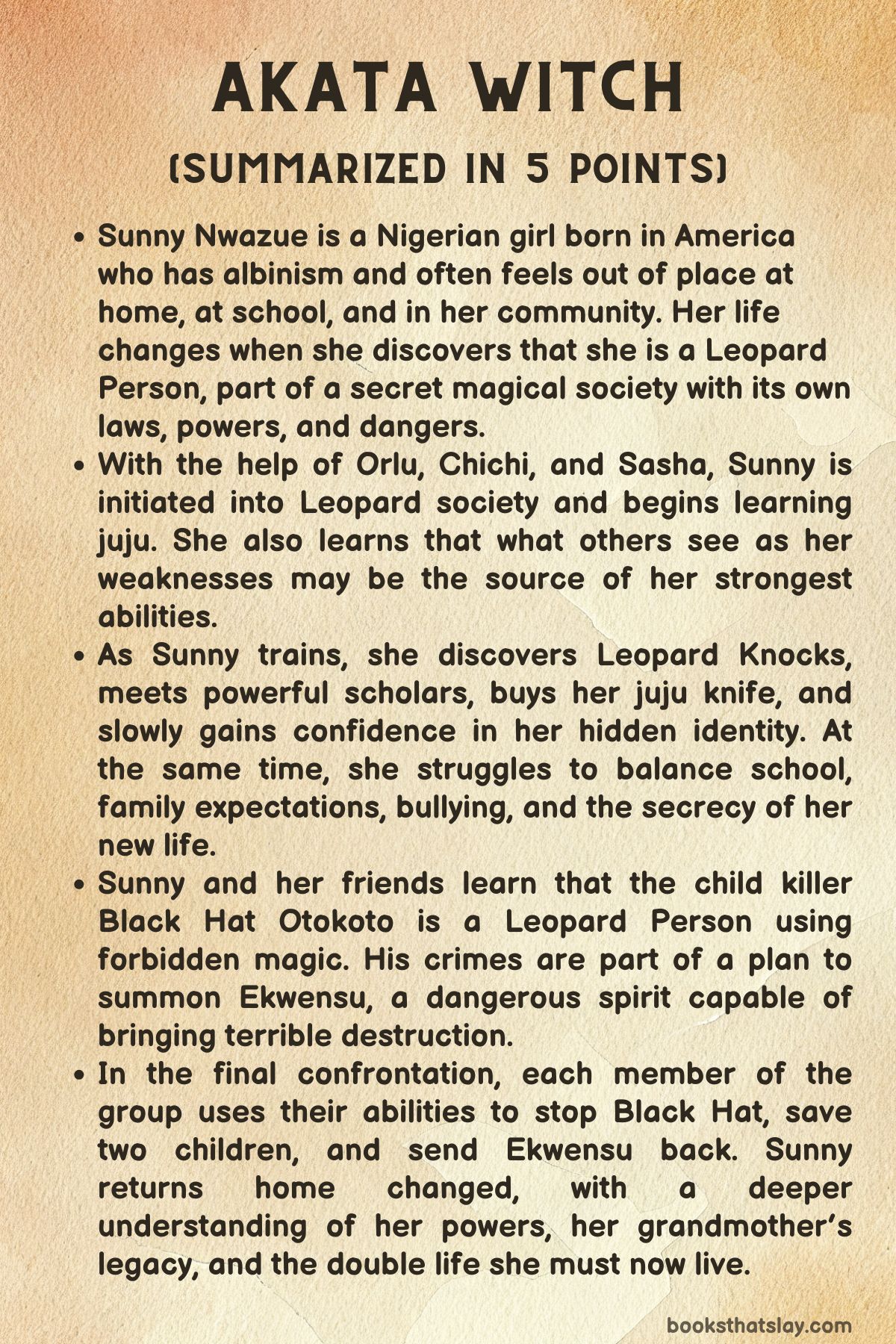
Akata Witch by Nnedi Okorafor is a fantasy novel about identity, power, courage, and belonging. Its heroine, Sunny Nwazue, is a Nigerian girl born in America who has albinism and often feels out of place at school, at home, and in her own skin.
Her life changes when she learns that she is a Leopard Person, part of a hidden magical society with its own rules, dangers, and traditions. As Sunny trains in juju and discovers her family’s secret past, she must face a terrifying killer whose plans threaten much more than her community. The book is the first book in The Nsibidi Scripts series.
Summary
Sunny Nwazue is twelve years old and lives in Nigeria, but she was born in the United States. Because she is American-born, Igbo, and has albinism, people often treat her as strange or hard to understand.
One night, while looking into a candle flame, Sunny sees a terrifying vision of the end of the world. The shock causes her to lean too close, setting her hair on fire.
This moment is frightening, but it also hints that Sunny’s life is connected to forces she does not yet understand.
At school, Sunny is bullied by other students. After her teacher asks Sunny to punish the class with a switch, Sunny refuses, but her classmates blame her anyway.
They call her insulting names, including “akata witch,” and a group of students later attacks her. A boy named Orlu Ezulike tries to stop them and walks home with her afterward.
Through Orlu, Sunny meets Chichi, a sharp, confident girl who lives nearby in a hut full of books. Chichi quickly suggests that Sunny may have powers.
Sunny soon learns that Orlu and Chichi belong to a secret magical society called the Leopard People. Ordinary people are called Lambs, while Leopard People can use juju and often have special natural abilities.
Orlu can undo harmful things, and Chichi has an extraordinary memory. Sunny is brought into their world through a magical trust knot that prevents her from revealing their secrets.
Though confused and uneasy, she is also drawn to what they show her.
Orlu and Chichi take Sunny to Anatov, a powerful scholar who recognizes that she is a Leopard Person even though her parents are not. Because she comes from a non-magical household, she is called a free agent.
Anatov initiates her, activating her abilities. During the process, Sunny is pulled through earth and water and returns changed, with chittim, the magical currency earned through knowledge, falling around her.
She also meets Sasha, an American Leopard boy from Chicago who has been sent to Nigeria after using forbidden juju against Lambs.
Sunny, Orlu, Chichi, and Sasha begin forming a close but uneasy group. They travel to Leopard Knocks, a hidden magical city, where Sunny learns about Leopard society, its levels of achievement, and its value for knowledge over ordinary money.
She discovers her spirit face, a hidden part of her Leopard identity, and begins to understand that her albinism is tied to her powers. After initiation, she no longer burns in sunlight, giving her the freedom to play soccer outside, something she has always wanted.
Training with Anatov is demanding and dangerous. Sunny studies magical books, learns basic juju, and begins to see how much she does not know.
She also learns that Leopard society is not perfect. Free agents are sometimes treated as ignorant, and many of the books she reads are biased.
Anatov teaches her that a Leopard Person’s greatest power often comes from what others see as a weakness. Sunny’s albinism gives her links to invisibility, the spirit world, and the future.
The four children are sent on difficult lessons, including a journey through Night Runner Forest to meet Kehinde, a major juju scholar. On the way, they face dangerous creatures and must work together to survive.
Chichi, Sasha, Orlu, and Sunny begin to function as a team, though their personalities often clash. Sasha is bold and impatient, Chichi is proud and daring, Orlu is careful and principled, and Sunny is still trying to understand where she belongs.
Meanwhile, Nigeria is frightened by a child killer called Black Hat Otokoto. Children are being murdered in ritualistic ways, and the danger grows closer to Sunny’s world.
Eventually, the children learn the terrible truth: Black Hat is not just a human criminal but a Leopard Person using forbidden juju. He is killing children as part of a plan to bring Ekwensu, a powerful evil spirit, into the world.
Sunny’s link to Black Hat is personal. After she breaks a major Leopard rule by using her spirit face to frighten a school bully, she is taken to the Obi Library for judgment.
There she meets Sugar Cream, the Head Librarian, who is severe but perceptive. Sugar Cream reveals that Sunny’s grandmother, Ozoemena, was a Leopard Person and had once mentored Black Hat.
He killed Ozoemena to steal her abilities. This discovery shocks Sunny and makes her family history feel both painful and important.
Anatov continues preparing the children. He takes them to Abuja, where Sunny buys her juju knife from the Junk Man.
The knife chooses her, cutting her hand, and she feels an immediate bond with it. In Abuja, the group attends a Leopard festival at Zuma Rock.
Sunny sees the beauty, pride, and brutality of Leopard culture. She is deeply disturbed by a wrestling match in which one fighter kills another, though the dead fighter becomes a guardian angel.
Anatov tells her that when things become bad, someone must stop the badness or die trying.
At the same festival, Sunny finally gets to play soccer in a major Leopard match. Many boys doubt her because she is a girl, but she proves herself through speed, skill, and courage.
Though her team loses by one point, Sunny earns respect and feels the joy of being seen for what she can do. This moment strengthens her confidence and shows that her identity is not limited by what others expect.
Not all events at the festival go well. Chichi, angered by a challenge from another student, uses dangerous juju from Udide’s Book of Shadows to call up a masquerade.
The act unleashes a frightening spirit full of stinging insects, and Orlu has to undo the danger. Chichi is punished, and the event exposes the risk of pride, recklessness, and magical power used for display.
As the threat from Black Hat grows, the weather turns unnatural, with rain falling for seven days during the dry season. Sunny and her friends are summoned to the Obi Library, where the scholars explain that Black Hat’s real name is Otokoto Ginny.
He became wealthy through oil dealings and has learned forbidden magic. He now intends to sacrifice two more children and summon Ekwensu fully into the physical world.
The scholars believe the four children are an Oha coven, a balanced group meant to face a great danger. Sunny is angry that adults expect children to do such a task, but there is no one else who can surprise Black Hat in time.
The four friends go to Black Hat’s gas station and find the evil juju surrounding it. Orlu uses his ability to undo the protection, revealing Black Hat’s hidden building.
Inside are two small children who appear dead. Sasha and Chichi fight attacking bush souls, while Sunny and Orlu try to rescue the children.
Sasha uses a conch shell to summon insects against Black Hat, and Chichi later calls on a charm connected to Sunny’s grandmother, bringing Black Hat’s past crimes back against him. Black Hat dies, but his death triggers the arrival of Ekwensu.
Ekwensu rises in a massive, terrifying form, and Sunny suddenly understands that she must act. Wearing her spirit face, she trusts her deeper self and performs juju without fully knowing how.
She commands Ekwensu to return, and the spirit is forced back into the earth. Orlu succeeds in reversing the juju on the two children, bringing them back to life.
Sasha survives, Chichi explains that Ozoemena helped through a vision, and the children are taken to the Obi Library, where Sugar Cream praises their success and agrees to mentor Sunny.
When Sunny returns home, her father is furious, but Sunny no longer feels helpless. Her mother reveals more about Ozoemena and admits she has long sensed that Sunny was connected to her grandmother’s secrets.
Sunny receives a box containing a letter from Ozoemena, who writes to her future grandchild with love and warning. Ozoemena explains her own hidden life as a Leopard Person and her ability to become invisible, the same power Sunny has inherited.
In the end, ordinary life resumes, but Sunny is no longer the same. At school, she talks with Orlu about lessons, mentors, and the strange reality of living two lives.
Sunny is still new to the Leopard world and has much to learn, but she has faced death, saved children, confronted a great evil, and discovered a family legacy. Her double life remains difficult, yet she now accepts that it is hers.
Characters
Sunny Nwazue
Sunny Nwazue is the central character of Akata Witch, and her journey is built around the painful and powerful experience of feeling out of place. She is Nigerian by heritage, American by birth, Igbo by ethnicity, and albino in appearance, which means people constantly misread her.
At school, she is mocked and treated as different; at home, she struggles under a strict father and a mother who withholds parts of the family past. Sunny begins the story unsure of herself, angry at her helplessness, and desperate to understand why she never seems to fit anywhere.
Her discovery that she is a Leopard Person does not immediately solve this problem, but it gives her difference a new meaning. What the ordinary world sees as weakness becomes the root of her magical strength.
Sunny’s growth comes from learning to trust herself while also accepting how little she knows. She is not raised in Leopard society, so she lacks the confidence and background knowledge that Orlu, Chichi, and Sasha have.
This makes her insecure, but it also gives her a questioning mind. She is often the one who notices when the adults are asking too much of children, and her anger at being used is reasonable.
Sunny is brave, but not blindly brave. She is afraid, confused, and sometimes resentful, which makes her courage feel earned.
Her ability to become invisible, connect to the spirit world, and see the future reflects her position between worlds. She has always felt unseen, but Leopard society teaches her how to turn invisibility into power.
Sunny’s relationship with her grandmother Ozoemena gives her identity a deeper foundation. Until she learns about Ozoemena, Sunny’s powers seem like an accident, but the revelation of her grandmother’s life shows that she belongs to a hidden family history.
This changes the way she sees her mother, her body, her heritage, and her future. By the end, Sunny has not become fully confident or fully trained, but she has changed from a girl who feels defined by other people’s labels into someone who can act when the world is in danger.
Her victory over Ekwensu is not just magical; it is a moment of self-recognition.
Orlu Ezulike
Orlu is calm, thoughtful, and deeply principled. From the beginning, he stands apart from the cruelty of Sunny’s classmates by defending her when she is being attacked.
His kindness is not loud or performative; it comes from a strong inner sense of fairness. As a Leopard Person, Orlu’s natural ability is to undo harmful things, and this gift reflects his personality.
He is careful, patient, and often the one who tries to restore balance when others act rashly. His dyslexia, which might be viewed as a weakness in ordinary school, becomes connected to his magical gift, showing that his mind works in a way that can repair what others damage.
Orlu often serves as the moral center of the group. He does not have Chichi’s hunger for challenge or Sasha’s impatience with rules.
He respects danger and understands that power requires restraint. This sometimes makes him seem cautious, but his caution is not cowardice.
When the group faces real danger, Orlu acts with quiet courage. His effort to undo Black Hat’s juju on the abducted children is one of the clearest examples of his character: he focuses on saving life rather than winning glory.
He is willing to exhaust himself completely if that is what healing requires.
His bond with Sunny is gentle and important. Orlu helps guide her into Leopard society without overwhelming her, and he often understands her fear better than the others do.
His affection for her develops softly, through protection, respect, and shared experience rather than dramatic declaration. Orlu’s presence gives the group steadiness.
Without him, their abilities could easily become chaotic or reckless. He proves that strength can be quiet, that intelligence can be nontraditional, and that the ability to undo harm is just as heroic as the ability to attack.
Chichi
Chichi is bold, brilliant, proud, and difficult. She does not attend ordinary school, lives in a hut filled with books, and has been raised deeply inside Leopard culture.
Her natural ability is a photographic memory, which suits her sharp mind and love of knowledge. She is often funny and exciting, but she can also be rude, impulsive, and too eager to prove herself.
Chichi introduces Sunny to the magical world, but she does so in a way that can be careless. She enjoys secrets, tests, and dramatic gestures, and she sometimes underestimates the emotional cost of dragging Sunny into dangerous situations.
Chichi’s pride is one of her defining traits. She knows she is gifted, and she wants others to know it too.
This confidence can be empowering, especially in a society where young girls are often underestimated, but it can also make her reckless. Her decision to summon a masquerade at the student social shows how badly her need to win can overcome her judgment.
She is not evil or cruel, but she is dangerously competitive. Her punishment after that event is necessary because it forces her to confront the difference between skill and wisdom.
At the same time, Chichi is loyal and courageous. She stands with Sunny, Orlu, and Sasha against Black Hat, and she plays a crucial role in defeating him.
Her connection to Nimm, her mother’s spiritual background, and her link to Ozoemena’s vision give her a powerful place in the final conflict. Chichi represents the thrilling and risky side of knowledge.
She loves learning, but she must learn that not every spell should be used simply because one knows how to use it. Her character shows that intelligence without humility can become dangerous, but intelligence joined with loyalty can help save lives.
Sasha Jackson
Sasha is energetic, rebellious, talented, and impatient with authority. He comes from Chicago and has already been punished for using juju against Lambs.
His backstory shows that he is not simply a troublemaker for the sake of it; he used magic because he wanted to defend his sisters from harassment. This makes him morally complicated.
He breaks rules, but often for reasons that come from anger at injustice. Sasha’s problem is not that he lacks a conscience.
His problem is that he believes his conscience gives him permission to ignore limits.
Within the group, Sasha brings confidence and daring. He is more advanced in some kinds of juju than the others, and he is often willing to act when everyone else hesitates.
This makes him useful in dangerous situations, but it also creates tension. Orlu distrusts his recklessness, while Chichi is drawn to his boldness.
Sasha and Chichi’s romantic relationship develops naturally because they share curiosity, pride, and a taste for risk. Yet together, they can encourage each other’s worst habits, especially when they become fascinated with forbidden or dangerous magic.
Sasha is also an outsider like Sunny, though in a different way. He is African American, living temporarily in Nigeria, and he must adjust to a magical culture that is both connected to and different from the one he knows.
His presence helps the story examine identity across the African diaspora. He pushes back when people insult Americans or use narrow ideas of belonging.
Sasha’s anger can be immature, but it often comes from a refusal to accept unfairness. By the end, he has proven his courage in the fight against Black Hat, but he still has to learn that bravery is strongest when joined with discipline.
Anatov
Anatov is the children’s first major teacher in Leopard society. He is strange, direct, knowledgeable, and sometimes unsettling.
He recognizes Sunny’s abilities and initiates her into the Leopard world, but he also exposes the children to danger as part of their education. His teaching style is harsh because Leopard society itself is harsh.
He does not soften the truth that power comes with risk, and he makes it clear that the children may not survive what they are being prepared to face.
As a mentor, Anatov is both necessary and morally uncomfortable. He helps Sunny understand that her albinism is not a defect but a source of spiritual and magical strength.
He also teaches the group that their perceived weaknesses can become their greatest abilities. This is one of his most valuable lessons.
However, he is part of an adult system that places enormous responsibility on children. Sunny’s frustration with him is justified because he often knows more than he reveals.
He guides the children, but he also withholds information, allowing them to discover danger by being placed inside it.
Anatov represents the demanding nature of Leopard education. Knowledge in this world is not passive; it is earned through fear, action, mistakes, and survival.
He cares about the children, as shown by his relief when they return safely from dangerous tasks, but he rarely expresses care in a comforting way. His role is to prepare them, not protect them from every threat.
This makes him a powerful but complicated mentor figure.
Sugar Cream
Sugar Cream, the Head Librarian of the Obi Library, is severe, brilliant, and deeply important to Sunny’s development. Her first major encounter with Sunny is intimidating because Sunny has broken a central Leopard rule by using her abilities against a Lamb.
Sugar Cream does not simply forgive her or offer comfort. Instead, she forces Sunny to face the seriousness of power.
Her harshness teaches Sunny that being mistreated does not give her the right to misuse magic.
Sugar Cream’s own background makes her more than just a stern authority figure. She was once a feral child and carries physical difference through her severe scoliosis.
She is also a shape-shifter, which connects her to Sunny’s own changing identity. Like many important characters in the novel, Sugar Cream turns what might be seen as damage or strangeness into authority.
She understands survival, discipline, and transformation. Because of this, she is especially suited to mentor Sunny.
Her revelation about Ozoemena and Black Hat changes Sunny’s understanding of her family history. Sugar Cream becomes the bridge between Sunny’s personal confusion and the larger conflict threatening Leopard society.
By agreeing to mentor Sunny after the defeat of Ekwensu, she confirms Sunny’s place in the magical world. Sugar Cream is demanding, but her severity is rooted in knowledge.
She does not flatter Sunny, but she sees her clearly, and that recognition matters.
Black Hat Otokoto
Black Hat Otokoto is the main human villain, and his evil is frightening because it combines magical ambition with real-world violence. He is a child killer who uses ritual sacrifice to gain power, making him a figure of both social horror and supernatural danger.
He represents what Leopard power becomes when completely separated from conscience. His crimes are not impulsive; they are planned, repeated, and tied to a larger goal.
His past makes him even more disturbing. He was once connected to Ozoemena, Sunny’s grandmother, who mentored him.
Instead of honoring that relationship, he murdered her to steal her abilities. This betrayal shows his hunger for power and his willingness to destroy anyone who helps him.
His background as an oil dealer also links him to greed, corruption, and exploitation. He is not just a magical criminal; he is a man shaped by wealth, violence, and selfish ambition.
Black Hat’s plan to summon Ekwensu reveals the full scale of his corruption. He wants access to a destructive force far beyond himself, even though it would endanger the world.
His defeat requires the combined strengths of the children: Orlu’s healing power, Sasha’s aggression, Chichi’s inherited charm, and Sunny’s spiritual authority. Black Hat is terrifying because he is what a gifted person becomes when knowledge is used only for domination.
Ekwensu
Ekwensu is not a human character but functions as the story’s highest supernatural threat. She represents destructive evil on a scale that goes beyond Black Hat’s personal crimes.
While Black Hat is cruel, ambitious, and human, Ekwensu is vast and ancient. Her arrival signals that the danger has moved from murder and forbidden juju to the possible destruction of the world Sunny saw in her vision.
Ekwensu’s presence also tests Sunny in a way no human enemy can. The adults know about Ekwensu, but they cannot stop her directly.
The children are sent because their balance as an Oha coven gives them a chance. When Ekwensu emerges, Sunny cannot defeat her through ordinary study or memorized technique.
She must trust the spirit side of herself and act from instinct. This makes Ekwensu less a conventional villain and more a force that reveals Sunny’s deepest power.
As an embodiment of chaos and destruction, Ekwensu gives the final conflict mythic weight. Yet her defeat is surprisingly simple in language: Sunny commands her to return.
That moment shows that Sunny’s strength is not based on loud violence. It comes from identity, inheritance, courage, and alignment with forces older than herself.
Ozoemena
Ozoemena, Sunny’s grandmother, is dead before the main events, but her influence shapes the entire story. She was a powerful Leopard Person from the Nimm clan and possessed the same natural ability as Sunny: invisibility.
Her hidden life explains much of Sunny’s own mystery. Through Ozoemena, Sunny learns that her powers are not random and that her difference has roots in family history.
Ozoemena’s story also carries pain. She lived between worlds because she became involved with a Lamb man and had to maintain a double life.
Her secrecy affected her daughter, Sunny’s mother, who grew up frightened and confused by things she could not fully explain. Ozoemena’s death at Black Hat’s hands turns the central conflict into a family wound as well as a public crisis.
Black Hat does not only threaten children in the present; he is tied to violence in Sunny’s own bloodline.
Her letter to Sunny is one of the most meaningful acts of care in the story. Though she never meets Sunny, Ozoemena speaks to her with love and warning, giving her a sense of belonging across time.
She also helps indirectly in the final battle when Chichi uses a charm connected to her. Ozoemena is a legacy character: absent in body, but present through memory, magic, inheritance, and love.
Sunny’s Mother
Sunny’s mother is protective, anxious, religious, and burdened by secrets. At first, she seems like an ordinary parent frightened by her daughter’s strange behavior and the danger posed by Black Hat.
Her fear when Sunny comes home late is practical and understandable because children are being murdered. Yet her reactions also suggest that she knows more than she says.
Her connection to Ozoemena’s past makes her silence emotionally charged.
She is caught between disbelief, fear, and recognition. As a Catholic and a Lamb, she does not openly participate in Leopard life, but she has seen signs of it before.
The chittim in Sunny’s room reminds her of her mother. Anatov’s arrival unsettles her because it brings buried family history into the present.
Her choice to reveal more about Ozoemena near the end is a turning point in her relationship with Sunny. She stops treating Sunny’s strangeness as something only to fear and begins helping her understand where she comes from.
Sunny’s mother also stands up to Sunny’s father when he tries to strike her. This matters because it shows that her love is stronger than her fear.
She may not fully understand Sunny’s Leopard identity, but she knows her daughter needs protection and truth. Her character shows how secrecy can damage families, but also how love can begin repairing what silence has broken.
Sunny’s Father
Sunny’s father is strict, angry, and often frightening. He represents the pressures of patriarchal control inside Sunny’s home.
His anger at Sunny’s absences is partly rooted in concern, but he expresses it through dominance and threats rather than care. Sunny’s statement that she hates him reflects the emotional distance and fear he has created.
His hostility toward Sunny’s grandmother reveals that he carries judgment and suspicion about women who do not obey expected roles. When he compares Sunny to Ozoemena, he suggests that staying out at night and having secrets make a girl shameful or dangerous.
He does not understand Sunny’s life, but he is quick to condemn it. This makes him one of the ordinary-world obstacles Sunny must face alongside supernatural danger.
Still, he is not the central villain. His role is more domestic and social.
He shows the kind of everyday power that can make a child feel trapped even before magic enters the story. By the end, Sunny’s ability to dodge his blows and remain calm shows how much she has changed.
She is no longer simply the frightened daughter under his authority. She has begun to claim her own strength.
Sunny’s Brothers
Sunny’s brothers are minor but useful characters because they show Sunny’s place within her family’s ordinary life. They tease, observe, warn, and sometimes serve as messengers of household tension.
Their presence reminds the reader that Sunny is not only a magical apprentice but also a sister in a busy Nigerian home. They help ground the story in family routine, especially when Sunny must cook, attend school, obey curfews, and hide her double life.
They also reflect the gender expectations around Sunny. Her brothers often seem freer than she is, especially in relation to her father’s control.
When they warn her that her father is angry, they act as part of the domestic environment Sunny must navigate. They are not deeply developed, but they help show the contrast between Sunny’s ordinary family role and her growing magical identity.
Auntie Chinwe
Auntie Chinwe is Sunny’s mother’s sister and serves as a freer, more open link to family truth. She lives in the United States, is a dancer, and seems less bound by the caution and silence that shape Sunny’s mother.
When Sunny asks about her grandmother, Auntie Chinwe does not give a complete explanation, but she points Sunny toward the box in her mother’s room. This makes her an important guide, even from a distance.
Her character suggests another way of being a woman in the family: expressive, independent, and more willing to acknowledge secrets. She does not have enough presence to shape the plot directly, but her advice helps Sunny uncover Ozoemena’s letter.
Auntie Chinwe represents the value of asking questions and refusing to let family history stay buried forever.
Miss Tate
Miss Tate, Sunny’s teacher, represents the unfairness and cruelty of ordinary authority. By asking Sunny to punish her classmates with a switch, she places Sunny in an impossible situation.
Sunny refuses, but the damage is done because the class turns against her. Miss Tate’s action shows how adults can create conflict among children and then leave the vulnerable child to suffer the consequences.
Although Miss Tate is not a major character, her role helps establish Sunny’s early isolation. School is not a safe place for Sunny.
Instead of protecting her from bullying, authority makes her more exposed to it. This prepares the ground for Sunny’s later understanding that power without wisdom can hurt people, whether it appears in a classroom or in Leopard society.
Jibaku
Jibaku is one of Sunny’s main school bullies. She is popular, cruel, and confident in the way groups can be cruel when they know they have numbers on their side.
Her attacks on Sunny are rooted in prejudice, jealousy, and social power. She uses Sunny’s albinism, American background, and outsider status as reasons to humiliate her.
Jibaku’s importance lies in the way she tempts Sunny to misuse her new abilities. When Sunny scares her with her spirit face, the moment feels emotionally satisfying because Jibaku has been cruel.
Yet the act also brings serious consequences. Through Jibaku, the story shows that being hurt does not erase moral responsibility.
Sunny must learn that magical power cannot become a shortcut for revenge.
Kehinde
Kehinde is an advanced juju scholar who lives in Night Runner Forest. His role is brief but important because reaching him becomes one of the group’s first major tests.
He already knows who the children are when they arrive, which gives him an air of mystery and authority. His comments about the danger they face make the children’s situation feel more serious.
Kehinde does not comfort Sunny when she questions why their lives are being risked. Instead, he responds with a hard view of the world, suggesting that young lives are often treated as expendable.
This makes him part of the adult Leopard structure that Sunny distrusts. He recognizes the group’s possible importance but does not pretend their destiny is gentle.
He especially likes Sasha, perhaps because he sees both power and danger in him.
Taiwo
Taiwo is another high-level scholar and one of the adults who confirms the group’s purpose as an Oha coven. Her home high in a palm tree gives her an unusual, almost mythic presence.
She values humility, as seen in her approval of Orlu’s respectful treatment of the Miri Bird. This detail shows that in Leopard society, wisdom is not only about performing strong juju but also about knowing how to approach powerful beings.
Taiwo is the one who tells the children that they are expected to help stop Black Hat. Her words are heavy because they transform the group’s lessons into a mission.
She does not hide that the danger is larger than them, but she insists they are part of it. Taiwo represents the adult belief that destiny may demand action before a person feels ready.
The Junk Man
The Junk Man is a strange but perceptive figure who sells Sunny her juju knife. He immediately understands something essential about her dual identity as both American and Nigerian.
Unlike many others, he does not treat this mixture as confusion. He sees it as part of who she is.
This makes him memorable even though his role is limited.
His shop scene is important because Sunny’s knife chooses her. The clear green blade connects to rare magical material, and the cut that seals the choice marks Sunny’s deeper entry into Leopard practice.
The Junk Man acts as a gatekeeper to tools, but also as someone who recognizes the person behind the purchase. He helps Sunny take possession of an object that becomes central to her magic.
Della
Della, Sunny’s wasp artist, is small but symbolically rich. She builds beautiful sculptures from crumbs, demanding praise in return.
If neglected, she can punish Sunny with a paralyzing sting. This makes Della both delightful and dangerous, like much of the magical world Sunny enters.
She is not evil, but she insists on being respected.
Della teaches Sunny a quieter lesson about responsibility. Magic is not only grand battles and secret cities; it also appears in daily care, attention, and relationship.
Sunny must remember to notice and praise Della’s work. The sculpture of Black Hat losing his head after the final battle gives Della a playful role in processing the victory.
She turns horror into art and helps Sunny laugh after fear.
Miknikstic
Miknikstic is a wrestler from Mali whose brief kindness to Sunny leaves a lasting impression. Before Sunny knows who he is, he comforts her when she is overwhelmed at the festival.
This scene shows his gentleness outside the ring and makes his later death more upsetting. He is not just a fighter; he is a person capable of compassion toward a frightened child.
His death during the wrestling match exposes Sunny to the brutality accepted within parts of Leopard culture. The crowd treats the event as celebration, while Sunny sees the grief and horror beneath it.
Miknikstic’s transformation into a guardian angel complicates the moment, but it does not erase the pain of his death. Through him, Sunny learns that Leopard society can be wondrous and cruel at the same time.
Sayé
Sayé is the wrestler who defeats and kills Miknikstic. He represents the violent side of public honor and magical competition.
His ghost arm abilities make him impressive, but his role is less about personal depth and more about what his victory reveals. In the wrestling arena, skill, violence, spectacle, and death are bound together in a way that Sunny finds deeply disturbing.
Sayé’s win forces Sunny to confront a culture that does not always share her moral instincts. The adults and crowd may accept the match as meaningful, but Sunny’s reaction shows that she is not willing to admire violence just because tradition approves it.
Sayé therefore functions as part of Sunny’s education in questioning the world she has entered.
Yao
Yao is a competitive student who challenges Chichi and helps bring out her pride. His interactions with her mix rivalry, attraction, and arrogance.
He wants to test her and perhaps impress her, but he underestimates how far she will go to prove herself. His challenge leads to one of Chichi’s most reckless acts.
Yao’s role is important because he helps expose the social pressures among Leopard students. The magical world is not free from ego, gender politics, or public humiliation.
Young Leopard People still compete for status, attention, and dominance. Yao becomes the spark that pushes Chichi into dangerous performance, showing how easily pride can turn a social moment into a crisis.
Godwin
Godwin is the boy who leads Sunny’s football team at the festival. At first, he doubts Sunny because she is a girl, repeating the gender bias that has kept girls away from the Cup for years.
Yet he is also capable of changing his mind when Sunny proves her skill. This makes him a minor but useful contrast to more rigid characters.
His decision to place Sunny in an important position allows her to show what she can do. Godwin’s character helps create one of Sunny’s most joyful moments, where she is judged by ability rather than appearance or assumptions.
Through him, the story shows that prejudice can be challenged when talent becomes impossible to ignore.
Ibou
Ibou is the opposing center forward during the football match and later appears in the student social scene. He mocks Sunny and represents the sexism she faces even in the magical world.
His comments are meant to diminish her confidence, but Sunny answers through performance rather than argument.
Ibou’s role is not complex, but it is effective. He gives Sunny a public obstacle to overcome and reinforces that Leopard society, despite its wonders, still carries ordinary human prejudice.
Sunny’s success against players like him becomes part of her growing confidence.
Jesus’s General
Jesus’s General, the driver of the funky train to Abuja, adds humor and strangeness to the magical world. His name and role capture the mixture of everyday Nigerian life, religious language, and Leopard absurdity that runs through the story.
He is not central to the emotional arc, but he helps build the sense that Leopard society has its own systems of travel, work, personality, and style.
His presence also reminds the reader that magic is not separated from ordinary culture. The magical bus ride is practical, social, and odd all at once.
Characters like Jesus’s General make the world feel lived-in beyond the main conflict.
Nyanga Toloto
Nyanga Toloto, Chichi’s father, is mostly absent, but his absence matters. He is a famous musician who left Chichi and her mother and does not support them.
This background helps explain part of Chichi’s fierce independence and pride. She has grown up without relying on him, and that may contribute to her refusal to appear weak.
He also shows that talent and fame do not equal responsibility. Though he is not present in the main action, his failure as a father shapes Chichi’s family life.
His absence contrasts with Chichi’s mother, who remains part of Chichi’s daily world and spiritual background.
Chichi’s Mother
Chichi’s mother is quiet, mysterious, and powerful in ways that are not immediately explained. She lives surrounded by books and is later revealed to be a Nimm priestess.
Her presence helps establish Chichi’s deep roots in Leopard and Nimm traditions. Unlike Sunny’s mother, who fears and hides magical history, Chichi’s mother lives closer to it.
Her past connection to Sunny’s mother also suggests that the adult women’s lives are more connected than Sunny and Chichi first understand. She becomes important in the final conflict because Ozoemena’s vision comes through her, allowing Chichi to use the charm against Black Hat.
Chichi’s mother represents inherited spiritual knowledge and the quiet power of women who carry old traditions.
The Library Council and Elders
The Library Council and the elders represent institutional Leopard authority. They possess knowledge, history, and power, but they are also distant and troubling.
They know the scale of Black Hat’s threat and understand the prophecy-like importance of the Oha coven, yet they still send children into mortal danger. Their reasoning may be strategic, but it raises serious ethical questions.
These elders show that institutions can be wise and flawed at the same time. They preserve knowledge and protect the world, but they also treat young people as instruments of destiny.
Their behavior forces Sunny to question authority rather than simply obey it. In Akata Witch, adults often have information, but children must bear the cost of action.
Themes
Identity, Belonging, and the Power of Difference
Sunny’s life is shaped by labels that other people place on her before they truly know her. She is called American, Nigerian, Igbo, albino, foreign, strange, and even insulting names meant to reduce her to an outsider.
These labels make her feel divided, as if she belongs everywhere partly and nowhere completely. Her discovery that she is a Leopard Person does not erase this confusion; in fact, it adds another identity she must hide from most of her family and classmates.
Yet the magical world changes the meaning of her difference. The albinism that makes her vulnerable in ordinary life becomes tied to invisibility, spiritual connection, and prophetic sight.
Her American birth and Nigerian heritage, instead of being contradictions, become part of her unique perspective. The story treats identity as something layered rather than simple.
Sunny does not have to choose one side of herself and reject the others. Her strength comes from accepting the very mixture that confuses people.
By the end, belonging is not shown as fitting neatly into a group. It is shown as understanding one’s own complexity and finding people who can recognize it without demanding that it be simplified.
Knowledge, Power, and Responsibility
Knowledge in Leopard society is treated as a form of wealth, and chittim makes this idea visible. Characters earn magical currency by learning, surviving, and gaining understanding.
This creates a world where education has direct value, but the story also makes clear that knowledge alone is not enough. Chichi and Sasha often know more advanced juju than Sunny, yet their confidence can become dangerous when they use power to prove themselves.
The masquerade incident shows how knowledge without restraint can harm innocent people. Orlu, by contrast, understands that ability should be guided by judgment.
His gift of undoing harm reflects a responsible relationship to power. Sunny’s education also emphasizes that magic cannot become a tool for revenge, even when she has been bullied.
Her punishment after frightening Jibaku teaches her that suffering does not excuse misuse of power. Akata Witch presents learning as necessary, exciting, and dangerous.
Books, mentors, libraries, knives, and spells all matter, but wisdom comes from knowing when not to use what one knows. True power is not measured only by what a person can do, but by whether they understand the consequences of doing it.
Coming of Age Through Fear and Choice
Sunny’s growth is not a simple movement from weakness to strength. She becomes stronger, but she also becomes more aware of danger, death, unfairness, and moral complexity.
Her coming of age begins with fear: fear of bullies, fear of her father, fear of sunlight, fear of Black Hat, and fear of not understanding the world she has entered. Each stage of her journey asks her to make choices before she feels fully ready.
She must cross the bridge into Leopard Knocks, learn juju, face punishment, travel through dangerous places, and finally confront forces that even adults fear. What makes her maturity convincing is that she does not stop being scared.
Instead, she learns how to act while afraid. She also learns to question adults rather than accepting their decisions automatically.
When scholars expect children to fight Black Hat, Sunny recognizes the injustice of that burden. Her courage is therefore not obedience; it is a decision made despite anger and doubt.
By the end, she has gained a clearer sense of self, but she remains young, unfinished, and still learning. Coming of age here means accepting responsibility without pretending that responsibility is fair.
Community, Balance, and Shared Strength
The Oha coven works because the four children are different from one another. Sunny, Orlu, Chichi, and Sasha do not always agree, and their conflicts are essential to their group dynamic.
Chichi is daring and intellectually fierce, Sasha is bold and rebellious, Orlu is careful and restorative, and Sunny is uncertain but deeply perceptive. Alone, each of them has limits that could become dangerous.
Chichi and Sasha can be reckless, Orlu can be cautious, and Sunny can be inexperienced. Together, however, their qualities balance one another.
The final confrontation with Black Hat proves this most clearly. Sasha attacks, Chichi uses inherited knowledge, Orlu saves the children by undoing deadly juju, and Sunny sends Ekwensu back.
No single character could have done everything. The theme of community also extends beyond the children.
Mentors, ancestors, family members, and even absent figures like Ozoemena contribute to the outcome. The story values individual gifts, but it does not treat heroism as purely individual.
Survival depends on trust, correction, shared risk, and the humility to accept help. Balance is not sameness; it is the difficult work of letting different strengths serve a common purpose.