Al Capone Does My Homework Summary, Characters and Themes
Al Capone Does My Homework by Gennifer Choldenko is a historical middle-grade novel set on Alcatraz Island in 1936, where prison life and family life sit side by side in uneasy closeness. The story follows Moose Flanagan, a thirteen-year-old boy whose father has just become associate warden of the famous federal prison.
Moose is already used to unusual responsibilities, especially caring for his older sister Natalie, who sees and responds to the world differently. When a fire, a counterfeiting scheme, and a violent prison threat shake the island, Moose must face fear, guilt, loyalty, and the limits of what one kid can control. It’s the 3rd book in the Tales from Alcatraz series.
Summary
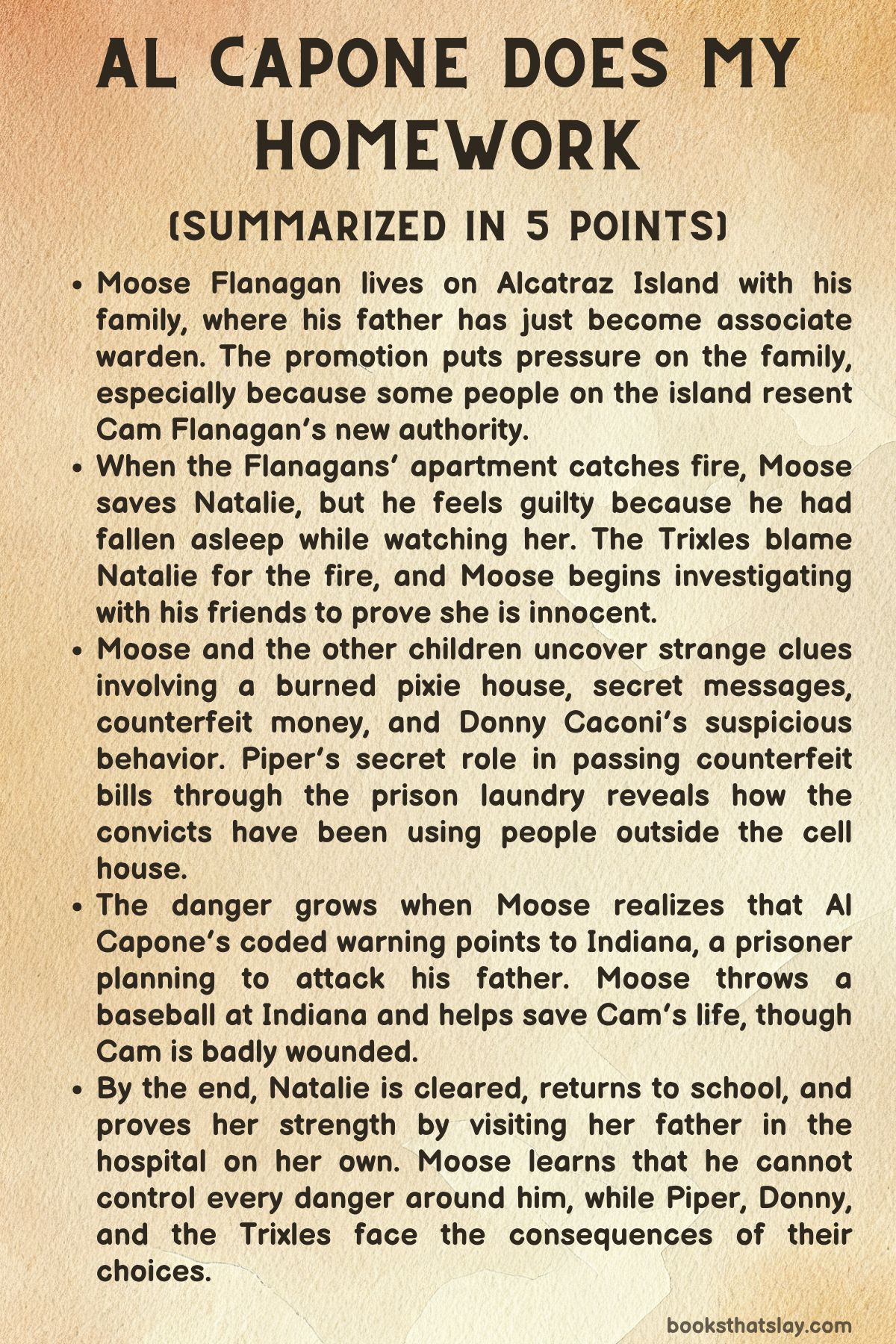
Al Capone Does My Homework follows Moose Flanagan, a thirteen-year-old boy living on Alcatraz Island with his family in 1936. His father, Cam Flanagan, has just been promoted from electrician to associate warden of Alcatraz Federal Penitentiary.
The promotion should be good news, but Moose is worried. Alcatraz holds dangerous prisoners, including famous criminals like Al Capone, and Moose thinks his father is too kind and trusting for such a hard job.
Other people on the island seem to agree, especially Darby Trixle, a harsh guard who wanted the promotion for himself.
Moose also worries about his older sister, Natalie. Natalie is sixteen and highly gifted with numbers, but she struggles with eye contact, change, social rules, and new situations.
Moose loves her fiercely, yet he often feels burdened by the expectation that he will someday be responsible for her. His mother and Natalie’s teacher, Mrs. Kelly, keep pushing him to help Natalie learn how to fit in better.
Moose tries, but he is still a kid himself, caught between baseball, school, friendship, and family duty.
Soon after Cam begins his new job, the Flanagans’ apartment catches fire while Moose is watching Natalie. Moose has fallen asleep, and when he wakes, the apartment is burning.
He manages to drag Natalie through the smoke and get them both out safely. The family survives, but the apartment is badly damaged.
Moose is terrified that Natalie may have accidentally started the fire, especially because she has habits such as flicking lights and repeating actions. The Trixles quickly blame her, and Bea Trixle spreads the accusation around the island.
Natalie’s special school even puts her on probation while the fire is investigated.
The Flanagans temporarily move into the empty house of the former associate warden, Mr. Chudley. The house is large and uncomfortable, and Natalie cannot sleep there.
The stress wears down the whole family. Moose feels guilty for falling asleep during the fire, but he hides this from his father.
He also feels angry that everyone is so ready to blame Natalie simply because she is different.
Moose and his friends decide to investigate the fire themselves. His group includes Annie, his best friend and baseball partner; Jimmy, a science-minded boy; Theresa, Jimmy’s younger sister; Piper, the warden’s clever and manipulative daughter; and sometimes Natalie.
They search the damaged apartment and find a burned hatbox that belongs to Janet Trixle, Darby’s young daughter. Janet calls it a home for her imaginary pixies.
The discovery raises questions, but Janet cannot clearly explain how it ended up in the Flanagans’ kitchen.
While the fire mystery grows, Moose becomes aware of other strange behavior on the island. Donny Caconi, the charming adult son of Mrs. Caconi, tricks Moose, Piper, and Theresa out of money through a bottle-cap throwing bet.
Moose suspects Donny cheated, but he cannot prove it. Later, while snooping through the Caconis’ laundry bag, Moose finds a roll of cash.
He is not sure what it means, but it bothers him.
Moose also finds signs that the prisoners may be sending secret messages. He sees Count Lustig, a famous con man, leave a folded paper in a downspout.
The note contains a string of numbers that Moose cannot understand at first. The Count, along with prisoners called Lizard and Indiana, seems to be involved in something beyond ordinary prison trouble.
Moose and his friends even try to send a message to the prisoners using a cockroach, but the plan fails when Lizard eats it.
At the same time, Piper’s behavior becomes more troubling. She has been spending money freely, giving gifts, and acting nervous.
Moose still has mixed feelings for her because he once had a crush on her, but he also knows she uses people. Annie notices Piper’s strange actions too.
Moose’s bond with Annie grows stronger as she helps him think through the fire. Together they realize Natalie could not have started it with the stove because she would have turned on the kitchen light and then flicked it repeatedly, something Moose would have noticed.
This gives Moose relief: Natalie is innocent.
The investigation shifts when Al Capone is questioned about the fire, the prisoners’ point system, missing money, and a stolen kitchen knife. Moose, Annie, and Piper secretly listen from a shed near the doctor’s house.
Capone denies knowing anything useful, but he hints that other prisoners have long reach. During the questioning, Piper becomes very upset when the topic of money and gifts comes up.
Soon after, Piper confesses that she has been receiving extra money through the prison laundry. It began when she accidentally left a dollar in her pocket and got two dollars back.
She kept sending money through the laundry and getting double in return. She convinced herself that a prisoner liked her, but the truth is more serious: the money is counterfeit.
The Count has been using Piper to pass fake bills in San Francisco because, as the warden’s daughter, she seems above suspicion. Donny appears to be involved too, smuggling counterfeit money through laundry.
The numbered note Moose found is likely a locker number and combination linked to hidden counterfeit bills.
The task force later announces that Donny Caconi set the fire. This clears Natalie, but it does not answer every question.
Moose and his friends suspect Donny burned the apartment to cover up his crimes or help someone else. Meanwhile, Moose receives strange comments from Al Capone written in his school notebook.
One phrase, “State problem,” stays in his mind.
That warning becomes terrifyingly important when Moose sees Indiana acting strangely on the dock. Moose suddenly connects “State problem” to Indiana’s nickname.
He sees a knife flash in Indiana’s hand and throws his baseball as hard as he can. The ball hits Indiana, but not before Indiana stabs Cam Flanagan.
Indiana jumps into the bay while guards fire at him. Cam is badly wounded and taken to the hospital.
Moose is crushed with guilt, believing he should have understood Capone’s warning sooner or shouted faster.
Mrs. Mattaman comforts Moose and helps him see that he saved his father’s life by throwing the ball. Moose begins to understand that he cannot be responsible for everyone and everything.
Natalie then surprises him by insisting that, because she is sixteen, she can visit their father in the hospital even though Moose cannot. Moose decides to trust her.
Natalie manages the hospital visit on her own, speaks to the receptionist, and sits with her father, showing more strength than others expected. Her mother finally acknowledges her as sixteen, not as a child to be hidden.
When Cam returns home, Moose confesses that he fell asleep the night of the fire. His father does not blame him.
Instead, he tells Moose that helping Natalie grow took courage. Later, Janet Trixle reveals through her “pixies” that Donny was paid to set the fire.
Moose realizes Darby may have taken money from Bea’s store and paid Donny, hoping to drive the Flanagans away and make Natalie look dangerous. Cam says they cannot prove it yet, but the idea makes sense: Darby resented his promotion and disliked Cam’s belief in treating prisoners fairly.
By the end, the Flanagans prepare to move back into their repaired apartment. Natalie is allowed back at school.
Piper is being sent away to boarding school and must repay the money she spent. Al Capone refuses to solve her problems for her, sending the message that she must face her own consequences.
Donny and his mother leave the island, but Donny still tries to charm Natalie by suggesting her gift with numbers could help him. Natalie looks him straight in the eye and repeats the number of the next Alcatraz prisoner.
Moose tells Donny that this will be his future prison number. In that moment, Natalie’s difference becomes power, and Moose sees once again that she notices far more than people think.
Characters
Moose Flanagan
Moose Flanagan is the emotional center of Al Capone Does My Homework, and his growth comes from learning the difference between caring for people and believing he must control everything that happens to them. At thirteen, he is still a boy who wants ordinary things: baseball, friendship, privacy, and a little freedom from adult problems.
Yet his life on Alcatraz makes ordinary childhood nearly impossible. He worries about his father’s safety, protects Natalie from judgment, tries to manage Piper’s schemes, and investigates the fire that threatens his family’s future.
Moose’s strongest quality is his loyalty, but that loyalty often turns into guilt. When the apartment catches fire, he blames himself for falling asleep.
When his father is stabbed, he blames himself for not understanding the warning sooner. His instinct is always to ask what he should have done differently.
This makes him compassionate, but it also shows how heavily responsibility has settled on him. Moose becomes more mature when he begins to understand that love does not mean carrying every burden alone.
His relationship with Natalie is especially important because it forces him to confront frustration, shame, protectiveness, and hope all at once. He sometimes resents how much is expected of him, but he never stops defending her dignity.
By the end, Moose has not become free of worry, but he has gained a clearer understanding of courage: it can mean saving someone in a crisis, telling the truth, trusting Natalie to act for herself, or accepting that he cannot fix every danger around him.
Natalie Flanagan
Natalie Flanagan is one of the most significant characters because she challenges the way others define intelligence, maturity, and worth. She is sixteen, gifted with numbers, deeply attached to routines, and often overwhelmed by social expectations.
Many people on Alcatraz see only what she cannot do easily: look people in the eye, adjust to change, control distress in public, or respond in expected ways. Moose, however, gradually helps reveal how much she notices and understands.
Natalie’s mind works with precision. She counts details others ignore, remembers patterns, detects irregularities, and sees through Donny’s cheating when the adults miss it.
Her strengths do not look like conventional social confidence, but they are real and powerful. Natalie also becomes a test of the other characters’ compassion.
Those who judge her quickly, such as Bea and Darby Trixle, expose their own cruelty and fear. Those who treat her with patience, such as Moose, Cam, and Mrs. Mattaman, recognize that she is not a problem to hide but a person who deserves space to grow.
Her decision to visit her father in the hospital is a major turning point. She insists on being treated as sixteen and proves that she can face an unfamiliar adult world when given the chance.
Natalie’s final confrontation with Donny is especially satisfying because she uses direct eye contact and numbers, the very things associated with her difference, to unsettle a criminal. Her character shows that independence does not always arrive in expected forms, and that being underestimated can hide a quiet kind of strength.
Cam Flanagan
Cam Flanagan, Moose and Natalie’s father, represents decency under pressure. His promotion to associate warden places him in a dangerous position because he must deal not only with prisoners but also with resentment from men like Darby Trixle.
Cam’s approach to authority is calm, fair, and humane. He believes in rules, but he also believes prisoners should be treated as people who might still be rehabilitated.
This makes him different from Darby, who sees power mostly as force and intimidation. Moose worries that his father is too nice for Alcatraz, but Cam’s gentleness is not weakness.
During the interrogation of Al Capone, he shows command without cruelty, refusing to let Darby’s aggression control the situation. Cam is also a thoughtful father.
He sees more than Moose realizes, especially the pressure Moose feels in caring for Natalie. When Moose finally confesses that he fell asleep during the fire, Cam does not punish him.
Instead, he recognizes how much Moose has already carried. His response gives Moose permission to stop seeing himself as a failed guardian.
Cam’s stabbing reveals the real danger of his work, but his decision to return to the job shows his resilience. He is not reckless; he simply refuses to let fear or violence decide his values.
As a father and warden, Cam’s strength lies in steadiness, fairness, and moral courage.
Mrs. Flanagan
Mrs. Flanagan is a loving but strained mother whose choices are shaped by exhaustion, fear, and years of fighting for Natalie’s future. She wants Natalie to succeed, but she also worries about how the world will treat her.
This makes her both protective and anxious. After the fire, her fear grows because Natalie’s school places her on probation and neighbors begin treating her as dangerous.
Mrs. Flanagan’s instinct is sometimes to keep Natalie away from public judgment, not because she is ashamed in a simple sense, but because she knows how quickly people can misunderstand and punish her daughter. Her conflict with Moose comes from their different responses to Natalie’s condition.
Moose wants Natalie to practice being in the world, even if it is messy and difficult. His mother, worn down by pressure, sometimes wants to reduce risk by keeping Natalie close.
This tension gives her character realism. She is not uncaring; she is tired, frightened, and used to fighting battles that other families do not have to face.
Her emotional shift at the hospital is meaningful. When Natalie insists that she is sixteen, Mrs. Flanagan finally accepts that truth aloud.
It is a small sentence, but it carries years of fear and hope. Her character shows the burden carried by parents who want safety for their children but must also learn when protection becomes limitation.
Annie Bomini
Annie Bomini is Moose’s best friend, but she becomes much more than a loyal side character. She is practical, honest, and emotionally steady in ways Moose badly needs.
Annie understands Moose without pushing him too hard. When he confesses that he fell asleep during the fire, she does not judge him; she helps him think clearly.
Her reasoning helps prove Natalie could not have started the fire, which gives Moose relief when he is close to being swallowed by guilt. Annie’s intelligence is quiet and grounded.
She is less flashy than Piper and less eccentric than Jimmy, but she often sees the truth more clearly than either of them. Her relationship with Moose develops naturally from friendship into first love, and that shift matters because it signals Moose’s growing ability to value sincerity over glamour.
He has been drawn to Piper’s confidence and beauty, but Annie offers trust, kindness, and emotional honesty. She also challenges Moose when he takes too much responsibility for others.
Her presence helps him understand that caring for Natalie, Piper, and his father does not mean blaming himself for every mistake or danger. Annie’s warmth is never weak.
She has a strong moral sense, and she is willing to stand beside Moose even when the situation becomes risky. Her character represents dependable love, clear judgment, and the comfort of being truly known.
Piper Williams
Piper Williams is charming, intelligent, manipulative, and insecure. As the warden’s daughter, she has access to information and influence that the other children do not, and she often uses both to control situations.
She likes attention, enjoys being admired, and knows how to make people feel they must prove their loyalty to her. Moose is drawn to her confidence and appearance, but he also recognizes that her “insides” are harder to trust.
Piper’s involvement in the counterfeit money scheme shows both her cleverness and her immaturity. At first, she convinces herself that the money appearing in her laundry is harmless or even magical.
Deep down, though, she knows something is wrong. Her refusal to tell her father comes from fear of consequences and from the pleasure of having secret power.
Piper is not evil, but she is used to bending rules and escaping punishment. That is why her downfall matters.
For once, her choices are too serious to brush aside. Her confession exposes her vulnerability, especially her fear that Moose no longer likes her.
Piper wants affection but often tries to secure it through control rather than honesty. By the end, being sent to boarding school and forced to repay the money suggests that she must finally face accountability.
Her character adds tension because she is both friend and troublemaker, both lonely and selfish, both useful and dangerous.
Darby Trixle
Darby Trixle is one of the clearest antagonistic forces in the story. He is bitter, loud, aggressive, and deeply resentful of Cam Flanagan’s promotion.
Darby believes authority should be harsh and intimidating. His bullhorn, uniform, and constant barking of orders all reflect his need to dominate others.
He treats prisoners with contempt, but he also treats children and neighbors with suspicion when it suits him. His anger toward Cam is not just professional jealousy; it is ideological.
Cam’s belief in fairness threatens Darby’s view of Alcatraz as a place controlled through fear. Darby’s possible role in paying Donny to set the fire makes him even more dangerous because it suggests he is willing to harm a family to advance himself.
His readiness to blame Natalie is especially cruel. He and Bea exploit prejudice against her, using her difference as a convenient explanation.
Yet Darby is not portrayed as simple brute force alone. He is observant enough to recognize Natalie’s usefulness after she exposes Donny’s cheating, which shows that even his respect is tied to personal benefit.
Darby’s character represents corrupted authority: a man who wants power but lacks the fairness, patience, and self-control needed to deserve it.
Bea Trixle
Bea Trixle is harsh, judgmental, and quick to turn fear into accusation. Her treatment of Natalie reveals the damage caused by gossip and prejudice.
Rather than waiting for facts, Bea spreads the idea that Natalie started the fire and even threatens her place at school. She uses Natalie’s disability as evidence against her, which makes her cruelty especially personal.
Bea’s behavior also shows how social power works in a small community. Because Alcatraz families live close together, rumors can become dangerous very quickly.
Bea does not simply hold a private opinion; she works to make that opinion affect Natalie’s life. Her grocery store gives her a place of authority, and she uses conversation as a weapon.
She also shows hypocrisy. When Janet later suggests that money from Bea’s store may have been used to pay Donny, Bea’s earlier accusations look even uglier.
She may not know everything Darby has done, but she contributes to the climate that allows Natalie to be blamed. Bea is important because she shows that cruelty does not always come from criminals.
Sometimes it comes from ordinary people who want a scapegoat and feel righteous while harming someone vulnerable.
Donny Caconi
Donny Caconi is charming on the surface and dishonest underneath. He presents himself as friendly, stylish, and easygoing, which makes people want to trust him.
Moose initially likes him because Donny seems partly like an older kid who understands him. That charm is exactly what makes Donny dangerous.
He cheats Moose and the others in a small throwing bet, then later cheats adults in a poker game. These smaller cons prepare the reader to understand his larger crimes.
Donny’s connection to Count Lustig and the counterfeit money scheme shows that he is willing to serve as a bridge between the outside world and the prison’s criminal networks. He uses laundry, trust, and casual friendliness to hide serious wrongdoing.
His possible role in setting the fire is especially disturbing because it turns his charm into something actively harmful. Donny is not just a cheat; he is someone who can smile while endangering others.
His interest in Natalie near the end reveals how his mind works. He sees her numerical brilliance not as a gift to respect, but as a tool he might exploit.
Natalie’s response to him reverses the power dynamic. For once, Donny is the one made uncomfortable, and his smooth confidence cracks.
Al Capone
Al Capone is physically present only in limited moments, but his influence runs through Al Capone Does My Homework as both a real prisoner and a larger symbol of criminal power. To the children, he is almost legendary, someone whose name carries danger and fascination.
Moose has received notes from him before, and when Capone writes comments in Moose’s school notebook, the moment is both strange and darkly funny. Capone’s intelligence shows in the way he communicates indirectly.
His “State problem” warning suggests that he knows more about the prison’s threats than he admits, but he protects himself by avoiding open action. During questioning, he is sarcastic and evasive, refusing to give the adults clear answers.
He is not heroic, but he is not foolish either. Moose eventually sees that Capone’s reputation for toughness has limits.
Capone warns him in code rather than directly helping, which Moose interprets as cowardice compared with his father’s open courage. The message he gives Piper, telling her to do her own time, is one of the sharpest moral statements in the story.
Coming from a criminal, it still carries truth: people must face the consequences of their own choices.
Count Lustig
Count Lustig is a polished con man whose danger lies in intelligence rather than physical force. His history of fraud and forgery makes him the perfect figure behind the counterfeit money scheme.
Unlike prisoners who intimidate through size or violence, the Count works through deception, coded messages, and manipulation. He understands human weakness.
Choosing Piper as a mark is clever because she is young, vain enough to enjoy secret money, and protected by her father’s status. By using her, he turns privilege into a weakness.
The Count’s folded note in the downspout, his connection to Donny, and his role in moving fake money through laundry show how criminal planning can survive even inside a heavily guarded prison. He is important because he proves that Alcatraz’s walls cannot fully contain corruption.
The prison may control bodies, but schemes can still pass through laundry bags, messages, and people who want something badly enough to ignore warning signs. Count Lustig’s character adds a quieter kind of menace: he does not need to shout, threaten, or attack to cause harm.
Indiana
Indiana is a disturbing and violent prisoner whose role becomes crucial when he attacks Cam Flanagan. His nickname becomes part of Capone’s coded warning, which Moose understands almost too late.
Indiana represents the immediate physical danger of Alcatraz. While Count Lustig shows the threat of deception, Indiana shows the threat of violence.
His participation in the prisoners’ point system reveals how cruelty can become a game among men who are desperate for status. The idea that stabbing a warden could earn prestige makes Indiana’s attack even more chilling because it reduces human life to a score.
Moose’s fear of him begins early, and that fear proves justified. Yet Indiana is not given the glamour that often surrounds famous criminals.
He is unsettling, brutal, and ultimately pathetic in his attempt to gain recognition through violence. Moose’s baseball throw stops him from doing even greater damage, turning a child’s skill into an act of protection.
Indiana’s character raises the stakes of the story and forces Moose to confront real danger, not just rumor or mystery.
Lizard
Lizard is one of the more physically memorable prisoners, known for his size and for having once eaten a live lizard. His behavior often borders on grotesque, especially when he eats the cockroach carrying the children’s message.
He is not developed as deeply as Count Lustig or Indiana, but he contributes to the atmosphere of menace and unpredictability around the prison. Lizard’s role in the group of prisoners suggests loyalty to other cons and willingness to participate in their schemes.
His swallowing of money when caught also shows how prisoners hide evidence and protect one another. To Moose and the other children, Lizard represents the strange closeness of danger on Alcatraz.
He is not an abstract criminal locked far away; he is someone they can see from balconies and docks, someone whose actions can disrupt their plans. His character adds rough humor as well as unease, reminding readers that life on the island is always shaped by the presence of men who follow rules only when forced.
Jimmy Mattaman
Jimmy Mattaman is Moose’s friend and one of the child investigators. He is curious, inventive, and often odd in a comic way, especially through his unusual science experiments.
His plan to send a message by cockroach is ridiculous but also imaginative, showing how his mind moves toward experiments even in serious situations. Jimmy’s family is under financial stress, which makes Donny’s cheating at poker especially harmful.
When Natalie exposes the crooked cards, Jimmy’s family is spared a major loss, linking his household directly to Natalie’s hidden strengths. Jimmy is loyal to Moose and willing to help investigate the fire without demanding every detail.
His friendship provides Moose with companionship during a period when Moose feels displaced from his home and overwhelmed by adult troubles. Jimmy also helps prove Moose could not have shouted a warning loud enough to reach his father on the dock, offering practical evidence that eases Moose’s guilt.
His character brings humor, curiosity, and steady friendship into a story full of fear and suspicion.
Theresa Mattaman
Theresa Mattaman is young, energetic, and often pulled into the plans of older children. She is easily influenced by Piper at first, accepting payment and gifts in exchange for running messages or doing small tasks.
Her reaction to the counterfeit money scheme is important because it shows how adult crimes can frighten innocent children. When she worries that spending fake money makes her a criminal too, her fear is sincere and childlike.
Theresa also helps reveal the moral confusion Piper has created. What Piper treats as secret fun becomes terrifying once Theresa understands that the money is connected to crime.
Theresa’s closeness to Janet also makes her useful in the children’s investigation, since she can approach Janet in ways older kids cannot. She adds innocence to the story, but she is not merely decorative.
Through her, the consequences of Piper’s choices spread beyond Piper herself.
Mrs. Mattaman
Mrs. Mattaman is one of the kindest and wisest adults in the story. She offers practical help after the fire, gives Moose emotional support, and treats Natalie with patience.
Unlike Bea Trixle, she does not reduce Natalie to her difficulties. She sees her as a person deserving care, respect, and gratitude.
Her conversations with Moose are especially important because she helps him loosen his grip on guilt. When Moose believes he has failed everyone, Mrs. Mattaman reminds him that he does not have the power to control every outcome.
Her faith and tenderness give him a healthier way to understand responsibility. She also shows courage in a quieter social sense.
By defending the Flanagans and welcoming Natalie, she resists the cruelty of gossip. Her family’s financial struggles make her vulnerable, but she does not become mean or suspicious because of hardship.
Mrs. Mattaman represents the kind of community Alcatraz needs: one built on compassion instead of blame.
Mr. Mattaman
Mr. Mattaman is a supporting adult whose role becomes important through his involvement in the poker game and his help after Cam is stabbed. He is not as central as his wife, but he contributes to the sense of a close island community where everyone’s choices affect everyone else.
His financial difficulty makes Donny’s cheating more serious, because the loss of money would genuinely hurt his family. He also helps during moments of crisis, especially when Cam is wounded.
Mr. Mattaman’s presence shows that not all adults on Alcatraz are caught in rivalry or suspicion. Some are ordinary working people trying to support their families in a stressful place.
His character helps ground the story in everyday hardship, making the crimes and conflicts feel more personal.
Janet Trixle
Janet Trixle is strange, imaginative, and more observant than adults realize. Her pixie houses first seem like childish oddities, but they become tied to the mystery of the fire.
Janet’s way of speaking through her pixies allows her to reveal dangerous information while protecting herself. When she says the pixies know Donny was paid to set the fire, she is likely repeating something she overheard at home.
This makes her both innocent and important. Like Natalie, Janet is easy for others to dismiss because she does not communicate in a straightforward adult-approved way.
Yet she holds one of the most important clues in the story. Her character also complicates the Trixle family.
She is not cruel like her parents, though she repeats some of their accusations about Natalie. She is a child shaped by her household, but she still has her own odd honesty.
Janet shows that truth can come from unexpected voices.
Warden Williams
Warden Williams is a figure of authority whose role is most visible through his relationship with Piper and his leadership of Alcatraz. He is stern when Piper confesses, and his reaction shows how serious her actions are.
As warden, he must manage not only dangerous prisoners but also the public reputation and internal order of the prison. Piper’s use of counterfeit money wounds him personally and professionally because it exposes his own daughter as a tool in a criminal operation.
His position gives Piper privilege, and the story suggests that she may avoid harsher punishment because of who he is. Still, he does not simply excuse her.
He understands the gravity of what has happened and requires consequences. Warden Williams represents institutional authority, but through Piper, the story also shows that authority figures can be vulnerable inside their own homes.
Mrs. Williams
Mrs. Williams appears less often, but her presence helps show the domestic side of the warden’s household. She is polite to Moose when she believes he may be Piper’s secret admirer, and later her worried appearance during Piper’s confession suggests that the family is deeply shaken by Piper’s choices.
Mrs. Williams helps humanize the warden’s family. They are not only symbols of authority on top of the island; they are also parents dealing with fear, embarrassment, and disappointment.
Her character is quieter than Piper’s father, but she adds emotional weight to Piper’s downfall.
Mrs. Kelly
Mrs. Kelly, Natalie’s teacher, represents the pressure to prepare Natalie for a society that may not understand her. She teaches social rules and encourages Moose to help Natalie practice eye contact and ordinary interaction.
Her methods can feel demanding, especially to Moose, because they remind him that he may one day be responsible for Natalie’s care. Still, Mrs. Kelly is not cruel.
She wants Natalie to gain skills that may help her survive beyond the protection of her family. Her role raises a difficult question: how much should Natalie be asked to change in order to be accepted by others?
Mrs. Kelly’s presence shows that helping Natalie is not simple. It involves love, training, patience, and the painful awareness that the outside world is not always kind.
Mr. Bomini
Mr. Bomini is Annie’s father and one of the decent adults in the community. He injures his hand while helping fight the fire, which makes Bea’s accusations against Natalie more painful because she uses his injury to strengthen her blame.
Yet the Bomini family does not join the attack on Natalie. Mr. Bomini’s presence matters because he represents practical courage and neighborly responsibility.
He helps when there is danger, and his family gives Moose emotional shelter through Annie. Though he is not a major character, he is part of the moral contrast between neighbors who help and neighbors who accuse.
Themes
Responsibility and the Weight of Guilt
Moose carries responsibility in a way that is far beyond his age. He is expected to watch Natalie, support his parents, understand the dangers of Alcatraz, and respond wisely when adults around him fail or act unfairly.
His guilt after the fire shows how quickly responsibility can become self-punishment. Because he fell asleep while watching Natalie, he convinces himself that he may have allowed the disaster to happen.
Later, when his father is stabbed, he again believes he should have done more, even though his baseball throw likely saves Cam’s life. This pattern reveals a painful truth about Moose: he measures love by how much he can prevent.
If someone he loves suffers, he assumes he has failed. The story gradually challenges that belief.
Mrs. Mattaman tells him he does not have the power to control everything, and Cam’s forgiveness helps Moose see that adults did not expect him to be perfect. Responsibility remains important, but the novel separates healthy responsibility from impossible responsibility.
Moose’s growth comes from learning that caring deeply does not mean being to blame for every accident, crime, or danger. A child can be brave and devoted without being the family’s shield against the whole world.
Difference, Dignity, and Being Seen Clearly
Natalie’s character places dignity at the center of the story. Many people judge her by what makes them uncomfortable: her lack of eye contact, her repetitive behaviors, her distress during change, and her difficulty with social rules.
Because they do not understand her, they treat her as suspicious or lesser. The accusation that she started the fire shows how quickly difference can be turned into guilt.
Bea and Darby do not need evidence because Natalie’s disability already makes her, in their eyes, an easy target. Against that cruelty, the story builds a more respectful view of Natalie.
Moose sometimes becomes frustrated with her, but he also knows her intelligence, her honesty, and her ability to notice patterns others miss. Her discovery of Donny’s card cheating proves that her mind is not limited; it is simply organized differently.
Her hospital visit is even more powerful because she steps into an unfamiliar public space and claims her age and identity. Al Capone Does My Homework argues that being seen clearly means looking beyond social performance.
Natalie does not need to become someone else to have value. The people around her need to recognize that dignity is not earned by acting “normal.” It belongs to her already.
Power, Corruption, and Fair Authority
Alcatraz is a place built around authority, but the story makes clear that not all authority is moral. Cam Flanagan and Darby Trixle offer two opposing models of power.
Cam believes authority should be fair, disciplined, and humane. He respects rules and tries to treat prisoners as people, even when they are dangerous.
Darby, by contrast, sees power as domination. He shouts, threatens, humiliates, and resents anyone who does not share his harshness.
His anger over losing the promotion shows that he wants status more than responsibility. The possibility that he paid Donny to set the fire reveals how corrupt authority can become when pride is wounded.
Darby is supposed to protect order, yet he may be helping create chaos for personal revenge. The prisoners also show different kinds of power: Count Lustig manipulates systems through fraud, Indiana seeks status through violence, and Capone influences events through reputation and coded messages.
Even Piper misuses her social power as the warden’s daughter. Through these contrasts, the story suggests that power itself is not the problem; character is.
Authority becomes dangerous when it serves ego, fear, or greed. It becomes honorable only when guided by fairness, restraint, and responsibility.
Growing Up Through Trust and Consequences
Growing up in the story is not shown as a single moment of becoming mature. It happens through difficult choices, mistakes, and the willingness to face consequences.
Moose grows when he admits the truth about falling asleep, when he stops treating Natalie only as someone to protect, and when he recognizes Annie’s steady love over Piper’s attention-seeking charm. Natalie grows when she is trusted to visit her father alone, proving that independence sometimes requires others to step back.
Piper’s growth is harsher. She enjoys the secret money until she must admit that her choices helped criminals pass counterfeit bills.
Her punishment shows that charm cannot erase consequences. Even Al Capone’s message to her, telling her to do her own time, reinforces the idea that people must carry the results of their own actions.
Donny, on the other hand, refuses true growth. He keeps cheating, manipulating, and looking for ways to use others.
This contrast makes the theme sharper: maturity is not about age alone. Natalie is sixteen and still learning public rules; Moose is thirteen and already burdened by adult worries; Donny is grown but morally childish.
Real growth comes when characters accept truth, respect others, and stop hiding behind excuses.