Ali Cross Summary, Characters and Themes
Ali Cross by James Patterson is a middle-grade mystery centered on Alex Cross’s son, Ali, a smart, restless boy with a detective’s instincts and a strong sense of loyalty. When Ali’s best friend Gabe disappears just before Christmas, Ali refuses to sit back while adults handle the case.
At the same time, his father faces a public assault trial, and the Cross family becomes the target of a burglary. The story mixes family pressure, friendship, online gaming, school conflict, and a missing-child investigation as Ali learns what courage and responsibility really demand. The book kickstarts the Ali Cross series.
Summary
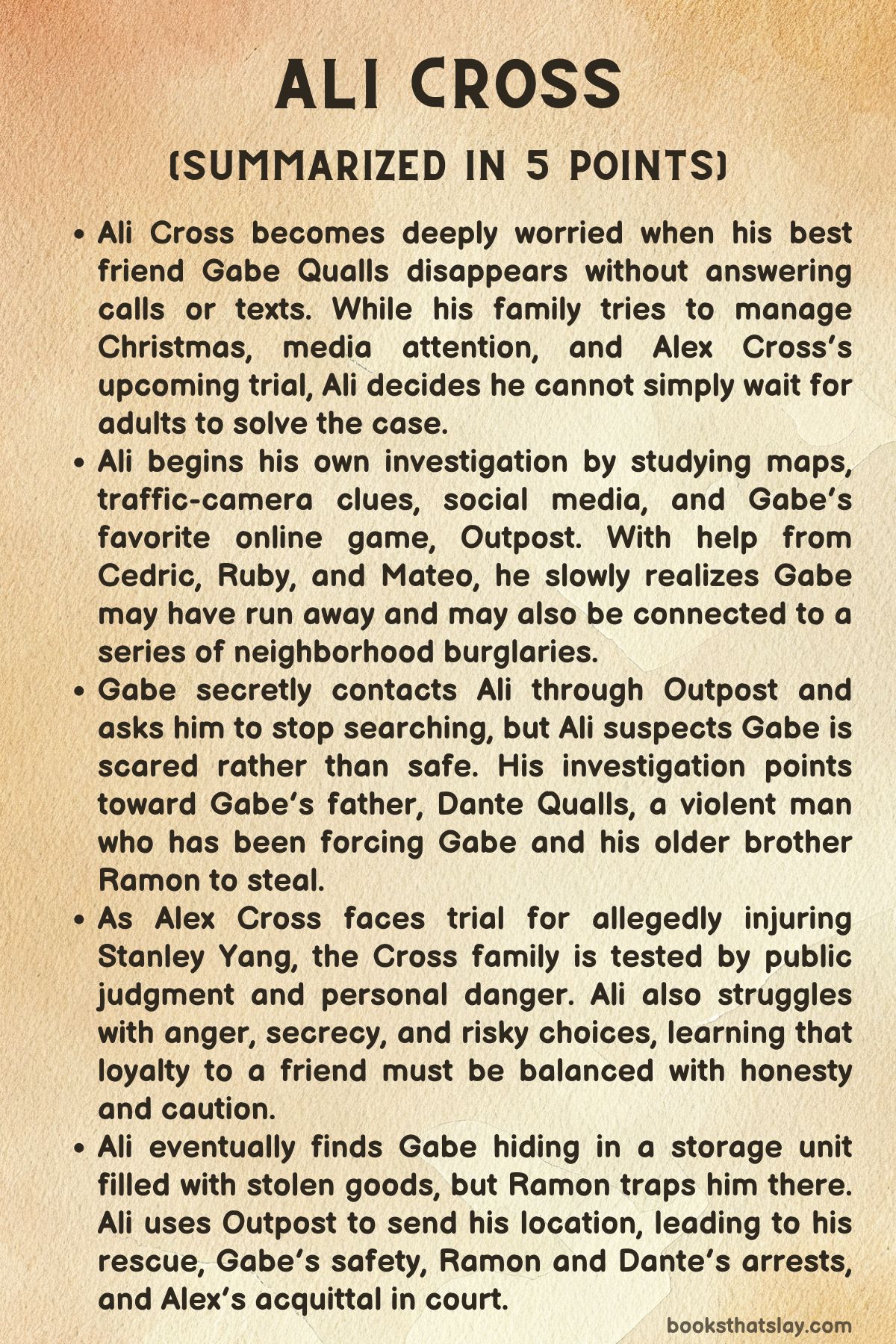
Ali Cross is worried because his best friend, Gabe Qualls, has been missing for several days. Gabe has not replied to calls or texts, and Ali cannot stop thinking about what might have happened to him.
During a Christmas Eve church service, Ali is asked to offer a prayer for children everywhere, but his thoughts are fixed on Gabe. Instead of giving a general prayer, he asks the congregation to pray for Gabe’s safety and return.
Outside the church, Ali’s family is met by reporters questioning his father, Alex Cross, about an upcoming assault trial. Alex is accused of badly injuring Stanley Yang, the father of a murder suspect, during a confrontation.
Ali hates hearing people suggest that his father is violent or corrupt, and he shouts at the reporters, defending Alex and telling them they should focus on Gabe’s disappearance instead. Later, Nana Mama reminds Ali that losing control only gives people what they want.
Ali apologizes, but the pressure on the family is already growing.
When the Cross family gets home, they find that their house has been broken into. Christmas presents have been opened and stolen, and worse, Alex and Bree’s locked gunboxes are gone.
Ali feels shaken because even with two police officers in the family, their home is not safe. He starts wondering whether the burglary is connected to Gabe, to his father’s trial, or to someone trying to damage Alex’s reputation.
Ali begins gathering information on his own. He listens to police technicians, studies how missing-person cases are handled, and creates a board with maps, clues, and questions.
Alex takes him to meet Detective Wendy Sutter, who is working Gabe’s case. Ali learns that Gabe’s phone has been tracked at times, but not well enough to locate him.
Sutter asks Ali about Gabe’s habits, home life, and online activity. Ali realizes he knows less about Gabe than he thought, especially outside their friendship and their shared love of the game Outpost.
Ali visits Gabe’s house, where he meets Gabe’s father, Dante Qualls. The man is hostile and calls Alex a dirty cop.
Ali asks to look in Gabe’s room, but Qualls refuses and shuts the door. Instead of giving up, Ali decides he needs help.
He brings in his online friends Cedric, Ruby, and Mateo, who also know Gabe through Outpost. Together they search Gabe’s virtual base in the game, hoping he left clues there.
Bree gives Ali traffic-camera footage from the day Gabe disappeared. Ali notices that Gabe’s backpack looks unusually full and that Gabe did not take his normal route home.
This suggests Gabe may have left with belongings on purpose. Later, when the Cross family receives a bag containing some of the stolen items from their house, Ali wonders if Gabe might be involved in the burglaries and trying to return things out of guilt.
Alex does not dismiss the idea.
At school, Ali struggles with anger. A student named Kahlil Weyland taunts him about Gabe and about Alex’s trial.
Ali eventually punches Kahlil and is suspended. Alex is disappointed but understands that his son is under enormous stress.
Ali feels guilty for causing more trouble when his father is already facing public judgment. While grounded, he continues tracking Gabe online and sending messages, hoping Gabe might see them.
A major clue appears when Ali notices a strange screensaver on his recovered laptop: “QUBUQ,” based on Gabe’s Outpost name, QUB. Ali uses it as a code to open Gabe’s virtual bunker in Outpost.
Inside, he finds a hidden area and a message telling him to return at two in the morning. When Ali logs in at that time, Gabe appears and speaks to him.
Gabe says he is safe but begs Ali to stop looking for him and to keep their conversation secret. Before Gabe can explain more, Ali hears a struggle, and Gabe disappears from the game.
Ali keeps the conversation secret at first, but his suspicions turn strongly toward Dante Qualls. He secretly uses Bree’s computer to search police records and learns that Qualls has a criminal history.
Ali visits Gabe’s house again with Cedric. This time, Gabe’s mother lets him see Gabe’s room.
Ali notices that Gabe’s PlayStation is missing, which likely explains the heavy backpack in the traffic footage. He realizes Gabe probably ran away and that his parents may have known more than they admitted.
Before Ali can leave calmly, Dante Qualls comes home, drags him out, and throws him off the property.
Soon after, Ali’s school ID is found at the scene of another burglary. Ali realizes Qualls must have stolen it from his jacket during the confrontation and planted it to frame him.
At police headquarters, Ali finally tells Detectives Sutter and Olayinka everything, including his Outpost meeting with Gabe. The police begin connecting Gabe’s disappearance, the burglaries, and Dante Qualls.
Meanwhile, Alex’s own case heads to trial. The prosecution tries to show that Alex acted aggressively toward Stanley Yang, while Alex explains that Yang lost his balance after pushing him.
The case weighs heavily on the Cross family, especially because public opinion is not on Alex’s side. Even so, Alex keeps trying to act honorably, including helping the Yang family quietly.
The police find Dante Qualls’s fingerprints on Ali’s stolen ID. When Sutter and Olayinka go to the Qualls home, Qualls attacks and runs.
Alex chases him through the neighborhood and finally catches him after a fight. The police learn that Dante had been forcing Gabe and his older brother Ramon to commit burglaries.
The boys had been hiding in a separate location and communicating through Outpost. Gabe had been scared, trapped between fear of his father and fear of getting caught.
Ali and his friends leave messages for Gabe inside Outpost, telling him he is safe now. Still, Gabe does not immediately come out.
Ruby suggests Gabe may be hiding near Ali’s neighborhood, since some burglaries happened there and Gabe warned Ali not to keep searching. Ali secretly follows his father to the area of a recent burglary and searches the streets on his own.
He spots Gabe carrying a bag and follows him to a storage-unit building beyond a freeway underpass.
Inside the unit, Ali finds stolen goods, PlayStations, sleeping bags, heaters, and supplies. Gabe is shocked to see him and tells him to leave.
Then Ramon appears, threatens Ali with a knife, takes his phone, and locks him inside the dark unit. Ali panics at first but forces himself to think.
He finds a PlayStation, logs into Outpost, and sends messages with his location to his friends and Detective Olayinka.
Cedric sees the message and alerts Alex. The police rescue Ali, and Ramon is caught while trying to steal a truck.
Gabe apologizes and explains that his father made him help with the burglaries by threatening him and claiming the family would lose their home. Ali reassures Gabe that he has friends who care about him and that he is not alone anymore.
The story ends with Alex’s trial verdict. The jury finds him not guilty.
Outside the courthouse, Alex tells reporters that justice was done but also acknowledges that police brutality is a real problem. He says he will try to set the best example possible and raise money for the Yang family.
Ali feels proud of his father and more certain than ever that he wants to follow in his footsteps. By solving the mystery of Gabe’s disappearance, Ali understands that he does not have to wait until adulthood to think like a detective.
Characters
Ali Cross
Ali Cross is the central character, and his personality is defined by loyalty, curiosity, impatience, and a strong need to act when someone he loves is in danger. Gabe’s disappearance affects him deeply because Gabe is not just a school friend but someone connected to Ali’s private world of gaming, codes, and shared imagination.
Ali’s first response to the crisis is emotional, but he quickly turns that emotion into action. He builds a case board, studies maps, follows traffic-camera clues, organizes friends, searches online spaces, and questions adults.
This makes him brave and resourceful, but it also shows his biggest weakness: he often mistakes determination for judgment. He lies, sneaks out, uses restricted information, and places himself in danger because he believes the urgency of finding Gabe justifies the risk.
Ali’s character is also shaped by his desire to live up to Alex Cross. He admires his father’s intelligence and courage, and he wants to prove that he has the same instincts.
However, Ali Cross does not present him as a perfect young detective. He makes mistakes, hurts his friendships by keeping secrets, and allows anger to control him when Kahlil taunts him.
His growth comes from learning that detective work is not only about clues and bold moves. It is also about trust, patience, honesty, and knowing when to ask for help.
By the end, Ali has earned a stronger sense of identity. He has not become an adult, but he has discovered that courage can exist in a child when it is guided by love, intelligence, and responsibility.
Alex Cross
Alex Cross is both a father and a professional detective, and the story places those two roles under pressure at the same time. Publicly, he is fighting to protect his reputation during an assault trial.
Privately, he is trying to protect his family from media judgment, a home burglary, and Ali’s reckless involvement in Gabe’s case. Alex is calm, disciplined, and principled, but the accusations against him reveal how vulnerable even a respected detective can be when public trust turns against him.
He understands that the justice system must question police behavior, yet he is also hurt by the assumption that he is guilty before the truth is known.
As a father, Alex is loving but firm. He sees Ali’s intelligence and recognizes his detective instincts, but he also understands the danger of Ali acting without limits.
He does not want to crush Ali’s curiosity, yet he must stop him from treating real danger like a game. His conversations with Ali are some of the most important parts of his character because they show patience, emotional honesty, and humility.
When he admits that even he has broken down under pressure, he gives Ali permission to feel overwhelmed without feeling weak. Alex’s final public response after being cleared is also revealing.
Instead of simply celebrating his innocence, he acknowledges real concerns about police brutality and chooses to help the Yang family. This makes him a model of accountability as well as strength.
Gabriel Qualls
Gabriel Qualls is the missing friend at the center of the mystery, but he is more than a victim or a clue to be solved. Gabe is shy, intelligent, private, and highly skilled in the online world of Outpost.
His isolated virtual bunker reflects his real-life situation: he has built a hidden place where he can control his surroundings because his actual home is unsafe. Gabe’s disappearance seems mysterious at first, but it gradually becomes clear that he is trapped by fear, family pressure, and abuse.
His silence is not betrayal; it is survival.
Gabe’s actions are morally complicated because he participates in burglaries, steals from Ali’s family, and hides the truth from his friend. Yet the story makes clear that he is a frightened child under the control of dangerous adults and an older brother.
His coded communication with Ali shows that he wants help but does not know how to ask openly. He trusts Ali enough to leave a trail but is terrified of what might happen if Ali comes too close.
Gabe’s character shows how children in abusive or coercive environments may appear secretive, guilty, or distant when they are actually trying to survive. His reunion with Ali is important because it restores friendship while also giving Gabe a path out of isolation.
Bree Cross
Bree Cross brings authority, calmness, and practical support to the story. As the DC police chief of detectives, she is experienced and capable, but within the family she is also a steady parental presence.
She understands danger clearly, yet she does not dismiss Ali’s concern for Gabe. Her decision to bring Ali traffic-camera footage shows that she respects his intelligence, even if she knows he must not become reckless.
Bree does not dominate the investigation emotionally, but her influence is constant: she helps maintain order when the family is under public and private stress.
Bree also represents a form of strength that is measured and composed. When reporters attack Alex with questions, she tries to protect the children from the emotional impact.
When the house is burglarized, she responds with professional discipline. She is not written as distant or cold; rather, she is someone who knows that fear must be handled through action.
Her presence helps balance Alex’s fatherly concern and Ali’s impulsiveness. She also reinforces the Cross family’s moral code, especially the idea that when others behave badly, the family must rise above it.
Through Bree, the story shows that courage is not always dramatic. Sometimes it is the ability to stay clear-headed while everyone else is frightened or angry.
Nana Mama
Nana Mama is the moral anchor of the Cross household. She is sharp, loving, strict, and deeply rooted in faith and history.
Her role is not simply to comfort Ali; she challenges him when he behaves selfishly or recklessly. After Ali shouts at reporters, Nana helps him understand that anger can be used against him and against his father.
She teaches him that dignity matters most when other people are trying to provoke a reaction. Her guidance is direct, sometimes stern, but it comes from devotion to the family’s well-being.
Nana also helps Ali think about courage in a broader way. Her reference to Black history gives Ali perspective beyond his immediate frustration.
She reminds him that people before him faced situations that seemed impossible and still moved forward. This matters because Ali is tempted to see Gabe’s case as something only he can fix through force of will.
Nana redirects him toward faith, patience, and disciplined effort. She does not tell him to stop caring; she tells him to care in a way that does not destroy him.
Her character gives the story wisdom, humor, and emotional grounding.
Damon Cross
Damon Cross has a smaller role, but he helps define the Cross family dynamic. As Ali’s older brother, he represents achievement, discipline, and maturity.
His basketball success gives the family a moment of pride and celebration during a period filled with fear and public pressure. Damon’s televised game also becomes the setting for one of Ali’s biggest discoveries, when Ali notices the clue Gabe left on the laptop.
In this way, Damon’s subplot indirectly supports the mystery while also showing that life in the Cross family continues beyond the central crisis.
Damon also contrasts with Ali. While Ali feels like the child who causes trouble, Damon appears focused and successful.
This comparison increases Ali’s insecurity, especially after his school fight and suspension. Ali sees Damon and Jannie as the impressive older siblings, while he worries that he is the one pulling his father away from more important matters.
Damon’s presence therefore helps reveal Ali’s inner conflict. Ali wants to be useful and brave, but he also fears being a burden.
Jannie Cross
Jannie Cross is Ali’s older sister, and she represents determination, confidence, and personal excellence. Her track race shows her competitive nature and discipline.
She pushes herself hard, refuses to give up, and wins through timing, strength, and willpower. Ali’s pride in Jannie reveals an affectionate sibling bond, even though they may not always get along.
Her success gives the family another reason to hope during a difficult time.
Jannie is also affected by the public accusations against Alex. When reporters attack her father, she becomes visibly upset, which triggers Ali’s anger.
This moment shows that the trial is not only Alex’s problem; it wounds the whole family. Jannie’s vulnerability helps explain why Ali feels so protective.
She does not need Ali to defend her, and she says she can take care of herself, but her reaction reminds readers that children suffer when adults turn family pain into public spectacle. Jannie’s character adds emotional depth to the family side of the story.
Cedric
Cedric is one of Ali’s most loyal friends and an important member of the search for Gabe. He is practical, steady, and willing to help even when Ali’s plans seem risky.
He joins Ali in handing out flyers, goes with him to Gabe’s neighborhood, and later plays a crucial role in saving Ali by responding to his Outpost message. Cedric’s loyalty is not passive.
He challenges danger, stands up when Kahlil is cruel, and remains involved when the search becomes more serious.
Cedric also shows the value of teamwork. Ali often believes he must carry the investigation himself, but Cedric proves that friendship can become a form of protection.
When Ali is locked in the storage unit, it is Cedric’s attention and action that help bring Alex to him. This turns Cedric from a side helper into someone essential to the resolution.
His character reinforces the idea that even a clever person like Ali cannot solve everything alone.
Ruby Sandoval
Ruby Sandoval is intelligent, socially aware, and emotionally direct. She helps the search through social media, using online attention to spread Gabe’s picture and raise awareness.
Her contribution is different from Ali’s physical searching or Cedric’s street-level help, but it is equally important. Ruby understands that public visibility can matter in a missing-child case, especially when the missing child comes from a poor Black family and may not receive the same attention as others.
Ruby is also one of the characters most hurt when Ali admits that Gabe contacted him and that he kept it secret. Her anger is justified because she has worked hard to help Gabe and deserved honesty from Ali.
Through Ruby, the story examines trust within friendship. She is loyal, but she is not willing to be treated as unimportant.
Her reaction forces Ali to confront the damage caused by secrecy. Ruby’s character is strong because she combines compassion with self-respect.
Mateo Sandoval
Mateo Sandoval brings humor, skepticism, and energy to Ali’s group. He participates in the Outpost missions, helps brainstorm possibilities, and contacts hospitals while the group searches for Gabe.
Mateo sometimes teases Ali, but he still shows up when it matters. His personality is less solemn than Ali’s, which helps balance the group’s mood during a frightening situation.
Mateo’s frustration after learning Ali kept Gabe’s message secret shows that he values honesty as much as loyalty. His anger is sharp enough that he knocks Ali’s avatar out of the game, but this moment also reflects how seriously he has taken the search.
Mateo is not simply playing along; he feels invested. His character adds realism to the friend group because friendships often include teasing, irritation, and conflict alongside loyalty.
Dante Qualls
Dante Qualls is the main adult threat in Gabe’s life. He is aggressive, manipulative, and willing to exploit his own children for criminal gain.
From his first meeting with Ali, he appears hostile and dangerous. His attempt to frame Ali by planting the school ID shows calculation as well as cruelty.
He knows how to redirect suspicion and is willing to endanger a child to protect himself.
Dante’s role is important because he represents a kind of power that operates inside the home, away from public view. Gabe’s fear is not abstract; it comes from living under someone who uses intimidation and violence to control him.
Dante also contrasts sharply with Alex Cross. Both are fathers, but Alex protects and guides his children, while Dante uses his sons as tools.
This contrast strengthens the story’s interest in what real fatherhood means. Dante’s eventual arrest brings justice, but it also exposes the damage he has already caused.
Ramon Qualls
Ramon Qualls is Gabe’s older brother and another source of danger, though his position is more complex than Dante’s. He participates in the burglary operation and threatens Ali with a knife, making him directly responsible for one of the story’s most frightening moments.
He is hardened, angry, and willing to use violence to keep control of the situation. To Ali, Ramon appears almost like an extension of the danger Gabe has been trying to escape.
At the same time, Ramon is also Dante’s son, which suggests that he may have been shaped by the same abusive environment that trapped Gabe. The story does not excuse his actions, especially his treatment of Ali, but it allows readers to see how family pressure and criminal control can pass from one person to another.
Ramon is what Gabe could become if fear, coercion, and crime fully take over his life. His arrest frees Gabe not only from immediate danger but from a possible future of deeper criminal involvement.
Detective Wendy Sutter
Detective Wendy Sutter is the official investigator in Gabe’s missing-person case. She is professional, cautious, and serious about her work, even when Ali feels the police are not doing enough.
Her questioning of Ali shows that she is methodical and focused on facts. She does not encourage Ali’s amateur investigation, but she also does not treat Gabe’s disappearance as unimportant.
Sutter’s character helps create tension between official procedure and Ali’s impatience. Ali wants instant answers and visible progress, while Sutter must work within rules, evidence, and safety concerns.
This difference makes Ali think adults are moving too slowly, but the story later suggests that police work often involves information that cannot be shared openly. Sutter’s injury during the confrontation with Dante Qualls also shows that she is not detached from danger.
She is actively involved in the case and willing to face risk.
Detective Isaac Olayinka
Detective Isaac Olayinka investigates the burglaries and becomes an important link between the thefts and Gabe’s disappearance. He is observant and collaborative, and he keeps Alex informed even when Alex is under professional restriction.
His discovery of Ali’s school ID at a burglary scene raises the stakes and pushes the investigation toward Dante Qualls.
Olayinka also stands out because of his familiarity with Outpost. This detail helps bridge the adult police world and the children’s online world.
Instead of dismissing the game as childish or irrelevant, he understands that it can be a real communication space and a meaningful part of the case. His role supports the idea that modern detective work requires attention to both physical evidence and digital behavior.
Olayinka’s openness helps validate Ali’s instincts while keeping the case within professional control.
Kahlil Weyland
Kahlil Weyland is Ali’s school rival and a major source of emotional pressure. He repeatedly taunts Ali about Gabe’s disappearance and Alex’s trial, using the most painful parts of Ali’s life to provoke him.
Kahlil’s cruelty exposes Ali’s weakness with anger. Ali can solve puzzles and follow clues, but he struggles when someone attacks his family and his friend.
Kahlil is not developed as deeply as Ali, but he serves an important purpose. He forces Ali to confront the difference between reacting and thinking.
After Ali is suspended for punching him, Ali begins to understand that anger can harm his own goals. Later, when Kahlil tries to provoke him again, Ali chooses not to fight.
That moment marks growth. Kahlil remains unpleasant, but Ali’s response changes, showing that maturity is not about controlling other people’s behavior.
It is about controlling one’s own.
Stanley Yang
Stanley Yang is mostly absent because he is in a coma, but his situation shapes Alex Cross’s trial and the public judgment surrounding the family. He represents the uncertainty at the center of the accusation against Alex.
Since Yang cannot speak for himself, others interpret what happened: his wife, the prosecutor, the medical examiner, Alex, and the public. His condition creates moral seriousness because the case is not merely about reputation.
A man has been gravely injured, and his family is suffering.
Stanley’s role also complicates the story’s view of justice. Alex is innocent of the charge, but the Yang family’s pain is real.
The ending matters because Alex does not dismiss that pain after being cleared. His decision to raise money for the family shows that being legally innocent does not mean being emotionally indifferent.
Through Stanley Yang, the story keeps sympathy from becoming one-sided.
June Yang
June Yang is Stanley Yang’s wife, and her testimony shows the grief and anger of a family that believes Alex may be responsible for their suffering. From Alex’s point of view, her account may feel unfair, but from her position, she is a woman whose husband is in a coma and who is searching for accountability.
Her presence prevents the trial from becoming only a problem for the Cross family.
June’s character adds emotional balance. Readers are encouraged to trust Alex, but they are also asked to remember that the Yang family has experienced trauma.
June does not need to be a villain for the courtroom conflict to matter. She is a grieving spouse in a painful situation, and her testimony reflects how fear and loss can shape memory and judgment.
Themes
Loyalty and the Risk of Going Too Far
Loyalty drives Ali’s actions from the beginning. Gabe’s silence terrifies him, and because Gabe is his best friend, Ali feels personally responsible for finding him.
This loyalty is admirable because it keeps Gabe from being forgotten. Ali prays for him, sends messages, organizes friends, studies clues, and refuses to accept easy answers.
His loyalty also helps others care more actively. Ruby spreads awareness online, Cedric joins the street search, and Mateo helps with research.
Gabe survives in part because Ali refuses to let him disappear quietly.
Yet the story also shows that loyalty can become dangerous when it is not balanced by judgment. Ali keeps Gabe’s secret after their Outpost conversation, even though adults need that information.
He sneaks into unsafe places, breaks rules, and eventually follows Gabe alone at night. His love for his friend is real, but it nearly gets him badly hurt.
The lesson is not that loyalty is wrong. Rather, loyalty must include honesty, teamwork, and trust in people who can help.
Ali has to learn that being a good friend does not mean carrying every secret alone. Sometimes the loyal choice is telling the truth, even if the person in trouble asked for silence.
That realization turns Ali’s loyalty from impulse into maturity.
Family, Protection, and Moral Example
Family in Ali Cross is not shown as a perfect shield against harm. The Cross home is burglarized, Alex is publicly accused, Jannie cries under the pressure of reporters, and Ali repeatedly places himself at risk.
The family cannot control everything that happens around them, but they can control how they respond. This is why the Cross household becomes a place of moral instruction as much as comfort.
Nana Mama teaches Ali that anger can be used against him. Bree reinforces the idea of taking the high road.
Alex models courage by facing trial honestly rather than hiding from public judgment.
The contrast between Alex Cross and Dante Qualls makes the theme even stronger. Alex protects his children, corrects them, and tries to guide them toward responsibility.
Dante uses his sons for crime and fear. One father teaches accountability; the other teaches survival through intimidation.
Gabe’s suffering shows what happens when family becomes a source of danger instead of safety. Ali’s family, by contrast, gives him the emotional structure to recognize injustice and fight it, even when he does so imperfectly.
The story suggests that protection is not only physical. It is also ethical.
A good family gives children values strong enough to carry into frightening situations, but it also teaches them that bravery without wisdom can become another kind of danger.
Justice, Public Judgment, and Accountability
Alex Cross’s trial creates a wider conversation about justice and reputation. The public sees headlines, accusations, and emotional claims before the full truth is known.
Reporters push for reaction, advocacy groups frame Alex through the larger issue of police violence, and even people around Ali repeat the idea that Alex is corrupt. This pressure shows how quickly public judgment can become its own punishment.
Alex has not been convicted, but his family already feels the consequences. The children are embarrassed, frightened, and angry.
Ali especially struggles because he knows his father as honorable, yet he cannot stop others from seeing him as guilty.
At the same time, the story does not dismiss concerns about police misconduct. Alex’s final response is important because he does not treat his acquittal as proof that the larger problem does not exist.
He acknowledges that police brutality is real and says he must set a better example. This gives the theme more depth.
Justice is not only about clearing one innocent person. It is also about recognizing why communities may distrust authority and why accountability matters.
The case against Alex ends in his favor, but the pain of the Yang family remains. By choosing to support them, Alex shows that moral responsibility can extend beyond legal innocence.
Justice, in this story, requires truth, humility, and compassion.
Childhood, Courage, and Growing Responsibility
Ali’s investigation shows that children can notice things adults miss. He understands Gabe’s gaming habits, recognizes the importance of the Outpost clues, and follows emotional patterns that official investigators may not see right away.
His youth is not a weakness in every sense; it gives him access to Gabe’s world and helps him decode messages hidden in play, friendship, and online spaces. Ali’s courage comes from this combination of curiosity and love.
He is willing to act because he believes Gabe’s life matters.
But the story also refuses to romanticize childhood bravery. Ali’s courage often runs ahead of his judgment.
He confuses being brave with being alone, and he treats danger as something he can manage if he thinks fast enough. The storage-unit scene proves the limits of that belief.
Ali’s intelligence helps him send a message through Outpost, but he still needs Cedric, Alex, and the police to rescue him. His growth lies in understanding that responsibility is not the same as independence.
A child can be brave and still need adults. A young person can contribute meaningfully without becoming careless.
By the end, Ali’s claim that he is already a detective feels earned because he has learned not only how to chase clues, but also how serious the consequences of that chase can be.