Allegedly by Tiffany D. Jackson Summary, Characters and Themes
Allegedly by Tiffany D. Jackson is a young adult psychological thriller about Mary Addison, a Black teenager trying to rebuild her life after being convicted at age nine for killing a baby. Now living in a hostile group home, Mary is pregnant, isolated, and desperate to keep her child from the same system that swallowed her childhood.
The novel uses court records, interviews, reports, and Mary’s own narration to question guilt, memory, motherhood, abuse, and public judgment. It is a story about a girl everyone thinks they already understand, until the truth becomes far more complicated than innocence or blame.
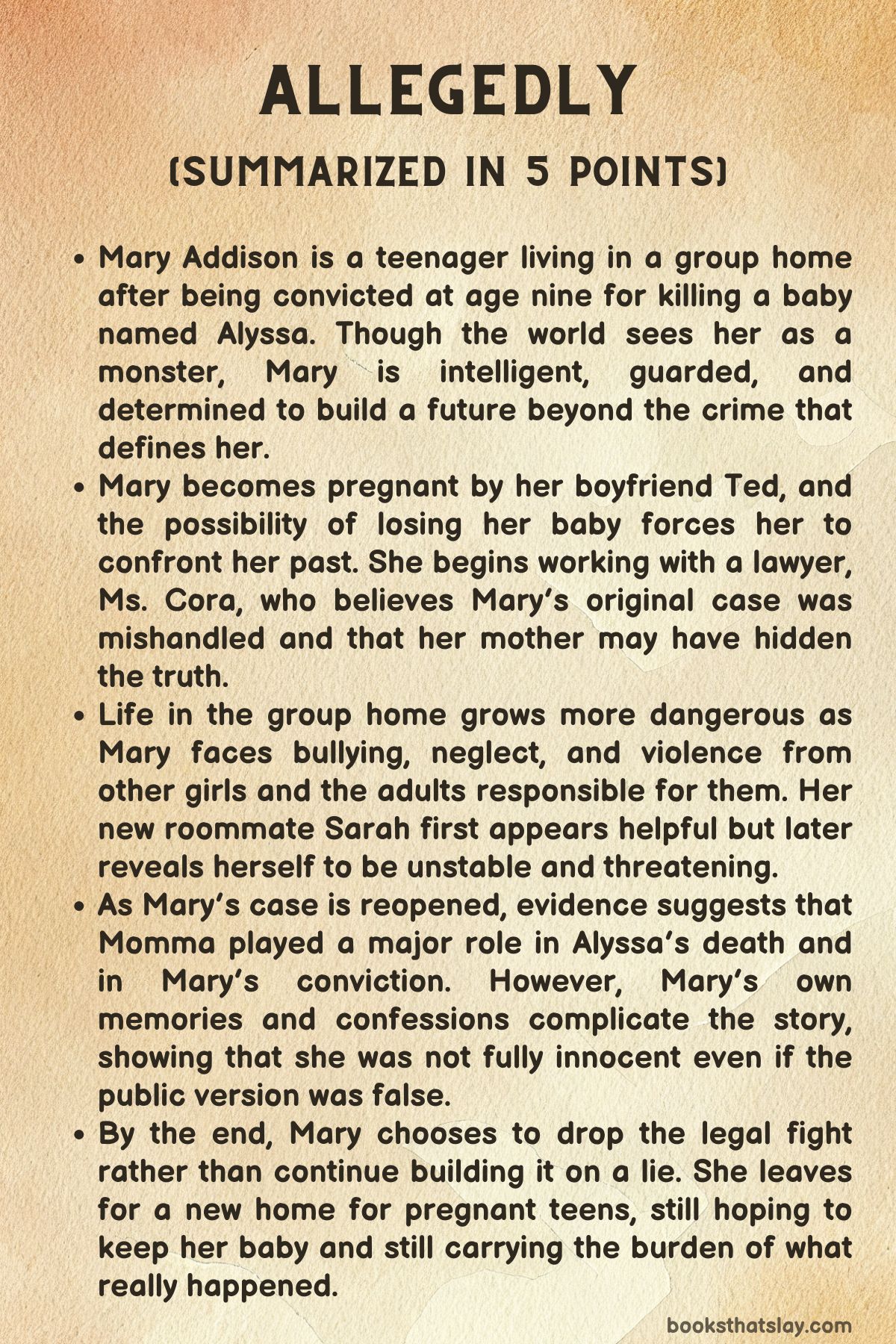
Summary
Mary Addison lives in a group home after serving time for the death of a baby named Alyssa. She was only nine when she was convicted, and the public has long treated her as a child monster.
Books, reports, and media stories have turned her into a symbol of evil, comparing her to fictional killer children and assuming she was born bad. Mary, however, is quiet, guarded, and observant.
She keeps to herself, follows rules when she must, and survives in a house where the adults neglect their duties and the other girls are often cruel.
The group home is run by Ms. Stein, with help from Ms. Reba. Neither woman protects Mary from violence or humiliation.
Mary hides small things that give her control, including a knife, a phone, and saved money. She also clings to dreams that others dismiss.
She wants to go to college and become a teacher, but her social worker, Ms. Carmen, pushes her toward cosmetology instead. Mary is intelligent, studies hard, and prepares for the SAT in secret.
Her hope for a future rests partly on education and partly on Ted, her boyfriend, who volunteers with her at a nursing home.
Ted is older than Mary and has his own troubled past. He was once involved with a gang and admits he helped hold down a girl during an assault, though he insists he did not rape her.
Mary wants to believe in his goodness because he makes her feel loved and seen. When she learns she is pregnant, Ted says he wants the baby and believes Mary can be a good mother.
For Mary, the pregnancy becomes both a source of fear and purpose. She knows the state may take the child from her because of her conviction, but she is determined to keep him.
Mary’s relationship with her mother, whom she calls Momma, is central to her pain. Momma visits regularly, dresses well, talks about church and her new life, and often acts as though Mary should remain loyal and grateful.
Yet Mary remembers a more unstable and frightening woman, especially after the death of Mary’s little brother and the arrival of Ray, Momma’s abusive partner. Mary also remembers caring for Momma when Momma could not care for herself.
Over time, the story suggests that Momma had a larger role in Alyssa’s death than the public knows.
When Mary tells Momma she is pregnant and asks her to tell the truth, Momma refuses. She slaps Mary and shames her.
This rejection pushes Mary toward action. She begins working with Ms. Cora from the Absolution Project, a lawyer who believes Mary’s case was mishandled.
Ms. Cora argues that Mary, as a nine-year-old child, was pressured into accepting blame and never received a fair chance. Evidence from teachers, doctors, and former neighbors shows that Mary was highly intelligent, nurturing toward Alyssa, and possibly misdiagnosed or medicated at her mother’s request.
As Ms. Cora investigates, the past opens in disturbing pieces. Mary tells a version of the story in which Momma killed Alyssa and manipulated Mary into taking responsibility.
There is evidence that could hurt Momma, including a jewel from Momma’s cross that was found in Alyssa’s throat. Mary also claims to have kept the cross itself, making it powerful proof.
For a while, it seems Mary may have been an innocent child sacrificed by an abusive mother and a careless justice system.
At the group home, Mary’s life grows more dangerous. She is bullied by girls like Tara and Kelly, and the adults repeatedly fail to protect her.
After Kelly steals Mary’s money and threatens her, Mary retaliates with calculated violence, burning Kelly with boiling water and oil. Mary uses the adults’ negligence against them to get what she wants, including her SAT book, a better roommate, and a birth certificate.
This shows Mary’s intelligence but also her capacity for revenge.
Her new roommate, Sarah, known as New Girl, first seems meek and frightened. She introduces Mary to the Absolution Project and acts like a friend.
But Sarah later reveals that she intentionally caused her mother’s death and feels triumph rather than guilt. Mary realizes Sarah is unstable and dangerous.
Sarah becomes possessive of Mary and reacts badly to the idea that Mary might leave. When Mary plans to run away with Ted, Sarah and Kelly confront her.
Kelly holds Mary’s knife near her pregnant belly, and Sarah pushes Mary down the stairs. Mary is badly injured, but the baby survives.
Ted, meanwhile, disappoints Mary deeply. After leaving his group home, he becomes homeless and enters an arrangement with Leticia, involving sex and money.
Mary sees him with Leticia and feels betrayed. Ted claims he did it to survive and to support Mary and the baby, but Mary cannot forgive the deception.
Still, after her fall, Ted visits and comforts her, showing that their bond is not easily broken, even if it is damaged.
Mary also reconnects with Mrs. Richardson, Alyssa’s mother. Mrs. Richardson is broken by grief and lives in an apartment frozen in the past, with Alyssa’s room preserved and Christmas decorations still untouched years later.
She once cared for Mary and recognized her intelligence. Mary wants Mrs. Richardson’s love more than almost anything.
When Mary fears losing her baby, she asks Mrs. Richardson to take him if the state refuses to let Mary raise him. Mrs. Richardson is too wounded to accept, but her presence reminds Mary of the motherly care she once received outside Momma.
Near the end, the truth becomes less clean. Ms. Cora learns Momma is blaming Mary for the death of Mary’s brother Junior, who had officially died of SIDS.
Mary denies killing him. The past with Ray and Momma becomes darker, and Mary confronts Momma again.
During their argument, Mary reveals that the story she told Ms. Cora was not fully true. Alyssa had been crying, and Mary, still a child, gave her some of Momma’s pills because she thought they would calm her.
Momma then panicked and tried to dislodge the pills using her cross, which led to the jewel being found in Alyssa’s throat. Both Mary and Momma were involved, though in different ways.
Mary was a neglected child acting out of confusion and learned caretaking, while Momma helped create the conditions for disaster and then protected herself.
Mary decides to drop the case. She knows that overturning it by blaming Momma would require continuing a lie.
She also admits to the reader that she is not harmless. She has lied, manipulated people, hurt others, and even poisoned Ms. Stein’s coffee with bleach before leaving.
Winters, who once doubted her, now believes she may not have killed Alyssa, but Mary understands that belief can be shaped by a good lie.
As Mary is taken to a new home for pregnant teens, she learns that the authorities may test her DNA to see whether Momma kidnapped her as a child. Mary no longer feels that this changes much.
Her focus is Bean, her unborn son. Winters also tells her that Mrs. Richardson plans to write a letter supporting Mary’s chance to keep the baby.
This gives Mary joy. She may lose Ted, her old life, and the fantasy of a simple escape, but she feels she has gained something more important: the possibility that Mrs. Richardson still cares for her and that she may yet become a mother.
Allegedly ends with Mary still morally uncertain, neither innocent victim nor simple villain. The novel leaves the reader facing a difficult truth: Mary was shaped by abuse, neglect, racism, media judgment, and a broken system, but she also makes frightening choices of her own.
Her story asks whether a child who has done harm can still deserve care, whether truth can survive years of lies, and whether motherhood can change someone who has never been safely mothered herself.
Characters
Mary Addison
Mary Addison is the emotional and moral center of Allegedly, and her character is built around contradiction. At first, she appears to be a victim of the justice system, the media, her mother, and the group home environment.
She was convicted at nine years old, stripped of a normal childhood, publicly labeled as a baby killer, and placed in spaces where adults either exploit her, ignore her, or underestimate her. Her silence, intelligence, and controlled behavior make her seem like someone who has learned survival through restraint.
She studies for the SAT, dreams of college, wants to become a teacher, and longs to keep her unborn child. These desires show her hunger for ordinary respectability, but they also reveal how much has been denied to her.
Mary’s complexity grows as the truth becomes less simple. She is capable of tenderness, especially toward Ted, Bean, Mrs. Richardson, and even Alyssa in her memories.
She also shows sharp emotional intelligence, knowing how to read people, hide information, and use weakness against others. Her actions against Kelly and Ms. Stein prove that she is not only a wounded girl but also someone who can calculate revenge.
By the end, Mary is neither fully innocent nor purely monstrous. Her confession about giving Alyssa pills changes the reader’s understanding of her, while her later admission about poisoning Ms. Stein’s coffee makes her even harder to judge.
Mary is a portrait of a child damaged by abuse and neglect who grows into a teenager desperate to become better, yet still shaped by the habits of secrecy, manipulation, and violence that helped her survive.
Momma
Momma is one of the most disturbing figures in the novel because she combines affection, cruelty, religious language, and self-preservation. To Mary, she is both beloved mother and dangerous force.
Mary remembers good days with her, including church outings, matching clothes, shared meals, and moments when Momma made ordinary life feel special. These memories explain why Mary continues to crave her approval even after years of abandonment and harm.
Momma’s power over Mary does not come only from fear; it comes from love, dependency, and the child’s longing to be chosen.
At the same time, Momma repeatedly protects herself at Mary’s expense. She allows Mary to carry the public blame for Alyssa’s death, denies responsibility, and reacts with anger whenever Mary tries to tell the truth.
She shames Mary for being pregnant, dismisses her fear of losing the baby, and frames Mary as corrupted or evil. Her instability is hinted at through her history as a neonatal nurse, her attachment to babies, her breakdown after loss, and her refusal to take responsibility for the damage she causes.
Momma’s relationship with Mary is emotionally abusive because she gives love selectively and withdraws it as punishment. Her final desperation when Mary cuts her off shows how dependent she is on Mary’s loyalty.
Momma wants to be seen as a mother, protector, and victim, but her choices reveal someone willing to sacrifice her child to save herself.
Ted
Ted represents love, escape, and disappointment in Mary’s life. He is one of the few people who treats her as a girl with a future rather than as a criminal record.
He gives her an SAT prep book, shows excitement about their baby, comforts her after abuse, and encourages her to fight for the truth. For Mary, Ted becomes proof that she can be loved, touched gently, and imagined as part of a family.
Their relationship offers her emotional shelter from the group home, the legal system, and Momma’s rejection.
Yet Ted is also deeply flawed. His past involvement in gang violence shows that he has participated in serious harm, even if he insists he was young and did not fully understand what he was doing.
His anger can be frightening, and his choices after leaving the group home reveal how survival can compromise morality. His arrangement with Leticia, which involves sex, control, and money, breaks Mary’s trust.
Ted believes he is doing what he must to provide for Mary and the baby, but his secrecy repeats the same pattern that hurts Mary elsewhere: people making decisions around her while claiming it is for her own good. Ted is not a simple savior.
He is another damaged young person trying to survive with limited tools, capable of love but also capable of betrayal and violence.
Alyssa Richardson
Alyssa is physically absent for most of the story, but her death shapes every major relationship and conflict. She exists in memory, legal records, media coverage, grief, and guilt.
To the public, she is the innocent baby whose murder turned Mary into a monster. To Mrs. Richardson, she is the lost child whose absence freezes time.
To Momma, Alyssa becomes a symbol of jealousy, resentment, and threat. To Mary, Alyssa is not an abstract victim but a real baby she remembers holding, feeding, and caring for.
Alyssa’s importance lies in how different characters use or remember her. The media uses her to create a sensational story.
The legal system uses her death to justify punishing a child. Mrs. Richardson keeps her memory sacred, while Momma twists the event to protect herself.
Mary’s memories of Alyssa reveal love and guilt at once. She did not see Alyssa as an enemy, yet her childish attempt to stop the baby from crying helped cause the tragedy.
Alyssa remains the moral center of the story because every version of the truth must return to the fact that a baby died and that the adults around her failed to protect all the children involved.
Mrs. Richardson
Mrs. Richardson is a tragic figure marked by grief, anger, and lingering compassion. Before Alyssa’s death, she recognized Mary’s intelligence and gave her academic attention that Momma resisted.
She saw Mary not as a problem but as a gifted child who needed care and challenge. This history makes Mary’s attachment to her especially powerful.
Mrs. Richardson represents the kind of maternal care Mary might have had if her life had been different.
After Alyssa’s death, Mrs. Richardson is emotionally ruined. Her apartment remains almost frozen in the past, with signs of grief everywhere.
She is angry, bitter, and unable to move forward, yet she is not shown as cruel in a simple way. Her confrontation with Mary is painful because she wants the truth but is still trapped in the horror of losing her child.
She believed Mary did not kill Alyssa, but that belief does not erase her suffering. When Mary asks her to take Bean if the state removes him, Mrs. Richardson cannot accept the role because she no longer sees herself as anyone’s mother.
Still, her later decision to write a letter for Mary matters deeply. It suggests that beneath her grief, she still sees Mary as a child who was also harmed.
Ms. Cora
Ms. Cora is the lawyer who gives Mary a serious chance to challenge the story that has defined her life. She is intelligent, committed, and outraged by the failures in Mary’s case.
Unlike many adults, she does not dismiss Mary as a lost cause. She studies the evidence, identifies legal weaknesses, and understands that Mary was a child whose plea and treatment deserve scrutiny.
Her belief gives Mary hope and helps expose the corruption, negligence, and assumptions that shaped the original conviction.
However, Ms. Cora’s role also shows the limits of advocacy when truth is unstable. She wants to save Mary from a false public narrative, but Mary is not fully honest with her.
Ms. Cora builds a case around Mary’s account, only to learn that the truth is more complicated. Her surprise and doubt when new information appears show that even well-meaning adults can be shaken when Mary’s story shifts.
Ms. Cora is important because she represents institutional help at its best: focused, educated, and passionate. Yet the novel does not make her a magical rescuer.
She can open doors, but she cannot give Mary a clean innocence that Mary herself does not possess.
Kain Winters
Kain Winters, Mary’s parole officer, begins as a skeptical authority figure but becomes more human as the story progresses. At first, he treats Mary like a case to manage.
He does not fully understand her fear, and he underestimates the danger she faces in the group home. Like many adults in the system, he sees warning signs but does not act quickly enough.
Mary’s pregnancy and her repeated pleas force him to confront the reality that she is not just a file or a convicted offender; she is a vulnerable teenager surrounded by threats.
Winters becomes more sympathetic after Mary is pushed down the stairs. His apology matters because it acknowledges his failure to listen.
He also shows personal warmth when he talks about his daughters and congratulates Mary on having a boy. By the end, he appears to believe that Mary may not have killed Alyssa in the way the public assumed.
Still, his character remains tied to the system’s limits. He can transport Mary, check on her, and sometimes advocate for her, but he cannot undo years of damage.
Winters represents an adult who is not evil, but whose delayed understanding still has consequences.
Ms. Stein
Ms. Stein is the abusive foster mother who runs the group home with cruelty, neglect, and resentment. She is responsible for Mary’s safety, yet she allows violence, bullying, and intimidation to continue under her roof.
She insults Mary, confiscates her SAT book, mocks her intelligence, and fails to protect her from other girls. Her treatment of Mary is especially cruel because she knows Mary has little power to complain or escape.
Ms. Stein’s abuse is not only physical or verbal; it is institutional. She uses her position to control vulnerable girls while avoiding accountability.
When violence occurs, she worries more about reports, inspections, and consequences for herself than about the girls’ well-being. Her fear after Mary exposes her negligence shows that she understands the system can punish her, but she only changes behavior when threatened.
Ms. Stein represents the kind of adult who turns a care facility into another site of harm. Her presence makes the group home feel less like a place of rehabilitation and more like a holding pen where damaged girls are expected to damage each other.
Ms. Reba
Ms. Reba functions as an extension of the group home’s neglect. She is not as dominant as Ms. Stein, but her passivity allows harm to continue.
She often appears slow to respond, careless, or more interested in maintaining order than protecting the girls. When fights break out or threats escalate, she rarely acts with urgency.
Her failure matters because neglect is not neutral in a place where the residents are already vulnerable.
At times, Ms. Reba bends rules, such as allowing Ted to see Mary after he arrives in panic. This suggests she is not completely without feeling.
However, occasional softness does not erase her broader failure. She works in a home where violence, theft, intimidation, and emotional abuse are common, yet she does little to stop them.
Her character shows how harm can flourish not only because of openly cruel people like Ms. Stein, but also because of weaker adults who look away, delay action, or treat suffering as routine.
Ms. Carmen
Ms. Carmen is Mary’s social worker and represents the system’s habit of reducing young people to risk categories. She asks Mary questions about her future but does not truly listen to the answer.
When Mary says she wants to become a teacher, Ms. Carmen dismisses the idea and pushes her toward cosmetology. This moment reveals how little faith she has in Mary’s ambition and how easily the system narrows the futures of girls with records.
Her reaction to Mary’s pregnancy is similarly cold. Rather than first asking what Mary wants or needs, she moves quickly toward adoption planning.
She assumes Mary’s baby will be taken and treats that outcome as practical rather than devastating. Ms. Carmen is not portrayed as cartoonishly evil, but her lack of imagination is damaging.
She cannot see Mary as a full person with intellect, desire, and maternal feeling. Her character criticizes professional systems that claim to help while quietly deciding who deserves a future and who does not.
Ms. Claire
Ms. Claire is one of the few adults who offers Mary care without demanding confession, gratitude, or performance. She encourages Mary academically, helps her prepare for the SAT, gives her clothing when she is cold, and speaks to her with firmness and warmth.
Her support is practical, not sentimental. She understands that Mary needs encouragement, but she also insists that Mary stay focused and not let Ted or fear derail her education.
Ms. Claire’s importance lies in her refusal to define Mary by accusation. When Mary asks whether Ms. Claire knows what she has done, Ms. Claire responds in a way that separates identity from wrongdoing.
This does not excuse Mary, but it gives her space to imagine herself as more than her worst act or the public’s worst assumption. Ms. Claire represents the kind of care Mary rarely receives: steady, honest, and protective without being possessive.
Her kindness stands in contrast to Momma’s unstable affection and the system’s cold supervision.
Sarah, or New Girl
Sarah first appears as a frightened newcomer, and that first impression makes her later transformation more unsettling. She seems meek, vulnerable, and in need of protection.
Mary initially sees her as someone lower in the group home hierarchy, another girl trying to survive. Sarah also provides a major turning point by directing Mary toward the Absolution Project, which makes her seem like an ally.
As her real nature emerges, Sarah becomes one of the clearest examples of hidden danger. She admits that she caused her mother’s death and shows joy rather than remorse.
Her possessiveness toward Mary grows intense, and she wants to imagine them as alike. This frightens Mary because Sarah’s violence is not rooted in the same kind of survival or childhood confusion Mary associates with herself.
Sarah kills out of resentment and entitlement, then expects Mary to understand. Her attack on Mary shows that her attachment is dangerous.
Sarah also forces the reader to compare different kinds of guilt. The novel makes clear that all troubled girls are not the same, even if the system houses them together and labels them similarly.
Kelly
Kelly is violent, intimidating, and cruel, but she is also another girl shaped by abandonment. She threatens Mary, steals from her, attacks her, and later joins Sarah in endangering Mary and Bean.
Her burnt face after Mary’s retaliation becomes a visible sign of the cycle of violence inside the group home. Kelly hurts others, but she is also hurt by a family that does not rescue her and by a system that leaves her in a brutal environment.
Her phone call with her father reveals a wounded side beneath her aggression. She wants to be wanted, and when that desire is denied, her rage sharpens.
Kelly’s cruelty toward Mary is partly about power: in a house where none of the girls has real control, she tries to dominate those around her. Mary’s retaliation proves that Kelly is not the only dangerous person in the home.
Their conflict shows how neglected children can become threats to one another when adults fail to create safety.
Tara
Tara is one of the group home girls who makes Mary’s daily life more dangerous. She destroys Mary’s SAT book, attacks her, and helps enforce the hostile social order of the house.
Tara’s cruelty is direct and physical, and she often seems to target Mary because Mary is isolated and already marked by public shame. Her behavior shows how the girls absorb the violence around them and redirect it toward whoever seems most vulnerable.
Tara is not explored as deeply as Mary or Sarah, but her presence matters because she helps define the group home as a place of constant threat. She also becomes part of Mary’s moral testing ground.
Mary often restrains herself because she has goals, but Tara’s attacks push her closer to retaliation. Through Tara, the story shows how hard it is for Mary to remain focused on education, motherhood, and freedom when her immediate world keeps demanding self-defense.
Marisol
Marisol becomes especially important near the end because she challenges Mary’s attempt to blame Momma completely. Unlike the adults, Marisol sees the emotional loyalty behind Mary’s choices.
She argues from the perspective of a girl who longs for a mother who visits and cares, even imperfectly. To Marisol, Mary’s willingness to send Momma to prison looks like betrayal, because Marisol measures motherhood by presence and loyalty rather than moral purity.
Her reaction forces Mary to face the guilt she has tried to manage. Marisol does not know every detail, but she understands something true about Mary: Mary still loves Momma and cannot fully separate herself from her.
Marisol’s role is brief but powerful because she complicates the reader’s judgment. She reminds us that for neglected children, even harmful love can feel precious.
Her comments help push Mary toward dropping the case, not because Momma is innocent, but because Mary knows her own story has become dishonest.
China
China is another resident of the group home whose role reflects the unsafe, invasive atmosphere Mary lives in. Her staring, boundary-crossing behavior, and presence during moments when Mary feels exposed add to the sense that Mary has no privacy.
In a house filled with surveillance from adults and threats from peers, China’s behavior makes Mary’s body feel even less her own.
Although China is not central to the legal plot, she contributes to the mood of constant vulnerability. Mary is pregnant, watched, judged, and physically unsafe.
China’s presence reinforces how the group home strips girls of dignity. They sleep near each other, fight near each other, and witness each other’s humiliation.
China is part of that environment, showing how damaged boundaries become normal when young people are placed in overcrowded, poorly supervised care.
Ray
Ray is absent from the present action but casts a long shadow over Mary and Momma. He enters their lives as Momma’s partner and becomes a source of abuse, instability, and financial harm.
His presence changes Momma’s relationship with Mary, taking away the closeness they once shared. Mary remembers him as someone who influenced Momma to beat her and helped turn their home into a place of fear.
Ray’s significance also lies in what he reveals about Momma. Momma’s accusation that Ray tried to sleep with Mary suggests danger, jealousy, and possible sexual threat within the household.
His death, officially explained as a stroke, is surrounded by suspicion, especially from his wife, Carmen Vaquero. Whether Momma killed him or not, Ray represents the kind of adult male violence and exploitation that worsens the already fragile lives of Mary and Momma.
He is part of the background of trauma that shapes Mary’s understanding of love, safety, and power.
Junior
Junior, Mary’s little brother, is another dead child whose memory shapes the story. His death from SIDS breaks something in Momma and changes the household.
Mary remembers finding him and insists she did not kill him. His death helps explain why Mary became responsible for caring for Momma at such a young age.
After Junior, Mary is pushed further into the role of caretaker, trying to manage an adult’s grief and instability.
Junior also becomes a weapon when Momma suggests Mary may have had something to do with his death. This accusation threatens Mary’s credibility and makes even Ms. Cora doubt her briefly.
The suspicion around Junior deepens the novel’s concern with how easily narratives form around children accused of violence. Once Mary is seen as capable of killing one baby, every other tragedy near her becomes suspect.
Junior’s death therefore shows how grief, accusation, and reputation can distort the truth.
Kisha
Kisha is most memorable for presenting a poem that Mary recognizes as copied from Maya Angelou. This moment highlights Mary’s intelligence and cultural knowledge, because she catches what others miss.
Kisha’s action also reflects the hunger for recognition among the girls in the group home. By using someone else’s words, she receives praise and attention, even if it is not honestly earned.
Kisha’s role is smaller than many others, but she helps show the emotional economy of the group home. The girls want to be seen, applauded, feared, or respected because they have so little stable validation.
Mary’s silent recognition of the plagiarism also reveals her isolation. She knows the truth but does not speak, partly because speaking often brings consequences.
Through Kisha, the novel shows how performance becomes a survival strategy in confined spaces.
Dr. Cross
Dr. Cross represents the suspicious medical and psychiatric systems surrounding Mary’s case. When he claims to have seen Mary before, though she has no memory of him, the encounter raises questions about records, evaluations, and manipulation.
His missing files add to the sense that Mary’s history has been shaped by unreliable adults and possibly false documentation.
His character matters less as an individual and more as a symbol of institutional uncertainty. Mary has been labeled with conditions that were never clearly proven, medicated despite strong evidence of intelligence and focus, and judged through reports that may not be trustworthy.
Dr. Cross shows how professional authority can create lasting consequences even when its foundation is weak. In Allegedly, medical language is often used to explain or control Mary rather than understand her.
Themes
The Unstable Nature of Truth
Truth in Allegedly is not presented as a single hidden object waiting to be uncovered. It shifts depending on who is speaking, what they remember, what they fear, and what they want to protect.
Mary’s story changes across the novel, and each version contains some emotional truth even when it is factually incomplete. At first, she appears to be a child wrongly blamed by a manipulative mother.
Later, her confession reveals that she did contribute to Alyssa’s death by giving her pills. Yet even that confession does not make the public version accurate.
Mary was a young child acting under the pressure of neglect, adult instability, and a learned sense of responsibility. The legal system wants a clean answer: guilty or innocent, killer or victim.
The novel resists that simplicity. Documents, interviews, depositions, and memories all compete with one another, showing how official records can be incomplete and personal memories can be shaped by trauma.
The truth becomes especially unstable because Mary has spent years surviving through silence and lies. By the end, the reader is left with a difficult understanding: truth can reveal guilt and victimhood at the same time, and knowing what happened does not always make judgment easier.
Motherhood, Possession, and Failed Care
Motherhood appears throughout the story as both a source of love and a form of control. Mary longs for Momma’s affection even after years of betrayal because her need for maternal love is deeply rooted.
Momma uses that need to keep Mary loyal, presenting herself as protector while allowing Mary to carry blame for Alyssa’s death. Her love is unstable, possessive, and conditional.
She wants Mary to remain her child, but she does not protect Mary in the ways a mother should. Mrs. Richardson offers a contrasting form of motherhood.
She once nurtured Mary’s intelligence and treated her with care, but after Alyssa’s death, grief makes her unable to mother anyone. Mary’s pregnancy adds another layer to the theme.
Her desire to keep Bean is not only about having a child; it is about proving she can give the love and protection she never consistently received. Yet the novel does not romanticize this desire.
Mary is still young, damaged, and morally compromised. Her wish to be a good mother exists beside her capacity for manipulation and harm.
The story asks whether motherhood is defined by biology, love, sacrifice, protection, or possession, and it shows how dangerous motherhood becomes when love is mixed with fear and control.
The Failure of Systems Meant to Protect Children
The institutions around Mary repeatedly fail the children they are supposed to protect. The courts accept a deeply flawed account of Alyssa’s death and allow a nine-year-old girl to become the face of a horrifying crime without fully examining the adults around her.
Doctors and psychiatrists medicate or label Mary without clear evidence, turning professional authority into another form of control. Social workers and parole officers monitor Mary closely but miss the immediate dangers she faces.
The group home, which should provide safety, becomes a place where violence, theft, intimidation, and neglect are normal. Ms. Stein and Ms. Reba care more about avoiding consequences than protecting the girls.
Even Mary’s pregnancy is treated first as a bureaucratic problem rather than as a human crisis. These failures are not isolated mistakes; they form a pattern.
Children like Mary, Sarah, Kelly, and the others are managed rather than understood. The system sees risk, paperwork, placement, and liability, but it often misses fear, intelligence, trauma, and need.
The novel’s criticism is sharp because Mary is not the only one failed. The girls in the home have all been shaped by abandonment, abuse, or instability, and the institutions surrounding them often reproduce the harm they claim to solve.
Guilt, Responsibility, and Moral Ambiguity
Mary’s character forces a difficult distinction between guilt and responsibility. She is not innocent in a simple sense.
She gave Alyssa pills, lies repeatedly, hurts Kelly, manipulates adults, and poisons Ms. Stein’s coffee. These actions cannot be dismissed.
At the same time, she is not the monster the media and legal system create. She was a neglected child trained to care for an unstable mother, exposed to abuse, and left without adult protection.
Her role in Alyssa’s death was tragic and serious, but it was also shaped by childhood ignorance and adult failure. The novel makes moral judgment uncomfortable because almost every major character carries some form of damage, guilt, or denial.
Momma is responsible for manipulation and cover-up, but she is also mentally unstable and marked by loss. Ted loves Mary but betrays her and has a violent past.
Mrs. Richardson is sympathetic but consumed by grief. Sarah’s violence is far less defensible, yet she too comes from a troubled home.
The story refuses to divide people neatly into victims and villains. Instead, it asks how much responsibility belongs to a child shaped by harm, and how much belongs to the adults and systems that allowed that harm to continue.