All Her Little Secrets Summary, Characters and Themes
All Her Little Secrets by Wanda M. Morris is a legal thriller about Ellice Littlejohn, a successful Black corporate lawyer whose carefully controlled life begins to collapse after she finds her boss and secret lover dead in his office. Her decision to walk away from the scene pulls her into a dangerous mix of murder, corporate corruption, racism, and buried childhood trauma.
The novel follows Ellice as she tries to protect herself, uncover the truth, and face the past she has spent decades hiding. It is a sharp story about survival, power, silence, and the cost of keeping secrets.
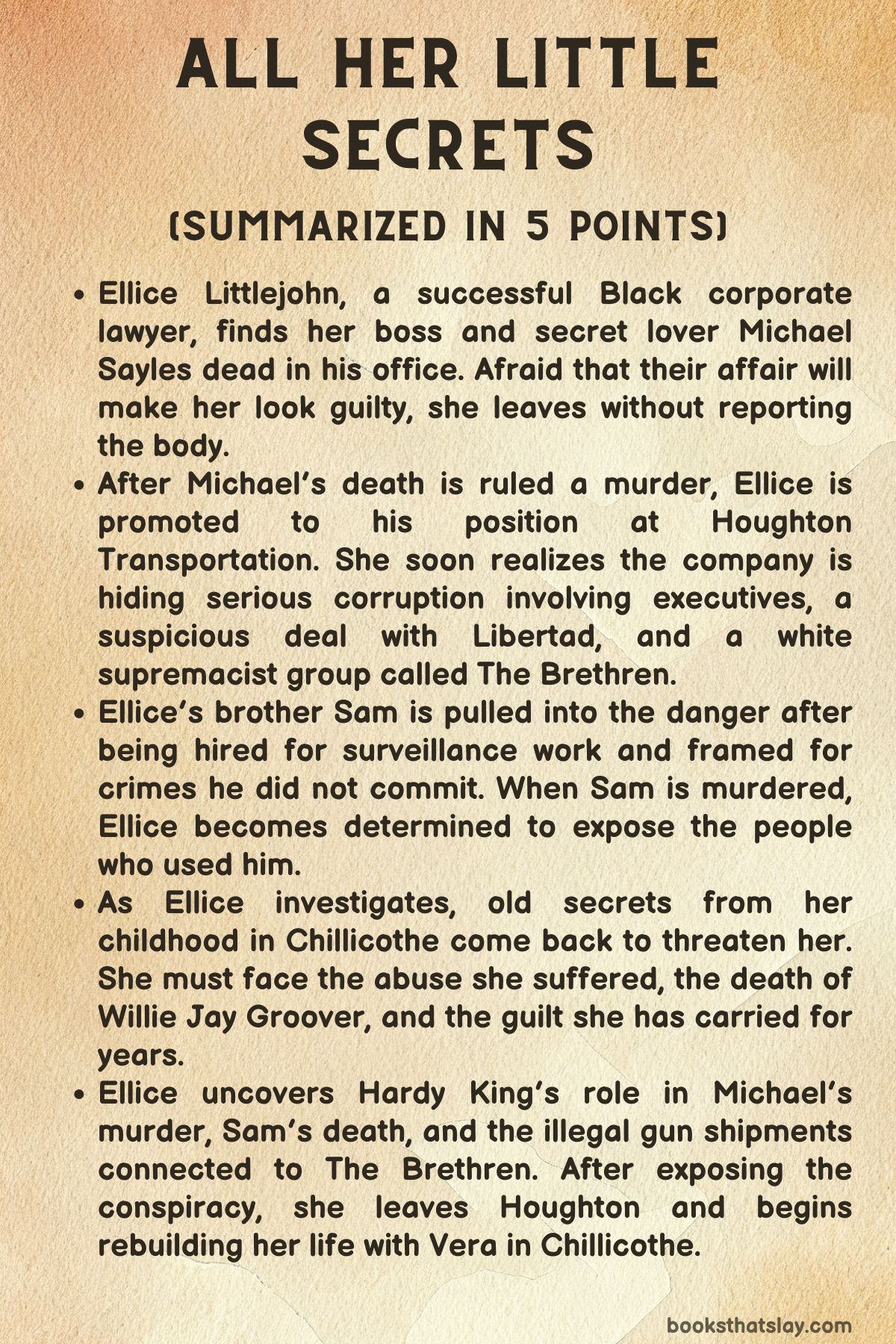
Summary
Ellice Littlejohn has built a life that looks polished from the outside. She is a lawyer at Houghton Transportation in Atlanta, working as assistant general counsel under Michael Sayles, the company’s executive vice president and general counsel.
She is intelligent, careful, and used to being one of the few Black people in powerful rooms. She is also having a secret affair with Michael, a fact that could damage both her career and reputation.
One morning, Ellice arrives early for a private meeting with Michael. When he does not answer, she enters his office and finds him dead, shot in the head, with a gun nearby.
Terrified by what her presence would reveal, she leaves without calling for help. Soon the office fills with police and emergency workers, and word spreads that Michael has died by suicide.
Ellice tries to act shocked, but she knows she has already made herself look guilty.
Houghton is already under public pressure. Protesters gather outside the company, accusing it of racist hiring and promotion practices.
Several people of color have filed complaints, and the company’s executives are anxious about the damage to its image. After Michael’s death, CEO Nate Ashe quickly offers Ellice his job.
He praises her qualifications, but he also makes it clear that her race helps make her useful to the company during a discrimination scandal. Ellice accepts after the announcement is made without her consent, though she feels isolated and used.
Detective Bradford begins asking questions, and Ellice lies about seeing Michael that morning. She claims she lost her ID badge weeks earlier.
Her fear grows when Michael’s death is ruled a homicide staged as a suicide. At his funeral, she learns that the police are looking closely at a woman believed to be his mistress.
Ellice knows that if her affair is exposed, she may become the main suspect.
Michael’s widow, Anna, later contacts Ellice and reveals that someone searched Michael’s house during the funeral. Anna found documents from Michael’s safe deposit box, including a resignation letter and emails with Geoffrey Gallagher, a criminal defense lawyer.
Michael had been seeking advice about a confidential deal involving a company called Libertad. Anna pressures Ellice to investigate from inside Houghton, threatening to reveal the affair if she refuses.
Ellice soon learns that Michael had been concerned about Houghton’s business with Libertad. Jonathan Everett, the chief financial officer, and Max Lumpkin, a senior operations executive, seem deeply involved.
Ellice notices that Max and certain board members wear the same lapel pin: a red heart above two gold flags. Their behavior toward her is dismissive and racially loaded.
At a country club event, Ellice sees how easily the company’s leaders treat her as an outsider, even while using her promotion to protect themselves.
Her private life is just as strained. Ellice visits Vera, the older woman who helped raise her and is now living in a nursing home with dementia.
She also struggles with her younger brother, Sam, who has a criminal record and often needs money. Ellice feels guilty for leaving him behind in their Georgia hometown of Chillicothe when she won a scholarship to boarding school as a teenager.
As Ellice investigates, she discovers that her missing ID badge was used by Sam to enter Houghton before Michael’s death. Detective Bradford shows her security images, and Ellice recognizes him but lies again.
When she searches Sam’s apartment, she finds the badge and a burner phone connected to Gallagher. Someone attacks her and steals the phone and badge before she can understand everything.
Sam later tells Ellice that Jonathan hired him for surveillance work. He says he was told to follow Gallagher and was given the badge.
Ellice realizes Sam is being set up, but Sam refuses to go to the police because he is on probation. Around the same time, Ellice receives a threatening envelope with an old article about a missing sheriff’s deputy from Chillicothe.
Someone knows about the secret she has spent her adult life hiding.
That secret goes back to Ellice’s childhood. Her mother, Martha, married Willie Jay Groover, a cruel white sheriff’s deputy who abused his power and terrorized the family.
Willie Jay sexually abused Ellice when she was a teenager. When Ellice became pregnant, Vera helped her end the pregnancy.
Ellice feared leaving for school because Willie Jay also hurt Sam, but Vera promised to help if Ellice needed to remove him from their lives.
After Michael’s murder, events become more deadly. Sam is instructed to drive a stolen car to a remote cabin.
When the car breaks down, he finds Gallagher’s body in the trunk and realizes he has been framed. Before he can escape, someone he recognizes shoots him.
Ellice learns of two bodies found near the stolen car and soon has to identify Sam at the coroner’s office. Grief turns into fury as she becomes determined to prove her brother was not a killer.
Jonathan threatens Ellice directly. He tells her that if she keeps talking to the police or refuses to support the Libertad deal, he will reveal what happened in Chillicothe.
Ellice finds a thumb drive in Max’s office containing a file on her past and another file about a white supremacist group called The Brethren. The group uses the lapel pin she has seen on Max and the board members.
The files show that Michael was likely killed because he learned too much about money laundering and refused to cooperate with the group.
Rudy, Ellice’s trusted friend at work, discovers suspicious shipping records involving Houghton, Cavanaugh Industries, and Libertad. Ellice begins to see that the company may be moving more than ordinary cargo.
She plans to give the evidence to the police, even though it could expose her past. She understands that her silence has only given dangerous men more control over her.
The truth about Chillicothe comes fully into focus. After Willie Jay locked Sam in a hot shed as punishment, Ellice decided he had to be stopped.
She poisoned his chicken and dumplings with strychnine. When he died, Vera helped Ellice drag his body to the river and dispose of the evidence.
Vera called it a grave secret, something they would carry forever.
Ellice eventually discovers that Hardy King, Houghton’s head of corporate security, is more involved than he seemed. With help from Sam’s friend Juice, she traces Sam’s surveillance job to Tri-County Outfitters, a gun shop.
There, she learns that Hardy posed as someone from Cavanaugh Industries and hired Sam. The shop also receives regular Houghton shipments containing guns.
Ellice realizes Hardy killed Michael and Gallagher, helped frame Sam, and shipped weapons for The Brethren.
Ellice goes to Houghton at night and searches Hardy’s office. She finds burner phones, her ID badge, a Brethren pin, and evidence connecting him to the gun shipments.
Hardy catches her, and she runs to the twentieth floor, where there are no cameras. During their confrontation, Hardy admits enough to confirm his role.
Ellice has already prepared the broken elevator area. In the struggle, Hardy falls into the empty elevator shaft and dies.
Ellice presents the police with evidence showing that The Brethren were planning attacks on Martin Luther King Jr. Day parades.
In the aftermath, the police arrest or expose several Houghton leaders, including Jonathan, Max, and board members connected to The Brethren. Detective Bradford chooses not to pursue the old Willie Jay case, allowing Ellice to leave with her past no longer controlling her future.
Ellice resigns from Houghton, recognizing the anger and exhaustion she has carried from years of racism, fear, and survival.
After Sam’s funeral in Chillicothe, Ellice begins to rebuild. She removes Vera from the nursing home and arranges care for her at Vera’s old farmhouse.
For much of her life, Chillicothe represented pain, poverty, and secrets. By the end, Ellice sees a chance to return on her own terms, care for the woman who once protected her, and create a quieter life beyond Houghton’s corruption and the shadow of her hidden past.
Characters
Ellice Littlejohn
Ellice Littlejohn is the central character of All Her Little Secrets, and her story is built around the tension between public success and private fear. On the surface, she is a high-achieving corporate lawyer who has earned her place through intelligence, discipline, and hard work.
She has escaped poverty, violence, and the suffocating racism of Chillicothe, Georgia, and made herself into someone respected in professional circles. Yet her life is not as secure as it appears.
She carries the trauma of childhood abuse, the guilt of leaving her brother Sam behind, the shame forced on her by others, and the fear that one hidden act from her past could destroy everything she has built.
Ellice’s first major decision, leaving Michael’s body without calling the police, reveals both her fear and her instinct for self-preservation. She knows how easily suspicion can fall on a Black woman in a white corporate environment, especially one who was secretly involved with the dead man.
Her lie is morally troubling, but it is also rooted in a lifetime of learning that institutions rarely protect people like her. She has survived by controlling information, managing appearances, and keeping her emotions locked away.
Her silence is not weakness; it is a survival method that has hardened into habit.
Her promotion after Michael’s death exposes another part of her conflict. She wants recognition for her talent, but she knows Houghton’s leadership also sees her as useful because she is Black.
This makes her success feel contaminated by tokenism. Ellice is qualified, but the company’s motives are cynical.
Her new role places her inside a corporate power structure that does not truly accept her, and she becomes both a symbol and a shield for people trying to protect themselves from accusations of racism.
Ellice’s relationship with the past is one of the most important parts of her character. She has tried to separate herself from Chillicothe, from Willie Jay, from her mother’s cruelty, and from the secret she shares with Vera.
Yet the past returns through threats, documents, memories, and danger to Sam and Vera. Her journey is not only about solving Michael’s murder; it is about refusing to be controlled by shame.
By the end, Ellice chooses action over fear. She exposes The Brethren, confronts Hardy, resigns from Houghton, and returns to care for Vera.
Her ending is not simple happiness, but it is a form of release. She no longer lets powerful men define the meaning of her life.
Sam Littlejohn
Sam Littlejohn is Ellice’s younger brother, and his character represents the life Ellice escaped but could never fully leave behind. Unlike Ellice, Sam did not get a scholarship, a new school, or a clean break from Chillicothe.
He remained closer to the damage caused by poverty, racism, family neglect, and Willie Jay’s abuse. His history with the criminal justice system makes him vulnerable to exploitation, and this vulnerability is exactly what Hardy and the corrupt Houghton executives use against him.
Sam is not presented as perfect. He asks Ellice for money, resents her success at times, and makes risky choices.
Yet his flaws are shaped by abandonment, trauma, and limited opportunity. He feels judged by Ellice even when she is trying to help him, and his anger often comes from the belief that she left him behind.
Their relationship is filled with love, guilt, and resentment. Ellice sees herself as responsible for him, while Sam wants to be seen as more than a problem she has to fix.
His decision to take the surveillance job shows both desperation and naivety. Sam thinks he has found legitimate work, or at least work that can help him stand on his own.
He does not understand that he has been selected because others believe he is disposable. His criminal record, his connection to Ellice, and his need for money make him an ideal target for a frame-up.
His death is one of the emotional turning points of the novel because it transforms Ellice’s fear into determination.
Sam also deepens the novel’s exploration of how systems punish people long before they commit any crime. His life is shaped by racist policing, childhood abuse, and the lack of protection from adults who should have saved him.
He is not only a victim of Hardy’s plot; he is a victim of every structure that made it easy for powerful people to use him and then discard him. His death forces Ellice to stop hiding and to fight openly for the truth.
Vera Henderson
Vera is one of the most important moral and emotional figures in the story. She is not Ellice’s biological mother, but she becomes the person who offers the care, protection, and practical love that Martha fails to provide.
Vera understands danger because she has survived it herself. Her past includes violence, flight, and the killing of a man who raped her, which gives her a grim understanding of what women sometimes do when no institution will protect them.
Vera’s love for Ellice is fierce and imperfect. She encourages Ellice to leave Chillicothe for school because she understands that education may be Ellice’s only path out.
At the same time, Vera becomes the keeper of Ellice’s darkest secret. When Ellice is pregnant after Willie Jay’s abuse, Vera helps end the pregnancy.
Later, when Ellice kills Willie Jay, Vera helps dispose of the body and teaches Ellice the idea of a grave secret. These actions are morally complicated, but they come from a world where legal justice has failed them repeatedly.
Vera acts because waiting for help would mean allowing more harm.
Her dementia later in life adds sadness to her role. Ellice visits Vera in a nursing home, feeling guilty because Vera never wanted to be there.
Vera’s memory fades, but fragments of the past remain, especially memories connected to Willie Jay, the chicken and dumplings, and Ellice’s suffering. Her condition makes her vulnerable when Jonathan’s threats reach her, but it also shows how deeply trauma remains even when ordinary memory breaks down.
By the end, Ellice’s decision to bring Vera home is significant. It is not just an act of gratitude; it is a way of honoring the woman who protected her when no one else would.
Vera represents survival outside official systems. She is not gentle in a conventional way, but her love is active, protective, and enduring.
Michael Sayles
Michael Sayles is dead early in the story, but his presence shapes much of the plot. He is Ellice’s boss, lover, and professional connection to the hidden corruption inside Houghton.
His affair with Ellice creates immediate danger for her because it gives the police a possible motive and gives Anna leverage. Michael’s secrecy also frustrates Ellice because she realizes too late that he had been carrying knowledge that could have helped her understand the threat around them.
Michael appears to have been involved in uncovering or resisting the Libertad deal. His communication with Geoffrey Gallagher suggests that he knew the company’s dealings were legally dangerous.
He was considering resignation, which indicates that he had reached a point where he could not comfortably continue inside Houghton’s corrupt structure. His refusal to join Max’s extremist circle also makes him a target.
As a character, Michael is morally mixed. His concern about the Libertad deal suggests a conscience, but his affair with Ellice reveals selfishness and carelessness.
He placed her in an emotionally vulnerable and professionally risky position. He did not share enough with her, even though his secrets could endanger her.
His death leaves Ellice with grief, confusion, and suspicion, but also with the burden of cleaning up a mess he helped keep hidden.
Michael’s function in All Her Little Secrets is not simply to be the murder victim. He represents the dangers of partial courage.
He knew something was wrong and seems to have tried to step away, but he did not fully expose the corruption before it consumed him. His silence, like Ellice’s, has consequences.
Anna Sayles
Anna Sayles, Michael’s widow, is a tense and practical character whose grief is mixed with anger and self-protection. She knows or strongly suspects that Michael was involved with Ellice, and she uses that knowledge to force Ellice into investigating his death from inside Houghton.
Anna is not shown as warm or forgiving, but her actions make sense within her position. Her husband has been murdered, her home has been searched, and the police may suspect her.
She needs answers and sees Ellice as someone with access.
Anna’s behavior toward Ellice is sharp because she has power in one area: she can expose the affair. In a story where secrets are weapons, Anna uses the secret she has.
She is not the villain, but she is willing to pressure another woman to protect herself and learn the truth. Her role also complicates Michael’s memory.
Through Anna, readers see that Michael’s private life had consequences beyond Ellice’s grief.
Anna’s importance lies in the way she pushes the investigation forward. Without her, Ellice may not have learned about the safe deposit box, the resignation letter, or Geoffrey Gallagher’s connection to the Libertad deal.
Anna opens a door into Michael’s hidden concerns, even though she does so through threat rather than trust.
Detective Bradford
Detective Bradford is the main law enforcement figure investigating the murders. She is intelligent, persistent, and skeptical.
From Ellice’s perspective, Bradford is a threat because she keeps getting closer to the truth Ellice wants hidden. Bradford’s suspicion is not baseless: Ellice lies, hides her connection to Michael, protects Sam, and delays turning over evidence.
The detective’s pressure forces Ellice to confront the consequences of her choices.
At the same time, Bradford’s role shows the uneasy relationship between Ellice and the justice system. Ellice fears that the police will not see her complexity, only a motive.
Bradford and her partner develop a theory in which Ellice used Sam to kill Michael and Gallagher, then killed Sam to silence him. This theory is wrong, but it is built from the evidence Ellice’s lies helped create.
The investigation becomes a mirror of Ellice’s fear: once she withholds the truth, every action looks more suspicious.
Bradford becomes more sympathetic near the end. After Ellice provides the evidence against The Brethren and Hardy, Bradford recognizes the larger danger and acts on it.
Her choice not to pursue the old Willie Jay case is a significant gesture. It does not erase Ellice’s past act, but it acknowledges the context of abuse, survival, and the greater justice achieved by exposing the present conspiracy.
Bradford represents law as imperfect, sometimes threatening, but not entirely unreachable.
Nate Ashe
Nate Ashe is Houghton’s CEO, a man with symbolic power but shrinking real control. At first, he appears to be the executive making major decisions, including Ellice’s promotion.
He speaks in polished corporate language and uses the image of elephants to discuss loyalty, power, and conflict. Yet his authority is compromised by early-onset Alzheimer’s, which Jonathan and Willow conceal from the board while Jonathan and Max quietly direct the company’s real operations.
Nate’s character is tragic because he is both powerful and manipulated. He is not innocent of corporate calculation; he promotes Ellice partly because her race is useful during a discrimination crisis.
This reveals his willingness to treat diversity as public relations. Still, he is also being used by people more dangerous than himself.
His illness makes him dependent, and that dependency creates an opening for Jonathan and Max to run Houghton for corrupt ends.
Nate’s fascination with elephants gives the novel one of its key metaphors. He sees elephants as loyal family animals, but his company behaves in the opposite way.
Houghton’s leaders protect themselves, sacrifice employees, and exploit vulnerable people. Nate’s proverb about fighting elephants and suffering grass also captures Ellice’s position.
She is among the powerful after her promotion, but she remains vulnerable to forces above and around her.
Jonathan Everett
Jonathan Everett is one of the central antagonists, representing corporate corruption hidden behind executive polish. As chief financial officer, he has access to money, deals, and influence.
He is deeply connected to the Libertad arrangement and helps manipulate Houghton while Nate’s health declines. Jonathan understands systems: finance, corporate hierarchy, reputation, and fear.
He uses all of them to protect himself.
Jonathan is especially dangerous because he studies Ellice’s past and uses it as leverage. He understands that shame can be more effective than open violence.
By threatening to reveal Chillicothe, he tries to make Ellice compliant. He also recommends her promotion not out of respect, but because he believes her history makes her controllable.
His racism is not always loud; it appears in his willingness to treat Ellice as a tool, a liability, and a shield.
Although Hardy is ultimately revealed as the killer, Jonathan remains morally responsible for much of the danger. His corruption creates the conditions for murder, trafficking-related business, money laundering, and cover-ups.
He is a man who believes power means never being accountable. His downfall is necessary because he represents the executive class that uses institutions to hide criminal behavior.
Max Lumpkin
Max Lumpkin is openly hostile in ways that Jonathan often masks. He resents Ellice’s authority, questions her competence, and treats her presence in leadership as a threat.
His language toward her is coded, but the meaning is clear: he does not believe she belongs in Michael’s role. Max’s racism is personal, ideological, and organizational.
His connection to The Brethren makes him one of the most dangerous figures in the novel. The lapel pin, the manifesto, and his attempt to recruit or pressure Michael reveal that he is not just a prejudiced executive but part of a white supremacist network.
He sees corporate power as a way to advance extremist goals. The company’s shipping infrastructure becomes useful to him because it can move weapons under the cover of normal business.
Max also shows how hate can operate inside respectable institutions. He is not a fringe figure living outside power; he is an executive with influence, access, and board connections.
His presence suggests that extremism does not always announce itself openly. Sometimes it wears a suit, sits in meetings, and speaks in the language of business risk and operational control.
Hardy King
Hardy King is one of the most deceptive characters in the novel. As head of corporate security, he appears protective, friendly, and approachable.
His habit of hugging people makes him seem warm, but it also allows him to cross boundaries and gather trust. Ellice initially views him as a possible ally, especially compared with Jonathan and Max.
This makes the revelation of his guilt more powerful.
Hardy’s role depends on misdirection. He pretends to help Ellice while guiding suspicion elsewhere.
He hires Sam while posing as someone else, gives him access through Ellice’s badge, and helps frame him. He murders Michael and Gallagher and later Sam, all while maintaining the appearance of a loyal security professional.
His position gives him the perfect cover: he knows cameras, access points, records, and building weaknesses.
Hardy’s motives combine loyalty to Houghton, hatred, and allegiance to The Brethren. He claims to oppose Jonathan’s money laundering because it stains the company, but he is himself involved in shipping guns for white supremacist violence.
This contradiction shows his warped morality. He does not object to crime; he objects to crime that does not serve his own ideology or idea of order.
His death at Ellice’s hands mirrors the larger conflict between hunter and hunted. Ellice prepares the setting because she understands that institutions may fail her again.
Her act is calculated, and it raises moral questions, but it also ends the immediate threat. Hardy is the face of friendly evil: the person who smiles, hugs, and destroys lives from behind the scenes.
Rudy Clifton
Rudy Clifton is Ellice’s closest workplace friend and one of the few people at Houghton who offers genuine support. He is not part of the executive inner circle, but his position gives him access to operational details that become crucial.
His discovery of suspicious shipping records helps connect Houghton’s business activities to Cavanaugh Industries, Libertad, and the movement of weapons.
Rudy provides emotional contrast to the hostile corporate environment. Around him, Ellice can be more open, though she still withholds much of the truth.
He encourages her to go to the police and warns her when he hears that a warrant may be coming. His concern is practical and loyal.
Unlike many people at Houghton, Rudy does not try to use Ellice’s vulnerability for power.
His character also shows that resistance inside corrupt institutions can come from ordinary employees paying attention. Rudy is not a heroic executive or investigator.
He is a colleague who notices inconsistencies, cares about Ellice, and chooses to help. His role is quiet but important because his evidence supports the truth Ellice is trying to expose.
Grace
Grace is Ellice’s friend from Georgetown and one of the few people connected to her life outside Houghton and Chillicothe. She represents friendship, stability, and outside perspective.
When Ellice is overwhelmed, Grace offers emotional support without trying to control her. She celebrates Ellice’s promotion, checks on her, and later advises her to resign from Houghton when the danger becomes too great.
Grace’s role is important because Ellice is isolated for much of the story. She cannot fully trust her coworkers, her family history is painful, and her affair with Michael must remain hidden.
Grace gives her a space where she can be seen as a person rather than a suspect, token, executive, or survivor. Her advice to leave Houghton is also morally clear.
She sees that the company is toxic and that Ellice’s continued presence there keeps her tied to people who mean her harm.
Although Grace is not central to the murder plot, she helps reveal Ellice’s need for chosen family and emotional honesty. She is part of the life Ellice might have had if she had not been forced to spend so much energy hiding and surviving.
Martha
Martha, Ellice and Sam’s mother, is a painful figure because she fails to protect her children. She is harsh toward Ellice, resentful of her ambition, and emotionally cruel when Ellice receives the chance to leave Chillicothe for school.
Instead of celebrating her daughter’s scholarship, Martha treats it as betrayal. Her bitterness helps explain why Ellice learns early that love and safety cannot be expected from the people who should provide them.
Martha’s marriage to Willie Jay is one of her most damaging choices. By bringing him into the household, she exposes Ellice and Sam to abuse.
Her response to Ellice’s pregnancy is also cruel. She blames Ellice rather than recognizing her as a child who has been harmed.
This failure deepens Ellice’s shame and pushes her toward Vera as the only adult who will act on her behalf.
Martha is not developed as a simple monster, but her weakness and resentment have devastating consequences. She may be trapped by poverty, limited choices, and her own pain, but she still abandons her children emotionally.
Her character shows how cycles of harm continue when adults choose denial over protection.
Willie Jay Groover
Willie Jay Groover is the source of some of Ellice’s deepest trauma. As a sheriff’s deputy, he combines domestic abuse with official power.
He is not only violent inside the home; he belongs to a racist law enforcement culture that brutalizes Black people in Chillicothe. His badge gives him social authority, and that authority makes him even more dangerous.
His abuse of Ellice is central to understanding her secrecy, shame, and later choices. He repeatedly assaults her, and when she becomes pregnant, the adults around her either blame her or help her in secret because the law cannot be trusted to protect her.
Willie Jay also abuses Sam, including locking him in a hot shed. His cruelty pushes Ellice to the point where killing him feels like the only way to save herself and her brother.
Willie Jay’s disappearance becomes the hidden foundation of Ellice’s adult fear. Even decades later, the possibility that this secret could be exposed allows Jonathan and others to threaten her.
Willie Jay is dead, but the damage he caused remains active. He represents how abuse can continue to control survivors long after the abuser is gone.
Juice
Juice is Sam’s friend and becomes an unexpected helper to Ellice after Sam’s death. At first, he appears connected mainly to Sam’s world, the part of life Ellice often approaches with suspicion or distance.
Yet Juice proves useful, loyal, and brave. He helps Ellice trace the person who hired Sam, taking her to Tri-County Outfitters and helping her uncover Hardy’s connection to the surveillance job and gun shipments.
Juice’s presence complicates Ellice’s assumptions. Because he comes from Sam’s circle, she might easily underestimate him, but he becomes one of the few people willing to act when she needs help.
His assistance honors Sam’s memory and gives Ellice access to information she could not have found through corporate channels.
His later interest in Ellice suggests the possibility of new connection, though Ellice wisely recognizes that she needs time. Juice is not presented as a solution to her pain.
Instead, he represents a future that may include trust, companionship, and ties to people who knew and cared about Sam.
Willow Somerville
Willow Somerville, the head of human resources, occupies an uneasy position in the company. She is close to Nate and helps manage the secret of his early-onset Alzheimer’s.
Her role is partly caretaking and partly corporate concealment. By helping hide Nate’s condition from the board, she allows Jonathan and Max to increase their control over Houghton.
Willow is not as openly malicious as Jonathan or Max, but her silence matters. She knows enough to understand that power inside the company has shifted in unhealthy ways.
Her explanation to Ellice about Nate’s condition helps Ellice understand why decisions are being made strangely and why Jonathan has so much influence. Willow’s behavior shows how people inside institutions can become complicit without being the main architects of wrongdoing.
As head of human resources, Willow should represent employee welfare and ethical process. Instead, she helps preserve appearances.
Her character reflects one of the novel’s sharpest criticisms of corporate culture: departments designed to protect people often protect the company first.
Geoffrey Gallagher
Geoffrey Gallagher is the criminal defense lawyer Michael contacted about the Libertad deal. Though he appears mostly through documents and the circumstances of his disappearance and death, he is important because his involvement confirms the seriousness of Houghton’s legal exposure.
Michael did not simply have vague concerns; he sought advice from someone who handled executives in criminal trouble.
Gallagher’s warning about Libertad connects the company’s business dealings to drug distribution, human trafficking, and gun trafficking. His disappearance and murder show how far the conspirators are willing to go to silence anyone who can expose them.
Like Michael, Gallagher becomes a casualty of knowledge. Once he understands too much, he is removed.
His body being used to frame Sam also shows the cold planning behind the conspiracy. Gallagher is not only killed; his death becomes a tool to destroy another vulnerable person.
His role emphasizes the ruthlessness of the people operating behind Houghton’s respectable image.
Themes
Secrets, Shame, and Survival
Secrets in All Her Little Secrets are not treated as simple lies; they are survival tools that become traps. Ellice hides her affair with Michael because exposure would threaten her career and make her vulnerable to judgment.
She hides the truth about finding his body because she fears the police will not see her as frightened and compromised, but as guilty. Most importantly, she hides what happened to Willie Jay because that secret was created in a world where the adults and institutions around her failed to protect her.
The shame attached to these secrets does not truly belong to Ellice, yet she carries it as if it does. This is one of the cruelest parts of the novel’s moral structure: victims are made to feel responsible for the violence done to them and for the desperate actions they take afterward.
Jonathan understands this and weaponizes her past against her. The more Ellice hides, the more power others gain over her.
Her eventual decision to bring evidence to the police, even at the risk of exposing herself, marks a major shift. She begins to understand that secrecy has protected her in the short term but imprisoned her in the long term.
Survival requires more than silence; it requires reclaiming the truth from those who use it as a threat.
Racism in Corporate and Legal Systems
Racism appears in both open and coded forms throughout the story. Houghton presents itself as a respectable corporation, yet it faces accusations of discriminatory hiring and promotion practices.
Ellice’s promotion after Michael’s death is not free from this context. She is qualified, but the timing and reasoning behind the decision make clear that the company wants to use her Blackness as proof of progress.
This places her in a painful position: her achievement is real, but the institution’s motives are false. The racism she faces is not always shouted.
It appears in condescending comments, exclusion from key information, suspicion of her competence, and the loneliness of being the only Black executive in rooms shaped by white power. The legal system also carries this pressure.
Ellice’s fear of reporting Michael’s body is shaped by her knowledge that police and courts have historically failed people like her. Her childhood memories reinforce this fear, especially through scenes of racist policing in Chillicothe.
The Brethren’s presence inside Houghton makes the theme even sharper. White supremacy is not outside the system; it is embedded in boardrooms, executive offices, security operations, and shipping networks.
The novel shows racism as both personal prejudice and organized power.
Power, Corruption, and Institutional Cover
Houghton Transportation is more than a workplace; it is a structure that allows powerful people to hide corruption behind procedure, hierarchy, and reputation. Jonathan, Max, and Hardy all use the company for private or ideological purposes.
Jonathan uses finance and corporate secrecy to protect the Libertad deal. Max uses his executive status to support white supremacist organizing.
Hardy uses his security role to manipulate access, erase suspicion, and move weapons. Each man benefits from the assumption that respectable titles indicate respectable behavior.
The company’s leadership culture helps them because it values control over transparency. Nate’s illness creates another opening for abuse.
Since his condition is hidden, others can act in his name while shielding themselves from scrutiny. Willow’s silence and the board’s complicity show how corruption rarely depends on one villain alone.
It survives because many people look away, protect appearances, or decide that the truth is too costly. Ellice’s investigation exposes how institutions can turn ordinary systems into tools of harm: ID badges, private jets, shipping accounts, confidential deals, executive meetings, and security offices all become part of the machinery of concealment.
The novel argues that corruption grows best where authority is trusted without question.
Trauma, Memory, and the Return to Home
Ellice spends much of her adult life trying to separate herself from Chillicothe, but the past refuses to stay buried. Her memories return through threats, old documents, Vera’s dementia, Sam’s death, and the repeated presence of Willie Jay’s shadow.
Trauma in the novel is not presented as something that ended when Ellice left home. It continues to shape how she responds to danger, authority, intimacy, and guilt.
Her decision to walk away from Michael’s body is connected to old lessons about fear and self-protection. Her need to rescue Sam is tied to the guilt of leaving him behind.
Her care for Vera is rooted in gratitude but also in shared secrecy. Vera’s dementia gives the theme of memory a painful form.
Even when Vera cannot fully recognize the present, emotional memories of danger and protection remain. The return to Chillicothe at the end is therefore complicated.
Ellice is not simply going back to a comforting home. She is returning to a place of violence, loss, and buried truth, but she does so with more control than she had as a child.
By bringing Vera home and choosing rest, Ellice begins to transform the meaning of that place. Home becomes not where she was wounded, but where she may finally stop running.