Allies by Alan Gratz Summary, Characters and Themes
Allies by Alan Gratz is a historical novel for young readers set during D-Day, June 6, 1944. The book follows several young people from different Allied nations and backgrounds as they take part in, witness, or are affected by the Normandy invasion.
Through soldiers, resistance fighters, medics, civilians, and reporters, Gratz shows that victory did not come from one hero or one army alone. It came from many people making brave choices under pressure. The story mixes action with questions about identity, prejudice, loyalty, courage, and what it means to stand together against tyranny.
Summary
Allies begins on the English Channel just before dawn on June 6, 1944. Sixteen-year-old Dee Carpenter is packed into a small landing craft with other American soldiers, heading toward Omaha Beach.
He is terrified, and so is his best friend Sid, a Jewish soldier. When another man insults Sid with an antisemitic slur, Dee defends him.
Yet Dee is hiding a painful secret: his real name is Dietrich Zimmermann, and he was born in Germany.
Dee’s family fled Nazi rule and built a new life in the United States. Because German immigrants in America are treated as “enemy aliens,” Dee knows that some people would never trust him if they learned where he was born.
He wants to fight Hitler and prove his loyalty, but he is underage, so he forges papers to join the army. A recruiting officer gives him the American name Douglas Carpenter to protect him if the Germans capture him.
As the landing craft nears France, Dee fears enemy bullets, but he also fears Sid’s reaction if the truth comes out.
The story then shifts to Samira Zidane, an eleven-year-old French Algerian girl living in Nazi-occupied France. Her mother works with the French Resistance, and Samira often helps by acting as a cover during secret missions.
They leave their village at night to carry news that the Allies are about to land. On the way, German soldiers begin rounding up civilians in retaliation for resistance activity.
Samira’s mother tries to help a family escape, but the soldiers catch her and the others. Samira survives by hiding in a doghouse, where her mother calls out in Arabic, warning her not to follow.
Samira refuses to give up. She frees the family dog, who follows her, and she continues toward the Resistance fighters.
To cross a guarded bridge, she uses her acting skills. She pretends she has lost her dog, tricks the German guards, and escapes into the woods.
She finds the Resistance and delivers the message about the coming invasion. The fighters prepare to slow German reinforcements, but they will not rescue Samira’s mother from Bayeux.
Samira stays with them, knowing they may still be her best chance.
The Resistance heads for a railway switching station to block German tanks from reaching the coast. Some fighters distrust Samira because she is Algerian, but others defend her.
At the station, they discover that the French guard is secretly loyal to the Resistance. With his help, they destroy a tunnel, but a train carrying German tanks gets through.
Samira, the guard, and a resistance fighter named Jason sabotage the tracks. The train derails, and the French engineers escape, but Jason is lost in the chaos.
Before leaving, Samira ties up the guard and damages his hut so the Germans will think he was attacked. Then she heads for Bayeux to find her mother.
Another part of the story follows James McKay, a nineteen-year-old Canadian paratrooper. He is flying over the English Channel, preparing to jump into France before the beach landings.
James thinks back to “If Day,” a war-bond event in Winnipeg that imagined what Nazi occupation would look like. That day taught him the power of people standing together, and that lesson returns as he and his fellow soldiers face danger in the dark.
James lands far from his assigned target and loses a bag of weapons on the way down. He meets up with Sam, a First Nations Canadian soldier, and together they search for their unit.
After asking for directions at a farmhouse, they learn they are miles off course and surrounded by Germans. They eventually join other Canadian paratroopers and receive a new mission: attack a German headquarters, radio station, and bridge.
During the assault, several Canadian soldiers are killed when explosives detonate inside a building. James is shaken, but he continues.
In the basement of the German-held house, he finds a French family who has been mistreated by the occupying soldiers. Seeing their suffering gives him a stronger reason to fight.
Back on Omaha Beach, Dee’s landing craft reaches shore. The scene is brutal and chaotic.
Soldiers are shot as they try to leave the boat, and Dee sees men die all around him. He is relieved to spot Sid alive, but an explosion separates them.
Dee takes shelter behind a metal beach obstacle, only to be forced away when another soldier must blow it up. He wonders why the planned support has not arrived and realizes the invasion is going badly.
The story then turns to Bill Richards, a young British tank driver waiting offshore. His unit is supposed to land with floating tanks, but rough water causes many of them to sink.
Bill’s tank, Achilles, is one of the few left. Bill dreams of reaching Amiens, where his father carved his name during the First World War.
Bill never met his father, who died before he was born, and he wants to honor him by carving his own name beneath it. Bill also hopes to return home to his pregnant wife, Maggie.
Bill’s tank lands on the wrong beach and ends up helping the Americans at Omaha instead of the British. Achilles becomes stuck after hitting a mine, and Bill must leave the tank to help dig it out.
Dee’s unit takes shelter behind the tank, and the Americans help free it enough for the gunner to destroy a German weapon. Soon after, another German gun destroys Achilles, killing Bill and his crew.
Dee mourns the men, even though he only knew them briefly.
Henry Allen, a Black medic from Chicago, appears next. Though he serves in a segregated unit, Henry treats any wounded soldier he can reach, including white soldiers.
He sets up a small aid area on the beach and keeps injured men talking by asking about movies. He is shocked to find a white soldier from boot camp who had treated him cruelly and had helped enforce racist rules against Black soldiers.
Henry treats him anyway. Later, when Henry diagnoses a life-threatening chest wound, another soldier doubts him and calls over a white medic.
The white medic confirms Henry is right, and Henry saves the wounded man.
Dee eventually reaches the seawall with other survivors. He sees a brave soldier make it across the beach, only to be shot near safety.
Dee risks his life to retrieve the body. Soon after, he helps Henry with a wounded man and discovers that the injured soldier is Sid.
The friends reunite, but their relief does not last long. Their unit pushes through the seawall, climbs toward a German bunker, and captures it.
Dee kills a German soldier for the first time and is disturbed to see that the enemy is a boy close to his own age. He thinks again about his German birth and his hope of becoming an American citizen if he survives.
The Americans move inland to a village that seems empty but is actually defended by German soldiers and a tank. Dee volunteers to carry explosives toward the tank, believing he owes America his courage because it gave his family refuge.
The blast disables the tank, but Dee is shot and trapped beneath it. There he hears the German soldiers speaking and understands their order to burn the village church, where civilians are locked inside.
Sid rescues Dee from under the tank, and Dee has to admit that he understands German because he was born there. Sid is furious, but he still helps Dee save the villagers from the burning church.
After the rescue, Sid pulls away from him. When Sid volunteers to guard captured Germans, Dee fears he plans to execute them.
Dee tries to stop him, but Sid threatens him in anger. As Dee leaves, he is shot, and for a moment it seems possible Sid may have done it.
Late that night, Monique Marchand, a thirteen-year-old French girl, emerges from a hut on Omaha Beach where she has been hiding all day. She finds a wounded soldier and begins treating him.
Dorothy Powell, an American reporter disguised as a medic, helps her. Dorothy has broken rules to reach the battlefield and report the truth.
She sees Monique’s skill and tells her she should become a doctor. When the two are thrown out of a medical tent because they are female, they head toward Bayeux and find Dee wounded on the road.
Monique recognizes that a German mine warning is false and helps reach him safely.
In Bayeux, Dee wakes in a truck with Monique and Dorothy. He sees Henry being refused service at a restaurant because he is Black, a reminder that even the Allied side carries injustice.
In the town square, wounded soldiers are treated, and Samira appears with her mother, now free, handing lilies to Allied troops in gratitude.
Sid finds Dee and explains that he did not shoot him. He could not kill the captured Germans, and the shots Dee heard came from newly arrived Americans firing at German snipers.
Dee was hit by one of those snipers. A doctor tells Dee his wounds will send him home.
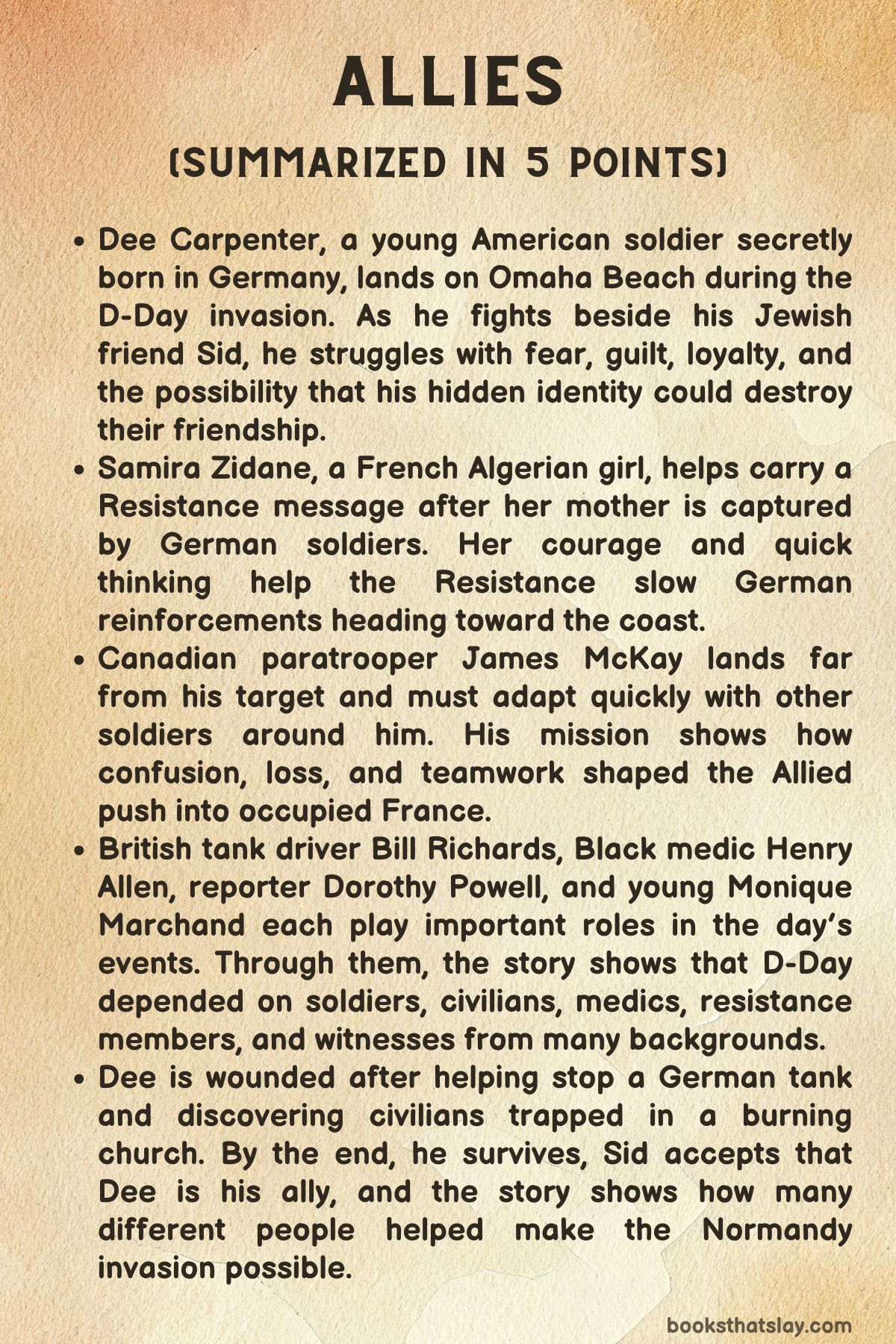
Dee has fought for only one day, but he understands that D-Day was never about one person. It was about many allies—American, British, Canadian, French, Algerian, Black, white, Jewish, Muslim, men, women, soldiers, civilians—each doing what they could to help defeat Nazi rule.
Characters
Dee Carpenter / Dietrich Zimmermann
Dee Carpenter is the central figure of Allies, and his character is built around conflict between identity, loyalty, fear, and courage. Born Dietrich Zimmermann in Germany, he carries the burden of being German while fighting in the American army against Nazi Germany.
His decision to forge papers and enlist at sixteen shows both youthful recklessness and deep moral conviction. Dee is not fighting because war excites him; he is fighting because he knows what Hitler’s rule has done to people, including his own family.
His uncle’s disappearance under the Nazis gives him a personal understanding of tyranny, and America represents safety and possibility for him. Yet Dee is constantly anxious that his German birth will make others see him as the enemy.
This fear shapes his friendship with Sid, because he loves and respects Sid but hides the truth from him. Dee’s bravery is not limited to combat.
He risks himself to retrieve a fallen soldier, helps Henry, attacks a German tank, and tries to save French civilians trapped in a burning church. His most important struggle, however, is internal: he must accept that his birthplace does not define his morality.
By the end, Dee understands that he belongs with the Allies not because of his paperwork, name, or accent, but because of his choices.
Sid Jacobstein
Sid is Dee’s closest friend and one of the most emotionally complex characters in the story. As a Jewish American soldier fighting Nazi Germany, he carries a direct and painful connection to the enemy’s hatred.
His friendship with Dee is warm and loyal at first, and he depends on Dee amid the fear and confusion of the Normandy landing. Sid’s shock after learning that Dee was born in Germany is understandable because, for him, German identity is tied to the people trying to destroy Jewish lives across Europe.
His anger shows how war can make even good people see others through fear, grief, and inherited pain. Yet Sid is not cruel at heart.
Even when furious, he helps Dee rescue civilians from the burning church, proving that his moral instincts remain stronger than his rage. His temptation to execute captured German soldiers reveals how close war brings him to becoming what he hates.
Still, he cannot go through with it. This choice is crucial because it shows Sid’s ability to step back from revenge.
By the end, his relationship with Dee is damaged but not destroyed. Sid’s arc shows that trust can be shaken by truth, but moral courage includes refusing to let hatred make one’s decisions.
Samira Zidane
Samira Zidane is one of the youngest characters, yet she shows remarkable intelligence, nerve, and independence. As a French Algerian Muslim girl, she faces prejudice not only from Nazis but also from people who are supposed to be on her side.
Her memories of discrimination in Paris reveal that France, even before and beyond the occupation, has not fully accepted her. She is treated as different because of her Algerian identity, and her desire to wear her headscarf becomes a sign of cultural pride and personal dignity.
Samira’s greatest strength is her quick thinking. She uses performance, misdirection, and emotional control to survive dangerous situations, especially when she tricks German guards at the bridge.
Her acting is not just a childish dream; it becomes a survival skill. Her loyalty to her mother drives her forward, but she also understands the larger importance of the Resistance mission.
Samira is brave without being unrealistic. She feels fear, grief, and loneliness, but she keeps moving because she knows the message must be delivered and her mother may still be saved.
Her role expands the meaning of Allied courage by showing that children, colonized people, immigrants, and civilians also helped resist Nazi occupation.
Samira’s Mother
Samira’s mother represents quiet resistance, maternal strength, and political conviction. She is not a soldier, but her work with the French Resistance places her in constant danger.
Her courage is practical rather than dramatic: she travels at night, carries messages, uses secrecy, and teaches Samira how to survive if they are stopped. She is also defined by compassion.
When she sees another family in danger, she chooses to help them even though it risks her own mission and safety. This decision leads to her capture, but it also reveals her moral priorities.
She is not fighting only for military victory; she is fighting because human lives matter. Her Algerian background adds another layer to her character.
She and her husband dreamed of Algeria’s independence from France, meaning she resists Nazi occupation while also understanding that France itself can be an occupying power. This gives her character political depth.
She can oppose Hitler while still recognizing injustice within the Allied world. Her reunion with Samira near the end offers emotional relief and confirms that her courage has not been wasted.
James McKay
James McKay is an ordinary young man placed in extraordinary danger, and that ordinariness is central to his character. He does not begin as a flawless hero.
He is nervous, uncertain, and sometimes overwhelmed by the chaos around him. His memories of “If Day” in Winnipeg show how propaganda, public performance, and community action shaped his understanding of the war.
The lesson he takes from that experience is that people are stronger together, and this idea becomes important once he lands in France far from his intended target. James loses equipment, becomes disoriented, and sees fellow soldiers die, yet he continues adapting.
His courage grows through action rather than appearing fully formed from the beginning. His friendship with Sam also broadens his understanding of what Canada’s war effort looks like, since Sam faces his own history of prejudice as a First Nations soldier.
When James discovers the French family mistreated by the Germans, the war becomes more personal to him. He is no longer fighting only because he enlisted or because his country is at war.
He sees directly what occupation does to civilians, and that knowledge gives him clearer purpose.
Sam
Sam is a Canadian soldier of First Nations descent, and his presence highlights the contradictions within Allied societies. He fights against Nazi oppression while coming from a country that has not treated Indigenous people with full justice or respect.
This makes him an important part of the novel’s wider moral structure. The Allies are fighting for freedom, but many of their own nations still practice discrimination.
Sam’s calm partnership with James gives both men strength after they land in the wrong place and must find their way through danger. He is steady, capable, and courageous, not a side figure who exists only to support James.
His identity reminds readers that the war effort depended on people from many communities, including those who were often marginalized at home. Sam’s role also helps challenge any simple idea that the Allied side was morally perfect.
He stands for the people who fought for a better world even when that better world had not yet been granted to them.
Bill Richards
Bill Richards is a British tank driver whose story brings a deeply personal dimension to the invasion. He is young, married, and soon to become a father, which makes his death especially painful.
Bill’s dream of reaching Amiens to carve his name beneath his father’s is symbolic of his desire to connect generations divided by war. His father died in the First World War before Bill was born, and Bill’s own journey to France repeats, in a tragic way, the path of the previous generation.
He wants to honor his father, create a link between them, and perhaps prove that his own life has meaning within a larger history. His fascination with William the Conqueror also shows that he thinks about history and identity, not just immediate military orders.
Bill’s tank, Achilles, gives the Americans crucial help on Omaha Beach, but his survival is brief. His death emphasizes the randomness of war.
A person can carry dreams, family love, and hope for the future, yet be lost in an instant. Bill’s role in Allies reminds readers that victory is built on countless interrupted lives.
Henry Allen
Henry Allen is one of the strongest moral figures in the story. As a Black medic in a segregated American army, he faces racism from the very country he is serving.
His duty is officially tied to Black soldiers, yet he treats wounded men regardless of race. This choice reveals his professional integrity and humanity.
Henry does not allow the prejudice of others to reduce his own standards. His encounter with a white soldier who once humiliated him is especially important.
Henry has every reason to feel anger, but he treats the man because his responsibility as a medic comes first. This does not mean Henry accepts racism or forgets what was done to him.
Rather, it shows that his ethics are stronger than the cruelty directed at him. When a white soldier doubts his medical judgment, Henry faces another insult, but his diagnosis is proven correct and he saves a life.
Henry’s character exposes the hypocrisy of fighting fascism abroad while tolerating racism at home. He is heroic not because he is fearless, but because he continues to save lives in a system that refuses to fully honor his.
Monique Marchand
Monique Marchand represents civilian courage, curiosity, and the beginning of a future beyond war. At thirteen, she is frightened by the violence on Omaha Beach, but once she sees a wounded soldier, her fear gives way to action.
Her interest in medicine has already begun before the invasion, and the battlefield gives her a harsh but meaningful test of that interest. She applies a tourniquet, helps move wounded soldiers, and learns quickly under pressure.
Monique’s bravery is different from that of the soldiers because she has no weapon, no training, and no command structure. She simply chooses to help.
Her knowledge of the local area also proves important when she recognizes that a German mine warning is false. This moment shows that civilians are not passive background figures in war; their knowledge can save lives.
Monique’s connection with Dorothy encourages her ambition to become a doctor, despite the gender expectations of the time. She stands for the generation that will inherit the world after the war and perhaps build something better from its damage.
Dorothy Powell
Dorothy Powell is bold, defiant, and determined to witness the truth for herself. As a female reporter, she faces restrictions that keep women away from the battlefield, but she refuses to accept those limits.
By disguising herself as a medic and getting close to the fighting, she breaks rules, yet her actions come from a desire to report honestly and to be useful. Dorothy’s character raises questions about who is allowed to tell history.
Men are expected to fight, command, and report from the front, while women are pushed aside even when they are capable. Dorothy challenges that system.
She also recognizes Monique’s talent and encourages her to imagine a future in medicine. This mentorship is significant because Dorothy does not merely rebel for herself; she opens a door in Monique’s mind.
When the medical commander throws them out after discovering Dorothy is a woman, the unfairness is clear. Dorothy’s courage lies in refusing to let gender rules decide the value of her work.
Jason
Jason, one of the French Resistance fighters, represents the hidden sacrifice of underground resistance. He is willing to risk his life to slow German reinforcements and help the Allied landing succeed.
His defense of Samira against suspicion shows that he has a broader understanding of loyalty than some of the others. He judges her by her actions rather than her ethnicity, which makes him a contrast to Perseus and others who question whether an Algerian girl can truly support France.
Jason’s death during the railway sabotage is sudden and painful, especially because the mission succeeds but still costs lives. His character shows that resistance work is dangerous, improvised, and often thankless.
People like Jason may not be remembered in the same way as uniformed soldiers, but their efforts are essential to the larger victory. Through him, the story honors those who fought in secrecy and accepted risks without expecting public recognition.
Perseus
Perseus is a resistance fighter whose suspicion of Samira exposes prejudice within the anti-Nazi movement. Although he fights against occupation, he still carries narrow ideas about who belongs to France and who can be trusted.
His distrust of Samira because she is Algerian shows that being on the right side of a war does not automatically make a person free from bias. Perseus is important because he complicates the moral landscape of the story.
The Resistance is fighting tyranny, but some of its members still reproduce smaller forms of exclusion. His attitude forces Samira to prove herself in a way others do not have to, which reflects the unfair burden placed on marginalized people.
Perseus is not presented as the main enemy, but his prejudice matters because it shows that injustice can exist even among allies. His character helps the reader see that defeating Nazism does not automatically solve racism, colonialism, or distrust.
Themes
Unity Across Difference
The Allied victory shown in Allies depends on people who do not share the same nationality, race, religion, language, age, or social position. The story brings together American infantrymen, British tank crews, Canadian paratroopers, French Resistance fighters, Algerian civilians, Black medics, Jewish soldiers, women, and children.
This variety is not decorative; it is the point of the novel’s understanding of war. No single group wins the day alone.
Dee survives because others help him. Samira’s message matters because the Resistance acts on it.
James and Sam continue their mission by depending on each other after landing far from their target. Henry saves soldiers who may never have respected him in civilian life.
Monique and Dorothy help the wounded even when military rules try to push them aside. The theme of unity does not erase conflict among the Allies.
Sid struggles to trust Dee after learning he was born in Germany. Perseus doubts Samira because she is Algerian.
Henry is treated as lesser by white soldiers and civilians. These tensions make the theme more honest.
Unity is not shown as easy friendship; it is shown as a difficult moral choice. The characters must decide whether the fight against Nazi hatred means rejecting hatred in themselves as well.
Identity and Belonging
Identity in the novel is never simple. Dee is German by birth, American by choice, and Allied by action.
His fear of being exposed shows how strongly people can judge identity by origin instead of values. He knows that if Sid discovers the truth, their friendship may collapse, even though Dee has risked his life beside him.
Samira’s identity is also layered. She is French in some ways, Algerian in others, Muslim, a daughter of resistance, and a child living under occupation.
Yet some resistance fighters still question her loyalty because they see her as foreign. Henry’s identity as a Black American medic places him in another painful contradiction: he serves a country that needs his courage but does not grant him equal dignity.
Sam’s First Nations background creates a similar tension within the Canadian war effort. These characters show that belonging is often denied by society before it is claimed by the individual.
The novel argues that identity should be judged by moral choice rather than birth, race, or background. Dee’s German birth does not make him a Nazi.
Henry’s race does not limit his skill or heroism. Samira’s Algerian heritage does not make her less committed to freeing France from occupation.
Belonging becomes something earned through courage, compassion, and action.
Courage Under Pressure
Courage appears in many forms throughout the story, and it is not limited to battlefield heroics. Dee running toward a tank with explosives is one version of courage, but so is Henry treating a racist former tormentor, Samira crossing enemy territory alone, Monique stepping out of hiding to help the wounded, and Dorothy risking punishment to report from the front.
The novel repeatedly shows that courage is not the absence of fear. Dee is afraid on the landing craft.
James is shaken after landing in the wrong place and seeing fellow soldiers die. Samira is frightened after her mother is taken.
Monique hides for most of the day before she finds the strength to act. Their bravery matters because it happens despite fear, not because fear disappears.
The pressure of war strips choices down to urgent decisions: help or hide, trust or suspect, save or abandon, continue or collapse. In these moments, characters reveal who they are.
Some choices are large and visible, while others are quiet and private. Sid’s decision not to execute captured Germans is one of the most important examples because it shows moral courage rather than physical bravery.
He must resist revenge when no one may stop him. The novel treats that restraint as a form of heroism.
Prejudice Within the Fight for Freedom
The novel does not present the Allied side as perfect simply because it fights Nazi Germany. Instead, it shows that prejudice exists even among those opposing a hateful regime.
Henry faces racism from white American soldiers and is later refused service at a restaurant, despite risking his life to save others. Samira is distrusted by members of the Resistance because she is Algerian.
Sid reacts to Dee’s German identity with anger, even though Dee has proved himself through action. Dorothy and Monique are dismissed because they are female, even after helping wounded men.
These moments matter because they prevent the story from becoming a simple tale of good people versus bad people. The Nazis represent a murderous system of hatred, but the Allied world still contains racism, sexism, antisemitism, colonial arrogance, and fear of outsiders.
By showing these contradictions, the novel asks a deeper question: what does it mean to fight for freedom while denying dignity to some of the people fighting beside you? The answer comes through the characters’ actions.
Henry saves lives anyway. Samira completes her mission anyway.
Dorothy keeps pushing toward the truth. Dee continues to fight against Hitler even when others might reject him.
The struggle for justice does not end with military victory; it must continue inside the societies that claim to defend freedom.