All’s Well by Mona Awad Summary, Characters and Themes
All’s Well by Mona Awad is a darkly comic, unsettling novel about pain, power, theater, and the desperate need to be believed. Its narrator, Miranda Fitch, is a former actor turned college theater professor whose life has been narrowed by chronic pain and professional failure.
When her students rebel against her choice to stage Shakespeare’s All’s Well That Ends Well, Miranda becomes caught in a strange bargain that seems to restore her body while harming others. The book blends campus satire, body horror, and supernatural ambiguity to ask what happens when suffering is dismissed until it demands a stage.
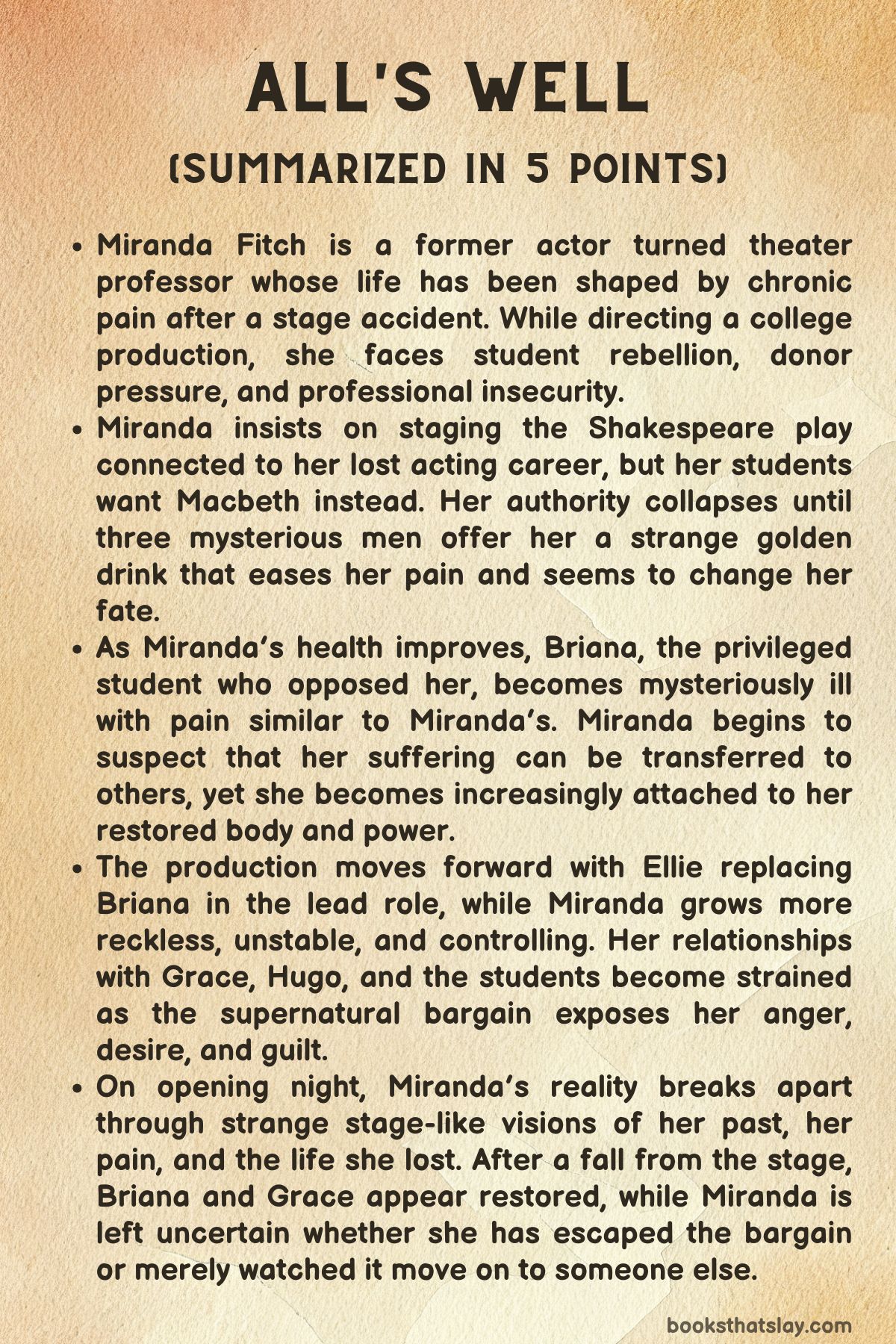
Summary
Miranda Fitch is an assistant professor in a weak theater department at a small New England college. Once a promising actor, she now lives with severe chronic pain in her hip, back, and legs after a stage accident ended her performing career.
Her pain controls nearly everything she does: how she moves, how she teaches, how she sleeps, how she relates to others, and how she thinks of herself. She spends much of her time lying on the floor, taking medications, trying treatments, and enduring doctors and therapists who seem either helpless or dismissive.
Miranda is directing the college’s annual Shakespeare production and has chosen All’s Well That Ends Well, a play that matters deeply to her because she once played Helen in a successful production in Edinburgh. Her students hate the choice.
They want to perform Macbeth instead, and their resistance is led by Briana, the wealthy donor-backed student cast as Helen, and Trevor, Briana’s boyfriend. Miranda believes Briana is wrong for the role and would rather cast Ellie, a shy but talented student who understands the play.
Grace, Miranda’s old friend and colleague, offers little support. Fauve, an ambitious adjunct, seems eager to use the conflict to undermine Miranda.
As pressure builds, Miranda’s professional standing weakens. The dean and other administrators push her to change the play because Briana’s parents and other donors prefer Macbeth.
Miranda feels humiliated and abandoned. Her pain worsens, her ex-husband Paul remains emotionally distant, and her treatments bring no relief.
In a state of despair, she goes to a pub called the Canny Man, where she meets three strange men who seem to know intimate details about her life, her illness, and her fears.
The men offer her a glowing drink they call a golden remedy. After drinking it, Miranda feels sudden relief from pain.
The men, who call themselves the Weird Brethren, suggest that pain can be transferred from one person to another. One of them demonstrates this by taking Miranda’s wrist, sending her into unbearable agony while he appears restored and healthy.
Miranda senses that she has entered a dangerous bargain, though she does not fully understand its terms.
Soon afterward, Miranda’s fortunes begin to change. When Briana and the cast try to move forward with Macbeth, Miranda grabs Briana’s wrist during a confrontation.
Briana immediately seems stricken, and Miranda feels better. At the same time, the dean announces a major donation from mysterious local businessmen who insist that the department stage All’s Well That Ends Well.
Miranda realizes the donors must be the men from the pub. Her authority is restored, and the original production goes forward.
Miranda’s body continues to improve. She walks more easily, feels energetic, flirts confidently with Hugo, the handsome set designer, and begins to enjoy a physical life she believed was lost.
Briana, however, becomes bedridden with severe pain that resembles Miranda’s old condition. Miranda is disturbed but also intoxicated by her new freedom.
She lets Ellie take over the role of Helen and tells Ellie that the healing bath salts Ellie gave her must have worked, encouraging the girl’s belief that her folk magic helped cure Miranda.
Miranda’s recovery becomes more troubling after another medical appointment. Her physical therapist Mark dismisses her improvement and roughly treats her, causing her pain to return.
In panic and anger, Miranda grips his wrist. Her pain vanishes again, while Mark collapses, weakened and unable to function.
Miranda flees, realizing that the transfer may be real. Yet instead of stopping, she becomes more dependent on her restored body and the power that comes with it.
Her behavior grows increasingly reckless. She throws herself into rehearsals with manic energy, pushes her students beyond their comfort, and becomes fixated on control.
She makes Ellie and Trevor rehearse an unnecessary kiss, partly to give Ellie a romantic triumph and partly to shape the production around her own desires. Grace grows suspicious, especially as Briana’s illness worsens and Miranda’s health improves.
Hugo and Miranda begin a sexual relationship after he recreates the set from her old Edinburgh performance, awakening memories of Paul and the life she lost.
Briana returns to rehearsal sick, pale, and limping, no longer the shallow actor Miranda once dismissed. Her pain gives her a depth she lacked before, and she auditions powerfully for the role of the ailing King.
Briana accuses Miranda of having done something to her. Miranda feels sympathy but also fear, knowing that Briana may be right.
Fauve supports Briana and tries to expose Miranda, but the accusations sound too strange to be believed.
Miranda goes back to the Canny Man to confront the three men. In a hidden downstairs room, they show her images of her past, including the performance accident that destroyed her body.
They refuse to explain clearly whether she has caused Briana’s suffering, Mark’s collapse, or the other strange events around her. They treat everything as theater, as if Miranda’s pain, ambition, cruelty, and longing are all part of a show staged for their amusement.
Grace sees the men and flees in terror. Miranda chases her and, while trying to help, takes Grace by the wrist.
Grace soon becomes incapacitated, and Miranda hides the truth by caring for her at home while continuing to pretend all is well.
By opening night, Miranda is physically radiant but mentally unstable. Briana is gravely ill, Grace is absent, Fauve is suspicious, Hugo is frightened by Miranda’s intensity, and Ellie believes her magic has played a role in the strange transformations.
Miranda appears at the theater in a salt-crusted dress after walking into the ocean the night before. She insists everything is fine, even as her wound bleeds and her mind becomes increasingly disordered.
During the performance, Miranda is drawn into the black box theater, where she experiences a series of surreal stage scenes. She finds what appears to be Grace’s dead or dying body amid the decayed gifts Miranda sent her.
She then watches a nightmare version of her own medical treatment, with doctors and therapists hurting her while an unseen audience applauds. Finally, she enters a fantasy life with Paul and a baby, a vision of the family and future she lost.
But accepting this dream seems to worsen Grace’s condition, and Miranda chooses to abandon the fantasy.
When Miranda returns to the main theater, the play is already ending. Ellie presents her with flowers, but Miranda is confused and behaves as though she herself is performing.
She recites lines from Macbeth, then sees Briana restored to health. Panicked, Miranda backs away and falls from the stage, repeating the accident that first injured her.
Miranda awakens in a dressing room with Ellie caring for her. Ellie says three men who claimed to be doctors examined Miranda and warned that her pain might return.
Briana enters, healthy and changed, thanking Ellie for what happened during the performance. Miranda confesses that she killed Grace, but Ellie assumes she is delirious.
Then Grace appears alive and well with champagne, suggesting that some form of healing or reversal has taken place.
Afterward, Miranda and Grace meet at the Canny Man. Grace apologizes for doubting Miranda’s pain, giving Miranda the recognition she has long needed.
Miranda waits for punishment from the strange men, but the golden remedy is no longer available to her. Instead, she sees another woman receive the glowing drink, suggesting the cycle may continue with someone else.
A storm strikes the pub and seems to threaten Miranda, but it passes. A dried flower from Miranda’s hair falls into her glass and begins to bloom, leaving the ending open, eerie, and uncertain.
Characters
Miranda Fitch
Miranda Fitch is the central character and narrator of All’s Well, and the novel’s entire emotional and psychological world is filtered through her damaged body, wounded pride, and unstable perception. She is a former actor whose promising career ended after a stage accident left her with chronic pain.
By the time the story begins, her body has become both a prison and a battleground. She is angry at doctors, therapists, colleagues, students, and even friends who fail to understand the scale of her suffering.
Her pain has isolated her so completely that she often sees ordinary life as something happening outside her reach. Teaching theater, once a continuation of her artistic identity, has become another site of humiliation because her students resist her authority and her institution treats her as expendable.
Miranda is not presented as simply sympathetic or simply monstrous. Her pain is real, and the dismissal she faces is cruel.
At the same time, her desire to be believed hardens into resentment, and resentment becomes a hunger for control. When she discovers that her suffering can be transferred to others, she does not fully stop herself.
The supernatural bargain gives her the body she wants back, but it also reveals how much bitterness she has been forced to carry. Her restored health brings confidence, sexuality, authority, and creative energy, yet it also makes her reckless and frightening.
She begins to treat others as performers in a drama built around her own recovery.
Her obsession with All’s Well That Ends Well is also deeply revealing. She is attached to the play not only because of its artistic value but because it belongs to the last period of her life when she felt beautiful, admired, and powerful.
Staging it becomes her attempt to reclaim a lost self. By the end, Miranda’s arc is less about being cured than about confronting the moral cost of wanting cure at any price.
Her final survival is uneasy because she has gained recognition from Grace and perhaps some release from pain, but she has also seen what her suffering can do when it is turned outward.
Grace
Grace is Miranda’s colleague, former close friend, and assistant director, and she represents both care and betrayal in Miranda’s life. She once helped Miranda through the practical realities of chronic pain, driving her to appointments and assisting with chores.
This history makes her important because she is one of the few people who has actually witnessed the daily limitations of Miranda’s illness. However, Grace also wounds Miranda deeply by suggesting that her pain may be in her head.
That comment becomes a symbol of everything Miranda fears: that even those closest to her doubt her, judge her, or secretly want her to become less inconvenient.
Grace is healthier, calmer, and more socially balanced than Miranda, which makes her presence painful for Miranda to endure. She often functions as a witness to Miranda’s instability, noticing changes in her behavior before others do.
Her suspicion grows as Miranda’s body improves and Briana’s health declines. Grace’s fear is important because it gives moral weight to the story.
She is not simply opposing Miranda out of jealousy or professional rivalry; she senses that something is wrong. When Miranda transfers pain to Grace, the act is especially disturbing because Grace had once been Miranda’s caregiver.
Miranda then reverses their roles, caring for Grace while also hiding her own guilt.
By the end, Grace’s apology becomes one of the most important emotional moments in the novel. She finally acknowledges that she failed Miranda by doubting her pain.
This apology does not erase the damage between them, but it gives Miranda something she has desperately wanted: validation. Grace’s return alive also complicates the story’s moral and supernatural logic.
She becomes a figure of restoration, suggesting that some relationships may survive harm, misunderstanding, and fear, but only if truth and remorse are allowed into them.
Briana
Briana begins as Miranda’s most obvious antagonist among the students. She is wealthy, entitled, beautiful, and backed by donor parents whose influence gives her power inside the theater department.
Miranda resents her because she believes Briana has been handed the role of Helen for reasons that have nothing to do with talent. To Miranda, Briana represents everything unfair about institutional theater: money, privilege, appearance, and student entitlement overriding artistic judgment.
Briana’s rejection of the chosen play also threatens Miranda’s already fragile authority.
Yet Briana becomes more complex once she receives Miranda’s pain. Her illness strips away the shallow confidence Miranda associates with her.
She becomes frightened, vulnerable, and desperate to be believed, mirroring Miranda’s own experience. This reversal forces the reader to see Briana not only as a spoiled student but as a young woman trapped in a body others cannot understand.
Her accusation that Miranda has done something to her sounds irrational to the administrators, but within the story’s supernatural logic, she is right. This makes Briana one of the clearest examples of how easily suffering is dismissed when it cannot be explained.
Her later performance as the ailing King reveals hidden depth. Pain gives her access to emotional truth onstage, and she becomes a stronger actor because she now understands helplessness and fear.
This transformation is unsettling because it suggests that art often feeds on suffering, but it also allows Briana to move beyond the role of privileged rival. Her healing near the end, especially after the performance, turns her from victim back into a living presence capable of gratitude and renewal.
She is one of Miranda’s doubles, showing what Miranda looked like to others when she was ill and what it means to be doubted from the outside.
Ellie
Ellie is quiet, talented, and underestimated. She is the student Miranda believes should have played Helen from the beginning.
Unlike Briana, Ellie understands the chosen play and respects Miranda’s artistic vision. Her loyalty gives Miranda emotional support when nearly everyone else challenges her.
However, Ellie is not merely a passive admirer. She has her own ambition, her own hidden desires, and her own connection to folk magic or ritual healing through the bath salts she prepares for Miranda.
Ellie’s role grows as Briana weakens. When she becomes Helen, she receives the recognition she has quietly wanted, but her joy is mixed with guilt.
She worries that her desire for the part may have caused Briana’s illness. This makes Ellie a softer counterpart to Miranda.
Both women want something intensely, and both become associated with supernatural change. The difference is that Ellie’s desire is marked by innocence, uncertainty, and remorse, while Miranda’s becomes more aggressive and self-justifying.
Ellie also represents theater as transformation. Her performance appears to help repair the damage around her, especially Briana’s illness and Grace’s fate.
Whether Ellie truly possesses magical power or whether the play itself becomes a ritual of restoration remains ambiguous. She believes in healing, but she also benefits from another person’s collapse.
This tension makes her more interesting than a simple innocent. She is kind, but she is not free from ambition.
She wants the stage, the role, and the chance to be seen, and the novel asks whether wanting those things can ever be completely harmless.
Hugo
Hugo is the set designer and Miranda’s lover, and he embodies desire, danger, fantasy, and theatrical illusion. Miranda is drawn to his physical strength, his beauty, and his apparent admiration for her.
At a time when she feels restored to herself, Hugo becomes proof that she can still be wanted. Their relationship allows Miranda to reclaim sexuality after years of pain, medication, and emotional abandonment.
Yet Hugo is also unsettling. His past incarceration and conviction for assault create an undercurrent of threat, even when he behaves with concern.
Hugo’s greatest significance lies in the way Miranda projects Paul onto him. When he recreates the Edinburgh set from her earlier acting career, he gives her an illusion of return.
The stage becomes a place where she can briefly imagine that time has reversed and that she is again the admired actor Paul once watched from the audience. Hugo does not simply seduce Miranda; he helps rebuild the scene of her lost self.
This makes their intimacy both moving and disturbing, because Miranda is often less interested in Hugo as himself than in what he allows her to remember.
As Miranda’s behavior becomes more extreme, Hugo begins to pull away. His fear during their later sexual encounter shows that he is not the simple dangerous man Miranda initially imagines.
Instead, he becomes one more person who recognizes that her restored body has not brought peace. His role exposes the difference between physical recovery and emotional repair.
Miranda can move, desire, and perform again, but she is still haunted by old loss and old pain.
Paul
Paul is Miranda’s ex-husband and a figure from her former life. In memory, he is tied to her beauty, talent, and early theatrical success.
He first admired her when she performed as Helen, and his devotion helped confirm her sense of herself as gifted and desirable. For Miranda, Paul is not only a lost husband but a witness to the person she used to be.
His love belongs to a time before the injury, before chronic pain, before her career and marriage collapsed.
His later emotional withdrawal is one of Miranda’s deepest wounds. Although Miranda left him, she understands the separation as something forced by his exhaustion with her illness.
Paul’s failure is not dramatic cruelty but a quieter inability to remain fully present with someone in long-term suffering. That kind of abandonment is central to Miranda’s bitterness.
She feels that pain made her unlovable, and Paul becomes the proof.
Paul also haunts Miranda’s relationship with Hugo. She repeatedly sees Paul in Hugo or confuses the two men in moments of emotional intensity.
This confusion shows that Miranda’s desire is directed backward as much as forward. She does not simply want a new lover; she wants the old life restored, including the version of herself who was loved without pity.
The fantasy scene of domestic happiness with Paul and a baby reveals the depth of what Miranda believes pain stole from her: marriage, family, stability, and an ordinary future.
Fauve
Fauve is Miranda’s professional rival and one of the sharpest sources of external pressure in the story. As an adjunct in the theater department, she occupies a precarious academic position, which helps explain her ambition.
Miranda sees her as someone waiting to take her job, and Fauve often appears exactly where Miranda does not want her: at rehearsals, around students, near the dean, and beside Briana. She encourages the push toward Macbeth and aligns herself with those who challenge Miranda’s authority.
Fauve is not supernatural, but she is politically alert. She understands the department’s power structure and knows how to use student complaints, donor influence, and administrative anxiety to her advantage.
Her conflict with Miranda is partly personal but also institutional. Both women are fighting for status in a weak department where security is limited and artistic choices are vulnerable to money.
Fauve’s opportunism makes her unpleasant, but the environment itself encourages this kind of competition.
Her attempts to expose Miranda often backfire because her evidence is either too strange or too petty. She suspects something is wrong with Miranda’s recovery and Briana’s decline, but she cannot prove it in terms that administrators will accept.
This places Fauve in an ironic position: she is often morally closer to the truth than the dean, yet her motives are so mixed that she cannot become a trustworthy moral center. She functions as a realist in a world where reality itself has become unstable.
The Weird Brethren
The Weird Brethren are the novel’s supernatural agents, tempters, spectators, and possible directors. They appear as three strange men who know far too much about Miranda’s life and offer her the golden remedy that removes her pain.
Their name links them to Shakespearean supernatural figures, but they are also theatrical patrons, audience members, doctors, donors, and tricksters. They do not behave like simple villains.
Instead, they tempt Miranda by giving her exactly what she wants while refusing to explain the cost clearly.
Their power lies in performance and exchange. They treat pain as something transferable, almost like a role that can be handed from one actor to another.
They also treat Miranda’s life as entertainment. Her suffering, moral compromises, sexual confusion, professional triumphs, and breakdowns are all part of a show to them.
This makes them deeply cruel, because they aestheticize pain rather than relieve it ethically.
They also expose the bargain hidden beneath many systems in the novel. Theater wants suffering to become art.
Medicine wants symptoms to become cases. Academia wants student satisfaction and donor money to become institutional success.
The Weird Brethren combine all these forces into one eerie presence. By the end, their attention seems to move on to another woman, suggesting that Miranda’s story is only one cycle in a larger pattern.
They do not create human desperation, but they know how to profit from it.
The Dean
The dean represents institutional weakness disguised as politeness and cultural taste. He claims to love theater and Shakespeare, but his decisions are guided less by artistic belief than by donor pressure and administrative convenience.
He once admired Miranda, especially during her job interview, but that admiration fades as her body deteriorates and her professional authority becomes easier to question. His support is conditional, and Miranda understands this even when she tries to defend herself before him.
He is important because he shows how institutions dismiss vulnerable people without appearing openly cruel. He does not need to attack Miranda directly; he simply listens to donors, entertains complaints, and frames artistic decisions as practical concerns.
When Briana accuses Miranda of witchcraft, he rejects the claim because it sounds unreasonable, not because he has any deep understanding of the situation. His response to Briana’s illness mirrors the broader dismissal of Miranda’s pain: if suffering cannot be explained in acceptable language, it is labeled stress, anxiety, or imagination.
The dean’s behavior also reveals the unstable value of art in the college. He praises theater when it brings prestige, money, or charm, but he does not protect the director’s vision unless powerful donors support it.
When the mysterious donation arrives, he immediately changes his attitude. His loyalty is not to Shakespeare, students, or faculty but to institutional survival.
Mark
Mark is Miranda’s physical therapist and one of the clearest representatives of medical dismissal. At first, he may appear professional and optimistic, but his patience has worn thin by the time the story begins.
He treats Miranda as a difficult case and responds to her worsening pain with detachment. His exercises and treatments seem less like care and more like procedures performed on a body he no longer fully listens to.
His role is crucial because he embodies a common frustration for people with chronic illness: being handled by experts who claim authority over the body while ignoring the patient’s actual experience. When Miranda says something hurts, Mark often minimizes or redirects her complaint.
His rough treatment after her temporary improvement is especially revealing. He wants credit for her recovery, and when she admits she has not followed his exercises, he becomes punitive.
When Miranda transfers pain to Mark, the scene is both revenge and moral crossing. He becomes what he failed to understand: a person suddenly trapped inside unbearable physical distress.
The moment satisfies Miranda’s anger, but it also shows how dangerous her new power has become. Mark is not innocent in his treatment of her, yet the punishment is extreme.
Through him, the novel examines the fantasy of making dismissive people feel exactly what they refused to believe.
John
John is an unaccredited therapist who treats Miranda in his garage, and his presence expands the novel’s picture of desperate medical seeking. Miranda has tried so many forms of treatment that even unofficial, uncomfortable, and socially awkward spaces become part of her routine.
John observes her misalignment and offers hands-on treatment, but the session is marked by embarrassment, discomfort, and the intrusion of his domestic life upstairs.
He matters because he shows how chronic pain can push a person beyond conventional medicine into any possible promise of relief. Miranda does not fully believe in every treatment she tries, yet she keeps going because doing nothing feels impossible.
Her interaction with John also shows her need to protect practitioners’ feelings, even when they are failing her. She pretends treatment is working because admitting otherwise would create more discomfort.
John is a minor character, but he adds to the exhausting pattern of Miranda’s life before the golden remedy. Her body has become a project passed between doctors, therapists, alternative healers, and self-medication.
His garage treatment makes that world feel humiliatingly ordinary, far from the glamour of the stage Miranda once knew.
Trevor
Trevor is Briana’s boyfriend and one of the student actors who challenges Miranda’s authority. He is vocal in his dislike of the chosen play and pushes for Macbeth, positioning himself as a representative of the cast’s dissatisfaction.
To Miranda, he is part of the entitled student group that does not respect her artistic judgment. His resistance contributes to the sense that she is losing control of the production.
Yet Trevor also functions as a young actor caught between peer loyalty, romantic loyalty, and directorial power. He follows Briana’s lead but is also subject to Miranda’s increasingly forceful staging choices.
The rehearsal kiss with Ellie places him in an uncomfortable position, revealing Miranda’s willingness to use students’ bodies and emotions to satisfy her own vision of theatrical fulfillment. Trevor’s discomfort matters because it shows that Miranda, once a victim of bodily disregard, can also disregard the boundaries of others.
Trevor is not as psychologically developed as Briana or Ellie, but he helps define the student atmosphere Miranda finds hostile. He represents youth, physical ease, and confidence, all qualities that intensify Miranda’s resentment.
Through him, the production becomes not only an artistic conflict but a generational one.
The Bartender
The bartender at the Canny Man serves as a seductive threshold figure between the ordinary world and the supernatural world of the Weird Brethren. He gives Miranda access to the golden remedy and appears connected to the strange forces operating through the pub.
His Scottish identity, skull pendant, and tattooed Shakespearean phrase mark him as part of the novel’s theatrical and occult atmosphere.
His sexual encounter with Miranda is important because it follows one of her first major experiences of restored bodily freedom. With him, Miranda tests the limits of her healed body and feels pleasure without pain.
However, the encounter is also strangely impersonal. He disappears afterward, leaving behind the pendant, and his presence feels less like romance than initiation.
He is part lover, part messenger, part sign that Miranda has entered a world governed by different rules.
He also controls access to the remedy near the end, when he tells Miranda it is no longer available to her. This refusal signals that Miranda’s special status has ended or shifted.
The drink has moved on to someone else, and the bartender remains at his post, serving the next person in need.
Themes
Pain, Belief, and the Need to Be Witnessed
Miranda’s chronic pain is not treated as a private condition alone; it becomes a social crisis because almost no one knows how to respond to it with sustained belief. Doctors reduce it to symptoms, therapists treat it as a problem to be corrected through discipline, colleagues quietly grow tired of it, and Paul’s love weakens under its pressure.
The worst wound is not only the physical pain but the repeated suggestion that the pain is exaggerated, psychological, inconvenient, or somehow Miranda’s fault. This creates the emotional foundation of the novel’s horror.
Miranda does not simply want relief; she wants proof. She wants another person to feel the truth of what she has endured.
The supernatural transfer of pain literalizes that desire. When Briana, Mark, and Grace suffer, Miranda’s private reality becomes visible through their bodies.
Yet this visibility comes at a terrible ethical cost. The novel asks whether being believed is still healing if belief arrives through harm.
All’s Well shows how disbelief can deform a person’s inner life, turning the need for compassion into a desire for revenge. Miranda’s suffering is real, but the story refuses to make reality the same as innocence.
Theater, Performance, and Control
The theater setting shapes nearly every relationship in the novel because performance is not limited to the stage. Miranda performs authority for her students, wellness for her colleagues, composure for the dean, seduction for Hugo, and sanity for herself.
The students perform obedience even when they are afraid. The dean performs artistic appreciation while obeying donor money.
Even illness becomes a kind of performance in the eyes of others, judged according to whether it looks convincing enough to be believed. Miranda understands theater as a place of transformation, but she also uses it as a place of control.
Her insistence on staging her chosen play is partly an artistic decision and partly an attempt to recover the self she lost after her injury. As her health improves, her directing grows more forceful and invasive.
She begins arranging bodies, kisses, movements, and emotional responses as if the people around her exist to complete her vision. The supernatural scenes near the end expose the terrifying possibility that Miranda herself has been performing for an unseen audience all along.
Her life, pain, desire, and guilt become staged events, watched and judged by forces that treat human suffering as entertainment.
Power, Privilege, and Institutional Cowardice
The college theater department is a small world, but it reflects larger systems of power. Briana’s parents influence casting and production decisions because they have money.
The dean presents himself as cultured, yet his choices shift according to donors and institutional convenience. Fauve’s ambition grows out of professional insecurity, while Miranda’s authority is weakened by illness, gender, and lack of institutional protection.
Artistic judgment has value only when it aligns with money. This creates a bitter environment in which everyone competes for safety, recognition, or control.
Miranda’s choice of play becomes a test of who actually holds power: the director, the students, the donors, or the administrators. The mysterious donation that restores Miranda’s authority proves how easily principle bends when money changes sides.
The same dean who pressures her to give up her vision suddenly supports her when wealthier patrons appear. This institutional cowardice also affects how pain is interpreted.
Briana’s illness is dismissed as stress once her supernatural explanation becomes inconvenient, just as Miranda’s pain was dismissed when it could not be neatly diagnosed. The novel presents institutions as systems that rarely seek truth directly.
They seek explanations that protect themselves.
Desire, Restoration, and the Cost of Getting What You Want
Miranda’s restored health initially appears to offer everything she has lost: movement, beauty, sexual confidence, artistic authority, and the possibility of being admired again. Her transformation is intoxicating because it answers years of humiliation.
She can walk without dragging her leg, command rehearsals, attract Hugo, and imagine herself as powerful rather than broken. Yet the restoration does not heal the grief underneath.
Instead, it intensifies old desires. Hugo becomes a substitute for Paul.
The production becomes a substitute for her lost acting career. Ellie’s rise becomes a substitute for Miranda’s old triumph as Helen.
Miranda wants not only to be well but to return to a version of life before injury, abandonment, and disappointment. The problem is that the past cannot be restored without distortion.
Each gain seems to require someone else’s loss, and each pleasure carries traces of violence or denial. Her healed body becomes morally unstable because it depends on refusing to fully acknowledge the suffering now carried by others.
The ending complicates the idea of cure. Miranda may escape complete punishment, and some wounds may be reversed, but the golden drink passing to another woman suggests that desire will continue to seek shortcuts.
The wish to be whole can become dangerous when it ignores who must pay for that wholeness.