A Midnight Pastry Shop Called Hwawoldang Summary, Characters and Themes
A Midnight Pastry Shop Called Hwawoldang by Lee Onhwa is a warm, mysterious novel set in a traditional Korean sweetshop that opens only late at night.
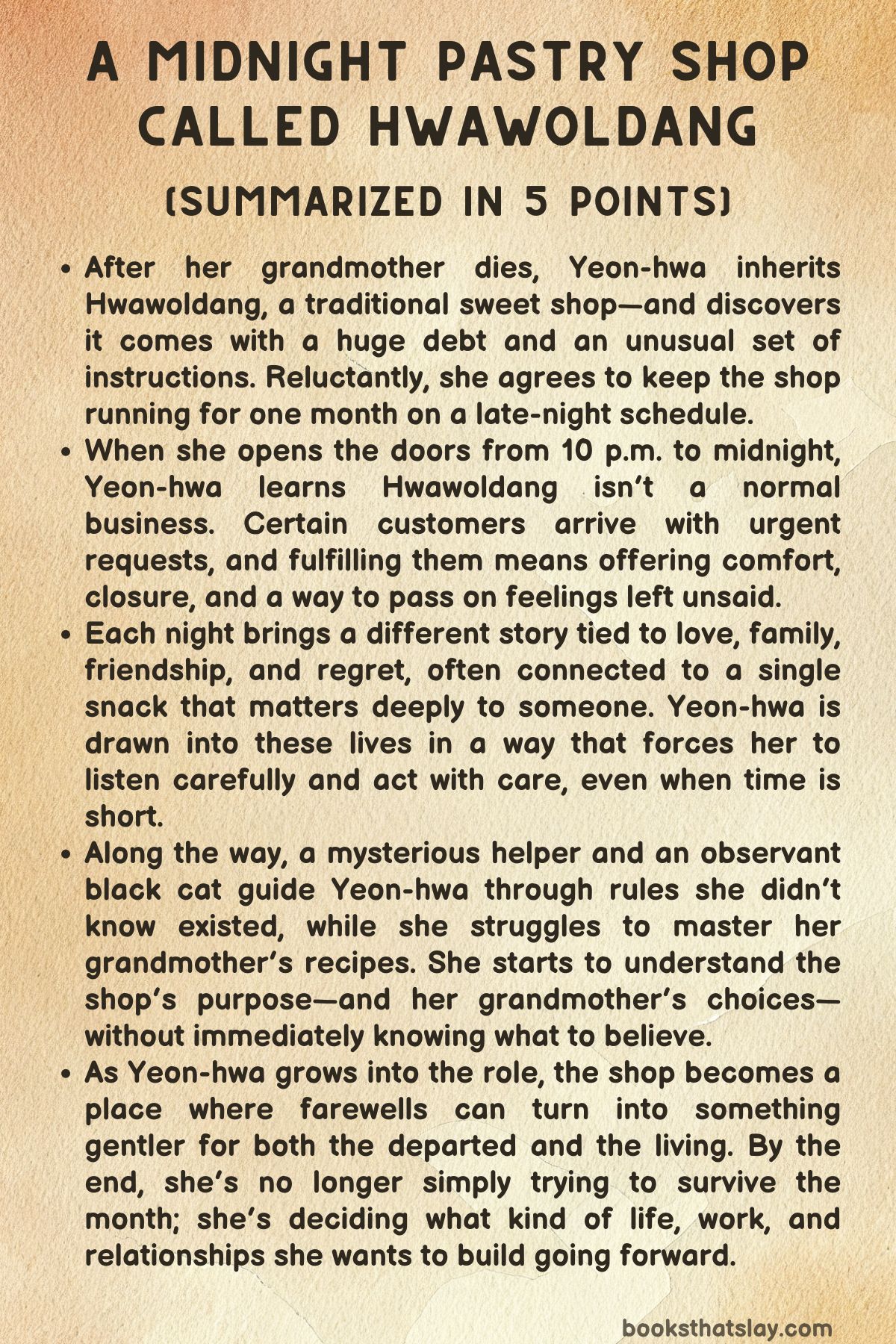
After Yeon-hwa’s grandmother dies, Yeon-hwa inherits not comfort but a crushing debt and an unusual set of instructions: run the shop for one month, open from 10 p.m. to midnight, and “wait in anticipation.” What begins as a reluctant obligation becomes an encounter with the unseen. Through handmade sweets and quiet acts of care, Yeon-hwa learns what her grandmother guarded, what the dead still carry, and what it means to keep living with honesty.
Summary
After her grandmother passes away on a bright spring day, twenty-seven-year-old Yeon-hwa feels strangely numb. Loss is not new to her; her parents died in a car accident when she was ten, and she has trained herself to stay steady.
With her best friend Yi-ryeong’s help, she moves into her own place for the first time and marks the new start with takeout and laughter that tries to cover the silence. But the question of her family’s traditional sweetshop, Hwawoldang, won’t go away.
The shop has been passed down through generations, and Yi-ryeong urges Yeon-hwa to at least clear it out, if only to understand her grandmother better. Yeon-hwa agrees, expecting she will soon sell it and return to her plan of studying for a stable government job.
The next day, Yeon-hwa meets her grandmother’s lawyer and learns the truth: her grandmother kept the business alive for years without profit and left behind 100 million won in debt. Selling the shop isn’t simple either.
The location is widely considered unlucky, and the neighborhood’s reputation—frequented by monks and shamans—keeps ordinary buyers away. The lawyer hands Yeon-hwa a letter from her grandmother with three conditions attached to a promised solution.
Yeon-hwa must run the shop for at least one month, open it from 10 p.m. to midnight on business days, and “wait in anticipation.” If she refuses or fails, the asset meant to resolve the debt will be donated to charity.
Cornered, Yeon-hwa decides to try, even if she believes it’s just one more burden.
That night, she unlocks Hwawoldang. The interior is bright and strange, decorated with symbolic images and calligraphy that seems to bless and warn at the same time.
Outside sits an old metal bowl, dirty from neglect; she scrubs it and puts it back, and a black cat appears as if summoned, watching with sharp yellow eyes. Inside, Yeon-hwa finds a recipe booklet labeled for the shop and begins with jeonbyeong crackers, following instructions that feel both ordinary and ceremonial.
A door chime rings, and a young man enters as if he belongs there. He introduces himself as Sa-wol, claims he supplied ingredients to her grandmother, and drops off a box of special materials with a firm warning not to give them away.
His tone shifts between teasing and serious, and before leaving he quietly admits he’s a shaman and that he knows what the “solution” in the will really involves.
Soon another customer arrives: Oh Hui-suk, a middle-aged woman who urgently demands jeonbyeong that same night. When Yeon-hwa hesitates, Hui-suk insists Yeon-hwa take her hand.
The moment they touch, Yeon-hwa is pulled into Hui-suk’s memories. Hui-suk works as a supermarket cashier, her fingers aching from repetitive labor.
She loves her daughter Ju-yeon and wants to contribute to her upcoming wedding, even if her own life has been reduced to careful budgeting and exhaustion. Hui-suk makes birthday soup, prepares savings for Ju-yeon, and treasures the small signs of affection between them.
But she also realizes something painful: the “favorite” snack she kept buying—jeonbyeong—was never Ju-yeon’s real favorite. Ju-yeon preferred chocolate, but accepted jeonbyeong because it was affordable and plentiful.
Hui-suk, ashamed and determined to make one honest correction, decides to coat the crackers in chocolate as both apology and gift.
On her day off, Hui-suk melts higher-quality chocolate, but she dozes off. A kitchen fire erupts and spreads fast.
She escapes and warns neighbors, then suddenly remembers the handmade wedding invitations and a white silk dress with bright yellow hydrangeas she gave Ju-yeon. Against everyone’s pleas, she runs back inside.
She grabs the invitations and reaches for the dress, but smoke overwhelms her. She collapses before she can reach the exit.
Yeon-hwa snaps back into the shop and realizes Hui-suk has no shadow. Hui-suk explains that Hwawoldang serves the dead: if a spirit receives a traditional snack before midnight on their final night, they can reincarnate into a life of their choosing.
Time is running out. Yeon-hwa scrambles to make chocolate-covered jeonbyeong, failing twice in panic and heat, until she finally succeeds with only seconds left.
Hui-suk takes a bite, relieved, and asks Yeon-hwa not to keep the rest for herself. Instead, she asks that the remaining crackers reach Ju-yeon, identifying her by a small reddish mole on her index finger.
The black cat appears, knocks the bag down, and carries it away. Hui-suk trusts the cat will deliver it through a dream so mother and daughter can share it.
As Hui-suk fades, she leaves behind the hydrangea dress, folded neatly on the counter like a final message.
Shaken but unable to turn away, Yeon-hwa returns the next day determined to learn her grandmother’s recipes and the shop’s rules. A living customer enters and Yeon-hwa embarrasses herself by treating him as a ghost, which only deepens her confusion about where the boundary lies.
Sa-wol returns, now dressed sharply, and Yeon-hwa tests him by slapping him—proof he is alive, or at least solid. He admits he promised her grandmother he would help Yeon-hwa, though he avoids giving full explanations.
He tells her the shop isn’t cursed; it is filled with her grandmother’s spiritual power, and Yeon-hwa doesn’t seem to share that power yet.
Another spirit arrives: Jang Mae-hyeon, a tall young man who wants a beautiful gift box of sweets but struggles to describe who it’s for. Sa-wol uses a bell that allows Yeon-hwa to “peek” into Mae-hyeon’s story.
Yeon-hwa sees Mae-hyeon’s life as a quiet former athlete who joins a hiking club and ends up at the back of the group with Seo-hui, a lively young woman who stops often, snacks constantly, and asks for photos. Mae-hyeon patiently helps her, carries her when she gets injured, and grows attached to her bright, direct manner.
Their connection becomes a steady rhythm of messages and casual dates, but Mae-hyeon never clearly names what they are. Wanting to be someone dependable, he works exhausting shifts at a logistics center to afford a meaningful Coming-of-Age Day gift for Seo-hui.
During a break he drops his phone into a storm drain; while trying to retrieve it, he is struck by a delivery truck and dies.
Mae-hyeon comes to Hwawoldang on the third anniversary of his death, desperate to leave Seo-hui one clear farewell before he risks becoming a wandering soul. Yeon-hwa makes plum-blossom-shaped manju, matching a photo Mae-hyeon kept as his phone wallpaper.
Because the shop cannot directly reach the living, Yeon-hwa convinces Sa-wol to help deliver the sweets discreetly. Guided by the black cat, they leave the box on a park bench.
Seo-hui arrives drunk and angry, still hurt by being “stood up” for years without explanation. Mae-hyeon briefly borrows Sa-wol’s body to speak.
Seo-hui admits Mae-hyeon was her first love and that she hasn’t dated since; she hated him for leaving but also wishes him peace. Mae-hyeon tells her he wants her to be happy, then releases Sa-wol and chooses to reincarnate quickly, hoping they might meet again under kinder circumstances.
Yeon-hwa learns more about Hwawoldang’s long-standing arrangement with Hongseoksa Temple, where a monk explains that lingering spirits generally remain up to three years; staying longer risks losing the chance to be reborn. Payment for Hwawoldang’s work comes in unusual forms, and Yeon-hwa begins to see that her grandmother built a bridge between worlds that required constant care.
A ghost named Kim Jeong-min arrives requesting green tea dango. When Yeon-hwa touches her, she sees Jeong-min’s life as a struggling young artist living with her best friend and roommate, Su-min.
They scrape by, teach children’s art programs for income, and save for an important joint exhibition. Su-min faces surgery for a gastric polyp; Jeong-min ignores nosebleeds and headaches to keep working.
Jeong-min buys matching heart lockets, imagining them as a symbol linking their different artistic styles and their friendship. Then Jeong-min collapses outside a gallery and dies from a brain tumor she failed to properly investigate.
Back at the shop, Jeong-min asks Yeon-hwa to deliver the dango and one of the lockets to Su-min. Yeon-hwa and Sa-wol attend the exhibition and find Su-min now successful, presenting work that memorializes her past and uses the locket concept Jeong-min created.
Su-min reveals Jeong-min died four years ago—beyond the three-year limit—suggesting Jeong-min may have sacrificed her own chance at reincarnation to remain near Su-min’s life. Yeon-hwa gives Su-min the locket and dango anyway, offering comfort even when the rules feel cruel.
Later, a ten-year-old ghost named Park Ji-hwan arrives in a bright cap, holding a handheld game console, and asks for strawberry chapssal-tteok. He wants it for his stepsister, Yeon-ju, who is alive.
He eagerly plays a two-player game with Yeon-hwa, then asks her to promise she will help him. Through his memories, Yeon-hwa sees a boy adjusting to a remarried family and a teenage stepsister who doesn’t know how to be close.
Their awkwardness softens when Yeon-ju shares her game with him and buys strawberry chapssal-tteok as a snack. Ji-hwan grows proud of having a big sister and plans small gifts for his family.
But after an argument—sparked by a confiscated console and hurt feelings—Yeon-ju fails to remind Ji-hwan to buckle his seatbelt. On a rainy highway, a chain collision kills him.
In the present, Ji-hwan insists he isn’t sad and talks excitedly about his next life, but Yeon-hwa gently cleans dried blood beneath his cap and reassures him that Yeon-ju cannot truly hate him. Ji-hwan writes Yeon-ju a letter with game advice and an apology, asking her to live a long time.
Yeon-hwa and Sa-wol deliver the letter and chapssal-tteok to Yeon-ju at school. Yeon-ju breaks down, confessing her guilt, and Yeon-hwa holds her and tells her Ji-hwan forgave her and wanted her happiness.
As Yeon-hwa grows more capable, the shop quiets. Then a preorder arrives for Hwawoldang’s signature red chestnut yanggaeng, and Yeon-hwa cannot find the recipe.
Sa-wol tells her the secret ingredient comes from Hongseoksa Temple, and they go together. On the way, Sa-wol reacts violently to riding in a taxi, collapsing after they stop.
At the temple, a monk explains the ingredient is powder from a red boulder cliff behind the grounds and warns it’s dangerous to collect alone.
At the cliff, Yeon-hwa demands answers about Sa-wol’s secrecy. Sa-wol finally confesses his past: he was an abandoned child raised at the temple alongside another boy, O-wol.
Years earlier, a taxi accident should have killed them. Yeon-hwa’s grandmother saved them by channeling her power, but a law of balance required another death in exchange—leading to the later car accident that killed Yeon-hwa’s parents.
Sa-wol has lived burdened by that debt and has been helping Yeon-hwa to repay what he feels he took.
Furious and devastated, Yeon-hwa returns to the shop and makes the red chestnut yanggaeng using the powdered stone. When she finishes, the black cat transforms into her grandmother’s spirit.
Her grandmother apologizes for saving the boys without understanding the cost and admits she hid the truth because she feared Yeon-hwa’s hatred. Yeon-hwa confronts her grief directly, then sees how her grandmother’s fear mirrors her own long habit of shutting down.
Her grandmother shows Yeon-hwa an image of her parents in the afterlife and asks her to live in a way that honors connection rather than avoidance. Yeon-hwa forgives her grandmother, and her grandmother departs.
Afterward, Sa-wol apologizes and continues to support Yeon-hwa. He reveals a hidden compartment with a locked chest and tells her it’s time to accept her role as the true master of Hwawoldang.
With her grandmother gone, fewer spirits arrive, and Yeon-hwa shifts the shop toward serving the living as well. The red chestnut yanggaeng becomes popular online and sells out daily, bringing hope even as the debt remains heavy.
Yeon-hwa learns her grandmother’s “secret” includes a deed to the red cliff land, but it cannot be sold due to protections, so the financial miracle she expected doesn’t arrive. Still, the shop begins to thrive through steady work, community interest, and the quiet reputation of a place that leaves people a little lighter than when they arrived.
Near the end, when Yeon-hwa hangs the hydrangea dress left behind by Hui-suk, a woman recognizes it with grief. Yeon-hwa offers it to her, passing along the simple message that the departed wanted her to be happy—proof that even when a life ends, care can still reach across the distance.
Characters
Yeon-hwa
In A Midnight Pastry Shop Called Hwawoldang, Yeon-hwa begins as someone who has trained herself to survive by staying emotionally contained: she doesn’t cry at her grandmother’s death, not because she feels nothing, but because grief has become a familiar landscape since losing her parents at ten. Her initial refusal to inherit Hwawoldang is less about dislike and more about self-protection—she wants a stable government job because stability is the one thing her life hasn’t reliably offered.
The shop’s strange rules force her into a month-long intimacy with the unknown, and the nightly encounters become a pressure test for her worldview: she is repeatedly asked to hold other people’s pain without turning away, even when she would rather treat it as unreal. Over time, Yeon-hwa’s competence grows from reluctant duty into chosen responsibility; the key change is that she stops seeing “moving on” as abandonment and starts seeing it as love expressed through action—making the right sweet, delivering the last message, or simply staying present.
By the end, she is no longer defined by what was taken from her, but by what she decides to build: a shop that becomes less a haunted inheritance and more a living practice of care, where she learns to metabolize loss into connection rather than avoidance.
Yeon-hwa’s Grandmother
Yeon-hwa’s grandmother is the quiet architect of the entire moral universe of the story, even after her death. She appears first as a figure of tradition—hands folded neatly, last words about bonds outlasting life—yet the story gradually reveals that her love was not purely gentle; it was active, interventionist, and imperfect.
Her will is both a lifeline and a trap: she leaves debt and imposes conditions that corner Yeon-hwa into the shop’s midnight work, suggesting a grandmother who believed that Yeon-hwa’s healing required lived experience, not comforting explanations. The later revelation—saving Sa-wol and O-wol by channeling power and triggering a “balance” that cost Yeon-hwa’s parents—recasts her as someone who carried unbearable guilt and hid it out of fear, not malice.
When she finally returns through the black cat, she doesn’t demand forgiveness as entitlement; she offers apology, truth, and a final push for Yeon-hwa to live differently than she did, which completes her role as both protector and cautionary mirror: love can save, but love can also harm when it assumes it knows the right price to pay on someone else’s behalf.
Yi-ryeong
Yi-ryeong functions as Yeon-hwa’s anchor to ordinary life, but she is not merely “the supportive friend.” She is practical, affectionate, and firm in a way that nudges Yeon-hwa toward engagement rather than retreat—helping her move, sharing celebratory food, and, crucially, insisting Yeon-hwa clean out the shop to understand her grandmother. That suggestion matters because it reframes inheritance as relationship instead of burden; Yi-ryeong is the voice that quietly says, “Look closer,” when Yeon-hwa’s instinct is to cut ties and move on.
As the supernatural intensifies, Yi-ryeong’s limited presence also highlights Yeon-hwa’s loneliness: Yeon-hwa cannot fully outsource this journey to friendship, and Yi-ryeong’s absences underscore the private nature of grief work. Still, Yi-ryeong’s warmth keeps Yeon-hwa from becoming consumed by the shop’s liminal world; she represents the future Yeon-hwa can still belong to—meals, plans, companionship—once Yeon-hwa stops living as if loss has the final say.
Grandma’s Lawyer
The lawyer is brief on the surface but structurally significant: he is the story’s “reality gate,” the one who translates death into paperwork and forces Yeon-hwa to confront consequences in numbers rather than feelings. His meticulousness and small, ordinary office contrast sharply with the mystical shop, emphasizing that Yeon-hwa’s crisis is both supernatural and mundane—spirits may arrive at night, but debt exists in daylight.
By delivering the letter and the conditions, he becomes the unwitting messenger of the grandmother’s plan, making him a symbol of how modern systems—contracts, liabilities, property stigma—can entangle with older spiritual economies. He also subtly sharpens Yeon-hwa’s character: her instinct to choose stability becomes complicated when “stability” arrives as a legal ultimatum, leaving her no clean exit and pushing her into the month that changes her.
Sa-wol
Sa-wol is the story’s most carefully layered character: playful on the surface, morally burdened underneath, and always operating with more information than he shares. He enters as a strange young man with a teasing demand for “bribes,” but his humor reads as a coping strategy—an easy mask for someone who lives in constant proximity to death and obligation.
As a shaman, he bridges the shop’s rules and the living world’s logistics, yet he repeatedly refuses to explain, which creates tension with Yeon-hwa and forces her to earn agency rather than simply receive answers. The reveal of his childhood—abandoned, raised at the temple, saved by Grandma in a way that indirectly cost Yeon-hwa’s parents—turns his secrecy into shame and debt rather than manipulation.
He is not a romanticized mystic; he is someone trying to “balance” a past that cannot truly be balanced, helping Yeon-hwa as penance and as a promise kept to the dead. His arc is a movement from concealment to accountability: when he finally tells the truth, apologizes, and continues to support Yeon-hwa without controlling her, he becomes a model of what the book values—responsibility that doesn’t demand absolution, and care that respects the other person’s right to be angry.
O-wol
O-wol is mostly offstage, but his importance is thematic: he represents the “other life” in the moral equation that haunts Sa-wol and the grandmother. As the boy raised alongside Sa-wol at Hongseoksa Temple, O-wol embodies shared survival and shared indebtedness; his presence in Sa-wol’s past explains why Sa-wol’s loyalty is so deep that it becomes self-punishing.
Even without many direct scenes, O-wol’s function is to widen the story’s view of family beyond blood: the temple-raised bond becomes a siblinghood that complicates the idea of who gets saved, who pays, and who gets to decide. In a story that repeatedly insists bonds outlast life, O-wol is proof that bonds also outlast explanation—some ties persist even when they are built on trauma and impossible trade-offs.
The Black Cat
The black cat operates like a living threshold: it watches, interrupts, delivers, and quietly enforces the shop’s rules without ever needing to explain them. Its gleaming eyes and uncanny timing establish it as more than an animal; it behaves like an emissary of the shop’s spiritual authority, selecting what is carried to the living and how messages are transmitted—through dreams, chance, or instinct.
The cat’s refusal to be controlled is part of its meaning—Yeon-hwa can clean the bowl and open the shop, but she cannot command what the shop truly is. When it later transforms into the grandmother’s spirit, the cat’s earlier behavior gains emotional weight: it was guardianship disguised as indifference, a way for the grandmother to remain near without overwhelming Yeon-hwa with immediate revelation.
The cat therefore becomes a symbol of grief itself in the book’s logic—present, watchful, sometimes disruptive, and ultimately a conduit through which truth arrives when the heart can finally bear it.
Oh Hui-suk
Oh Hui-suk’s story is a portrait of love expressed through small, exhausted choices, and the tragedy of realizing too late which choices mattered most. As a supermarket cashier with aching fingers, she is defined by repetitive labor and quiet sacrifice; she gives her daughter what she can—savings for a wedding, careful meals, practical affection—yet she also carries the pain of misunderstanding her daughter’s preferences, discovering that her idea of “favourite” was shaped by cost and survival rather than the daughter’s true taste.
Her ghostly urgency is not selfishness; it is maternal desperation concentrated into minutes, because her last act in life was literally running back into fire to rescue symbols of her daughter’s future. Her request for chocolate-covered jeonbyeong becomes both apology and blessing: she wants her daughter to taste the sweetness she intended, not the bargain she settled for.
Hui-suk’s calm disappearance—claiming no regrets and dreaming of singing in her next life—adds complexity: she is not clinging to life, she is clinging to connection. The hydrangea dress left behind becomes the physical residue of that connection, later allowing the living to recognize grief and receive comfort, which is exactly what Hui-suk wanted: not remembrance as pain, but remembrance as permission to keep living.
Ju-yeon
Ju-yeon is mostly seen through her mother’s memories, which is precisely what makes her poignant: she is a living person shaped by what the dead thought they knew about her. The detail that she preferred chocolate but accepted jeonbyeong because her mother chose the cheapest, biggest option suggests a daughter who learned to translate love through constraints, not demands.
Ju-yeon’s role is to show how easily affection can become misread inside families—how a child can swallow disappointment to protect a parent’s dignity, and how that silence can later become a parent’s regret. Even when she is not directly present, she is the destination of Hui-suk’s final care, and that matters because it frames the shop’s work as relational rather than supernatural spectacle: the goal is not to astonish the living, but to soften the hardest edges of what they are left carrying.
Gi-hun
Gi-hun appears as Ju-yeon’s fiancé and a participant in wedding preparations, and his understated presence serves a specific purpose: he represents the ordinary forward motion of life that grief interrupts. In the scenes of invitations and planning, he is part of the future Hui-suk is trying to secure for her daughter, making the later fire and death feel even sharper because the tragedy occurs in the middle of building something communal.
Gi-hun’s character is less about individual psychology and more about context: he is a reminder that death doesn’t only affect the person who dies; it hits families at the exact moment they are rehearsing joy, and it forces survivors to continue life milestones while carrying absence inside them.
Jang Mae-hyeon
Jang Mae-hyeon’s arc is built on gentleness and hesitation, and the story treats those traits not as weakness but as the human cost of wanting to be good. As a former athlete who deliberately avoids attention, he is someone used to being evaluated, and his choice to slow down during the hike suggests both humility and a quiet fear of being seen too clearly.
With Seo-hui, he becomes tender in practical ways—sharing water, taking photos, carrying her when she is hurt—yet he cannot cross the emotional threshold into confession. That delay is not framed as cruelty; it is framed as a form of self-doubt, intensified by the age gap and his desire to be “responsible” rather than impulsive.
His death is brutally mundane—an accident triggered by a dropped phone—highlighting the book’s insistence that life’s endings are often absurdly abrupt. As a ghost, Mae-hyeon is defined by unfinished intention: the gift he never gave, the date he never kept, the explanation that arrived too late.
His decision to reincarnate quickly, hoping to meet again under kinder circumstances, is both romantic and heartbreaking because it’s less a fantasy of destiny and more a wish for fairness—an afterlife where he can finally show up on time.
Seo-hui
Seo-hui is initially all motion and brightness—talking about flowers, asking for photos, teasing Mae-hyeon into smiling—yet her cheer is gradually revealed as something deeper than personality: it is a way of surviving a difficult family situation without letting it define her. Her straightforward questions and relentless texting aren’t portrayed as immaturity so much as honesty; she reaches for connection openly, in contrast to Mae-hyeon’s caution.
The cruel irony is that her openness becomes the soil for long-term hurt when Mae-hyeon dies without explanation, leaving her to interpret absence as abandonment. When she appears years later, drunk and upset about being “stood up,” the anger reads as grief that has never found a clean shape; she loved him, hated him for “leaving,” and stayed emotionally paused, not because she is weak, but because ambiguity is a prison.
Her receiving the plum-blossom manju is powerful precisely because it doesn’t “solve” grief—it simply gives it a truthful object. The familiarity shakes her because it proves she wasn’t foolish for feeling what she felt.
Seo-hui becomes the book’s study of the living side of haunting: sometimes the dead linger, but often it’s the living who are left lingering in unanswered questions.
Gyu-tae
Gyu-tae plays the role of blunt friend, but his bluntness is protective rather than comedic filler. By teasing Mae-hyeon about liking someone younger and then warning him to be serious and responsible, Gyu-tae articulates the ethical anxiety Mae-hyeon already carries, making it explicit.
His presence shows that Mae-hyeon is not isolated; he has community and counsel, which makes the tragedy feel less like a fate sealed by loneliness and more like an ordinary life interrupted. Gyu-tae also embodies the practical voice of adulthood—gift budgets, responsibility, consequences—contrasting with the fragile, blossoming tenderness Mae-hyeon is trying to build.
In a story filled with supernatural mechanisms, Gyu-tae is a reminder that the emotional stakes are always grounded in everyday choices and friendships.
Kim Jeong-min
Kim Jeong-min’s story is a meditation on ambition, neglect, and devotion, especially the way young people can treat their own bodies as expendable in the pursuit of meaning. As an artist scraping by with her roommate Su-min, she lives in the tension between scarcity and vision: she sacrifices comfort for a December exhibition that represents hope, identity, and proof that their struggle mattered.
Her untreated symptoms—nosebleeds, headaches—aren’t framed as ignorance so much as a familiar kind of denial: when survival is already hard, acknowledging illness can feel like an additional impossibility. What makes Jeong-min especially moving is her clarity after death; she jokes, she accepts, and she focuses her remaining desire not on herself but on Su-min.
The green tea dango and the locket are not simply gifts; they are the last attempt to complete a shared artistic language, to ensure that their friendship remains visible in Su-min’s future success. The revelation that Su-min believes Jeong-min died four years ago—and the implication that Jeong-min has stayed beyond the three-year limit—casts Jeong-min as someone who chose attachment over reincarnation, turning her into the book’s sharpest example of love as sacrifice: she doesn’t move on because she wants to be present for the life they dreamed together, even if it costs her the possibility of another life.
Su-min
Su-min represents the survivor who “makes it,” and A Midnight Pastry Shop Called Hwawoldang refuses to treat that success as clean or purely celebratory. Her later prominence at a solo exhibition built around memorial and the plaster torsos connected to the locket concept shows that she did not leave Jeong-min behind; she carried her forward as a foundation.
Yet her belief that Jeong-min died four years ago also signals the cruelty of time: the living must continue, and the dead may become trapped in the wake of that continuation. When Su-min receives the matching locket and the dango, her overwhelm is not only grief resurfacing; it is the collision of past and present—the proof that the bond she has been honoring was reciprocated all the way to the end.
Su-min’s character highlights a central tension of the book: moving forward is necessary, but it can feel like betrayal; art becomes her way of turning that guilt into tribute. She is the living counterpart to Jeong-min’s lingering—one carries memory into the future, the other stays near the memory until it hurts too much to release.
Park Ji-hwan
Park Ji-hwan is one of the most emotionally direct characters, and his childlike tone is precisely what makes his story devastating: he speaks casually about death while carrying the rawness of what was lost. His bright yellow cap, game console, and eagerness to play two-player mode emphasize that he is still oriented toward play and connection, not tragedy; he doesn’t arrive seeking absolution for himself so much as comfort for his sister.
His memories reveal how love can grow in hesitant households—especially stepfamilies—through small shared rituals like gaming and snacks. The strawberry chapssal-tteok becomes their bridge: the moment Yeon-ju stops being an intimidating “high school sister” and becomes someone who chooses him.
His death in a highway collision, intensified by the seatbelt detail, brings the book’s theme of regret into its most unbearable form: a single petty moment of annoyance becomes a lifelong wound for the survivor. Yet Ji-hwan’s characterization refuses to reduce him to a victim; he imagines a next life, wants to be a pro gamer, wants to be a great big brother.
That hopeful self-portrait is the book’s insistence that a child’s love can be generous even when adults cannot be. His letter—game advice paired with apology and blessing—makes him a figure of reconciliation: he turns the language of their bond, games, into a vehicle for forgiveness.
Yeon-ju
Yeon-ju is defined by the specific cruelty of survivor guilt, especially guilt anchored to a decision that felt small at the time. As a seventeen-year-old stepsister, she is initially constrained—busy, awkward, careful—trying to do “the right thing” without knowing how to feel close.
When she finally connects with Ji-hwan through games and strawberry chapssal-tteok, her warmth is genuine, but it is also fragile, easily disrupted by stress and adolescent irritation. The moment she fails to remind him about the seatbelt becomes unbearable because it is so human: she wasn’t trying to hurt him; she was annoyed, tired, and young.
After the accident, she carries a kind of moral injury—believing she caused his death by not acting—and the delivery of the letter at her school confronts her with two truths at once: her regret is real, and his forgiveness is real. Her crying confession that she “should have buckled him in,” and Yeon-hwa’s embrace, shows the book’s gentlest kind of healing: not erasing responsibility, but separating responsibility from lifelong self-punishment.
Yeon-ju becomes a living proof of the grandmother’s phrase about bonds lasting: even after death, the relationship continues—not as torment, but as a chance to choose a different way of living.
Themes
Grief that doesn’t look like grief
Yeon-hwa’s reaction to her grandmother’s death refuses the public script of mourning. She doesn’t cry, not because she is cold, but because her body has already learned how to survive loss by switching into practicality.
Having lost her parents as a child, she has rehearsed emotional containment for years; it becomes a habit that keeps her functioning but also delays her ability to process what still hurts. The story treats this numbness as a form of grief rather than the absence of it.
The sudden discovery of debt and the strict conditions of the will force Yeon-hwa into the physical spaces of memory—cleaning, cooking, opening doors at night—where grief stops being an abstract fact and becomes a daily encounter. Instead of healing through talk, she begins healing through repeated action: measuring ingredients, failing, trying again, staying until midnight.
Each night brings another person’s unfinished story, and their urgency pressures her to feel things she has kept sealed. Over time, the shop becomes the place where she learns that grief is not only sadness; it is also anger, exhaustion, guilt, and love that has nowhere obvious to go.
By the time she meets the truth about her parents’ deaths, her earlier emotional restraint finally cracks, and what comes out isn’t a neat breakdown but a messy, honest confrontation. That moment matters because it shows grief as movement rather than a single event—something that changes shape as new information, new responsibilities, and new relationships keep arriving.
Food as love, apology, and proof of care
The traditional sweets in A Midnight Pastry Shop Called Hwawoldang are never just products; they operate like messages that can be carried when words fail. Hui-suk’s request for jeonbyeong is driven by a very specific heartbreak: realizing she misread her daughter’s preferences and mistook practicality for closeness.
Her attempt to make chocolate-covered jeonbyeong is an apology she cannot articulate directly, and the tragedy of the fire turns that apology into her final mission. When Yeon-hwa rushes against the clock to get the cracker into Hui-suk’s hands, the act of cooking becomes an act of witnessing—someone finally taking Hui-suk’s feelings seriously and treating her love as real, not embarrassing or small.
This pattern repeats: Mae-hyeon’s plum-blossom manju stands in for a confession he never managed to make in life, while Jeong-min’s green tea dango and matching locket become a bridge between two artists whose bond shaped their ambitions. Even Ji-hwan’s strawberry chapssal-tteok is a child’s attempt at care with limited money, but it carries enormous emotional weight because it represents recognition: he thought of each family member separately and wanted to give something that meant “I belong here.” The sweets work because they are tangible and sensory; they can be held, tasted, shared, and remembered.
In a world where death interrupts conversations, food becomes evidence that love existed and still has direction, even after the person is gone.
Unfinished words and the need for closure
Many characters in the story suffer less from death itself than from what death interrupts: explanations that never happened, apologies that weren’t spoken, and love that stayed unconfirmed. Mae-hyeon’s story is built on hesitation—he wants to be dependable, wants to do things “properly,” but delays clarity until the chance disappears.
The pain that follows is not only his; Seo-hui lives with confusion and anger, because the silence makes it easy to interpret abandonment as choice. Hui-suk’s tragedy similarly revolves around a late realization: she recognizes a gap between what she believed about her daughter and what her daughter actually wanted, and she tries to correct it too late.
Ji-hwan and Yeon-ju’s conflict shows how everyday pettiness becomes unbearable when time is cut off; Yeon-ju’s regret isn’t simply that she was annoyed, but that she allowed annoyance to replace responsibility for one moment, and that one moment becomes permanent. The shop’s midnight limit turns closure into a moral urgency.
It is not there to create suspense for its own sake; it reflects how quickly opportunities vanish in real life. By forcing last requests into a narrow window, the story suggests that closure is an action, not a feeling that arrives on its own.
People need a completed gesture—a delivered gift, a final message, a shared taste, a witnessed truth—to loosen the grip of unfinished words. At the same time, the narrative stays realistic about closure: it doesn’t erase pain.
Seo-hui still cries, Yeon-ju still carries guilt, and Yeon-hwa doesn’t become serene overnight. Closure simply gives grief a cleaner edge so life can move forward without the same brutal confusion.
The boundary between the living and the dead
The midnight opening hours, the rule that the shop cannot openly reveal itself to the living, and the three-year limit for spirits create a world where death has structure. That structure is important because it prevents the story from treating the afterlife as a casual extension of everyday life.
Contact is possible, but it is constrained, and those constraints shape what love can do. The living cannot be “fixed” by a ghost appearing in broad daylight with a full explanation; instead, they receive subtle gifts, dreams, misplaced letters, and found boxes on benches.
This limitation makes the acts of connection feel more tender and more realistic, because they resemble how people in real life interpret signs, coincidences, and sudden waves of emotion after someone dies. The three-year rule also introduces stakes that are not about punishment but about spiritual deterioration—staying too long risks becoming lost.
Through Jeong-min, the story examines what happens when love resists those boundaries. Her extended presence suggests that attachment can be a shelter, but it can also become a kind of staying that costs the self.
For Yeon-hwa, the boundary is not only supernatural; it is emotional. She begins the book emotionally distant from death, convinced she is “fine,” but the shop forces her into direct contact with the dead and, by extension, with her own avoided pain.
The narrative treats this boundary as necessary: life has to remain life, and death has to remain death, or neither has meaning. What Hwawoldang offers is not reversal, but a brief, meaningful chance for the living and the dead to exchange something honest before the door closes again.