Dandelion Is Dead Summary, Characters and Themes
Dandelion Is Dead by Rosie Storey is a contemporary novel about grief, identity, and the risky ways people try to keep the dead close. After her sister Dandelion’s sudden death, Poppy can’t stop orbiting the life Dandelion left behind—her flat, her clothes, her messages, her unfinished jokes.
When Poppy answers a dating-app message meant for Dandelion, a strange connection begins with Jake, a father who is lonely and raw from his own disappointments. Their relationship grows out of a lie, but it becomes a space where both of them confront loss, desire, and the truth they’ve avoided.
Summary
Poppy is walking home in North London when a man in a car pulls alongside her and exposes himself. The street looks ordinary, but Poppy feels cornered by fear and by the private count of days since her sister died.
Her phone hits the ground and breaks, and the moment leaves her shaken, angry, and reminded that Dandelion isn’t here anymore—especially not to tell her what to do next.
The next day Poppy lets herself into Dandelion’s flat, a place she has kept half-preserved since the death. Dandelion’s bedroom stays locked, as if the right door and the right boundary can keep her sister’s life intact.
Poppy comes for a replacement phone, but once she has Dandelion’s device in her hand, she can’t stop looking. She scrolls through photos, messages, apps, anything that proves Dandelion existed a few swipes ago.
On Hinge, Dandelion’s profile is still live—pictures at festivals, playful selfies, a Halloween shot with Poppy in the frame. In the inbox, Poppy finds a year-old thread from a man named Jake.
He wrote warmly, mentioned his small son, and didn’t push after she never replied. Poppy reads his words again and again, then answers as if she is Dandelion.
The first message is small and casual, but it feels like stepping into a doorway she can’t close.
Jake, meanwhile, is flailing through modern dating. After a dull date and awkward sex, he leaves feeling humiliated and restless.
A fresh message from “Dandelion” lands in his inbox, and he latches onto it with hope. He remembers her photos and the sense that she might be fun.
He suggests meeting quickly, trying to sound confident while overthinking every emoji. In the days leading up to the date, Jake’s life stays crowded with reminders of what he doesn’t have: shared custody of his five-year-old son Billy, and the sting of his ex-wife Zoe moving on fast with her new partner, Yan.
Jake tries to improve himself in silly, desperate ways, even googling anatomy on the train while Billy reaches for his phone.
On Dandelion’s first birthday since her death, Poppy wakes long before sunrise and cries over old WhatsApp chats. Her parents plan a quiet memorial routine: the grave, a meal Dandelion loved.
Poppy plans something else. She decides that for one night she will be Dandelion—not just in messages, but in flesh.
She goes to the flat, drinks champagne, puts on Dandelion’s loud clothes, copies her makeup, and builds a version of herself that feels bolder than grief allows.
Poppy meets Jake at a dim sum place near Victoria Park and introduces herself as Dandelion. The beginning is strained: nerves, alcohol, the pressure of pretending.
But the date shifts into laughter and ease. Poppy tells exaggerated stories as “Dandelion,” and Jake offers his own awkward confessions, especially about dating and fatherhood.
They leave the restaurant closer than they should be. Poppy tries to keep the night as a sealed event, but when Jake asks to see her again, she says yes, breaking the rule she made to protect herself.
Back at home, Poppy slips into her life with her boyfriend Sam. He’s irritated she’s late and wants a serious conversation about their future.
Poppy lies about where she was. Sam notices she’s changed—wearing Dandelion’s clothes, disappearing into Dandelion’s flat, pulling away.
Poppy uses the birthday as cover, and Sam softens, but the relationship feels full of pressure: the next steps, marriage, children, responsibility. Poppy’s body is with Sam while her mind keeps replaying Jake’s voice and the heat of being someone else.
Jake tells Zoe he’s met someone, and for a moment it looks like Zoe is both annoyed and strangely supportive. But Jake still can’t stop measuring himself against Zoe’s new life.
He watches Yan fix the car, sees how easily Yan fits into Billy’s world, and tries not to show how threatened he feels.
After the date, Jake spirals. He checks his phone constantly, sends overeager messages, and becomes convinced he’s been ignored.
Without knowing “Dandelion’s” surname, he calls through Hinge. When she answers, Poppy stays silent, frozen by guilt and fear, and Jake panics, blurting that he’s glad she’s “not dead” before hanging up in shame.
Poppy is pulled in two directions: she wants the connection, but she also feels the lie tightening around her.
Poppy’s work takes her out of London to photograph a wedding in the Cotswolds, and even there she can’t escape unwanted attention. A drunk older man touches her and whispers crude remarks.
Poppy reacts with sharp rebellion, as if Dandelion’s voice is in her head giving her permission to fight back. Later, she calls Jake.
This time she drops the name. She corrects him—she isn’t Dandelion—and yet the conversation comes easily.
They tease each other, and something real starts forming in the space between confession and avoidance.
Poppy also tries to find relief through ritual, attending a “cacao ceremony” with Jetta, Dandelion’s best friend. The night is meant to honor Dandelion, but it triggers a memory: childhood, Dandelion shaving Poppy’s head in fury at the way men look at girls, insisting she’s doing it “for” Poppy.
Poppy bolts from the ceremony in panic, runs to Dandelion’s flat, and collapses into her sister’s bed repeating the thought that keeps haunting her—she’s doing this for Dandelion.
Jake and Poppy meet again, this time at the Tate Modern. Jake is smitten and clumsy, struggling to stop himself from reaching for her.
Poppy avoids details about her own life and insists they go slowly, controlling what she reveals. When Jake starts to explain his cheating during his marriage, she shuts down any attempt to blame Zoe.
Their dynamic becomes a push-pull between intimacy and distance. Outside, Poppy does something reckless and theatrical—losing her beret and diving into the Thames to retrieve it—an act that thrills Jake and scares him.
At work, Jake’s fragile hope is rattled when a coworker recognizes Dandelion’s profile and claims he knew her through another app, describing her as non-monogamous. Jake feels destabilized, unable to tell what is true.
At the same time, his body and mind are unraveling after a chaotic party at his company, Yesness, where he ended up injured and accused of misconduct. He has bruises, memory gaps, and colleagues keeping their distance.
Poppy’s relationship with Sam breaks further. Sam talks about using Dandelion’s flat to fund their future—moving in, selling, buying a house, planning marriage and children.
He tracks Poppy’s cycle and pushes “Project Baby” like a deadline. Poppy resists, and their argument turns cruel.
Sam says she’s trying to sound like Dandelion but can’t manage it. He storms out, leaving Poppy with the awful realization that Dandelion is being used as both ideal and weapon.
Eventually Jake asks to talk at Dandelion’s flat. Poppy arrives ready to perform control, even thinking about flashing her engagement ring, but she drops the act when she sees Jake’s condition.
He looks ill and wrecked. Inside the flat, the lie finally collapses.
Poppy admits she messaged him from Dandelion’s phone months after the death, that she couldn’t stop once she began, and that she isn’t proud of it. Jake tells her she deceived him, and he isn’t wrong.
But he also admits something complicated: when he met her, he felt like he was meeting Dandelion, and now she feels like herself again. The truth stings, because Poppy can’t bear the idea that she was wanted mainly as her sister’s echo.
Still, a strange, practical closeness follows. Jake needs housing, and Poppy offers Dandelion’s flat as a short-term rental.
It’s an arrangement that keeps them near each other while letting them pretend it’s only logistics. Jake moves in and begins wandering through Dandelion’s belongings, drawn to the locked bedroom like a forbidden shrine.
He enters, lies on Dandelion’s bed, and slides into a sexual fantasy that flips between Dandelion and Poppy, exposing how badly he’s been mixing desire with grief.
Around this time, Poppy is in Devon with her parents, trying to hold herself together in the place where she and Dandelion grew up. Poppy can’t face the grave directly, watching from a distance while her mother tends it with obsessive care.
Poppy’s father pushes her to take a call from Jetta, and the call changes everything. Jetta reveals the reason she and Dandelion fell out before the illness: Dandelion intended to do something involving Sam, and Jetta tried to stop her.
After Dandelion’s death, Jetta felt obligated to tell Poppy the truth Dandelion couldn’t live with. Dandelion slept with Sam.
She couldn’t bring herself to confess to Poppy, but she didn’t want the secret buried. Poppy is shattered, not only by the betrayal but by what she thinks it means: that Dandelion believed Poppy would stay trapped unless something forced her to leave.
Poppy’s father adds another layer by telling a family story Poppy doesn’t remember. When they were children, Dandelion found Poppy with a teacher, Greg McCaid, his hand on Poppy’s leg.
Dandelion attacked him, and the adults initially believed the teacher and punished Dandelion. But Dandelion kept going.
She baited him online, gathered evidence of grooming, printed it, involved Childline and the police, and exposed him. He went to prison.
Hearing this, Poppy finally understands something she’s avoided: Dandelion protected her in ways she didn’t recognize, and much of Dandelion’s anger at men had a reason.
Meanwhile Jake’s work crisis resolves in an unexpected direction. HR and legal discover that Jake likely ingested drugs unknowingly after finishing a coworker’s drink.
CCTV supports this, and the complaint against him is dropped. The company fires the coworker who dosed the drink and offers Jake compensation and therapy.
Jake accepts, but he wants to leave Yesness and start over.
Back in London, Poppy confronts Sam. He admits the affair but frames himself as powerless, refusing real responsibility.
He tries to scare Poppy with the idea that leaving means losing her chance at children. Poppy ends the relationship anyway, admitting she cheated too before the engagement and refusing to keep living inside their mutual ugliness.
She stays with Jetta and Stefan, demanding a new standard of honesty.
Jake prepares to move out of Dandelion’s flat. Before he goes, Jetta confronts him, protective and furious, and warns him away from turning Dandelion into a story that serves him.
Jake also confronts his father, finally voicing the abandonment that shaped his life. His father apologizes, and Jake faces the truth about his mother’s suicide and the guilt he carried.
Poppy returns to Dandelion’s flat and leaves flowers in the locked bedroom, a quiet gesture that’s more honest than her earlier impersonation. She meets an estate agent about selling the place, signaling she is ready to change her relationship to the past.
Outside, she sees Jake across the road. Their conversation is awkward but alive.
Poppy recognizes the man from the car who exposed himself months earlier and, in a burst of rage and courage, keys his car and photographs the plate. It’s messy, impulsive, and satisfying—an act that belongs fully to Poppy.
In the park, Jake tries to apologize properly and admits he cares about her, insisting it was always Poppy, not Dandelion. Poppy forgives him and asks for forgiveness in return.
They accept each other’s flaws without pretending they didn’t happen, and they finally kiss as themselves rather than as replacements for ghosts.
A month later, on the first anniversary of Dandelion’s death, Poppy visits the grave alone. She speaks to her sister about the family, about Jetta’s pregnancy, and about her own plans to freeze her eggs—choosing time and agency instead of pressure.
She also talks about going to Copenhagen with Jake, helping him with a museum project, and trying something new without denying what came before. She leaves the grave carrying grief and love at the same time, walking along the beach into dusk, still missing Dandelion, but no longer living as her shadow.
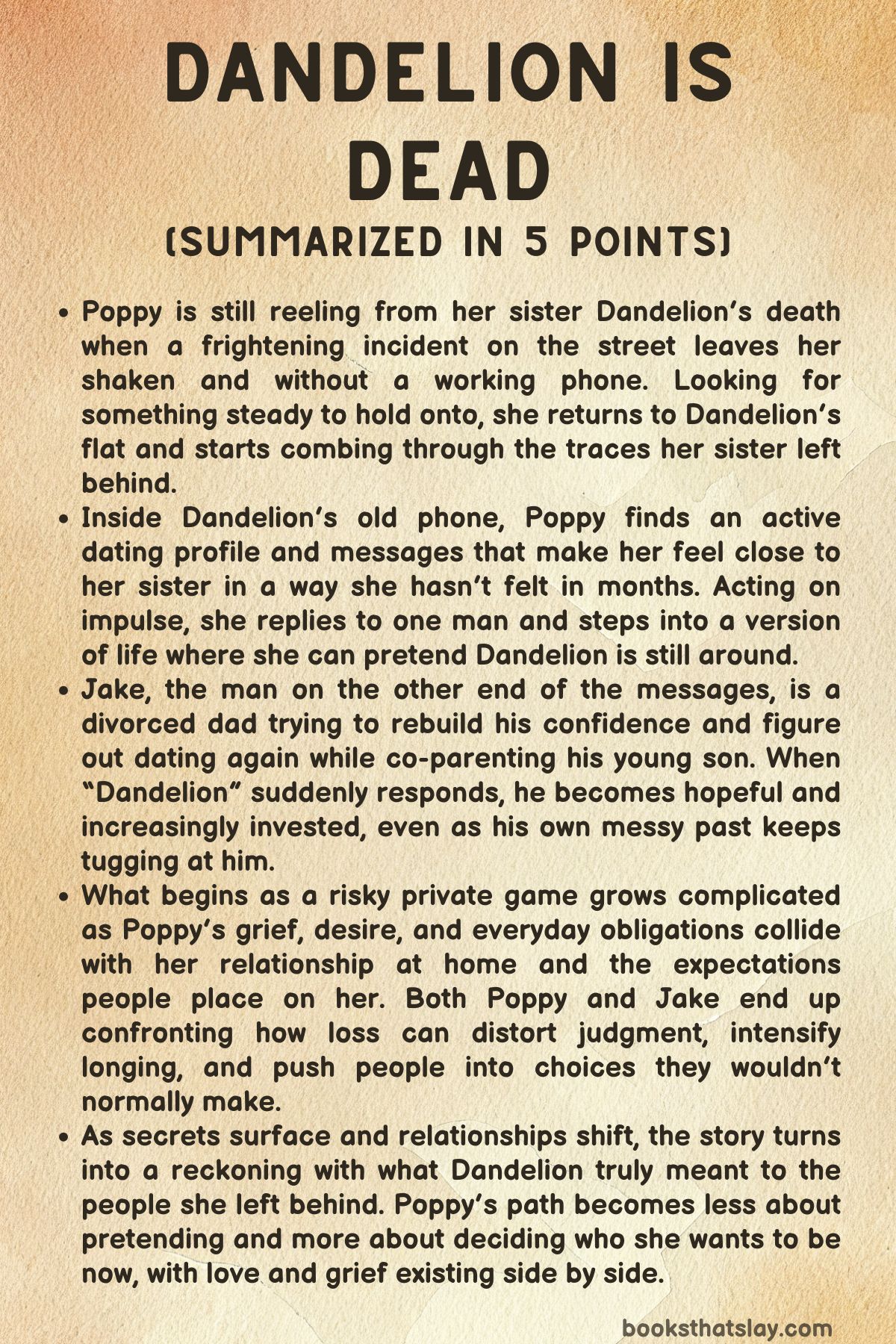
Characters
Poppy
Poppy is the novel’s raw nerve: a younger sister whose grief makes the world both painfully vivid and unreal. In Dandelion Is Dead, she moves through North London with a constant awareness of absence—counting days since Dandelion died, guarding her sister’s bedroom like a shrine, and using Dandelion’s flat as both refuge and pressure chamber.
What makes Poppy especially complex is the way she tries to survive by borrowing another self. When she slips into Dandelion’s clothes, makeup, and even her dating profile, it isn’t simple deception for thrill; it’s a desperate, messy attempt to keep Dandelion “alive” long enough to feel held by her again.
Yet the masquerade also exposes a hunger Poppy has long suppressed: for attention, for desire, for a voice that doesn’t ask permission. Her encounters with sexual threat—from the exposure incident in the car to Digby at the wedding—show how grief doesn’t insulate her from danger; it sharpens her reactions and pushes her toward strange forms of retaliation, as if Dandelion’s ferocity has become an internal companion.
Poppy’s arc is ultimately about reclaiming authorship of her own life: she moves from being someone who preserves, covers up, and absorbs pressure to someone who chooses rupture, confession, and change. By the end, her love and grief coexist without one erasing the other, and she begins shaping a future that is not a replacement for Dandelion but a life that can carry Dandelion’s influence without being consumed by it.
Dandelion
Dandelion is physically absent but narratively omnipresent—the gravitational center around which every living character tilts. She is remembered as dazzling, loud, reckless, magnetic, and also deeply strategic in ways that only become visible in fragments.
The story complicates any “saint after death” framing by showing that Dandelion could be playful, manipulative, and performative, someone who used exaggeration and invention as a form of social armor, especially in dating and intimacy. At the same time, her defining quality is a fierce protectiveness that borders on militancy: as a child she intervenes when Poppy is vulnerable to a predatory adult, and as an adolescent she constructs a deliberate trap to expose him when no one believes her.
That early pattern—seeing danger clearly, acting decisively, and accepting personal cost—echoes through how others interpret her later choices. Even the revelation that she slept with Sam sits inside this ambiguity: it can read as betrayal, but it also reads as Dandelion trying to force a decisive break for Poppy, turning herself into the villain so Poppy can escape a relationship she might otherwise endure.
Dandelion’s “voice” becomes an internalized force inside Poppy, sometimes empowering and sometimes destabilizing, which is why Dandelion functions less like a memory and more like a living moral weather system—rage, love, protection, and grief all arriving at once.
Jake
Jake is written as a man whose longing is sincere but poorly contained, and whose emotional instability is amplified by old wounds he hasn’t metabolized. His awkwardness is not merely comedic; it is a sign of someone who wants intimacy but keeps colliding with shame.
His anxiety about sex—googling anatomy on public transport, replaying humiliations, overcorrecting in messages—creates a portrait of vulnerability that is both sympathetic and occasionally exasperating. Jake’s life is structured around fracture: shared custody, a past marriage damaged by his cheating, a father who abandoned him, a mother he lost to suicide, and a present in which he is trying to be better without fully understanding what “better” demands of him.
That makes him especially susceptible to projection. When he connects with “Dandelion,” he is drawn to her warmth and charisma, but also to what she represents: a version of himself who might be chosen, forgiven, and desired without being measured against his failures.
His obsession—the spiraling messages, the fixation, the desperate phone call—reads like grief in disguise, a craving for certainty because uncertainty has hurt him too many times. Once the truth surfaces, Jake’s response is mixed: he feels duped, but he also recognizes the grief underneath Poppy’s behavior, and that recognition allows him to move from wounded ego toward something like empathy.
His final turning point is not romantic; it’s familial—confronting his father, hearing a reframing of his mother’s death, and allowing himself to cry without converting pain into performance. Only then does his relationship with Poppy begin to look like a choice made by an adult self rather than a collision between two people using each other as medicine.
Sam
Sam represents the seduction of “normal life” as coercion, the kind of partner who frames control as care and timelines as love. He positions himself as practical—talking about selling the flat, buying a house, marriage, and children—but his practicality repeatedly becomes a weapon, especially when he uses fertility anxiety and age as leverage.
His insistence on “Project Baby,” his tracking of cycles, and his impatience with Poppy’s grief reveal a worldview where emotions are obstacles to be managed rather than realities to be honored. The most revealing moments come in conflict: he shames Poppy for changing, resents her connection to Dandelion, and tries to establish dominance by making her feel unstable or selfish.
His cruelty spikes when he tells her she sounds like Dandelion but cannot “pull it off,” which isn’t just an insult; it is a direct attack on her identity at the moment she is most fragile. The revelation that he slept with Dandelion confirms a pattern: he avoids responsibility, reframes himself as the one acted upon, and expects the women around him to carry the moral weight.
Even his rapid return to dating apps signals that he values the appearance of forward motion more than any genuine reckoning. Sam isn’t drawn as a cartoon villain; he’s drawn as a familiar kind of interpersonal threat—someone who can look stable from the outside while quietly eroding the person closest to him.
Jetta
Jetta is grief with teeth: protective, volatile, loyal, and burdened by a promise that corrodes her from the inside. In Dandelion Is Dead, she functions as both Dandelion’s advocate and Poppy’s reluctant lifeline.
Her spirituality—the cacao ceremony, the rituals, the insistence on honoring Dandelion—can look performative on the surface, but it also reads as a practical attempt to give grief a shape when language fails. Jetta’s relationship with Poppy is complicated because she is simultaneously furious at Poppy’s choices and deeply aware that grief can make a person behave in ways that do not resemble their “real” self.
The central tension in Jetta is ethical: she knows the truth about Sam and Dandelion, and she both wants to protect Poppy and wants to protect Dandelion’s memory from being reduced to scandal. That inner conflict makes her sharp, sometimes cruel, sometimes unexpectedly funny, and ultimately human.
When she finally tells Poppy the truth, the scene doesn’t land as a clean act of honesty; it lands as an overdue detonation—painful, unavoidable, and strangely clarifying. Her hostility toward Jake is another extension of that protectiveness: she reads him as someone who might turn Dandelion into a fetish or turn Poppy into a substitute, and she responds as a gatekeeper of the dead.
Yet Jetta is not only a guard dog; she is also someone willing to show up physically—helping pack, offering shelter, insisting on a new promise of full disclosure—because she understands that survival after grief often requires logistics, not just feelings.
Billy
Billy is the novel’s quiet moral anchor, a child whose needs and observations force adults to confront the consequences of their instability. Billy isn’t used as a cute accessory; he is the living reminder that Jake’s choices ripple outward.
His presence pulls Jake toward responsibility even when Jake is spiraling, and Billy’s casual comments—about who lives with whom, what he notices, what he accepts as normal—highlight how quickly children absorb shifting adult realities. Billy also subtly exposes the gap between performance and truth: adults try to keep cheerful faces during conflict, but Billy’s existence makes it impossible to pretend that tension doesn’t shape a household.
In a story saturated with grief and adult desire, Billy represents continuity, the future that keeps arriving regardless of whether the adults feel ready.
Zoe
Zoe is not written as simply an antagonist ex-wife; she is a woman actively rewriting her life and refusing to cushion Jake’s feelings while doing it. Her sharpness often reads like resentment, but it also reads like fatigue from years of managing Jake’s immaturity and betrayal.
She needles him about his cheating, challenges his claims that he is “fine,” and names his abandonment issues with a bluntness that suggests she has done the emotional labor long enough to learn the pattern. Her relationship with Yan unsettles Jake partly because it collapses his fantasy that she will remain available as an emotional reference point.
Zoe’s pregnancy lands as a seismic shift not only because it changes Billy’s world, but because it confronts Jake with the fact that the life he once had continues without him at the center. The moment carries cruelty and vulnerability at once: Zoe uses humor to deliver shock, but the underlying message is final—she is moving on in a way Jake cannot control.
Yan
Yan is presented largely through Jake’s threatened gaze, which is precisely why he matters: he becomes a mirror reflecting Jake’s insecurity. Yan appears competent, present, and unbothered by the emotional chaos around him—working on the car, doing handstands, inhabiting the domestic space with ease.
Whether or not Yan is truly flawless is less important than the role he plays in the story: he symbolizes replacement, the fear that someone else can step into your life and perform it better. Yan’s calm physicality contrasts with Jake’s anxious overthinking, and that contrast intensifies Jake’s sense that he is losing status not only with Zoe but also in Billy’s universe.
Yan’s function is psychological: he is the embodied proof that Jake’s past actions created an opening for someone else.
Jake’s Father
Jake’s father represents abandonment as a long echo—an absence that shapes the adult child’s relationships, self-worth, and capacity for stability. His presence is complicated by the fact that he returned, which creates a particular kind of injury: not the clean wound of a permanent disappearance, but the chronic ache of someone who came back without fully repairing what they broke.
His conversations with Jake are often awkward, evasive, or lightly joking, which reflects a generational discomfort with emotional accountability. When Jake finally confronts him, the father’s apology and explanation do not erase the damage, but they create a rare moment of emotional truth in a book full of half-truths and roleplay.
By reframing Jake’s mother’s suicide and telling Jake he was the reason she stayed as long as she did, he offers Jake a way out of self-blame—imperfect, late, but still transformative. The father’s arc suggests that repair is possible even after long neglect, but it also shows the cost of postponing honesty until pain becomes unavoidable.
Poppy’s Mother
Poppy’s mother embodies a grief that organizes itself into caretaking and ritual. She tends the grave with almost devotional precision—planting, pruning, arranging—as if beauty and order can keep loss from spreading.
Her excitement about engagement and weddings reads as a survival strategy: a way to insist the family still has a future shape, still has milestones, still has something to plan that is not death. Yet underneath that forward motion is a grief that can feel controlling to Poppy, because it risks turning Dandelion into a symbol rather than a complicated person.
The mother’s attachment to tradition, family church ideas, and “proper” plans also increases the pressure on Poppy at the exact moment Poppy is unraveling. She is loving, but her love arrives in forms that sometimes prioritize structure over emotional permission.
Poppy’s Father
Poppy’s father is the novel’s quietest tragedy: a man whose restraint reads as fragility because he is carrying a history of misjudgment and regret. He appears subdued while the mother organizes and Sam pushes, and that subdued quality signals that grief has hollowed him out rather than animated him.
His most important role is as the keeper of the family’s buried truth—the story of Greg McCaid and what Dandelion did to expose him. By admitting he believed the teacher at the time and punished Dandelion, he reveals a parental failure that helps explain Dandelion’s lifelong intensity and Poppy’s complicated relationship to memory.
When he shares the home videos and later tells the story, he isn’t offering comfort; he is offering reckoning. That confession shifts Dandelion from myth to person and gives Poppy a new frame for her sister’s “for you” refrain.
The father becomes the bridge between childhood harm and adult understanding, showing how families can protect predators by mistake and then spend decades trying to forgive themselves.
Colin
Colin functions as the story’s reminder that harm often enters lives through banal proximity rather than cinematic villainy. His casual revelation about knowing Dandelion from another app destabilizes Jake because it threatens the romantic narrative Jake has built.
Later, when workplace investigations reveal he dosed his own drink with acid and Jake accidentally consumed it, Colin’s presence becomes darker: he represents a reckless entitlement that endangers others while treating risk like a private game. His role is less about personal depth and more about what he triggers in Jake—paranoia, humiliation, professional instability, and the realization that some of his recent “madness” had a concrete cause.
Colin is a plot catalyst, but also a thematic one: a man whose carelessness becomes someone else’s crisis.
Digby
Digby is an emblem of socially sanctioned predation—the kind that hides behind weddings, alcohol, and older-male entitlement. He corners Poppy with the ease of someone who expects no consequences, touching her and speaking crudely as if her discomfort is part of the fun.
His importance lies in how he activates Poppy’s internal Dandelion: the defiance, the rage, the refusal to be politely violated. Poppy’s response—spitting into his drink—doesn’t solve anything structurally, but it reveals an emerging boundary: she is no longer willing to absorb humiliation quietly.
Digby exists to show that the dangers Dandelion raged against are still present, still normalized, and still capable of pushing women toward desperate small rebellions.
Stefan
Stefan plays the role of steady support without demanding narrative dominance. He appears as part of Jetta’s home base, someone willing to help pack, host, and make practical survival possible for a person in crisis.
He is significant precisely because he is not another person pulling Poppy into a storyline of desire or confrontation. Stefan’s presence suggests that healing often depends on ordinary kindness—space on a sofa, help with boxes, food at a table—rather than grand emotional speeches.
Karla, Sydney, and the Yesness HR and Legal Team
These characters represent institutional reality intruding on private chaos. Karla and the HR-legal presence are not individualized as intimate personalities, but they matter because they force Jake’s spiral into an official frame: complaints, CCTV, liability, therapy offers, compensation, and the corporate need for discretion.
They are the mechanism through which Jake learns that a portion of his unraveling had an external cause—being unknowingly drugged—and that recognition changes the moral texture of his shame. Sydney’s complaint and its reversal show how fragile reputations are inside systems designed to protect the company first, and how “truth” can become negotiable based on evidence, risk, and public exposure.
Collectively, they embody the modern anxiety that personal catastrophe can become a workplace file, a meeting, a settlement, and a quiet exit.
Themes
Grief as a Physical Presence and a Daily Negotiation
In Dandelion Is Dead, grief behaves less like an emotion Poppy “has” and more like an atmosphere she moves through, something that alters her sense of time, safety, and even the shape of ordinary streets. Her counting of days since Dandelion’s death turns loss into a measurable unit, yet it never becomes manageable; the number is proof that time is passing without resolution.
Poppy’s return to the flat and her ritual of keeping the bedroom locked shows how grief can create private rules that mimic control: preserve a room, preserve a person, preserve a version of the past that can still be entered. Even her practical intentions—renting the flat, closing accounts, retrieving a phone—keep collapsing into craving.
The administrative tasks of death are meant to be tidy, but Poppy’s scrolling through photos and apps becomes an act of hunger, as if enough images could reverse absence. The story keeps showing grief as something that interrupts basic functioning and redirects attention toward small objects: an old device, a locked door, a bouquet, a message thread.
It also appears as bodily disruption: waking too early, crying while eating, reaching for alcohol and medication, feeling both numb and overstimulated. The grief does not soften in a neat arc; it spikes at birthdays, at graves, in conversations that touch the future, and in moments when Poppy encounters male threat.
What finally shifts is not that grief ends, but that it becomes shareable and survivable—Poppy can hold it while still making decisions, leaving Sam, admitting the impersonation, and choosing what to do with her life. The ending doesn’t promise “closure”; it presents a new form of living where grief and love coexist without canceling each other out.
Identity, Performance, and the Temptation to Become Someone Else
Poppy’s decision to answer Jake using Dandelion’s dating profile is not only deception; it is also a complicated experiment in identity under pressure. The sister who is gone becomes a role that can be worn, and the role becomes appealing because it seems to offer what Poppy believes she lacks: boldness, ease, nerve, appetite for risk.
Dressing in Dandelion’s clothes and copying her makeup highlights how the self can feel thin after bereavement, as if the person left behind needs a template to keep moving. The impersonation also exposes how identity is partly relational: Jake responds to a set of signals, stories, flirtations, and photos, and Poppy learns she can be received differently when she carries Dandelion’s name.
Yet the performance costs her. Every moment of connection contains a fracture—Poppy is present, but also watching herself act; Jake is falling for someone, but the “someone” is unstable.
The narrative keeps tightening this tension until the confession scene, where Poppy’s fear is not only that she lied, but that she was wanted for the wrong reasons. Jake’s own confusion mirrors hers: he wants the intensity he felt, and he tries to map it onto the person he thinks he met, then onto Poppy, then onto his own loneliness.
The theme becomes sharper when Poppy hears herself being compared to Dandelion in a cruel way, or when she hears Dandelion’s voice in her head during moments of defiance. Identity is shown as porous: siblings borrow from each other, partners project onto each other, and memory can masquerade as guidance.
What makes Poppy’s arc meaningful is that she doesn’t simply stop performing; she begins to choose which parts are hers. The point is not to “return” to an old Poppy, but to claim a new one that includes anger, desire, limits, and truth.
Romantic Love, Projection, and the Search for a Safe Attachment
Jake and Poppy’s connection operates in the space where loneliness, desire, and grief distort perception. Jake is not presented as a villain; he is presented as someone hungry for reassurance, struggling with rejection, and desperate to feel chosen.
His clumsy dating experiences and his compulsive checking of messages show how need can become obsession, especially when he’s already destabilized by co-parenting tension, his ex-wife’s new partner, and his unresolved history with an absent father. Poppy, meanwhile, is not pursuing romance from stability; she is using it as oxygen, a way to feel alive on a day that is otherwise unbearable.
Their early dynamic is shaped by the lie, but it is also shaped by mutual projection: Jake wants a version of connection that repairs his bruised self-image, and Poppy wants a version of herself that can escape the weight of being “the sister who is still here.” When Jake learns about Colin’s prior involvement with Dandelion, jealousy and insecurity flare, revealing how easily he converts uncertainty into a story about being replaceable. The relationship becomes a test of whether love can exist without turning the other person into a solution.
Poppy’s fear that Jake preferred “Dandelion energy” is not just about romance; it is about being seen accurately. Jake’s later efforts to apologize and to separate Poppy from Dandelion suggest growth, but the book keeps the question alive: how much of attraction is recognition, and how much is need searching for a shape?
The resolution is cautious rather than magical. Forgiveness happens, but it is negotiated: Poppy asks for forgiveness, Jake gives it, and both accept that they have used each other in ways they didn’t fully understand.
Their choice to continue is framed as a step into honesty rather than a reward for suffering. Love becomes less about rescue and more about accountability, steadiness, and allowing the other person to be real, not symbolic.
Family Pressure, Reproduction, and the Struggle to Own the Future
Future-planning becomes a battleground because it forces characters to declare what they think life is supposed to look like and when it is supposed to happen. Sam’s fixation on marriage logistics, housing, and “Project Baby” turns intimacy into a schedule, and the more Poppy resists, the more he escalates the pressure, using age and fertility as leverage.
This reveals how reproductive timelines can be weaponized, especially against someone already destabilized by grief. Poppy’s ambivalence is not just indecision; it is a refusal to let her future be decided as compensation for loss.
Her grief makes the future feel unreal, but Sam treats it as a checklist, implying that moving forward is proof she is “fine.” The family visit intensifies the theme: her mother’s excitement about the engagement, her father’s fragility, and the unspoken weight of Dandelion’s absence create a setting where Poppy is expected to play the role of continuity. Even her moment of imagining a baby as hope is complicated—hope appears, but it arrives alongside fear, anger, and the sense that she is being pushed into a life to make other people comfortable.
Parallel to this, Zoe’s pregnancy hits Jake like a blow, not only because it changes Billy’s world, but because it reopens old wounds around IVF, effort, and disappointment. The book shows how parenthood and fertility are not neutral topics; they are loaded with identity, status, and regret.
Poppy’s decision to freeze her eggs later is meaningful because it reframes agency: rather than being coerced by a partner’s timeline, she creates options for herself. The theme is not anti-family or anti-children; it is about consent and timing, about not allowing grief to be exploited by someone else’s agenda, and about choosing a future that belongs to the person living it.