Death to Valentine’s Day Summary, Characters and Themes
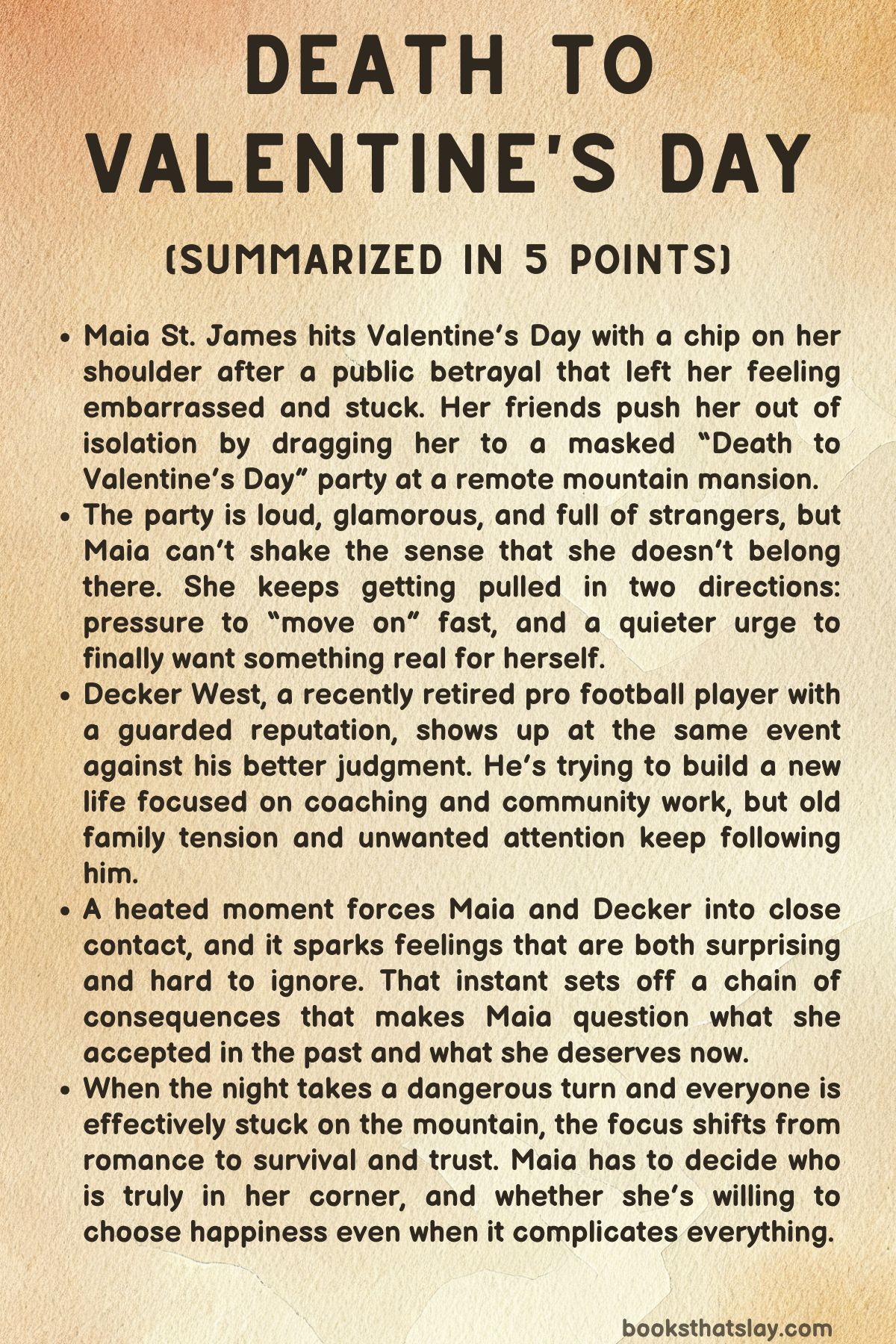
Death to Valentine’s Day by Catherine Cowles is a romantic suspense story set in snowy Colorado, where one hated holiday turns into a night that changes everything. Maia St. James is still raw from being cheated on and humiliated, so her friends drag her to a masked “Death to Valentine’s Day” party at a remote mountain estate.
What starts as a forced attempt at fun becomes personal, risky, and dangerous when Maia collides with Decker West—her ex’s older brother and the one man who has quietly known her far better than anyone else. Then a murder traps the guests, and Maia must face both the past and what she truly wants.
Summary
Maia St. James wakes up on Valentine’s Day with one goal: get through it alone. The holiday feels like a cruel joke after what happened last year, when she caught her longtime boyfriend, Jackson West, cheating on her with her cousin.
The betrayal still stings, but what bothers Maia just as much is the clarity that followed—she spent years in a relationship that never really fit, and she kept accepting less than she deserved. Her closest friends, Violet and Erik, refuse to let her rot in bed.
They bully her into getting dressed and announce they’re taking her to a “Death to Valentine’s Day” masquerade party at a wealthy donor’s mountain mansion.
Maia doesn’t want to go, especially when she sees the outfit Violet picked: a black, lacy top that barely qualifies as a dress, a black lace mask, and Maia’s own expensive deep-red heels. She feels exposed and ridiculous, but Erik does her hair and makeup, Violet pushes her out the door, and a limo shows up to deliver them to the estate.
The lavishness makes Maia uneasy—she works at a nature preserve and hates relying on people like Frederick Ashford, a rich donor whose attention often feels slippery. Still, she tries to keep an open mind and focus on her friends’ intention: one night to stop thinking about Jackson.
The mansion is crowded with masked guests, music, and alcohol. Maia immediately feels out of place, surrounded by people who look like they belong in expensive chaos.
She catches sight of a tall man on an upper balcony—broad shoulders, commanding presence—and feels a jolt of attraction that hits her so hard she can’t explain it. Before she can sort through that reaction, she’s forced into polite hell: Frederick Ashford greets guests like he owns the world, including Maia, and his smile lands on her with too much confidence.
Violet admits she chose this party because it’s full of “eligible men,” which irritates Maia, but she plays along and tries to act normal. She bumps into people she knows, including her coworker Henry, who’s wearing a Spider-Man mask and providing the kind of grounded humor she needs.
Across the estate, Decker West arrives with his friend Booker. Decker is Jackson’s older brother, recently retired from professional football, and thoroughly sick of attention.
He hates parties, hates being approached by fans, and carries years of frustration about Jackson’s behavior. Decker talks about his plans to coach and work with youth programs now that football is behind him.
Booker teases him for being isolated, for acting like he’s sworn off fun, and for never letting himself want anything openly. Then Decker sees Maia across the room—black lace, red heels, a mask hiding her expression—and something in him snaps into focus.
He’s overwhelmed by a desire he doesn’t try to label as reasonable. He starts toward her, pushing through the crowd, but she disappears before he can reach her.
Maia tries to mingle, but her feet hurt, her nerves are tight, and she has no interest in picking a stranger for a meaningless hookup. When she heads toward the bar for another drink, Frederick intercepts her.
He flirts too aggressively, blocks her path with conversation, and implies he could give her more than she has now if she’d let him. Maia’s discomfort rises fast.
She finds an excuse, slips away into a darker hallway, and ducks into an empty bathroom to breathe and steady her shaking hands.
When she steps back into the corridor, her heart drops. Jackson is there, masked, with a woman clinging to him—close enough for Maia to see the fresh hickey on his neck and the possessive way the woman hangs on his arm.
Maia’s instinct is to escape, but doors are locked and the hallway funnels her into the open. Panic hits.
At the other end of the corridor, a tall masked man approaches, and Maia makes a split-second decision. She blurts out that she needs him to kiss her—right now—and before she can second-guess herself, she grabs his lapels and pulls him in.
The kiss is immediate and intense. Maia expects awkwardness or a brief distraction, but instead she feels like she’s been struck by lightning.
His hand slides into her hair, his mouth is firm and certain, and Maia’s whole body reacts in a way that shocks her. When he pulls back, she starts to apologize, calling him a stranger.
His voice stops her cold. Recognition hits in pieces until it lands fully: it’s Decker.
She whispers his nickname, “Deck,” and he calls her “Birdie,” the childhood name he’s used for her for years.
Maia is rattled and angry that he didn’t reveal himself, but Decker doesn’t pretend the kiss was a mistake. He makes it clear he wanted her long before tonight.
The moment is cut short when Jackson notices them and storms over, furious. Jackson claims Maia is his “girlfriend,” and the woman beside him realizes he’s been lying.
Jackson turns on Maia with ugly insults, calling her names and accusing her of sleeping with Decker behind his back. Decker’s restraint breaks.
He punches Jackson hard enough to drop him. Jackson spits threats, promising payback.
Maia, overwhelmed by the kiss, the violence, and the shame Jackson still knows how to trigger, yanks herself away and runs.
She hides in a quiet gallery-like room, shaking and trying to get her thoughts to line up. Henry finds her and checks in.
Maia admits she kissed Jackson’s brother, and she insists she can’t pursue it—partly because she feels responsible for the mess, partly because she cares about the West family despite everything. Henry doesn’t soften the truth.
He tells her Jackson never seemed to like her, and Maia is forced to face how much she shrank herself for that relationship. Henry encourages Maia to choose what makes her happy, and Maia urges Henry to take a real chance with Violet instead of staying on the edges.
Needing air, Maia wanders outside onto a covered patio while snow thickens around the estate. She watches two bright streaks in the sky—comets people call the Star-Crossed Lovers—and stands there, cold biting through her thin clothes.
When the chill forces her to move, she circles, trying to find a way back inside. In the shadows, she spots a figure collapsed near the edge of the patio.
She rushes closer and finds a red-haired woman sprawled in the snow, her hair soaked with blood. Maia screams.
Inside, Decker is still burning from the confrontation with Jackson, and Jackson is raging about always being compared to the “perfect” brother. Decker tries to understand the resentment but refuses to accept Jackson’s cruelty as inevitable.
Then the scream cuts through everything. Decker runs outside and finds Maia crouched over the body.
Booker checks the woman and confirms she’s dead. A small bird statue lies nearby, stained, suggesting the victim was struck with it.
Security rushes in, and Decker carries Maia inside, holding her while she shakes uncontrollably. The host, Frederick, tries to manage the situation, but the reality is immediate and terrifying: they are trapped on a mountain, snow has blocked the roads, and law enforcement cannot reach them.
The guests gather in a library while security whispers about murder. Frederick produces a phone and sets up a video interview with Detective Silva.
Maia tries to answer questions, but the tone makes her feel like a suspect rather than a witness. She panics, and Decker shuts the interview down, insisting she won’t speak further without legal representation.
Tension spikes around the lack of cameras in the mansion; Frederick claims it’s for privacy, which only adds to the unease. Maia realizes she hasn’t eaten.
Jackson brings appetizers, but he forgets Maia hates mushrooms, and Decker corrects him without thinking. It’s a small moment, but it lands hard: Decker remembers Maia better than the man who dated her for a decade.
Frederick announces there’s one room short and offers Maia his room, which feels like a claim disguised as generosity. Decker refuses and insists Maia stay with him.
In Decker’s room, Maia apologizes for the chaos, but Decker takes responsibility for his choices—kissing her, punching Jackson, shutting down the detective call. He removes Maia’s heels, massages her calves, and gets her to eat simple food he pulls together: apples and cheese.
Maia admits she’s furious at herself for settling, for accepting a relationship that asked her to be smaller. Decker reminds her that she built a life she cares about—her work, her friends, her values—and that she deserves more in every sense.
Maia decides to take a shower to calm down. Mid-bath, the power cuts out and the water turns icy.
She screams, startled and half-panicked from the shock. Decker bursts in instantly and wraps her in a towel, steady hands, steady voice.
In the dark, with danger pressing in from outside the room and feelings pressing in from inside it, Maia stops trying to control everything. She tells Decker she doesn’t want to think for once.
Decker agrees. They give in to the pull between them and sleep together, crossing a line Maia has spent years telling herself she’d never touch.
When it’s over, the reality hits Maia all at once: the family connection, the history, the distance between their lives. She fears what this could cost, and she doubts it can turn into anything real.
In the morning, power is back, but roads are still blocked. Maia avoids Decker’s eyes at first, embarrassed by how much she wants him and scared of what that means.
Booker pushes Decker to stop hiding, to stop pretending he doesn’t care. Decker overhears Maia telling Violet and Erik that being with him felt like something shifted in her, but she’s worried about fallout and about how complicated it all is.
Maia goes to the restroom and decides she’s tired of living cautiously. On the way, Jackson corners her and demands a conversation.
In a billiards room, Maia finally says what she’s swallowed for years: Jackson never loved her, and she doesn’t love him either. She lists the moments when she needed him—grief, practical crises, fear—and how he always chose himself.
Decker arrives and adds a truth Maia never knew. When she had appendicitis, Decker flew across the country to be there for her, missing a game, not because Jackson sent him but because Decker chose to show up.
Maia realizes how consistently Decker has been present in the background of her life, quietly reliable. Then Booker lets another secret slip: Decker has been anonymously donating a million dollars a year to Maia’s animal preserve on her birthday.
Jackson mocks them, but the mask slips further when Decker reveals he moved back to Colorado three days ago and is taking a coaching job with the Cougars along with youth outreach work. He didn’t just want Maia for one night—he changed his life to be closer, to build something.
Maia asks if he’s sure, and Decker tells her that anything worth having comes with mess. Maia kisses him openly, deciding she’s done letting shame steer her.
Soon after, Frederick announces the roads are clearing and police have information: the dead woman, Lucy Carmichael, had a restraining order against an ex who is now being sought. It sounds like an outside threat, and everyone starts preparing to leave.
While people pack, Decker tries to speak to Jackson to prevent retaliation. Maia returns to the room to gather her belongings and runs into Frederick, who makes smug comments about how he could “give her the world.” His words feel like a warning wrapped in temptation, and Maia is relieved when he leaves.
Then Violet appears—and the air changes.
Violet’s smile is wrong, her eyes sharp with something Maia hasn’t seen before. She explodes with resentment, accusing Maia of always being admired, always being chosen.
In a fast, terrifying shift, Violet grabs Maia by the hair and presses a knife to her throat. Violet admits she wanted sympathy and planned to claim a masked man attacked Maia, using it to become the center of attention.
Then she confesses the truth about Lucy Carmichael: Violet killed her in a rage. She mistook Lucy for Maia in the snow, grabbed the bird statue, and struck until Lucy died.
Now Violet blames Maia for everything and threatens to finish what she started.
Outside the room, Decker, Booker, and Erik hear enough to understand. Decker enters carefully, using his voice to keep Violet’s attention while Booker positions himself to intervene.
Erik calls out from the hallway in a light, careless tone, just enough to pull Violet’s focus away for a split second. Decker lunges, yanking Maia out of reach as Booker tackles Violet.
Booker and Erik restrain her while Maia stumbles back, shaking, alive.
In the aftermath, Maia admits the truth that finally feels simple: she loves Decker. She realizes she always has, underneath the fear and the history and the rules she thought mattered.
Decker tells her he loves her too, without hesitation.
Two years later, Maia and Decker live together in a forest home they designed—quiet, warm, and built on daily choices rather than old expectations. Violet is serving a long sentence in a mental health program.
Frederick is in prison for insider trading, and his estate has been foreclosed. Jackson tried to stir chaos but eventually burned his own life down, and his noise has faded.
Maia and Decker share a life with two dogs, Tank and Tinsel, and a steady rhythm that feels earned. Booker and Erik are together, and Booker has moved into work with Decker at the Cougars.
On Valentine’s Day, Maia and Decker watch wolves outside their window, and Decker proposes with an emerald ring. Maia says yes, ready to keep choosing the life they’ve made—together.
Characters
Maia St. James
Maia begins Death to Valentine’s Day emotionally raw and stubbornly committed to hating Valentine’s Day because it has become a symbol of betrayal and humiliation. Her wound is not only Jackson’s cheating; it is the dawning realization that she spent years shrinking herself inside a relationship that was never truly nourishing.
At the masquerade, Maia’s discomfort with attention and extravagance shows how deeply she associates visibility with danger—being seen feels like being judged, used, or hurt. Yet she is also brave in a very human way: she keeps showing up, even when she would rather disappear, and that resilience becomes the engine of her transformation.
The kiss with Decker cracks open a part of her that has been locked away—desire, joy, spontaneity—and the murder forces her into a crisis where she can’t keep living on autopilot or out of guilt. By the end, Maia’s growth is not just romantic; it is self-reclamation.
She stops negotiating her worth, names the truth about her past, and chooses a future that is messy, public, and real because it is hers.
Decker West
Decker is built like a wall—controlled, intimidating, and used to carrying pressure—but under that exterior he is intensely observant, loyal, and quietly tender. His role as the “perfect” brother is a burden as much as a label; it feeds Jackson’s bitterness and makes Decker wary of being cast as the villain simply for existing as the steadier one.
He is allergic to shallow attention, which fits with his dislike of parties and celebrity, but he is drawn powerfully to what feels true, and Maia is the most honest thing in the room for him. His long-held feelings are not presented as a sudden whim; they come out through what he remembers, what he does without credit, and how instinctively he protects her—stopping the interview, insisting on boundaries, and anchoring her body back to safety when she is in shock.
Decker’s romantic intensity could easily read as forceful, but the story frames it as consent-driven devotion: he does not just want Maia, he wants her well-being, her choice, and her future. His biggest emotional leap is deciding that love is worth disrupting the old family narrative, even if it means confronting Jackson and inviting chaos, because he refuses to keep living small in a different way.
Jackson West
Jackson is the embodiment of entitlement turned corrosive, a man who confuses possession with love and attention with validation. His cheating is not a single moral failure but a pattern that reveals how he centers himself in every crisis—choosing convenience over compassion and ego over responsibility.
His rage when he sees Maia with Decker exposes the hypocrisy at his core: he claims her as “girlfriend” not because he values her, but because her autonomy threatens his self-image. Jackson’s resentment toward Decker reads as lifelong insecurity sharpened into cruelty; he weaponizes insults, tries to rewrite history, and lashes out when the narrative slips from his control.
Even when he is confronted with specifics—times Maia needed him and he failed—he cannot metabolize accountability, so he defaults to blame, threats, and manipulation. His later spiral is a continuation of the same flaw: he keeps gambling on selfish impulses and is shocked when consequences finally stick, making him a cautionary figure rather than a redeemed one.
Violet
Violet is initially staged as the fierce best friend—the one who drags Maia out of bed, forces momentum, and engineers the masquerade as a blunt instrument for healing. That role makes her betrayal particularly brutal in Death to Valentine’s Day, because Violet’s early “helpfulness” is revealed to have an unstable foundation: her identity is entangled with being central, admired, and needed.
Underneath the tough-love energy is a deep envy that has been fermenting for a long time, and the masquerade setting becomes the perfect pressure cooker for her delusions of grievance. Violet’s jealousy is not a fleeting irritation; it escalates into a worldview where Maia’s existence is an offense and sympathy is something Violet believes she is owed.
Her confession reframes earlier moments as performative and controlling—she was not simply pushing Maia toward happiness, she was staging a scenario where Maia’s humiliation or victimhood could be repurposed. Violet’s violence is impulsive yet revealingly personal, driven by misrecognition and displaced rage, and her final unmasking turns the story into a portrait of how intimacy can be weaponized when someone’s need for validation becomes pathological.
Erik
Erik functions as steadiness and warmth, someone who can sit close to chaos without becoming it. He is part of Maia’s protective social circle, but unlike Violet’s aggressive style, Erik’s support reads as grounding and practical—helping Maia get out the door, staying present during the crisis, and later acting decisively during the confrontation.
His courage is quiet; he does not need to dominate the room to matter in it. What makes Erik particularly important is that he is emotionally perceptive without being intrusive—he knows when to provide comfort, when to distract, and when to step in.
His relationship trajectory also positions him as someone who chooses love honestly rather than as a game, making him a thematic counterpoint to Jackson’s performative claims and Frederick’s transactional seduction.
Booker
Booker is the story’s social spark and moral pressure valve, using humor and blunt commentary to keep Decker from retreating into silence. He is the kind of friend who refuses to let avoidance masquerade as strength; he pokes at Decker’s isolation, challenges his self-denial, and nudges him toward emotional risk.
Yet Booker is not just comic relief—he becomes crucial during the murder aftermath, staying clear-headed, checking the victim, and later physically intervening when Violet turns violent. His loyalty is kinetic, expressed through action and readiness rather than speeches.
Booker also helps collapse the distance between what Decker feels and what he is willing to admit, especially when the truth about Decker’s anonymous financial support comes out, making Booker a catalyst who accelerates honesty even when it complicates everything.
Henry
Henry serves as an unexpected pocket of clarity in the masquerade’s emotional fog. His Spider-Man mask and easy presence make him approachable, but his real function is as a truth-teller who sees Maia’s pain without sensationalizing it.
When he finds her after the confrontation, he does not lecture or pity her; he listens, reflects back what is real, and challenges the way she has normalized being diminished. Henry’s insight—that Jackson never truly liked her—lands because it reframes the past as something Maia did not “fail” at, but something that was structurally wrong from the start.
He also becomes a bridge between Maia’s growth and the broader friend group by encouraging possibility in love rather than cynicism, which helps keep the story’s emotional world from collapsing into fear after the murder.
Frederick Ashford
Frederick is predation dressed as sophistication, using wealth, access, and philanthropy to create an illusion of desirability and power that he expects others to accept as irresistible. His sleaziness is not just flirtation that misses the mark; it is control—cornering Maia, implying ownership over outcomes, and presenting “the world” like a purchase he can make with her as the reward.
His insistence on privacy and the lack of cameras hints at a man who prefers environments where he can curate the rules and limit accountability. Even when he appears “helpful” by arranging rooms and facilitating contact with law enforcement, it carries the undertone of someone managing optics and access.
His later downfall for insider trading fits his characterization: Frederick’s worldview is fundamentally transactional, and he treats ethics as an obstacle rather than a boundary, which makes him a social villain even before the plot confirms his criminality.
Detective Silva
Detective Silva represents the external world pressing in on an isolated, emotionally volatile situation. His questioning is methodical and understandably skeptical given the circumstances, but the effect on Maia is immediate and visceral—she feels accused because she is already overwhelmed and because the night has taught her that control can vanish instantly.
Silva’s role is less about personal characterization and more about function: he introduces procedural pressure, reminds everyone that the situation is serious and dangerous, and indirectly validates Decker’s protective instincts when Decker insists on boundaries and legal support. He also amplifies the claustrophobia of being trapped—help exists, but it is distant, filtered through a screen, and unable to change the immediate reality.
Lucy Carmichael
Lucy is present in the story mostly through absence, but her impact is immense because her death transforms a messy romantic reckoning into a survival scenario. Lucy becomes a tragic symbol of misdirected violence—killed not for who she is, but for who she is mistaken for, which underscores how obsession collapses individuality into projection.
The detail of her restraining order situates her within a broader pattern of threat and vulnerability, suggesting a life where safety was already complicated before the mountain made it worse. Lucy’s function in the narrative is to force truth into the open: the party’s masks stop being playful, the characters’ intentions become urgent, and Maia’s internal conflict is no longer abstract because real blood is on the snow.
Tank
Tank, one of Maia and Decker’s dogs in the epilogue, represents the domestic life Maia once believed she could not claim—warmth, routine, and uncomplicated loyalty. Even as a small detail, Tank signals that Maia and Decker have built a home defined by care and steadiness, not by performance or fear.
Tinsel
Tinsel mirrors Tank in function, reinforcing the sense that Maia and Decker’s ending is not just passionate but grounded. Tinsel contributes to the emotional texture of the future they choose: a life with living, dependent creatures to care for, suggesting commitment that shows up daily rather than only in dramatic declarations.
Themes
Betrayal, Humiliation, and the Long Shadow of Being Wronged
Maia’s hatred of Valentine’s Day is not a quirky preference; it grows out of a betrayal that rearranged how she sees herself in public and in private. Being cheated on by a partner and a cousin is not only a relationship rupture, it is a social humiliation, because it suggests she was the last to know the truth in her own life.
That kind of experience trains a person to anticipate ridicule even when none is present, and to interpret attention as danger rather than comfort. Maia’s early determination to isolate is a protective strategy that looks like bitterness from the outside but functions like a cast around an injury that never healed cleanly.
The masquerade party intensifies this theme because the setting turns personal pain into spectacle: masks, curated outfits, wealthy hosts, and a crowd that invites comparison. Maia’s discomfort around Frederick’s entitlement echoes the earlier cheating in a different form—another person treating her as an object to acquire and assuming access to her time and body.
When Jackson appears again, still careless and still using another woman, Maia is forced to face how betrayal repeats when someone refuses accountability. The story keeps returning to the idea that humiliation does not end when the relationship ends; it lingers in reflexes, in avoidance, in the urge to disappear.
Maia’s growth depends on recognizing that her life cannot be organized around not being hurt again, because that still gives the betrayer control. The shift begins when she stops managing other people’s impressions and starts naming what happened as it was: not a mistake she made, but a harm done to her.
Self-Worth, Shrinking Yourself, and Learning to Take Up Space
Maia’s emotional center is the realization that she spent years making herself smaller to keep a relationship intact. The story shows this not through abstract affirmations, but through concrete memories of being unsupported when she needed basic care: family grief, practical emergencies, money stress, illness.
These are ordinary life events that reveal character over time, and Maia’s list of moments is powerful because it reframes her past as a pattern rather than a series of isolated disappointments. She is not merely angry at Jackson; she is angry at her own training to accept less than she needed.
That anger becomes productive when it transforms into clarity. Once she can say out loud that she never truly loved him and that he never truly showed up, she can stop bargaining with the past.
The contrast with Decker sharpens the theme: he remembers her preferences, anticipates her discomfort, and proves through action that her needs are not “too much.” Even the small acts—food she can actually eat, removing painful shoes, taking control when a detective’s questions become overwhelming—build a new internal story for Maia: she is worth consideration without having to earn it by being easy. This is not a simple switch from insecurity to confidence.
It is a messy, bodily, moment-by-moment recalibration of what she allows. Her decision to be brave after a night of intimacy is not about romance alone; it is about refusing the old habit of retreating the moment her choices might cause conflict.
Taking up space here means accepting that a meaningful life includes discomfort, confrontation, and the possibility that other people will not approve.
Desire, Agency, and Choosing Without Apology
The hallway kiss begins as a survival tactic—an escape from being seen by Jackson—yet it quickly becomes a turning point because Maia feels desire that is not tangled with obligation. That matters because her past relationship has trained her to associate romantic attention with compromise and performance.
With Decker, Maia experiences an intensity that shocks her precisely because it feels mutual and chosen, not negotiated. The story treats physical attraction as more than heat; it becomes a language of agency.
Maia asks for what she wants in the bedroom and refuses to default to being “good” or “low-maintenance” to preserve harmony. That shift is significant because it is risky: she is involved with her ex’s brother, in a context full of judgment and potential fallout.
Agency here is not presented as moral perfection; it is presented as honesty. Maia does not pretend it is tidy.
She worries about distance, family reactions, and the history attached to the West name. But she still chooses.
Death to Valentine’s Day pushes against the idea that a woman must justify desire with a socially acceptable rationale. Maia’s desire does not need to be softened into something palatable, and Decker’s desire is not portrayed as conquest; it is tied to responsibility, restraint when needed, and consistency over years.
The theme becomes even sharper when Jackson tries to reassert ownership with the word “girlfriend,” using language as a leash. Maia’s refusal to accept that label is a declaration that her body and future are not open for revision by a man who discarded her.
Choosing without apology also means accepting consequences without self-punishment: Maia can acknowledge the mess and still move toward what is true for her.
Family Roles, Sibling Rivalry, and the Damage of Comparison
The conflict between Decker and Jackson is not just about a woman; it is about a lifelong competition shaped by roles assigned early and repeated often. Jackson’s resentment reveals the corrosive effect of being the “lesser” brother in a family narrative, especially when the “better” brother is a public figure with admiration built into his career.
The story suggests that constant comparison does not only hurt the child being compared; it also distorts the entire family dynamic, turning love into a scoreboard. Jackson’s behavior—sabotage, entitlement, lying, cruelty—reads as a maladaptive strategy to regain power in a system where he feels perpetually second.
Decker, meanwhile, carries the exhaustion of being cast as the dependable one, the person expected to absorb damage without reacting. His punch is important not because violence is romantic, but because it marks a breaking point where he refuses to be endlessly composed in the face of abuse.
The brothers’ confrontation exposes how family history can trap adults in adolescent patterns: provocation, proving, retaliation, and the fear of losing status. Maia is pulled into that system because dating Jackson for ten years made her part of the family story, even if she never benefited from belonging.
Her hesitation about Decker is not only about morality; it is about not wanting to be a weapon in sibling warfare. The eventual shift comes when Decker stops letting Jackson’s likely reaction dictate his choices—moving back, taking a coaching job, committing openly.
The theme argues that family roles can be rewritten, but only when someone accepts short-term chaos in exchange for long-term integrity. It also shows that unresolved sibling rivalry can spill outward, harming partners and friends who never agreed to play the game.
Healing, Accountability, and Building a Future That Isn’t Perfect
The ending does not present healing as forgetting. Maia does not erase what happened with Jackson or pretend the betrayal did not matter; she builds a life in which that history no longer decides her choices.
Accountability appears in contrasts. Decker’s accountability looks like consistent presence and willingness to be seen choosing Maia even when it is complicated.
Jackson’s lack of accountability looks like blame, spiraling, and repeated self-sabotage. Violet’s accountability is external and legal, but the story also frames it as a mental health issue that requires structure and containment.
Frederick’s downfall for insider trading reflects another kind of accountability: the powerful man who thought he was untouchable is finally touched by consequences. What makes the resolution emotionally satisfying is that the future is not portrayed as a magical reward for suffering; it is portrayed as a series of deliberate decisions.
Maia and Decker design a home, choose routines, share responsibility, and build companionship that is quiet enough to feel real. Even the proposal on Valentine’s Day functions as a reclaiming rather than a reversal.
Maia does not suddenly love the holiday because romance fixed her; she can tolerate and even accept the date because it no longer represents her humiliation. The wolves outside the window reinforce the idea of life continuing beyond human drama, mirroring Maia’s work with animals and her attachment to a world that is steady and non-performative.
Healing here means returning to herself—her values, her work, her capacity for love—without pretending that love must be clean to be valid. The story’s promise is not that life becomes simple, but that it can become honest, safe, and chosen.