Inside Man Summary, Characters and Themes
Inside Man by John McMahon is a fast-moving crime thriller that follows FBI agent Gardner Camden and his small, specialized team in the Patterns and Recognition unit. Their job is to spot what other agencies miss in stalled or messy cases—especially when the “official” version doesn’t add up.
What starts as a sprawling unemployment-fraud scheme in Florida turns into something far more dangerous: illegal weapons, a domestic militia, and corruption close enough to ruin an investigation overnight. As Camden tries to keep one case alive, another erupts in the background—missing women, buried bodies, and a killer with a method that feels designed to stay invisible. It’s the 2nd book in the Head Cases series.
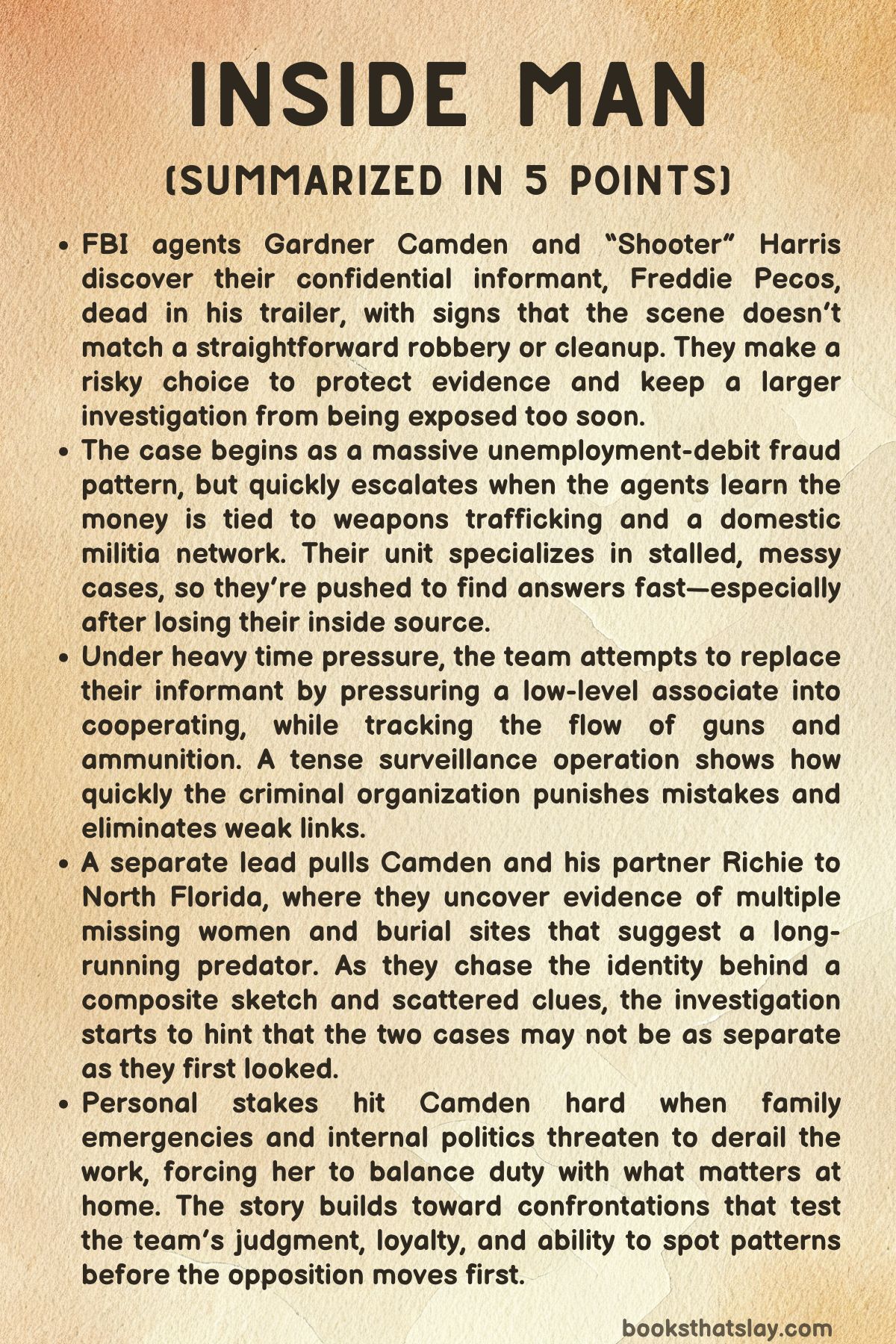
Summary
Gardner Camden and his partner, Joanne “Shooter” Harris, enter the filthy mobile home of their confidential informant, Freddie Pecos, after he goes silent. They find him dead on a couch with a whiskey bottle nearby and a flintlock rifle that appears to be the murder weapon.
The timeline suggests he has been dead about a day. As Shooter inspects the wound, Camden searches the trailer and quickly realizes Pecos was sitting on a fortune: plastic boxes filled with envelopes holding debit cards, each with money still loaded.
The stash totals over a million dollars in remaining balances, untouched. That detail makes no sense if the people who killed Pecos were there to clean up loose ends.
Camden charges Pecos’s phone and sees incoming messages from people connected to the operation, warning they are on their way to check on him soon. Camden believes local police can’t be trusted because officers in the area may be linked to the fraud ring.
If the criminals arrive and discover Pecos is dead, they’ll take evidence and likely destroy the trailer to erase traces. With minutes to act, Camden makes a risky call: he and Shooter remove key items, pull the bullet from Pecos’s body, and stage the scene to look like an accidental fire.
They ignite the trailer and disable the door so it can’t be opened easily. From a distance, they watch two men arrive and try to get inside before an internal blast forces them back.
Camden calls emergency services from a burner phone and destroys the SIM.
Camden reports to FBI Director Craig Poulton, who is furious that a confidential informant died and that evidence was burned. Camden argues the fire kept compromised locals from learning Pecos had cooperated and kept the criminal leadership from panicking.
Before he went silent, Pecos provided critical intelligence: the fraud was funding a domestic militia led by arms dealer J. P. Sandoval, a shipment of 186 guns had already moved to an unknown location, and an invoice suggested 2,000 ghost-gun pistol kits were in play—possibly produced at speed with help from a legitimate manufacturer. Poulton gives Camden’s unit forty-eight hours to find a new informant and answers.
Back in Miami, Camden meets his PAR team: Richie Brancato and Cassie Pardo. They plan to flip Travis Wells, a Sandoval associate with two prior strikes, by engineering a DUI arrest in a county where a prosecutor is eager to pursue DUIs as a third strike.
Surveillance at a bar called the Rotten Coconut turns chaotic when Wells arrives with a low-level runner, Daniel Horne, and then Sandoval himself shows up. Sandoval pulls Wells away and questions Horne, making it clear mistakes get punished in ways that look like accidents.
Soon after, Cassie finds Horne dead in the restroom, drowned while still dressed. The team withdraws to avoid exposure, but the message is clear: Sandoval is watching his own people closely.
Richie digs into Pecos’s final hours. ATM footage shows Pecos meeting an unknown man late at night—someone who avoids cameras and drives a vehicle without a rear plate.
Another camera captures the man’s face, and software links it not to a normal database record, but to a composite from an older Jacksonville FBI case PAR previously declined to pursue. That man may have been the last person to see Pecos alive.
Meanwhile, despite the bar chaos, Wells does leave intoxicated and is pulled over, giving the team a chance to turn him.
Wells is booked into jail, but the local DA, Justin Seethers, insists there’s a waiting period before any deal talks tied to the “third strike” threat. Camden and Richie use the delay to chase the mystery man lead in Jacksonville.
They assemble a precise timeline showing Pecos met the unknown man at an ATM and likely died within a short window afterward. The speed of it troubles Camden.
He suspects there’s more than a simple argument-and-shooting story, especially given the larger gun investigation.
In Jacksonville they encounter Agent Ray Chizek, who treats PAR with open contempt, but hands over the file: three murdered women connected to Shilo, Florida. A retired agent, Ed Offerman, had pursued the case informally, driven by personal history and the way the victims were dismissed.
Two women vanished in 2018 and a third disappeared months later. In 2019, three bodies were found buried in a line at a construction site.
Witness descriptions and sketches exist, but the composites don’t perfectly match each other—or the ATM image. The inconsistencies suggest either flawed memory, multiple offenders, or someone careful about appearances.
Camden decides they need to go to Shilo.
In Shilo, Detective Warner Quinones provides copied missing-person records. Camden studies geography and timing and proposes that burial sites are chosen for concealment: fertile floodplain zones near borders of county lines and mixed public-private land, where regrowth hides disturbed soil quickly.
He and Richie dig in a targeted area near the Sestes River and uncover a buried skeleton. Camden urges Quinones to keep the discovery quiet to avoid spooking the killer, and brings in a drone specialist, Tristan DeLillo, to scan broader areas for decomposition patterns and vegetation anomalies.
Pressure from Washington mounts. Poulton wants Camden focused on Sandoval’s weapons pipeline, not a murder investigation, and orders him to D.C. to coordinate with ATF leadership.
Camden agrees—then detours to Dallas after receiving news that his mother, comatose for over a year after being poisoned by a suspect from an earlier case, has awakened. Camden sees her in the hospital and hears her recognize him briefly, grounding him just long enough to return to the mission.
When Camden gets back to Florida, the Shilo case has exploded: more bodies are recovered, bringing the count to six newly unearthed skeletons. Some appear recent, others years old.
Identification begins with small clues like jewelry. Camden pushes for rapid forensic work, including facial reconstruction, but Poulton gives him limited time before forcing him back onto the gun case.
The team finally sits down with Travis Wells. Wells tries to bargain hard—immunity, money, and escape—but he also hints he knows where the weapons are going.
He gives two initials: “D.C.” Under pressure and fearing Sandoval will tighten control, the team agrees to proceed. Wells reveals a row house in Foggy Bottom in Washington, D.C., where weapons are staged.
He describes the stockpile and claims the next run will be ammunition because the guns are already positioned. The team installs monitoring tools on Wells and creates a cover story for his absence.
Wells is sent back into the network. He meets Darren Regnar at a machine shop and is ordered to pick up a massive load of ammunition.
Regnar confirms the destination is the same D.C. house and outlines a fast unload protocol. Wells then travels with Regnar’s cousin, Bayard Hemmings, to a storage facility.
Camden and Cassie conduct close surveillance and even plant a tracker, but the operation turns brutal. Hemmings attacks Wells with a spinning saw blade, seriously injuring him, and locks him inside the storage unit.
The hit appears pre-planned, and Hemmings makes a call confirming the job is done.
Camden’s team chooses not to raid immediately, fearing it will alert Sandoval and collapse their window into the D.C. pipeline. They shadow Hemmings and the U-Haul and coordinate with ATF.
A booby-trap on the trailer is accidentally triggered during a check, forcing Camden, Cassie, and Frank to improvise a repair before dawn so Hemmings won’t notice tampering. Hemmings tests the device, believes it intact, and continues the run.
The convoy heads toward the D.C. area as the team leapfrogs surveillance and hands off to broader federal tracking.
As preparations build for the D.C. takedown, a new threat emerges: Shooter learns at Pecos’s funeral reception that a medical examiner noticed signs suggesting arson and tampering, including an accelerant pattern and unusual findings that could expose the bullet removal. A report will hit local channels soon, and corrupt cops could warn Sandoval’s people.
Camden realizes this could trigger an armed standoff at the Foggy Bottom house, with suspects choosing violence rather than surrender.
At the same time, Camden’s Shilo work reveals the identity and method of the killer behind the buried women. The clue comes from small cloth strips: they are pre-cut animal burial shrouds, pointing to a veterinary source for tranquilizers like xylazine.
The team traces a suspect who used fake names at an animal clinic, stole large amounts of drugs, and offered pet burial services—skills that match the burial patterns. Richie becomes critically ill from suspected xylazine exposure, and Camden pushes a risky reversal approach using a veterinary medication.
With family authorization, the reversal is administered, and Richie stabilizes.
Then the killer escalates. A wealthy woman tied to the case is murdered, suggesting the suspect is reacting to pressure.
Camden connects the suspect to the Burrows estate and a nearby boutique hotel. Acting alone and exhausted, she crosses onto the property and enters the mansion—only to be ambushed and restrained.
The killer, masked and bandaged, reveals himself as “El Médico” and explains his motive: resentment, identity theft, and a medical obsession. He admits killing Edward Burrows and murdering women to practice a crude form of facial alteration, using xylazine to immobilize victims for hours.
He also admits killing Freddie Pecos after Pecos noticed something that could expose him.
As the killer prepares to cut Camden, Richie arrives—still weak, in a hospital gown, having followed breadcrumbs and instincts after hearing where Camden went. He shoots the killer and frees her.
Police respond, and the case finally breaks open. More remains are recovered, and the suspect’s history is uncovered: a hidden connection to the Burrows family, financial betrayal, and years of violence fueled by grievance and obsession.
In the aftermath, PAR is honored publicly, but Camden can’t let go of the weapons case. A casual moment with his daughter triggers a realization about serial-number patterns.
Camden spots evidence of guns marked with nonsense serial numbers, suggesting a deliberate effort to flood the market with untraceable firearms and undermine systems used to track weapons. The team moves quickly, confronts leadership, and traces an ATF agent tied to suspicious activity at the Port of Miami.
A container of guns is discovered, the agent flees, and political damage control begins. Camden and Cassie, exhausted and wary of the machinery around them, choose to step away from the noise and reclaim a small piece of the night—knowing the next crisis is never far behind.
Characters
Gardner Camden
In Inside Man, Gardner Camden is the engine of the story—an FBI agent whose talent is seeing structure where others see noise, and whose biggest strength, decisive action, doubles as his most dangerous flaw. He leads PAR with a pattern-driven mind that constantly converts chaos into hypotheses, timelines, maps, and operational bets.
That mental speed keeps people alive and moves stalled cases, but it also pushes him into ethically gray terrain: the staged fire at Pecos’s trailer shows a man who will burn evidence and rewrite a crime scene if he believes it protects the larger investigation and prevents compromised locals from tipping the enemy.
What makes Camden compelling is that his ruthlessness isn’t cold; it’s intimate. He is a father trying to model morality to Camila while actively breaking rules in the field, and a son still tethered to a mother whose awakening reopens old wounds and responsibilities.
As the plot expands into both a militia arms pipeline and a serial killer operating with surgical cruelty, Camden becomes the narrative’s fulcrum—trying to juggle two disasters at once, absorbing institutional pressure from Poulton, and learning the hard lesson that pattern recognition is not a substitute for backup when his need to act fast isolates him on the Burrows estate. His arc is a constant negotiation between control and vulnerability: he can out-think most systems, but he cannot out-run the cost of going alone.
Joanne “Shooter” Harris
Shooter is competence with a pulse—an investigator whose first language is evidence and whose instincts are calibrated to violence without being seduced by it. Her nickname is earned through the way she reads a wound, distances, weapons, and angles as if they are sentences waiting to be diagrammed, and the opening scene establishes her as the team’s most immediate forensic presence.
Yet Shooter is not merely tactical; she is also the team’s social operator, able to enter environments like the Rotten Coconut and turn performance into access, using a pool tournament and a planted phone not as gimmicks but as a controlled extension of tradecraft.
Her moral center tends to show through practicality: she documents fast, she moves faster, and she understands that the job is often choosing the least destructive option under time pressure. Later, her role at Pecos’s funeral and the discovery that the medical examiner is uncovering the arson mechanics positions her as the messenger of consequences—bringing back the reality that shortcuts echo and that the team’s improvisations can boomerang into operational catastrophe.
Shooter’s character works because she feels like the person who keeps emotion from interfering while still carrying it; she does not romanticize the work, but she doesn’t detach from its human cost either.
Freddie Pecos
Freddie Pecos functions as both a human loss and a narrative accelerant: his death detonates the story into urgency, improvisation, and exposure. As a confidential informant, he’s portrayed as someone living in the grime of the world PAR is trying to map—close enough to the fraud-and-guns ring to provide real intelligence, but compromised enough to be unreliable and self-serving.
The stacks of debit cards and the untouched inventory become a postmortem portrait: Pecos is a man sitting on a fortune that he either couldn’t move, didn’t dare move, or didn’t have time to move—an informant who is valuable precisely because he is embedded, and doomed because he is embedded.
The later revelation that he had been skimming reframes him from victim-as-symbol into victim-as-person: flawed, opportunistic, and trying to get something out before the world took everything from him. His final interactions, especially the ATM encounter and the sense of familiarity with the “mystery man,” imply that Pecos’s downfall isn’t only the militia ring—it’s also the everyday danger of being the kind of man who knows too many people and trusts the wrong version of “friendly.” Even after his death, Pecos keeps shaping events: the staged fire, the funeral intelligence leak risk, the timeline work in Jacksonville, and the pressure cooker that forces PAR to flip Wells.
J. P. Sandoval
Sandoval is the novel’s institutional predator: an arms dealer and militia leader whose power comes less from brute force than from disciplined intimidation and operational compartmentalization. He enters the Rotten Coconut scene like a weather front—changing everyone’s behavior without needing to raise his voice—and his interrogation of Daniel Horne demonstrates his style: he offers a calm explanation of “accidents” that is really a ritualized threat, turning murder into a lesson plan for loyalty.
Sandoval’s menace is amplified by how he inspires bureaucracy in his own orbit: protocols for unloading, staged locations, layers of errand men, and a willingness to eliminate weak links immediately. He doesn’t merely traffic weapons; he traffics certainty—selling his people the idea that they are patriots, that history is on their side, and that violence is both inevitable and righteous.
The “D.C.” clue and the Foggy Bottom staging suggest a leader thinking symbolically as well as tactically, placing guns near the heart of government as if proximity itself is power. Sandoval’s narrative purpose is to embody a modern kind of domestic threat—one that exploits systems and weaponizes ideology to make criminality feel like destiny.
Richie Brancato
Richie is the team’s timeline architect—the analyst-investigator who turns scattered receipts, camera angles, texts, and travel time into an account of what must have happened. His value is that he doesn’t just find facts; he builds sequences, and sequences expose lies.
In Jacksonville and Shilo, Richie’s method becomes almost obsessive, narrowing a window of death, questioning short intervals, and noticing the emotional micro-beat in Pecos’s body language that suggests recognition.
That obsessive competence comes with physical vulnerability when he ends up hospitalized and deteriorating, creating a striking reversal: the man who is usually the one stabilizing uncertainty becomes the unstable variable everyone is trying to save. The xylazine angle and the push for atipamezole transform Richie into the case’s living proof that the Shilo killer isn’t abstract—his tactics can reach into the team itself.
Richie’s most defining moment, though, is his return: in a hospital gown, cracked phone in hand, following scraps of information to Lucas Beach, arriving not as a rescuer with perfect resources but as a stubborn friend who refuses to let a colleague disappear. By shooting El Médico in the critical second, Richie becomes the character who converts analysis into action, showing that intellect and loyalty can be just as forceful as a tactical team when time collapses.
Cassie Pardo
Cassie is the novel’s blend of field nerve and quiet calculation—a PAR agent who can perform undercover presence without tipping into recklessness, and who repeatedly serves as the team’s “precision risk” specialist. In the Rotten Coconut operation, she’s the one who can enter a public space, play a role, and still keep her mind on the mic placement, sight lines, and timing.
Later, her decision to slip into the truck cab and plant a GPS tracker is classic Cassie: not dramatic, not performative, just a high-impact move executed with minimal margin.
That moment also captures her character tension—she’s brave, but her bravery is logistical; she is always thinking about how to win tomorrow’s problem, not today’s applause. Cassie’s relationship with Camden is defined by mutual reliance and a slow-burn trust: she can challenge him, cover for him, and also match his pace when the situation demands improvisation, like the frantic repair of the U-Haul booby-trap with batteries, magnesium powder, and improvised wiring.
In the aftermath, her presence beside Camden—frozen yogurt with Camila, rooftop confrontation with Poulton and Kemp—shows her as the character who helps translate instinct into accusation: she doesn’t just chase suspects, she recognizes systemic rot when the gun-tracing scheme emerges.
Camila Camden
Camila is not just a personal subplot; she is the moral mirror held up to Gardner. Living with him in a hotel makes her feel the instability of his life in a way that a distant home never would, and her school incident—sabotaging a bully’s science project to defend her friend Sophie—echoes her father’s own logic of “protect the vulnerable, handle the consequences later.” Gardner’s attempt to teach her that loyalty matters but cannot justify wrongdoing reveals his central contradiction: he wants his daughter to live by rules he cannot consistently follow.
Camila also functions as an unexpected catalyst in the larger investigation when her “chocolate for life” sweepstakes chatter triggers Gardner’s attention to patterns—demonstrating how his mind never stops mapping, even in parenting moments. She is written as a point of tenderness that also raises stakes: every time Gardner makes a choice that could end his career or life, the reader feels the silent question of what that choice does to his child.
Camila’s presence makes Gardner’s heroism less glamorous and more accountable.
Craig Poulton
Director Craig Poulton represents the institutional pressure cooker that PAR operates inside. He is furious when Camden burns the trailer because, from a leadership perspective, it risks scandal, compromises procedure, and creates political exposure.
Yet Poulton is not portrayed as a simple antagonist; he is the embodiment of mission hierarchy—guns and militia threat first, everything else second—and his impatience with the Shilo murders illustrates how bureaucracy prioritizes what is visible to national security over what is “just” human tragedy in rural Florida.
His power is blunt: he sets deadlines, threatens to replace Camden, and demands immediate results. But he also shows flashes of pragmatic empathy when Camden’s mother awakens, briefly softening and then re-centering on operational necessity.
Poulton’s role is to remind the reader that even brilliant investigative work must survive internal politics, optics, and resource constraints—and that leadership can be both rational and cruel depending on where you stand.
Travis Wells
Wells is the story’s failed pivot point: the planned replacement informant who almost becomes PAR’s clean solution and instead becomes proof of how fast Sandoval’s world punishes weakness. He enters as a target for manipulation—engineered DUI, third-strike leverage, a controlled flip—and for a moment he seems like the classic cooperator: bargaining hard, demanding immunity and escape, hinting at big information with “D.C.”
His negotiations reveal a man ruled by survival math, not ideology; he wants money, distance, and a reset, and he’s willing to trade betrayal for it. But Wells also shows that he’s not as deep in the operation as he pretends—he’s useful, but disposable—and his murder in the storage unit is gruesome precisely because it’s procedural.
Hemmings doesn’t kill him in rage; he executes him like closing a file. Wells’s arc exposes the emotional cost of informant strategy: PAR’s plan treats him as a tool, Sandoval’s crew treats him as a leak, and in between Wells is simply a frightened man trying to buy a future with information.
Damon Alicante
Alicante, Wells’s public defender, is an example of how the legal system becomes another battleground in the investigation. He isn’t portrayed as villainous; he’s doing what defense attorneys do—maximizing leverage, extracting concessions, building an exit ramp for his client.
But in a story about compromised locals and shadow networks, his presence also raises the constant worry of contamination: is he simply aggressive counsel, or is he connected to Sandoval’s influence?
The text uses him as a pressure mechanism, forcing PAR to decide whether to gamble on a deal now or risk losing Wells to better representation and intimidation. Alicante’s demands—record purge, money, relocation—highlight the transactional nature of cooperation and the uncomfortable reality that justice sometimes has to be negotiated like a hostage exchange.
Frank
Frank operates as PAR’s stabilizer and operational adult in the room—the person who can push pressure without slipping into Camden’s impulsiveness. He’s consistently positioned in moments where discipline matters: interviewing Wells, running surveillance, coordinating with leadership, and handling the practical frictions of field operations.
His skepticism about using a veterinary reversal agent on Richie shows a healthy caution—he is not easily seduced by clever ideas—yet he also yields when the situation demands moral courage, moving forward once the power of attorney approves.
Frank’s role expands when he’s tied into Director Poulton’s movements, indicating he has credibility and access that Camden sometimes jeopardizes. He reads as the character who understands both sides: the street-level reality and the top-level politics.
When the narrative needs someone to translate urgency into a plan that won’t collapse, Frank is often that person.
Daniel Horne
Horne is the cautionary parable inside the Rotten Coconut episode: a low-level errand man whose proximity to power becomes lethal. He exists to show Sandoval’s brutality in miniature—how a single mistake can trigger immediate elimination.
His drowning on a toilet is deliberately humiliating and intimate, signaling that Sandoval’s violence is not only about removing threats but about sending a message to everyone nearby: you can be killed anywhere, even in the most banal private space, and your death will be staged as an “accident.”
Horne’s abrupt end also forces PAR to retreat and recalibrate, demonstrating how quickly an operation can be blown not because the FBI errs, but because the criminal ecosystem is violently self-correcting.
Darren Regnar
Regnar functions as the mid-tier nerve node of Sandoval’s logistics—angry, controlling, and focused on process. His scenes emphasize the militia pipeline as a supply chain rather than a series of random crimes: he assigns pickups, references weight and inventory, and speaks in destination shorthand like “DMV,” showing how normalized the movement of ammunition has become in their world.
Regnar’s suspicion toward Wells reflects the internal paranoia that keeps the organization secure, and his mention of a cousin now driving the next load introduces the theme of replaceability—people are swapped in like parts, and the machine keeps moving. Regnar is not the ideology salesman; he is the operations manager, the character who makes the threat feel scalable.
Bayard Hemmings
Hemmings is the enforcer who makes betrayal irreversible. Unlike Sandoval, who leads through charisma and fear, Hemmings leads through action—silent, sudden, mechanical violence.
The diamond saw blade attack is a horror scene, but it also clarifies Hemmings as a person who plans, contains, and finishes; he locks the unit, makes a call, and moves on.
His use of booby traps and counter-surveillance cues suggests a man trained to think in layers, not just lash out. Hemmings embodies the “security wing” of the militia network: the part that assumes infiltration is constant and treats humans as vulnerabilities to be sealed.
He is frightening because he doesn’t posture; he simply executes the logic of the organization.
Tristan DeLillo
DeLillo appears as a modern investigative specialist, representing the technological expansion of PAR’s toolkit. His drones and near-infrared/infrared scanning are not just cool gadgets; they’re the story’s way of scaling pattern recognition beyond a whiteboard and a shovel.
DeLillo is the character who turns Camden’s theory—floodplain regrowth, decomposition islands, plant anomalies—into actionable search capability, bridging intuition and proof.
Even without heavy characterization, his function is crucial: he makes the Shilo investigation feel like it can accelerate, and he symbolizes how contemporary crime-solving often relies on niche expertise rather than lone-detective grit.
Ray Chizek
Chizek represents the institutional resentment aimed at PAR—an agent who greets Camden and Richie with hostility and treats their unit like a pretentious intrusion. His attitude is important because it shows how internal culture can sabotage collaboration; even when the same organization is theoretically aligned, pride and territoriality slow information flow.
Chizek’s “thin file” and dismissive posture also highlight how cases involving marginalized victims can be under-resourced and quietly deprioritized. He’s not the murderer, not the mastermind—he’s the friction in the pipe, the character who reminds you that bureaucracy has emotions, and those emotions can cost time.
Ed Offerman
Offerman functions as the ghost of conscience in the Shilo case—a retired agent who pursued murdered women with unusual persistence because the story hit a personal nerve. His discovery about his birth mother reframes his investment as something deeper than professional curiosity: he is trying to correct a lifetime of cultural indifference toward sex workers and missing women.
Offerman’s notes and informal obsession become the foundation Camden builds on, showing how justice sometimes survives only because one person refused to accept the official level of caring. He also serves as a thematic counterpoint to Poulton: where leadership prioritizes national threats, Offerman prioritized human ones.
His character is a reminder that the past doesn’t stay past; it leaves files, sketches, and unfinished empathy that the living inherit.
Detective Warner Quinones
Quinones is the local lawman caught between cooperation and suspicion. He is wary of federal attention, and that wariness feels earned in a rural context where outsiders can bring scrutiny, politics, and blame.
Yet he also turns out to be unusually prepared—he has copied records ready, he engages with Camden’s mapping logic, and he helps move the investigation forward once convinced it can be done quietly.
Quinones’s defining trait is protective pragmatism: he wants results, but he also wants control over how the town is portrayed and how panic spreads. His recognition of jewelry for IDs shows his closeness to the community and the victims, grounding the horror in local memory rather than abstract statistics.
Ingrid Santos
Santos, as the Jacksonville medical examiner, represents scientific authority entering a rapidly expanding graveyard of unknowns. Her presence matters because identification is the hinge that turns skeletons into people, and people into urgency.
By bringing an ME into the Shilo scene, the story shifts from discovery to accountability—names, timelines, causes, and patterns that can support prosecution.
Santos embodies the slow, meticulous work that must follow the adrenaline of field discovery, reinforcing that catching a killer is as much lab discipline as it is bravery.
Patsy Davitt
Davitt, the facial reconstruction expert, functions as a humanizing technician: her craft literally gives faces back to the dead. In a narrative where El Médico steals faces and reshapes them for identity theft, Davitt is an almost symbolic counterforce—using science and artistry to restore identity rather than erase it.
Her role strengthens the theme that the victims are not props; the story makes room for the tools that return them to recognition, family, and record.
Detective Brian Johnson
Johnson is a local detective who becomes a practical guide through Shilo’s social geography—correcting misinformation, contextualizing land ownership, and inadvertently pointing Camden toward the Burrows connection through small, grounded facts. He’s significant because he demonstrates how breakthroughs often come from mundane corrections rather than dramatic reveals.
Johnson isn’t framed as genius or villain; he is competent local glue, and his ability to casually identify names in donor photos becomes one of the story’s most consequential accelerants.
Detective Eloise Curtis
Curtis is the bearer of escalation—the detective who calls in Natalie Kastner’s murder and forces the investigation into its next, more urgent phase. Her assessment that Natalie likely let the killer inside suggests she reads people as well as scenes, and it adds a chilling intimacy to the crime: the killer isn’t just prowling; he’s being welcomed.
Curtis functions as the character who confirms that the suspect is not only active but adapting, moving from hidden burials to bold, personal execution.
Natalie Kastner
Natalie begins as a wealthy, possibly performative source of insight and ends as a victim whose death clarifies the killer’s social access. Her character is important because she complicates the victim map: she isn’t marginalized in the way earlier missing women were, which implies the killer is either broadening his targets or silencing threats, and in either case becoming more dangerous.
Through El Médico’s confession, Natalie is also positioned as a symbol of Edward Burrows’s private life—someone whose intimacy with Edward becomes motive for murder once identity envy turns into identity theft. Natalie’s death is the narrative’s warning flare: privilege does not immunize you from a predator who is hunting a role, not a demographic.
Clive
Clive, the night manager at the Olive, is a small character with outsized impact because he provides the connective tissue between property, ownership, and secrecy. His casual knowledge of neighboring estates and the Burrows Family Trust’s involvement reveals how the killer’s power is structural, not just personal.
Clive’s details turn Camden’s intuition into a direction, and he also underscores a theme of unnoticed isolation: Edward Burrows not ordering room service becomes a quiet signal that something is profoundly wrong behind wealth’s closed doors.
Edward Burrows
Edward exists mostly as absence—an heir, an owner, a “professional shut-in” who has withdrawn from the visible world—and that absence becomes the killer’s opportunity. His wealth and isolation create a perfect shell for El Médico to invade, erase him, and then wear his life like clothing.
Edward’s fate is uniquely grotesque because it literalizes what the killer wants: not just to kill, but to replace. Edward’s character is defined by what others say about him—no record, no public presence, a life sealed off—and that sealed life becomes the ultimate vulnerability.
He represents the illusion that money and privacy equal safety, when in fact they can create the perfect hiding place for someone else’s violence.
El Médico
El Médico is Inside Man’s nightmare of identity obsession—a killer who turns medicine into theater and bodies into practice material, using xylazine to suspend victims in long, controlled suffering while he experiments with cutting, restraint, and “drugless plastic surgery.” His origin story is fueled by grievance and entitlement: a failed path through medical ambition, resentment at Edward’s inheritance, and a warped philosophy of shared lifespan that justifies theft of identity as cosmic fairness.
He is terrifying not simply because he kills, but because his killings are educational to him; each victim is a lesson, a rehearsal for becoming someone else. His earlier alias, “Donnie Dom,” reveals his self-mythologizing—he leaves wordplay breadcrumbs because he wants to be understood, not just feared.
His confession ties his crimes together with chilling coherence: he killed Freddie because Freddie recognized him with a dead woman’s card, he killed Natalie because she represented Edward’s intimacy, and he killed multiple women because their faces were stepping stones toward his transformation. El Médico is also the novel’s thematic mirror to PAR: both are pattern seekers, but where PAR finds patterns to restore order and protect people, El Médico finds patterns to perfect domination and erase identity.
Manny
Manny, the evidence tech, appears briefly but plays a critical structural role at the end when the gun photo and its nonsense serial number become the seed of a larger conspiracy. He represents the quiet power of competent support staff—people who rarely take center stage but whose files, photos, and chain-of-custody discipline can crack open the next layer of threat.
In the broader theme of systems failing, Manny’s contribution is a moment where the system works: the right evidence, preserved and shared, triggers the next insight.
Barry Kemp
Kemp, as ATF Deputy Director, is portrayed as an ally with a leak-sensitive mindset—someone who understands that the guns case is not only about seizures but about preventing information from spilling into compromised channels. His discreet meeting with Camden and his willingness to stay on standby indicate a leader who can collaborate without performing dominance.
Later, as the fake-serial-number scheme emerges, Kemp becomes the character who must face institutional betrayal at close range, using resources like immediate phone traces to respond. He embodies interagency tension done right—cautious, pragmatic, and aware that operational success depends on controlling who knows what, and when.
Agent O’Reilly
O’Reilly begins as help and ends as the warning that the threat has seeped into the enforcement side. His presence in surveillance feels like reinforcement, but his later evasiveness and location at the Port of Miami reframe him as either compromised or actively participating in the scheme to move guns and sabotage traceability.
O’Reilly’s character is important because he turns the story’s paranoia into proof: it isn’t only that local Hambis cops might be dirty, it’s that even federal-linked operations can be infiltrated. He functions as the central infiltration pressure point—the embodiment of the fear that the enemy is not only outside the system but wearing the system’s badge.
Amber Isiah
Amber Isiah is a late-rising but meaningful figure because she illustrates the ripple effects of predation and fear beyond the investigative team. Her disappearance and eventual contact with Shooter show how victims and witnesses behave under terror: they run, they hide, they choose family over process, and they re-enter the story only when the immediate danger feels survivable.
Amber’s role also reinforces the urgency Camden feels at the Olive and Aurora House—she is the human countdown clock that makes “wait for SWAT in the morning” feel morally unbearable, even if tactically sound.
William Banning
Banning, Richie’s grandfather, is a quiet embodiment of civilian authority and moral burden. Holding medical power of attorney makes him the person who must decide whether to approve an unconventional treatment, and the story uses him to show how investigative work spills into ordinary families in moments of terror.
His decision, guided by Camden’s blunt honesty, becomes an act of trust in people he barely knows, and it marks the moment where love for Richie intersects with the team’s willingness to gamble on an unapproved solution. Banning’s presence adds weight to Richie’s recovery: it wasn’t only skill that saved him, it was a family member choosing hope over institutional caution.
Justin Seethers
DA Justin Seethers is the story’s portrait of prosecutorial ambition harnessed as leverage. He wants Wells pressured, he embraces the third-strike strategy, and he treats the case like a chance to win big—both against criminals and in his own career calculus.
Seethers is not depicted as corrupt; he is depicted as forceful, impatient, and politically aware, using the law as a cudgel to force cooperation. His demands create urgency and friction for PAR, reminding the reader that flipping an informant is never just an FBI decision—it’s a negotiation among agencies, egos, and incentives.
Themes
Moral injury and the price of “necessary” choices
The opening crisis in Inside Man sets a hard moral problem in motion: two federal agents arrive too late to save a confidential informant, and then choose to reshape the scene to protect a larger investigation. The decision to burn the trailer isn’t framed as an abstract ethical puzzle; it is a practical act carried out under time pressure, with the expectation that compromised local officers and Sandoval’s men will erase evidence anyway.
That “we had to” mindset becomes a recurring weight that follows the team.
The story shows how a single choice made in the dark can become a permanent presence—changing how people talk to each other, how they justify their actions upward, and how they measure their own integrity. The consequences are not only institutional, including an angry Director, the risk of exposure, and a medical examiner noticing anomalies, but personal and psychological: the agents must keep functioning while carrying the knowledge that they manipulated a death scene and destroyed a body and location that deserved honest processing.
What makes the theme land is that the narrative doesn’t allow a clean moral victory. Even when the action protects the operation in the short term, it creates a ticking vulnerability that can detonate later through paperwork, imaging, gossip, or a single conscientious person asking the wrong question.
The team’s competence—bagging evidence, documenting fast, maintaining a cover story—coexists with an erosion of certainty about what “good work” looks like.
The more they succeed, the more they risk becoming people who can do terrible things efficiently. That is the central harm of moral injury here: not guilt alone, but the gradual rewriting of internal boundaries so that extreme actions become part of standard procedure.
The book keeps returning to the tension between outcomes and process, pushing the reader to notice how a mission can demand behavior that damages the very people tasked with defending the law.
Institutions under stress and the problem of trust
Authority rarely arrives as a stabilizing force; it arrives as pressure, deadlines, and political calculation. PAR exists because systems stall and blind spots persist, yet the unit itself is treated with suspicion by other agents and by local departments.
That friction is not just workplace drama—it highlights how law enforcement institutions fracture when reputations, funding, and jurisdiction matter as much as truth.
Gardner and his team operate in a landscape where local police may be compromised, prosecutors bargain for headline-worthy convictions, federal leadership cares about optics and measurable deliverables, and partner agencies worry about leaks. As a result, trust becomes a tactical resource rather than a default assumption.
The agents choose burner phones, covert audio capture, and carefully controlled information sharing not because they enjoy secrecy, but because the system around them is porous.
Even relationships that should be cooperative—FBI to FBI, FBI to local detectives, FBI to ATF—are shaped by defensiveness and rivalry. The theme becomes sharper when the story moves between cases: unemployment fraud funding militia weapons, and a string of murders that local authorities struggled to connect.
In both arenas, institutional incentives distort attention.
Leadership wants the guns case prioritized because it threatens national stability; the murders, despite their horror, are treated as a diversion until the body count becomes undeniable. That contrast exposes a grim reality: what gets resources is not always what most needs them, but what most threatens powerful interests or public order.
Meanwhile, the “dirty cop” risk turns ordinary procedures—calling local police, waiting for a report, filing evidence—into potential traps.
The narrative also shows how bureaucratic timelines can be dangerous. A medical examiner’s report moving through channels on schedule can become a countdown to violence when the wrong people might hear about it first.
The constant calculation—who can be told, when, and in what form—reveals a system where truth is fragile and can be weaponized. Ultimately, the book portrays institutional stress as something that pushes individuals toward improvisation, and improvisation toward rule-bending.
When trust is scarce, everyone becomes both investigator and risk manager, and the pursuit of justice starts to look like surviving an ecosystem where information is currency and loyalty is never guaranteed.
Predation, identity, and the urge to rewrite the self
The serial-killer thread introduces a disturbing form of identity hunger: a person who doesn’t merely want to harm, but wants to replace—taking a life, then attempting to wear the social reality attached to that life. The murders are not presented as random brutality; they are tied to control, sedation, confinement, and the reduction of victims to instruments for a private project.
The killer’s interest in facial alteration turns violence into a form of study, where bodies become a means to acquire skill and confidence without accountability.
This theme of predation is intensified by the killer’s social camouflage: access to property, to a local network, to plausible roles, and to institutional blind spots that allowed missing women—especially those with less social protection—to be overlooked or treated as less urgent. The story makes clear how predation thrives where victims can be discounted.
Sex workers and marginalized women become targets not only because the predator is cruel, but because he expects fewer resources will be spent on finding them, fewer people will demand answers, and fewer systems will treat their disappearance as an emergency.
Alongside that, the killer’s resentment about inheritance and status shows another layer: violence as compensation for a perceived theft of identity and opportunity. He frames his actions through a warped sense of entitlement—believing he has been denied a life and is therefore justified in taking one.
That internal narrative matters because it mirrors the book’s broader interest in storytelling as power: who gets to define what happened, who gets believed, and who becomes “real” in the public record.
The predator attempts to rewrite reality through disguise, misdirection, and control of physical evidence, while investigators attempt to restore reality through patterns, timelines, and forensic reconstruction. The confrontation is not just physical; it is about which version of events becomes official.
The book also places a mirror beside the investigators: while the killer tries to alter his face to become someone else, the agents risk altering their own moral identity through repeated exposure to deception and emergency decisions. Both arcs emphasize that identity is not fixed; it can be shaped by obsession, environment, and choices.
The crucial difference is consent and harm—one person rebuilds the self by stealing from others, while the investigators are forced to adapt in order to stop him and prevent further losses.
Pattern recognition versus chaos: making meaning without certainty
PAR’s method is built on spotting anomalies, clustering data, mapping behaviors, and translating scattered signals into a coherent story. That approach is tested constantly because the world they face is designed to look like noise.
Unemployment claims withdrawn from a small set of ATMs could be written off as routine fraud until someone notices scale and structure. A dead informant with untouched cash and weapons could be read as a simple hit until the details don’t fit.
A drowning in a bar bathroom could be dismissed as an accident until the timing, the intimidation, and the pattern of “accidents” point to a controlled message.
The theme here is not that intelligence work is glamorous; it is that meaning must be constructed carefully, and construction can fail. The narrative repeatedly shows how the team builds working theories, then collides with facts that force revision.
Richie’s timeline work, the strange ATM encounter, the composite match to another case, and the discovery of multiple burial sites all demonstrate how progress often comes from treating minor inconsistencies as valuable rather than inconvenient.
At the same time, the book refuses to make pattern work feel like magic. Witness sketches don’t align cleanly; memories fracture; faces resemble each other in parts; local records are incomplete; evidence is vulnerable to corruption or destruction.
Even technology is shown as partial—helpful but not decisive. A software match points toward a lead, drones can detect anomalies, a phone trace narrows a location, but none of it replaces the messy judgment calls that humans must make under pressure.
This is where the theme becomes emotionally tense: pattern recognition is a discipline built on patience, yet the team’s reality is deadlines, political threats, and imminent violence. Gardner is forced to compress the slow logic of analysis into fast operational moves—sometimes correctly, sometimes recklessly, as when he goes alone into danger and later admits the mistake.
The book also suggests that “pattern recognition” is not limited to crime data; it appears in parenting moments, interpersonal trust, and the recognition of how small behaviors predict larger risks.
Camila’s school incident, for example, echoes the broader question of loyalty versus wrongdoing: the same mental habit of noticing motives and consequences applies at home and at work. In the end, the theme argues that the fight against sophisticated harm requires more than courage; it requires the ability to hold uncertainty without freezing, to act without perfect information, and to keep updating your understanding as new facts arrive.
The story’s momentum comes from that tension: order is possible, but never guaranteed, and every attempt to create clarity carries the risk of being wrong at the worst time.