Just Watch Me Summary, Characters and Themes
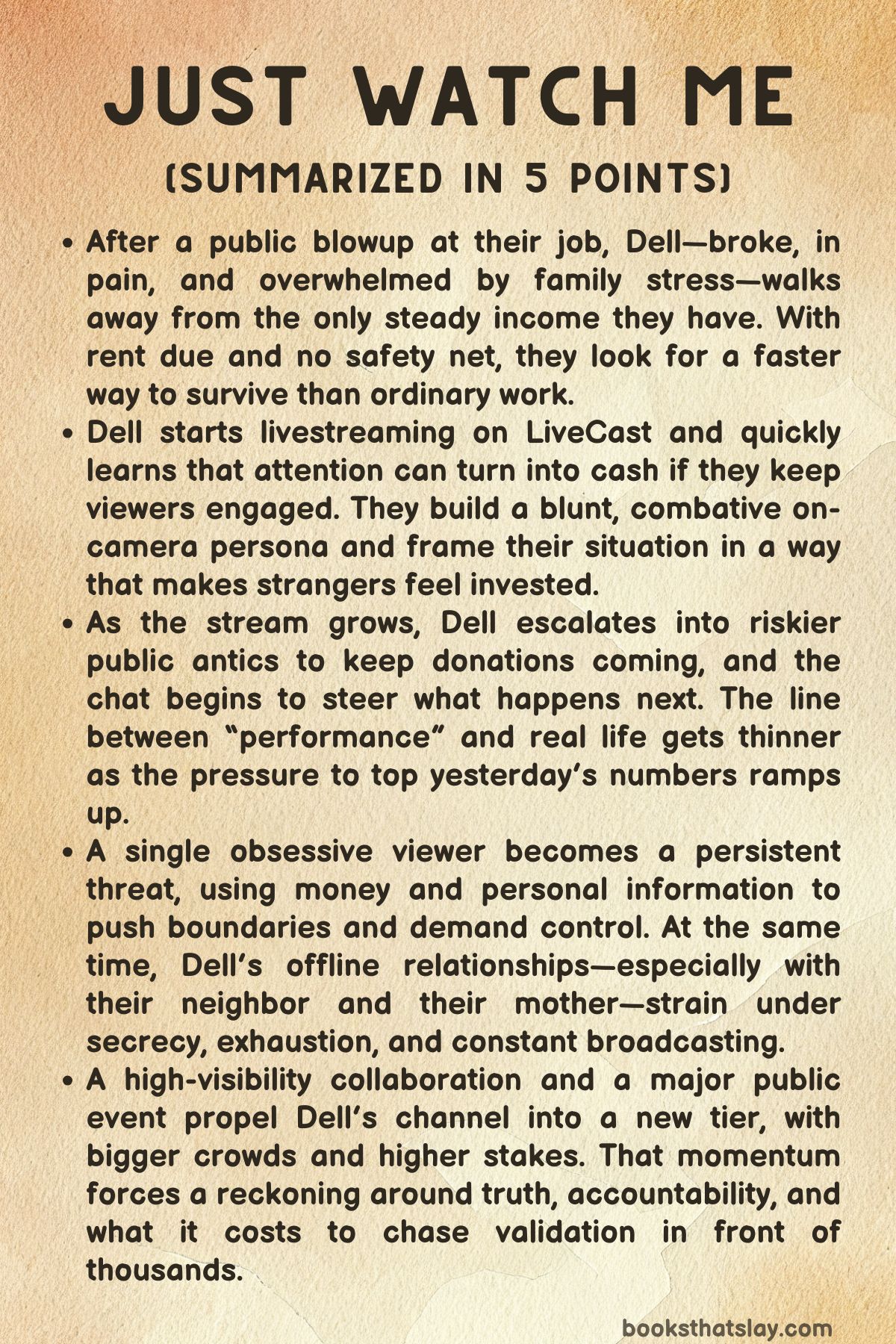
Just Watch Me by Lior Torenberg is a darkly funny, nerve-jangling novel about a broke New Yorker who discovers that attention can pay better than any job—if you’re willing to keep raising the stakes. After a humiliating blow-up at work leaves Dell Danvers unemployed and desperate, she turns to LiveCast, a livestreaming platform where strangers reward confession, conflict, and spectacle.
Dell builds an audience fast by telling a story about her sister Daisy that isn’t exactly true, then chases donations with escalating stunts, spicy-food challenges, and public breakdowns. The result is a sharp look at performance, shame, and what happens when survival becomes content.
Summary
Dell Danvers is working a shift at Juice Body in Grand Central when a well-dressed customer orders a “Doctor Clean Green” smoothie and demands almond butter instead of peanut butter. Dell explains it costs extra.
The customer argues, insists he got it free yesterday, and starts threatening a nasty review while calling for a manager. Dell feels cornered: break policy and risk punishment, or follow rules and risk a complaint that could cost her the job anyway.
She loses control, hurls a jar of almond butter at him, tells him to take it, rips off her apron, and walks out.
Not long after, reality hits. Dell has left the shop unlocked and unattended, and she imagines cameras capturing everything.
Her boss, Nik, calls furious and fires her immediately, dismissing any explanation. Dell tries to plead, mentioning the chaos in her life and her sister Daisy’s condition, but Nik is unmoved.
Someone else has already been sent to cover, and Dell is told she’s no longer part of the “Juice Body family.”
Dell drags herself to her tiny Hell’s Kitchen studio—an illegal, windowless space carved out of her neighbor Lee’s apartment. She’s behind on rent, drowning in bills and student loans, and dealing with constant abdominal pain she keeps ignoring because she has no insurance.
She sneaks into Lee’s place while Lee is on a video meeting, raids the medicine cabinet for antacids, and eats whatever she can find. Lee confronts her, and the two argue about Dell’s instability, her habit of burning bridges, and the way one public complaint can wreck a service worker’s prospects.
In Dell’s cramped room, panic becomes math. She needs money fast, and her side hustle—propagating and selling houseplants online—won’t cover what’s due.
She watches LiveCast, where streamers earn through donations and subscriptions, and she decides to try it. At first, nobody shows up.
Then she changes the stream title and mentions her sister is in a coma. Viewers arrive immediately.
Dell adopts a new online persona, “mademoiselle_dell,” and speaks with a cutting, combative confidence she doesn’t feel. She says Daisy is on life support and that doctors are about to withdraw it.
Dell announces a goal: $14,000 to pay for a week of private life support at home. When people question her story, she insults them, blocks skeptics, and trains her audience to prove loyalty with money.
Once Dell sees cash arriving, she starts offering more. Viewers dare her to eat jalapeños for donations; she does it and earns enough to feel momentum.
Hungry for bigger numbers, she takes her stream outside, heading to Whole Foods with a plan to steal while entertaining the chat. She shoplifts snacks and drinks while narrating the risk like it’s a game.
Security stops her, takes her to a back room, and claims facial recognition links her to repeated thefts at multiple locations. Dell refuses to give her real name, jokes through questioning, and bolts before the police arrive, escaping into the crowd.
The chase becomes a highlight reel for her viewers, and the attention boosts her ranking.
Among the growing chat, one donor stands out: excelsior404. He gives money, then starts pushing for special attention.
His messages shift from needy to threatening. He hints he’s found information about Dell and Daisy and could reveal it.
Dell feels uneasy but hesitates to block him because he donates heavily, and she’s running on fear—rent, bills, and the story she has promised the internet.
Dell tries to get her final paycheck from Juice Body, streaming discreetly as she confronts Nik. Nik refuses to pay and suggests they “call it even,” treating her rage like a nuisance.
Dell storms out, realizing she’s now missing the money she was counting on for rent. Back in her apartment, she doubles down on LiveCast.
If streaming can make in one night what a job pays in days, she’ll force it to work.
Her channel’s turning point comes when a famous streamer, hot_pat_of_butter—Patrick—joins her chat. He’s top-ranked and known for eating extreme spicy foods.
Dell takes the hint and announces a habanero challenge on-stream. She goes to buy peppers, spends more than she earned the day before, and pitches the event as both entertainment and fundraising.
During the walk home, excelsior404 keeps pushing for a meetup, trying to buy access to her offline life. Dell refuses, but his hints about knowing her real identity land like a hand on the back of her neck.
Back home, Dell starts eating five habaneros for money. The pain is immediate and brutal: coughing, sweating, shaking, gulping milk and bread just to keep going.
The chat climbs, and donations increase. Lee appears in the chat unexpectedly, which rattles Dell—Lee knows Daisy exists, but not the story Dell has been selling.
Patrick returns, offering pepper tips, and Dell snaps at him while forcing herself through the last bites. A bidding war erupts between donors, and excelsior404 tries to seize control of the channel.
He offers $500 if Dell will insert a habanero into her vagina on the next stream, then disappears after posting the demand.
Dell’s body collapses into consequences. She runs into Lee’s apartment, locks herself in the bathroom, and suffers a miserable, scorching bout of diarrhea.
When she checks her earnings, she’s stunned: hundreds of dollars in a single night and a major jump in ranking. The temptation is clear—money, attention, power—alongside the fear of being recorded and humiliated in a way she can’t undo.
As the days blur into a constant streamathon, Dell grows increasingly erratic. She becomes fixated on a sensation in her left ear, convinced a seed is lodged inside and growing into a plant.
She avoids doctors and tries to dig it out herself. Excelsior404 escalates, returns under new accounts, and sends threats and explicit harassment.
Dell blocks him repeatedly, warns her audience, and tries to keep control of the performance even as her private life frays.
Patrick proposes an in-person collaboration, and Dell agrees, hoping to turn borrowed fame into a huge payout. They meet at a burger spot where Patrick arrives with professional streaming gear, linking their broadcasts so his audience floods Dell’s stream.
Dell retells her fundraiser story with confidence: Daisy is on life support, doctors want to end care, and Dell is fighting the system. They eat spicy “napalm burgers,” but Dell senses the spectacle isn’t enough, so she produces ghost peppers she bought earlier.
Patrick eats one calmly; Dell follows and is overwhelmed, fighting tears, panic, and pain while donations pour in. Afterward, she ends up back in Lee’s bathroom again, sick and shaking, but when she checks the numbers she has earned $4,402 from the collaboration alone.
Dell’s mother keeps calling, urging her to visit Daisy and pushing Dell toward school and stability. Dell meets her for coffee but stays guarded, feeling watched even when her phone is muted.
The pressure from home clashes with the identity Dell has built online, where cruelty reads as confidence and desperation becomes a brand. Dell continues to push her audience for money, insulting them as part of the act because it works.
Dell eventually goes to Mount Babel Hospital to visit Daisy, partly because it sounds meaningful on stream and partly because she’s running out of new angles. She sneaks in without checking in, briefly films Daisy’s feet under a blanket, then closes the curtain.
A neurologist, Dr. Dole, recognizes Dell and pulls her aside. He explains the medical reality and the decision-making process.
Dell argues, brings up stories about comas, and attacks the system as biased toward wealth. The conversation ends with Dell being escorted out, angry and hollow, with her stream earnings from the visit far lower than she hoped.
Patrick then urges her to enter a Carolina Reaper world-record style contest with a $20,000 prize, telling her it could change everything. Dell signs up, chasing the payoff and the surge in viewers it will bring.
At the expo, amid hot sauce booths and crowds, Dell spots someone she recognizes from her plant sales: Casper. She realizes Casper is also her harasser—excelsior404—now physically present.
The danger becomes real, not just digital.
Onstage, Dell tries to protect herself the only way she knows: she calls attention to him publicly, warning security that he is dangerous. Then she competes, eating Reapers as fast as she can within the strict timed rules.
She manages to hold on through the required waiting period onstage, but the pain and nausea are overwhelming, and she runs to vomit as soon as she’s allowed. The stream spikes.
Donations soar. Dell earns more than $10,000 during the event, pushing her total above $20,000, even though she places second and doesn’t win the prize money.
Afterward, Casper corners her and demands refunds, threatening to dox her and expose her. Dell sends him a mocking token payment and escapes.
But the damage is already in motion. Casper posts Daisy’s death certificate and Dell’s real identity, and the audience turns fast.
Viewers accuse Dell of fraud, demand refunds, and pile on with rage. Patrick, furious and worried about his own reputation, cuts ties, feeling betrayed by the lie that powered Dell’s rise.
Dell’s body finally breaks. Her abdominal pain becomes catastrophic.
She passes blood, collapses, and crawls to Lee’s apartment for help. Lee calls an ambulance.
Dell wakes in a hospital with her mother beside her. Doctors explain she had a perforated ulcer and needed emergency surgery, and recovery will take weeks.
Dell ends the stream, the performance finally interrupted by consequences she can’t talk her way out of.
In the aftermath, Dell faces what she has done—especially the truth about Daisy. She returns with her mother to Daisy’s grave.
She admits more lies and sits with the reality she tried to monetize and avoid. The strange fixation with her ear resolves in a surreal moment: Dell pulls a fully grown flower from it, not the pepper plant she imagined but a marigold, and places it on Daisy’s headstone.
A week later, Dell refunds every donor manually, emptying her account down to zero. She deletes her LiveCast presence and disappears from the life she built in New York, leaving behind the apartment, the bills, and the digital crowd that once cheered her on.
Lee, still angry but still present, visits and supports her anyway. Dell receives a small final paycheck at last, and when her mother later sees Dell return with Lee, her messages shift from fear to relief—an exhausted kind of love that remains after the show is over.
Characters
Dell Danvers (Odelia “Dell” Danvers / “mademoiselle_dell”)
Dell is the story’s volatile center: a person in their early thirties whose private life has narrowed into survival math—rent due, medical debt looming, a sister-shaped absence—until desperation turns into performance. In Just Watch Me she splits into versions of herself: Odelia, the exhausted neighbor with abdominal pain, shame, and bills; and “mademoiselle_dell,” the livestream persona that weaponizes charisma, cruelty, and spectacle to force the world to look and to pay.
Dell’s need isn’t only money; it is control over a life that keeps slipping out of her hands, and the stream becomes a place where she can rewrite outcomes by sheer force of will. That’s why she leans into hostility, bans skeptics, and frames donation as obedience—because every challenge completed and every ranking jump feels like proof she can still steer the narrative.
Her contradictions are the point. Dell can be calculating—baiting viewers with Daisy’s coma, setting goals, escalating stunts with clear fundraising logic—yet she’s also impulsive in ways that repeatedly endanger her, from shoplifting on camera to sprinting from security, from ingesting peppers past her limit to flirting with a humiliating sexual dare because the money and attention promise relief.
The more the stream rewards escalation, the more Dell confuses harm with achievement, treating pain as content and humiliation as a currency she can convert into rent. Underneath, her guilt is not an occasional pang; it is the engine.
The eventual confession about taking Daisy clubbing and delaying medical help reveals that Dell’s streaming lie is a distorted attempt at retroactive rescue—if she can “save” Daisy publicly, maybe she can neutralize what she did privately. Even her odd fixation on the “seed” in her ear reads like her psyche turning culpability into a physical, solvable problem: if something is growing inside her, then her rot can be extracted, named, and removed.
The ending—surgery, refunds, the marigold pulled from her ear, the grave—forces Dell into a truth that performance cannot outpace: healing requires limits, witness without voyeurism, and accountability that costs her everything she used to feel powerful.
Daisy
Daisy is the gravitational absence around which Dell’s choices spin. For most of the novel, Daisy exists as a claimed coma, a bargaining chip, and an emotional trigger that keeps viewers hooked—someone fragile whose fate can supposedly be altered with enough donations.
That invented version matters because it shows what Dell wishes were true: a sister still reachable, still savable, still able to offer Dell a chance to be the hero instead of the person who failed. When the truth surfaces—that Daisy died after the night Dell brought her home unconscious—the character becomes devastatingly sharp in retrospect.
Daisy is no longer a plot device but the moral core of the book: the irreversible consequence that Dell cannot algorithmically optimize away.
In Dell’s memories, Daisy is also the favored child, protected by their mother and buffered from consequences, which feeds Dell’s lifelong resentment and sense of injustice. That perceived favoritism doesn’t make Dell’s later decisions inevitable, but it helps explain why Dell clings so hard to being seen as wronged even when she has done wrong.
Daisy becomes both beloved and envied, a symbol of what Dell feels she was denied—ease, forgiveness, a soft landing. The tragedy is that Daisy’s death collapses those rival emotions into a single wound: Dell’s longing for her sister, Dell’s rage at the family dynamics, and Dell’s guilt over the final night all become inseparable.
By the end, Daisy’s role is quiet but decisive: she forces Dell out of performance and into mourning, and the act of placing the marigold on the headstone suggests a fragile shift from exploiting Daisy’s image to honoring Daisy’s reality.
Nik
Nik represents the corporate, coercive warmth of low-wage work: the boss who calls the workplace a “family” only when it serves discipline, and who becomes instantly transactional when an employee needs understanding. His response to Dell’s crisis at Juice Body is chillingly simple—rules matter, optics matter, abandonment is unforgivable—and his refusal to care about the customer’s abuse shows how service workers are expected to absorb humiliation as part of the job.
Nik is not portrayed as a complex villain so much as an embodiment of a system that monetizes compliance and punishes human limits. The small details—his vacation inconvenience, his insistence on “call it even,” the quick replacement by Krishell—underline Dell’s disposability, making it easier to see why she starts hunting a platform where attention and money flow directly to her instead of through gatekeepers like him.
Nik’s importance is structural: he is the first force that shoves Dell into the internet economy. By firing Dell and withholding the final paycheck, he tightens the financial noose that turns streaming from curiosity into necessity.
He also helps shape Dell’s later on-camera posture. Being patronized and dismissed primes Dell to adopt an aggressive persona that refuses to beg politely ever again; she learns that politeness doesn’t protect her, so she chooses dominance—at least in the chat, where she can kick people out.
Nik doesn’t have to appear often for his impact to persist; he’s the reminder that in Dell’s offline world, dignity is expensive and compassion is optional.
Lee
Lee is Dell’s closest thing to stability, and also the person most consistently harmed by Dell’s survival tactics. As a neighbor with a better apartment, better skincare, and seemingly steadier routines, Lee functions as a mirror that shows Dell what “normal” might look like—and that contrast needles Dell’s shame.
Dell’s casual trespasses into Lee’s space—using the bathroom, raiding the medicine cabinet, eating food without permission—aren’t just comedic boundary-crossings; they reveal how Dell has normalized dependence while resenting the vulnerability it creates. Lee scolds, argues, and draws lines, but keeps the door open longer than many people would, which makes Lee both caretaker and reluctant enabler.
Lee’s moral role in the story is crucial because Lee reacts like an actual human rather than a viewer. Where the chat treats Dell’s suffering as entertainment and incentives, Lee treats it as real risk, warning her not to do sexual humiliation for donations, urging her to approach Nik politely, and confronting her when she becomes rude and secretive.
When the harassment escalates and a death certificate appears, Lee becomes the first person in Dell’s offline life to see how the stream is bleeding into danger. And when Dell collapses after the contest, it’s Lee who acts decisively—calling the ambulance—turning care into action rather than commentary.
Lee’s continued support after the implosion, even while angry, suggests a different kind of “audience”: someone who witnesses without consuming, who stays not because it’s exciting but because it’s the right thing to do.
Patrick “Hot Pat of Butter” (Patrick)
Patrick is a professionalization of what Dell is improvising. He’s charismatic, skilled, and fluent in the mechanics of attention: pacing, equipment, overlays, mirrored broadcasts, and the carefully calibrated suffering that reads as authentic but remains controlled.
In Just Watch Me, Patrick initially appears as validation—proof that Dell’s chaotic stream can be “real streaming,” and that she can access the upper tier if she learns the craft. He offers mentorship with a hint of opportunism: Dell’s rawness is a compelling ingredient for his own content ecosystem, and collaboration benefits him too.
Yet he isn’t simply exploitative; he gives practical advice, warns her to be careful, and shares a personal grief about his brother, implying a genuine emotional bridge between them.
Patrick’s arc becomes a study in trust as currency. He stakes his reputation on Dell’s story when he introduces her as raising money for a comatose sister, and when the lie is exposed, his fury is less moral outrage than the panic of someone whose audience relationship can fracture instantly.
That reaction doesn’t absolve him—he profits from danger for a living—but it shows the fragile ethics of influencer culture: honesty is not just virtue, it is brand safety. Patrick embodies what happens when performance becomes livelihood; he understands boundaries because his career depends on managing them.
Dell, still new and desperate, keeps crossing boundaries because she believes boundaries are what made her powerless in the first place. Their collision is inevitable, and Patrick walking away marks the end of Dell’s illusion that bigger platforms will save her rather than amplify her consequences.
Excelsior404 (Casper / fr13ndlygh0st and other handles)
Excelsior404 is the story’s most direct threat: the viewer who turns parasocial obsession into coercion and then into real-world stalking. He weaponizes the platform’s structure—private messages, donations, anonymity, the implied right of paying customers—until Dell’s financial need becomes a leash.
His demands escalate in a predictable predator pattern: attention as a “perk,” proof as a condition of payment, then in-person access, then threats and exposure when refused. The unsolicited explicit photo is not merely gross; it’s a power move designed to force Dell into reacting, to make her body part of the transaction whether she consents or not.
Even his reappearing under new usernames shows how moderation tools can be outpaced by persistence, especially when the target is exhausted and dependent on the same system for income.
The reveal that Excelsior404 is Casper—the plant buyer—sharpens him into a commentary on how thin the boundary is between online persona and offline vulnerability. He doesn’t just heckle; he doxes, produces documents, corners Dell after the contest, and frames blackmail as a business negotiation.
His fixation on refunds is especially revealing: he wants to rewrite the relationship so that Dell “owes” him, turning donations into debt and attention into obligation. Dell’s attempt to label him publicly as a “known sex offender” is a desperate attempt to redirect power through public suspicion, essentially using the crowd as protection.
It partially works in the moment, but his final act—exposing Daisy’s death certificate and Dell’s identity—triggers the collapse of Dell’s entire constructed world, proving that the most dangerous viewer is the one who insists the performance entitles them to the performer.
Dell’s Mother
Dell’s mother is a complicated blend of love, pressure, denial, and long-term favoritism that shaped the sisters’ dynamic. She appears first as a worried voice—messages, requests to meet, insistence on visiting Daisy—yet her worry is threaded with control: pushing Dell to return to school, steering her decisions, and refusing to let Dell avoid the family’s grief.
Her presence highlights Dell’s arrested development; Dell is thirty-something, but around her mother she becomes defensive and adolescent, muting the stream, avoiding eye contact, eating a muffin like it’s a concession in a negotiation. The mother also embodies a conventional morality that clashes with Dell’s internet logic.
She doesn’t understand rankings or the economy of spectacle; she understands responsibility, family duty, and showing up.
At the same time, Dell’s memories suggest the mother’s past choices helped produce Dell’s resentment and volatility. Bringing Gary into their lives, having Daisy, and repeatedly protecting Daisy from consequences created a household where Dell learned that blame travels downward to whoever is least protected.
That history doesn’t turn the mother into an antagonist, but it makes her love feel uneven in Dell’s mind, and that perceived unevenness feeds Dell’s hunger to be seen. After Dell’s collapse and surgery, the mother’s care becomes tangible—hospital bedside presence, post-discharge support, going to Daisy’s grave together—suggesting that crisis finally forces a kind of direct intimacy that Dell previously avoided.
The ending note of relief and love in her voicemails hints that, stripped of the stream’s noise, the mother’s primary emotion is not judgment but fear of losing her remaining child too.
Dr. Dole
Dr. Dole functions as the voice of institutional reality: prognosis, protocols, and the grim pragmatism of medical decision-making. His confrontation with Dell is less about villainy than about collision between two worldviews.
Dell wants narrative exception—miracle coma stories, moral arguments about wealth and fairness, the belief that determination can bend outcomes—while Dr. Dole speaks from systems, data, and liability. His role matters because he punctures Dell’s performance with a setting that cannot be gamed for donations.
Even Dell’s attempt to stream at the hospital yields little money, which underscores the book’s bleak observation that audiences reward transgression and spectacle more readily than quiet, real grief.
Dr. Dole also exposes Dell’s deeper motive: she isn’t only trying to fund care; she is trying to rewrite culpability into advocacy. When he escorts her out, it symbolizes the limits of Dell’s control—she can dominate a chat, but she cannot browbeat reality into changing.
His presence pushes Dell toward her most dangerous escalation afterward, because when the hospital scene fails to deliver validation or funds, she pivots back to risk as the only reliable lever. In that way, Dr. Dole is a catalyst: by denying Dell the illusion of agency in a clinical setting, he indirectly nudges her back into the brutal agency of self-harm-as-content.
Krishell
Krishell is a small but telling figure: the replacement worker Nik sends immediately when Dell walks out. Krishell represents how quickly the service industry swaps bodies to keep the register running.
We don’t see Krishell as a fully developed personality because the point is precisely that the system doesn’t require one; the role is coverage, not character. That reality lands hard on Dell, because it confirms she was never “family,” only labor that could be replaced within hours.
Krishell’s presence intensifies Dell’s later obsession with being irreplaceable. Streaming offers Dell something the smoothie shop never could: a sense that her particular personality—her voice, anger, audacity, and mess—is the product.
The irony is that even online, she is still replaceable in aggregate; attention is fickle and rankings drop overnight. But Krishell is the first proof that Dell’s old life will not wait for her, and that proof helps drive her toward increasingly extreme acts to make herself the one thing she was never allowed to be at Juice Body: necessary.
Cadmus
Cadmus is the winner of the Carolina Reaper contest, and he represents the cold difference between competence and desperation. Where Dell is driven by panic and narrative—money, guilt, a collapsing identity—Cadmus appears as a competitor who can simply perform the task at a higher level.
His victory matters less as personal triumph and more as structural humiliation: even in the arena Dell thinks will save her, she is outmatched. Second place still brings her huge stream earnings, but it also reveals how the internet’s reward system is disconnected from official outcomes.
Cadmus wins the prize, yet Dell’s stream—fueled by drama, harassment, and eventual scandal—generates its own windfall and then its own ruin.
Cadmus also sharpens the book’s critique of spectacle economics. The contest has rules, referees, and measurable results, but the livestream has feelings, mob judgment, and virality.
Cadmus’ clean win cannot compete with Dell’s messy implosion for attention. By placing him in the story as a clear victor, the novel contrasts legitimate achievement with the attention economy’s perverse incentives, where disaster can be more profitable than excellence—until the bill arrives in blood and exposure.
Themes
Performance, Attention, and the Economy of Watching
Inside Just Watch Me, Dell’s turn to LiveCast is not simply a career pivot; it becomes a survival strategy that trains her to treat attention as food, rent, and pain relief. The story places her in situations where being watched is the only reliable way to make money quickly, and that pressure steadily pushes her from ordinary self-presentation into a hard-edged character who can keep viewers paying.
What makes this theme unsettling is how little space exists between “sharing” and “selling” when the audience is both the crowd and the cash register. Dell learns, fast, that the platform doesn’t reward honesty so much as it rewards momentum—higher numbers, louder reactions, sharper conflict, bigger spectacle.
Her persona becomes a tool that can be switched on even when her body is breaking down, because the stream does not care about fatigue or shame or medical risk; it cares about engagement. As the view count rises, her ability to stop narrows.
The stream’s chat begins to feel like a steering wheel held by strangers: they suggest dares, they punish hesitation, they demand proof, and they treat her discomfort as entertainment. Dell is repeatedly forced into the logic of “if I don’t do it, I lose everything,” and the platform structure turns that into a believable fear rather than a melodramatic excuse.
The book also shows how public identity becomes fragile when it is built for strangers instead of for relationships. Dell’s screen name is armor, but it is also bait; the more she is “mademoiselle_dell,” the less she can safely be Odelia in private.
When a powerful viewer threatens exposure, the threat works because the stream depends on partial anonymity while demanding total access. Watching becomes a kind of ownership—viewers feel entitled not only to content but to her body, her location, her history, and even her humiliation.
The narrative demonstrates how a platform can convert loneliness into a marketplace: Dell’s isolation makes her dependent on a crowd, and the crowd’s demands make her more isolated from the few people who might steady her. By the time the truth detonates, the collapse is not only social; it is financial and bodily.
The same mechanism that lifts her up can erase her in minutes, showing that attention is a volatile currency that purchases short-term relief and long-term exposure at the same time.
Precarity, Work, and the Violence of “Rules”
Dell’s crisis begins with a small charge at a smoothie counter, but the story treats that moment as a pressure point where multiple systems meet: low-wage work, customer entitlement, and management that values policy and optics over human context. The customer’s rage is not just about almond butter; it is about the power to force service workers to absorb humiliation to preserve a brand’s promise of smoothness and compliance.
When Dell refuses, she is cornered by two threats that feel equally lethal in her situation: the risk of being fired for breaking rules and the risk of being fired because a bad review harms the store. The customer weaponizes the public nature of online ratings, and Dell’s boss weaponizes the private power of employment.
Neither side needs to be fair to win. That structure creates a workplace where “doing the right thing” is whatever reduces liability, not whatever protects the worker.
After the firing, the theme widens from the store to the city: rent is overdue, loans are looming, medical care is unaffordable, and the apartment is illegal and unsafe. Dell’s physical pain runs alongside financial dread, and the two reinforce each other—she avoids doctors because she can’t pay, and she can’t work steadily because she’s hurting.
The story makes clear how precarious living conditions encourage boundary-breaking as routine. Borrowing a neighbor’s bathroom and food is not framed as a quirky choice; it is the consequence of a life where the basics are negotiable and dignity is often traded for survival.
Even when Dell tries to pursue her final paycheck, she faces another blunt form of power: wage withholding and dismissal wrapped in smug moral language about “calling it even.” The employer’s control is not only over her schedule; it is over her ability to stay housed.
Livestreaming enters as an alternative economy, but it does not free her from precarity; it repackages it. Instead of a boss, she answers to metrics.
Instead of one abusive customer, she answers to an audience that can be supportive one minute and cruel the next. The story keeps highlighting how quickly “rules” become an excuse for harm.
Store rules justify firing without compassion. Platform rules create incentives for escalation while offering limited protection from harassment.
Social rules make Dell appear responsible for the chaos even when the environment is engineered to push her toward it. The result is a portrait of precarity as a kind of constant bargaining: every day Dell is deciding which damage is cheapest.
The theme lands hardest when her body finally refuses the bargain. Her medical emergency exposes the hidden cost of trying to out-hustle instability: the bill comes due in flesh, not only in money.
Grief, Guilt, and Self-Punishment as a Substitute for Repair
Dell’s lies about Daisy begin as a tactic to draw viewers, but the novel presents those lies as a symptom of something larger: grief that has nowhere to go and guilt that cannot be spoken plainly without consequences. The truth about Daisy’s death is not a twist for shock value; it clarifies why Dell’s choices become so self-destructive.
She is not merely chasing money. She is chasing a way to keep Daisy present without having to sit inside the unbearable fact of what happened.
By claiming Daisy is alive and in danger of losing care, Dell creates a narrative where urgency can still save someone. That story lets her live in a world where action can reverse the past, where donations can rewrite time, where she can become the hero instead of the person who delayed calling for help.
The platform’s constant motion supports this avoidance: as long as the stream is running, she does not have to be alone with memory.
The dares and escalating stunts take on the shape of punishment. Dell repeatedly chooses pain in exchange for attention, but the exchange also functions like a ritual of penance.
Eating extreme peppers until she is vomiting, shaking, and bleeding is not just content; it resembles a private belief that she deserves to suffer and that suffering can stand in for accountability. The more her guilt intensifies, the more she is drawn to public endurance tests that let strangers validate her through money.
Donations become a warped form of absolution: if people pay, then the suffering is “worth it,” and if it is worth it, then maybe she is not simply wasting her life. The tragedy is that this economy can reward self-harm without ever producing healing.
The audience might cheer, but cheering does not fix the original wound.
Grief also distorts Dell’s relationships. Her mother’s demands—visit, talk, return to school—read as attempts to restore stability, but they also pressure Dell into silence because the honest version of events is explosive.
Lee becomes a witness to Dell’s unraveling, offering practical support while also insisting on limits and reality. Dell struggles with both kinds of love because love requires stopping, listening, and admitting things that cannot be monetized.
When exposure finally happens, the punishment shifts from chosen pain to imposed humiliation. Viewers feel cheated, outrage spreads, and Dell’s fragile scaffolding collapses.
That collapse forces the story’s most important movement: guilt cannot be paid off through spectacle. It has to be faced in ordinary time, with consequences that don’t produce likes or rankings.
The ending, where Dell refunds everyone and steps away, reads as an attempt to replace performance with repair—imperfect, costly, and quiet. The theme insists that grief cannot be managed by speed, and guilt cannot be erased by being punished publicly.
The only exit is honesty, even when honesty means losing the identity that once kept her afloat.
Bodily Autonomy, Medical Vulnerability, and the Limits of Control
Dell’s body is not a background detail; it is the main site where the story’s conflicts become real. From early abdominal pain and heavy antacid use to escalating stomach distress, the narrative shows a person trying to willpower their way past physical warning signs because stopping is unaffordable.
Without insurance, medical care becomes a last resort, and that reality shapes Dell’s behavior as strongly as any emotional motive. She self-medicates, pushes through pain, and chooses risky challenges because the short-term payoff feels more tangible than long-term health.
The platform amplifies this by turning bodily suffering into a marketable event. Viewers don’t have to harm her directly; they simply reward the moments when she harms herself.
That reward system makes consent complicated. Dell technically chooses each stunt, but her choices are boxed in by debt, fear, and the promise that pain will pay.
The theme sharpens when sexual coercion enters through the donor’s demand. The request is framed as a “dare,” but the power dynamic is unmistakable: money offered in exchange for a degrading act, with an audience as the implied witness.
Dell’s hesitation is not only about personal boundaries; it is about being recorded, reduced to a clip, and owned by the internet forever. Her fear shows how the platform dissolves privacy.
The body becomes content, and content becomes permanent. Harassment then escalates that loss of control in a different way, through doxxing threats and the sense that her offline life can be accessed and rearranged by strangers.
The watcher is no longer just a viewer; the watcher becomes an intruder. The stream teaches Dell that visibility equals income, but the story makes clear that visibility also creates vulnerability that cannot be negotiated once personal information is exposed.
Illness becomes the final boundary Dell cannot bargain with. Her ulcer and emergency surgery function as the point where the body refuses to be a prop.
The earlier pepper challenges already show her trying to treat her body like equipment that can be pushed beyond safe limits if the donations justify it. The surgery forces a different truth: the body keeps score whether or not the stream is trending.
The hospital setting also exposes how little control she has had all along. She can argue with doctors about Daisy’s care, but she cannot purchase certainty or time.
She can try to manage her own symptoms, but she cannot out-stream anatomy. Even the strange “seed in the ear” obsession reads as the mind’s attempt to translate stress and guilt into something tangible she can extract, a problem with a clear physical solution.
The final reveal connected to her ear suggests a desperate need for meaning and transformation, a way to externalize what is rotting inside and make it into something that can be held. This theme ultimately insists that autonomy is not only about choice; it is about having the conditions that make real choice possible—health care, safety, privacy, and the ability to stop without losing everything.