No One Would Do What The Lamberts Have Done Summary, Characters and Themes
No One Would Do What The Lamberts Have Done by Sophie Hannah is a contemporary mystery told through an unusual set of pages that land on a police officer’s doorstep. In a tense English village full of old grudges, one family’s beloved dog becomes the target of a vicious accusation—and the fallout spirals far beyond a neighbourhood dispute.
The story mixes police skepticism, social-media frenzy, family loyalty, and a question that won’t go away: what if the official version of a young woman’s death is wrong? It’s a novel about fear, control, and how far people will go to protect what they love.
Summary
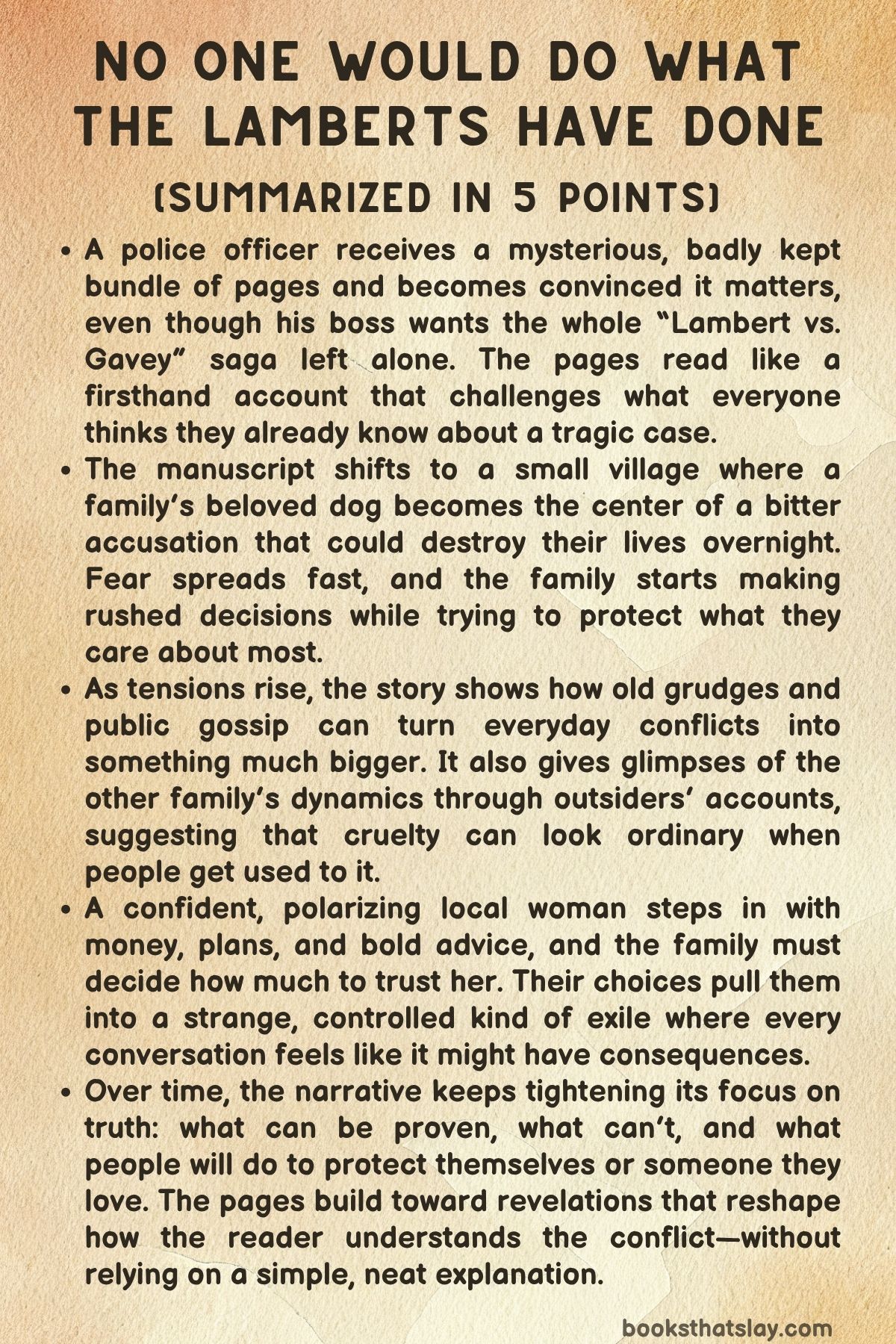
PC Connor Chantree arrives at work carrying a battered, damp bundle of paper that smells as if it has been left outside for days. It was placed in a soggy box near his garage, addressed to him without explanation.
He read the pages twice, sorted them by hand, and can’t shake the feeling that he’s been handed something important. Connor takes the bundle to his superior, Large, who immediately bristles at the mention of “Lambert,” assuming Connor has written some kind of true-crime fan fiction about a notorious local dispute.
Connor insists he didn’t write a word of it and isn’t even sure whether it counts as a novel. What matters is what the pages suggest: a young woman’s death tied to the Lambert–Gavey feud might not be as “natural” as the coroner concluded.
Large refuses to reopen old pain. He says the post-mortem ruled out suicide and murder, and both families have suffered enough.
Connor pushes back with a personal story about his sister’s ill-advised tattoo and the way his wife Flo taught them to hold two truths at once: accept your negative feelings in one mental “box,” while still choosing love and support in another. Connor argues the same could apply here—one box contains the official finding of natural death; the other contains this strange manuscript insisting there was a murder with no obvious physical trace.
Reluctantly, Large begins to read.
The pages call themselves No One Would Do What The Lamberts Have Done and open with a first-person voice introducing the Lambert family and the moment everything changed. The key date is 17 June 2024, 4:45 p.m., in the village of Swaffham Tilney.
A police officer comes to their door while the narrator is upstairs playing tug-of-war with Champ, the family’s Welsh terrier. From above, the narrator hears the doorbell, hears Mum’s voice tighten, and senses fear that feels new.
Mum refuses to let the officer inside. The young officer is awkward, speaks like he has already decided what happened, and then says the name that turns the air cold: Gavey.
To the narrator, that name explains everything.
A second viewpoint follows, from Sally Lambert—Mum—at the same moment. After the officer leaves, Sally shuts the door, collapses on the floor, and cries until she can’t breathe.
Champ licks her face as she shakes. Her thoughts circle around the silly songs she sings to her dog, especially the line she now can’t say without breaking down: a plea that Champ won’t be taken away.
When her husband Mark and their son Toby return from Toby’s GCSE exam, they try to joke about Sally sitting on the floor—until they see her face and realise something is truly wrong. Their daughter, Rhiannon “Ree” Lambert, storms in furious, convinced this is the work of Tess Gavey.
Ree says Tess has accused Champ of biting her the day before, at 4:15 p.m., and that the authorities might seize Champ and put him down.
Sally admits a dangerous detail: Champ was with her on a walk by the lode at the time Tess claims the bite happened, but Sally didn’t say that to the officer. She was in shock, and the officer spoke as if he already had the story.
Ree panics that silence will look like guilt. Mark tries to calm everyone down, insisting they can sort it out with facts and common sense.
Sally can’t share his confidence. She remembers their first terrier, Furbert, who used to nip people, and fears the police will see a “pattern.” Panic hardens into decision.
If this is a trap, she needs money, secrecy, and a way out before anyone can take Champ.
Sally calls her mother Julia in London and demands an immediate £10,000 transfer, then orders Julia to begin releasing another £37,000 from an investment. Sally sees that larger sum as effectively hers, built out of years of swallowing feelings to keep family peace.
With money on the way, she chooses someone local to ask for help—Avril Mattingley—but when Sally arrives at Avril’s home, Avril is drowning in domestic chaos and refuses to treat a dog as a crisis worth uprooting lives for. The conversation collapses into cruelty and anger.
Sally leaves more isolated than before.
On the village green, Corinne Sullivan approaches Sally and, seeing her distress, offers help without hesitation. Corinne is wealthy, confident, and wrapped in village gossip from an earlier community feud over an Agatha Christie book club.
Sally has quietly supported Corinne in local disputes before, and Corinne now acts as if that history makes them allies. Sally calls Mark to check that Champ is safe at home and orders him to lock doors and ignore the phone.
Corinne, meanwhile, lays out a bold plan: take Champ and get the entire family out of the village before police can return with paperwork. Sally feels uneasy—Corinne’s certainty is intense—but fear outweighs doubt.
The Lamberts gather quickly: Sally, Mark, Ree, Toby, and Champ. They leave their iPhones behind, climb into Corinne’s Range Rover, and head north.
Corinne promises burner phones the next day. During the drive, small facts become loaded—rumours about Furbert’s death, questions about vaccines, old resentments.
Late at night, they reach Corinne’s enormous holiday home near Troutbeck in the Lake District. The house is so grand that Corinne jokes about it being her “smallest house,” and Sally tries to believe the size of the place equals safety.
Even in hiding, the Gaveys remain present through messages and stories. Corinne shows Sally a message from Lesley Gavey urging Corinne to turn the Lamberts in.
Corinne replies with an insult-laced refusal, which reassures Sally—at least for now—that Corinne is on their side. Mark argues they should stop running and face the accusation properly; Corinne counters with what she has read online about dogs being seized during investigations.
She proposes an extreme option—alter Champ’s identity, remove his microchip, report him stolen, and later “find” him under a new name. Sally refuses instantly.
Champ is Champ. She will not pretend otherwise.
As the family travels again—this time toward Norfolk and a luxury boarding setup called West Acres—tension inside the car builds. They play a truth game that exposes small betrayals and old embarrassments.
Sally admits to a desperate late-night call she once made to a man named Henry Christensen, begging him to sell their old house back to them. Ree admits she has posted a video of herself singing Champ’s “Night Song,” and hints their friends are doing the same, creating online support.
At West Acres, Corinne reveals another unsettling “truth”: the family will stay in a house room, not in kennels, and she had enjoyed letting them believe otherwise. Privately, she gives Sally a high-limit bank card “for emergencies,” a gesture that feels both generous and like a warning.
The pages also include odd fragments Connor couldn’t place neatly: a poem addressed to Corinne, memories of Sally’s strict father, and family conversations that show how the village watches itself and feeds on rumour. Over time, Ree pieces together the logic that changes everything.
If Tess had truly been bitten by a dog, and if the Gaveys were simply mistaken, the “culprit” should resemble Champ. But the more they look, the less “mistake” makes sense.
Ree’s reasoning lands hardest on one point: Lesley Gavey is known for vindictiveness and control. If a real dog had bitten Tess, Lesley would never allow that dog to escape consequences just to frame Champ—she would demand punishment for the real biter.
That means the bite story is likely not about misidentification at all. Sally’s fear clicks into a new certainty: no dog bit Tess.
A human did.
Sally decides to confront the Gaveys in the middle of the night. Corinne drives her to The Stables at Bussow Court while Mark stays behind with Ree, Toby, and Champ at a hotel.
Sally forces her way inside and accuses Lesley directly: Lesley bit Tess to frame Champ. Lesley’s panic seems to confirm it.
Sally bluffs that she has proof and that Tess has told someone; she urges Lesley to admit Champ’s innocence publicly before everything explodes online. Lesley breaks down and confesses, describing the plan to create bite marks and admitting she has bitten Tess before.
Sally is disgusted and demands a full confession to police.
Then Tess appears and flips the script. She insists Champ bit her and claims Lesley only “confessed” because Sally pressured her.
Lesley retracts everything and backs Tess. Sally reveals the real pressure point: she has recorded Lesley’s confession on a burner phone, an idea attributed to Corinne.
Tess tries to stop her, shouting and scrambling, but Sally escapes with the keys, locks them in, and flees.
Back at the hotel, Ree spreads the recording online at speed. It detonates across the internet.
Police announce an urgent investigation, and public opinion swings hard toward the Lamberts. Mark adds another crucial detail: Sally’s sister Vicky has a WhatsApp voice-to-text record from 17 June 2024 at 4:14 p.m.
It captures Sally speaking to Champ during their walk by the lode—one minute before Tess claims the bite occurred elsewhere—making the allegation impossible on its face.
Just as the family begins to believe they can return to normal life, the story turns darker. Tess dies on 29 June 2024 at 1:10 a.m.
The coroner records an open verdict but says the cause was natural, though strange. A fire occurs at The Stables, but Tess was already dead before it began, and she didn’t die from smoke.
The internet shifts focus from the dog scandal to arguments about Tess’s death, and the manuscript implies the official explanation doesn’t fit. The pages add surreal elements that blur the line between literal events and the narrator’s worldview, including a section voiced by Furbert, the family’s dead dog, who claims to know what really happened behind the scenes and hints at forces that can’t be measured by an autopsy.
In the aftermath, the Gaveys leave the village. The Lamberts eventually return home, and Champ becomes a symbol of vindication—celebrated, photographed, and turned into local legend through websites and online support.
The village begins to reconcile, at least on the surface. But the manuscript’s existence—and the fact it was delivered to Connor—keeps one question alive in the reader’s mind and in Connor’s: if people can manufacture a “dog bite” to destroy a family, what else might they have manufactured, and what really caused Tess Gavey’s death?
Characters
PC Connor Chantree
Connor functions as the conduit between “official reality” and the unsettling counter-narrative that arrives at his home, and his personality is defined by that compulsion to assemble, reorder, and make meaning out of disorder. He is both methodical and emotionally porous: he painstakingly reconstructs the scattered pages, yet admits to an almost irrational sense that the manuscript “feels true,” suggesting an investigator whose instincts are as strong as his procedural training.
His long tattoo anecdote is not a digression so much as a self-portrait—Connor persuades through stories and moral thought experiments, trying to widen other people’s tolerance for ambiguity when facts are incomplete. In No One Would Do What The Lamberts Have Done, Connor’s central tension is that he cannot accept an unexplained death as an administrative conclusion; he needs a humanly satisfying explanation, and that need pushes him toward professional risk, conflict with authority, and an intimacy with the case that borders on possession.
Large
Large embodies institutional fatigue and the protective cynicism of someone who has seen too many cases reopen into public spectacle and private ruin. His irritation at seeing “Lambert” again is not merely impatience; it is a defense mechanism that frames reopening as cruelty rather than justice.
Large’s authority rests on closure—autopsies, classifications, procedures—and he reacts to Connor’s “two boxes” argument like a man hearing heresy because it threatens the stability of a system built to decide one truth at a time. Yet his eventual act of reaching for the bundle is revealing: even when he refuses to concede, he cannot wholly resist narrative evidence, implying a buried curiosity or conscience that Connor manages to trigger.
Large is less a villain than a portrait of how institutions protect themselves by narrowing what they are willing to imagine.
Flo Chantree
Flo appears briefly, but her “two boxes” framework becomes one of the story’s guiding philosophies: she models a practical emotional intelligence that refuses false choices. By separating feelings from commitments—allowing the mother to dislike the tattoo while still loving the daughter—Flo demonstrates a mature, non-performative compassion that Connor tries to import into policing and truth-seeking.
In narrative terms, Flo is a quiet counterweight to escalation: where others polarize, she holds two realities without demanding immediate resolution. Her influence shows how private, domestic wisdom can become an ethical tool in public life, and it implicitly challenges the rigidity that Large represents.
Danielle Chantree
Danielle is constructed through Connor’s recollection, and she functions as a symbol of how families turn conflicts into loyalty tests. Her tattoo is less important than what it provokes: a mother who feels forced into either acceptance or estrangement, as if love must be proven by agreement.
Danielle’s role in the story highlights the theme that relationships are often endangered by the demand for a single “correct” emotional stance. Even offstage, she amplifies Connor’s sensitivity to unfair binaries, which is precisely why the manuscript’s competing truths grip him so hard.
Connor’s mother
Connor’s mother illustrates how easily moral dilemmas get framed as all-or-nothing, particularly across generations where respectability and control are mistaken for care. Her reaction to Danielle’s tattoo shows a love that becomes conditional under stress, and the story uses her to expose the everyday mechanisms of coercion: withdrawing affection, threatening distance, turning disagreement into moral failure.
Through the “two boxes” solution, she also becomes a case study in how people can be taught to soften without being shamed—she is not demonized, but shown as trapped in a limited emotional vocabulary.
Sally Lambert
Sally is the beating heart of the Lambert sections: intensely maternal, fiercely loyal, and prone to catastrophizing in ways that sometimes look irrational but are rooted in a lifetime of control, fear, and learned vigilance. Her bond with Champ is not simply pet affection; it is identity, comfort, and proof that she can choose love freely after a childhood shaped by prohibition.
Under threat, Sally becomes both strategic and volatile—demanding money from Julia, seeking secrecy, pivoting from neighbor to neighbor in search of an ally—yet her choices are guided by a consistent moral center: she refuses to rename Champ, refuses to scapegoat another dog, and insists that truth must be spoken rather than manipulated into a convenient lie. Sally’s confrontation with the Gaveys shows her capacity to weaponize performance—pretending she has proof, invoking an “online audience”—but the performance serves an ethical goal, and her horror at Lesley’s confession reveals that what she wants is not triumph but moral repair.
Mark Lambert
Mark represents pragmatism and the desire for normalcy, often acting as the family’s internal brake when panic threatens to become identity. He repeatedly tries to translate fear into manageable steps—dinner, procedure, “it can be sorted”—and his frustration with flight reflects a worldview that trusts systems more than people do.
Yet Mark is not naïve; his eventual presentation of “independent proof” via Vicky’s message shows that he works quietly, gathers corroboration, and understands that evidence, not outrage, is what survives scrutiny. Mark’s deeper role is relational: he is often crowded out by the louder emotional alliance between Sally and Corinne, which hints at a marriage strained not by lack of love but by incompatible threat responses.
Rhiannon “Ree” Lambert
Ree is defined by sharp perception, anger that is quick to ignite, and a fluency in the modern battlefield of reputations: social media, clips, hashtags, and viral proof. She is the family member most immediately outraged by the Gaveys’ accusations, and her profanity and urgency convey a protective ferocity that is as much about family honor as it is about Champ’s safety.
Ree’s real power, however, is analytical: her observation about resemblance—how an honest mistake would require a similar-looking dog—becomes the conceptual key that flips the case from “misidentification” to deliberate fabrication. When the recording spreads, Ree turns private truth into public leverage, showing that she understands how contemporary justice often moves through attention as much as through institutions.
Her complexity lies in how she can be both reckless and brilliant, a catalyst who sometimes inflames fear but also produces decisive clarity.
Toby Lambert
Toby carries the adolescent energy of competitiveness and storytelling, but he also serves as a barometer for what the village “knows” in its informal circuits. His talk about fights and his casual mention of recordings of Lesley’s screaming point to a community where private cruelty has become background noise—documented, shared, normalized.
Toby’s function is partly to show that even younger residents have learned to live alongside dysfunction by turning it into content, gossip, or entertainment, and that this normalization is itself a form of community failure. At the same time, Toby’s contributions are not trivial: his awareness of weekly patterns of volatility, and the existence of recordings, suggest a long-standing truth that authorities and neighbors have chosen not to confront directly.
Champ
Champ is both an animal and a symbol: innocence under accusation, love under bureaucratic threat, and a focal point for the family’s sense of moral order. The “day song” and “night song” make Champ an emotional language inside the Lambert home, a ritual that turns care into structure and gives Sally a way to soothe fear.
Champ’s importance also exposes the story’s central cruelty: the ease with which systems can destroy what a family loves most based on an allegation and a narrative. By becoming the center of a public movement, Champ transforms from private companion to communal emblem, forcing the village to renegotiate empathy, allegiance, and shame.
Furbert
Furbert is one of the narrative’s strangest and most revealing devices: a dead dog with consciousness, memory, and moral commentary, positioned as both witness and guilty conscience. He reframes Sally’s grief as a kind of self-protective mythmaking—she needs a villain, the peach-stone litterer, so that random tragedy becomes punishable, which mirrors how the village needs villains like the Gaveys to make chaos feel legible.
Furbert’s admission that he intensified Lesley’s bite adds a supernatural layer of complicity that complicates any clean human courtroom logic, and it also externalizes the theme that rage can possess otherwise controlled bodies. His claim about animal spirits refusing to speak unless in extreme crisis is a metaphor for suppressed truths: things “could” be said, but are withheld until suffering reaches a breaking point.
Tess Gavey
Tess is portrayed as both victim and instrument, and the story deliberately keeps her interiority scarce, which mirrors how communities flatten disliked people into caricatures. She participates in narrative warfare—posting the wound, sustaining the accusation, pivoting instantly to deny Lesley’s confession—and her ability to override her mother’s collapse suggests a chilling comfort with manipulation.
Yet Tess’s position inside the Gavey household also reads as damage: she is shaped by a family culture where affection arrives as mockery and humiliation is ordinary conversation. Her death becomes the ultimate ambiguity: officially “natural,” socially explosive, narratively contested, and used by others as proof of whatever they already believe.
Lesley Gavey
Lesley is drawn as an engine of control, grievance, and emotional absolutism: she cannot tolerate rules applied to her, but demands rules be weaponized against others. Accounts of her pub conversation with Tess show cruelty delivered with calm laughter, as if tenderness has been replaced by performance and domination.
Her behavior at the health club illustrates a mind that interprets limitation as persecution and responds by trying to destroy the system that limits her. Lesley’s “confession” scene is crucial because it exposes her as both perpetrator and coward: she bites Tess to frame Champ, then pleads for secrecy, then instantly retracts when Tess applies pressure, revealing that her deepest loyalty is not to truth or even family, but to self-preservation and control of the narrative.
Even those who dislike her acknowledge something oddly consistent: she does not choose suffering for herself, which makes her cruelty feel less like passion and more like strategy.
Alastair Gavey
Alastair appears as a man with a veneer of pseudo-spiritual posturing that collapses into misogyny when his ego is bruised. Ed’s account suggests Alastair uses “guru” language as social camouflage—performing depth to excuse self-importance—while his vicious reaction to romantic rejection reveals entitlement and contempt.
Unlike Lesley, Alastair can read as less the architect and more the enabling environment: he sustains a household where screaming is routine and cruelty is conversational currency. His role in the late-night confrontation is telling: he is present, but the power dynamics are driven primarily by Lesley and Tess, which paints him as simultaneously complicit and peripheral—dangerous not because he always initiates, but because he normalizes.
Corinne Sullivan
Corinne is the story’s most ambiguous ally: charismatic, wealthy, decisive, and orbiting the Lamberts with a confidence that can look like rescue or like recruitment. She offers immediate certainty—leave now, burn phones, move fast—and that certainty is intoxicating to Sally, who is drowning in fear.
Yet Corinne’s intensity raises questions about motive: she enjoys control, enjoys “plans,” and even frames deception as entertainment, as seen when she jokes about the family sleeping in kennels. Her loyalty is repeatedly asserted, but her need to be central is unmistakable, and the bank card she gives Sally quietly suggests she anticipates marital fracture and positions herself as Sally’s private exit route.
Corinne also understands psychological warfare in modern terms: the insulting comment is not impulsive but calculated, and the burner-phone recording is her tactical gift. She is, in effect, a patron of conflict—someone who can solve problems, but also escalates them into dramas where she is indispensable.
Avril Mattingley
Avril functions as a harsh mirror for Sally’s desperation, showing what happens when someone’s crisis meets another person’s exhaustion. Her home chaos and her dismissal of Champ as “just a dog” reveal a worldview in which survival leaves little room for symbolic attachments.
Avril’s refusal is not framed as evil; it is framed as the collision of two kinds of overwhelm—Sally’s fear of loss and Avril’s lived scarcity of emotional bandwidth. The abrupt collapse into insults exposes how quickly empathy evaporates when people feel judged, and it reinforces Sally’s isolation: even asking for help can become humiliating.
Julia
Julia is both resource and reminder: London, money, distance, and the family systems Sally is trying to escape. Sally’s demand for immediate transfers shows how, under threat, she reverts to command, and Julia’s compliance implies a long-established pattern where Julia’s role is to stabilize Sally financially even when emotionally removed.
Julia also represents inherited control: Sally’s fixation on money from investments and “what is effectively hers” is bound up with the sense that love in this family arrives through resources, inheritance, and bargaining power.
Sally’s father
Sally’s father is the origin point of forbiddenness in her emotional life, and his control teaches the family to “forbid themselves” pleasures to keep peace. His legacy is not only psychological but practical: the delayed dog ownership, the stored resentment, and Sally’s belief that certain joys must be defended at all costs.
Even after his death, he continues to govern behavior through internalized rules, which helps explain why Sally experiences threats to Champ as existential, not situational.
Granny
Granny is the quiet architect of the family’s money narrative: by investing, sending updates, and casually joking about shrinking funds, she turns inheritance into an ongoing conversation rather than a settled gift. Her presence illuminates how finances become emotional property—Sally’s sense that £37,000 is “hers” is not strictly legal logic but moral accounting built from years of silence and compliance.
Granny also demonstrates how power can be exercised gently yet still shape everyone’s choices for decades.
Pascale
Pascale, as the investment advisor, is a minor figure but symbolically important: the family’s money is mediated by outsiders who translate life, death, and control into percentages and updates. Pascale represents the “official” world Sally struggles with—systems that do not care what the money means emotionally, only what it is administratively.
This mirrors the coroner’s conclusion later: institutions produce verdicts, while families live meanings.
Judith Whiteley
Judith, the landlady, acts as a community witness whose credibility comes from being neither partisan nor sentimental. Her recounting of Lesley and Tess’s pub exchange is chilling precisely because it is mundane: cruelty and laughter are woven together like routine banter.
Judith’s shaken reaction functions as moral testimony—she does not need proof of crimes to sense danger, and her instinct that Lesley would be the likelier culprit reveals how some people radiate threat in ways a village can feel yet still chooses to tolerate.
Ed Debden
Ed is the portrait of someone who recognizes toxicity and quietly withdraws rather than confronting it publicly. His friendship with Alastair deteriorates when Alastair exposes misogyny without shame, suggesting Ed’s moral line is firm but privately enforced.
He offers uncertainty with honesty—he can imagine Alastair doing something terrible, but refuses to claim certainty—which makes him a rare voice in a narrative full of confident accusations. Ed represents the better version of community judgment: cautious, experiential, and aware of his own limitations.
Kellie Dholakia
Kellie illustrates how Lesley exerts social control through arbitrary punishments and gaslighting. Her story shows a pattern: Lesley reframes her own jealousy as a virtue, declares emotions “never wrong,” and demands others adapt to her sensitivities while erasing their labor and generosity.
Kellie’s insistence that Lesley would not commit the later crime because Lesley would not choose suffering for herself is psychologically astute, even if it underestimates how cruelty can still backfire. Kellie’s role highlights how communities often mispredict harm because they confuse selfishness with harmlessness.
Conrad Kennedy
Conrad appears mainly as Kellie’s fiancé, but his presence anchors Kellie in a future-oriented life outside the village’s feud logic. He functions as contrast: while the feud culture cycles through grudges, engagement implies stability and commitment.
That contrast makes Lesley’s ability to eject Kellie from belonging feel even more invasive—Lesley’s power disrupts not just friendships but people’s sense of social safety.
Jill
Jill, as the co-owner of West Acres and Corinne’s daughter-in-law, is the institutional face of refuge: she brings the “professional care” environment that makes Sally feel Champ can be protected without constant running. Yet her link to Corinne also suggests that even safety is routed through Corinne’s network, keeping Corinne central.
Jill’s calm practicality offsets Corinne’s theatricality, implying that real protection may be quieter than the dramatic rescues that dominate Sally’s imagination.
Vicky
Vicky becomes pivotal because she provides the kind of proof that cannot be easily spun: a timestamped message placing Sally and Champ away from the alleged bite location. She is the unseen stabilizer, the person outside the immediate emotional cyclone who still holds a piece of objective reality.
Vicky’s role underscores a major theme of No One Would Do What The Lamberts Have Done: truth often survives not through grand confrontations but through mundane digital traces that contradict a lie’s timeline.
Henry Christensen
Henry is a brief but telling presence in Sally’s confession that she once woke him at 2 a.m. to beg him to sell Shukes back.
That moment reveals how Sally’s attachment to “home” can become desperation and boundary-crossing, and it also shows her belief that loss is reversible if she can push hard enough. Henry represents the outside world’s limits—property, ownership, time—against which Sally’s emotional demands collide.
Vinie Skinner
Vinie exists mostly as a reference point in a family argument about resemblance, but her function is thematic: she is a symbol of how villages turn individuals into types, faces into talk, and identity into speculation. The argument about whether someone resembles Vinie parallels the story’s larger conflict about whether Champ “resembles” the accused dog, highlighting how fragile and socially constructed recognition can be when it becomes evidence.
Tavia Foster
Tavia is the hidden, accidental origin of Sally’s peach-stone revenge myth, and her existence reveals how tragedies are frequently caused by ordinary human mess rather than malice. By making the “culprit” someone distraught and unintentional, the narrative critiques Sally’s need for a villain and suggests that grief often becomes a story people cling to because randomness is intolerable.
Tavia’s invisibility also shows how the wrong person can carry blame forever simply because the truth is unknown.
Themes
Loyalty, protection, and the moral price of taking action
The events keep returning to a simple, urgent impulse: protect Champ, no matter what it costs. That impulse starts as ordinary family devotion but quickly becomes a force that reshapes everyone’s sense of right and wrong.
Sally’s fear of losing Champ is not treated as a mild worry; it is experienced as a threat to the family’s identity and stability, so the idea of “waiting for due process” feels like surrender. Once that mindset sets in, loyalty becomes less about steady care and more about decisive moves—phone calls for money, secrecy, leaving devices behind, trusting a powerful ally, and accepting disruption as the only responsible choice.
The story stresses how quickly a community dispute can turn loyalty into a closed system: outsiders’ explanations are dismissed in advance, and every official step is interpreted as hostile intent. Corinne’s intervention pushes this theme further by showing how protection can become controlling.
She offers rescue, but her rescue contains conditions: her plans, her confidence, her definitions of what is sensible. The family’s dependence on her resources blurs the line between being helped and being directed.
That blur matters because it changes how choices feel: rejecting Corinne’s more extreme “Plan A” is framed as a moral stand, yet the same moment also shows how close Sally comes to accepting identity-altering deception if it would keep Champ alive. The theme doesn’t argue that loyalty is bad; it argues that loyalty becomes dangerous when it treats harm as an acceptable tool.
Even the public campaign that later supports Champ carries a shadow: moral clarity arrives only after private panic has already encouraged secrecy, manipulation, and a willingness to run. In No One Would Do What The Lamberts Have Done, protection is both love and a pressure that tests what a person will justify when the thing they love might be taken away.
Competing realities and how narratives override evidence
Connor’s “two boxes” idea sets up a world where two versions of truth can exist at once, and the book keeps stressing how that happens in practice. Official reality is the realm of institutions—police conclusions, coroner language, neat categories such as natural death, no physical trace, nothing to reopen.
But personal reality is shaped by texture: the smell of the pages, the compulsion to reorder them, the sense that the account “feels true.” That contrast shows how narratives can become stronger than facts, not because people are foolish, but because stories meet emotional needs that evidence often cannot. The Lamberts interpret events through an existing script about the Gaveys’ malice, so the accusation about Champ is instantly understood as a targeted attack rather than a mistake or a messy misunderstanding.
In parallel, the villagers’ statements portray the Gaveys as people who can speak cruelly one minute and behave normally the next, which makes it hard to pin them down using standard expectations of guilt, remorse, or consistency. This is important because it demonstrates why communities struggle with truth: we rely on coherence as a clue, and when coherence is missing we reach for the explanation that best matches our fears.
The online dimension intensifies that dynamic. Once recordings, posts, and hashtags enter the story, “what happened” becomes whatever spreads fastest and satisfies the audience’s appetite for a clean villain and a clean victim.
The recording of Lesley’s confession is powerful evidence, yet the same scene shows how quickly evidence can be contested through counter-claims, intimidation, and denial. Tess’s later death amplifies the theme at the highest stakes level: the coroner’s language points to natural causes and an open verdict, while the manuscript insists on another account that cannot be proven in conventional terms.
The book’s tension comes from watching these realities compete—procedural truth versus narrative truth—until even characters who want certainty are forced to live with unresolved overlap.
Social cruelty, reputation warfare, and the community as an amplifier
The village setting operates like an emotional loudspeaker. Small incidents—pub talk, a health club rule dispute, a party invitation revoked—are not trivial background; they are shown as training grounds where people practice humiliation, retaliation, and status control.
Lesley’s behavior in particular illustrates how reputational aggression works: she reframes events to position herself as wronged, demands symbolic apologies to prove dominance, and uses “sensitivity” language as a weapon rather than a bridge. Tess’s online identity and the attention to screenshots and posts show that this cruelty is not only face-to-face; it has an afterlife online, where accusations become permanent and portable.
The Lambert–Gavey conflict grows because it is constantly fed by witnesses, gossip, and the human urge to pick sides. Corinne’s earlier “book club war” history signals that the community already has patterns of faction-building and escalating disputes, so when the dog-bite allegation arrives it slots neatly into an existing culture of rivalry.
What makes the theme sharp is that cruelty is not presented as rare. It is routine, even domestic: people can trade vicious insults and then talk about shopping lists, as if emotional harm is a normal conversational mode.
That normality is why the Lambert family becomes so frightened—because they can imagine the machinery of public opinion turning against them in a way that cannot be reversed. The book also shows how reputation warfare pressures good-faith behavior into strategic behavior.
Sally’s initial shock and failure to immediately state her alibi becomes a potential liability, not because it is suspicious in itself, but because reputational logic treats any gap as proof. Later, when Sally confronts Lesley, her tactics rely on the threat of publicity—an “online audience” that functions like a court, but one that rewards spectacle.
Even the eventual reconciliation and Champ’s celebrity carry this theme forward: the village can swing from persecution to celebration quickly, which suggests that community judgment is less about careful evaluation and more about collective momentum. Here, the village is not just a setting; it is an active force that turns private fear into public crisis and teaches people to live as if they are always on trial.
Control, helplessness, and the need to assign blame
A persistent engine in the story is the discomfort of randomness and the resulting need to make events feel caused, chosen, and punishable. Sally’s earlier family history with her controlling father shows how deeply control can shape a person: she learns to “forbid herself” desires, to keep peace through silence, and to measure safety by compliance.
After that kind of upbringing, losing control is not merely stressful; it feels like a return to captivity. Champ becomes more than a pet—he becomes proof that Sally can finally choose something for herself and keep it.
That helps explain why the bite allegation triggers such extreme responses. It threatens to turn her hard-won autonomy into another period of being told what she must accept.
The money story reinforces this theme by showing how control can be internalized and justified: the investment becomes “effectively hers” because it represents years of emotional restraint, as if suffering can be converted into entitlement and then into decisive power. The theme becomes even clearer through Sally’s obsession with Furbert’s death.
She constructs a culprit for the peach stone because a tragic accident is harder to tolerate than a story with an offender. The need to punish offers the comfort of direction: anger has a target, grief becomes a mission, and helplessness is replaced by purpose.
That same pattern appears in the conflict with the Gaveys. The family’s hatred is fueled by the belief that the Gaveys must be behind everything, because “no reason” is unacceptable.
Connor voices this bluntly when he argues that healthy young people do not die for no reason, pushing against institutional closure that asks everyone to live with ambiguity. Tess’s death is the ultimate test of this theme.
The official conclusion attempts to contain uncertainty, yet the manuscript’s account insists on another kind of causality that does not fit forensic expectations. Whether a reader treats that account as literal, symbolic, or unreliable, it still performs the same psychological function: it refuses to leave death as an empty space.
By the end, the story suggests that control is never fully regained; it is substituted. The family replaces fear with fame, secrecy with a website, and helplessness with a public narrative that protects Champ.
The story shows how the hunger for control can push people toward rigid blame, and how hard it is to accept that some events remain strange even after the world moves on.