Pendergast: The Beginning Summary, Characters and Themes
Pendergast: The Beginning by Douglas Preston and Lincoln Child is an origin story for FBI Special Agent Aloysius Pendergast, set in the humid, haunted edges of Louisiana and Mississippi in the late 1980s and early 1990s. The book introduces Pendergast as brilliant, unconventional, and quietly intimidating—an investigator who pairs sharp observation with unusual methods and an iron will.
Alongside the weary, grieving Agent Dwight Chambers, Pendergast is pushed out of the New Orleans field office after a risky internal sting and into a case that begins as a brutal, baffling murder and expands into something far stranger, more secretive, and more dangerous than anyone expects.
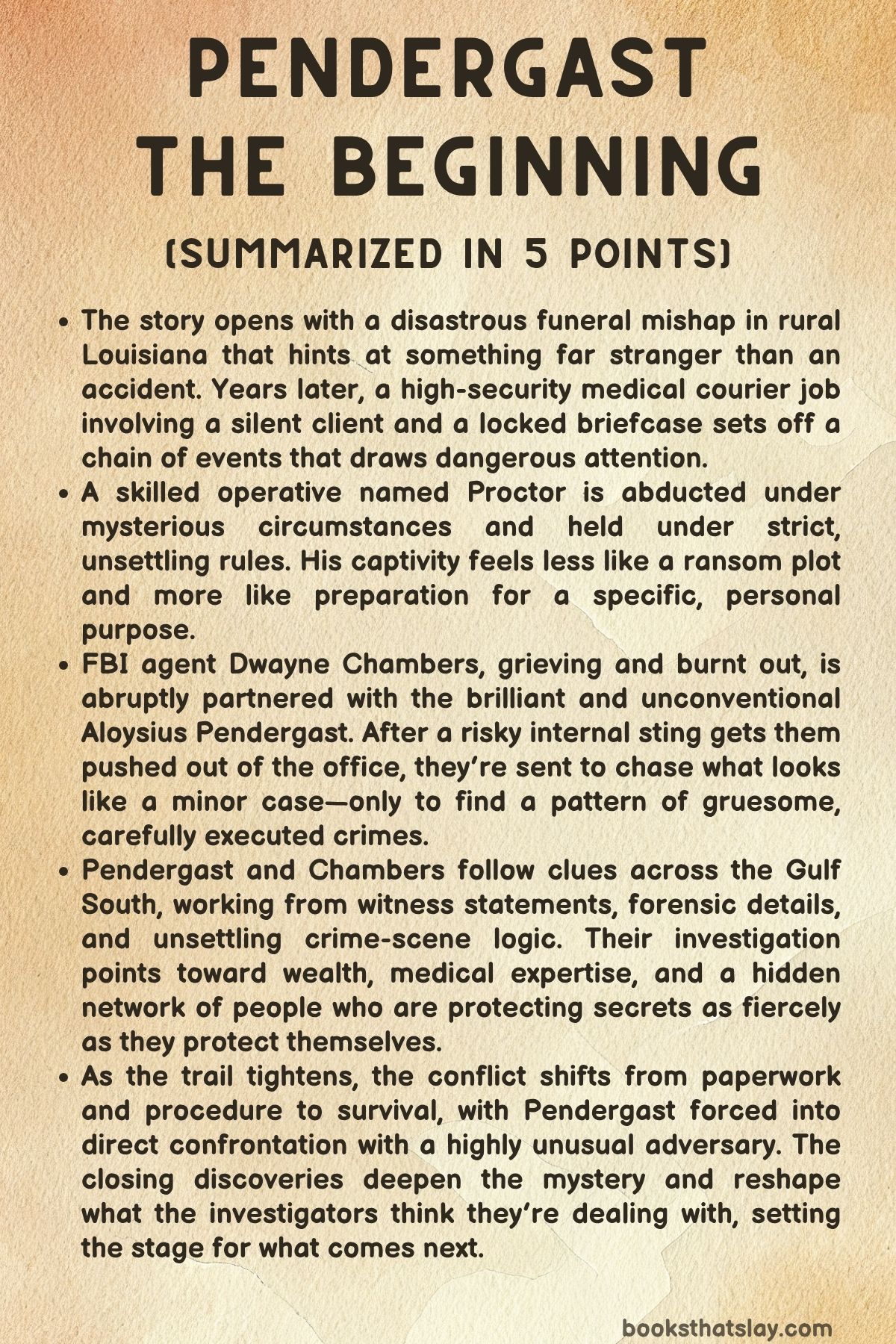
Summary
In 1989, at a cemetery in Grosse Tete, Louisiana, a routine funeral turns into a public nightmare. Austin Landry, a hired pallbearer, helps carry an expensive, unusually heavy casket toward an open grave.
The strain, a faulty lowering strap, and a cracking coffin base combine into disaster: the casket drops, breaks, and the body spills out in front of mourners. People scream and faint as the scene becomes grotesque.
Landry, staring into the grave, notices something that causes an even deeper wave of horror—an early hint that something unnatural or tampered-with may be tied to death in this region.
Five years later, on August 7, 1994, J. F. Foreman prepares an unusual transport for his discreet courier company, Expedited Medical Transport (EMT), which uses armored vans disguised as ambulances. Foreman runs his operation like a covert unit: employees are isolated, monitored, and trained to stop one another if anyone goes off-script.
A client has arranged a high-value run for August 9. The “package” is not a box or evidence container but a living person: a small Asian woman in her thirties, handcuffed to a brown crocodile Hermès attaché case that must remain attached at all times.
She is to ride in the van’s internal metal safety chamber, and the team is warned not to speak to her.
Foreman quietly grows uneasy. He discovers two employees have been meeting socially outside work, violating the company’s strict rules and raising the possibility of collusion.
Unable to cancel the job, he shifts assignments and pulls aside Proctor, a new hire with exceptional discipline and competence. Foreman gives him a special role and an unspoken warning: if the run is compromised by internal betrayal, Proctor is to act decisively, take control, and ensure the delivery is completed.
Before the mission can happen, Proctor is targeted at home. As he prepares to leave, a man posing as a utility worker distracts him and attacks with a cattle prod.
Proctor is restrained, hooded, drugged, and taken away. He wakes in complete darkness, bound carefully with zip-ties and chained to a wall.
When the lights finally come on, he finds himself in a padded cell. His captor is a tall, young blond man dressed in black, oddly calm and rule-bound.
The kidnapper explains that Proctor will be held for days, fed through a slot, and punished for any disobedience, especially if he refuses food or medicine. Proctor tries to connect the abduction to the EMT job and the handcuffed case, but the kidnapper seems genuinely confused by the question, suggesting the motive is personal and specific to Proctor rather than the transport.
Proctor begins to suspect he is dealing with someone unstable, someone with a fixed objective.
On August 10, 1994, FBI agent Dwight D. Chambers arrives at work in New Orleans carrying heavy grief after the recent death of his wife. The field office atmosphere is sour: Assistant Special Agent in Charge Gerald Urbanski pushes a culture of internal “assessments,” and morale is low.
Chambers is told he has a new partner. Moments later, chaos erupts when Urbanski escorts a bank president, T. J. Fulsom, and a strange, sloppy-looking “lawyer” through the office while that “lawyer” takes Polaroids and baiting comments fly.
The “lawyer” then reveals himself: he is Agent Aloysius Pendergast, disguised, running an unauthorized sting. Pendergast has used Urbanski’s own obsession with surveillance and internal reporting as a weapon.
He claims to have caught Urbanski agreeing to accept $50,000 from Fulsom in exchange for retrieving an incriminating videotape and arranging a quiet handoff. Pendergast produces the evidence: a tape tagged as Bureau property and photos documenting the exchange.
The office head, Estevez, is furious at the reckless operation but cannot ignore the proof. Urbanski and Fulsom are arrested.
Chambers tries to shield his new partner by admitting he approved the sting, even though he did so without Estevez’s knowledge. Estevez punishes them both in a way that protects the office while sidelining the problem: he orders Chambers and Pendergast out of the building for at least a week, instructing them to take a minor case far from town.
Over tea—Pendergast insists on green tea rather than coffee—the two men settle into an uneasy partnership. Pendergast is courteous and precise, yet clearly accustomed to operating outside normal boundaries.
Chambers, drained and uncertain about his own future, agrees to take a case from a newspaper clipping: an exceptionally brutal murder in Diamondhead, Mississippi, with interstate angles that allow federal involvement.
In Mississippi, they learn a nude man was found mutilated in a storage unit, with signs of careful cutting mixed with savage damage. Witnesses report seeing a white van near swampy roads and a man in a hospital gown running from the marsh before being forced back into the vehicle by a larger man.
The victim is identified as Kenneth Drakos, a hotel manager missing for over a week. At the morgue, Chambers notes strangulation and other trauma.
Pendergast studies the surgical aspects with unsettling attention, focusing on how the arm was removed and what happened afterward. On the drive back, he offers a preliminary view: the killer has experience, resources, and a method that does not fit simple cruelty.
One detail bothers him most—the right arm.
As Proctor remains captive, he treats confinement as a problem to solve. He observes patterns, controls his breathing, exercises, and tests the limits of the cell.
The kidnapper continues feeding him well and insists on vitamins and antibiotics, speaking as if preparing Proctor for a procedure rather than merely holding him for ransom. Proctor notices the attention given to his right arm and realizes, with dread, that the limb itself may be the goal.
Chambers is soon drawn into Pendergast’s private world at Penumbra Plantation, where Pendergast has set up advanced computer access to search databases from home. Re-examining the witness story and terrain, they reconsider assumptions.
Drakos may not have escaped from the van itself but from a deeper swamp location, with the vehicle positioned to intercept him. They identify old structures near the drowned town of Frenier as possible sites.
At the storage facility, a hostile owner refuses entry until Chambers bluffs him with a frightening contamination story. Inside the unit, they find medical supplies, gowns, and signs of hurried activity.
Pendergast performs an unusual mental exercise, lying where the victim likely lay and concentrating intensely. Later, he explains that the killer’s pattern suggests a specific objective: harvesting right arms, searching for a particular “match,” and reacting with fury when something goes wrong.
Their search leads to another victim and then to a catastrophic scene: a grand mansion reduced to ash, firefighters still hosing the ruins. In the subcellar, a survivor is found—Proctor—alive but battered.
Two more bodies, along with severed arms recovered from the swamp, are taken away. Chambers expects standard procedure and jurisdictional battles, but Pendergast insists on entering immediately, fearing evidence will be lost.
Inside the charred remains, he collects small remnants and rescues scorched files from a melted cabinet before Estevez arrives and explodes in anger. Estevez pulls them off the case and assigns others, rejecting Chambers’s argument that they saved a victim and cracked a major pattern.
Despite the order, Chambers and Pendergast continue working the edges. At the morgue, Pendergast points out key details: the fire appears to have been set with ethanol; a surgical mask and a melted glove fingertip with fresh blood suggest a medical professional was present at the end; the amputations were done expertly.
One victim was alive when his arm was removed. The mansion owner, Parker C. Wickman, was dead when his was taken.
Pendergast infers two perpetrators: a surgeon who obeyed and a second man with higher status—someone who even smoked an expensive cigar during the act. From this, he forms a disturbing theory: Wickman wanted his right arm replaced and had been “testing” stolen limbs in a search for the perfect replacement, using victims as unwilling donors.
Pendergast visits Proctor in the hospital and uses coded phrases from a shared past to wake him fully. Proctor confirms the essential horror: the kidnapper repeatedly examined his right arm while he was sedated and intended to take it.
Proctor, realizing this, scarred his own arm to ruin it, provoking rage in his captor. He also reveals he worked a high-security transport job in a New Orleans suburb—connecting his abduction to the broader pattern of specialized operations and hidden clients.
They dig into Wickman’s history. Interviews with a nanny in Florida describe a bright, sensitive child who once seemed normal, until family ruin and tragedy reshaped his life.
A teacher recalls him as intelligent and gentle, controlled by a severe religious grandmother tied to a remote rest home. Later accounts show a shift around 1988, when Wickman worked with cadavers and became flat, calculating, and intent on strange ideas.
At Tulane, missing catalogs and suspicious transcripts hint at falsified records and a deliberate cover-up. A professor minimizes questionable research, while a colleague—Dr. Dorion Magnus—appears at the wrong moment, mocking the agents and offering cigars.
To Pendergast, it matches the cigar evidence too neatly to ignore.
Estevez, impatient and furious, demands they stop chasing theories and focus on standard tasks: identify the unknown victim, find Wickman’s killers, and investigate the arson. Chambers, under pressure and exhausted, lashes out at Pendergast, blaming him for distractions.
Pendergast remains calm and, to Chambers’s outrage, leaves for a formal party as if nothing is urgent.
The narrative then reveals the enemy more clearly. Dorion Magnus travels through the Mississippi Delta aboard his paddle-wheel steamer, the Fantôme, heading into back channels where the boat can vanish from sight.
Magnus possesses PSI abilities that allow him to read thoughts at close range, a talent that has made him arrogant, isolated, and cruel. He is fixated on Pendergast, whose mind resists easy access.
Magnus plans to keep him alive long enough to probe him, then kill him in isolation.
But Pendergast is already aboard, hidden, armed with improvised tools and a ruthless plan. Moving through the ship’s corridors, he kills crewmen, takes weapons, and sabotages systems.
He discovers a sealed steel door protecting an opulent, private room outfitted with embalming gear, needles, and chemicals—echoing the mansion’s hidden facilities. He sets traps: a halon canister to flood spaces, acetone to ignite, and a timed explosion that wipes out multiple armed men at once.
Fire spreads, the ship begins to sink, and Magnus and Pendergast face each other in a lethal chase across tilting decks and smoke-filled passages.
Magnus uses his mind-reading to anticipate shots and track movement, gradually cornering Pendergast as ammunition runs low. Yet at the critical moment, Magnus is seized from behind and hurled into the turning paddle wheel, mangled by the machinery.
Pendergast escapes into the delta, reaching shore as the Fantôme erupts into a massive explosion. Magnus crawls back from the wreckage, mutilated but alive, demanding answers.
Pendergast reveals he used intense mental visualization to misdirect what Magnus perceived, creating false certainty and openings. In a final exchange, Pendergast shows he has one bullet left and offers the gun.
Magnus chooses to end his own life.
The next day, Pendergast returns to Magnus’s New Orleans mansion in disguise, slipping past police lines. In the basement, he finds a hidden mechanism and opens a concealed stainless-steel chamber—an elegant room paired with medical equipment and a cryogenic unit.
Inside lies the preserved body of a woman, abused and kept for a long time. Shaken, Pendergast gathers letters left nearby and prepares to bring Estevez to the discovery, knowing the case is far larger than an arson and a string of amputations—and that the secrets they’ve uncovered have been protected for years.
Characters
Special Agent Aloysius X. L. Pendergast
In Pendergast: The Beginning, Pendergast is introduced as a man who treats investigation as both performance and precision instrument, moving effortlessly between theatrical deception and forensic exactitude. His early disguise as a “lawyer” is not just a trick; it reveals how he weaponizes other people’s assumptions, using their arrogance and complacency as the real trap.
Beneath the cultivated charm—green tea, rarefied tastes, fluent languages, a chauffeur and estate—there is a relentless will to dominate uncertainty: he needs to know what happened, why it happened, and what it means, and he refuses to let hierarchy or protocol slow that pursuit. What makes him especially compelling is the fusion of rational method with seemingly mystical discipline: his “meditation-like” reconstruction at the storage unit reads as eccentric, but it functions as an extreme version of empathy and pattern-recognition, a way to inhabit the crime’s logic until the hidden motive surfaces.
At the same time, his moral line is starkly pragmatic: when violence becomes necessary, he turns lethal without hesitation, and his shipboard campaign against Magnus is calculated, ruthless, and strategically theatrical in its own way—baiting perception, manipulating attention, and ending lives to end a larger threat. Pendergast’s defining tension here is that he is both savior and destabilizer: he solves cases and saves victims, yet he also creates institutional chaos, forces colleagues into ethical risk, and radiates a private intensity that makes even allies feel used.
Special Agent Dwight D. Chambers
Chambers functions as both the emotional grounding point and the moral temperature gauge of Pendergast: The Beginning. He enters the story exhausted by grief and disillusionment, moving through a workplace that feels petty and corrosive, and that inner depletion makes him vulnerable to being pulled into Pendergast’s orbit.
His choice to back Pendergast’s unauthorized sting is a crucial reveal: the “broken” agent still has an instinct for justice and a willingness to gamble his career when the system seems compromised. Chambers’s dynamic with Pendergast is mentorship inverted—he is officially the senior partner, yet he’s often reacting, catching up, trying to impose order on a man who lives beyond ordinary restraints.
What makes Chambers significant is that he does not simply admire or condemn; he argues, resists, compromises, and then regrets, showing how a principled person can be slowly bent by proximity to brilliance and urgency. His skepticism about conspiratorial leaps and his insistence on straightforward priorities make him the story’s conscience, even when he fails to hold the line.
The robin’s-egg blue Impala and the Magritte reference add an understated tenderness: Chambers is not only grieving, he is still capable of beauty and symbolic devotion, which makes his clashes with Pendergast feel less like bureaucratic whining and more like a man fighting to keep his humanity intact inside an escalating nightmare.
Proctor
Proctor is presented as competence under pressure—quiet, disciplined, and deeply trained—yet his ordeal reveals how even elite preparedness can be neutralized by surprise, deception, and psychological control. His kidnapping is not merely a plot detour; it exposes the theme of bodily autonomy being violated by people who believe they have the right to “use” another person, whether for crime, experiment, or grotesque desire.
In captivity, Proctor’s mind becomes the battleground: he observes, measures, exercises, and plans, turning the cell into a problem to solve rather than a fate to accept. The captor’s obsession with keeping him medically “compliant” pushes Proctor into a chilling realization that survival itself might be preparation for mutilation, and his decision to scar his own arm is a brutal act of self-defense—damaging himself to deny someone else possession.
When Pendergast speaks to him using coded military phrasing, Proctor’s characterization sharpens: he is not just a victim but a man from a world of hard rules and shared signals, someone whose loyalty and clarity remain intact even after prolonged violation. In the broader narrative, Proctor embodies the terror of being targeted for what your body contains, and the fierce dignity of refusing to be turned into an object.
J. F. Foreman
Foreman represents the corporate face of paranoia: a man who has built a business around secrecy, compartmentalization, and controlled force, convinced that the world is always trying to penetrate his perimeter. His EMT operation—armored vans disguised as ambulances, vetted ex-military personnel, strict rules against social contact—shows a worldview where trust is a liability and human connection is the first crack in security.
Yet his competence carries a fatal weakness: he can detect risk and still chooses to proceed, because his enterprise depends on never saying no. His decision to quietly deputize Proctor as an internal counter-coup reveals Foreman’s core contradiction: he demands absolute loyalty while engineering betrayal as a contingency plan, turning employees into watchdogs against one another.
Foreman’s “no one speak to her” instruction also marks him as ethically hollow; the woman is treated as cargo, and his system is designed to suppress empathy before it can interfere. In effect, Foreman is a portrait of a man who equates control with safety, only to discover that control is an illusion when the threat does not follow the expected script.
The Kidnapper in Black
The blond, gloved captor is characterized less by backstory than by the distinctive texture of his control: calm voice, rigid rules, and a compulsive insistence on compliance that feels ceremonial rather than practical. His insistence that Proctor must not hurt himself and must eat everything provided is revealing—he does not merely want a prisoner; he wants a maintained specimen, a body preserved for a purpose he cannot fully articulate without exposing his instability.
The most unsettling element is his confusion when Proctor references the EMT job, because it suggests the kidnapper’s motives are detached from normal criminal logic; he operates inside a private obsession, not a rational scheme. His methods—disguise as a utility worker, use of incapacitating tools and drugs, a padded cell engineered for containment—show planning and resources, which makes his instability more frightening, not less.
In narrative terms, he is an early signal that the story’s violence is not opportunistic; it is curated, ritualized, and centered on the body as a collectible object.
Dorion Magnus
Magnus is the story’s most overtly predatory intellect: a man whose PSI ability has not expanded his empathy but instead corroded it, turning other people’s inner lives into background noise he despises. He lives with contempt because constant access to thought has convinced him that most minds are trivial, and that belief becomes permission to manipulate, exploit, and discard.
His fixation on Pendergast is especially telling: Pendergast’s resistance is not merely an obstacle, it is an existential affront—proof that Magnus is not omnipotent. Magnus’s life is organized around sealed spaces—hidden rooms, controlled environments, a private ship corridor, a locked door nobody else can pass—which mirrors his psychological structure: access for him, confinement for everyone else.
Even when he is physically in danger, he frames reality as a contest of dominance, trying to reduce Pendergast to a mind he can finally open and then destroy. The final confrontation exposes Magnus’s weakness: his power encourages overconfidence, and when perception becomes unreliable, his advantage collapses into terror.
His end, choosing suicide with the last round, reads as the final act of control from a man who cannot tolerate being mastered, even for a moment, by another will.
Parker C. Wickman
Wickman’s character arc is shaped as a tragedy of gradual moral and psychological deformation, moving from sensitivity and intelligence into a cold, instrumental relationship with human bodies. Early accounts describe him as gentle, imaginative, and well-liked, someone whose identity could have formed around design, curiosity, or community; those details matter because they make his later transformation feel like a deliberate severing from the self he once was.
The family ruin and the loss of his parents create a foundation of instability and potential grievance, but the more decisive shift appears tied to his exposure to cadavers and the clinical power of cutting: at some point, death becomes not a boundary but a toolkit. Wickman’s implied motive—wanting his own right arm replaced—turns him into a figure of grotesque longing, someone who treats identity as interchangeable parts.
His “high-end operating room” suggests wealth, planning, and a desire for surgical legitimacy, yet his trajectory is fundamentally delusional: he chases wholeness through theft, and self-repair through the destruction of others. Even his death does not end his agency; his history becomes the key to understanding the network around him, implying that he was not just a lone madman but a node in a more sophisticated, more protected design.
Kenneth Drakos
Drakos is initially presented through the aftermath—mutilated, staged, and stripped of dignity—yet the investigation reconstructs him as a man who fought ferociously for life. The witness account of a hospital-gowned figure running from the swamp, the distance Pendergast later infers, and the signs of strangulation and hurried procedure all suggest desperation, endurance, and a mind forced into primal survival.
His role in the story is essential because his death is not random: he becomes evidence of a system, a pattern of right-arm targeting that transforms individual murder into a signature obsession. Drakos also functions as the case that exposes how quickly a killer’s composure can fracture—careful amputation followed by shredding rage—implying that the violence is driven by a compulsive “need” rather than simple cruelty.
Even without a fully developed personal life on the page, Drakos’s characterization emerges through what he endured: he is the human cost that forces the investigators to look beyond ordinary motives and into something more pathological and organized.
Nicholas Mabley
Mabley’s importance is that his injuries carry diagnostic meaning: needle marks on the right shoulder and brutalization of the other arm suggest selection, testing, and surgical intent rather than improvisational violence. He represents an intermediate data point that helps reframe the case from “serial brutality” into “serial procurement,” implying that victims are evaluated and prepared, not merely attacked.
In the story’s logic, Mabley becomes a hinge character—evidence that the perpetrator’s method includes medical protocols and that the obsession may involve compatibility, preservation, and the fantasy of replacement. Even in his absence as a speaking presence, the marks on his body tell a story about a killer who operates with clinical rituals, and about the terrifying idea that being harmed might be only the first step in being “used.”
Austin Landry
Landry is defined by working-class competence and a sense of responsibility that is constantly undermined by the negligence and greed around him. He notices Fontenot’s drunkenness, anticipates the casket’s dangerous weight, and recognizes the strap hazard in real time, which positions him as a man who sees problems early and tries to prevent catastrophe.
The cemetery disaster becomes his nightmare not because he caused it, but because he is forced to witness the moment when professionalism collapses and dignity is destroyed in front of grieving people. His experience also frames an important theme in the novel: horror arrives not only through masterminds and conspiracies, but through everyday systems—funeral homes, equipment, understaffed labor—where one failure cascades into public trauma.
Landry’s lingering shock at “something even worse” in the grave suggests that this opening incident is meant to seed dread beyond accident, hinting that the grotesque is not a one-off event but a doorway into larger corruption.
Ned Fontenot
Fontenot is characterized through impairment and fragility: drunk on the job, physically at his limit, and ultimately the first to fail under unbearable weight. While he is easy to judge, his role is less about moral condemnation and more about how weakness—whether addiction, carelessness, or despair—becomes a lever that tragedy can pull.
Fontenot’s collapse is the immediate mechanical cause of the casket drop, but the narrative treats it as part of a larger set of failures: the wrong number of pallbearers, the unsafe strap, the expensive heavy casket sold to a family, and the indifference of those profiting from the arrangement. In that sense, Fontenot functions as a symptom of a broken setup, the human point where systemic irresponsibility becomes physical disaster.
Stanley Trahan
Trahan is a quieter presence, but his function is telling: he is one of the hired bodies required to simulate ceremony when the real community is absent or exhausted. As a professional pallbearer, he represents the commodification of grief—mourning as logistics—where strangers shoulder literal weight to preserve a family’s appearance of dignity.
In the catastrophe, he becomes one of the men trapped between respect for the dead and the brute reality of failing equipment, demonstrating how quickly ritual collapses when it’s built on transactional labor rather than genuine support.
Albert Kroker
Kroker embodies the predatory underside of respectable services: a funeral home operator who sells expensive appearances and then disappears at the first sign of scandal. The “Mahogany Requiem” casket choice signals profit-driven upselling, and his orchestration of expensive cars at the service suggests a man invested in spectacle as a business strategy.
His vanishing act during the disaster is the truest characterization—when confronted with the human consequences of his decisions, he chooses self-preservation over responsibility. Kroker’s role resonates with the broader novel’s themes of concealed rot beneath polished surfaces: institutions that present sanctity while operating through exploitation and cowardice.
Parson Jessup
Jessup appears briefly, but his presence anchors the contrast between spiritual ritual and physical horror. As the officiant, he represents the intention of the ceremony—closure, reverence, order—and that makes the collapse more brutal: the moment the casket fails, the priest’s structured world is invaded by a grotesque truth the ritual was meant to contain.
In narrative terms, Jessup is a symbol of how thin the membrane is between the civilized performance of mourning and the uncontrollable realities of death.
Gerald Urbanski
Urbanski is the portrait of institutional ambition weaponized into cruelty: a supervisor who rules through scolding memos, paranoia, and encouragement of internal reporting that corrodes trust. His willingness to accept money in exchange for evidence—if Pendergast’s sting is accurate—exposes the logical endpoint of his worldview: power is not stewardship, it is monetizable leverage.
Urbanski’s rage when confronted is also revealing; he is not shocked by wrongdoing so much as outraged by loss of control and exposure. He functions as a local villain whose corruption helps justify why mavericks like Pendergast can thrive in such environments: when the system is compromised, the unconventional operator can claim the moral high ground, even while breaking rules.
T. J. Fulsom
Fulsom is characterized as a polished actor in a dirty exchange, a man whose status provides a veneer of legitimacy for deeply illegitimate aims. His attempt to buy the retrieval of an incriminating videotape suggests he understands institutions not as moral structures but as markets—places where outcomes can be purchased.
His resort to threats of lawsuits when cornered reveals his reflexive belief that wealth and legal pressure can substitute for innocence. Fulsom’s narrative function is to show that the corruption Pendergast hunts is not limited to back alleys; it lives comfortably in boardrooms and “respectable” influence.
Special Agent in Charge Estevez
Estevez is defined by institutional responsibility and the constant pressure of optics, legality, and chain of command. He reacts with fury not only because rules were broken, but because unauthorized stings create vulnerabilities—cases can collapse, careers can implode, and public trust can be damaged.
Yet he is not a caricature of bureaucracy; he takes decisive action when presented with evidence, ordering arrests immediately and asserting authority. His conflict with Pendergast and Chambers shows the classic dilemma of leadership in crisis: the best results often come from the hardest-to-manage people.
Estevez’s attempt to sideline them after the fire scene reflects self-protection and organizational control, but it also highlights a real fear—that Pendergast’s methods could turn an investigation into spectacle and scandal. He stands as the institutional counterweight to Pendergast’s personal justice, insisting that being right is not the same as being allowed.
Agent Decker
Decker’s presence is indirect but influential: the person whose decision helped bring Pendergast into the office, effectively importing a disruptive genius into a fragile system. Decker functions as the unseen architect behind the partnership, implying that Pendergast is not an accident but a calculated risk—someone higher up believed the Bureau needed an extraordinary tool, even if it cut the handler as often as it cut the target.
Agent Malone
Malone operates as a narrative catalyst rather than a deeply drawn personality, delivering the newspaper clipping that becomes the pair’s escape route from internal fallout and the gateway into the swamp murders. The fact that the case arrives via a simple clipping suggests how much of this story runs on informal currents—tips, intuition, opportunism—rather than clean procedural assignment.
Malone’s role underscores that the Bureau’s official channels are not always the source of meaningful work; sometimes the real cases find you sideways.
Deputy Willis
Willis represents local law enforcement caught at the edge of something far beyond routine. His briefing is practical and grounded—witnesses, van description, storage unit details—and he becomes the bridge between the muddy immediacy of the crime scene and the federal investigators’ broader pattern-hunting.
In a story filled with strange methods and grand personalities, Willis is valuable because he reminds the reader that these events occur in real jurisdictions with real limitations, where people try to do competent work despite scarce tools and incomplete information.
Rockelton
Rockelton, the hostile storage facility owner, is a small but telling figure: defensive, obstructive, and more concerned with his property and liability than with the violence that occurred on his premises. His resistance forces Chambers into improvisation, and the ease with which he can be bluffed suggests how much everyday authority depends on confidence rather than truth.
Rockelton symbolizes the recurring friction investigators face—not always from masterminds, but from ordinary people whose self-interest becomes a barrier to justice.
Agents Mears and DuBois
Mears and DuBois appear as the “official replacement” mechanism—competent bodies the institution can deploy to reassert control over a case that has become messy and high-profile. Their mention is significant because it illustrates Estevez’s strategy: when mavericks generate results but also risk, leadership tries to contain the risk by swapping them out.
Even without detailed characterization, they represent the Bureau’s preference for predictability over brilliance, especially when press and interagency conflict loom.
Carson
Carson, the EMT driver, is defined largely by the contingency plan Foreman outlines—his “breast pocket” is literally where the mission’s destination is stored, making his body part of the security architecture. That detail characterizes Carson as a functionary inside a system that treats people as compartments, trusted only insofar as their role can be exploited or overridden.
In narrative terms, Carson is a reminder that in high-security criminal logistics, individuals are often interchangeable parts—until the moment one becomes the weakest link.
The Shotgunner and the Payload Master
Though unnamed, these roles are characterized by suspicion and the threat of internal betrayal. Foreman’s fear that they may subvert the run reveals how fragile his operation truly is: despite all the armor and protocols, the greatest danger still comes from the humans inside the van.
They function as embodiments of insider risk, and their shadow presence amplifies the sense that the “package” is valuable enough to corrupt even a tightly controlled team.
The Asian Woman with the Hermès Attaché Case
This woman is deliberately rendered as an enigma, which is itself a form of characterization: she is treated as a high-value secret, not a person, and the handcuffing of a luxury case to her wrist merges prestige with imprisonment. Her silence is enforced, making her a living symbol of concealed power—someone important enough to be protected like contraband, yet controlled like a hostage.
The safety chamber she must ride in reinforces her liminal status: she is both client and cargo, possibly protected, possibly constrained, and certainly central to forces that operate beyond ordinary law. Even with minimal personal detail, she generates narrative gravity because her presence implies international stakes, elite networks, and secrets worth violence.
Captain LaGrange
LaGrange, steering the Fantôme into vanishing waterways, is characterized by complicity and professional skill in service of criminal secrecy. His navigation into remote bayous is not just setting; it reveals intent—this crew knows how to disappear.
LaGrange functions as the logistical backbone of Magnus’s world: the kind of person whose expertise makes predation possible, and whose loyalty is purchased by proximity to power.
Mako John
Mako John is framed as Magnus’s enforcer, a presence meant to convert psychic arrogance into physical dominance. His role suggests that Magnus, despite his PSI abilities, still relies on brute force to secure outcomes—muscle to back up mind.
As an enforcer figure, Mako John represents the violent perimeter around an intellectual predator, the human weapon that keeps victims and subordinates afraid even when they do not understand the true nature of the threat.
Robertson
Robertson, the chief engineer, is characterized through function and vulnerability: he runs the ship’s mechanical heart, which makes him both essential and exposed. His death at Pendergast’s hands illustrates how quickly expertise becomes helplessness when confronted with surprise violence, and it reinforces the ship as an engineered trap—one where control of systems is as deadly as guns.
Dunning
Dunning, the engineer’s mate, becomes a portrait of coerced complicity and opportunistic survival. Subdued and tied, he still finds a way to whisper a warning over radio, revealing allegiance to Magnus and a willingness to gamble on rescue or reward.
His behavior highlights a recurring theme: even when dominated, people will reach for agency, and that small act of agency can escalate catastrophe.
The Cabin Boy
The cabin boy’s brief appearance adds moral contrast to the Fantôme sequence. He is not presented as predatory or powerful; he is terrified, young, and trapped among dangerous men, which allows Pendergast’s ruthlessness to appear alongside a conditional mercy.
Pendergast’s choice to spare him, and the boy’s forced leap into the water, underscores how innocence survives in this world only by fleeing it—silently, quickly, and at risk of death.
Professor Telligren
Telligren is characterized by minimization, evasiveness, and institutional protection. His posture—downplaying PSI research and barely remembering Wickman—reads less like forgetfulness and more like defensive positioning, as if acknowledging too much would unravel a carefully maintained cover.
He embodies the kind of academic gatekeeping that can hide wrongdoing behind jargon, bureaucracy, and selective memory. Whether cowardly, complicit, or strategically ignorant, Telligren serves as a sign that the story’s horror may be rooted not only in individual madness but also in systems of prestige that can quietly erase records and sanitize scandals.
Randall Fortnum
Fortnum appears through the history of Wickman’s ruin, functioning as the human mechanism by which a family is dismantled from within. By stealing assets and secrets, he becomes more than a thief; he becomes a catalyst for psychological collapse and future obsession, helping to create the conditions under which Wickman later becomes unrecognizable.
Fortnum’s characterization is that of betrayal made administrative—damage done with paperwork and access rather than overt violence—showing how catastrophe can begin in the quiet places long before it becomes bloody and public.
Themes
Institutional Corruption and Personal Accountability
A paid funeral detail collapsing into public horror, a covert courier business built like a private paramilitary unit, and an FBI office riddled with petty power games all point to the same pressure point: systems that claim order can become machines for concealment. The story keeps returning to organizations that run on rules, uniforms, and procedures—then shows how quickly those structures can be bent by money, ambition, or fear.
A funeral home sells an “upgrade” that becomes a disaster; a transport company enforces secrecy so rigid that basic human contact is treated like a breach; a federal office uses “assessments” as a weapon, encouraging people to report on one another while leadership quietly entertains corrupt favors. These are not random failures.
They show how institutions can normalize the idea that the appearance of professionalism matters more than ethics.
Inside that environment, characters are forced into uncomfortable choices about complicity. Chambers knows the sting is unauthorized, yet he backs Pendergast because he recognizes that the official channels are compromised by ego and careerism.
Estevez’s anger is not only about legality; it’s also about control—who gets to define legitimacy. Pendergast’s tactics are aggressive and sometimes reckless, but the narrative makes his behavior a reaction to a workplace culture where misconduct hides behind policy language and plausible deniability.
When the organization punishes initiative more harshly than wrongdoing, people either become cynical or they start operating outside permission structures.
That tension becomes even sharper once the investigation touches privileged suspects, missing records, and academic gatekeeping. The missing catalogs and suspicious transcripts suggest that institutional knowledge can be curated to protect reputations, not truth.
In Pendergast: The Beginning, accountability becomes less about following the rulebook and more about deciding what kind of damage you’re willing to risk—career, status, safety—to prevent rot from spreading. The theme lands with a grim implication: the most dangerous corruption is not the overt bribe, but the daily habit of looking away because challenging it is inconvenient.
The Body as Commodity, Evidence, and Identity
The narrative refuses to treat the human body as a neutral object. From the first catastrophe at the cemetery—where a sealed coffin becomes a spectacle—to the later pattern of amputations and surgical precision, bodies are presented as sites of meaning that different people try to control.
There’s the public body: the corpse that a community expects to remain hidden, managed, and “respectable.” When that control fails, the reaction is immediate nausea and panic, as if social order itself has ruptured. Then there’s the criminal body: dissected, restrained, altered, and used as a message.
The repeated focus on the right arm turns anatomy into a kind of currency, something that can be taken, evaluated, rejected, and replaced.
The horror here is not only violence; it is the logic behind it. The killer’s surgical skill and careful preparation show a mindset that treats people as interchangeable parts.
Even Proctor’s captivity carries this theme: his captor feeds him, doses him with vitamins and antibiotics, and enforces rules against self-harm—not out of compassion, but because Proctor’s body is being maintained for a purpose. Care becomes indistinguishable from exploitation when it serves ownership.
The body is preserved like inventory. That’s why Proctor scarring his arm is such a powerful moment: he uses his own flesh as a form of resistance, corrupting what the captor wants to claim.
It’s self-protection that looks, from the outside, like self-destruction—because the usual categories of “harm” and “help” have been flipped.
At the investigative level, the theme changes shape again. Pendergast’s attention to punctures, incisions, tool marks, and ash fragments frames the body as an archive—one that can’t lie, even when documents disappear.
The medical examiner’s work and Pendergast’s observations highlight a conflict between two kinds of record: paper trails that can be edited and physical traces that stubbornly remain. The imagined transplant motive intensifies the identity angle: wanting another person’s arm is not only about function, it is about remaking the self through stolen biology.
Bodily integrity becomes a boundary line between personhood and possession. When that boundary is violated, the crime isn’t simply murder; it’s an attempt to rewrite what a human being is allowed to be—whole, sovereign, and unowned.
Captivity, Control, and the Architecture of Fear
Control in the story is rarely loud at first. It arrives through procedures, restraints, sealed rooms, and rules that sound “reasonable” until their purpose becomes clear.
EMT’s armored van is designed as a moving fortress, with isolation between employees and a literal internal chamber meant to secure a living “package.” The mission is framed like logistics, but the language of “no one speaks to her” turns a person into cargo. That same pattern repeats in Proctor’s abduction: a padded cell, carefully chosen zip-ties, a feeding slot, regulated movement, and a captor who presents himself as orderly.
It’s captivity dressed in routine. The captor’s insistence that Proctor must eat everything and avoid injuring himself creates a sick imitation of guardianship.
The rules are there to convince the prisoner that compliance is the only rational path, and to persuade the captor that what he’s doing is controlled, not chaotic.
The theme expands beyond literal imprisonment into institutional spaces. The FBI office is another kind of enclosure, where memos, surveillance of colleagues, and performative discipline create a climate in which people self-censor.
Urbanski’s “tours” are not just corruption; they’re a display of dominance, a reminder that he can move outsiders through secure spaces and bend rules without consequence. Even Estevez, positioned as a stabilizing authority, uses exile—sending agents out of town—as a tool to restore control.
The message is consistent: power is often exercised by deciding where someone is allowed to be, what they are allowed to see, and who is allowed to speak.
What makes this theme bite is the contrast between control and unpredictability. The killer’s plan depends on invisibility: a van on a road, a safe house, medical supplies hidden in a storage unit, a mansion with a subcellar.
Yet chance keeps cracking that control open—witnesses on a highway, an unexpected escape through swamp terrain, a survivor pulled from ruins. The response to those cracks is escalation: hurried amputations, arson to erase evidence, rage-driven slashing that looks like frustration at losing command of the situation.
Meanwhile, Pendergast’s methods show an opposing kind of control: not domination over victims, but mastery over attention, discipline, and risk. He breaks rules, but he does it to prevent predators from setting the terms.
Fear is built into environments—vehicles, offices, basements, plantations, boats—so that people feel watched, trapped, or replaceable. The story argues that the scariest captivity isn’t only chains; it’s a world where systems and rooms are designed to make resistance seem pointless, and where the powerful can claim they’re simply “following protocol.”
Knowing, Believing, and the Battle Over the Mind
The investigation constantly tests what counts as valid knowledge. Chambers relies on procedure, jurisdiction, and conventional profiling, partly because grief has stripped him down to what feels dependable.
Pendergast operates differently: he reads tiny physical cues, makes bold inferences, uses memory training and visualization, and treats human behavior as something that can be mapped through attention as much as through paperwork. Their partnership becomes a debate about truth itself—whether truth is produced by approved methods or by results, and whether intuition is insight or just ego wearing a smarter suit.
That conflict becomes sharper when the story introduces psychic intrusion through Dorion Magnus. Mind-reading turns the private self into contested territory.
Magnus’s contempt comes from being unable to escape other people’s thoughts; he treats awareness as superiority and uses it for manipulation. The power is framed as intimate violation rather than magic: if someone can access your intentions, you lose the basic advantage of secrecy, and even your next move can be stolen before you act.
Pendergast’s resistance matters because it’s not simply tactical; it’s an assertion that a person’s inner life should not be accessible on demand. The eventual confrontation on the Fantôme turns into a contest over perception: gunfire, fire, smoke, and movement are important, but so is the struggle to control what the other person believes is happening.
When Pendergast uses visualization to misdirect Magnus, he’s not trying to “outpower” him; he’s exploiting the weakness inside certainty—the way confidence can narrow attention and make someone miss what doesn’t fit.
The theme also shows how knowledge can be controlled socially. Missing academic records, minimized recollections, and gatekeepers who downplay controversial research point to a softer version of mind control: shaping what others are allowed to learn.
It’s not supernatural, but it produces similar effects—confusion, self-doubt, and a sense that reality is being edited. Chambers’s skepticism is understandable in that environment; believing too quickly can make you easy to mislead.
Yet the story also shows the cost of refusing unconventional explanations when the evidence keeps insisting on them.
By the end, the question isn’t “Is the strange element real?” but “What does it do to human ethics?” Magnus uses access to thoughts to justify contempt and cruelty. Pendergast uses disciplined perception to protect others and to expose what powerful people try to hide.
The mind becomes both a crime scene and a refuge. Whoever controls attention—what is noticed, what is dismissed, what is believed—controls the direction of events, sometimes more than whoever holds the weapon.