Psycho Fae Summary, Characters and Themes
Psycho Fae by Jasmine Mas is a dark, fast-paced fantasy romance set across hidden, portal-linked realms controlled by a secret High Court. It follows a group of powerful shifters and their allies as they’re trapped in the fae queen’s brutal court, where public spectacle, political deals, and deadly arena trials are used to keep captives obedient.
At the center is Sadie, a scarred but defiant young alpha who refuses to be reduced to anyone’s prize. Alongside Jax, Cobra, Ascher, and the uneasy guard Xerxes, she fights for survival, truth about stolen lives, and a way out of a system built on control. It’s the 2nd book in the Cruel Shifterverse series.
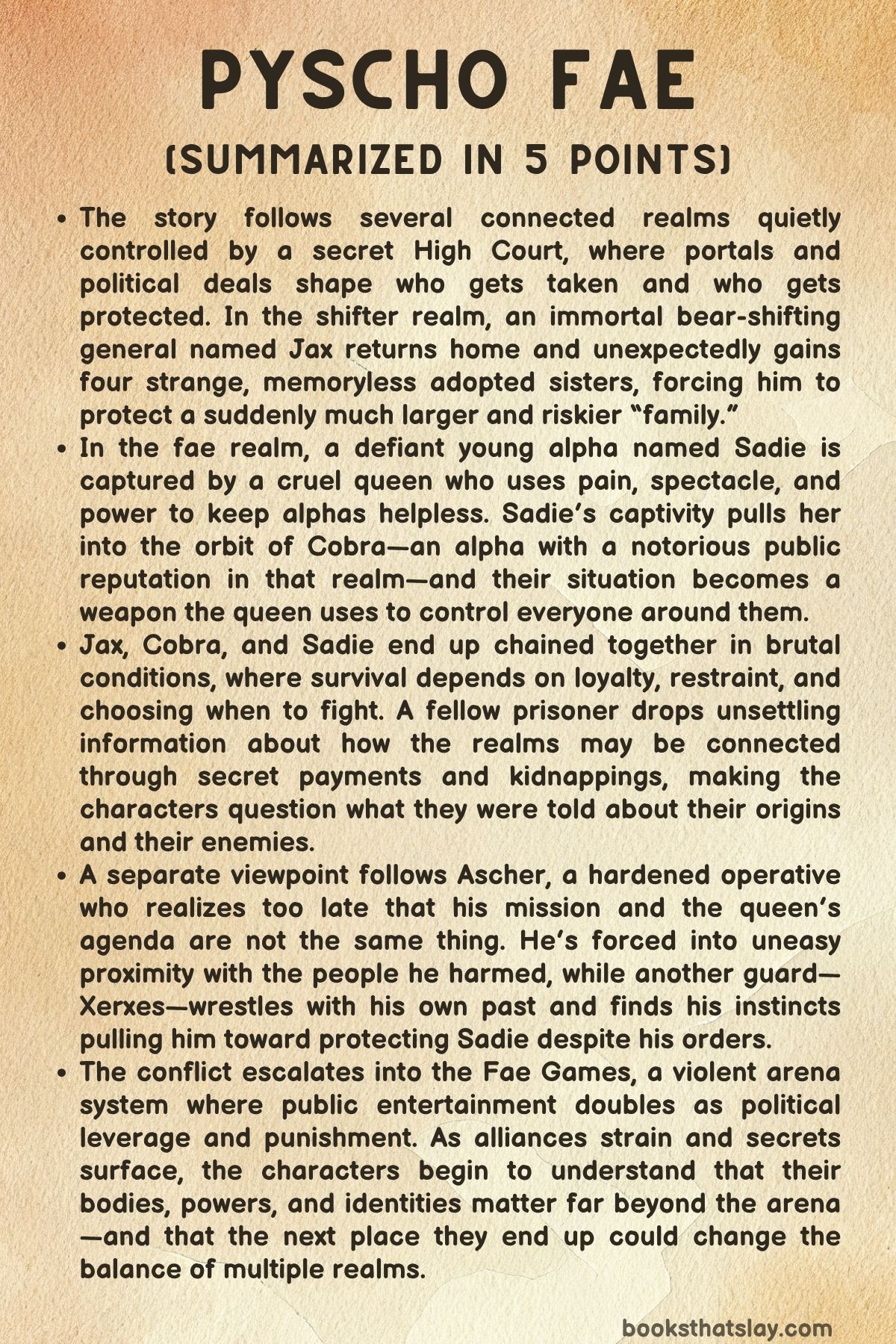
Summary
In a world of connected realms and guarded portals, Jax, an immortal alpha general who can shift into a massive bear, returns to his home in the shifter realm to see his elderly adoptive mother and his teenage sister, Jess. Jax has recently been reassigned under a new alpha, Cobra, and his thoughts keep circling around Cobra in ways he doesn’t fully name aloud.
Home should feel familiar, but something has changed: during Jax’s absence, a cloaked stranger with striking blue eyes arrived and convinced Jax’s mother to take in four orphaned girls.
The girls are unusual from the start. Red-haired twins Jen and Jan are bold and mouthy.
Pink-haired Jala is bright and sharp-tongued. Dark-haired Jinx is quiet, unsettlingly clever, and watches everything like she’s solving a puzzle no one else can see.
None of them remembers where they came from. They suspect magic was used to erase their pasts, and their “orphan” story feels staged.
Jax is alarmed by the risk of having vulnerable children in a harsh realm, but he also can’t turn them away. He accepts them as family and makes a promise to protect them, even as the stranger’s visit raises questions he can’t answer.
Elsewhere, Sadie, a young alpha shifter, wakes up naked and captive in the fae queen’s palace. Her memory snaps back in pieces: she, Cobra, and Jax were drugged; Ascher betrayed them; and Sadie was attacked by the queen’s blue fire before being dragged through to the fae realm.
The queen greets Sadie with cruelty, mocking her scars and treating her pain like entertainment. Sadie answers with pure defiance, even striking the queen, and pays for it as the queen repeatedly burns her with magic that causes agony while leaving no visible marks.
The queen makes one thing clear: alphas can’t shift in her realm unless she allows it.
Sadie learns the queen has brought Cobra back as a prized “entertainer,” a role that turns his body into a public commodity for the fae elite. The queen intends to humiliate everyone involved, especially Sadie.
Cobra, meanwhile, is forced through ritual preparation for another broadcasted performance. He remembers years of imprisonment in the fae realm and the methods used to break him.
He also remembers how he once escaped by holding a dangerous secret over the queen’s head, a secret she wants contained at any cost. Now recaptured, Cobra plans to endure whatever he must if it keeps Jax and Sadie alive.
Sadie is dragged into Cobra’s chamber as part of the queen’s spectacle. Cobra’s fury ignites when he sees Sadie’s scars, evidence of long-term abuse that goes far beyond anything the queen can understand or dismiss.
When a guard touches Sadie, Cobra kills him instantly, even though the act is being broadcast. He covers Sadie with a blanket to shield her from the audience and refuses to play the queen’s game.
Realizing they are expected to perform sexually for the realm, Cobra makes a hard choice: he knocks Sadie unconscious so the queen cannot force her into another public violation.
Cobra then tries to bargain directly with the queen, threatening to expose the secret he knows if she doesn’t release him, Sadie, and Jax. The queen responds by escalating instead of yielding.
She destroys the broadcasting crystal and announces that all three alphas will be thrown into the Fae Games, a deadly gladiatorial competition designed to produce profit and fear. Guards overpower Cobra after a vicious struggle.
Sadie wakes in the palace dungeon, chained among hundreds of prisoners in filth and overcrowding. She discovers Jax imprisoned nearby.
When Sadie mentions a guard hurt her, Jax’s protective rage detonates. He kills the guard so brutally that other prisoners begin calling him “Meat Grinder,” a reputation that becomes its own shield.
Cobra is eventually dumped into the same hellish cell, battered and bloodied. Even in that state, his first concern is whether Sadie is injured.
In the cell, Sadie finally speaks about her past. She was raised by a man named Dick in a tavern, treated as property, and punished for years starting in childhood.
Jax and Cobra immediately promise revenge, but Sadie snaps back that she doesn’t want to be spoken for, coddled, or treated like a symbol. She orders them to stop calling her “Kitten” and to stop killing in her name.
Under the tension, another detail surfaces: Sadie has felt something like a small “shadow snake” on her lower back, sending comforting signals when she’s overwhelmed, as if someone is reaching for her in the dark.
A chained prisoner near them introduces himself as Legolas, a treasurer for the High Court that secretly governs the realms. He reveals information that reframes everything: the shifter realm may have started as a prison realm long ago, and rumors suggest powerful groups have been trafficking alphas for generations.
Legolas claims the fae queen controls portals and has been paid to kidnap alpha babies—possibly from the beast realm—while other leaders pretend they’re dealing with a faceless crime network. He begs them that if they escape, they must alert a High Court representative that “Legolas, position 4444” is being held by the queen.
Sadie reels as the implications land: “orphan” stories, missing families, erased memories—none of it may have been accidental.
The story shifts to Ascher, a syndicate-trained spy and soldier. He’s furious after seeing the broadcast that exposed Cobra and Sadie to the realm’s gaze.
Ascher believed his mission was to help retrieve kidnapped alphas and return them safely. He confronts the queen, demanding the promised handoff.
The queen coolly admits she intends to profit first, then send survivors back with the truth buried. When Ascher refuses to accept that, she assigns him as a guard for the alphas in the games, forcing him to “complete” his mission under her control.
Xerxes, an omega soldier in the queen’s service who still bears injuries from Sadie’s resistance, requests to oversee them as well, claiming he doesn’t trust them.
Sadie, Jax, and Cobra are marched from the dungeon into dazzling sunlight under two suns and brought to a massive stadium blaring the Fae Games. Ascher appears, and Jax and Cobra attack him on sight.
The group is shoved into a tense arrangement: enemies by betrayal, allies by circumstance. Xerxes informs them they will fight the realm’s deadliest warriors.
Sadie refuses to forgive Ascher, blaming him for her humiliation and captivity. Cobra quietly tries to reassure her that no one will use her again, but his protectiveness arrives mixed with possessive language that makes Sadie bristle.
Inside the competitor quarters, the rules and power dynamics tighten. The alphas form an agreement that none of them will have sex with Sadie during the games, insisting it would endanger her and fracture the team.
Sadie hears it as rejection and control at the same time. She storms off, masking hurt with anger.
Xerxes, watching from the edges, becomes increasingly conflicted. His own past is revealed: he discovered late that he was a rare male omega, was sold to abusive alphas, escaped by shifting into a small white kitten, and fled through the realm-connecting subway until he ended up in the fae realm.
The queen offered him structure and survival, even if her court is cruel. Now, Xerxes finds his instincts pulling him toward Sadie because she doesn’t behave like the alphas who once owned him.
The games begin with escalating brutality. In a later match, the shifting ban is lifted.
Jax becomes an armored bear. Ascher becomes a massive ram-like beast.
Cobra struggles to fully shift but still protects the others with speed and ferocity. Sadie shifts into a saber-toothed tiger and fights through elemental chaos, taking heavy damage in the arena’s rotating battlefield.
She’s burned, wounded, and eventually impaled by an ice weapon, collapsing as the crowd chants Jax’s dungeon-born nickname. He wins by sheer violence against a dragon-shifter opponent, but the victory doesn’t erase how close Sadie came to dying.
Sadie wakes in a clinic where healers used extreme magic to repair her. A doctor is suddenly possessed and speaks a prophecy in a deep voice, warning about blood, pain, and weakness.
Afterward, the doctor returns to normal as if nothing happened. Outside, arguments erupt again—Cobra’s possessive claims push Sadie into fury, and she punches him hard enough to break his nose.
Instead of retreating, Cobra reacts with unsettling satisfaction, treating conflict like foreplay and insisting she belongs to him. Aran, the fae princess who has become Sadie’s closest friend in the realm, notes that the prophecy’s focus on blood seems connected to Sadie.
A shocking realization follows: Sadie understands words spoken in an ancient fae language. That should be impossible for a shifter.
The group begins to suspect something bigger is inside her—something tied to forbidden magic and a long-lost fae bloodline. Sadie, terrified of what it means, retreats and breaks down privately, overwhelmed by pain, uncertainty, and the sense that her identity has been manipulated from the beginning.
Later, Sadie is ambushed in a fae “clinic” in a humiliating setup that turns out to be orchestrated by Jax, Cobra, Ascher, and Xerxes. They claim it’s punishment for trying to seek comfort outside their group, warning her that any man she approaches will die and she will be disciplined.
Cobra reveals the source of the comforting “snake” Sadie has felt: he branded her with one of his shadow snakes, leaving an unseen mark on her lower back that appears as embedded emerald jewels forming a heart. He admits the snakes are not just weapons but part of him—his “jewels” are sleeping serpents, and he doesn’t have a separate shifted form because he is always a beast, hiding in plain sight.
In response, Sadie confesses her own frightening truth: in battle, a murderous “voice” can take over, turning her into a killer until it needs time to recover.
The next major event in the Fae Games brings a new threat: a vampyre judge named Lothaire arrives to evaluate competitors for an elite academy, draining those he deems unworthy. Shackled and unable to shift, the group is forced into the arena first.
Lothaire bites Jax and Ascher and dismisses them. He bites Cobra and senses something potent but still lacking.
When he turns to Sadie, her battle numbness returns—and she reaches for the brand on her back, forcing Cobra’s snake awake as Xerxes hurls daggers to help. Even so, Lothaire overwhelms them and Sadie is nearly destroyed.
In the crisis, Sadie recognizes the truth: her numb battle state is linked to an ancient blood-based fae element, a forbidden “fifth element.” She speaks a blood-song in the old language, and her power wakes fully. She senses blood like music and uses it as a weapon, turning the queen’s own body into a battlefield from within.
The queen responds by unveiling hostages to force Sadie to yield: Lucinda, Sadie’s sister; Jax’s sisters; and Dick, the abuser. The hostage threat nearly breaks Sadie’s focus—but the hostages fight back, creating a crack in the queen’s control.
Sadie commands the chains binding them. Cobra’s collar falls away, freeing him, and his jewel-snakes erupt into a storm of shadow serpents that tear through executioners in the arena.
Aran seizes the moment and attacks the queen directly, ripping out her heart and consuming it before the crowd. By the realm’s brutal tradition, that act makes Aran the new fae monarch, and the stadium kneels.
Sadie withdraws the blood she used from the queen’s corpse and collapses from the strain, barely conscious as survivors rush her to safety.
When she wakes, the group has escaped into open fields beyond the palace grounds. Aran uses an enchanted ring to shift presentation and insists they must flee before a forced coronation traps them in another cage.
Using a hidden portal inside a massive flower, they escape the fae realm—but not back to the shifter realm. They emerge in the beast realm, a modern city with a subway system.
At customs, most are processed with confusion and suspicion, but when Cobra is scanned, alarms blare. Guards demand he reveal his nature.
Once he does, they bow: they are in Serpentes City, ruled by a snake-shifter mafia Don whose only single-form alpha heir vanished a hundred years ago. The guards declare Cobra is the Don’s lost son—and the heir to Serpentes City—setting the stage for a new kind of war: not just survival, but inheritance, power, and the price of being claimed by blood.
Characters
Sadie
Sadie is the story’s emotional core in Psycho Fae, defined by a volatile mix of defiance, trauma, and an instinctive refusal to be owned. Her scars are not just backstory detail; they shape how she interprets every threat, every touch, and every claim of “protection,” making her hypersensitive to control even when it’s offered as care.
She meets humiliation with aggression because it is the only language that reliably keeps her from being reduced to an object in a system designed to consume her. What makes her compelling is the split between her outward ferocity and the private spirals—scrubbing herself raw, locking herself in bathrooms to panic, and clinging to any small anchor of safety.
As the plot escalates, Sadie’s identity fractures and then reforms around power: the “numb” battle state that once looked like a coping mechanism is revealed as something older and more supernatural, tying her survival instincts to a forbidden blood element. By the time she awakens that power, she stops being merely a victim resisting a sadistic realm and becomes an existential threat to the structure that fed on her helplessness.
Jax
Jax embodies protective violence with a surprisingly domestic heart, and the tension between those two drives is what keeps him interesting. He is an immortal alpha general and a bear shifter, but the story repeatedly frames him first as a son and brother—returning home, worrying about food and safety, and instinctively folding strangers into the category of “mine” once his mother has chosen them.
His brutality is not random; it is ritualized enforcement of boundaries in a world where boundaries are the only real currency. The “Meat Grinder” reputation grows from moments where he responds to harm against Sadie with immediate, decisive killing, and that nickname becomes a kind of language the prisoners and fae understand: hurting someone under his protection will cost you.
At the same time, he is emotionally simpler than the others—his loyalty is straightforward, his jealousy less strategic, and his tenderness shows most clearly when he reassures, checks injuries, and physically places himself between Sadie and danger. That combination makes him the group’s shield and also its blunt instrument, the one most likely to escalate conflict because he can’t tolerate watching someone he considers family be degraded.
Cobra
Cobra is written as a paradox: a sexualized spectacle forced into performance, yet also the character most obsessed with consent when it involves Sadie being exploited by others. His rage is sharpest not when he is harmed, but when he sees harm normalized—Sadie’s scars, the broadcast, the guards’ casual touch—because it mirrors his own history of being treated as a commodity.
He performs ownership language (“Kitten,” “you belong to me”) as both a protective claim and a psychological scar, blending genuine devotion with learned domination, which makes him simultaneously seductive and alarming. The reveal of his nature reframes everything: he is not a shifter with a separate beast form but a constant beast wearing a disguise, with jewel-snakes that can brand, track, comfort, and kill.
That turns “possession” from metaphor into literal bodily control, making his love language inseparable from predation. Yet he repeatedly chooses restraint when it matters most—knocking Sadie out to prevent forced public sex, threatening the queen to protect the group, enduring humiliation to keep them alive—so his arc becomes a question of whether someone built by captivity can learn to protect without controlling.
The final twist that he is a mafia heir deepens his central theme: Cobra is born for ownership structures, but he keeps colliding with Sadie, who treats ownership as the one thing she will never allow to define her.
Ascher
Ascher is the character of disciplined deception, trained to be useful to systems that treat people like assets. He carries himself with controlled calm, but his anger spikes when he realizes the “mission” narrative was a lie that enabled Sadie’s public violation and the alphas’ exploitation.
Unlike Jax and Cobra, whose loyalties are openly personal, Ascher’s loyalty starts as ideological and operational—he believes he is correcting a wrong through covert action—and then collapses into guilt when he recognizes his role in making the wrong possible. His attempt at atonement is practical rather than emotional: he inserts himself as their guard to mitigate harm, tries to manage panic, and uses dominance tools with unsettling ease.
That dominance is a reminder that even his “help” can feel like control, especially to Sadie, who experiences him as the face of betrayal. Ascher’s value to the group is strategic competence and a willingness to stand in front of consequences, but his internal conflict remains unresolved because he wants forgiveness while still operating in the same power logic that caused the damage.
Xerxes
Xerxes is the most morally ambiguous in tone yet arguably the most psychologically transparent, because his contradictions are the point: he is a guard for an abuser, but also a survivor whose definition of “safety” is warped by what he escaped. His past as a rare male omega sold into brutal pack ownership makes him deeply sensitive to coercion, and that sensitivity leaks out despite his attempts to stay cold.
He watches Sadie not like a predator choosing prey, but like someone trying to map danger signals that don’t match his expectations—she is an alpha who does not default to cruelty, and that disrupts the worldview he built to survive. His kitten shift is symbolic in a way the story uses deliberately: an identity society deems small and mockable becomes the form that saved him, and he carries that humiliation into how he responds to vulnerability in others.
Around Sadie, he becomes protective in small, deniable ways—guarding a shower, accepting bedding, using scent to de-escalate Ascher—while telling himself it’s only “mission.” Xerxes’ arc is pulled between complicity and conscience, and the more he fixates on Sadie’s distress, the more the story suggests he is inching toward a choice that will define whether he remains the queen’s instrument or becomes his own person.
The fae queen
The fae queen is not just a villain; she is a system with a face, embodying spectacle, commodification, and the weaponization of shame. Her blue fire torture is crafted to be especially cruel because it produces pain without visible burns, a mechanism that lets her deny evidence while maximizing suffering.
She rules by turning bodies into entertainment—broadcasts, sexual performance, gladiatorial games—so her power is as much cultural control as magical dominance. She understands alphas as desirable resources and designs environments where they cannot shift, cannot resist, and must perform roles that feed her economy and status.
Her threat is also political: she manipulates cross-realm kidnapping schemes through portals and payments, revealing how easily “war” narratives can disguise profiteering. She ultimately falls not because she underestimates strength alone, but because she underestimates what happens when her spectacle produces unity among the exploited, and when Sadie’s hidden element allows rebellion to become physically unavoidable.
Aran
Aran functions as both relief and knife-edge danger, presenting as playful and teasing while carrying a capacity for brutality that matches the realm’s traditions. As a fae princess and Sadie’s best friend, Aran is the first consistent emotional “home” Sadie gets inside captivity, which makes Aran’s later collaring and bruising feel like a direct attack on Sadie’s last safe attachment.
Aran’s gender presentation through an enchanted ring emphasizes fluid identity in a world obsessed with rigid hierarchies, and it also signals how performance is survival—Aran can change presentation to evade control, just as others are forced into roles. The moment Aran kills the queen, rips out her heart, and eats it is less a sudden shock than a revelation of how fae legitimacy works: rule is inherited through violence, and Aran knows exactly how to seize it.
Yet Aran immediately rejects the trap of forced coronation and chooses flight, showing a strategic self-awareness that separates them from the previous ruler. Aran’s bond with Sadie is therefore both personal and political: Aran is a friend, but also the pivot point that turns a private survival story into a realm-level upheaval.
Lucinda
Lucinda operates as Sadie’s most vulnerable tether to a past that was already painful, making her both motivation and leverage. Her existence reinforces that Sadie’s identity is not solely forged through romantic or power dynamics with the alphas; she is also a sister, protective and terrified of failing the one person she cannot replace.
When Lucinda becomes a hostage, the queen’s manipulation hits its most effective form because it forces Sadie into a choice between rage and restraint. Lucinda’s rescue is not just a plot payoff; it is proof that Sadie’s newfound power is immediately tested against the oldest fear of abused survivors: that freedom always comes with a cost paid by someone weaker.
Jax’s adoptive mother
Jax’s adoptive mother represents quiet, stubborn mercy in a world built to punish softness. By accepting four orphaned girls delivered by a suspicious stranger, she creates the story’s domestic ignition point: her compassion forces Jax to expand his idea of family beyond blood and beyond what is convenient.
She also serves as a moral contrast to the realm’s rulers—she adopts rather than purchases, shelters rather than brands. Even though she is physically vulnerable and elderly, her choice has massive consequences, implying that in these realms, power is not only magical or political; it can begin as a single act of care that refuses to ask permission.
Jess
Jess, Jax’s teenage sister, anchors the early shifter-realm segment in normalcy and affection, which makes later violence feel sharper by comparison. She is part of what Jax is trying to preserve: a home life untouched by court politics, kidnapping conspiracies, and fae spectacle.
When she later becomes one of the threatened hostages, she shifts from background warmth to high-stakes vulnerability, reinforcing that the antagonists’ reach extends into the most intimate spaces. Jess’s importance is less about direct action and more about what she represents: the family Jax is willing to become monstrous to protect.
Jinx
Jinx is framed as unnervingly intelligent, the kind of child whose silence reads as strategy rather than fear. Her lack of memories and sharp perception make her a living clue that the “orphan” narrative is fabricated, and her presence quietly supports the larger conspiracy about kidnapped alphas and wiped identities.
In a story full of loud dominance and spectacle, Jinx’s unsettling calm becomes its own form of menace—she suggests that not all danger arrives with a roar. By later appearing among the rescued hostages, she also embodies the cost of the realm’s crimes: even children are shaped into puzzles by those who profit from stolen lives.
Jala
Jala’s distinctiveness initially comes through her striking appearance and attitude, but her deeper role is to show how stolen identities fracture in different ways. Where some characters respond to memory loss with suspicion or aggression, Jala’s personality reads more expressive and openly reactive, emphasizing that trauma does not produce one uniform kind of survivor.
As part of Jax’s newly expanded family, she also tests Jax’s protective instincts: he is forced to become a caretaker, not just a warrior, and Jala helps keep that caretaking from becoming sentimental by remaining unpredictable.
Jen and Jan
Jen and Jan, the red-haired twins, amplify the theme of mirrored selves—two people sharing a look while lacking the one thing that would differentiate them internally: memory. Their twinship is a visual reminder of the story’s obsession with identity as something that can be assigned, duplicated, or erased by force.
They also intensify the sense of intrusion in Jax’s home life: four girls appear at once, and the twins in particular make that arrival feel almost orchestrated, like pieces delivered as a set rather than individuals rescued by chance. As later hostages, they reinforce the queen’s tactic of targeting symbols of belonging, because nothing threatens Sadie and Jax more efficiently than placing “family” on a blade’s edge.
Legolas
Legolas plays the classic informant role, but the story gives him a political and historical weight that makes him more than exposition. As a High Court treasurer, he represents institutional knowledge and the fragile possibility that truth can still matter in a world where everyone sells narratives.
His revelation that the shifter realm may have originated as a prison realm and that kidnapping schemes may be funded through misdirection reframes the conflict from personal betrayal into systemic rot. Legolas is also defined by desperation: he is chained, filthy, and powerless, yet still tries to send a message outward, clinging to the belief that the High Court can act if properly alerted.
He is significant because he turns the characters’ suffering into evidence, giving them a language to understand why their lives feel manufactured.
Demetre
Demetre is a spectacle-warrior shaped to match the arena’s appetite, and his presence functions as proof of how normalized lethal entertainment has become in the fae realm. His dragon shift makes him an apex threat, forcing Jax into an epic, brutal confrontation that the crowd celebrates like theater.
Demetre is less individualized than some antagonists, but that is intentional: he represents the kind of competitor produced by a system that rewards violence and turns survival into currency. His near-killing of Sadie also exists to underline a recurring point—Sadie’s survival is never guaranteed by the men around her, and even their protection can fail in an arena designed to break teams through chaos.
Ryak
Ryak is one of the sharper, more personal dangers in the arena sequence because his violence feels tactical rather than theatrical. By impaling Sadie with an ice spear, he becomes the moment where play-fighting ends and the cost of underestimating the games arrives in her body.
In Psycho Fae, Ryak’s function is to force the group dynamic into its rawest form: Ascher’s intervention, Jax’s rampage, Cobra’s vulnerability, and Sadie’s collapse all pivot around this injury. He embodies how quickly the games punish hesitation and how easily Sadie can be turned from participant into casualty.
Lothaire
Lothaire is a different category of threat: not arena chaos, but judgment masquerading as selection. As a vampyre who drains competitors and decides who is “elite,” he embodies predation with institutional legitimacy, turning feeding into an audition process.
His calm dismissal of Jax and Ascher, and his near-approval of Cobra, exposes how arbitrary and cruel “worthiness” becomes when defined by monsters. With Sadie, he becomes the trigger for the story’s biggest power shift—his bite forces her into the edge where the forbidden element surfaces, and his refusal to fall even when attacked shows that brute force is not enough without something fundamental changing inside her.
Lothaire’s role is to push the narrative from survival to revelation, from fighting to awakening.
Dick
Dick is the most human, mundane evil in the story, and that is precisely why he is horrifying. He represents the childhood abuse that predates fae politics and proves Sadie’s suffering wasn’t created by magic alone—it existed in ordinary spaces where no queen needed to order it.
His whipping, his attempt to “beat the sass out” of a child, becomes the origin of Sadie’s reflexive defiance and her disgust at anyone who interprets her survival as something to be controlled. When the queen later uses him as a hostage, it becomes a particularly vicious psychological tactic: forcing Sadie to confront the fact that her abuser still has narrative power over her life.
Dick is a reminder that even if you kill a ruler, the imprint of cruelty can persist in the body and mind.
Themes
Autonomy Under Systems of Ownership
Control over bodies is treated as currency across the realms in Psycho Fae, and the story keeps returning to the question of who gets to decide what happens to a person. The fae queen’s rule is built on the idea that power includes access: access to other people’s pain, their humiliation, their sexuality, and even their ability to shift.
Cobra’s history as a forced “entertainer” shows a version of captivity where survival requires performing submission while privately planning resistance. Sadie’s capture turns autonomy into a public issue rather than a private one; the humiliation isn’t only that she is harmed, but that strangers are invited to witness it and participate by watching.
Even small acts—Cobra wrapping her in a blanket, knocking her unconscious to block the spectacle—become loaded because they exist on a thin line between protection and control. That tension expands when the men decide on a “sex pact” without Sadie’s input.
Their intent is safety and strategy, but it still repeats a pattern she has known her whole life: decisions made about her, justified as necessary. The later “punishment” scene at the clinic sharpens this theme into something uncomfortable and direct.
What they call protection is enforced through coercion and surveillance, including a hidden brand that tracks and marks her body as claimed. The story refuses to make autonomy a simple slogan; it shows how easily “I’m keeping you safe” can become “I get to set the rules,” especially in relationships formed under extreme pressure.
In that way, captivity is not only a physical condition in the dungeons and games, but a social habit that characters have to unlearn if they want something better than the regimes they are fighting.
Trauma, Shame, and the Politics of the Scarred Body
Sadie’s scars are not just backstory detail; they function as a social battleground where cruelty, desire, disgust, and solidarity all collide. The fae queen weaponizes Sadie’s history by turning her body into evidence meant to shame her publicly, as if the marks of abuse are a personal failure rather than proof of survival.
The constant emphasis on visibility—broadcasts, crowds, uniforms that don’t fit, the gown slipping open—shows how trauma is repeatedly reactivated when control over one’s appearance is taken away. Sadie’s coping strategies also feel shaped by this history: she uses aggression and sarcasm to maintain distance, but the moments where she obsessively scrubs herself raw reveal a different truth—an attempt to reclaim ownership through ritual, cleanliness, and pain she can choose.
Other characters respond to her scars in ways that reveal their own values and damage. Cobra’s immediate rage reads as empathy, but it also becomes possessive, as though the horror of what happened to her grants him the right to decide how no one will ever touch her again.
Jax’s protectiveness similarly risks turning her into a symbol that justifies violence. Sadie pushes back, demanding they stop killing on her behalf, because she recognizes how quickly her suffering can become someone else’s excuse for domination.
The story also links trauma to performance in combat: Sadie can enter a numb state that makes her frighteningly effective, suggesting that survival sometimes requires shutting down parts of the self. That state is later revealed to be connected to forbidden power, which adds a troubling implication: the same inner mechanisms that helped her endure abuse can also make her dangerous.
Instead of treating healing as a neat progression, the narrative shows it as uneven, angry, and full of contradictions—wanting care while rejecting control, wanting intimacy while expecting harm, wanting to be seen while fearing the gaze. Sadie’s body becomes a site where the world tries to assign meaning, and her real fight is to choose her own meaning anyway.
Identity, Erased Histories, and the Shock of True Lineage
The story is crowded with people who have been mislabeled, stripped of context, or rewritten by institutions that benefit from confusion. The orphaned girls delivered to Jax’s mother arrive with wiped memories, and their existence immediately raises the question of how many lives have been edited to serve a political economy of kidnapping and trade.
Sadie’s realization that her “orphan” status may be manufactured reframes her entire identity as a product of a trafficking system rather than a tragic accident. This theme expands through Legolas’s revelations about prison realms, portal control, and the quiet business arrangements between supposedly opposing powers.
What makes it land is that identity loss isn’t only emotional—it is administrative. Paperwork, labels, and official stories become tools of domination.
If a realm can decide who your parents were, what species you are, and where you belong, it can decide what you are worth. The characters’ bodies carry evidence that contradicts their assigned narratives: Sadie understands an ancient language she “shouldn’t” understand; Cobra’s true nature is hidden beneath a socially acceptable presentation; Xerxes’s late discovery that he is an omega shows how even biology becomes a category used to control futures.
When the forbidden blood element awakens in Sadie, identity turns from personal mystery into political threat, because it challenges what fae society claims is possible. Power and identity become inseparable: once you can do something the regime says cannot exist, you become proof that the regime lies.
The final reveal about Cobra’s lineage—recognized as an heir lost for a century—pushes the theme into inheritance and destiny, but with a twist: lineage is not a comforting homecoming; it is another set of expectations, alarms, and claims. Discovering who you are rarely brings peace.
It brings new factions that want to own the story of you, and it forces characters to decide whether identity is something uncovered or something chosen in defiance of what others demand.
Spectacle, Propaganda, and Violence as Entertainment
Public entertainment in the fae realm is not a side feature; it is the engine of social control. The queen’s broadcasts and the Fae Games turn suffering into content, and content into legitimacy.
When a million spectators chant for blood, the story shows how violence becomes normalized when it is packaged with music, screens, costumes, and a confident moderator’s voice. The crowd isn’t just watching; they are being trained.
Every match teaches them who is disposable, what cruelty is acceptable, and which bodies are allowed to be harmed for pleasure. The Games also function as propaganda because they rewrite the captives’ identities in real time: Jax becomes “Meat Grinder,” reduced to a brand that flatters brutality; Cobra becomes a product whose humiliation is meant to erase his personhood; Sadie becomes a target the crowd is encouraged to hate.
Even medical spaces are folded into spectacle—the clinic is both healing station and stage for possession-prophecy and sexual punishment. That blending suggests a world where no institution is neutral; everything is either content or collateral.
The queen’s rule relies on the assumption that fear is more effective when it is public, because public fear discourages private resistance. Yet the same spectacle system carries the seeds of its collapse.
Broadcasts spread information the queen cannot fully control: Cobra’s refusal, the visible reality of Sadie’s scars, and later the emergence of the forbidden blood power. The arena is designed to demonstrate the queen’s dominance, but it also gathers all the pieces of her story in one place—hostages, collars, chains, crowds—so a single disruption can flip the meaning of the entire event.
Aran ripping out the queen’s heart in front of everyone is not only assassination; it is a hostile takeover of the realm’s narrative rules, using their own public tradition against them. The story highlights an uncomfortable truth: when a society builds itself on watching pain, it can be redirected just as easily as it can be managed.
Spectacle is unstable. It can crown monsters, but it can also expose them, especially when the people forced onto the stage stop performing the roles written for them.