Romance Is Dead Summary, Characters and Themes
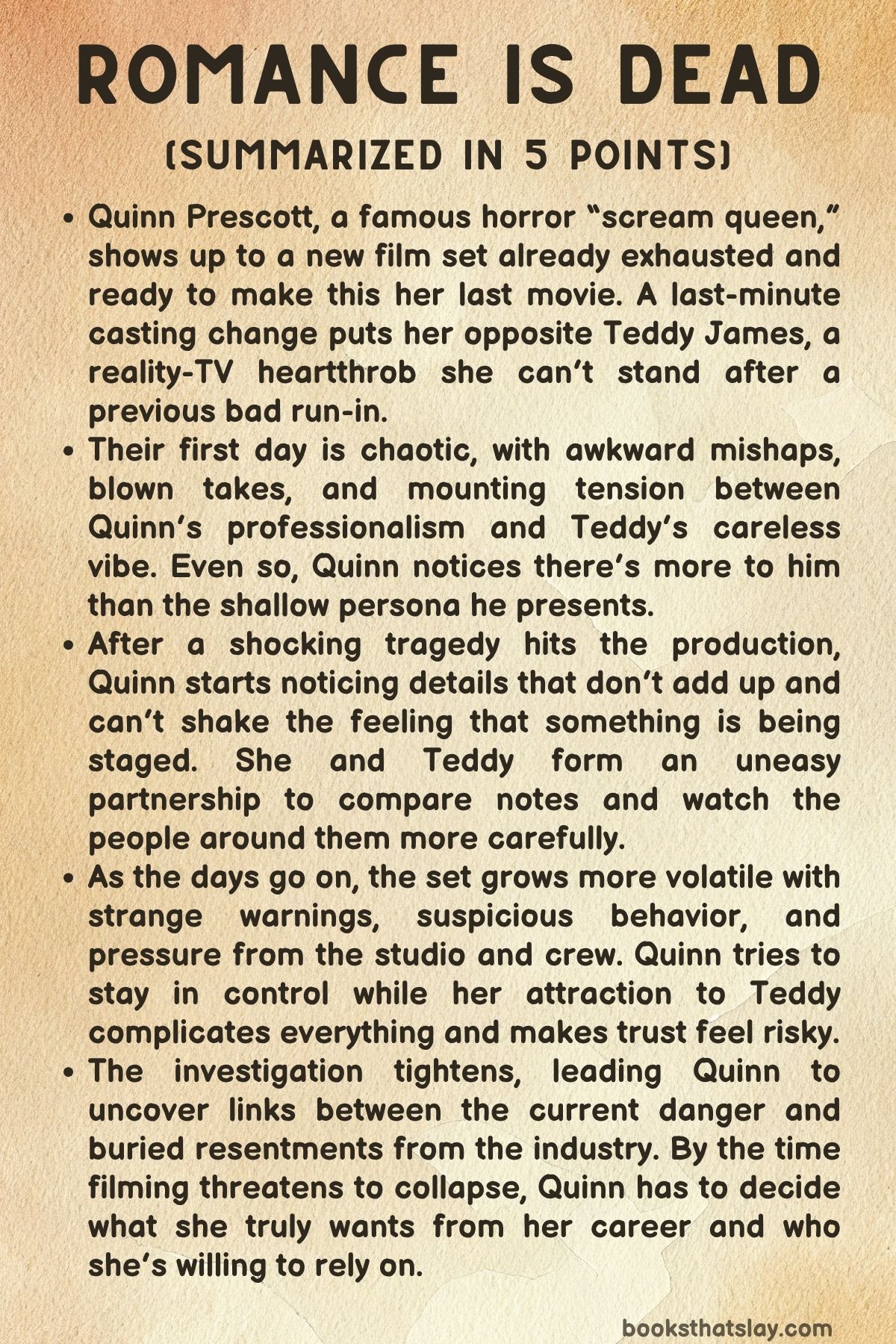
Romance Is Dead by Katie Bohn is a romantic thriller set on a chaotic horror-movie production in the Virginia mountains. Quinn Prescott, a veteran scream queen, shows up tired, hungry, and ready to make this her final film before walking away from Hollywood.
Then the studio replaces her co-star with Teddy James, a reality-TV heartthrob Quinn already can’t stand. When a crew member turns up dead on set, Quinn’s exit plan collapses into a dangerous mess of secrets, sabotage, and unwanted attraction. The story balances behind-the-scenes filmmaking stress with escalating danger and a romance that keeps showing up at the worst possible moments.
Summary
Quinn Prescott arrives late to the first day of filming House of Reckoning, a new horror movie shooting near the Virginian mountains. A production assistant named Trevor shuttles her through the woods to a Gothic mansion dressed as a party-house location.
Quinn is running on fumes and already sure of one thing: after this movie, she’s done with acting. The last year has been brutal, and she’s tired of the industry, the scrutiny, and the sense that her career has slid into a place she never wanted.
On set, Quinn reunites with her best friend Mara, the makeup artist, who immediately clocks how serious Quinn is about quitting. Mara also drops a surprise: Quinn’s co-star was replaced at the last minute after an accident, and the replacement is Teddy James—a smug reality-show celebrity known for Pleasure Island Paradise.
Quinn’s stomach drops because she’s met Teddy before, and it went badly enough that she wants nothing to do with him.
Their day gets worse fast. Trevor accidentally spills scalding coffee all over Quinn, and in the scramble to get her soaked sweater off, she ends up exposed in front of people she’d rather not flash.
Teddy steps in to help, acting like they’re strangers, then slides straight into crude flirting that leaves Quinn furious and flustered at the same time. When filming begins, Teddy proves he’s unprepared: he forgets lines, misses cues, and wrecks a complicated take involving a stained-glass lamp.
The mistake triggers a chain reaction—props are destroyed, people get knocked around, and the director Natasha Vossey storms off. Quinn confronts Teddy for treating everyone else’s work like it doesn’t matter, but he shrugs it off, claiming the paycheck is what counts.
That night, Mara tries to pull Quinn into the usual first-night cast party, but Quinn retreats to her trailer instead, crocheting to calm down. Curiosity gets the better of her and she watches Teddy’s reality show, which only deepens her irritation.
Teddy shows up at her trailer door to apologize, but he ruins the moment by insisting he’ll do the minimum required and still be fine. Quinn leaves for the hotel to escape him—and then everything turns.
Walking through the dark base camp, Quinn nearly steps into a ditch and spots a body below. She and Teddy call 911 and scramble closer.
It’s Trevor, bleeding badly and already gone. Quinn notices something that makes her skin go cold: Trevor’s distinctive friendship bracelet—the one he said he never removed—is missing.
Police question them, and Teddy’s careless comments make Quinn look suspicious, which adds rage to her shock.
The next morning, Natasha tells the production that Trevor’s death is being treated as an accident, and filming continues despite the unease hanging over everyone. During lunch, Chloe—a younger actress thrilled to be there and eager to bond—talks to Quinn about an upcoming scene where her character falls and hits her head.
The detail hits Quinn hard because Trevor’s death seems to echo the movie’s planned “accident.” Quinn returns to the ditch and notices the safety fencing doesn’t look torn down by chance. It appears carefully cut and moved, as if someone cleared the path on purpose.
At the hotel, Quinn digs through Trevor’s social media and finds a selfie taken the evening he died. In the background, she spots a blurry face near the props area, watching Trevor with an intensity that feels wrong.
Quinn takes the evidence to Teddy. He’s skeptical and distracted, but he admits he panicked on set because he actually wants to prove he can act and hates feeling incompetent.
Quinn proposes a trade: he helps her investigate Trevor’s death, and she helps him become good enough that the production can survive. Teddy agrees, and they start by trying to identify the face in the photo.
They meet early to rehearse scenes, and Quinn begins compiling a suspect list, refusing to give anyone a free pass—not even herself, not even Teddy, and not even Mara. Their coaching sessions improve Teddy’s performance, and the time together starts shifting the tone between them.
During rehearsal, Quinn realizes a scene has been rewritten to include a lap dance. Annoyed but determined not to look rattled, she demonstrates she can handle it—first turning it into a joke, then landing in a charged, quiet moment when the music stops and they’re suddenly too close.
They nearly kiss, but Quinn snaps out of it and pulls away, reminding herself that attraction can be expensive in her world.
Quinn visits her father, a retired horror icon known as Puzzle Face, at his cabin. Going through an old scrapbook, she finds a cast-and-crew photo from his early career and recognizes the same face from Trevor’s Instagram background: Scott Rossi, the current props master.
Her father warns her Scott has a history of violence and resentment tied to being fired years ago, and Quinn returns to set convinced Scott is her first solid lead.
Soon after, a message appears on set: graffiti reading Run, Rabbit with a symbol Quinn recognizes from one of her older cult movies. It feels aimed at her personally.
Quinn and Teddy decide to sneak into the props trailer that night. Inside, Scott is working and blasting classical music.
When Quinn spots what looks like a severed head on his bench, she panics—only to learn it’s a prop. Scott produces receipts suggesting he wasn’t near the ditch when Trevor died, but he mentions a chilling detail: before leaving that night, he saw someone watching from the attic window.
That clue pushes Quinn and Teddy into the attic. There, they find signs someone recently hid out—trash, a sweatshirt placed where it could be grabbed fast, and a cleared patch of dust.
The sweatshirt appears to belong to Brent, a cast member Quinn has worked with before. Threatening rhyming notes also begin appearing, warning Quinn to stop investigating or she’ll die.
Brent confronts Quinn, furious that rumors are spreading, and his odd certainty about the threats makes Quinn wonder what he knows.
Then the violence escalates. At lunch, Brent steals Quinn’s labeled meal and eats it.
Seconds later, he collapses from an allergic reaction. Quinn realizes peanuts were mixed into her food despite a clear “no peanuts” label.
The tampering looks intended for her, but Brent dies instead. Teddy helps Quinn through a panic spiral, and they finally go to the police with the notes.
Detective Larry scolds Quinn for waiting but agrees the threats are serious and starts interviewing the set.
During the pause, Quinn and Teddy grow closer in ways Quinn doesn’t want to name. A closed-set intimacy scene pushes them into something physical, and afterward Quinn struggles with the aftermath—desire tangled with fear of public fallout and past experiences she doesn’t want repeated.
While searching for a missing wig in a spare room, they overhear Audrey, the actress playing the witch, speaking on the phone. Her accent slips from British to American mid-sentence.
When she passes, Quinn spots Trevor’s missing friendship bracelet on Audrey’s wrist, linking Audrey directly to Trevor’s final night.
Before Quinn can decide what that means, another “accident” nearly kills her. A heavy tree limb breaks and crashes down during filming, and Teddy yanks Quinn out of the way just in time.
Audrey is injured badly, and a medic recognizes her as Addie Abrams, an actress with a messy past who’s been hiding behind a new identity. Quinn’s hotel room is later trashed, with a message left behind promising the threat is still active.
Shaken, Quinn stays in Teddy’s room, where emotional closeness starts to match the physical.
Production is abruptly shut down, and tensions explode. Mara, already hurt by personal news and by Quinn’s secrecy, gives Quinn an ultimatum about their living situation back in LA.
Then a TMZ story drops photos of Quinn and Teddy kissing, including an image that appears to come from Teddy’s phone. Quinn assumes Teddy sold them out for attention—especially with his reality-TV future—and she storms off, feeling humiliated all over again.
At her father’s cabin, Quinn replays everything and tries to quit acting for good, but one more shock hits: a photo reveals Teddy tied to a chair, and a message warns Quinn that calling the police will get him killed. Quinn pulls Mara into the truth, returns to the set, and searches the attic.
She finds Teddy bound—and Chloe waiting with a gun. Chloe drags them into a hidden basement filled with Quinn’s posters and stolen items, confessing she idolized Quinn, resented her, and believed Quinn stole the lead role from her.
Chloe meant to hurt Quinn, but in the dark she killed Trevor by mistake. She later killed Brent to silence him and manipulated Audrey by exploiting her hidden identity, even using Trevor’s bracelet as leverage.
When police arrive, Chloe tries to misdirect them, but Mara’s actions force officers back inside. Quinn fights free, knocks the gun away, and Chloe is arrested.
In the aftermath, Teddy explains he suspects Natasha had access to his phone and used it to leak the selfie for publicity, possibly arranging other photos too.
With the killer caught, Quinn and Teddy finally stop circling the obvious: they care about each other, deeply. Quinn admits she isn’t ready to disappear, just ready to change.
Two years later, she has moved into directing and finishes her first film, with Teddy steady at her side. He proposes in a way that fits them—playful, supportive, and certain—and Quinn says yes.
Characters
Quinn Prescott
In Romance Is Dead, Quinn Prescott is a layered protagonist whose journey blends vulnerability, resilience, and self-reinvention. A longtime horror actress known as a “scream queen,” Quinn begins the story emotionally exhausted and ready to abandon Hollywood after a demoralizing year.
Her decision to make this film her last reflects not only burnout but a deeper crisis of identity—she has long lived in the shadow of both her father’s horror legacy and her own public scandals. Throughout the novel, Quinn oscillates between guarded cynicism and aching loneliness, particularly in her resistance to trusting Teddy or confiding fully in Mara.
Her instinct to investigate Trevor’s death demonstrates her intelligence, persistence, and moral courage, especially when others are content to accept convenient explanations. At the same time, her panic attacks, jealousy, and fear of public humiliation reveal unresolved trauma tied to fame and past relationships.
By the end of the novel, Quinn evolves from someone trying to escape her career to someone reclaiming creative control, transitioning into directing. Her arc is ultimately about agency—over her profession, her narrative, and her heart.
Teddy James
Teddy James initially appears as a superficial reality television heartthrob whose charm masks carelessness and ego. However, as the story unfolds, his character complicates that first impression.
Though he begins as unprepared and unserious about the film, his willingness to admit insecurity—particularly his confession that he freezes under pressure—reveals a deep vulnerability beneath the bravado. Teddy’s humor and flirtation often function as defense mechanisms, shielding him from judgment and rejection.
His therapy background and knowledge of coping techniques like box breathing signal emotional self-awareness, contrasting with Quinn’s more avoidant tendencies. While he occasionally undermines serious moments with jokes, he consistently shows up when it matters most: supporting Quinn through panic attacks, helping her investigate danger, and ultimately risking his life.
His motivations for fame—financial support for his mother rather than vanity—further humanize him. Teddy’s arc is one of redemption and authenticity; he grows from a man perceived as shallow into a steady, emotionally available partner capable of love and commitment.
Mara
Mara serves as Quinn’s best friend, emotional anchor, and occasional moral challenger. As the on-set makeup artist, she exists in the background of the film production, yet she remains central to Quinn’s emotional life.
Mara’s loyalty is fierce, but it is not unconditional—she demands reciprocity and honesty. Her heartbreak over her ex, Austin, parallels Quinn’s romantic turmoil, yet Mara confronts her feelings more directly.
When she senses Quinn withdrawing or hiding information, she reacts with hurt rather than passive acceptance. This tension underscores the realism of their friendship; it is deep but imperfect.
Mara ultimately proves indispensable by believing Quinn’s confession about Teddy’s abduction and helping bring the police to the scene. Her insistence that Quinn examine her emotional avoidance forces Quinn to confront her fear of intimacy.
Mara embodies grounded realism amid escalating chaos, serving as both confidante and conscience.
Chloe
Chloe is one of the novel’s most psychologically complex figures, evolving from an anxious young actress into the story’s primary antagonist. Introduced as nervous and eager to connect, she initially appears vulnerable and insecure about her first major role.
Her curiosity about Trevor’s death and her fear regarding dangerous scenes cleverly position her as sympathetic. However, this façade conceals deep resentment and obsession.
Chloe once idolized Quinn and believed she deserved the lead role in the film, interpreting Quinn’s casting as a personal theft. Her motivations stem from a toxic mixture of envy, delusion, and entitlement.
When she accidentally kills Trevor in a botched attempt to harm Quinn, she doubles down rather than confessing, spiraling into further violence by murdering Brent to silence him. Her manipulation of Audrey and calculated planting of threatening notes reveal strategic thinking beneath her emotional instability.
Chloe represents the destructive side of fandom and ambition—what happens when admiration curdles into obsession and self-pity transforms into violence.
Brent
Brent initially appears as a relaxed, familiar presence in Quinn’s professional world. Having worked with her before, he provides a sense of continuity and mild comfort on set.
However, his increasingly erratic behavior raises suspicion and complicates his role. His confrontational interaction with Quinn about rumors and his cryptic warnings suggest knowledge he never fully explains.
Brent’s death, caused by eating food laced with peanuts meant for Quinn, transforms him into both victim and tragic collateral damage. His allergy mirroring Quinn’s heightens the dramatic irony of the poisoning attempt.
Brent’s function in the narrative lies largely in redirection; his volatility makes him a plausible suspect while also demonstrating how paranoia spreads in a confined environment. Ultimately, he represents unintended consequences—an innocent caught in the crossfire of someone else’s vendetta.
Audrey / Addie Abrams
Audrey, later revealed as Addie Abrams, embodies reinvention taken to deceptive extremes. Presenting herself with a British accent and a new identity, she attempts to escape the mockery tied to her failed horror spoof career.
Her hidden past introduces themes of shame and second chances. The discovery of Trevor’s bracelet in her possession makes her appear deeply suspicious, yet her involvement stems from blackmail rather than murderous intent.
Audrey’s fractured accent under stress symbolizes the instability of her constructed persona. While not the killer, she participates in concealment, allowing fear to override integrity.
Her character illustrates how desperation to rebuild a career can lead to moral compromise, even if not outright violence.
Scott Rossi
Scott Rossi, the props master with a violent past, initially appears to be the most obvious suspect. His history of aggression and resentment toward Quinn’s father create a compelling motive rooted in bitterness.
The eerie imagery of him working with realistic severed props and wielding a scythe reinforces his threatening presence. However, Scott ultimately proves to be a red herring.
His documented alibi and claim about seeing someone in the attic provide crucial investigative leads rather than incriminating evidence. Scott represents the danger of assumptions—his rough demeanor and past misconduct make him easy to blame, but he is not responsible for the crimes.
His presence underscores how past mistakes can permanently stain a reputation, regardless of present innocence.
Natasha Vossey
Natasha Vossey, the film’s director, is intense, ambitious, and deeply invested in completing the production despite mounting chaos. Her temper and pressure-driven management style create an atmosphere of stress that exacerbates tensions on set.
She is pragmatic to a fault, resuming filming quickly after Trevor’s death and prioritizing the schedule over emotional well-being. Her possible involvement in leaking photos to the press highlights her willingness to manipulate scandal for publicity.
Though not physically violent, Natasha embodies the exploitative side of the entertainment industry—one that capitalizes on drama and personal turmoil. She functions as a symbol of systemic pressure within Hollywood, contrasting Quinn’s eventual move toward creative control and healthier leadership.
Trevor
Trevor, the young production assistant whose death sets the plot in motion, serves as the emotional catalyst for the story. Though his screen time is limited, small details—like his missing friendship bracelet and social media activity—humanize him and drive the mystery forward.
Trevor’s accidental death at Chloe’s hands is tragic precisely because he is innocent and enthusiastic. His presence in the Instagram photo becomes the thread Quinn pulls to unravel the truth.
Trevor represents the often-overlooked crew members who operate behind the scenes, and his loss underscores the real stakes beneath what initially seems like industry melodrama.
Quinn’s Father
Quinn’s father, a retired horror icon known as Puzzle Face, provides warmth, wisdom, and grounding perspective. Living in seclusion, he represents a version of fame survived and left behind.
His protective instincts and candid warnings about Scott demonstrate both experience and paternal care. Importantly, he never pressures Quinn to remain in acting, instead supporting her autonomy.
His scrapbook and old cast photos become key narrative tools that help Quinn identify connections and ultimately recognize the killer. As a character, he embodies stability and unconditional support, offering Quinn a model of life beyond public validation.
Together, these characters in Romance Is Dead create a layered narrative that blends romance, satire of Hollywood, and psychological suspense. Each individual contributes not only to the mystery but to Quinn’s emotional transformation, culminating in her reclamation of identity, love, and creative power.
Themes
Reinvention after public life stops feeling safe
Quinn arrives on set already convinced she is done with Hollywood, and that decision isn’t framed as a dramatic career pivot so much as a survival response to accumulated exhaustion, humiliation, and a sense that her public persona has swallowed her private self. Being a “scream queen” once gave her a clear identity and a reliable place in the industry, but the story shows how that label also becomes a trap: people treat her as durable, disposable, and always available for one more scene, one more embarrassment, one more headline.
Even before the murders, Quinn’s day is shaped by small violations that feel routine to everyone else—arriving hungry and overlooked, being scalded and half-undressed in front of coworkers, then having her discomfort turned into banter. Those moments build the emotional logic for reinvention: quitting isn’t about lack of talent, it’s about refusing to keep paying the same price for access and relevance.
The danger escalates into literal threats, but the more lasting harm is the constant pressure to keep functioning publicly while privately unraveling. When production collapses, Quinn is forced to confront a fear she didn’t anticipate: that she might miss acting, not because the system was good to her, but because performance gave her structure, purpose, and proof that she mattered.
That tension makes her eventual path feel earned. Reinvention in Romance Is Dead isn’t portrayed as a clean break; it’s a messy process of separating craft from industry, passion from punishment, and ambition from the need to be liked.
Quinn’s shift into directing becomes the clearest expression of control returning to her hands. Instead of being the body on camera expected to absorb risk and commentary, she becomes the decision-maker shaping risk, story, and set culture.
The ending doesn’t pretend the past disappears; it argues that reinvention is possible when someone stops accepting a role others wrote for them and starts choosing the conditions under which they will create.
Power, professionalism, and the violence of being treated as replaceable
The production environment runs on hierarchies that feel normal until the plot forces them into the open. A young assistant like Trevor exists at the bottom of that ladder, expected to move fast, fix problems, and absorb blame without protection.
When the lamp breaks, the outrage falls hardest on the people with the least power, and the story makes a point of showing how quickly human beings become “costs” on a set. After Trevor dies, the decision to keep filming carries the ugliest implication: grief is inconvenient, and the schedule matters more than the person who just vanished from the working world.
That choice isn’t simply callous; it exposes how professionalism can be used as a moral shield. People act as if continuing production is strength, as if stopping would be weakness, as if the machine must run because too much money is at stake.
The same logic makes it easy to dismiss warning signs, delay involving police, and treat threats as drama until bodies pile up. Quinn’s anger at Teddy for being unprepared isn’t only about lines; it’s about what his carelessness costs everyone else.
He can treat the job as a paid appearance because his celebrity insulates him from consequences, while the crew is left cleaning up the damage and facing the director’s rage. That contrast turns the set into a miniature model of how status works: those with leverage can be messy and still protected, while those without it are one mistake away from being shouted at, fired, or worse, forgotten.
The murders intensify the theme because the killer exploits the environment’s habits: late nights, isolated spaces, people moving around unseen, and the assumption that accidents happen on sets. Even the marketing ecosystem becomes part of this power story.
Images leak, a narrative forms online, and Quinn is pushed into defending herself yet again. The story suggests that in a world built on visibility, power often belongs to whoever can control the story people believe.
By the time Quinn suspects that someone higher up may have used Teddy’s phone and fed the press, the theme is clear: professionalism and publicity are tools, and they can be used against the very people whose work keeps the production alive. The novel uses the film set not just as a backdrop for suspense, but as a system where exploitation can look like normal business until it becomes lethal.
Trust under pressure and intimacy that requires accountability
Quinn and Teddy begin with disdain, suspicion, and a history that makes her feel exposed around him. The story doesn’t ask the reader to accept their connection as inevitable; it shows how trust is negotiated through repeated tests, especially when danger makes every interaction feel like evidence.
Teddy’s early behavior—flirting that lands as crude, an apology that undercuts itself, a casual attitude toward mistakes—fits Quinn’s expectation that he is selfish and performative. What changes the dynamic isn’t a sudden revelation of hidden goodness; it’s the gradual appearance of accountability.
Teddy admits he froze under pressure, shows up to rehearse, accepts coaching, and starts offering care in ways that cost him something—time, pride, comfort, and eventually safety. Quinn, for her part, has to confront how her own protective instincts can become a form of control: she wants to manage the investigation, manage the narrative, manage her feelings, and keep every risk contained.
The relationship grows in the exact spaces where that control fails. Panic attacks, the fear after Brent’s death, the violation of her room being ransacked—these moments force Quinn to accept help without turning it into a transaction.
Teddy’s use of therapy tools like controlled breathing and his calm, practical support reframes him from “headline guy” to someone who has actually built coping skills and knows what it means to take responsibility for mental health. At the same time, the story is careful about the costs of intimacy in a public-facing life.
Quinn’s past scandal makes her read desire as danger, not because she doesn’t want it, but because she understands how quickly it can become content for other people. The leaked photos become the ultimate stress test: trust isn’t measured by chemistry, it’s measured by what each person believes when humiliation returns.
Quinn’s first instinct is self-protection through accusation, and Teddy’s response is not perfect control but persistence and clarity about what he did and didn’t do. By the end, trust is rebuilt not by grand romance speeches but by solving the central violation: someone used their proximity to steal images, manipulate perception, and weaponize intimacy.
The story argues that love in a media ecosystem can’t survive on attraction alone; it needs boundaries, honesty about motives, and the willingness to be accountable even when it would be easier to retreat into persona. The proposal in the epilogue lands because it comes after a shift from spectacle to partnership, with Quinn’s directing career symbolizing that she is no longer dating inside someone else’s storyline.
Obsession, fandom entitlement, and the urge to punish an idol for being human
The reveal that Chloe is the killer reframes earlier interactions as a study in how admiration can rot into grievance. Chloe enters the production as a younger performer who appears earnest, nervous, and eager for connection, and the story uses that mask to show how easily insecurity can be mistaken for innocence.
Her obsession is built on a familiar fantasy: if you love someone’s work enough, you deserve proximity to them, and if you don’t get it, you’ve been wronged. That logic turns an idol into a possession.
Chloe doesn’t just want success; she wants the specific life she imagined she was owed, and she chooses Quinn as the person who “stole” it. The theme becomes especially sharp because Quinn is not a distant pop star in Chloe’s mind—Quinn is a horror icon whose persona invites devotion and identification.
Chloe’s basement shrine of posters and stolen items makes the point bluntly: this isn’t admiration, it’s consumption. Quinn is reduced to imagery, trophies, and a story Chloe tells herself about replacement and betrayal.
The violence follows the same pattern. Trevor’s death begins as a mistake made in the dark, which matters because it shows how obsession doesn’t start with a plan to kill; it starts with a willingness to cross lines, to scare someone, to control them “just a little,” and then to justify whatever happens next.
Once the first boundary is broken, Chloe’s choices escalate into calculated harm—poisoning, threats, abduction—because preserving her fantasy becomes more important than other people’s lives. The story also highlights how obsession feeds on institutions that already treat people as interchangeable.
If a production can swap co-stars overnight and keep rolling after a death, it becomes easier for someone like Chloe to believe the world will keep moving no matter what she does. Her sense of entitlement is mirrored by a broader culture that turns actors into targets for projection: audiences can idolize them, mock them, cancel them, or pity them, often without seeing them as full people.
That’s why the “Run, Rabbit” message hits so hard. It isn’t just a threat; it is a fan using Quinn’s own legacy as a weapon, proving that the boundary between performance and personal safety has collapsed.
The novel treats obsession as a form of distorted intimacy: the obsessive person believes they know the idol, believes they have been personally injured, and then feels justified in punishment. Chloe’s defeat requires Quinn to reject that script completely.
Quinn survives by refusing to play the helpless icon in Chloe’s private movie, reclaiming agency through quick thinking and physical action, and then rebuilding a life where her identity is not up for ownership by strangers.