Rook and Rebel Summary, Characters and Themes
Rook and Rebel by Kate Crew is a dark, fast-paced romance set in a city where money, power, and violence sit close to the surface. Rook runs a motorcycle shop that doubles as the front for his crew’s illegal work—debt collection, information trading, and enforcement for bigger players.
Regan Fletcher is the sheltered daughter of the city’s most polished public figure, a security-company kingpin with secrets behind every locked door. When Rook and Regan collide over a debt, the attraction is immediate—but so is the danger, because Regan’s last name is tied to the tragedy that shaped Rook’s life. The book kickstarts the Mavericks series by the author.
Summary
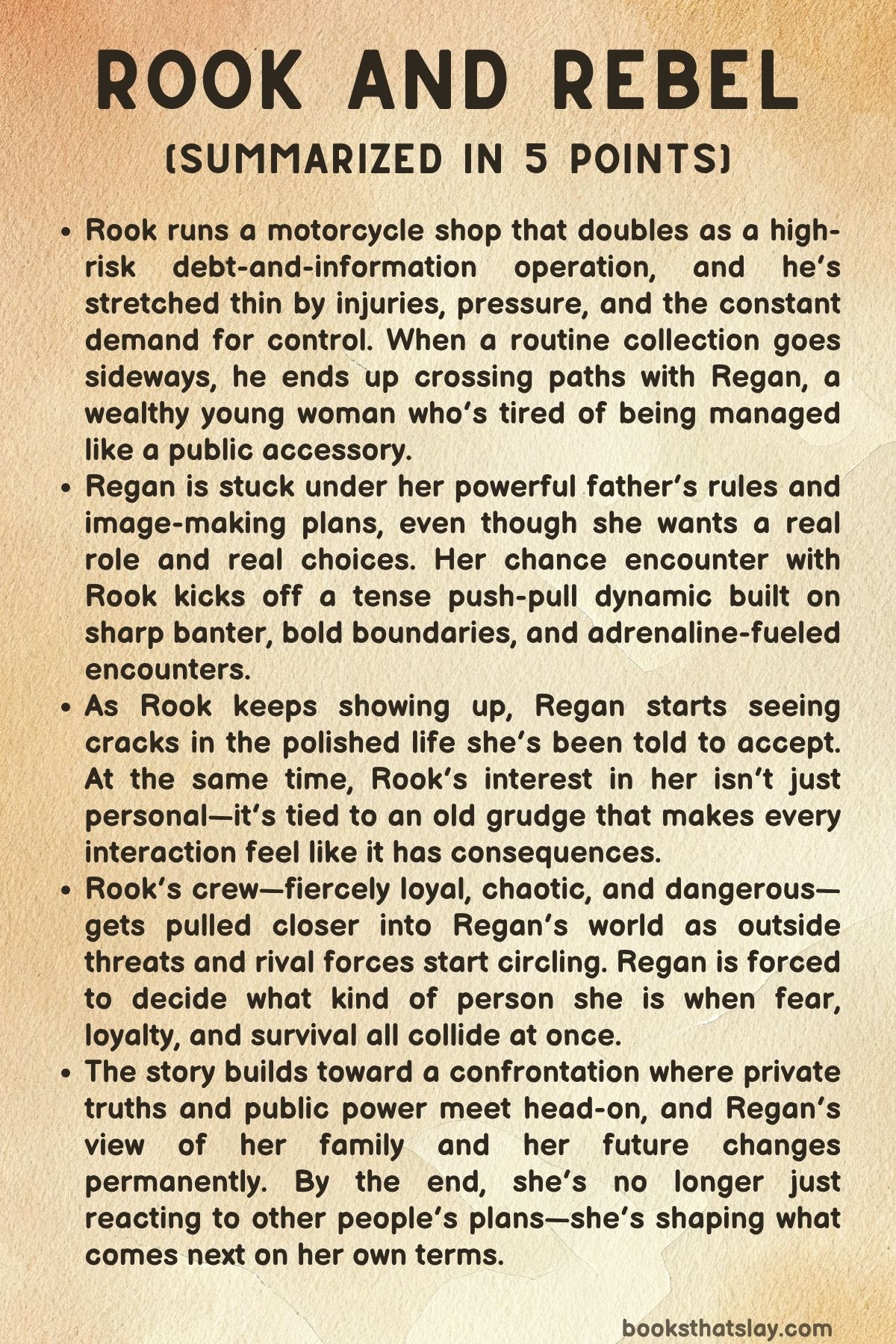
Rook barrels through the city on his motorcycle after a rough day at his shop, angry that the crew’s criminal “side work” keeps piling up. By day, they fix bikes; by night, they collect debts and sell information to people who pay for access and silence.
Rook carries constant pain from a serious burn injury, and he snaps at his crew for being stretched thin. Aiden, his closest ally, pushes back with practical reasons: bikes are down, newer members aren’t ready for hard jobs, and Aiden is busy dealing with Rook’s sharp-tongued sister, Evie.
The crew’s next target is Elliot, a wealthy gambler who owes them fifteen thousand dollars and keeps dodging payment.
Rook tracks Elliot to an art exhibit where he’s out with his girlfriend, Regan. Before heading in, Rook rides past the mansion of Cameron Fletcher, the man he holds responsible for the fire that destroyed his childhood home and for the deaths that followed.
Cameron has risen above consequences, living in comfort and influence, and Rook has built his adult life around the idea that he’ll eventually make Cameron pay.
Regan spends her days under strict control. Her father, Cameron, runs the city’s largest security company and keeps her on a schedule of public events meant to support his image.
He is publicly “ill,” and he hints at a political future, but Regan is treated more like a prop than a partner in the business. That evening, she attends the exhibit with Elliot, who quickly proves selfish and pushy.
Regan decides to head home early, texting her friend Harper that she wants a quiet night with cookies and a movie.
Outside the exhibit, Elliot insists on taking a “romantic” detour to an overlook, leading Regan through a darker, sketchier route. A blacked-out motorcycle begins following them.
Regan’s fear rises as the rider closes the distance, cuts them off, and raises a gun. Rook demands Elliot’s wallet.
Elliot’s reaction is immediate and cowardly: he drops Regan’s hand and runs, leaving her alone.
Rook lowers the gun, irritated that Elliot fled so easily, and makes it clear Regan was never the target—Elliot’s debt was. He introduces himself as Rook and, despite his threats and harsh tone, insists she shouldn’t be left stranded in a dangerous area.
When a stranger approaches, he pushes Regan onto his bike and gives her strict instructions on how to hold on and stay balanced.
On the ride toward safer streets, Regan shocks him by asking to stop for cookies. Rook follows her into a late-night bakery, pays, and warns the clerk not to call the police.
Outside, Regan reveals she knows his name because someone called her phone while it was in his helmet, and she answered. Rook takes her phone and answers Elliot’s frantic calls on speaker, humiliating him for abandoning Regan and ordering him to bring cash to the shop if he wants any hope of making this right.
He also needles Elliot by suggesting Regan is with him now. Rook’s aggressive flirting escalates, but Regan shuts him down by stuffing a cookie into his mouth.
She refuses to give him her address, gets off near a random house, and sneaks back to her mansion through the dark, later recounting everything to Harper.
The next day, Cameron confronts Regan for coming home late and triggering alarms that panicked his security team. His concern is wrapped in control and anger.
Regan overhears enough to sense there’s pressure on Cameron for money and deadlines, and his threats on the phone don’t sound like those of a harmless businessman. He orders her to stay home for the weekend, but she sneaks out for Hallows Night, the town’s Halloween festival, and meets Harper downtown.
Elliot appears and acts defensive, and Harper calls him out for leaving Regan behind.
The sound of motorcycles cuts through the festival. A pack rides into the closed streets, pulling stunts and splitting the crowd.
Elliot bolts again the moment he hears them. Regan spots the black bike with pink underglow—Rook.
He points directly at her, circles her, and stops inches away, his face painted in a skull pattern. He removes his helmet and says he found her.
Rook sends his crew after Elliot and stays with Regan, demanding her name. She refuses, so he proposes a game: she runs, and if he catches her within an hour, she must tell him who she is.
Regan runs through alleys and side streets, riding the rush of being hunted while trying to outsmart him. Near the end of the hour, she misjudges an alley that dead-ends.
Rook arrives silently, pins her hands, bites at her neck, and demands her name. Cornered, she gives in: Regan Fletcher.
The name hits Rook hard. He withdraws at once, tense and disgusted, and asks how she’s connected to Cameron.
When she confirms Cameron is her father, Rook warns her to stay away from him and speeds off, shaken. Later, back with his crew, Rook tries to focus on work, but Regan won’t leave his mind.
Rook’s crew operates as violent middlemen, enforcing deals and brokering information. During an interrogation in their sealed garage, Rook is distracted by the problem Regan represents: she is Cameron’s daughter, and Cameron is the man Rook believes destroyed his family.
Rook tells Aiden the story he’s carried for years: his parents ran an art business, Cameron tried to force them into criminal smuggling, and when they refused, everything burned and his parents died. Rook and Evie were pushed out of their old life, and Cameron took what he wanted.
Aiden argues Regan is the most direct leverage point. Rook agrees and orders the team to monitor her.
Rook begins surveillance and finds Regan’s routine surprisingly quiet—home, bakery shifts, digital drawing, true-crime shows, and occasional art events. Bored with watching from afar, he texts her from an unknown number and taunts her.
Regan panics, tightens her security, and demands answers. Rook admits he’s watching and implies he can get around her home systems, even unlocking doors remotely.
When Regan mentions her father is out of town, Rook warns her not to share information like that so easily, then shows up masked outside her window to avoid cameras. Regan invites him in because she hates being alone.
She shows him her art, and for a moment the tension is almost calm—until Rook is pulled away by trouble with his crew.
Still rattled and curious, Regan decides to find him at a biker gathering called Syndicate. She gets there with Jake, a reckless rider who offers a lift in exchange for a dinner date.
At the meet, Regan spots Rook surrounded by attention. She confronts him, and he becomes instantly possessive, driving off the woman on his bike and refusing to let Regan leave with Jake.
He humiliates Jake into backing down, then kisses Regan forcefully. Regan slaps him and tries to leave anyway, but Jake abandons her.
Rook lifts Regan onto his bike and takes her.
A rival group appears, and a chase breaks out. Rook’s crew surrounds them, escorts them onto the highway, and then pulls off to avoid escalating the danger.
When two enemy riders show up, Rook and Hero kill them quickly and dispose of evidence. Regan witnesses the reality of Rook’s life and is shaken.
Back at the mansion, she tells him to stay away and runs inside. Rook realizes he can’t afford to lose her if she’s his path to Cameron, and he becomes determined to keep her close.
Later, the crew works on breaking into Cameron’s secured space, with Evie handling alarms and keypads. Regan is incapacitated from drinking, and Rook carries her upstairs, stays with her while she’s sick, and unexpectedly falls asleep holding her.
In the morning, Regan finds Harper with her and learns Rook cared for her and left later. Wanting control, she drives herself for the first time in years and brings donuts to the motorcycle shop.
Rook’s crew teases her, and when she mentions a “date,” Rook reacts with immediate jealousy. He pulls her into a back office, marks her with his name in marker, and insists she go out with him instead.
Rook gives Regan a helmet and jacket labeled “Rebel” and takes her riding, teaching her how to move with the bike and testing her limits. He brings her to an abandoned house in the woods where the crew has set up an outdoor movie night.
Rook turns it into another chase game, catches her easily, and they have sex before joining the others inside. Regan learns more about the crew—especially Evie’s hacking skills—and sees that their bond is real, even if their choices are brutal.
The danger surrounding them grows. Harper comes to the shop terrified: her manager has been stalking and escalating harassment, and she’s afraid of what he’ll do.
Rook and the crew kidnap the manager, expose hidden cameras, and hold him under a lift. Harper chooses to be part of his punishment.
When Regan arrives unexpectedly and sees the scene, she runs in shock. Later, she finds “Call me” smeared in blood on her window.
Rook admits it was his blood and that he did it to force her to contact him. Regan tells him to leave her alone, but the pull between them doesn’t disappear.
Soon after, Regan is dragged into a new crisis when she, Evie, and Harper are taken by men connected to Cross, a local drug boss who wants to force Rook’s crew into helping him. Regan secretly contacts Rook, and the crew storms in.
Rook shoots one of the men to end the standoff and warns Cross not to try it again. Regan rides home with Rook, furious but also aware he just saved them.
Rook finally tells Regan the truth as he sees it: Cameron Fletcher destroyed his family, and Rook started watching Regan to use her as leverage. Regan refuses to believe her father is capable of it, but Rook claims Cameron isn’t just corrupt—he’s tied into stolen drug shipments and criminal deals, using his security business to gain power.
Worse, Rook says Cameron has ordered a hit on him and “the girl that rides with him,” with extra money if Regan is killed first to maximize Rook’s pain. Regan is horrified and calls him insane, but Rook shows proof: messages listing prices for their deaths.
Rook refuses to leave the mansion because he believes Regan is in immediate danger. He calls his pack—Evie, Aiden, Hero, and Mason—to move in and lock the place down.
To prove the threat is real, he calls Asher, a powerful ally, on speaker. Asher confirms there’s a bounty and identifies Cameron as the one who ordered it.
Regan tries to argue Cameron didn’t know she was the rider, but Evie hacks into Cameron’s devices and finds incriminating texts with Elliot: confirmation of arson, mockery of past deaths, and instructions for the hit.
Regan tries to escape onto the roof, but Rook catches her and drags her back inside. After a tense night, Regan stops running and demands the full truth.
Rook brings her cookies, apologizes for hurting her, and admits he loves her. Regan bargains: he cannot kill her father without her permission.
Rook agrees, even though it costs him.
They search Cameron’s office and find locked records tied to missing drug shipments worth enormous sums. Elliot arrives and is restrained.
Regan confronts him about abandoning her and leading her into danger; he admits he and Cameron thought her disappearance would reduce pressure on them. They gag him and hold him for answers.
Then Cameron walks in and is restrained as well. Rook reveals who he is by showing his burn scars and naming his parents.
Cameron responds with cold recognition and mockery. Evidence piles up: drug records, arson, the bounty, and paperwork shifting property into Regan’s name.
Rook offers Cameron a cruel test, forcing the truth into the open. Cameron is given a chance to prove what he values.
When he tries to shoot Regan and the gun clicks empty, it’s clear he was willing to kill his own daughter.
Cameron then admits he faked his illness to keep Regan close and controllable, calling her a puppet. In the chaos, Elliot breaks free, stabs Cameron in the chest, and kills him—furious at being treated as disposable.
Elliot then tries to threaten the group and escape. Regan tells Rook to stop him, and after a violent struggle, Rook kills Elliot.
To avoid a massive investigation that would bring law enforcement and enemies crashing down on them, they decide on a cover: remove the bodies and burn Cameron’s side of the house so it looks like an accident. Time passes.
Regan begins learning to ride her own motorcycle so she can protect herself and escape if needed. Asher provides a new location for the crew to reopen their shop.
Months later, Rook surprises Regan at an art gallery where her work is displayed on digital screens, marking her new life—one built on hard truths, chosen loyalty, and a love that came from the worst possible beginning.
Characters
Rook (Emberson)
Rook is built around contradiction: he runs a legitimate motorcycle shop while also leading a violent “middleman” operation that collects debts, brokers information, and enforces deals for bigger criminals, and that split mirrors how he sees himself—someone trying to survive like a businessman while behaving like a weapon. His old burn injury is more than backstory; it’s a constant physical reminder of the fire that killed his parents and destroyed his childhood, shaping him into a man who treats pain as normal and softness as dangerous.
In Rook and Rebel, his obsession with control shows up everywhere: he barks rules on how Regan should sit on the bike, he issues orders to his crew, and when he feels threatened emotionally, he escalates into possessiveness—publicly humiliating rivals, marking Regan, and turning “protection” into confinement. Yet the same man who tortures informants and kills without hesitation also repeatedly chooses to keep Regan safe even when she is, at first, only a means to reach Cameron; that tension is the engine of his character.
He doesn’t evolve into a gentler person so much as he reorganizes his brutality around a new priority—Regan—until “revenge” and “love” become inseparable in his mind. His most revealing moments are the ones where his mask slips: the shock and withdrawal when he learns Regan’s last name, the unexpected tenderness of staying with her while she’s sick, and the raw confession that he’s doing something that could ruin her life.
Rook’s arc is ultimately about the collapse of a clean moral story he’s been telling himself—Cameron as the sole villain, Rook as karma—and the terrifying discovery that, when given power, he can become the kind of monster he hates unless he actively chooses restraint.
Regan Fletcher
Regan begins as a woman trapped inside a gilded structure: her father’s mansion, her father’s schedule, her father’s political aspirations, and the polished role he assigns her as a public accessory rather than a successor. Beneath that, she’s quietly hungry for agency—she wants competence, real responsibility, and a life that belongs to her—so it makes sense that danger doesn’t only frighten her; it also wakes her up.
In Rook and Rebel, Regan’s defining trait is not naïveté but resistance: she pushes back with sarcasm, demands ugly truths, refuses to hand over her address, and repeatedly tries to set boundaries even when she’s drawn to the thrill Rook represents. Her attraction to Rook isn’t written as simple swooning; it’s entangled with adrenaline, curiosity, and the intoxicating experience of being seen as someone with sharp edges rather than a curated “good girl.” At the same time, Regan’s moral line is constantly tested.
She recoils from the crew’s violence when it becomes explicit, but she also discovers an unsettling capacity in herself—jealousy that she missed Harper’s revenge, the willingness to participate in lethal decisions, the pragmatism of burning part of the house to avoid investigation. The most painful transformation is her forced re-evaluation of her father: she wants to believe in the story she grew up in, and that faith doesn’t die quickly; it shatters through evidence and betrayal, culminating in the moment Cameron proves he would kill her.
By the end, Regan’s growth is not “becoming darker” so much as becoming self-owned: she claims her name, her home, her choices, and even her art as something no longer controlled by Cameron, and learning to ride her own motorcycle becomes a symbol of that—freedom with teeth, an exit she can command.
Aiden
Aiden functions as Rook’s closest operational counterweight: he understands the limits of the crew, calls out logistical realities, and says the things Rook doesn’t want to hear when rage narrows his vision. He’s pragmatic to the point of bluntness—whether he’s pointing out that the newer guys aren’t hardened enough or immediately identifying Regan as leverage against Cameron.
That practicality could read as cold, but it also reveals a caretaker streak: he’s the one stuck “babysitting” Evie, he helps stabilize chaos, and he steps into leadership when Rook peels off to fixate on his personal vendetta. Aiden’s morality is shaped by the criminal world’s math; he evaluates risk, reward, and survivability rather than right and wrong, and he’s comfortable treating people as pieces on the board—until those people become “theirs.” His dynamic with Rook is a mix of loyalty and frustration, like someone who believes in the mission of keeping the pack alive but doesn’t romanticize Rook’s impulses.
When the conflict escalates to an active bounty and a war with Cameron, Aiden becomes the kind of lieutenant who can move from teasing banter to hard action without hesitation, embodying the crew’s ethos: protect the pack, eliminate threats, don’t leave loose ends.
Evie
Evie is the story’s sharpest blend of chaos and competence: Rook’s sister who bickers like a normal young woman in one scene and then calmly works a keypad, bypasses alarms, and hacks devices in the next. She’s positioned as both Rook’s vulnerability and his reinforcement; Aiden “babysits” her, but she’s also essential to the crew’s survival, handling digital intrusion, tracking, and the kind of technical work that makes their operation scalable.
Her personality reads fearless—she jokes about pulling guns on men, throws herself into the crew’s lifestyle without flinching, and speaks with the blunt familiarity of someone who grew up around violence and decided to master it rather than be broken by it. Evie also serves an important relational purpose: she humanizes Rook by showing the sibling bond beneath his brutality, and she helps pull Regan into the pack’s orbit in a way that’s less purely sexual or transactional.
When Regan begins to understand the crew’s real capabilities and their willingness to move into her home, Evie is the bridge between “criminal strangers” and a weird, invasive domesticity—still threatening, but oddly communal—where Regan is forced to negotiate power rather than simply fear it.
Hero
Hero operates like the crew’s efficient violence made flesh: present when the story needs swift enforcement, willing to kill quickly to erase witnesses, and dependable in the way dangerous people value most—he does what needs doing without spiraling into doubt. His role emphasizes that Rook’s world isn’t a solo-dark-hero fantasy; it’s a machine, and Hero is one of its cleanest blades.
He also subtly reinforces Rook’s leadership: when Rook is distracted by Regan or revenge, someone like Hero keeps the threat response immediate and decisive, preventing hesitation from becoming vulnerability. Because he’s not depicted as needing moral justification, Hero’s presence makes the story’s violence feel systemic rather than purely emotional—this is simply how the pack survives.
Mason
Mason is the crew’s abrasive comic pressure valve—crude jokes, loud energy, the kind of presence that keeps fear and tension from becoming paralyzing. He often functions as a social stress test, especially for Regan: when he pushes boundaries with humor, it forces her either to shrink back into her polished façade or to stand up for herself in the pack’s environment.
That makes him an important tool in Regan’s integration—uncomfortable, but effective—because his provocations reveal whether she can exist in their world without being consumed by it. Mason’s humor also hints at a coping mechanism; people who do violent work often either go numb or go loud, and Mason goes loud.
He helps normalize the pack’s dynamic so the story can depict them as a dysfunctional family rather than a lineup of identical killers, even while the cruelty underneath never truly disappears.
Kane
Kane reads as part of the pack’s muscle and presence—one of the bodies that turns Rook’s individual threat into a collective force. His significance is less about personal interiority and more about what he represents: the crew is large enough to ride in formation, control public space, and respond to threats with numbers.
That matters because Rook’s power isn’t only his personal aggression; it’s the social infrastructure of loyalty behind him. Kane’s existence in the group helps sell that reality: there are enough committed people around Rook that kidnapping, surveillance, intimidation, and rapid escalation are not improvisations but a practiced mode of life.
Zack
Zack plays the practical verifier and operator, the one who checks intel and turns violent interrogation into actionable direction. He’s the connective tissue between the crew’s brutality and their businesslike reliance on information; after torture extracts a location, someone still has to confirm it, and that function matters because it shows the crew isn’t chaotic evil—they’re methodical criminals.
Zack’s presence reinforces the idea that their operation runs on systems: surveillance, verification, disposal of evidence, moving logistics, and keeping stories consistent. Even when he’s not foregrounded emotionally, he’s part of what makes the pack feel real as an organization rather than a collection of dramatic personalities.
Cameron Fletcher
Cameron is the book’s central architect of corruption: outwardly a powerful security-company head, a terminally ill man planning a mayoral run, and inwardly someone who appears to use “protection” as a cover for enabling and exploiting criminals. He embodies a specific kind of villainy—respectable power that hides predation—because he doesn’t need to get his hands dirty to be devastating; he creates systems where others suffer on his behalf.
His control over Regan is psychological and structural: he schedules her, isolates her, weaponizes “safety,” and later is revealed to have manipulated even his illness narrative to keep her close and compliant. What makes Cameron especially chilling is his lack of sentiment—he mocks deaths, treats people as tools, and when offered the choice, he’s willing to kill his own daughter to preserve himself.
That single action clarifies everything about him: Regan was never a person to him, only property. Cameron’s conflict with Rook is not just revenge; it’s a clash between two forms of power—Cameron’s institutional authority and Rook’s street-level violence—each capable of destroying lives, but only one wrapped in polite legitimacy.
Elliot
Elliot is the story’s portrait of cowardice dressed up as privilege: a rich gambler who can posture and pressure Regan sexually in safe spaces but collapses the moment danger arrives. His defining act—abandoning Regan when Rook confronts them—brands him as someone who uses others as shields, and his later behavior continues that pattern: defensive, entitled, eager to dodge consequences while still benefiting from Cameron’s orbit.
Elliot’s significance grows when he’s tied into larger criminal logistics, suggesting that his “weakness” isn’t harmless; it becomes operational complicity. His end is thematically fitting because it comes from the same core trait: he’s disposable in Cameron’s hierarchy, and when Elliot realizes he’s treated as a tool, his fear flips into rage.
Killing Cameron is not redemption so much as a desperate seizure of agency from someone who’s always been running, and his immediate attempt to threaten and escape afterward confirms he never truly changes—he just panics in a different direction.
Harper
Harper represents the story’s grounded vulnerability—she’s not born into wealth or embedded in the pack; she’s someone whose ordinary life exposes her to a realistic, escalating threat from a manager abusing power. Her arc complicates the moral landscape because it forces a question: what do you do when formal systems can’t or won’t protect you?
Harper turns to criminals for help, and the book doesn’t frame that choice as clean; it’s terrifying, messy, and violent, but it’s also effective. Her participation in punishing her abuser shows a breaking point where fear turns into fury, and her closeness to Regan makes that turn contagious—Regan is shocked, then startled by jealousy, revealing how proximity to the pack changes what feels possible or even desirable.
Harper is also an emotional anchor for Regan; even when romance and revenge dominate, Harper keeps reminding the story that danger doesn’t only come from cartel-level villains—it can come from small men with access and entitlement. By surviving and being believed by her friends, Harper becomes a quiet counterpoint to Regan’s isolation under Cameron: she’s proof that solidarity can exist even inside darkness.
Jake
Jake is a catalyst character—reckless biker energy that offers Regan a doorway into Rook’s world without Rook’s direct permission. He functions as a test of Rook’s possessiveness and a mirror for Regan’s attempt to prove independence.
Jake’s “deal” for a ride in exchange for a date signals that the broader biker scene also objectifies and negotiates women, just with different aesthetics than the mansion world. His quick retreat when confronted by Rook demonstrates the hierarchy of menace: Jake is bold only until real power shows up.
He’s important less for who he is and more for what he triggers—Regan’s defiance, Rook’s public claiming behavior, and the escalation into danger that follows.
Victor
Victor is an instrument of coercion—someone who watches, follows, and grabs, embodying the threat of being hunted in public spaces. He’s the immediate face of Cross’s leverage play, and his death is used to draw a hard line about how Rook handles threats: instantly and irreversibly.
Victor’s role matters because it pushes Regan past abstract awareness of violence into direct exposure to it, and it also shows the pack’s tactics when they want control fast—shock, fear, and dominance rather than negotiation.
Cross
Cross is a local drug boss who operates through intimidation and hostage tactics, positioning himself as a rival force who believes he can press-gang Rook’s crew into service. He’s significant because he demonstrates that the pack is not the top of the food chain; there are bigger predators and shifting alliances, and everyone is trying to force labor and loyalty out of everyone else.
Cross’s attempt to use Regan, Evie, and Harper as leverage is strategic, not personal, which makes it a different flavor of danger than Rook’s obsession or Cameron’s control. His failure—because Rook escalates immediately—reinforces both Rook’s protective fixation on Regan and the crew’s unwillingness to be owned by another criminal power.
Asher
Asher functions as a higher-tier node in the criminal ecosystem: powerful enough that a bounty from him is credible, and influential enough that negotiating with him can reshape consequences. He also serves as an authority that validates reality for Regan—when Rook calls him on speaker and Asher confirms the hit originates with Cameron, the story shifts from “Rook’s obsession might be delusion” to “the threat is verified.” Asher’s willingness to call the hit off in exchange for free services highlights how transactional this world is: lives have price tags, safety has bargaining chips, and even alliances are essentially contracts.
He’s not portrayed as moral; he’s portrayed as real power—calm, practical, and terrifying because he doesn’t need to shout to decide who lives.
Candy Collins
Candy Collins is less a present character and more a structural shadow—a name used as a front, a breadcrumb in the paper trail, and a sign of how Cameron launders wrongdoing through proxies. Candy’s importance lies in what her name represents: the way powerful criminals hide behind other identities and convert people into shields, whether those shields are storage-unit registrations or human beings.
The recurring appearance of her name helps Regan understand that her father’s world is not just rumor or accusation; it has logistics, records, patterns, and deliberate misdirection. Even without direct scenes, Candy becomes part of the story’s theme of manipulation: the truth is always buried under someone else’s name until someone digs it up.
Themes
Power, Control, and the Performance of Safety
Regan’s life starts inside a version of security that functions more like containment than protection. Her father’s wealth, his private guards, and the rigid schedule of parties create the image of safety, yet they strip her of agency: she is monitored, managed, and reprimanded for stepping outside the plan.
That same logic shows up in a harsher register with Rook’s world. His crew sells protection and enforcement as a service, and their “rules” are treated as necessary because the city is dangerous and the system is unreliable.
Both environments argue that control is justified if it prevents harm, but Rook and Rebel keeps exposing the cost: people become assets to be secured rather than individuals with choices. Regan’s father uses paternal authority and corporate power to keep her close, while Rook uses intimidation, surveillance, and physical dominance to keep her within reach.
The uncomfortable point is that their methods sometimes succeed at the surface-level goal—Regan is repeatedly kept alive—but they also erase her consent and shrink her world.
What makes this theme hit harder is how often “safety” becomes a mask for self-interest. Regan’s father frames restrictions as care while hiding crimes and manipulating her dependence.
Rook frames his intrusions as protection while admitting she began as leverage. Even when Rook is honest about wanting her safe, he still chooses tactics that place his judgment above hers, such as tracking, breaking into her space, or deciding where she can go.
The story pushes Regan into a fight for adulthood where she has to redefine what safety means: not a locked mansion or an armed escort, but knowledge, mobility, and the ability to make decisions with clear information. By the end, her learning to ride and preparing an escape plan is a direct rejection of safety as confinement.
It’s a claim that real security includes the option to leave, not just the promise that someone stronger will stand in front of you.
Revenge as Identity and the Hunger for Moral Balance
Rook’s anger is not simply about money, territory, or reputation; it’s rooted in a personal catastrophe that has never been answered with consequences. The fire, the loss of his parents, the sense that the guilty party prospered—these become the central organizer of his identity.
He doesn’t only want justice; he wants a correction of the universe, a result that feels proportional to what was taken. That demand shapes his daily choices: the illegal work is not just profit, it’s power accumulation, a way to become the kind of person who can force outcomes on people like Cameron.
His fixation also narrows his emotional range. Pain and resentment become familiar, even stabilizing, because they provide direction.
Without revenge, he would have to face grief without a target, and the story shows how much he resists that kind of vulnerability.
Regan complicates this hunger for balance because she is both innocent and connected. When Rook discovers who she is, the revenge narrative cracks.
She isn’t the enemy, but she belongs to the enemy, and that forces an ugly question: how far can retaliation go before it becomes the same cruelty it claims to punish? Rook’s willingness to consider using her—then his refusal to treat her as disposable—marks the boundary between revenge as mission and revenge as corruption.
Yet he doesn’t become gentle; he becomes selective. He is capable of tenderness while still being capable of torture and murder, and that’s the point: revenge doesn’t remove brutality, it organizes it.
The eventual confrontation with Cameron turns revenge into a moral test rather than a simple payoff. Cameron’s readiness to sacrifice his own daughter exposes him as something beyond a rival—he is a person who treats relationships as tools.
That moment grants Rook the confirmation he’s wanted, but it also places Regan at the center of the reckoning. She isn’t just a hostage or a weakness; she becomes the one who must decide what consequence fits betrayal.
The theme suggests that revenge can begin as a desire for justice but easily becomes a structure you live inside, and escaping it requires surrendering the fantasy that violence will restore what was lost. Even after Cameron and Elliot are gone, the “solution” is still an engineered narrative—burning part of the house to avoid investigation—which implies that revenge doesn’t end cleanly.
It changes the shape of life, and everyone involved has to build a future while carrying the choices they made.
Intimacy Under Threat and the Problem of Consent
The relationship between Rook and Regan is repeatedly initiated and intensified in moments of fear, pursuit, and pressure. Their first major encounter begins with a gun, a chase, and abandonment.
Later, their dynamic turns into games of catching, cornering, and forcing proximity, often with sexual tension tied directly to intimidation. This creates an intimacy that is chemically intense—adrenaline, danger, and relief collapsing into attraction—but it also raises constant ethical friction.
Regan’s “yes” is frequently surrounded by constraints: she is isolated, she is being watched, she is dealing with men who can bypass locks, and she knows Rook is capable of lethal violence. Even when she desires him, the context repeatedly blurs whether she has the freedom to choose without consequence.
The story doesn’t treat this as a neat romance of equals; it treats it as a relationship born in imbalance, where desire and coercion can sit uncomfortably close together.
At the same time, Regan is not written as passive. Her resistance is active and creative—deflecting him, negotiating terms, refusing her address, running when he demands her name, choosing when to engage and when to shut down.
Over time, she also asserts control sexually, particularly in moments when she refuses to be acted upon and insists on directing what happens. That shift matters because it’s one of the few arenas where she can immediately reclaim agency from people who assume control is their right.
Yet the theme doesn’t pretend that agency in one moment cancels coercive patterns in another. Rook’s possessiveness, surveillance, and forced confinement after the hit keep the imbalance alive even as emotional attachment grows.
What the book seems to be examining is how intimacy can become a coping mechanism for power struggles. Sex becomes a way to end arguments without resolving them, a way to soothe fear without changing the conditions that caused it, and a way to claim someone when trust is unstable.
Rook’s obsession reads like a substitute for stability; Regan becomes the one place where his anger softens, which makes him cling harder and behave worse when he feels her slipping away. For Regan, the attraction seems tied to being seen—her art, her darker thoughts, her preference for truth over comforting lies—and that recognition is something she never gets from her father or from Elliot.
The theme lands in the uneasy space where genuine affection exists, but the relationship must constantly wrestle with whether love can be real when it begins as leverage and continues under conditions of threat. The ending gestures toward a healthier direction—skills, escape options, shared decisions—but it doesn’t erase how the intimacy was formed, and that lingering discomfort is part of what the theme is doing.
Corruption Behind Respectability and the Collapse of Legitimacy
The story is built on the contrast between “legitimate” public structures and the criminal networks operating beneath them, then it steadily shows how thin the line really is. Rook’s crew runs a legal motorcycle shop while conducting debt collection, information brokering, and violent enforcement after hours.
Their legitimacy is a cover, but it’s also a reminder that criminal operations often survive by blending into ordinary commerce. On the opposite side, Cameron’s empire is a security company—an institution that sells trust, safety, and risk management—yet he is connected to stolen drugs, manipulation, arson, and contract killings.
The theme isn’t simply “crime exists”; it’s that the most dangerous criminal in the narrative is the one wearing the cleanest suit. Cameron’s public role gives him access, plausible deniability, and influence, letting him weaponize the very concept of protection.
Regan’s arc exposes the psychological effect of this kind of corruption. She wants to earn her place in the business, to be taken seriously rather than displayed, but the closer she gets to the truth, the more she realizes the organization is not something she can “improve” from within.
Her father’s terminal illness, later revealed as a lie, is a key part of the theme: respectability is maintained through storytelling. The illness narrative keeps Regan obedient and sympathetic, and it discourages outside scrutiny.
Similarly, his planned political run depends on curated appearances and social events, where Regan is deployed as proof of family values and stability. The book shows corruption as something that feeds on image management, and it makes the daughter’s role painfully clear: she is used as a brand asset until she becomes inconvenient.
When the evidence finally arrives—texts, financial records, hit confirmations—the legitimacy collapses rapidly, not because the system catches Cameron, but because his own private cruelty becomes undeniable to the people closest to him. His willingness to shoot Regan after being offered the “deal” destroys the last excuse that he is a complicated protector making hard choices.
He is simply someone who values power over family. That moment also reframes Rook’s criminality: his violence is still horrifying, but Cameron’s violence carries the added poison of hypocrisy and institutional cover.
The resolution—disposing of bodies and staging a fire—drives home how little faith the characters have in formal justice. They assume that exposure would bring chaos, retaliation, and investigation that could swallow everyone.
The theme ends with a grim suggestion: in a city where respectable power is already criminal, “clean” solutions feel impossible, and survival often means constructing your own version of order, even when it comes at a moral price.