One Week Later Summary, Characters and Themes
One Week Later by KJ Micciche is a contemporary romance about grief, unfinished love, and what happens when private memories become public stories. Melody Adams, a high school teacher and romance author, is trying to live in the silence left after her mother’s death while facing a career crisis: readers are accusing her of copying a bestselling novelist, Beckett Nash.
The problem is painfully personal—Melody and Beckett share a real past, and his breakout novel mirrors parts of a trip that changed her life. Forced back into contact with him, Melody must face what really happened, what she’s been running from, and what she still wants.
Summary
Melody Adams is back in the apartment she once shared with her mother, and everything about it feels wrong without her. The quiet is the hardest part: no background music, no singing, no small sounds that used to make the space feel alive.
Melody tries to keep her days controlled and predictable—teach at Forest Hills High School, do her chores, keep moving—but the grief keeps catching her in unexpected moments. On top of that, she’s under pressure to deliver her fourth romance novel.
She has an idea—one inspired by her mother’s heart failure diagnosis years earlier—but she can’t write a single page. The story feels too close, too complicated, and she’s convinced she isn’t qualified to handle it.
When she can’t sleep, Melody rereads a novel called The Beginning of Everything by Beckett Nash. Beckett isn’t just an author she admires; he’s someone she once knew in a way that still stings.
She’s been looking him up online, watching him become famous, sign big deals, and get movie buzz. Now he’s also publicly engaged to Analise Renda, the lead singer of the mega-famous band Untethered.
Their glossy public life makes Melody feel invisible—just a teacher who happens to write books, sitting alone with an overdue manuscript and an empty apartment.
At school, Melody’s agent and close friend, Evan, calls with bad news. Online reviewers have started claiming Melody copied Beckett’s book, and the chatter is spreading fast.
Evan says he and Melody’s editor, Jax (Jackie Girardi), want to get ahead of it. Without asking Melody, Jax has already contacted Beckett’s team to propose a joint response.
Melody is blindsided. The idea of being pulled into Beckett’s orbit again makes her feel trapped, and she ends the call shaken.
Melody can’t stop thinking about how Beckett wrote their “first meeting” in his book—and how it isn’t true. In his version, he meets a woman named Harmony on a beach.
In real life, Melody met him at JFK Airport while trying to get her sick mother a better seat on a packed flight. The gate agent wouldn’t help.
As Melody walked away, a stranger returned a small hacky sack she’d dropped—an object she carries like a lifeline—and then offered something generous: he’d swap his window seat so Melody’s mother could be more comfortable. Her mother, Birdie Paulson, immediately turned the moment into a performance, loudly insisting Melody sit with the handsome stranger.
Melody joked by asking if he was a serial killer. He joked back and introduced himself as Beckett.
That was the actual start: an airport gate, a sick parent, and a quiet kindness that made everything tilt.
Evan calls again later with a concrete plan. People magazine wants a joint feature with Melody and Beckett—an interview and photo shoot framed as two authors with suspiciously similar stories.
Evan sells it as a career-saving move that could clear her name and even boost her sales enough to let her leave teaching. Melody hates that the decision is being pushed on her.
She insists she can’t face Beckett, not with everything unresolved between them. Evan begs her not to torch her career out of fear.
He also shares gossip about Beckett’s engagement to Analise—how it began through publishing-world connections, accelerated quickly, and became a public spectacle. Melody doesn’t commit, but Evan gives her a deadline: next Monday.
At home, Melody circles the parts of her life she avoids. She still hasn’t stepped into her mother’s old bedroom since the funeral.
She remembers moving back in after Birdie’s diagnosis, how they used to walk to the same school together, and how Melody now feels like she’s living her mother’s life without her. Over the weekend, she forces herself to read Beckett’s book with fresh eyes.
The narrator describes Harmony as unforgettable, then turns bitter about losing her. Melody flips between the printed version of events and her own memories of the trip that sparked it all: Aruba.
She remembers the flight—how she and Beckett talked for hours once they were seated together, how both admitted they were scared to fly, and how he offered his hand during takeoff. She held on like she might fall out of the sky.
Beckett told her he was a park ranger on Long Island, studied earth and atmospheric sciences, and had huge plans for himself. He spoke like he’d already decided he would succeed: finish his novel, get an agent, sell it for a massive advance, move to the city, become known.
Later, Melody learned that dream had come true. She saw a Publishers Marketplace announcement: Beckett sold his debut novel for $250,000 in a major deal.
The summary described a weeklong love affair on a tropical island—nothing like the family drama he’d originally claimed to be writing. The news hit Melody hard at a time when she was already struggling through another holiday season without her mother.
About a year after Aruba, Melody’s team realized the timing was turning into a disaster. Evan read Beckett’s book and panicked: it wasn’t just generally similar to Melody’s upcoming novel, Holiday Island; specific scenes matched, including three sex scenes with the same settings and sequence.
Beckett’s book was also getting major praise. Since his release date came first, Melody risked being labeled the copycat.
Evan proposed moving Melody’s publication earlier to reduce suspicion. She agreed, even though it would collide with the school calendar and scramble her plans.
Under pressure, Evan asked the obvious question: how could Beckett possibly know these scenes? Melody finally confessed that Beckett was the man from her Aruba trip—the man she never told Evan about.
Evan’s sympathy vanished into anger on her behalf.
On the last Monday of the school year, Melody gives in and agrees to the People feature, but only on one condition: she needs to talk to Beckett alone first. Evan gets Beckett’s number from his agent, Shelby, and sends it.
Melody stares at it like it might bite. When she finally calls, Beckett answers.
Hearing his voice knocks the air out of her. She panics, hangs up, turns off her phone, and cries at her kitchen table.
When she turns her phone back on, Beckett has called multiple times and left messages saying he wants to talk—and that the People interview is happening. When they finally speak, it starts stiff and awkward, then turns sharp.
Melody brings up his engagement and learns Analise is away. Melody accuses Beckett of switching his book into a romance to chase attention, leaving her to deal with plagiarism accusations while he enjoys fame.
Beckett claims he agreed to People to help her, not to sell more books, and resents being treated like a brand instead of a person. Melody brings up the real wound: he disappeared after Aruba.
Beckett fires back that she vanished and broke him, and that writing the book was how he survived it. He says he fell in love with her.
Melody refuses to accept his version and calls it self-serving. Beckett asks if she even finished his book.
She admits she hasn’t. He tells her to read it—then hangs up.
With no help from Evan, who admits he never read the ending either, Melody goes to bed with ice cream, her hacky sack, and Beckett’s novel. As she reads, she notices how he changed details—names, jobs, places—sometimes in ways that make her feel erased, other times in ways that feel like he’s protecting something.
One key moment shocks her: the infamous casino bathroom scene is written as fade-to-black rather than explicit. She keeps reading, tense and exhausted, and the story drags up another thread of her life: the origin of the hacky sack, bought when she was three to break her thumb-sucking habit, later retrieved when her mother collapsed at work.
Melody relives the day Birdie was rushed to the hospital, the emergency procedures, the terrifying new vocabulary of heart failure, and the way Birdie still tried to comfort Melody even while hooked to machines. After that, the hacky sack became Birdie’s constant companion—and after Birdie died, it became Melody’s.
As Melody continues reading, the Aruba memories sharpen. Birdie, playful and fearless, pushed Melody toward life even while her own health was fragile.
On the island, Birdie flirted with everyone, teased Melody about Beckett’s charm, and insisted there was “magic” between them. Melody and Beckett spent time together—talking on balconies, walking the beach, sharing family stories, and acknowledging the ache of being abandoned or afraid.
They kissed in the ocean after Beckett asked permission. On New Year’s Eve, Birdie pulled them into the resort celebration, and Melody and Beckett shared fireworks, dancing, and a midnight kiss.
Beckett gave Melody and Birdie matching bracelets engraved with “BON BINI.”
On New Year’s Day, Beckett secretly planned something bigger: he booked access to a private overwater dinner and created a night that felt like a promise. Melody went, encouraged by Birdie, and spent the night with him.
But the trip unraveled fast afterward. Melody rushed to make her flight, realized she’d lost her bracelet, and left in a haze.
Beckett, in his own narration, went to the airport early with food and coffee to share, only to spot his estranged father—and then suffer a sudden accident that left him unconscious before Melody arrived.
Then Melody reveals what Beckett never knew: that same night she spent with him, Birdie died back at the hotel. Melody returned to a world that had split in half.
She navigated the logistics of death far from home—cremation rules, panic attacks, strange kindness from hotel staff, and the shock of carrying ashes through an airport. When she finally landed and turned on her phone, there were no messages from Beckett.
Feeling abandoned on top of everything else, she blocked his number and tried to survive the weeks that followed: funeral planning, a father who offered words but little help, and a home full of echoes she couldn’t control.
Therapy helped her name the double loss: her mother and the love she never got to understand. Her therapist urged her to write, and Melody did.
She wrote Holiday Island as a lighter version of the trip—changing key truths so the story could end with joy. But the past didn’t stay buried.
Years later, the plagiarism rumors and People magazine pressure push Melody back into the open wound.
Eventually, Melody decides she can’t keep living around her grief. She clears out Birdie’s bedroom, sorts donations and keepsakes, repaints the room, and finds the suitcase from Aruba.
Inside is Birdie’s bracelet—the one Beckett gave her—still there, waiting. In Birdie’s purse, Melody also finds her mother’s old phone and a final selfie from the trip.
Hearing her mother’s happiness in that memory steadies Melody enough to make a new plan: return to Aruba alone and scatter some of Birdie’s ashes.
At JFK, Melody spots a People magazine cover featuring Beckett holding Melody’s book. She buys it and reads the article on the spot.
Instead of the joint spin Melody feared, Beckett tells the full truth publicly: how they met, what happened in Aruba, how his head injury prevented him from finding her at the airport, and how Birdie died. The article also reveals that Analise ended the engagement after realizing Beckett was still in love with Melody.
Beckett says openly that he wants Melody and asks her to come back into his life.
As Melody boards her flight to Aruba with her mother’s ashes, Beckett appears beside her. He returns her lost bracelet and clips it onto her wrist, telling her “bon bini” means welcome—welcome back.
In Aruba, Melody and Beckett spend the week together, rebuilding trust through ordinary time: meals, mornings, familiar streets, and conversations that don’t need an audience. With Hugo’s help, Melody arranges a private boat ride to scatter Birdie’s ashes.
On the water, she speaks directly to her mother, releases her, and feels a goodbye she’s been waiting for.
Back in the U.S., the media frenzy grows and Holiday Island sales surge. Their publishers plan a big tour, starting with Melody’s remaining Cape Cod event.
At the Brewster Book Store, a huge crowd shows up. Melody is asked to read first, but she finds a note tucked inside her book: “Will you marry me?” Beckett proposes onstage.
Melody says yes. Then, with the room roaring around them, she opens her book and reads the first line about meeting the love of her life at a JetBlue counter—this time with the truth finally in the open.
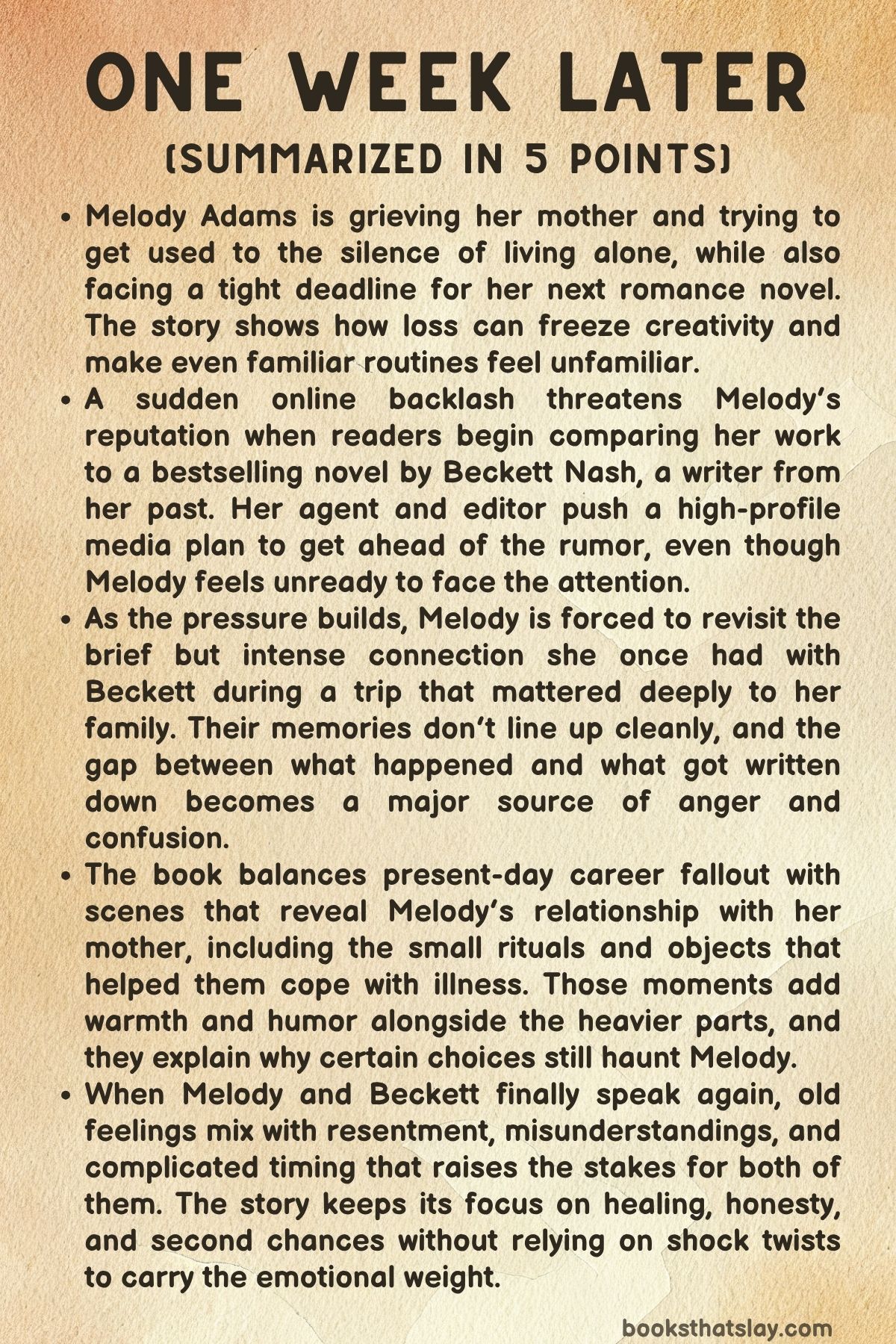
Characters
Melody Adams
Melody is the emotional and narrative center of One Week Later, and nearly every conflict in the story runs through her grief, her ambition, and her fear of being misunderstood. She’s a teacher-turned-romance author who once relied on the steady presence of her mother’s music and routines, and her struggle to live alone isn’t just about silence in an apartment—it’s about losing the person who made her world feel safe and legible.
Professionally, Melody is caught between the pressure to produce a fourth book and the paralyzing belief that she isn’t “qualified” to write the story that matters most to her, especially when it brushes against real trauma and medical realities connected to her mother’s heart failure. Emotionally, she is both tough and brittle: capable of holding down a job, meeting deadlines, and navigating publishing politics, yet easily tipped into spirals by public judgment, online accusations, and the unresolved wound of Beckett’s disappearance after Aruba.
Melody’s hacky sack becomes more than a quirky comfort object—it’s a physical symbol of how she self-soothes, how she survives panic, and how her mother’s care continues to shape her long after death. What makes Melody compelling is that her growth isn’t about becoming fearless; it’s about learning to stop punishing herself for grief, to stop rewriting her own needs as moral failures, and to choose truth over silence even when the truth is messy, public, and inconvenient.
Beckett Nash
Beckett is the story’s catalyst and its most controversial mirror, a character whose tenderness and selfishness exist in uncomfortable proximity. He enters Melody’s life through an act of spontaneous kindness—giving up a window seat for her sick mother—and that gesture establishes his core appeal: he’s instinctively generous in the moment and emotionally vivid when he feels connected.
At the same time, Beckett is driven by hunger—for meaning, for recognition, for a life bigger than the one he came from—and that hunger shapes the choices that later wound Melody. His reinvention of their meeting and their relationship in his novel reveals a deep need to control the narrative, not just for fame but for emotional survival; he turns pain into story because he doesn’t know how else to hold it.
Beckett’s father’s abandonment is the psychological engine behind this: he’s haunted by being left, so when Melody disappears from his perspective, it reactivates an old injury and pushes him toward extreme coping, including monetizing their love story. Yet he is not written as a simple villain—his insistence that he loved her, his shock when he learns about Birdie’s death, and his eventual willingness to go public with the truth suggest that his arc is about moving from self-protective storytelling to accountability.
Beckett’s greatest conflict is that he confuses devotion with possession: he believes he “had to” write the book, “had to” become famous, “had to” keep going, but love demands consent and clarity, and he learns—late—that real love requires surrendering the version of events that makes him look best.
Birdie Paulson
Birdie is the book’s beating heart even after her death, a character whose humor and boldness function as a shield against vulnerability and as a gift she gives her daughter. She’s loud, flirtatious, theatrical, and disarmingly honest, using jokes and charm to move through spaces that might otherwise reduce her to “the sick mom.” Birdie’s relationship with Melody is built on fierce devotion and a kind of practical romance: she doesn’t preach independence in abstract terms; she models it by choosing a life centered on her child without presenting that choice as a sacrifice.
Her insistence that there’s “magic” between Melody and Beckett is not simply meddling—Birdie recognizes her daughter’s capacity for joy and tries to protect it from Melody’s instinct to minimize herself. At the same time, Birdie’s decline is portrayed with painful realism: coughing, denial, medical procedures, lifestyle warnings, and the way illness can warp family dynamics by turning every moment into a potential last moment.
Birdie’s death becomes Melody’s central haunting, not only because of the loss itself, but because the timing ties joy to catastrophe, making Melody fear happiness as if it’s a trigger for punishment. In the end, Birdie remains Melody’s internal compass—her remembered voice urging truth, urging love, urging forward motion—so that grieving Birdie becomes inseparable from learning how to live.
Evan
Evan is both a friend and a professional pressure point, embodying the publishing industry’s constant demand for speed, optics, and damage control while still caring deeply about Melody as a person. His most defining trait is urgency: he’s always trying to get ahead of a rumor, manage a timeline, reposition a release date, and turn catastrophe into opportunity.
That urgency sometimes makes him cross boundaries—moving forward with plans that overwhelm Melody, pushing her toward People magazine, emphasizing sales outcomes—and yet his loyalty shows in how he advocates for her with editors and publicists and how fiercely he reacts when he learns Beckett is the man from Aruba. Evan also reveals the story’s central tension between art and product: he reads with a strategist’s eye, skimming for “evidence,” focusing on scene parallels, and treating the public narrative as something that must be controlled.
But he’s not cold; he’s protective, and when Melody is spiraling, he tries to stabilize her even if his methods are imperfect. Evan’s role ultimately clarifies a key theme: in a public scandal, even people who love you can unintentionally turn your pain into a campaign, and part of Melody’s growth is learning when to accept help and when to reclaim agency.
Jax (Jackie Girardi)
Jax represents institutional power in a friendly disguise: the editor who likely believes she’s making smart, proactive decisions while inadvertently stripping Melody of choice. By contacting Beckett’s agent without Melody’s consent, Jax sets the tone for how the industry treats authors during a crisis—less like humans in distress and more like brands that require swift narrative management.
Jax’s presence highlights the asymmetry of control: Melody is the one living the accusation, but other people coordinate the response. Even if Jax’s intentions are pragmatic rather than malicious, her actions amplify Melody’s feeling of being cornered into public confrontation before she’s emotionally ready.
In this way, Jax functions as a subtle antagonist—not because she wants harm, but because she normalizes a system where boundaries are negotiable and personal history is collateral.
Analise Renda
Analise is introduced as a glamorous, high-status figure—lead singer of a massively popular band and part of the celebrity ecosystem Beckett now inhabits—and her role is intentionally complicated by distance and perception. For much of the story, Analise exists in Melody’s mind as a symbol: proof that Beckett moved on, proof that he belongs to a world where Melody feels ordinary and replaceable.
That symbolic weight matters more than the on-page intimacy of Analise’s relationship with Beckett; she is the face of the life Melody thinks she can’t compete with. Yet the eventual breakup reframes Analise as someone with boundaries and clarity: she recognizes Beckett’s unresolved love and refuses to stay in a relationship where she is second to a ghost.
In that sense, Analise becomes a moral contrast to the chaos—she doesn’t cling to the narrative for optics; she leaves when the truth becomes undeniable. Her function is not to be demonized as “the other woman,” but to force the story to confront what commitment means when the past is still alive.
Adriana
Adriana, as Melody’s publicist, is the voice of professional triage and reputational realism. She assesses Melody not only as an author but as a client with emotional limits, warning that Melody may not be able to handle bad news and anticipating the psychological cost of the scandal.
Her role underscores how exposure and virality can transform literature into a battleground: reviews, BookTok videos, canceled events, and public suspicion become forces as real as any internal conflict. Adriana’s presence also emphasizes that the crisis isn’t simply interpersonal; it is mediated through PR machines that can protect an author or flatten them, and Melody’s vulnerability becomes a factor to manage rather than an experience to honor.
Shelby
Shelby is mostly offstage, but her significance lies in what she controls: access. As Beckett’s agent, she sits at the gate between private conversation and public strategy, and her ability to pass along Beckett’s number becomes the hinge that shifts the story from rumor-management to direct confrontation.
Shelby represents the professional infrastructure behind celebrity authorship, the network that can arrange interviews, orchestrate narratives, and package conflict into marketable content. Even in brief mention, she reinforces the idea that intimacy in this world often requires permission from the business layer.
Mr. Ludwig
Mr. Ludwig is a small but meaningful figure because he embodies a form of quiet, humane support that contrasts sharply with the public spectacle later. In the moment when Melody learns her mother has collapsed, he becomes the adult who steps in without making it transactional—pulling her aside, driving her to the hospital, staying for hours.
His presence shows that Melody’s life contains genuine kindness outside romance and publishing, and it grounds her character in a community that notices when she is drowning. Mr. Ludwig’s role also highlights the ways institutions can be both impersonal and deeply personal depending on who occupies them.
Hugo
Hugo functions as an anchor to Aruba itself, representing local warmth, continuity, and the reality that Melody’s “romance trip” also contained authentic human connections beyond Beckett. Birdie’s rapport with Hugo—snacks, teasing, attention—shows Birdie’s gift for making strangers feel like friends, and Hugo’s later condolences and practical help reinforce that her charm wasn’t superficial; it created real bonds.
When Melody returns to scatter ashes, Hugo’s help is a form of ritual guidance, turning a tourist setting into a sacred landscape. He helps transform Aruba from a site of traumatic association into a place where grief can be released, making him a quiet healer figure in the story.
Diego
Diego appears during Melody’s most destabilized period after Birdie’s death and represents the unexpected compassion of strangers in crisis. His help is practical and immediate, the kind of presence that matters because it asks nothing and doesn’t require Melody to perform composure.
In a story where so much attention is about narrative control, Diego’s decency stands out as purely human. He helps create the small safety net that keeps Melody functioning long enough to get home, underscoring how grief is sometimes survivable only because people you barely know choose to care.
Edwin
Edwin’s role is similarly protective, and his actions—bringing food, helping coordinate care, offering a trial prescription—show how grief can become medical as well as emotional. He reinforces the story’s attention to panic, insomnia, and the body’s response to trauma.
By helping Melody manage immediate symptoms, Edwin becomes part of the bridge between catastrophe and endurance, illustrating that healing often begins with stabilization rather than insight. His presence also subtly echoes the book’s larger preoccupation with hearts—failing hearts, broken hearts, and the fragile systems that keep people alive.
Alphonse
Alphonse, as the hotel manager who attends the small service, represents institutional compassion that becomes personal. Hotels are often anonymous spaces, yet Alphonse shows how places can become witnesses, and how workers who see guests at their most vulnerable can still choose empathy.
His attendance signals that Birdie’s life—even in its last days—had the power to matter to people outside her immediate circle. In the story’s grief arc, that matters because it pushes back against Melody’s isolation, reminding her that love and community can form quickly and still be real.
Melody’s Father
Melody’s father is defined less by what he does and more by what he withholds: presence, support, tangible help. His limited involvement after Birdie’s death sharpens Melody’s loneliness and explains part of her intense bond with her mother, who carried the emotional and practical weight of family life.
He functions as a portrait of abandonment that is quieter than Beckett’s father but similarly damaging, leaving Melody to manage logistics and mourning without the kind of parental scaffolding many people expect. This absence contributes to Melody’s self-reliance, but it also feeds her tendency to blame herself—when support doesn’t arrive, she interprets it as something she must deserve.
His character underscores one of the story’s harsher truths: grief is harder when your family structure collapses into a single person, and then that person is gone.
Beckett’s Father
Beckett’s father is a shadow that shapes Beckett’s entire emotional architecture. The betrayal—cheating, leaving, essentially vanishing—creates in Beckett a craving for control and a fear of being discarded.
When Beckett later encounters his father at the airport, the moment becomes symbolically loaded: just as Beckett believes he is about to secure connection and closure with Melody, the original wound reappears in physical proximity, and his body literally collapses. That collapse is crucial because it complicates the “he ghosted her” narrative; it suggests his disappearance wasn’t just callousness, but also crisis and disorientation.
Even so, the story doesn’t let the father’s damage excuse Beckett’s choices; instead, it explains how Beckett learned to convert pain into narrative and survival into ambition. Beckett’s father stands for the origin of Beckett’s fear that love will vanish without warning—and therefore for the destructive strategies Beckett uses to make love permanent by turning it into art, fame, and proof.
Through this family wound, One Week Later deepens Beckett’s flaws without fully absolving him.
Themes
Grief as a Daily Environment, Not a Single Event
Silence becomes a physical presence for Melody after her mother’s death, and the story treats that quiet as something she has to learn how to live inside. The apartment is no longer just a home; it’s a space that keeps reminding her of what used to fill it—music, routine, small noises that once made life feel shared.
That absence is not presented as a dramatic wave that comes and goes neatly, but as a constant condition that alters how she thinks, works, and even moves through ordinary tasks. The way Melody avoids her mother’s bedroom shows how grief can create “no-go zones” in the mind—places that are too charged to enter because they force an encounter with what has changed.
Her inability to write isn’t simply writer’s block; it’s a breakdown in confidence and identity that follows loss. She wants to turn her mother’s heart failure into art, yet she feels unqualified because the subject is not abstract to her—it’s tied to a real person whose absence still feels new.
That tension exposes how grief can make even familiar skills feel unfamiliar, as if the person left behind has to rebuild themselves in order to return to their own life.
Objects carry an emotional weight that words can’t always hold, and the hacky sack becomes a clear example of how grief attaches itself to touch, habit, and comfort. Melody squeezing it to sleep is not sentimental decoration; it shows how the body tries to stabilize itself when the mind can’t.
The memories around the hacky sack also show how grief rearranges time. A present-night panic can trigger a childhood scene, and a late-night reading session can pull her into the hospital corridor where everything started to change.
Mourning is also mixed with guilt, especially when Melody links the best night of her life with the worst loss she has ever experienced. She starts treating joy as suspicious, as if happiness must be paid for.
That belief drives many of her choices—her hesitation to reconnect with Beckett, her fear of becoming the person who harms others, and her urge to retreat from public attention. By showing grief as something that shapes career decisions, relationships, and even sleep, the book insists that mourning is not a side plot.
It becomes the condition under which Melody has to learn how to live, love, and create again.
Ownership of Story, Memory, and Public Narrative
Melody isn’t only fighting rumors; she’s fighting a world that prefers a clean, marketable version of events over the messy truth. The plagiarism accusations and the proposed People interview turn her private past into a public argument, and the story highlights how easily an audience treats a narrative as “evidence” when it’s packaged as entertainment.
What unsettles Melody most is not just that Beckett’s book resembles elements of her own work, but that his version of their origin changes core facts. That change becomes a deeper violation than any online accusation because it suggests her lived experience can be overwritten by someone else’s storytelling.
The beach meeting with “Harmony” versus the airport seat swap is more than a detail; it becomes a symbol of who is allowed to define what happened and why it mattered. The airport scene has care, illness, and generosity at its center—things that ground their connection in real life rather than fantasy.
When that is replaced with a more romantic set-up, Melody hears an implied message: the truth is less valuable than what sells.
The conflict also reveals how celebrity can tilt credibility. Beckett is famous, engaged to a music star, and surrounded by public shine, while Melody feels ordinary, teaching during the day and writing under pressure.
That imbalance makes her fear that any similarity will be automatically blamed on her, as if her work is only valid when it is separate from his. The pressure from Evan, Jax, and the publisher shows another layer of narrative ownership: even people who care about her are willing to shape her story for strategic reasons.
Plans are made without her consent because the industry treats an author’s life as part of the product. Melody’s anger is not only emotional; it is about agency.
She wants to decide how much of her past becomes public, how it is framed, and whether she has to sit beside the person who changed key parts of it.
At the same time, the book complicates the idea of “truth” in fiction. Beckett insists he had to write in order to survive heartbreak, which suggests he used art as a coping method, not just as a career move.
Melody, however, reads the inaccuracies as proof that he benefited from changing reality while she absorbed the fallout. That dispute raises a sharp question the story keeps returning to: when two people share an experience, who owns it, and what happens when one person turns it into a bestselling narrative?
By the end, the People article flips the power dynamic because Beckett chooses to state the truth publicly, including details that make him vulnerable. That decision matters because it gives Melody her reality back in a space where she was being erased.
In One Week Later, storytelling is never neutral; it is tied to control, reputation, survival, and the right to be believed.
Love Under the Pressure of Timing, Loss, and Miscommunication
The relationship between Melody and Beckett is shaped less by incompatibility and more by timing and missing information, which makes their bond feel both intense and fragile. Their connection begins with a practical kindness—Beckett giving up his seat for Melody’s sick mother—and that origin matters because it sets their intimacy on a foundation of care rather than pure attraction.
The trip to Aruba becomes a compressed space where closeness accelerates: long conversations, shared fears, family stories, and physical intimacy that carries the thrill of discovery. But the book refuses to treat that week as a simple romantic peak.
It places the most meaningful connection right beside a catastrophic loss, making love and grief occupy the same memory. That collision changes everything for Melody.
After her mother dies, the romantic storyline is no longer “what happened on vacation.” It becomes tangled with survival decisions, panic, logistical nightmares, and the shock of returning home without the person who anchored her life.
Their later conflict shows how silence can be interpreted as rejection when it is actually crisis. Melody turns on her phone and finds no messages from Beckett, and she reads that absence as abandonment.
From her side, blocking him is a way to keep herself from collapsing; from his side, his head injury and collapse at the airport creates a gap he cannot simply explain in the moment. The tragedy is that both feel left behind, and both build a story in their heads to make sense of it.
When they reconnect, they talk like two people who have been rehearsing arguments for years. Melody accuses him of chasing spotlight and rewriting history; he accuses her of disappearing and breaking him.
Neither is fully wrong, which is why their conversation cuts so deep. The romance here isn’t built on misunderstanding as a cute obstacle; it is built on the way grief, pride, and fear can harden into certainty.
The engagement to Analise intensifies the moral pressure. Melody doesn’t just fear getting hurt again; she fears becoming a person who causes harm.
She frames the universe as warning her, as if love is a temptation that leads to punishment. Beckett, in contrast, speaks like someone who has been emotionally paused for years, using success as noise around an absence he can’t fix.
Their kiss in the rain is not portrayed as a victory; it’s a moment where desire and regret hit at once, immediately interrupted by the reality of his phone vibrating. The story uses that interruption to show how love is not happening in a vacuum; it is happening inside commitments, public images, and unfinished pain.
In the end, what resolves their connection is not just passion but truth—truth about the mother’s death, truth about the airport collapse, truth shared publicly instead of hidden. The book treats romance as something that has to survive real consequences: not just emotional consequences, but ethical ones, public ones, and the kind that linger when people have already lost too much.
Creativity, Work, and the Fear of Being “Not Enough”
Melody’s struggle to write her fourth novel is not only about deadlines; it reflects a deeper fear that her voice is smaller than the world around her. She reads Beckett’s success as proof that he belongs in the glamorous, visible version of authorship, while she is stuck in the ordinary version—teaching, grading, following routines, and trying to produce art in the leftover spaces of her day.
That comparison becomes painful because it isn’t only professional jealousy; it is tied to self-worth. The Goodreads accusations hit a vulnerable place: she already worries she is unqualified to write a story about heart illness, and now strangers claim she can’t even own her own imagination.
The story shows how public opinion can invade the private act of writing until it feels like someone else is watching every sentence.
The publishing machinery around her makes that pressure worse. Evan and Jax frame the People feature as an “opportunity,” but it functions like a demand: perform your story, manage the narrative, protect the brand.
Melody’s anger comes from being treated like a product to stabilize rather than a person in pain. Even the schedule change for her book release highlights how art becomes a strategic object in the marketplace.
She agrees to move the date not because it serves the work but because it might reduce suspicion, which shows how creators sometimes have to make career decisions defensively. The cancellation of bookstore events due to a viral video adds another layer: her work is judged not primarily by readers who finished it, but by algorithms and quick takes.
That environment is exhausting for someone already carrying grief. It also makes her question whether writing is worth it at all, because the reward system feels random and cruel.
Yet the book also insists that creativity can function as a form of self-rescue. Melody’s therapist encourages her to write, not as a productivity tip, but as a way to give shape to what she can’t otherwise hold.
Writing Holiday Island becomes a way to take a real experience and give it an ending that reality refused to provide. Importantly, this is not presented as “fiction fixes everything.” Melody still has nightmares, still carries guilt, still avoids rooms in the apartment.
But the act of drafting a romantic comedy becomes a method of reclaiming control over tone and outcome. If grief made her life feel like a story that stopped mid-sentence, writing becomes the place where she can finish a sentence, even if it is invented.
The plagiarism crisis also forces a question about originality. The book suggests that originality isn’t only about never sharing material; it’s about intention, voice, and lived context.
Two people can witness the same moment and create different meanings, but the market often reduces that complexity into a simple accusation. Melody’s journey is therefore about rebuilding confidence: trusting that her perspective is not less valid because someone else became famous, trusting that teaching does not make her “less” of a writer, and trusting that she can still create even when the world is loud and her home is quiet.
Creative work is not treated as a magical gift; it is treated as labor done under emotional strain, public scrutiny, and a constant fear of being measured and found lacking. The story’s movement toward resolution shows her slowly choosing to keep writing anyway, not because it’s easy, but because it is part of who she is.