Snow by Brittanee Nicole Summary, Characters and Themes
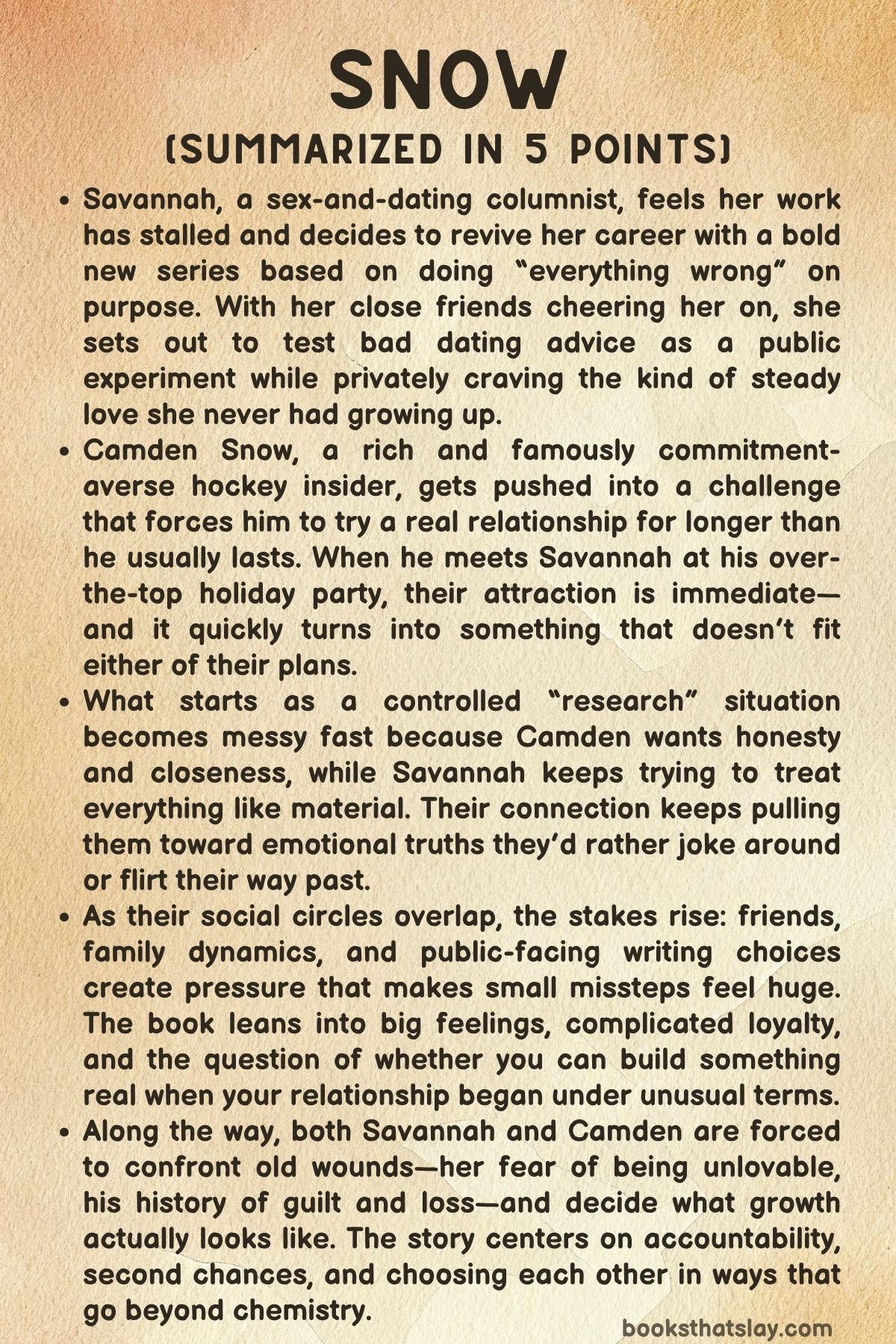
Snow by Brittanee Nicole is a contemporary romance set in a glossy Boston world where pro hockey, money, and tight friend groups shape everyone’s orbit. Savannah, a sex-and-dating columnist whose career is stalling, decides to revive her work with a “reverse” dating experiment: she’ll deliberately make all the common mistakes to show readers what not to do.
Then she meets Camden Snow, a rich former hockey star with a reputation for short flings and a hard shell around anything emotional. What begins as “research” turns into a relationship that challenges Savannah’s defenses and forces Camden to face old guilt, family pain, and the fear that he isn’t someone people stay for. The book is the 6th book in the Boston Bolts Hockey series.
Summary
Savannah is twenty-seven and quietly tired of feeling stuck. She writes a sex and dating column for Jolie magazine under the name “Calliope,” and she can tell the attention around it is fading.
Her friends—Josie Warren, Addie Langfield, and Sutton Jones—have the kind of big, loud support systems Savannah never had. They come from money, sports fame, or family networks that show up and stay.
Savannah’s background is the opposite: a childhood shaped by a narcissistic mother, an absent father, and a constant sense that she’s on her own. The contrast makes her grateful for her friends, but it also sharpens the loneliness she’s spent years pretending doesn’t bother her.
At work, Savannah fears her column is nearing the end. During a girls’ night out, Josie finds an old “Good Wife’s Guide” tucked into her parents’ wedding album, and the group starts laughing at the outdated “rules” meant to keep women desirable and men interested.
That joke becomes Savannah’s lifeline. Instead of writing another neat list of tips, she decides to prove the point by doing the opposite of what dating advice always says.
She’ll cling. She’ll overshare.
She’ll rush things. She’ll show readers what happens when you follow the so-called “turnoffs,” and she’ll document it as a public experiment with a working title that basically blames her on purpose.
Sutton, who falls fast and gets hurt fast, is the friend who unintentionally shows what those “mistakes” can look like in real life, which only reinforces Savannah’s resolve: she will do this deliberately, and she will stay emotionally detached while she does it.
Camden Snow is introduced from another angle: hockey royalty without the jersey. He used to play for the Boston Bolts and now works as head of scouting.
He’s famous for being charming, rich, and impossible to pin down, a man who never keeps anyone longer than a couple of dates. At a dinner in New Hampshire with his best friend Daniel Hall and their circle, Camden gets teased about his commitment issues.
Daniel’s wife Hannah turns the teasing into a bet: if Camden can date one woman for three months—past his usual cutoff—Hannah will help support letting Daniel and Hannah’s godson, Maverick, enter the NHL draft early. Camden acts like it’s ridiculous, but the bet lands in his head anyway.
Not long after, Camden hosts a lavish holiday party at his harbor mansion in Boston. Savannah arrives with her friends with one purpose: find a man for her experiment.
The party is a full display of Camden’s world—pro players, wealth, and entertainment designed to shock. Savannah quickly learns Camden is single, loaded, and known for brief flings.
To her, he’s the perfect “subject.” If she can demonstrate that even the most tempting playboy isn’t worth chasing, she’ll have material that sells.
When Savannah and Camden finally meet, the connection is instant and physical, but it doesn’t stay superficial for long. Their flirting is bold, explicit, and playful, and Camden leans into a controlling persona that Savannah chooses to tease rather than fear.
She tells herself it’s just one night. She can be daring without getting attached.
On his patio, though, the conversation slips into something neither of them planned. Camden admits that he doesn’t believe anyone has ever loved him enough to stay.
Savannah, caught off guard, admits something even rawer: she doesn’t think anyone has ever loved her at all. The confession cracks her usual armor.
Camden’s response isn’t casual. He tells her she would be easy to love, and he says, plainly, that he wants more than a one-night story.
Savannah tries to drag it back toward sex, because sex is the part she knows how to control.
Camden takes her downstairs to reveal the “surprise” at the party: a basement speakeasy transformed into an erotic performance space with pole dancers and music. Savannah is shocked, but she’s also fascinated.
Camden keeps her close, sitting her on his lap, making it obvious she has his full focus even in a room designed for distraction. A dancer offers Savannah attention, and Savannah checks Camden’s reaction before allowing anything.
Camden says she can do what she wants, but when the dancer touches Camden, Savannah redirects the hand firmly. The possessiveness surprises even her, and it hits Camden hard.
He likes that she wants him to herself, but he hates the idea of other people watching her.
When Savannah jokes that she can’t dance because she isn’t wearing panties, Camden’s reaction is immediate and intense. He carries her out, angry at the thought of her exposed in public, then stops himself when he realizes he’s pushing too far.
Savannah could leave, and he tells her she can. Instead, she chooses to stay—but she asks to slow down.
That request changes the atmosphere. Camden offers her water, gives her comfortable clothes, and lies beside her fully dressed.
The night becomes oddly quiet and intimate before it turns sexual again.
In bed, Savannah asks questions she didn’t expect to ask, including whether he wants kids. Camden admits he used to picture a future that included family, but he stopped trying for it.
He learned to sabotage himself because rejection hurts less when you’re the one who ends things first. The honesty draws Savannah closer, and their restraint breaks.
They have sex that’s intense, prolonged, and defined by explicit consent and careful attention to safety. Savannah slips out at dawn anyway, returning to Addie’s apartment, where her friends tease her for disappearing.
Savannah admits she hasn’t heard from Camden.
Days pass with no call. Savannah takes that silence and turns it into her first experiment installment, framing the night as a lesson in how certain behavior can scare men off.
Josie pushes her to move on to the next date. Savannah tries.
At a bar with Josie, they run into familiar faces from their overlapping hockey world, and Theo James—a wealthy, charming man—becomes Savannah’s new “test.” Savannah plans to build chemistry and then intentionally ruin it for the sake of her project.
Camden, meanwhile, is irritated Savannah left while he slept and feels an unexpected possessiveness about her. When he learns she’s out with Theo, jealousy hits so hard he can’t hide it.
He storms into the restaurant, interrupts them, and demands Savannah acknowledge him. Savannah, hurt that he disappeared for days, dismisses him in front of Theo.
The clash leaves both of them rattled.
Later, Savannah goes to Camden’s house late at night, unable to settle her nerves without confronting him directly. Camden stops her from leaving, insisting it isn’t safe, and the argument flips into a sexual power struggle that matches their earlier dynamic.
Camden sets strict terms, asks blunt questions about Theo, and turns Savannah’s anger into a game about attention, control, and confession. They end up in bed again, and Savannah finds herself apologizing for agreeing to see Theo while Camden claims, in no uncertain terms, that he wants her to belong to him.
It’s messy, thrilling, and far too personal for something that was supposed to be “research.”
Christmas Eve pulls Savannah deeper into Camden’s social world. She helps at Addie’s family gathering, surrounded by the Langfields’ intense, communal family setup.
Savannah sees how Addie carries her own tension—especially around JJ, someone tied to complicated history—and Savannah steps in where she can, distracting kids and easing pressure. All the while, she waits for Camden, aware their circles overlap enough that secrets are risky.
Camden arrives late, shaken from dealing with his mother’s Alzheimer’s and the guilt that comes with it. He’s received a message implying Savannah is playing him, including a link to Calliope’s blog.
He doesn’t read it immediately, but the doubt sits there. When he sees Savannah, he softens.
She notices he’s struggling and gets him out of the party early without making it a spectacle. Back at her apartment, she tries to lift his mood with a seductive Christmas “gift,” and the night pulls them closer again.
While Savannah sleeps, Camden reads the blog link. He realizes Savannah is Calliope and that she wrote about him.
Instead of exploding, he feels a strange relief that the focus is him—and he decides on playful payback rather than punishment. On Christmas morning, he gives Savannah coffee and a key, then asks her to move in with him.
Savannah panics for a second, fearing something much bigger, but the ask still overwhelms her. She says yes.
Their relationship escalates fast, and Camden’s friends notice the change in him. Savannah is also pulled into their group events, including a “couples’ night” that turns out to be a tantric sex class taught by someone Savannah recognizes from pole dancing.
The night is chaotic and revealing, and Savannah learns Hannah once wrote the original Calliope column years earlier, which makes Savannah feel like her secret is always one careless moment away from exposure.
Camden’s life outside Savannah is heavy. His mother’s illness worsens, and the trauma around his father’s death still haunts him.
One night, in the middle of an emotional moment, he explains the plane crash that killed his father and how guilt has fused itself into Camden’s identity, especially as his mother cycles between confusion and blame. Savannah stays with him through the call, offering steady comfort rather than trying to fix it with jokes or sex.
Then Camden does something extreme: in a rush of emotion, he takes Savannah to a tattoo shop and gets her name inked over his heart. Savannah gets a tattoo too.
The move-in happens soon after, and Savannah says goodbye to the neighbors who have quietly been her chosen family, promising herself she isn’t abandoning her past—she’s finally allowing herself a future.
The relationship cracks when the truth about the bet surfaces. Savannah learns there was a wager tied to Camden dating someone for three months, and it turns her trust into rubble.
She starts to believe she was never chosen for herself, only as a way for Camden to win. Camden tries to be careful and respectful during a tense conversation, but Savannah interprets his restraint as disgust and distance.
Camden spirals into self-blame, convinced he ruined her.
In his lowest moment, Camden goes to the rink late at night and meets Daniel, Aiden, Brooks, and War. They shoot pucks and talk, and Camden finally breaks.
He confesses the layered guilt he’s carried: the secret that drove his sister away, the belief his choices led to his father’s death, the pain of his mother’s hatred when she’s lucid, and the twisted relief when she forgets and loves him again. Then he reveals another bombshell: Savannah is Tara’s daughter—Tara being Camden’s high school girlfriend who cheated on him with his best friend and got pregnant.
Camden panicked when he learned it. He pushed Savannah away because it felt like the only way to breathe.
His friends push him toward therapy, real accountability, and actual emotional work, not more self-destruction.
Savannah, devastated, writes a brutally honest Calliope entry admitting she lost the man she thought was different. The post goes viral.
Instead of being punished, Savannah is called into her boss’s office and learns the response is massive—thousands of comments, deep reader connection, and advertisers paying attention.
Then Savannah sees Camden’s public response: a “How You Get the Girl” piece written in his voice. He admits the bet existed, admits he should have told her, apologizes, and promises to work on himself.
He follows it with more entries over time—therapy updates, gratitude lists, and even a fertility check because he wants kids with her. He keeps saying, in plain language, that he loves her and he’s trying to become someone worthy of staying with.
Two months later, Savannah goes to Cora Snow’s therapy office under a fake name, terrified Camden’s sister will hate her because of who her parents are. Cora doesn’t.
She tells Savannah she isn’t responsible for Tara or Jeremy’s choices, and she admits Camden misses her. The kindness gives Savannah permission to believe she can return without being punished for her bloodline.
Savannah later attends Addie’s final game and a surprise retirement party. Theo flirts again, and Savannah tries to act like moving on is possible.
Camden shows up and behaves politely, almost detached, which makes Savannah panic. She corners him in the hallway and demands to know if his written words were real—especially calling her the love of his life.
Camden confirms they were. He clarifies that a woman Savannah saw with him was simply someone who arrived at the same time, not a date, and he tells her he isn’t thinking about anyone else.
Still, he steps back and tells her to return to the party because the night belongs to Addie.
A few days later, Camden arrives for a promised photo shoot and finds Savannah there, calm and ready. She tells him she’s been promoted and now has her own column under her real name, “The New Romantics,” and she wants to write their love story truthfully.
Then Savannah flips the script: she proposes to Camden. Camden reveals he’s been carrying a ring for months and proposes back.
They say yes to each other at the same time, choosing a future built on honesty instead of games.
In the epilogue, they cross the threshold into a home that finally feels like theirs. They confirm they haven’t been with anyone else during the separation, and they reconnect with clarity and relief.
By August, Camden surprises Savannah by buying the house she once loved but lost in a bidding war, paying well above the other offer. A welcome-home party waits inside with their friends and extended family, and Savannah realizes the space isn’t just for them—it’s for the family they’re choosing to build, including guests, kids, and a crowded, chaotic circle that no longer feels intimidating.
It feels like belonging.
Characters
Savannah
Savannah is the emotional and narrative engine of Snow—a woman who sells confidence for a living while quietly fearing she is fundamentally unlovable. As a sex-and-dating columnist, she’s trained herself to observe romance like a case study, and that instinct becomes her armor when she feels her career slipping and her audience drifting.
The “reverse-dating experiment” isn’t just a clever hook to save her column; it’s also a controlled environment where she can be messy on purpose and call it research, which lets her flirt with intimacy without admitting she wants it. Her backstory—an emotionally barren childhood shaped by a narcissistic mother and an absent father—explains why she equates attachment with danger and why she’s more comfortable being desired than being known.
When she meets Camden, Savannah initially frames him as a “type” to prove a point, but her control starts to crack the moment they share mutual confessions about love and staying. She’s bold, sexually direct, and quick with humor, yet the bravado repeatedly gives way to a core truth: she longs for stability, chosen-ness, and family, even if she doesn’t trust those things exist for her.
Her arc is essentially the slow decision to stop hiding behind the persona—Calliope, the experimenter, the girl who doesn’t care—and to risk being Savannah, the woman who does.
Camden Snow
Camden is presented as the fantasy—wealthy, dominant, magnetic, and famous—but the story makes him most compelling when the fantasy frays and the ache underneath shows. He’s spent years in a pattern of brief flings not because he can’t connect, but because he connects too quickly and then panics at the cost of being left.
His admission that he doesn’t think anyone has ever loved him enough to stay is the core wound that explains nearly everything: his defensiveness, his possessiveness, and his instinct to control the emotional temperature of a room the way he controls physical moments. Camden’s family history adds weight to that wound—his father’s death and his mother’s Alzheimer’s create a constant loop of grief, guilt, and destabilized attachment, where love is present but unreliable and often painful.
With Savannah, Camden experiences something that feels like home and threat at once; he wants permanence, yet he’s terrified of being exposed as unworthy of it. His jealousy and dominance read as erotic play on the surface, but the story also shows how those impulses can become self-sabotage when he’s emotionally flooded.
The turning point for Camden is not just winning Savannah back—it’s choosing accountability: therapy, public honesty, and sustained emotional labor, which marks him as a character who learns that devotion isn’t a feeling he can demand, it’s a practice he has to earn.
Josie Warren
Josie functions as both friend and catalyst, the one whose social ease and family security make Savannah feel both comforted and quietly alien. As the daughter of a hockey legend, she moves through a world of tight-knit wealth and sports-family familiarity, which positions her as a bridge between Savannah’s isolated upbringing and the communal ecosystem Camden belongs to.
Josie sparks the book’s central premise when she finds the vintage “Good Wife’s Guide,” but what matters is the psychology behind that moment: she recognizes Savannah’s fear and gives it a “project” shape, turning emotional risk into an experiment that feels safer. At her best, Josie is steady and practical—nudging Savannah to move forward, offering perspective, and showing up when Savannah is wrecked.
At her messiest, she’s also capable of crossing lines, particularly when money and male influence enter the picture, which reveals how even well-intentioned friendships can buckle under the weight of loyalty tests. Still, Josie’s consistent role is love-in-action: coffee at 3 a.m., apologies that don’t dodge responsibility, and a refusal to let Savannah collapse alone.
Adeline “Addie” Langfield
Addie is the disciplined, high-achieving counterpoint to Savannah’s improvisational chaos—someone who has built her life around performance under pressure, whether as a pro goalie or as a woman constantly managing the emotional weather of the people around her. Her career milestone, becoming the Boston Bolts’ first female goalie coach, signals a character who has fought for space in systems not designed for her, and that fight seems to have trained her to compartmentalize fiercely.
In her family sphere, Addie’s tension around JJ—her discomfort, avoidance, and the way others subtly adapt to it—suggests history with emotional teeth, and the story uses those moments to show that even in a loving, communal family, some dynamics remain unresolved and raw. Addie’s friendship with Savannah has a protective quality; she gives Savannah proximity to warmth and family while also exposing Savannah to exactly the kind of closeness Savannah never learned to trust.
By the end, Addie’s retirement and the chaotic reshaping of her living situation position her as a character on the edge of a new chapter, where control may no longer be her primary survival tool.
Sutton Jones
Sutton embodies romantic hope in Snow, but not the polished kind—the kind that bruises easily and still keeps showing up. As a Broadway actress, she lives in a world where emotion is both craft and currency, which mirrors Savannah’s job in a different register: both women perform versions of intimacy, one onstage and one on the page.
Sutton’s “falls too fast” pattern makes her a cautionary example for the column experiment, yet the story doesn’t treat her as foolish so much as tender; she believes in love even when it hurts her, and that belief becomes both her flaw and her charm. Her presence also sharpens Savannah’s contrast: Sutton is willing to admit longing, while Savannah disguises longing as strategy.
Sutton’s teasing and friendship support help keep the story from becoming purely insular around the main couple; she’s part of the chorus that normalizes wanting, even when wanting makes you vulnerable.
Tyler “War” Warren
War is the mythic hockey presence in the background, but his real narrative function is to represent legacy, family gravity, and the kind of stable network Camden and Josie take for granted. He’s part of the group that ribs Camden about his bachelor streak, and that teasing isn’t just humor—it’s social pressure from men who have built lives beyond the rink, suggesting the “next step” Camden avoids.
War also contributes in quieter ways as an example of someone who has survived grief and hardship and still built a foundation, which becomes relevant when Camden’s friends later push him toward therapy and emotional maturity. He reads as a steady patriarchal figure in the sports-family ecosystem: blunt, loyal, and present.
Daniel Hall
Daniel is Camden’s anchor—best friend, truth-teller, and the person who can confront Camden without it feeling like an attack. He participates in the bet premise through his household dynamics and friend-group banter, but once the relationship becomes real, Daniel’s role shifts into accountability and repair.
He’s the one who confronts Camden after realizing Savannah is Calliope, and his reaction matters because it signals what the “healthy couple” in the friend group looks like: direct, communicative, not interested in letting men hide behind ego. Later, when Camden spirals into guilt and panic, Daniel helps redirect that energy into a plan that requires time and work, reinforcing the book’s message that redemption is structured and sustained, not dramatic and instantaneous.
Hannah Hall
Hannah is a catalyst in two major ways: she initiates the bet that pressures Camden into proving he can stay, and she is revealed as the original “Calliope,” which reframes Savannah’s column as part of a lineage rather than a solitary gimmick. That revelation also makes Hannah an unsettling mirror for Savannah—someone who once wrote a similar voice and still lives inside a committed, teasing, sexually open relationship, implying that Savannah’s desires are not naive or impossible.
Hannah’s boldness and willingness to poke at Camden’s identity cracks the bachelor persona and forces the question Camden fears: can you be chosen for real, and can you choose someone back without running?
Maverick Hall
Maverick’s presence is mostly structural, but meaningful: he’s the godson whose future becomes leverage in adult negotiations, which shows how tightly this world’s relationships braid together—career, family, loyalty, and control. The bet’s stakes hinge on his draft timeline, making him the innocent center of a power play between adults who love him and still use him as a bargaining chip.
Maverick also highlights Camden’s capacity for care beyond romance; Camden isn’t emotionally empty, he’s emotionally gated, and his bond with Maverick proves it.
Cora Snow
Cora is Camden’s twin and one of the most quietly important characters because she represents the part of Camden’s life he can’t dominate his way out of—family history, shared trauma, and the long shadow of old wounds. Her role as a therapist is symbolically pointed: she’s literally positioned as someone who helps others untangle pain, while her own family remains tangled.
When Savannah seeks her out under a fake name, Cora responds with unexpected kindness, which marks her as emotionally generous and more evolved than Camden expects. She refuses to transfer Tara and Jeremy’s sins onto Savannah, and in doing so, she becomes a gatekeeper who opens the door rather than slams it.
Cora also serves as proof that Camden’s world can accept Savannah fully, not as an outsider being tested, but as a person being welcomed.
Sienna Langfield
Sienna operates as both boss and cultural barometer within the story—the person who understands what audiences want and who validates Savannah’s voice when Savannah is sure she’s failing. She surprises Savannah by praising the column and later by treating the viral heartbreak piece as an authentic connection point rather than a scandal.
That reaction matters: it reframes Savannah’s vulnerability as power, not professional risk. Sienna also embodies a kind of feminine authority that isn’t moralizing about sex; she’s pragmatic, amused, and business-savvy, showing that the story’s world rewards honesty when it’s well-written and emotionally true.
Noah
Noah plays the role of the suspicious observer, the one whose protective instincts sniff out that something about Savannah’s writing and social circle doesn’t add up. By sharing the column link with Camden, he becomes the mechanism for exposure, forcing the relationship to confront the tension between performance and truth.
His presence heightens Savannah’s fear of being discovered and judged, especially inside a community where everyone overlaps, and he indirectly pushes Camden into the moment where secrecy stops being sustainable.
Finn Langfield
Finn is part of the wider social web that keeps colliding with Savannah’s private plan, and his significance comes from how easily men in this world talk about women, dating, and “turnoffs” as both humor and research. His presence at the bar scene helps Savannah justify her project as data collection, but it also shows her tendency to intellectualize intimacy.
Finn’s easy rapport with Josie and the group reinforces the theme that these families and friendships are interconnected in ways Savannah can’t control, which is exactly what makes her experiment so risky.
JJ Hanson
JJ is a charged figure in Addie’s orbit, and the story treats him like a live wire: present, influential, and connected to multiple people, yet carrying a history that makes Addie tense and avoidant. He moves through the Langfield family space with a kind of inevitability, suggesting he is either family in all but name or something close enough to blur the boundary.
The prologue teaser about a goalie camp moment—JJ defending young Addie after a crude comment—repositions him as both protector and rival-energy, hinting at a relationship built on respect, friction, and long memory. Even without full resolution in the summary, JJ reads as a “next-book” gravity well: someone whose past with Addie is unfinished and emotionally complicated.
Theo James
Theo is the shiny, socially approved alternative—wealthy, charming, and useful for Savannah’s plan precisely because he feels safely replaceable. He exists as a narrative foil to Camden: where Camden triggers vulnerability and possessiveness, Theo enables performance and strategy.
Savannah uses him to prove she can manufacture chemistry and then sabotage it, but Camden’s reaction to Theo exposes the depth of Camden’s attachment and Savannah’s unresolved anger about being ignored after their first night. Theo’s later flirting at the retirement party also tests Savannah’s ability to move forward, and his presence emphasizes that Savannah isn’t short on options; what she’s short on is the ability to accept love without suspecting a trap.
Gavin
Gavin’s role is small but pointed: he’s the kind of friend who can observe the truth from the outside and name it simply, as when he comments that Savannah seems good for Camden. That sort of line matters in romance narratives because it grants the couple social legitimacy—someone in Camden’s world can see the change in him and believes it’s real.
Rosalie and Nick Donadio
Rosalie and Nick are Savannah’s chosen-family proof, the quiet argument against Savannah’s belief that no one has ever loved her. They show up not as glamorous wealth or hockey legacy but as steady, everyday care—elderly neighbors who have made space for Savannah’s life and treat her as family.
Their goodbye scene and their insistence that Camden promise to care for her give Savannah’s move-in moment emotional grounding: she isn’t being “rescued” from nothing, she is being carried forward by the love she already had and struggled to name.
Tara
Tara functions like a buried landmine in Camden’s emotional history, and her impact arrives late but detonates powerfully. As Camden’s high school girlfriend who cheated with his best friend and became pregnant, she embodies betrayal in its most identity-shaping form, the kind that convinces a person love is not just fragile but humiliating.
The revelation that Savannah is Tara’s daughter doesn’t taint Savannah morally, but it contaminates Camden’s nervous system; it fuses past pain with present love and triggers his instinct to push away before he can be abandoned again. Tara’s role is therefore less about being an active character and more about being the origin of Camden’s deepest relational fear—and the final obstacle that forces him to choose healing over avoidance.
Jeremy
Jeremy is the betrayal counterpart in the Tara history—the former best friend whose involvement makes Camden’s wound more than romantic. It’s not just “a girl cheated”; it’s “my closest person participated,” which explains Camden’s long-term distrust and his complicated relationship with male friendship, loyalty, and self-worth.
Even as an off-page presence, Jeremy’s actions shape the psychological architecture of Camden’s adult behavior, especially the reflex to keep relationships short enough that no one gets the chance to ruin him again.
Camden’s mother
Camden’s mother is one of the story’s most heartbreaking forces because she represents love that exists alongside harm and confusion. Her Alzheimer’s creates cycles where Camden is alternately rejected and embraced, blamed and adored, depending on lucidity—and that unpredictability trains Camden to associate closeness with instability.
The sedation moment on Christmas Eve and the phone call where she’s confused about Camden’s deceased father underscore how Camden lives in constant anticipatory grief. She is not framed as villainous; she is framed as tragic, and the tragedy deepens Camden’s guilt, because he interprets her pain as something he caused and must endure.
Her condition also explains why Savannah’s steadiness affects Camden so strongly: with Savannah, affection doesn’t vanish overnight or turn into accusation, and that consistency becomes addictive.
Angel
Angel’s presence in the tantric class scene is both comedic and thematic: she brings Savannah’s “sex world” into the supposedly wholesome couples’ space, collapsing the false divide between eroticism and real relationship intimacy. She also contributes to the book’s recurring message that sex is not the enemy of love; it can be a language of connection, humor, and vulnerability when it’s consensual and honest.
Angel’s familiarity to Savannah underscores how Savannah’s expertise isn’t the problem—her fear of emotional exposure is.
Winnie Langfield
Winnie offers a grounded depiction of motherhood and exhaustion, and her candor about raising twins alone—even by choice—adds texture to the community Savannah is entering. Winnie doesn’t romanticize family life; she admits it is relentless, which makes the Langfield closeness feel more real and less like a glossy ideal.
Her openness also gives Savannah a model of adulthood where love and struggle coexist without shame, subtly challenging Savannah’s belief that if something is hard, it must be wrong.
Avery, Beckett, and Declan
The children function as more than cute background; they are a test of Savannah’s instinctive caretaking and an early hint that she’s capable of family life even if she doubts she deserves it. When Savannah takes the squabbling twins outside to burn off energy, she’s not performing for an article—she’s simply stepping in, regulating chaos, and protecting Addie’s boundaries.
Those moments quietly contradict Savannah’s self-image as a lone, detached woman; she is someone who can create safety, even in small domestic scenes.
Beckett Langfield
Beckett’s role is mostly contextual, but he signals the stability and tradition of the Langfield family structure, the kind of anchored father figure Savannah never had. His presence in the communal household web reinforces the theme that Savannah is moving into a world where men are expected to show up for family, not just succeed professionally.
Brooks
Brooks is one of the key voices in Camden’s “men’s circle” moment because he introduces the idea that rage and grief can become dangerous if left unprocessed. His admission about nearly attacking someone with a skate blade is startling on purpose—it externalizes what Camden’s possessiveness and jealousy could become if Camden keeps refusing help.
Brooks isn’t there to look heroic; he’s there to model vulnerability among men and to prove that extreme feelings don’t make you irredeemable, but they do make help non-negotiable.
Aiden
Aiden acts like the translator of panic, someone who understands the suffocation Camden feels and can name it without excusing it. By acknowledging that pushing Savannah away might have felt like the only way to breathe, he validates Camden’s internal experience while still pointing out it won’t solve anything.
That combination—empathy plus accountability—helps move Camden from self-hatred into action.
Themes
Love as a choice that challenges old survival habits
Savannah walks into Camden’s world planning to treat dating like a controlled experiment, and that mindset is not just a professional strategy—it is emotional self-protection shaped by a childhood where love felt unreliable or absent. Her “reverse-dating” project is built on the assumption that attachment is a trap: if you act “wrong,” the other person leaves, and you can pretend that proves you were never safe to begin with.
Camden arrives with a different version of the same fear. His pattern of ending things quickly is not random playboy behavior; it is a practiced way to avoid the humiliation of wanting something that might not stay.
When they meet, the attraction is immediate, but the theme becomes clear in the moments when neither of them can keep the connection comfortably shallow. Camden’s blunt admission that he doesn’t think anyone has ever stayed because they loved him enough exposes the real engine under his charm: he expects abandonment, so he tries to control the timing of loss.
Savannah’s confession that she doesn’t think anyone has ever loved her at all reveals how she has learned to act confident while assuming she is fundamentally unchosen. Their relationship keeps forcing them to make decisions that contradict those internal scripts—staying when it would be easier to disappear, talking when it would be easier to turn everything into a joke, offering reassurance when pride wants distance.
Even the “bet” that starts as a social dare becomes thematically important because it turns commitment into a measurable performance, something you can “win,” rather than a vulnerable promise you have to live inside. The later repair—public accountability, therapy, repeated efforts to show up—pushes the theme toward love as sustained behavior, not just heat or fate.
By the time Savannah chooses to write their love story under her real name and proposes, Snow has made a clear argument: love is not proven by intensity in a single night, but by the willingness to keep choosing closeness after your instincts tell you to run.
Power, control, and consent as emotional language
The relationship’s sexual dynamic is not presented as decoration; it functions as a communication system for two people who struggle to speak plainly about fear. Camden’s dominance and Savannah’s willingness to provoke him create a structure where intensity feels safer than tenderness, because rules and roles can temporarily replace messy uncertainty.
Yet the theme is not “control is sexy” in a simple way—it is that control becomes meaningful only when it is paired with consent, restraint, and care. Several scenes underline this by showing Camden pulling back when he recognizes he has crossed a line.
When he carries Savannah away after feeling triggered by the idea that she might be exposed in front of others, the moment initially reads as possessiveness and panic, but the story immediately tests it: Savannah insists on agency, and Camden stops, tells her she is free to leave, and chooses to offer comfort instead of forcing a scene to continue. That pivot matters because it reframes dominance as something that must be chosen by both people in real time, not something one person takes.
Their sexual escalation is repeatedly tied to explicit communication—protection, birth control, checking in—so the theme positions consent as a form of respect that makes intensity possible without harm. Jealousy is another pressure point where control could become toxic.
Camden’s reaction to Theo and his need to “claim” Savannah could have been framed as romantic ownership, but the narrative complicates it by showing how that impulse is connected to his fear of being replaced and his belief that he is not enough. Savannah’s own possessiveness during the performance scene is equally revealing: she is not only aroused; she is also asserting, in the only language that feels immediately available, that she matters and that she can be chosen.
In this theme, sex is not separate from emotion—it is where both characters try to negotiate safety, value, and belonging. The story’s later movement toward therapy and open apology suggests that the goal is not to keep translating everything into power games, but to grow into clearer honesty, where control no longer has to do the emotional work that words and trust should be doing.
Reinventing identity under public scrutiny
Savannah’s job turns private life into content, and that professional setup creates a constant tension between performance and truth. She begins with a persona—Calliope—whose authority depends on distance, cleverness, and the ability to reduce dating into rules that readers can copy.
The “reverse mistakes” experiment is designed to produce predictable outcomes, which would protect her from admitting that love is unpredictable and that she wants it anyway. Once Camden enters the picture, the theme shifts into what happens when the story you tell the public starts shaping the story you tell yourself.
Savannah tries to interpret silence from Camden as evidence that her “mistakes” worked, because that explanation keeps her in control and preserves her columnist identity. But the more she cares, the more that identity becomes a mask she cannot comfortably wear.
The exposure of her authorship, and Camden’s discovery that he is the subject, turns intimacy into a question of ethics and consent in storytelling: who has the right to narrate a relationship, and what does it mean when one person finds out they were turned into a lesson? The book leans into the discomfort rather than smoothing it over, especially when the column goes viral and the audience response becomes part of the couple’s reality.
Sienna’s reaction—treating the personal fallout as a professional win—adds another layer: Savannah’s pain becomes measurable in clicks, comments, and advertiser interest, and that is both empowering and unsettling. Camden’s decision to respond publicly is thematically sharp because it flips the usual romance script.
Instead of a private grovel, he enters her arena and uses language not to seduce, but to take responsibility, admit the bet, and describe concrete steps like therapy and health checks because he wants a future. Their eventual shift—Savannah getting promoted and writing under her real name, framing the column as “The New Romantics”—signals identity integration.
She stops hiding behind a pseudonym and stops treating romance as either a cautionary tale or a game she can control. By choosing to write their love story openly, she claims authorship of her life rather than just other people’s dating mistakes, and the theme resolves into a statement about authenticity: public voice becomes meaningful when it matches private truth.
Family wounds, found belonging, and breaking inherited patterns
Both Savannah and Camden carry family histories that shape their expectations of love. Savannah’s upbringing with a narcissistic mother and absent father leaves her with a hunger for stability paired with a reflex to dismiss her own needs before someone else can.
Camden’s family burden is different but equally corrosive: grief tied to his father’s death, guilt about decisions around that tragedy, and the ongoing disorientation of his mother’s Alzheimer’s. The story treats Alzheimer’s not only as backstory, but as a force that repeatedly destabilizes Camden’s sense of being loved, because affection becomes inconsistent and memory-dependent.
That instability reinforces his belief that love can vanish without warning, and it helps explain why he clings to control and avoids long commitment. Against that backdrop, the theme of belonging is built through community, not just romance.
Savannah’s friends and their families show her a model of closeness that is loud, messy, and reliable—something she both envies and fears. The Langfield brownstone, the communal childcare chaos, the tight-knit hockey circle, the “couples’ night” absurdity, and even the older neighbors who call Savannah family create a broader emotional environment that slowly contradicts her loneliness narrative.
When Rosalie and Nick frame Savannah as already belonging, it lands like a correction to her internal story that she is temporary in people’s lives. Camden’s friendships function similarly, especially in the late-night rink scene where his friends do not let him hide behind jokes.
They name therapy, forgiveness, and actual emotional work as the price of a real relationship, which turns masculinity away from stoic dominance and toward accountability. The revelation about Savannah’s parentage connects the theme to generational damage: old betrayals and resentments threaten to define the present, and Camden’s initial response is to push her away so he can breathe.
The repair requires both of them to accept a hard truth: they are not responsible for what their parents did, but they are responsible for what they choose next. Found family becomes the mechanism that helps them choose differently, because it offers models of care, confrontation, and loyalty that neither of them received in the same way growing up.
By the end, the home they build is not only a romantic symbol; it is a deliberate rejection of the instability they came from, a place designed for guests, children, and everyday belonging rather than survival.