The Infamous Gilberts Summary, Characters and Themes
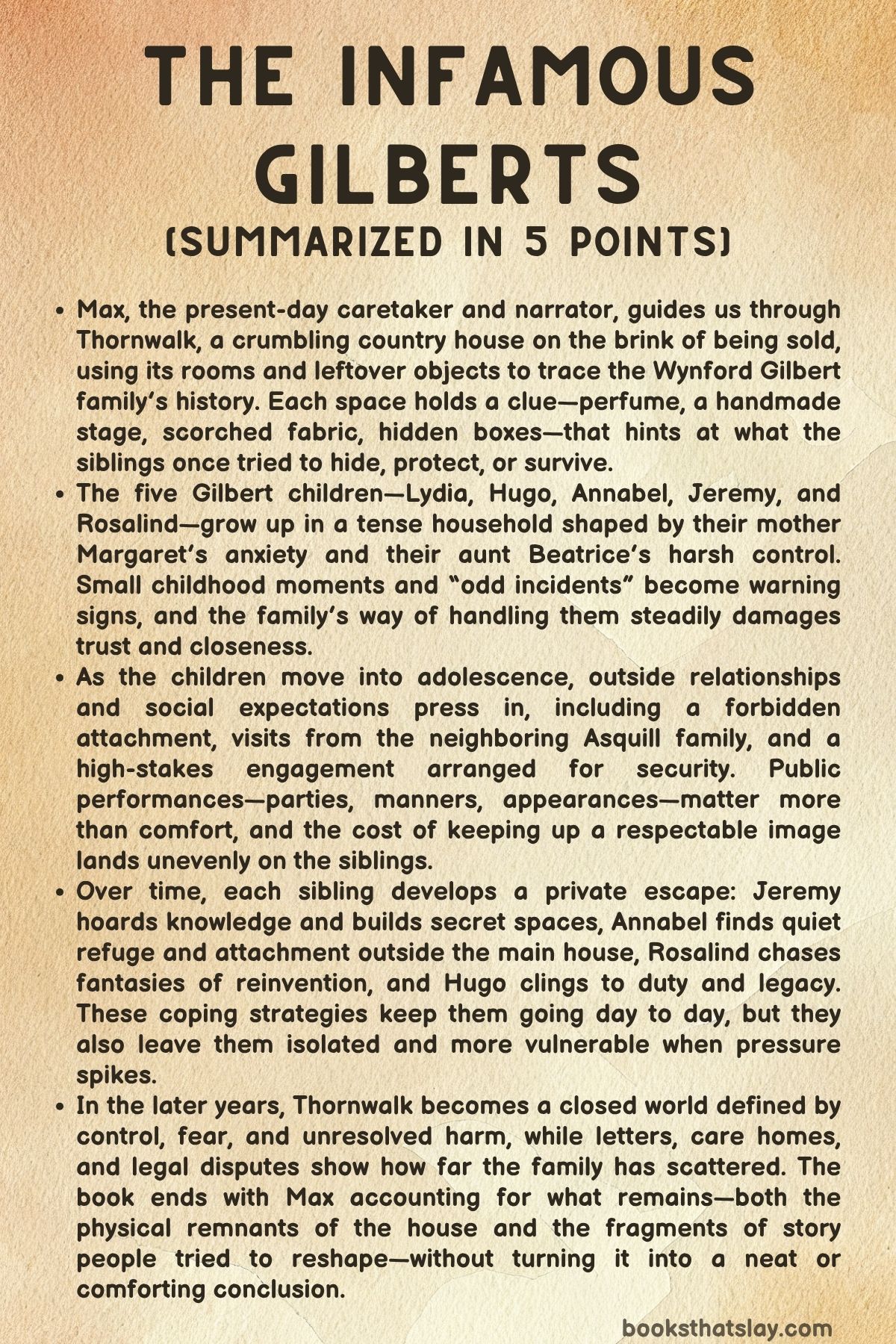
The Infamous Gilberts by Angela Tomaski is a dark family chronicle set inside Thornwalk, a crumbling English great house whose rooms still hold the evidence of decades of secrecy, control, and damage. The story is told by Max, a careful observer who moves through the house as if it were a museum, letting objects and places unlock what happened to the Wynford Gilbert siblings—Lydia, Hugo, Annabel, Jeremy, and Rosalind—and to their mother, Margaret.
What begins as a guided tour becomes a record of how a family’s private rules, shame, and fear can shape children into adults who can’t escape what they were taught to endure.
Summary
Max narrates the history of the Wynford Gilbert family by walking through Thornwalk room by room, treating each space as a container for memory. He begins in Lydia’s former blue bedroom, noting an ugly bolt fixed to the doorframe and the traces of old blood in the rug—marks that suggest later confinement and violence.
The room still carries Lydia’s perfume, and a hidden box of small treasures hints at a girl who once expected a future shaped by love and choice.
Lydia’s turning point arrives when, at fifteen in 1928, she starts a secret relationship with the family tutor, Mr. Higgins. Their bond grows through long walks and intense talk until Rosalind catches them together in the Chaplain’s Cottage.
Margaret reacts with panic and calls in Aunt Beatrice, a relative who brings not comfort but punishment disguised as “sense.” Beatrice humiliates Higgins and turns Lydia’s feelings into something to be corrected, not understood. Lydia is taken to London for examinations and harsh “treatments.” When Higgins later tries to reach her, Lydia shuts him out with a sudden, rehearsed rejection.
He vanishes from their lives, and Margaret collapses into tears that do nothing to protect her children.
Max leads the reader downstairs to the library, where the siblings once staged homemade plays. Jeremy built a small wooden platform like a stage, and Hugo wrote scripts that always centered himself as hero while the others took lesser parts.
Even play becomes a rehearsal for the family’s hierarchy. Under a rug near the fireplace lies a burnt patch, left from an incident in 1921 when five-year-old Annabel sat unmoving as a spark caught the rug.
Hugo carried her away and smothered the fire. The adults respond with alarm and whispering; Aunt Beatrice privately decides Annabel is broken, an unwanted remainder.
As the children grow, Thornwalk’s corridors and rooms divide them into roles. Jeremy collects survival equipment and dreams of escape, even attempting to saw through barred nursery windows to run away and search for their father—unaware the father is already dead, a truth wrapped in family lies.
Annabel becomes absorbed by insects and hidden life, drawn to what lives quietly in cracks and shadows. Margaret keeps cabinets of medicines and forces Annabel to swallow sedatives and tonics, trying to medicate difference into obedience.
Hugo, the eldest son, begins to sense his own cowardice: he sees what is being done and later admits he should have protected Annabel.
A violent storm in February 1930 brings the neighboring Asquill children—Wilfred and Emma—into Thornwalk for the night after lightning strikes near their home. Emma’s diary captures the house’s candlelit strangeness and the tense kindness the Gilberts can still perform for outsiders.
Soon Margaret decides to host a grand party to appear “normal,” and Beatrice takes control of every detail, especially Annabel’s appearance. Annabel is scrubbed, restrained, and painfully groomed offstage while the household pretends not to hear her screams.
The party fills with unsettling older guests. Hugo dances with Emma, Lydia is cornered by Cooper Coldwell, and Annabel slips outside, where she meets Simon Greenway, a young gardener.
Away from the house’s rules, Annabel dances with Simon among the servants and mist, tasting a freedom she barely understands.
After the party, Lydia’s future is negotiated like a transaction. Beatrice and Margaret agree to Lydia’s marriage to Coldwell, selling woodland to fund the dowry.
Lydia convinces herself she can manage the match because she is young and he wants her; she tells herself power is enough. Meanwhile, Annabel’s fascination shifts toward Wilfred, and she begins to cross boundaries at night, standing by his bed listening to him breathe.
Jeremy grows more bitter and restless, and the family’s fractures widen.
Rosalind, the youngest, clings to a white pony named Sparklefoot as the last bright thing in a shrinking world. When the estate’s finances worsen and horses are sold, she stages a dramatic protest to save Sparklefoot, even chaining herself to the stable door.
Margaret relents, but Rosalind’s promise to care for the pony fades quickly. Sparklefoot disappears and is quietly taken in by Simon near the cottages.
Rosalind barely notices until years later, when a white pony on a film set triggers sudden guilt—an emotion she pushes away to keep functioning.
Rosalind’s hunger for attention grows wilder. She trails Lydia, demands a trousseau, throws theatrical tantrums, and seeks romantic validation from Wilfred.
When he retreats, frightened by what he has encouraged, she collapses into self-loathing and obsession with beauty and comparison. Soon she vanishes entirely, taking a travel bag, hidden savings, and their father’s address book—copied by Jeremy—because she believes a note about a “film man” can lead her to an acting life.
Police find her unharmed, and Margaret forgives her after a promise, but Rosalind privately insists she found the man and must keep it secret. She also begins claiming she is pregnant, clutching her stomach as if insisting on a story that will force the world to pay attention.
Jeremy retreats into discovery and hoarding, finding hidden passages and building a private attic storeroom filled with fossils, coins, insects, slides, and tiny skeletons. He becomes the family’s historian and dissenter, disgusted by their performance of respectability.
By 1934, Beatrice brings another “solution” for Rosalind: an older man, Mr. Simms. Rosalind initially protests, then returns suddenly announcing an engagement.
Jeremy and Annabel call it disgusting. Jeremy withdraws further, refusing to participate in the family’s bargains.
Annabel’s refuge becomes the sawmill loft, where she grows close to Simon. She lies beside him on hay, rests her head on his chest when pain troubles her body, and makes tiny hay dolls lined along a rafter like secret companions.
But Beatrice’s control tightens. A chauffeur named Randall arrives, and Annabel is pulled toward him too, hungry for any warmth not shaped by pity.
In 1936, Annabel overhears Beatrice pressuring Margaret about “arrangements” for Annabel, spoken about as if she were a problem to be managed before it spreads. Margaret yields.
Annabel tries to flee to Simon, but Randall catches and restrains her, and Beatrice drives her away. Annabel disappears for three months and returns changed, with later memories of wrists being gripped and choice removed.
She burns her hay dolls, keeping only a tiny leftover tangle and a stolen silver spoon among her private objects. Simon proposes marriage; Annabel refuses.
After a final cold exchange, she stops visiting the sawmill, and Simon leaves. Annabel waits in the rain as if waiting can undo what has been done.
War brings new absences. Hugo and Wilfred enlist; Jeremy remains due to medical issues, channeling his rage into mock defenses and obsessive plans.
Thornwalk houses army stores; a bomb lands in the lake without exploding. After the war, Hugo returns injured and hollowed out.
He declares he will take over the failing family business and fights with Jeremy, who sees Hugo’s plans as another form of denial. Annabel, seeing the emptiness behind Hugo’s presence, says flatly that “Hugo is dead,” meaning the brother she knew has been replaced by something harder and stranger.
Margaret’s decline becomes its own trap. Annabel ends up living with her mother in the Chaplain’s Cottage, a filthy outbuilding made deliberately hard to reach after Hugo alters the estate paths.
Food is left at a distance. Margaret talks endlessly about abandonment and betrayal, repeating the same fears until Annabel has no room left for her own life.
Lydia does not come. Emma visits briefly, but even she cannot stay.
In the 1950s, the family collapses into open danger. Emma writes to Jeremy in 1954, desperate: Hugo has been drinking on a hill with a shotgun and a pile of bricks, trying to build a “tower” to honor his father.
He swings between need and threat, even striking Emma. Jeremy returns and confronts Hugo.
The brothers fight violently in the kitchen. Jeremy leaves again, refusing to be pulled back into the house’s sickness.
After that, Hugo tightens his control over Emma: locks, keys, rules, surveillance, punishments disguised as “trust.” Emma eventually escapes through a bathroom window, but her attempt to help Margaret at the cottage triggers Hugo’s worst outburst. Hugo drags Emma into Thornwalk and bolts her into Lydia’s old blue room.
Her bleeding smears the door and rug—the blood Max showed the reader at the start.
Inheritance and money arrive as a second kind of violence. After Beatrice dies, her estate becomes contested, delayed by Lydia and Cooper Coldwell’s legal efforts.
When the money is finally near release, Lydia begins sending affectionate letters and photos shaped by her husband’s interests. She visits the cottage with her sons, presses them to perform family warmth, and angles for access to Beatrice’s money.
Annabel feels sickened by the manipulation and walks out rather than participate.
Rosalind’s adult life ends in disaster. After Nicholas Middleton divorces her and remarries, Rosalind lies to obtain his new address, dresses in her wedding gown, and goes to confront him with a fruit knife.
The legal case turns her into a public spectacle and she is labeled criminally insane. Years later, she escapes a psychiatric hospital and walks more than a hundred miles back to Thornwalk in a yellow raincoat, small and childlike.
Annabel hides her in the attic for a night of frantic talking—apologies mixed with bitterness, pain mixed with defiance. Rosalind runs again the next morning and is recaptured; in a rare moment of gentleness, two officers take her for ice cream by the sea before returning her to custody.
She later dies, asking for Wilfred.
The darkest event centers on Emma’s captivity. While Hugo sits outside the bolted blue room with a fire axe, Annabel tries to summon help by placing a crude sign meant to redirect a farmhand, Percy Kirby, toward the house.
Percy follows it, hears Emma pleading and Hugo raging, and runs upstairs to free her. Hugo catches him, attacks with the axe, and Percy flees bleeding.
Hugo pursues him into the woods and severs his hand against an oak. Hugo is arrested and sent to psychiatric care; the outcome is shaped by testimony about his long decline and by settlements that transfer property as reparation.
Three days later, Emma goes to Max’s village house. She agrees to support Hugo legally and financially through her family’s influence, but only if she never sees him again.
She leaves her wedding ring behind and disappears from public view.
In the long aftermath, Thornwalk becomes a slow ruin. Annabel attempts to write a hopeful manuscript that reshapes the family into a kinder story, but Max states plainly it did not happen.
No one returns to save the house. Margaret dies in 1972 without confession or apology.
A fire damages Thornwalk badly; Annabel rings the tower bell, but help comes too late. Simon, living elsewhere with a family, does not attend Annabel’s funeral.
Jeremy’s life becomes scattered across pseudonyms and small publications; in 1966 he sends Hugo a letter revealing their father’s true death and secret second family, but Hugo burns it and destroys a treasured model ship, choosing the old lies over unbearable truth.
Max remains, caring for Hugo after everyone else is gone. Hugo attempts suicide in the lake and is pulled out.
He fades through collapses and fear, obsessed with the idea that every trace of his family will vanish. Max cooks, gardens within strict limits, plays records, and shields Hugo from anything that might trigger panic.
Hugo eventually dies in a narrow room near the blue bedroom, exhausted by years of control, guilt, and loss. Max keeps small souvenirs, places a new tombstone in the chapel graveyard naming Hugo as “beloved of Maximus,” and finally leaves Thornwalk behind, asking that the door be locked after him.
Characters
Max (Maximus)
Max is the novel’s steady, melancholy lens: a caretaker-narrator who moves through Thornwalk as if the house were both museum and confession booth, translating stains, scents, and leftover objects into meaning. His voice suggests a person who has chosen proximity to ruin because it offers a kind of control—if he can name every scratch and relic, perhaps the past stops shifting under his feet.
Yet he is not a neutral archivist. He frames the Wynford Gilberts with an intimacy that comes from long exposure and, eventually, from dependence: by the end he is not simply documenting the family’s decay but actively participating in its last phase, living alongside Hugo and shaping what will be remembered.
His tenderness—seen in the small “souvenirs,” the careful curation of Hugo’s days, and the final tombstone inscription—also raises an uneasy question: whether love, in this world, is ever cleanly separate from possession. Max’s ultimate act of naming Hugo as “beloved of Maximus” reads like devotion and like authorship at once, a final claim laid over a life that has been defined by claims.
Lydia Wynford Gilbert (later Lydia Coldwell)
Lydia begins as the family’s concentrated longing for romance, escape, and validation, and her early story with Mr. Higgins sets the template for how the novel treats “love” as something easily weaponized by class, shame, and adult intervention. Her first attachment is intense and imaginative, the kind of feeling that makes a teenager believe the world will reorganize itself around sincerity, but she is taught—brutally, clinically—that desire can be reclassified as illness and corrected by force.
What follows is not merely heartbreak; it is training. Lydia learns to survive by converting emotion into strategy, and that conversion is visible in how she accepts Cooper Coldwell: she persuades herself that power comes from being chosen, from being younger, from being “secure,” even if the bargain hollows her out.
As an adult she becomes a figure of managed appearances and calculated narratives, sending curated affection and deploying children and politeness as tools when money is at stake. Yet the old wound never fully closes: in old age her memories return to Mr. Higgins with a softness that implies the romance was less a mistake than the last time she felt unadministered feeling.
Her late-life scenes also expose how institutions repeat Thornwalk’s original cruelty in a modern register—her story is edited, sweetened, made “suitable”—and Lydia, once again, is reduced to a version others can tolerate.
Hugo Wynford Gilbert
Hugo is the family’s most terrifying transformation: a boy who can act decisively in crisis becomes a man whose decisive impulses curdle into control, violence, and delusion. As a child he is the rescuer—carrying Annabel from the fire, running through a storm to bring others to safety—and those early moments matter because they show an innate capacity for care, even competence, that later collapses under guilt, inheritance, and the pressure to “hold” the family together.
He grows into the role of Thornwalk’s defender as if it were a military post, and the estate becomes an extension of his nervous system: paths are altered, access is restricted, doors are locked, people are monitored. The war returns him wounded and emotionally blunted, and from there his identity narrows to obsession—business, legacy, “tower,” father, property—until relationships become threats to be managed rather than bonds to be lived.
His marriage, or marriage-like captivity, of Emma is the clearest expression of this: love is rewritten as surveillance, protection as imprisonment, fear as justification. Even his paranoia after welcoming tourists shows how unstable his grip is—hospitality flips into persecution in the span of an afternoon.
Yet Hugo is not written as a simple monster; his dread of being forgotten, his frantic attachment to relics, and his eventual decline under Max’s care reveal a man haunted by the very softness he can no longer access safely. The tragedy is that his need to preserve the family’s world destroys every living relationship that could have made preservation meaningful.
Annabel Wynford Gilbert
Annabel is the novel’s most quietly devastating character because her suffering is not only immense but persistently misread—by her mother, by Aunt Beatrice, by the household, even sometimes by the reader who is forced to interpret her silences. From early childhood she is treated as a problem of affect: when she fails to react to fire, adults interpret stillness as defect rather than as a different wiring, shock, or dissociation.
That misinterpretation becomes permission for coercion—sedatives, hiding, “treatments,” grooming-as-assault—until Annabel’s body is managed as if it belongs to the family’s reputation rather than to herself. Her inner life, however, is vivid and specific: she loves the hidden ecosystems of Thornwalk—beetles, woodlice, secret compartments—and those fascinations feel like an alternative ethics, a devotion to small truths that do not lie for social comfort.
Her relationship with Simon offers the closest thing she has to safety, but even there tenderness is fragile because she has learned that intimacy invites capture; when she is taken away for months, the aftermath is not melodrama but a scorched, private ritual—burning the hay dolls—that reads as both grief and an attempt to regain ownership of memory. Annabel’s later manuscript, with its comforting ending that “never happened,” reveals the last defense available to someone repeatedly denied agency: she rewrites reality not to deceive others but to build a psychic shelter.
Her continued life at Thornwalk, talking to herself and circling the past, is less “madness” than an enforced intimacy with trauma—when escape is structurally denied for decades, the mind makes a home in repetition.
Jeremy Wynford Gilbert
Jeremy is Thornwalk’s internal exile, a boy whose restlessness becomes a lifelong refusal to accept the house’s lies as normal. Early on he is the builder and the planner—constructing a stage, attempting escape, sawing at bars—yet his creativity is always pointed toward exit routes rather than performances of family unity.
Unlike Hugo, who channels duty into domination, Jeremy channels disgust into withdrawal and private systems: hidden passages, the attic storeroom, collections of fossils and coins and bones. Those collections are not mere hobbies; they represent a counter-authority, a world where evidence matters and things can be known without being socially approved.
His later life—publishing, writing under many names, scattering traces that Hugo tries to burn—extends that pattern: Jeremy survives through fragmentation, refusing the single fixed identity Thornwalk demands. Crucially, he also holds truths the household cannot bear, including the revelation about their father and the American half-sisters; his letter is an ethical act, an attempt to replace myth with fact, and Hugo’s destruction of it shows how Jeremy’s role threatens the family’s last defenses.
Even his return in the 1950s is structured as confrontation: he refuses to soothe Emma with passive sympathy and insists on facing Hugo, only to leave again when the house proves unchanged. Jeremy embodies the novel’s bleak insight that knowing the truth is not the same as being able to use it to save anyone.
Rosalind Wynford Gilbert
Rosalind is the family’s most volatile blend of hunger and performance, a girl who seems to grow up on the boundary between attention-seeking theatrics and genuine psychic fracture. Her early fixation on Lydia’s life and on the idea of glamour—trousseaus, engagement, being “like” the women in magazines—suggests a child who has learned that love in Thornwalk is distributed as spectacle: to be noticed, she must stage herself.
Her dramatic gestures, including self-harm-like acts and the runaway attempt to find a “film man,” are not simply bratty rebellions; they are desperate bids to force the world to answer her, to prove she exists beyond the house’s suffocating hierarchy. The recurring claim of pregnancy functions less as literal fact than as symbolic insistence: she wants something inside her that cannot be taken away, a secret that makes her powerful, a narrative that centers her.
As she ages, this need collides with exploitative adult arrangements, such as Mr. Simms, and later with the wreckage of love that turns into violence in her confrontation with Nicholas. Her trajectory into institutionalization and the label of criminal insanity feels like the state finishing what the family began: reclassifying inconvenient pain as pathology.
Yet Rosalind’s brief escape and return to Thornwalk, childlike in her yellow raincoat, reveals the part of her that never stopped being the thirteen-year-old who believed reinvention was possible; her final request—asking for Wilfred—lands as a last grasp for a gentler fork in the road, the moment before she learned that longing could be punished.
Margaret Gilbert (Mrs. Gilbert)
Margaret is both victim and architect of Thornwalk’s internal cruelty, a woman worn down by grief, dwindling money, social scrutiny, and fear, who responds not by protecting her children but by tightening control through medicalization, concealment, and denial. She performs maternal concern through cabinets of medicines and “treatments,” yet her care is repeatedly shown as harmful because it prioritizes manageability over understanding.
Margaret’s deepest vulnerability is abandonment: she speaks obsessively of being left, and later in the Chaplain’s Cottage her looping monologues become a kind of emotional imprisonment for Annabel, who is forced to live inside her mother’s anxiety with no other witness. Her relationship to truth is opportunistic—she sustains myths about the father, accepts Beatrice’s “solutions,” and welcomes Lydia’s carefully staged affection when it offers relief or status.
When she moves to Chelsea with the Coldwells and begins writing letters that reveal humiliation and manipulation, the reader sees the bitter symmetry: the woman who enabled exploitation becomes exploited, still clinging to the idea that family obligations will rescue her. The most chilling element of Margaret’s portrait is her refusal of revelation at the end; her death without apology or explanation is not just personal failure but thematic closure, showing how damage persists when the generation that caused it chooses silence as its last act.
Aunt Beatrice
Aunt Beatrice functions as Thornwalk’s external authority and internal executioner, a relative who arrives whenever the family’s shame threatens to spill into public view and who responds by converting emotion into procedure. She is contemptuous of romance, disgusted by physicality, and obsessed with cleanliness and correction, using sensory judgments—such as her fixation on Mr. Higgins’s “rancid breath”—to strip humanity from those she controls.
Beatrice’s most consistent pattern is the reduction of people into categories: Annabel becomes a defective remainder, Rosalind becomes a problem to be solved, Lydia becomes a transaction to be arranged. Her interventions are presented as “practical,” but their practicality is simply cruelty with paperwork.
Even her household staff become instruments: grooming is done as restraint, sexuality is policed through surveillance, and “arrangements” are treated as necessary hygiene. The grotesque normalcy of taking tea with a corpse nearby after Marbles’s death captures Beatrice’s essence perfectly—she is a woman for whom decorum overrides empathy so completely that death becomes another inconvenience to manage.
Her eventual diminished final visit and later death do not redeem her; instead they underline the novel’s insistence that the harm she set in motion did not require her continued presence. She taught the family how to be brutal, and they kept the lesson.
Mr. Higgins (Geoffrey Higgins)
Mr. Higgins appears briefly compared to the family, but his imprint is disproportionate because he represents the story’s first rupture between private desire and public punishment. As tutor, he occupies a liminal class position—close enough to the gentry to be inside their home, not safe enough to be treated as fully human when scandal threatens.
His relationship with Lydia is portrayed through intensity and language—walks, conversations, poetry—suggesting a man who offers her a vocabulary for feeling that Thornwalk otherwise suppresses. Yet his pursuit becomes messy when he tries to contact her after her removal; the window scene with mud marks him as both desperate and socially blind, unable to grasp the machinery already moving against him.
The later discovery of his published poetry with a dedication “For Lydia” complicates him again: it suggests genuine attachment and a long memory, but also a life that continued while Lydia’s was redirected into bargain and containment. In the moral geometry of The Infamous Gilberts, Higgins is not the primary predator; he is the catalyst whose presence exposes how quickly the family will turn intimacy into a punishable offense.
Cooper Coldwell
Cooper Coldwell is the novel’s embodiment of transactional power, a man who does not need overt violence to be dangerous because he can extract what he wants through contracts, respectability, and slow financial pressure. His courtship and marriage negotiations treat Lydia as a ledger item, and his demand for money and security reveals a worldview in which relationships are acquisitions.
Later, the carefully shaped affectionate letters and orchestrated family visit show a sophisticated understanding of manipulation: warmth is performed as strategy, children are deployed as emotional leverage, and “taking care of things” becomes a euphemism for control. Even the contesting of Beatrice’s inheritance signals that his ambition extends beyond his own household into the broader wreckage of Thornwalk.
What makes Coldwell particularly chilling is how plausible he is; unlike Hugo, he does not need madness to justify domination. He operates comfortably within social norms, using politeness as cover, and that normality is precisely why his presence feels like a continuation of Thornwalk’s violence by other means.
Emma Asquill
Emma begins as an outsider who can still be enchanted by Thornwalk’s gothic atmosphere—candlelit corridors, strange siblings, games and plays—but she gradually becomes the novel’s central witness to Hugo’s decline and, tragically, its primary captive. Her diary and later letters position her as someone attentive, dutiful, and increasingly exhausted by the labor of managing other people’s crises; she listens to Rosalind’s breakdowns on the telephone, returns to Thornwalk after fleeing, and keeps trying to believe in Hugo’s promises because believing is easier than admitting the full danger.
Her relationship with Hugo curdles from intimacy into captivity through incremental escalations—keys under pillows, bell-ringing schedules, escorted bathroom visits—capturing how coercive control often disguises itself as concern before revealing itself as ownership. Emma’s eventual escape is both heroic and heartbreaking because it does not restore her life; it merely ends one chapter of terror.
Her bargain after the attack on Percy Kirby—helping Hugo legally and financially on the condition she never sees him again—reveals her final posture toward the Gilberts: pragmatic survival. She leaves behind the wedding ring, a small but potent symbol that in this family love is always paid for, and leaving is the only way not to keep paying.
Wilfred Asquill
Wilfred is a quieter figure, but his role is essential because he becomes the screen onto which both Annabel and Rosalind project their unmet needs. To Annabel, he is an object of fascination so intense it turns eerie, suggesting how hunger for closeness can become ritualized when ordinary intimacy is impossible.
To Rosalind, he is the imagined rescuer and validating audience, the boy whose attention could confirm her desirability and future, and when he retreats, her collapse shows how little inner stability Thornwalk has allowed her to build. Wilfred’s own responses—unease, withdrawal, fear—mark him as comparatively healthy: he senses danger and backs away, but his decency is passive, unable to intervene meaningfully.
His later enlistment alongside Hugo connects him to the broader world that pulls the young men out of the house, leaving the women and the vulnerable behind to bear the consequences. His name on Rosalind’s lips at death reads less like romance than like a last attempt to locate a moment when she still thought tenderness could be real.
Simon Greenway
Simon is the story’s clearest counterpoint to Thornwalk’s toxicity: grounded, physical, and quietly generous, he offers practical care rather than grand declarations. His dance with Annabel in the garden and their later closeness in the sawmill loft suggest a relationship built on presence, touch, and permission—Annabel approaches, retreats, and approaches again, and Simon largely allows her pace to lead.
His secret sheltering of Sparklefoot shows the same instinct: he acts without needing credit, repairing what he can in the margins where the family’s neglect has consequences. Yet Simon also illustrates the novel’s pessimism about escape through love; he cannot protect Annabel from the family’s “arrangements,” and after her return, her refusal to speak and her eventual cold severing of the bond show how trauma can make even kindness feel unsafe.
His proposal and her rejection are devastating because they reveal two different realities: for Simon, marriage is a doorway out; for Annabel, it is another structure that might trap her. His absence at her funeral underscores the book’s bleakest truth: people can be important to each other and still fail to remain in each other’s lives when power and fear have already rewritten the rules.
Nicholas Middleton
Nicholas appears most fully through absence and refusal, a man who stands at the edge of Rosalind’s crisis and chooses self-preservation over entanglement. His presence in the hospital suggests a relationship that once promised stability or rescue, but his inability—or unwillingness—to stay when Rosalind will not cooperate with police questions exposes the limits of his commitment and perhaps the limits of what any individual can do when the situation is dangerous and opaque.
His note, his mother’s number, the unanswered calls, and the emptied flat form a chain of small abandonments that mirror Margaret’s emotional pattern: when pain becomes inconvenient, responsibility is outsourced. Nicholas is not portrayed as a villain on Hugo’s scale, but he becomes one more figure who confirms Rosalind’s core belief that love is conditional and that she will be left.
Her later confrontation of him, dressed in her wedding gown, turns him into the target of all the losses she cannot otherwise name, and the courtroom framing of her intent shows how quickly her suffering is converted into a spectacle for public judgment.
Mr. Simms
Mr. Simms functions less as a fully drawn person than as the embodiment of Beatrice’s “solution” culture: an older man offered as containment for Rosalind, a way to redirect female volatility into socially acceptable captivity. Rosalind’s initial disgust and then sudden, flushed announcement of engagement suggest coercion or manipulation operating beneath the surface, whether through pressure, fear, or the intoxicating promise that being chosen by an adult man will transform her into a respectable heroine.
Jeremy and Annabel’s reaction—calling it disgusting—signals that within the siblings’ moral universe, this match is not romance but predation sanctioned by family convenience. Rosalind’s later admission that she made a mistake confirms that marriage, like medicine in Margaret’s cabinets, becomes another instrument used to make a difficult girl easier for others to manage.
Randall
Randall is a disturbing hinge character because he sits between complicity and conscience without ever crossing fully into accountability. He restrains Annabel during the “arrangements” and becomes part of the machinery that removes her, yet later he is shown arguing with Lizzie, claiming he did not realize what would be done and expressing a desire to make it up to Annabel.
That claim matters less as exoneration than as exposure of a common moral failure: he understands enough to feel discomfort but not enough—or not brave enough—to intervene when intervention would cost him. His flirtations and charm in the kitchen establish how easily superficial attractiveness can mask the capacity for harm, and the fact that he never apologizes to Annabel solidifies his role as another adult who benefits from the system while pretending regret is the same as repair.
In The Infamous Gilberts, regret without action is simply another way the powerful avoid consequences.
Lizzie
Lizzie, Beatrice’s maid, is cruelty translated into household routine: she is present where harm becomes physical, especially in the grooming and restraint of Annabel. Her later argument with Randall reveals a worldview stripped of empathy, where Annabel is dismissed as someone who does not truly feel and cruelty is framed in terms of hygiene and inconvenience.
Lizzie’s significance lies in how ordinary she makes violence; she is not the grand authority like Beatrice, but the hands that carry out authority’s will, turning class hierarchy into intimate violation. Through Lizzie, the book insists that evil often operates through people who treat suffering as a job done properly, not through people who announce themselves as monsters.
Annie (Activity Coordinator at Wyke Manor Care Home)
Annie arrives late, but she provides one of the novel’s most humane contrasts: she is a listener who tries to preserve Lydia’s story without sanding it down to something cheerful and marketable. Her interest is not exploitative; she searches out Higgins’s poetry, returns with the book, and continues visiting Lydia because she senses the dignity of an old woman finally allowed to speak.
Yet Annie also becomes a lens on institutional cynicism: her supervisor rejects Lydia’s truth as “unsuitable,” demanding uplifting material, which echoes Thornwalk’s lifelong demand that unpleasant realities be hidden. Annie’s private keeping of Lydia’s account is a small act of resistance, suggesting that while the Gilberts’ world is built on erasure, individual witnesses can still interrupt that erasure in modest, imperfect ways.
Her presence at Lydia’s death as the only mourner is both tender and damning: it shows how thoroughly Lydia’s family reduced her to a disposable asset once she ceased to be useful.
Lord and Lady Asquill
The Asquill parents remain mostly offstage, but their role is structural: they represent the stable, outwardly respectable world across the valley that Thornwalk both envies and resents. Their house, Belmont, feels like an alternative social order—still aristocratic, but less claustrophobic, less decayed—and their children’s visits bring Thornwalk into contact with normal adolescence and ordinary affection.
The storm that damages Belmont and prompts Hugo’s rescue-run also symbolically links the families: catastrophe crosses class boundaries, but Thornwalk metabolizes it differently, turning connection into entanglement and, eventually, captivity.
Percy Kirby
Percy is the novel’s sharpest image of what happens when an ordinary person collides with the Gilberts’ private horror. He is drawn in not by curiosity but by Annabel’s desperate attempt to signal for help, and his response is immediate and brave: he follows the evidence, hears the danger, and tries to free Emma.
The punishment he receives—being attacked and then losing his hand—shows the extreme lengths Hugo will go to protect his control and the extreme cost of intervention. Percy’s later life, building a bungalow and living one-handed, reads as a grim coda: survival is possible, but it carries permanent alteration.
In the book’s moral logic, Percy is one of the few characters whose decency is uncomplicated, and the violence done to him exposes the family’s darkness with undeniable clarity.
Birdie Long, Elsa, and Irma
Birdie and the American half-sisters function as the late-breaking truth that could have reorganized the family’s understanding of itself if anyone had been able to bear it. They represent the father’s hidden life and the broader world beyond Thornwalk’s myths, and Jeremy’s revelation about them is a test of whether truth can heal.
Hugo’s reaction—burning the letter and destroying the model ship—shows that for him, reality is not a relief but an existential threat, because his identity depends on preserving the story their mother gave them. These figures are important precisely because they remain mostly unseen; their offstage existence proves that the Gilberts’ tragedy is not the whole universe, only the universe Thornwalk insists upon.
Mr. Gilbert
Though largely absent in the living narrative, Mr. Gilbert is the family’s foundational ghost: his death, his sealed study, his address book, and the myths surrounding him shape the children’s fantasies and imprisonments. Jeremy’s childhood plan to run away “to find” him—despite the father being dead—captures how absence can be more tyrannical than presence when a household refuses clarity.
The later revelation that he did not die as believed and had another family reframes him as a source of both abandonment and deceit, not merely a tragic loss. Yet because Margaret and Hugo cling to denial, his true story becomes less a correction than another wound that cannot be metabolized.
In the end, the father is less a character than a missing cornerstone; the house collapses the way it does partly because everyone keeps building on a lie where a foundation should have been.
Themes
Inheritance, Property, and the Economics of Respectability
Thornwalk is never only a setting in The Infamous Gilberts; it behaves like a financial instrument that dictates choices long before any character can claim genuine agency. The house is introduced as a place already slipping toward developers, and that future sale hovers over every earlier memory as proof that family prestige is a transaction that eventually comes due.
The Gilberts keep trying to purchase “normality” with appearances: a grand party meant to imitate higher social circles, Lydia’s marriage negotiations that treat affection as optional but money as essential, and the constant anxiety about what can be sold, who must be married off, and what scandal might reduce value. Even childhood games in the library occur beside a burnt patch and an improvised stage, quiet hints that performance is a household skill learned early because the family’s public face must never crack.
The adults convert the children into assets and liabilities. Lydia becomes a dowry problem to solve; woodland is liquidated to meet a husband’s demands, and Lydia internalizes the logic, persuading herself that power is simply leverage within a bad contract.
Rosalind’s ambitions are shaped by scarcity and envy: she watches her sister travel while she is kept at home, and her eventual flight with an address book is less a romantic adventure than a desperate attempt to escape the narrow roles assigned to her in a house that cannot fund her dreams. Even later, the inheritance from Aunt Beatrice does not offer relief so much as it invites predation, with the Coldwells contesting and manipulating, turning “care” into a method of control.
The theme deepens because the estate’s decline is paired with moral decay: the family protects property more reliably than it protects people. Paths are altered to isolate, rooms are bolted, and access is controlled—these are architectural choices that echo financial ones.
By the time Max is caring for Hugo, the house’s value is no longer measured in money alone but in evidence: objects, stains, trinkets, and documents become a contested archive. The tragedy is that the Gilberts keep acting as if the right sale, marriage, inheritance, or business decision can restore dignity, yet the pursuit of respectability repeatedly funds cruelty, silence, and abandonment.
The final loss of Thornwalk is not only an economic outcome; it is the logical end of a family that treated survival as a ledger and affection as an expense to be minimized.
Control, Confinement, and the Normalization of Cruelty
Private power in the novel functions through routine rather than spectacle, which is why the most frightening moments often arrive through ordinary domestic details: a bolt on a doorframe, barred nursery windows, a tarnished spoon used to force medicine, a bell that must be rung every quarter hour. Confinement begins as something that can be explained away—children behind bars “for safety,” an adolescent removed to London “for examinations,” a girl hidden on Sundays so visitors will not see her hair or dress.
Over time, these practices stop needing justification. They become the household’s language of care, a way to convert fear and shame into procedure.
Aunt Beatrice represents an especially cold version of this logic: she does not merely enforce rules; she defines what counts as acceptable humanity. Annabel is labeled defective, treated as an embarrassing remainder rather than a child, and the family adapts around that judgment until cruelty feels practical.
The grooming before the party captures the theme’s core: pain is inflicted so Annabel can be displayed, and screaming is treated as background noise to the event’s success. The people who might intervene—Hugo listening, Mrs. Gilbert wavering, servants following orders—are trained by the house to treat harm as normal as polishing silver.
The violence later becomes explicit in Hugo’s control of Emma, but it grows from earlier habits rather than appearing suddenly. Hugo’s locking, escorting, letter-reading, and key-hoarding are extensions of a family culture that equates love with possession and anxiety with entitlement.
His paranoia turns the house into a machine that produces compliance: doors are boundaries, rooms become cells, and “misunderstandings” become the story told afterward to keep the household functioning. What makes the theme devastating is the complicity created by dependence.
Emma returns after fleeing; workers are warned away; Annabel is left trying to manage the appearance of a household that is already morally uninhabitable.
Even institutional responses mirror domestic ones. Lydia’s “treatments,” Rosalind’s psychiatric labeling, and Hugo’s transfer to a psychiatric unit all show systems that can restrain bodies without resolving harms.
The pattern is consistent: when the family or society cannot tolerate a person’s distress, it chooses containment over listening. Confinement becomes an answer to discomfort, and the victim’s credibility is eroded by design.
The result is a world where coercion can present itself as protection, and where the true scandal is not what happens in the locked room, but how easily everyone learns to live with the lock.
Sexual Bargains, Gendered Vulnerability, and the Cost of Being Believed
Sexuality is presented less as intimacy than as a series of negotiations conducted under uneven power. Lydia’s early relationship with Mr. Higgins begins with the language of romance—walks, conversations, secrecy—but the household’s response reframes it as contamination and disgrace.
The humiliations Lydia experiences are not only emotional; they teach her that desire is punishable and that the story others tell about her body will matter more than her own. When she later chooses a marriage based on security, she is not simply becoming cynical; she is adapting to a world that has shown her what happens when a girl wants something outside approved terms.
Her insistence that she will have power because she is younger reads as self-defense, the creation of a strategy inside a system where affection is unreliable and reputation is everything.
Annabel’s vulnerability is even more severe because the family refuses to grant her full personhood. She is drugged, hidden, spoken about as a problem to be “arranged,” and ultimately seized and removed when adults decide she has become a sexual risk.
The horror lies in the planning: conversations about her occur as if they are discussing livestock or household waste, and the decision is executed with the efficiency of a chore. Her later reactions—burning the hay dolls, keeping a tiny remnant and the silver spoon—show how trauma can compress a life into private objects because speech feels unsafe and explanation feels pointless.
Even the possibility of tenderness with Simon becomes corrupted by what is done to her; a proposal cannot compete with her learned expectation that closeness leads to punishment and that men, however gentle, cannot protect her from the family that owns her.
Rosalind’s storyline shows another consequence of gendered vulnerability: when a girl is desperate for recognition, she may accept fantasy as proof of worth. Her fixation on engagement, appearance, and promised returns is not trivial; it is an attempt to secure a future in a household where female value is repeatedly measured by desirability and public narrative.
When she later speaks of “a man” who harmed her but refuses to cooperate, the text exposes how belief becomes conditional: institutions want testimony in an approved form, while trauma often resists tidy disclosure. Her final violent act is then read by the public as insanity, a label that both may be accurate in legal terms and yet also functions as a convenient way to close the file on a woman whose pain has become socially disruptive.
Across these arcs, sexuality operates as a site where male authority, family reputation, and female survival strategies collide. The theme insists that what ruins lives is not desire itself but the conditions under which desire is judged, controlled, traded, and later doubted.
In this world, the cost of being believed is often the surrender of privacy and dignity, and the cost of not being believed can be the loss of one’s future.
Memory, Narrative Ownership, and the Ethics of Witnessing
Max’s tour of Thornwalk establishes memory as something physical: perfume in a drawer, blood in a rug, a box of trinkets, burnt patches, scripts, and hidden rooms. The novel treats the past as an inventory that can be handled, preserved, altered, or concealed.
That matters because the family’s survival has depended on controlling stories—what gets said, what is denied, what is rewritten into something tolerable. The children learn early that truth is dangerous: Lydia is trained into abrupt denial when Higgins tries to reach her; Annabel learns silence as protection; Emma learns to monitor her own movements and words; Rosalind learns that confession can be weaponized against her.
Memory becomes less a source of clarity than a battlefield where the most powerful person decides what counts as “what happened.”
The theme becomes especially sharp through Annabel’s attempt to write a manuscript that offers a comforting alternative history. The narrator’s blunt correction—that none of that hopeful version occurred—raises the moral question of whether narrative can heal or whether it risks becoming another form of evasion.
Annabel’s desire to revise events is understandable: it is a way to reclaim agency, to impose order on chaos, to imagine rescue where none arrived. Yet the rejection from a publisher asking for a murder highlights a second distortion: the market’s appetite for sensational suffering.
Annabel briefly adds Gothic touches and then abandons the project, suggesting an awareness that turning pain into entertainment can feel like a betrayal of the self.
Witnessing in the novel is never neutral. Some characters see and do nothing, and that inaction becomes its own kind of authorship because it shapes what the future will remember.
Hugo’s later guilt about failing to protect Annabel shows how memory can become a sentence that lasts longer than any legal judgment. Percy Kirby’s intervention and injury, by contrast, demonstrates the cost of breaking the household’s enforced story; he pays with his body, and the family pays reparations that still cannot restore what was taken.
Even decades later, institutional storytelling continues: in the care home, Lydia’s life is filtered into a cheerful newsletter format, and the parts that do not fit the desired tone are rejected. Annie’s private preservation of Lydia’s account becomes an act of resistance against enforced optimism, but it is also fragile—one person holding a truth that official channels refuse.
By the end, Max’s caretaking of Hugo and his creation of a tombstone “beloved of Maximus” shows memory’s final twist: the last witness can reshape meaning through tenderness, even toward someone who caused immense harm. The theme does not offer easy verdicts.
It asks what it means to keep evidence, to remember accurately, and to tell a story without turning it into a weapon or a product. In a family built on denial, the simplest ethical act becomes refusing to let the stains, objects, and names be erased—even when remembering is painful and accountability arrives too late.