The Storm by Rachel Hawkins Summary, Characters and Themes
The Storm by Rachel Hawkins is a contemporary Southern gothic–leaning thriller that uses a hurricane-battered Alabama Gulf Coast town as the stage for old scandals and fresh danger. Decades after the notorious death of governor’s son Landon Fitzroy during Hurricane Marie, Gloria “Lo” Bailey—forever treated as guilty despite a mistrial—returns to St. Medard’s Bay to finally monetize and control her story.
She arrives with writer August Fletcher, but their presence collides with the fragile life of Geneva Chambers, who is barely keeping her historic beachfront inn afloat while caring for her ailing mother. As storms gather again, buried truths surface fast—and the town’s legends turn into a very real reckoning.
Summary
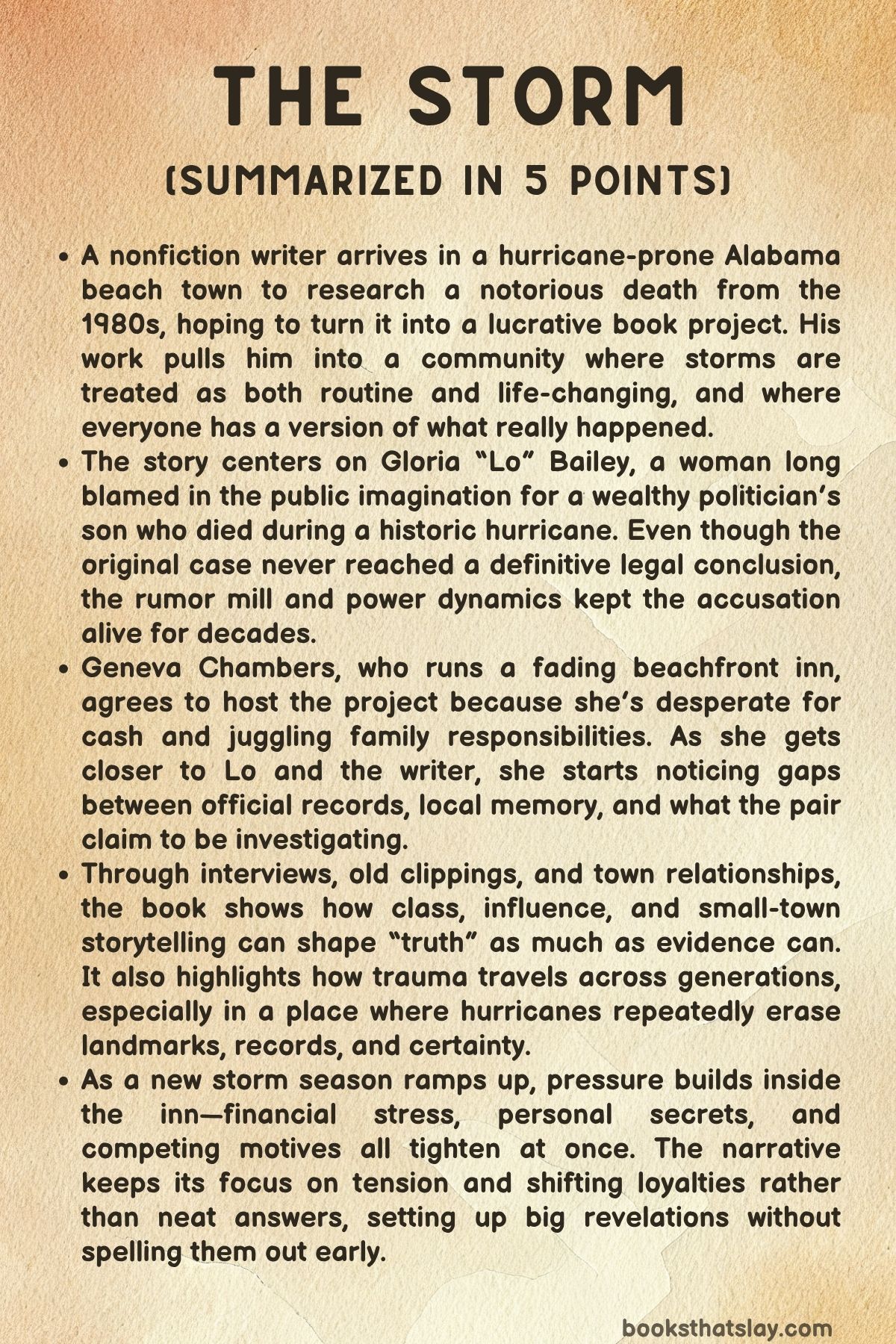
In 1996, a visiting writer comes to St. Medard’s Bay on Alabama’s Gulf Coast, a place where hurricanes are a fact of life and a source of local mythology. In a tourist shop playing Jimmy Buffett under harsh air-conditioning, the owner, Beth-Anne Bailey, speaks with unsettling ease about how many people storms have killed around town.
She has lost two husbands to hurricanes—one swept away in 1965 and another who survived a later storm but died days afterward from strain and exhaustion. Beth-Anne explains that storms feel worse at night not because of darkness, but because of the waiting: boarding windows, filling tubs, listening to wind build, and hoping the storm changes course.
People stay because the town is home, even when the sea and wind keep taking from them.
The story’s central scandal dates to August 4, 1984, when Hurricane Marie hits and Landon Fitzroy—handsome heir to a powerful, politically connected Alabama family—is found dead along the shoreline. A coroner rules he did not die from drowning or the storm itself, and the state accuses nineteen-year-old Gloria “Lo” Bailey, Landon’s lover.
The case becomes a national spectacle: gossip casts Lo as a calculating girl who used the hurricane as cover, while others argue Governor Beau Fitzroy needed a culprit to protect his dynasty. The evidence is largely circumstantial: bruises on Lo’s arms that resemble fingerprints, conflicting accounts of phone calls made as the storm approached, testimony suggesting a threat, and damage to Lo’s distinctive hot-pink nails.
Yet none of it produces a conviction. In December 1986, after long jury deliberations and repeated requests to review graphic evidence and Lo’s testimony, the jury deadlocks.
A mistrial is declared, and although the district attorney claims the state will retry, the case fades without another trial. Lo remains free, but the town—and the wider public—never stops treating her as guilty.
In April 2025, Lo resurfaces with a new goal: profit. She emails her former literary agent, Jack Harrison, asking whether podcasts make money.
A nonfiction writer named August Fletcher contacts her, suggesting her story belongs in a memoir rather than a typical true-crime production. Lo is sharp, funny, and blunt.
She admits she once cashed in through talk shows, QVC, and even a paid phone line, then ended up scraping by in ordinary jobs after the attention dried up. Now she cleans at a nursing home and listens to podcasts while working.
She wants to sell her version before someone else sells theirs. She proposes a deal: she tells what happened, August shapes the book, and they split the money.
August agrees, emphasizing that Lo’s voice should lead.
On June 21, 2025, Geneva Chambers introduces herself as the present-day caretaker of the Rosalie Inn, a fading pink beachfront hotel that has survived nearly a century of storms. Geneva is forty, exhausted, and financially trapped.
The inn is bleeding money; the air-conditioning fails; guests complain; and longtime repeat customers cancel, taking thousands with them. Geneva also has her mother, Ellen, in a long-term care facility due to early-onset Alzheimer’s.
Geneva lives in an Airstream on the property after her boyfriend, Chris, abandoned their shared plan to run the inn together. Her most reliable support is Edie, the assistant manager—older, punk-styled, and constantly bracing for the next crisis.
Then Geneva receives an email inquiry from August Fletcher. He wants an open-ended stay from July 1 for at least a month, maybe until September, and he offers to pay double.
He claims he’s writing a book about local history and specifically wants to research Hurricane Marie and Landon Fitzroy’s death—warning there’s a true-crime angle. Geneva hesitates, sensing risk, but the money is too necessary.
She accepts.
Intercut with Geneva’s present-day struggle is Lo’s account of her past. She describes being seen as the prettiest girl in town, shaped early by men’s entitlement and adults’ refusal to protect girls like her.
She insists she wasn’t a “slut” and wasn’t a murderer. She describes meeting Landon Fitzroy at a rough bar called The Line near the Florida–Alabama border in September 1983.
Landon is married, wealthy, and used to getting what he wants, but Lo is drawn to the attention and the way he makes her feel chosen. Their relationship begins in secret, fed by gifts and trips and an intoxicating sense of being inside the Fitzroy world.
A letter from Landon dated September 4, 1983, confirms his obsession and frames the affair as more than a fling.
As the 1984 death is re-examined, the suspicious details remain: Landon is found face down without water in his lungs and with head injuries that suggest multiple blows rather than a single impact. Abrasions hint he may have been dragged.
A jagged tip of a hot-pink fingernail is discovered caught inside his tuxedo jacket. Investigators focus on Lo quickly, especially under pressure from Governor Fitzroy.
A theory hardens: Lo and Landon fought on the beach, she struck him with something heavy, and she tried to pull the body toward the water so the hurricane would erase evidence.
On July 1, 2025, August arrives at the Rosalie Inn during a thunderstorm—and Lo arrives with him. Geneva is stunned by Lo’s beauty and presence, and by how calm she seems walking back into the town that has demonized her.
Geneva assigns Lo a room beside August’s. August then drops the real hook: they chose the Rosalie because it is where Landon Fitzroy died—where the body was found.
Geneva is rattled because she has never heard that detail tied to the Rosalie, not in local gossip, not in clippings, not anywhere.
August and Lo pull Geneva into their research. They take her to The Line, a chaotic bar where Lo once worked and performed with a band.
Lo navigates the space like someone reclaiming territory. An older man recognizes her and publicly humiliates her as “trash,” claiming she has no right to be there.
August challenges him, but Lo controls the moment by refusing to shrink. She needles the man, learns he is connected to Landon’s wife, Alison, and turns the confrontation into usable material for the book.
Geneva’s personal life spills out in pieces: she left town for school and work, returned when her father died and her mother’s illness worsened, and tried to build a future at the inn with Chris until he walked away. Rumors claim he left because he caught Geneva with Edie.
Lo uses this as a lesson: St. Medard’s Bay is a place where stories metastasize into “truth,” and scandal is the town’s favorite currency. People shape narratives to suit themselves, not facts.
Geneva visits Hope House to see her mother, Ellen, who sits in a fog of routine. Geneva tells her Lo Bailey is back and that the book could save the inn.
For a brief moment, Geneva thinks Ellen reacts, but it vanishes. Later, when Geneva breaks down about losing her mother while she is still alive, Lo comforts her with surprising gentleness.
August asks Geneva for a recorded interview about the inn and the town. Geneva agrees.
Lo watches Geneva and August with a flicker of anxiety that Geneva can’t place.
Older storm stories surface alongside the main timeline, revealing a pattern in the town: storms become cover for violence. In 1965, Beth-Anne endures Hurricane Delphine with her cruel husband, Linus.
During a frantic attempt to flee, their car floods, and Beth-Anne escapes by climbing a magnolia tree. Linus follows, grabs her ankle, and insults her.
In panic and self-defense, she kicks him, and he falls into floodwater and dies. Beth-Anne later lets the storm take the blame and implies her injuries were caused by hurricane debris.
In 1977, another woman, Frieda, remembers being best friends with Lo and Ellen as children. They called themselves the “Witches of St. Medard’s Bay,” playing at power in a place that often made girls feel powerless.
During Hurricane Audrey, the girls sneak into the nature preserve to camp in a tent. The storm turns abruptly; they barely survive by making it to the Shipwreck Inn.
Frieda’s parents and little brother die when their car is swept into floodwaters while searching for her. Frieda is taken in by an aunt and grows resentful—of storms, of recklessness, and of Lo.
Back in 2025, as a new storm system forms, Geneva and Lo retrieve abandoned guest bikes in worsening weather. Lo talks about the local shipwreck and remembers Landon taking her snorkeling near it, while Geneva notes that a later hurricane shifted the wreck farther out.
Lo mentions that Ellen’s family discouraged the friendship after Lo became involved with Landon. Geneva admits she doesn’t know anyone named Frieda—until Lo tells her that Edie is Frieda.
This changes everything. Soon after, August finally interviews Geneva over lunch and reveals that Edie—really Frieda Mason—was a major prosecution witness at Lo’s trial.
Edie testified that she saw Lo and Landon together shortly before the hurricane and claimed Lo threatened to kill him rather than be discarded. Geneva is shaken that Edie never told her, and that Lo waited until now to reveal it.
August admits he still doesn’t know whether Lo killed Landon, and he has found inconsistencies: where Lo says the body was found doesn’t match official records, and phone-call details don’t line up with her repeated claims. He also suspects Landon was juggling multiple women, and that political image mattered to the Fitzroys in a way that could make anyone around Landon vulnerable.
Tension spikes. Lo confronts Edie at the inn, furious about her testimony and calling it betrayal that could have led to execution.
Then Edie vanishes. That night, Geneva hears Edie’s “Free Bird” ringtone and finds her on a dark, rain-slick porch in a pool of blood, her head badly injured.
Edie is rushed into surgery and placed into a medically induced coma.
Geneva immediately suspects Lo, especially because the injuries echo Landon’s fatal head trauma. August comforts Geneva, then looks through Geneva’s mother’s box of clippings and memorabilia.
Geneva and August nearly cross a line romantically, but Geneva stops, overwhelmed by fear and guilt. August asks to borrow the clippings and confesses he may be writing a different book than Lo thinks—one that could expose more than Lo’s story.
The next day, Lo acts concerned but also subtly tries to isolate August from Geneva. Tropical Storm Lizzie intensifies toward hurricane strength.
Then August reveals a shocking theory: an old portrait of Landon’s sister, Camile Fitzroy, resembles Geneva. He asks Geneva if she truly never knew Landon Fitzroy was her father.
A separate account from November 1980 shows teenage Ellen Chambers meeting Landon at the inn during Tropical Storm Velma. He charms her while they prepare—filling tubs, moving supplies—and comforts her during the storm.
In 2025, as guests cancel and Lizzie approaches, Geneva visits Edie in the ICU and her mother again. She notices her mother wearing a bracelet engraved with a single letter: “L.” Geneva demands her mother’s box back from August and later realizes it is less full than before.
She suspects August has already taken what he needs.
Geneva searches the attic and discovers the truth. The box is not a scrapbook about Lo’s scandal; it is a memorial to Landon and the Fitzroy family, kept for decades.
Geneva finds a photo caption about Landon studying in Geneva, Switzerland, and understands why her mother named her Geneva. The affair was real.
Landon is her biological father. The revelation reframes her entire life—her mother’s secrecy, the inn’s role in the story, and why August chose the Rosalie.
As Lizzie becomes a direct threat, evacuation pressure rises. Edie remains hospitalized.
Hope House moves some residents, including Ellen, inland to Montgomery. Geneva stays at the inn with only August and Lo as the storm draws near.
Geneva prepares the Rosalie with supplies and sandbags, trying to protect the building and herself. August types constantly.
Lo writes obsessively on a legal pad.
Finally, Geneva decides she will not repeat the town’s history of letting storms decide everything. She confronts August and orders him to leave.
He tries to reframe her fear as overreaction, then snaps that their near-kiss was a mistake. Geneva sees his draft and realizes he is shaping her as the tragic “angle” for his book.
Before the fight ends, a crash shakes the inn. In the lobby, a plywood board is ripped away from a sea-facing window—and Lo is standing there with a hammer, intentionally opening the inn to Hurricane Lizzie.
Lo announces that if August wants to understand what happened the night Landon died, he needs to experience the storm itself. Geneva realizes Lo has known about her parentage all along, but Lo isn’t speaking to Geneva—she’s speaking to August.
Lo reveals that August is also Landon’s child.
Lo’s confession follows, split between the chaos of the hurricane and her written account of 1984. Lo explains she learned as a teenager that her own mother killed her abusive father during a hurricane and let the storm absorb blame.
During Hurricane Marie, Lo was involved with Landon, but she discovers he has also slept with Ellen—Lo’s best friend. Lo finds a letter from Ellen in Landon’s jacket and calls Landon to confront him.
Ellen’s account of that night reveals she was pregnant with Landon’s baby and intended to tell him. Landon arrives in the storm and reacts with cold calculation.
He proposes Ellen disappear, have the baby, and let him and his wife adopt the child to protect his political future. Lo arrives and finds them fighting.
Landon grabs Lo, humiliates her, and calls her “nothing.” In the struggle, Ellen reaches for what she thinks is a wooden decoration but grabs a heavy anchor instead and strikes Landon in the head. As he collapses, Lo takes the anchor and delivers additional blows until he is dead.
The two girls attempt to drag his body toward the water and fail. They decide the hurricane will erase what they did, repeating the pattern Lo learned from her mother.
Back in 2025, Lo admits plainly that she killed Landon and never felt remorse. August, already unsteady from learning the truth through a DNA test, explodes with rage.
He describes how the discovery ruined his family and how he nearly slept with Geneva—his half-sister. As the lobby floods and the inn shakes under Lizzie’s force, August attacks Lo near broken glass.
Geneva grabs the hammer and hits August to stop him. He takes the hammer and moves to hurt Lo.
Geneva and Lo struggle with him together and shove him backward toward the shattered window. August falls onto jagged glass, slicing his throat.
He dies as Hurricane Lizzie tears into the Rosalie.
Afterward, a news report states August Fletcher died during Hurricane Lizzie at the Rosalie Inn, and authorities call it a storm accident. The inn is heavily damaged.
Months later, Lo returns to St. Medard’s Bay, while Geneva tries to recover—traumatized, homeless after losing her trailer, and staying near Hope House while beginning repairs on the Rosalie. Police recover August’s laptop, and the story explodes across national media, tabloids, podcasts, and online obsession.
The Fitzroy family begins contacting Geneva.
Edie eventually wakes and remembers the truth about her attack: August did it. She confronted him after finding a journal filled with rage and plans, and he lured her outside before striking her.
This clears Lo of Edie’s assault. Edie moves into the inn with Geneva as they rebuild.
Edie also admits one more buried secret: she was present during Hurricane Marie, witnessed Ellen and Lo kill Landon, and later lied in ways that helped aim suspicion toward Lo—partly to protect Ellen, partly fueled by old resentment. In the end, Geneva decides she will no longer carry her mother’s hidden devotion to Landon.
On the beach, with Lo and Edie beside her and the Rosalie being rebuilt behind them, she throws the bracelet marked “L” into the ocean. The three women remain linked by what happened in storms—what they survived, what they did, and what they choose to keep hidden.
Characters
Gloria “Lo” Bailey
Gloria “Lo” Bailey is the story’s most volatile center of gravity: charismatic, self-mythologizing, and unapologetically strategic about turning pain into leverage. As a teenager and then as a young woman, she learns early that the town will always prefer a simple villain to a complicated truth, and she becomes fluent in performing whatever version of herself the moment requires—seductive, wounded, funny, threatening, helpless, or brutally honest.
Her long public limbo after the mistrial hardens her into someone who treats narrative as survival: if the world insists on a story about her, she will cash in before others do. What makes Lo frightening is not just what she did during Hurricane Marie, but the way she frames it later—without remorse, with a near-religious conviction that storms erase accountability and that being underestimated is a weapon.
In The Storm, Lo’s “voice” is both confession and trap: she tells truths, but always in a way that keeps her in control, even when the truth finally destroys the people around her.
Geneva
Geneva is built from responsibility, exhaustion, and a stubborn refusal to abandon what she believes is hers to protect. Running the Rosalie Inn is not just a job for her; it is a last thread tying her to a family life that is slipping away as her mother declines, and it becomes a stage where she performs competence while privately drowning in debt, loneliness, and grief.
Geneva’s vulnerability is that she wants stability so badly that she can be manipulated by anyone offering salvation—money, attention, or certainty—and August and Lo both exploit that need in different ways. Her arc is a painful coming-of-age at forty: she is forced to see that “home” is not automatically safe, that caretaking can become self-erasure, and that the past she thought she escaped has been shaping her identity all along.
The revelation of her parentage collapses the story she believed about her life, and her eventual choices—protecting herself, surviving the hurricane, and refusing to keep carrying her mother’s private memorial—mark the moment she stops living as a custodian of other people’s secrets.
August Fletcher
August Fletcher arrives wearing the costume of a conscientious nonfiction writer, but underneath is a man driven by obsession, ambition, and a deep hunger to control the meaning of other people’s lives. He presents the project as collaboration, insisting Lo must tell the story in her own voice, yet he constantly re-centers himself—his research, his structure, his “angle”—and he treats Geneva as another usable element once he senses her connection to the Fitzroys.
What makes August dangerous is that he is not simply cynical; he is sincerely convinced that his pursuit is justified, even when it crosses into exploitation, manipulation, and violence. The later reveal that he is Landon’s child reframes his behavior as something more combustible than professional greed: it becomes personal vengeance disguised as journalism.
His final unraveling—rage, entitlement, and a willingness to hurt others—shows how easily the true-crime impulse to “solve” can become an excuse to destroy.
Landon Parkes Fitzroy
Landon Fitzroy is less a fully present character than a haunting force whose privilege and appetites ripple outward long after his death. As the governor’s son and heir to an entrenched dynasty, he moves through the world expecting access—to women, to reinvention, to secrecy, to consequence-free pleasure.
He is capable of charm and tenderness in small, intimate scenes, but his core is shaped by legacy: the insistence on a biological heir, the performance of civic ambition, the ability to split himself into different men depending on the audience. Landon’s relationships expose him as both predator and product—someone who uses the town, the women, and the moment, while also being used by a family that treats him as a political asset.
His death becomes a public spectacle not because the state cares about justice, but because the Fitzroy machine needs a story that protects itself, and Landon—alive or dead—remains the centerpiece of that machinery.
Beau Fitzroy
Beau Fitzroy functions as the engine of institutional power, the man who can turn tragedy into prosecution and rumor into a weapon. His grief is real enough to be believable, but it expresses itself as control: he needs a culprit because a random, storm-driven death would mean the Fitzroys are not invulnerable.
His role shows how authority manufactures certainty—pressuring investigators, shaping the narrative, and allowing the state to perform righteousness even when the evidence is thin. He embodies the most suffocating kind of legacy: not merely wealth, but the presumption that the world must arrange itself around his family’s image.
Alison Carleton-Fitzroy
Alison appears mostly through public framing and secondhand accounts, which is precisely what makes her important: she is a symbol of respectable suffering, the sanctioned version of womanhood the Fitzroy narrative prefers. Her presence highlights the story’s obsession with who gets believed and who gets protected; Alison is treated as dignified and credible by default, while Lo is treated as disposable by default.
Her marriage to Landon and her inability to have children become political facts, not private pains, used to reinforce the dynasty’s fixation on inheritance. Whether she is personally cruel or simply complicit matters less than what she represents: the social class that can absorb betrayal without losing legitimacy.
Edie Vargas (Frieda Mason)
Edie Vargas is the novel’s most intricate portrait of survival through reinvention. As Frieda Mason, she carries childhood trauma, catastrophic loss, and the resentment that comes from being the one who paid the highest price for other people’s recklessness.
Her choice to become Edie is not cosmetic; it is a refusal to live as the girl who lost everything in a hurricane and then had to keep living among the ruins. In The Storm, Edie’s guarded loyalty to Geneva is one of the few relationships that is not immediately transactional, yet even that bond is strained by the secrets she has kept for decades.
Her trial testimony and later confession reveal her as neither hero nor villain: she lies, she protects, she punishes, and she bargains with her conscience in the only ways she knows. When she finally wakes and tells the truth about August attacking her—and about what she witnessed in 1984—she becomes the story’s reckoning with complicity: how people can do terrible things not out of evil, but out of fear, grief, jealousy, and the instinct to keep moving.
Ellen Chambers
Ellen Chambers is the story’s quiet catastrophe: a young woman whose longing for escape and tenderness becomes the spark for irreversible violence, and an older woman whose illness turns her into a living absence. As a teenager, Ellen’s connection with Landon reads like a dangerous collision between vulnerability and power—she is flattered, comforted, and ultimately cornered by a man who offers solutions that preserve his future, not hers.
Her pregnancy, her plan to tell Landon, and her presence at the confrontation during Hurricane Marie place her at the moral heart of the original crime. Ellen’s later Alzheimer’s functions like a cruel metaphor: the truth is physically present but unreachable, and Geneva is left pleading with someone who cannot give her the answers she deserves.
Ellen’s secret memorial—kept for decades—suggests complicated feelings that don’t resolve neatly into love or regret; it reads as an unresolved tether to the moment her life split in two.
Beth-Anne Bailey
Beth-Anne Bailey represents the town’s generational relationship with violence, especially the kind that can be hidden inside “storm stories.” She speaks about death with a casualness that feels chilling until it becomes clear it is a coping mechanism, a way of living in a place where nature routinely turns domestic life into catastrophe. Her history—especially what happened with Linus during Hurricane Delphine—reveals how storms can become alibis, how survival can require moral compromise, and how a community can prefer to interpret bruises and disappearances as weather rather than truth.
Beth-Anne’s presence expands the theme beyond the Fitzroys and Lo: she shows that long before the famous scandal, St. Medard’s Bay already knew how to let the wind and water swallow the evidence.
Linus Bailey
Linus Bailey is remembered through Beth-Anne’s recollection as an embodiment of private cruelty that becomes publicly invisible when disaster strikes. His behavior during Hurricane Delphine—control, insults, physical menace—turns the storm into a pressure chamber where abuse becomes lethal.
Linus matters less as a fully drawn person and more as a template: he is the kind of man the world often expects women to survive quietly, and his death illustrates the story’s recurring idea that extreme weather does not create violence so much as reveal and amplify what was already there.
Thad Morrison
District Attorney Thad Morrison functions as the face of the state’s determination to appear decisive. His insistence on retrying the case after a mistrial reads as less about certainty and more about posture—an institutional refusal to admit the narrative might be wrong, especially with a governor watching.
He represents how legal systems can become performance, driven by political stakes and public appetite rather than clarity, and how a woman like Lo can be treated as a useful solution even when proof is fragile.
Linda Nowak
Linda Nowak serves as the story’s counterweight to prosecutorial certainty, articulating what the town and the state refuse to face: that the evidence may not even prove a crime occurred, and that the entire case might be built on the need to assign blame rather than discover truth. She represents intellectual integrity and skepticism, but also the limits of those things—being right does not restore Lo’s life, and it does not stop the public from choosing the most sensational explanation.
Jack Harrison
Jack Harrison is a small but revealing figure because he shows what Lo becomes once the spotlight fades: not a headline, but a client with a complicated past trying to monetize the only asset she still controls—her story. His role underscores how quickly industries move on from scandal, leaving the subject stranded between notoriety and poverty.
Jack is part of the machinery that turns lived trauma into product, even when he is not actively malicious.
Chris
Chris is the novel’s portrait of the man who leaves when caretaking stops being romantic and starts being relentless. His abandonment of the Rosalie plan exposes how uneven Geneva’s relationship has always been: she carries the risk, the labor, and the emotional responsibility, while he retains the freedom to walk away.
Chris matters because his absence shapes Geneva’s vulnerability to August and Lo; the loneliness he leaves behind becomes an opening that other people exploit.
Camile Fitzroy
Camile Fitzroy appears primarily as an image—an old portrait that shocks Geneva because it reflects her own face back at her. That resemblance turns Camile into a symbol of bloodline and inheritance, a reminder that the Fitzroy legacy is not abstract but stamped onto bodies.
Her function is less about her personal actions and more about what her likeness triggers: the sudden recognition that Geneva’s life has been orbiting the Fitzroys without her consent, and that the dynasty’s reach extends into identities that were never meant to be acknowledged.
Themes
Home as a Choice, Not a Safe Place
In The Storm, the Gulf Coast setting is not just scenery; it is a force that shapes identity, loyalty, and refusal. St. Medard’s Bay keeps getting punished by hurricanes, and yet the people who live there keep returning, rebuilding, and defending their decision as if it needs no justification.
Beth-Anne’s matter-of-fact tone about losing husbands to storms is chilling precisely because it is ordinary to her. That ordinariness shows how repeated disaster rewires what people consider acceptable risk.
The town learns how to prepare—boarding windows, filling tubs, tracking forecasts—but preparation becomes its own ritual, a way of pretending control over something that cannot be controlled. The line about storms being “worse at night” because of waiting captures how fear often comes less from impact than anticipation, and how long stretches of helplessness can train a community to live with dread as a background condition.
What makes “home” powerful here is that it isn’t presented as comforting or gentle. Home is where the stories are, where the graves are, where the nicknames and grudges and reputations stick to you.
Leaving would not just be relocation; it would be surrendering the only social reality that recognizes you. Geneva’s attachment to the Rosalie is especially revealing because the inn is falling apart and trapping her financially, but it also holds her family history, her mother’s fading presence, and a sense of duty that replaces personal freedom.
The choice to stay becomes a form of self-definition: if the town can withstand storms, then so can the people in it. That belief gives them endurance, but it also becomes a trap, because the same loyalty that keeps them grounded also keeps them exposed—to weather, to old power, and to secrets that never really leave.
Reputation, Storytelling, and the Economy of Blame
The conflict runs on narrative as much as it runs on evidence. Lo’s life is shaped by a trial that ends without a conviction, yet she remains socially sentenced for decades.
The mistrial does not free her in any meaningful way because public belief becomes its own verdict, and it is harder to appeal. The town’s gossip functions like an unofficial court: people trade versions of events that fit their preferred moral lesson, and those versions become stable even when facts stay uncertain.
Lo understands this better than anyone. Her insistence that people’s retellings reveal more about themselves than about the truth is not a defensive slogan; it is an observation about how communities use scandal to define boundaries.
Calling her “trash” is less about her actions and more about preserving a hierarchy that needs someone lower to keep others feeling clean. The Fitzroy influence intensifies this, because political families cannot tolerate randomness.
A hurricane killing the governor’s son would be chaos, but a murder with a suspect can be organized into outrage, prosecution, and a promise of control. That pressure bends institutions: investigators interpret ambiguous injuries as proof, the state frames circumstantial details as motive, and the town treats a young woman’s sexuality as a credible reason to assume violence.
In 2025, the same machine returns with modern tools. Podcasts, media cycles, and book deals turn personal tragedy into content, and content into money.
Lo wants to profit before others do, which sounds cynical until it becomes clear that her life has already been mined by strangers for entertainment. August presents himself as a writer seeking her voice, but he is also choosing what angle sells.
Geneva becomes anxious when she senses she is being shaped into a “tragic figure,” because she realizes the story will not simply report her life; it will redesign it for an audience. The theme becomes sharper when the final public account reduces a death to “storm accident,” showing how easily institutions and media collaborate in convenient closure.
Truth matters, but control over the story matters more, and the book shows how blame is often assigned less to match reality and more to satisfy the need for a neat explanation.
Power, Class, and Gendered Vulnerability
The social world of the story is built on unequal protection. The Fitzroys represent inherited authority that can pressure law enforcement, steer public conversation, and protect a legacy even when individuals behave badly.
Landon is allowed contradictions: charming heir, reckless pleasure-seeker, political asset, married man having affairs. His status gives him room to be many things without being fully accountable for any of them.
Lo, by contrast, is given a single role by the town and the state—temptress, liar, threat—and once that label hardens, everything she does is interpreted through it. Her beauty becomes part of the prosecution in the court of public opinion; it is treated as both weapon and evidence.
The summary’s early incident at a school dance, followed by an adult dismissing it, shows how girls learn that discomfort is not considered urgent when it complicates social peace. That same pattern continues when bruises on Lo’s arms are read as guilt rather than as possible signs of harm.
Her sexuality and class position make her easier to target because she lacks the resources and respectability that would force people to slow down and ask harder questions. Even Geneva, who is not positioned as a scandal figure, is still vulnerable to being used.
She is desperate to keep the inn running and to care for her mother, which makes her a soft target for August’s “generous” offer. Power does not need to threaten her directly; it only needs to exploit her needs.
The theme also works through inheritance and legitimacy. Landon’s obsession with a biological heir exposes a worldview where family line matters more than human consequences, and where women become containers for legacy rather than people with their own futures.
Ellen’s pregnancy is treated by Landon as a problem to manage, not a life to honor. The proposed solution—hide her, keep appearances, absorb the child into the approved marriage—shows power behaving like administration.
Even the final truth of who Landon’s children are becomes less about connection and more about destabilization: it produces rage, shame, and danger, because identity in this world is not neutral information. It is currency.
When class and gender combine, the cost of being unprotected is extreme: women become the ones who carry the social punishment, the secrecy, and the aftermath, while powerful names keep reshaping events until the world looks orderly again.
Trauma, Memory, and What People Choose to Carry
Trauma does not arrive only through a single catastrophe; it accumulates through repetition, silence, and the body’s refusal to forget. Hurricanes are physical disasters, but the long-term damage is psychological and relational: people keep souvenirs of fear in the form of routines, avoidance, and private rituals.
Geneva’s experience with her mother’s Alzheimer’s adds another layer, because she is grieving someone who is still alive but not fully present. That kind of loss creates a constant sense of unfinished conversation, and it makes Geneva hungry for explanations that might stabilize her world.
When she pleads for answers from her mother and receives nothing, the silence becomes its own injury. Memory becomes unreliable not just because of disease but because communities edit it.
Ellen’s box of clippings is a physical symbol of what is carried for decades: not only the scandal, but a secret memorial that reshapes Geneva’s understanding of her own life. The bracelet engraved with “L” is especially heavy because it compresses affection, regret, obsession, and secrecy into a single object worn on the body.
It suggests that Ellen lived with a private attachment she never spoke aloud, and that her love, guilt, or longing survived even as her mind faded. Lo’s confession complicates the usual expectation that revealing truth brings relief.
She admits she never felt remorse, which forces others to confront the fact that closure is not guaranteed by honesty. August’s rage shows trauma traveling across generations: his identity and family story collapse when he learns the truth, and he spirals into violence not because he suddenly becomes evil but because he cannot absorb the meaning of what he has inherited.
Edie’s delayed memory and eventual admission highlight another trauma response: survival by distortion. She lied to protect someone and to protect herself from what she saw, then lived with the cost until it broke open again.
The final image of Geneva throwing the bracelet into the ocean is not a tidy ending; it is a choice about what to stop carrying. It signals a refusal to remain a curator of someone else’s secret grief.
Rebuilding the Rosalie while keeping certain truths buried shows a hard-earned realism: healing here is not purity or complete transparency. It is learning which memories must be faced, which stories must be corrected, and which burdens do not deserve a lifetime of loyalty.