The Society by Karen Winn Summary, Characters and Themes
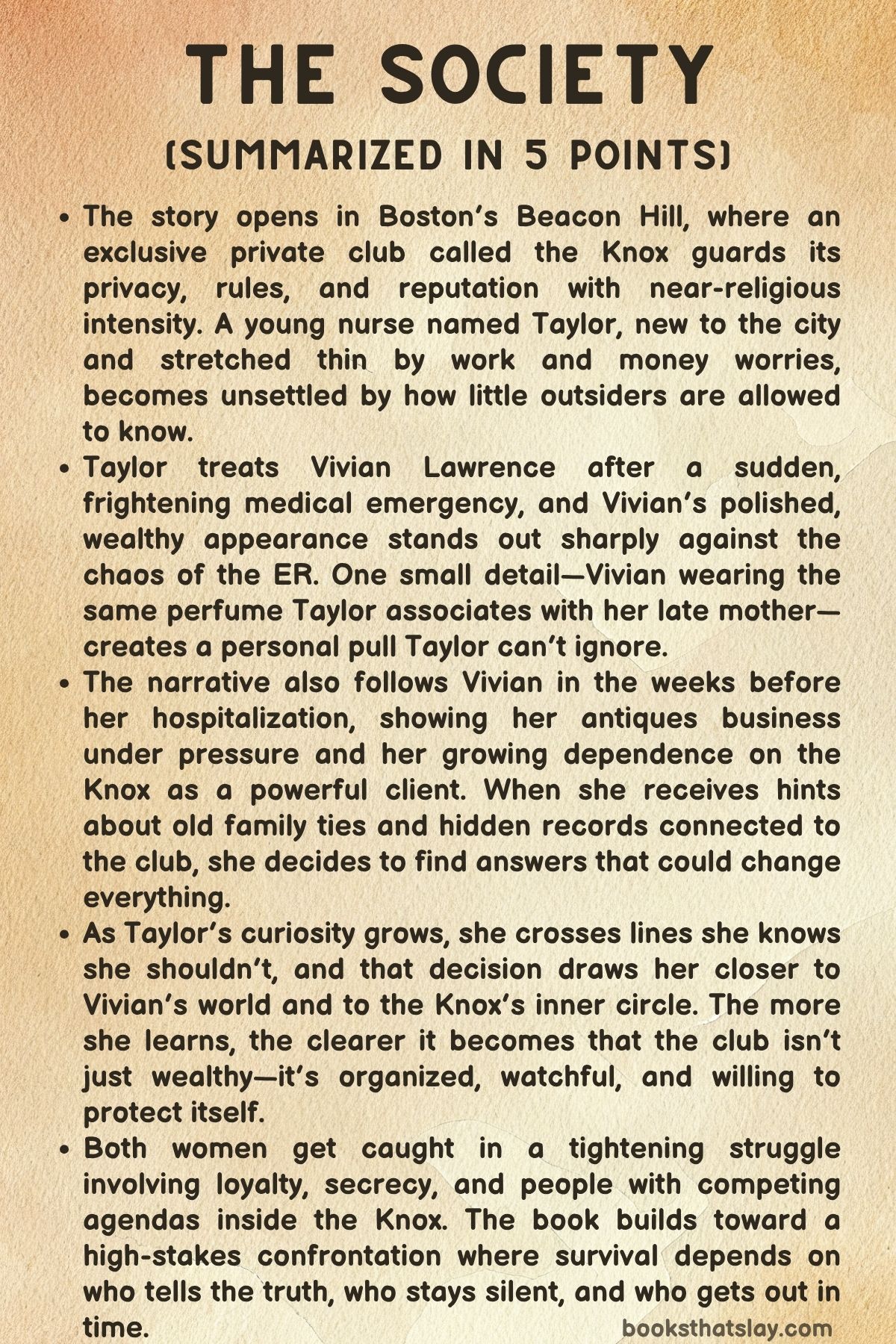
The Society by Karen Winn is a Boston-set thriller that moves between two women caught in the gravity of an old, elite institution. Taylor, a young nurse new to the city, is exhausted, homesick, and quietly haunted by her mother’s death in a Boston fire years earlier.
Vivian, a polished antiques dealer with money trouble and a complicated family past, edges closer to the powerful Knox Society in hopes of saving herself. When Vivian is brought into the ER under suspicious circumstances, Taylor’s curiosity turns personal, and both women are pulled toward the Knox’s locked doors, hidden rooms, and rules built to protect the people inside.
Summary
The story opens with the Knox itself speaking like a watchful presence on Beacon Hill, warning outsiders that the building is not for them. Its brick façade and polished history are a disguise for what happens inside: wealth, private rituals, dangerous loyalties, and secrets that never leave the walls.
Taylor, twenty-five and newly arrived from North Carolina, trudges through a bleak Boston winter into another brutal twelve-hour shift at Mass General. The ER is overflowing with flu cases, and Taylor spends the day racing between patients and tasks without time to breathe.
Her aunt Gigi, a respected head nurse who helped her get hired, checks in and pushes Taylor to show more gratitude and stability. Taylor smiles through it, but inside she is stretched thin.
Boston is expensive, her savings are shrinking, and she feels guilty that she cannot send her father as much money as she promised. She sometimes buys secondhand designer pieces she can’t truly afford, and she can’t stop comparing this life to the one she left behind.
Most of all, she carries the ache of her mother, who once left for Boston and later died in a fire, leaving Taylor with questions that never settled.
Near the end of Taylor’s shift, paramedics wheel in Vivian Lawrence, forty-four, who reportedly fell down stairs at a cocktail party. Vivian looks like money: immaculate hair, designer clothes, a luxury handbag, red-soled heels, and fine jewelry—especially a vivid emerald ring.
Taylor notices every detail, partly out of awe and partly out of longing for a life that seems smooth and protected. Then she catches a familiar scent: Chanel N°5, the perfume her mother wore.
The connection hits Taylor hard, as if the past has reached out and grabbed her sleeve.
Vivian initially seems oriented, though oddly distracted, bothered by a small detail about a drink not “clinking.” Within minutes, her condition worsens fast. Her blood pressure spikes, her pain escalates, her heart rate shoots up, and Taylor realizes she has been paying attention to the wrong things.
Vivian begins seizing as alarms erupt and staff flood the room. Vivian is rushed for scans and then transferred to intensive care.
The narrative steps back three weeks to show Vivian’s life before the hospital. Vivian runs Storied Antiques on Beacon Hill, a shop filled with objects that carry old stories and even older money.
But the glamour is a shell. Vivian’s accountant lays out how bad things have become: an expansion into a second location, renovation loans, rising costs, and income that can’t keep up.
Vivian is also paying for her mother’s care in an expensive nursing home. Her mother’s degenerative illness has not softened her taste for luxury, and Vivian keeps buying costly creams and comforts even while sinking financially.
Vivian also pays tuition for Lucy, the daughter of a deceased friend, because she can’t bring herself to stop.
Pressed from every direction, Vivian relies on medication to steady herself and tries to think like a problem-solver. Her friend Xavier stops by with wine and asks for a favor: he wants Vivian to connect him with her U.S. Customs contact so he can bring in an elephant ivory necklace for a rich client.
Vivian refuses, uneasy about what he’s asking. Then Xavier notices a turquoise-painted carousel horse in the shop and reacts with alarm, demanding to know where she got it before leaving abruptly.
Soon after, Vivian receives a message from Michael, a contact connected to the Knox, asking for the repaired carousel horse by Friday and offering to cover additional costs. Vivian knows the Knox has a reputation—whispers about how it protects itself, and what it takes from people—but it is also one of her biggest clients.
Desperate and calculating, she lies that the horse won’t be ready and adds an unusually warm sign-off. It’s a small gamble meant to open a door.
Back in the present, Vivian lies in the ICU, sedated and ventilated, while Taylor can’t stop thinking about her. Taylor is shaken by how quickly Vivian crashed and by the perfume that brought back her mother in an instant.
After a lonely night and drinks with her neighbor Sam, Taylor realizes she has Vivian’s key—tagged “Home”—which fell out during the emergency and somehow stayed with Taylor. At 3 a.m., driven by obsession, Taylor logs into the hospital records system to look up Vivian’s chart.
Vivian’s consciousness flickers in and out beneath sedation. She hears voices and machines, senses time slipping, and clings to fragments—especially the name “Peter,” and the urgent feeling that something important happened before she lost control.
Vivian’s past catches up: in early February, she walks to the Knox and insists on entry. Rose, a guarded woman at the door, tries to dismiss her, but Vivian pushes.
Peter Wales appears and treats her like someone he’s been expecting. Charming and confident, he invites her inside for tea.
Vivian crosses the threshold and sees a world built for the rich: grand staircases, carefully chosen objects, and rooms designed to impress. Vivian remembers the family story she grew up with—that her great-great-grandmother was born at the Knox, a child kept quiet because of scandal.
Vivian wants proof, leverage, and maybe access to money that could save her.
Vivian visits her childhood home and enlists her friend Rachel, a genealogist, to help dig through family documents. Her mother’s home has been stripped of warmth by a modern renovation, as if the past has been erased.
In the basement, Vivian and Rachel sift through old papers until letters fall from a book. The letters point to a hidden record: a “schedule of beneficiaries” that could reveal who inherited what after a death, and where certain truths were buried.
The note suggests the document was hidden inside a secretary with a secret compartment. Vivian becomes convinced that the Knox’s history and her own bloodline are tied together in a way the Knox would rather deny.
Taylor, meanwhile, tries to monitor Vivian’s case at work but discovers Vivian’s chart is now restricted, the kind of lock used for high-profile patients. When Taylor tries to force access, the system flags her and locks down her account.
Panicked, Taylor admits to her nurse manager that she accessed a restricted chart. She’s told she may need retraining and formal review.
The professional risk should stop her. Instead, the lock only convinces her something is being hidden.
With the key still in her pocket, Taylor goes to Vivian’s Beacon Hill building and unlocks the penthouse. Inside is a carefully curated life: designer clothes, expensive shoes, fragrances, and small signs of loneliness.
Taylor tries on Vivian’s world like a costume—clothes, jewelry, perfume—crossing lines she knows she shouldn’t. While searching Vivian’s desk, she finds business cards confirming Vivian owns Storied Antiques.
Then she finds something that changes the shape of her fixation: a note that says “PLEASE STAY AWAY” beside an embossed symbol of a top hat with a flower. Taylor recognizes the symbol from the last letter her mother ever sent from Boston.
The connection is no longer only perfume and fantasy. It feels like a warning meant for Taylor, too.
Vivian attends the Knox’s masquerade ball, one of the rare events where nonmembers can slip inside under controlled circumstances. She wears a bold black dress from her mother’s closet and stays close to Peter, who keeps her supplied with martinis and once offered her a pill she refused.
The party is extravagant and disorienting—masked faces, heavy drinking, and private hallways where the rules change. Vivian searches for the secretary described in the letters and sees a hidden room where people lounge on a mattress, suggesting a private appetite the Knox doesn’t advertise.
She spots the turquoise carousel horse again like a marker guiding her deeper. In the crowd, Xavier finds her and urgently warns her to be careful before disappearing again, frightened by something he has seen.
Taylor’s nursing life falls apart, and she is pulled toward the Knox from a new angle. She is hired to work there, trading hospital chaos for a private club that pays shockingly well and avoids digital records.
Staff talk about a sealed basement room and an effort to open it. The Knox runs on paper lists and whispered systems, and the employees know that the wrong kind of attention can ruin someone.
Taylor hears about internal power struggles, about Oliver—restless, reckless, and positioned to take over—and about the ways young women have “gotten lost” around the Knox.
As construction opens the basement space, a diary tied to Dr. Robert Thurgood surfaces, describing autopsies and the difficulty of obtaining bodies in the 1800s. The basement isn’t just a room; it is a historical wound the Knox has kept closed.
One of the staff, Jerry, steals items from the basement—books and tools—hoping to sell them. Taylor agrees to help him move the stolen items through a used-book shop, deepening her involvement.
Vivian’s own research connects the Knox to Thurgood and to a disturbing legacy. Rachel uncovers clues in cemeteries, bookplates, and a pseudonym that points back to Thurgood.
The deeper Vivian digs, the clearer it becomes that the Knox’s history includes medical secrets, exploitation, and documentation that was meant to stay hidden.
Then Vivian disappears from the hospital. Taylor goes to the ICU to return the key and finds Vivian’s room empty, cleaned as if she was never there.
The absence confirms Taylor’s fear: Vivian isn’t simply recovering somewhere else. Someone has taken her.
The story races toward the Knox basement as smoke fills the air during a chaotic confrontation. Rose is coughing, disoriented, and broken by guilt.
A mechanism activates around a table holding a scroll, sealing it behind rising glass and metal like a vault closing itself. Michael emerges armed, insisting Rose is unstable.
Taylor focuses on one goal: find Vivian. Under pressure, Rose admits the truth—she pushed Vivian down the stairs and wanted her dead, calling Vivian a problem.
Fire spreads, alarms scream, and the Knox’s members prioritize escape and protecting valuable items rather than saving lives.
Taylor staggers through smoke and heat, fighting confusion and fear. Michael forces a mask onto her and drags her toward a viable route as the building becomes impossible to navigate.
Taylor insists Vivian is still inside, hidden in servants’ quarters. Instead of going out the front, Michael leads Taylor up the grand staircase and through a corridor into an adjacent servants’ wing.
There, they find a makeshift medical setup. Vivian is alive, weak, and recovering under the watch of staff members who look frightened and complicit.
In the confusion, they carry Vivian down through smoky stairs toward safety.
Outside, Taylor is treated in an ambulance and questioned by police as the Knox burns behind her. The night is full of sirens, fire crews, and figures slipping through smoke.
Sam arrives after finding Taylor’s note. Taylor is handed a cat, China, and claims it, as if she needs one real thing to hold onto after everything she has seen.
A week later, Taylor meets Tara, the person behind the strange online signal Taylor noticed. Tara explains that Vivian is in a private facility and expected to recover.
Tara admits she helped keep Vivian hidden, saying she believed Rose’s version of events and felt trapped by a deal: the Knox would pay for schooling and housing if Tara, Jerry, and Eduardo stayed silent. Tara says the situation wasn’t a ritual sacrifice, but part of a larger mess involving Oliver, drugs, and a missing associate, Xavier, connected to cyanide.
Tara is also pregnant with Oliver’s child and believes Rose died in the fire.
Months pass. Vivian heals slowly from her brain injury and fractured wrist, haunted by sensory reminders of smoke and chemicals.
She learns of a horrifying artifact tied to the Knox’s past: a nineteenth-century book, Opii Pericula, rumored to be bound in Margaret Knox’s skin and undergoing testing for a genetic link. Vivian reorganizes her life, reshapes her business, and accepts help from Michael as she plans a new start while keeping her suspicions close.
She believes Oliver manipulated events and that Xavier, under pressure, obtained cyanide and vanished.
Taylor tries to rebuild, too. She learns Oliver has been charged in a corruption and drug case, but she knows legal charges won’t reveal everything.
Taylor visits the townhouse where her mother died, newly aware that her mother may have been trapped and silenced in a way that echoes what happened to Vivian. And as the Knox is restored and reopened, the building’s voice returns—proud, sealed, and confident that it can survive fire, scandal, and exposure, ready to continue as if it has always been untouchable.
Characters
The Knox
In The Society, the Knox is more than a setting; it behaves like an intelligent gatekeeper that controls information, access, and even the story’s emotional temperature. Its voice frames the club as a self-justifying organism that treats secrecy as a kind of moral duty, warning outsiders that knowledge itself is dangerous if you are not chosen.
This “building as narrator” also mirrors the club’s power structure: it hides what matters, displays only curated surfaces, and treats human lives as incidental to the preservation of its order. When the fire comes, the Knox’s perspective exposes the club’s cold priorities, emphasizing continuity over conscience and reinforcing the idea that the institution’s true loyalty is to itself.
Taylor
Taylor is driven by a volatile mix of empathy, insecurity, and longing, and that combination makes her both the story’s moral center and its easiest target. Her nursing work reveals real competence under pressure, but her private life is dominated by financial strain, loneliness, and unresolved grief, especially around her mother’s Boston past and death in a fire.
Taylor’s fascination with Vivian begins as envy and projection, then mutates into compulsion when the perfume and symbol connect Vivian’s world to her mother’s unfinished story. What makes Taylor compelling is that she repeatedly crosses lines for reasons that feel emotionally honest rather than purely thrill-seeking: she wants certainty, belonging, and a narrative that explains her losses.
By the end, she becomes a survivor who understands that the Knox doesn’t just exploit “outsiders,” it manufactures them—pulling in the vulnerable, rewarding compliance, and punishing curiosity—yet she still clings to care as her defining trait, shown in her insistence on saving Vivian even when escape would be easier.
Vivian Lawrence
Vivian is the story’s portrait of high-functioning desperation: she looks untouchable, but her life is held together by debt, obligation, and fear that her sacrifices will never be recognized. She is materially fluent—brands, objects, taste, presentation—and that fluency becomes both her armor and her trap, because it invites assumptions about power while masking how little control she actually has.
Vivian’s financial crisis pushes her toward the Knox, but her deeper motivation is identity: she wants proof that her family history means something, that her lineage can protect her the way wealth protects others. As her coma sequences unfold, she becomes a consciousness caught between glamour and violation, slowly realizing that the club treats her ancestry not as a birthright but as a resource to be extracted.
Her recovery arc shifts her from reactive survival to strategic rebuilding, and her partnership with Michael suggests she chooses pragmatism over romance, using the tools available to reclaim agency without pretending the Knox can ever be cleansed.
Aunt Gigi
Gigi represents institutional nursing culture at its sharpest—capable, demanding, and emotionally stingy in the way high-stress caretaking roles can become. She helped Taylor get placed at Mass General and expects gratitude not as a feeling but as a kind of payment, which creates a tense dynamic where love is expressed through pressure and critique.
Gigi’s bluntness also functions as a warning system: she senses danger when Taylor drifts toward secrecy and reacts with withdrawal rather than open confrontation. Her silence when Taylor mentions the Knox reads like protective instinct colliding with fear—either she knows enough to be alarmed or she recognizes the pattern of institutions swallowing young women who think they can handle them.
Charlie
Charlie is a practical presence during Vivian’s admission, embodying the teamwork and routine that hold emergency medicine together. The detail that Charlie bags belongings and records vitals while Taylor assesses helps underline how easily a crisis can become chaotic when attention is pulled toward the wrong details.
Charlie’s role is also structural: they highlight Taylor’s isolation afterward because Charlie remains part of the normal system, while Taylor veers into obsession and secrecy. Charlie is less a developed psychology and more a stabilizing counterpoint to Taylor’s spiraling inner life.
Sam
Sam is Taylor’s nearby refuge—an accessible, ordinary kind of comfort that contrasts with the Knox’s seductive, curated intimacy. He offers alcohol, company, and a place where Taylor can admit fear without performance, which makes him an anchor even when she ignores him.
His arrival after the fire suggests he cares in a steady way that Taylor struggles to accept because it does not come wrapped in glamour or mystery. Sam’s function is not to “save” Taylor but to show what non-exploitative closeness looks like, emphasizing how warped Taylor’s idea of belonging becomes once the Knox enters her life.
Vivian’s Mother
Vivian’s mother is a portrait of entitlement persisting even as the mind deteriorates, and her illness becomes a financial weapon that forces Vivian into morally risky dependence. Her insistence on luxury in the nursing home and the costs attached to her condition trap Vivian in a cycle of guilt and obligation, where love is indistinguishable from expenditure.
The mother’s renovated modern house also symbolizes erasure: a remade surface that hides what Vivian needs—old documents, old truths, and any stable story of where she comes from. Even when she is not present in scenes, her demands shape Vivian’s decisions and keep Vivian susceptible to predatory “solutions” like the Knox.
Taylor’s Mother
Taylor’s mother is the story’s haunting absence, and her influence operates through fragments—perfume, a symbol, a letter, and the echo of a fatal Boston fire. She appears to have been drawn into the same orbit of secrecy and danger that later ensnares Taylor, suggesting a generational pattern where curiosity and vulnerability are punished by powerful systems.
The top-hat symbol connects her to the Knox’s hidden culture and implies she either warned Taylor too late or was prevented from warning her fully. Taylor’s final visit to the townhouse reframes her mother’s death not as isolated tragedy but as part of a repeating method—drugging, trapping, and disposing of inconvenient women—making the mother a silent witness whose story becomes Taylor’s motivation for refusing to look away.
Taylor’s Father
Taylor’s father represents the life she left behind and the emotional debt she carries as she tries to establish herself in Boston. He is both a source of grounding and a pressure point: Taylor wants to support him financially, but the city’s cost and her own impulsive spending make her feel like she is failing him.
His conversations with Taylor expose her need to be seen as responsible while she secretly behaves recklessly, intensifying her shame and pushing her toward fantasies of sudden security. He also functions as a reminder that Taylor’s choices have consequences beyond herself, which makes her eventual entanglement with the Knox feel more dangerous because it threatens to ripple outward.
Peter Wales
Peter is charisma shaped into a tool—warm, playful, attentive, and skilled at making people feel specially chosen. He draws Vivian in with ease, using personal knowledge, humor, and invitations that blur boundaries, and his presence at the masquerade emphasizes how the Knox recruits through seduction rather than force.
Peter’s background as an orphan who rose through mentorship gives him a crafted mythology of self-made belonging, which makes him persuasive to outsiders hungry for entry. Yet he is also suspiciously positioned: he seems to know how to appear safe while moving within an institution that harms, suggesting he is either complicit, self-deluding, or strategically loyal to the club’s survival.
His magnetism becomes a narrative test: if you trust Peter, you risk accepting the Knox’s story about itself.
Michael
Michael is the story’s controlled, intimidating pragmatist—the kind of figure who speaks softly, carries authority, and treats morality as subordinate to containment. He is linked to logistics and enforcement: requests, payments, restrictions, and the sense that the Knox’s real power is administrative as much as physical.
During the fire, his actions complicate him; he protects Taylor with a mask and shepherds escape, yet he also chooses the route that preserves survival and control, not necessarily justice. His later assistance to Vivian reads like damage management mixed with selective loyalty, implying he may care, but only within the boundaries of what keeps the Knox’s secrets stable.
Michael embodies the club’s modern face: less theatrical than Oliver, less seductive than Peter, and therefore more dangerous because he feels rational.
Rose
Rose is the Knox’s grim threshold in human form: guarded, dismissive, and devoted to the club’s rules, yet personally fractured beneath the discipline. Her hostility toward Vivian and her later confession about pushing Vivian down the stairs reveal a fear-driven loyalty that turns quickly into violence when the club feels threatened.
Rose’s breakdown in the basement exposes the cost of long-term complicity—she is not a cool villain so much as someone whose identity has been hollowed out by obedience and loss. Her repeated confusion, calling Taylor by another name, hints at the Knox’s interchangeable treatment of women, as if individuality is irrelevant once someone is assigned a role.
Rose’s end, implied by the fire, feels like the institution consuming one of its own caretakers when she becomes unstable and inconvenient.
Oliver
Oliver is chaos packaged as inheritance—reckless, entitled, impulsive, and surrounded by people cleaning up after him. His flirtation, druggy energy, and misrecognition of Taylor as sexually available establish how the Knox’s power culture turns staff into objects and boundaries into jokes.
He also seems to represent a factional struggle inside the club: a push to return to older, darker traditions that make even insiders uneasy. The later charges against him align with the portrait of someone who treats corruption as a lifestyle rather than a risk, and the revelations tied to cyanide and coercion suggest he is a catalyst for escalation, whether or not he personally planned every harm.
Oliver functions as the Knox’s id—what happens when privilege is unrestrained by empathy or consequence.
Xavier
Xavier is a profiteer with nerves: someone who traffics in illicit luxury and dangerous favors but is still capable of fear when he sees the true depth of the Knox’s violence. His request about importing elephant ivory marks him as morally flexible, yet his abrupt reaction to the turquoise carousel horse implies he recognizes symbols and artifacts that connect to something worse than smuggling.
His warning to Vivian at the masquerade is one of the few moments where a compromised character chooses to protect rather than exploit, suggesting he knows the Knox’s internal dangers firsthand. Xavier’s later disappearance keeps him ambiguous—either victim, accomplice turned liability, or runaway—yet his role is crucial because he links the club’s refined surface to black-market networks and chemical harm.
Rachel
Rachel is the story’s methodical intelligence: a genealogist who treats mystery as a solvable problem rather than an emotional vortex. She grounds Vivian’s family lore in research practices—documents, letters, pseudonyms, burial plots—and her skepticism prevents Vivian from collapsing into romantic myths about inheritance.
Rachel’s discovery work connects the Knox’s modern secrecy to historical abuses, showing that what looks like eccentric tradition often masks exploitation. She also represents a kind of friendship that is not transactional: she helps because truth matters, even when it is frightening, and that steadiness highlights how isolated Vivian is within her polished life.
Lucy
Lucy is an offstage responsibility that defines Vivian’s conscience. Vivian paying her tuition shows that Vivian’s generosity is real and costly, and that she has been living as a substitute guardian in addition to being a business owner and caretaker for her mother.
Lucy’s presence adds moral pressure: Vivian cannot simply “cut losses” without harming a child, which narrows her choices and makes the Knox’s money and promises more tempting. Functionally, Lucy is proof that Vivian’s desperation is not just about maintaining luxury; it is also about sustaining commitments she cannot ethically abandon.
Jan
Jan embodies institutional boundaries and the ordinary mechanisms that try to prevent exactly what Taylor does. Her response to Taylor’s chart access is procedural, firm, and focused on compliance, which highlights the contrast between hospital ethics and the Knox’s preference for paper records and secrecy.
Jan does not villainize Taylor; instead she treats the violation as a serious risk that requires retraining, emphasizing that systems can be protective when they are designed for accountability. Her role also heightens tension by showing Taylor is closing doors behind herself, making her more vulnerable to the Knox’s seductive alternative structure.
Liam
Liam is the staff member who translates the Knox’s internal culture into digestible lore, offering Taylor information with a mix of humor and caution. He understands the club’s obsession with control—paper over digital footprints, shaming delinquent dues, rituals of vetting—and his commentary reveals how normalized surveillance becomes inside elite spaces.
Liam’s observations about factions and about why people dislike Oliver provide a political map of the Knox, showing it is not monolithic but contested. He is less morally decisive than Eduardo, but he helps demonstrate how staff survive by reading power accurately.
Eduardo
Eduardo is the Knox worker who has lasted long enough to see patterns and still retain empathy. His long tenure implies he has learned when to speak and when to disappear, and his gentler interactions with Taylor suggest he recognizes her vulnerability early.
Eduardo’s presence during the rescue sequence underscores the staff’s complicated position: they are both instruments of secrecy and, at times, the only people willing to act like human beings in a crisis. He represents the possibility that someone can be trapped in a corrupt system without fully becoming corrupt, though survival likely requires compromise.
Jerry Doyle
Jerry is opportunism sharpened by resentment. His theft from the basement is not just greed; it is a small rebellion against an institution that treats staff as disposable and silence as purchasable.
The way he negotiates an extreme split in his favor shows a worldview where trust is weak and leverage is everything, which fits a man who has watched the Knox’s power up close. His connection to Tara and his anger about Oliver suggest personal history has shaped him into someone who expects exploitation and therefore preemptively exploits back.
Jerry’s proximity to hidden artifacts also makes him a key hinge between the Knox’s buried past and the black-market present.
Tara
Tara is a study in coerced survival and morally compromised hope. She is tied to the Knox through money, schooling, housing, and fear, which turns her into an informant and caretaker inside a situation she does not control.
Her pregnancy with Oliver’s baby places her in a precarious position where the club’s promises can feel like the only safety net, even as they function like a leash. Tara’s claim that Vivian’s abduction was framed as protection shows how institutions launder harm into benevolence, and her insistence that this was not a ritual sacrifice reads less like certainty and more like a coping narrative she needs to stay sane.
She is not a clean hero or villain; she is what the Knox produces when it captures a young person with incentives and threats and calls it opportunity.
Dr. Robert Walter Thurgood
Thurgood is the historical spine of the horror in The Society: a physician whose interest in autopsies and access to bodies reveals how “science” can become an excuse for predation when paired with privilege and secrecy. His diary and the basement table suggest a legacy of concealed violence that the club has preserved rather than condemned, implying the Knox’s foundations are literally built around violations of the dead.
The caretaker arrangement and the price per body point to a transactional brutality that echoes in the modern plot’s treatment of women and outsiders. Thurgood’s presence also reframes the club’s artifacts not as romantic antiques but as evidence of a long-running system of exploitation.
Edgar Rolo Butterworth
This pseudonym is a mask that demonstrates how the Knox’s corruption depends on misdirection and cleverness. The anagram is not just a fun clue; it shows the confidence of someone who believes he can hide in plain sight because the world will not look closely enough.
Linking the pseudonym to books, tombstone language, and bookplates emphasizes that secrecy is coded into culture, scholarship, and objects, not only locked doors. Butterworth represents the paper trail of wrongdoing—proof that the club’s crimes have always required literacy, classification, and curated history.
William Knox
William Knox functions as the mythic origin point the club uses to legitimize itself, and the correction of his identity underscores how even names are curated for narrative effect. The stopped clock at 3:03 turns his death into ritual timekeeping, suggesting the club treats its founder’s end as a sacred timestamp that anchors tradition.
For Vivian, William Knox is both potential salvation and potential trap: if she can prove connection, she might gain access to wealth, but the closer she gets, the more she realizes lineage inside the Knox is less inheritance than ownership. He is less a character in scenes and more a gravitational force that pulls the present toward the past’s unresolved violence.
Margaret Knox
Margaret is the ancestor whose body becomes a battleground between truth and monstrosity. The claim that a disturbing book may be bound in her skin turns genealogy into horror, showing how the Knox weaponizes women’s bodies even across centuries.
Margaret’s absence from expected burial records and her connection to hidden documents suggest she is the missing piece the club both needs and fears. She embodies the story’s bleak thesis about legacy: what is passed down is not only money or status, but also the machinery that turns people into objects for power.
Mercy
Mercy exists through letters, but her emotional presence is strong because she represents the private human cost behind the club’s public grandeur. The correspondence suggests secrecy imposed by shame, illegitimacy, and social punishment, implying women in this lineage were forced to live as footnotes to powerful men’s reputations.
Mercy’s role in the discovered papers also highlights how women’s history survives in fragile forms—tucked into books, hidden in compartments—while official records erase them. She is a reminder that the Knox’s “history” has always depended on silencing the people most harmed by it.
Gilbert Joseph
Gilbert Joseph appears as a mentor figure in Peter’s rise, representing the Knox’s internal ladder and the way belonging is granted, not earned, inside closed systems. His importance lies in what he implies: membership is engineered through sponsorship and grooming, and the club’s future is controlled by those who choose successors.
By shaping Peter, Gilbert symbolizes how the Knox reproduces itself through personal patronage that looks like generosity but functions like recruitment. He is part of the club’s infrastructure—proof that the institution persists by manufacturing loyal narrators of its own virtue.
China
China, the cat, seems small compared to fires and conspiracies, but the cat’s presence is psychologically revealing. In Taylor’s smoke-hazed hallucination, China becomes a voice, which shows Taylor’s mind trying to find comfort and meaning while the Knox collapses around her.
Taylor claiming China afterward reads like an instinct to keep something innocent and living from that night, a counterweight to all the secrecy and harm. China becomes a token of survival, grounding Taylor in caretaking when everything else is designed to make her feel powerless.
Themes
Class Power and the Economics of Access
The Society builds its tension around the idea that money is not only comfort but also permission—permission to enter certain rooms, ask certain questions, and survive certain mistakes. The Knox announces this from the start by treating the building itself as a gatekeeper: outsiders may admire the brick and symmetry, but they will never touch the inner life where decisions are made and consequences are buried.
That separation is not just social; it is enforced through systems that look ordinary from the outside. Taylor’s Boston is shaped by scarcity—long shifts, tight rent, guilt about sending money home, and small “treats” that feel like relief but also like self-betrayal.
Vivian’s Boston is shaped by the costs of maintaining an appearance that keeps doors open: luxury becomes less a pleasure than a requirement, especially when her business and her mother’s care are bleeding her dry. Both women are working, both are anxious, but the world responds differently to their anxiety.
Vivian’s polish earns attention, deference, and ultimately interest from powerful people who assume she belongs near them; Taylor’s competence earns exhaustion and a lecture about gratitude. The story makes access feel physical: a key tagged “Home,” a penthouse door, a private club threshold, a restricted medical chart that punishes the wrong kind of curiosity.
Even the Knox’s preference for paper over digital tools is a class tactic—wealth can afford slowness, secrecy, and deniability. Meanwhile, the staff are kept close enough to the riches to be tempted yet far enough to be disposable.
Paychecks can triple overnight, warnings can appear without explanation, and a person can be “relocated” without a trace. The theme lands hardest in how the club treats people as assets or liabilities depending on their usefulness, and how “belonging” is not earned through ethics but through sponsorship, silence, and the ability to absorb harm without making it public.
Identity Substitution and the Politics of Being Mistaken
Confusion over who someone is becomes a tool of control here, and the plot repeatedly shows how dangerous it is to be seen as interchangeable. Taylor is drawn into another woman’s life through a series of seemingly small misalignments: a fallen key, a scent that pulls her into grief, a chart that becomes forbidden the moment she tries to understand it, and a symbol that ties Vivian’s danger to her own family history.
Her choices are framed as personal failings—curiosity, envy, impulsiveness—but the environment around her is designed to exploit those exact pressures. When she steps into Vivian’s apartment, she is not simply trespassing; she is rehearsing an identity that Boston keeps advertising as “the real life,” one that feels close enough to wear.
That rehearsal matters later at the Knox, where staff are evaluated through opaque rituals and private assumptions. Taylor fears she has been confused with another candidate, and the fear is reasonable because people in power benefit from making individuals blur together.
Rose calling Taylor “Tara” is not only a mistake from smoke and panic; it reveals how easily the club collapses women into roles: the innocent worker, the compliant helper, the lost girl, the one you can threaten, the one you can pay. This theme also surfaces in Vivian’s lineage quest.
Her search for proof of descent is a search for a name that unlocks legitimacy, as if identity itself were a legal document. Yet the Knox’s version of identity is more flexible and more violent: people can be renamed, masked, drugged, hidden, and later rewritten as rumors.
The masquerade ball literalizes the idea that faces are optional and the rules are set by those who can afford anonymity. It also shows how “recognition” can be used as a trap—Xavier recognizes Vivian, Peter “remembers” Taylor, Michael watches, the club tracks.
Identity becomes a battlefield between self-definition and institutional labeling. By the end, Taylor trying to reconstruct what happened is not only detective work; it is a fight to stop the club from assigning her a story that excuses them.
The theme insists that in a world built on hierarchy and secrecy, being misidentified is not an accident—it is one of the easiest ways to make harm look like confusion instead of intention.
Curiosity, Surveillance, and the Consequences of Looking Too Closely
The narrative treats curiosity as a moral test, but also as an unavoidable human response to sealed doors and unanswered grief. The story makes “looking” feel risky long before anything explodes: Taylor looks at Vivian and notices brands before symptoms; she looks at the perfume and feels her past reach for her; she looks at a chart she is not allowed to open; she looks for meaning in a symbol that refuses to explain itself.
Curiosity is not framed as purely virtuous or purely reckless. Instead, the plot shows how institutions decide whose curiosity is acceptable.
Taylor’s need to know is punished instantly by the hospital system: restricted access, forced retraining, a message that her desire for understanding is a violation. Yet the Knox operates on the opposite principle for its own members: it collects artifacts, documents, bodies of knowledge, even bodies themselves, and calls it heritage.
The difference is not the act of seeking information; it is who has the right to seek it without consequences. The book also highlights how surveillance works without cameras.
The Knox discourages digital footprints, but it still tracks behavior through cash errands, anonymous notes, strange online attention, and personal intimidation. Someone knows where Taylor works, what she is doing, and how to reach her, and the method is deliberately vague so she cannot fight it.
Vivian, too, is pulled in by partial knowledge—family lore, missing papers, a suggestion of a fortune—and the club leverages that hunger. At the masquerade, altered states and secrecy blur consent and memory, making it harder for Vivian to later state what she saw and prove it.
This theme becomes brutal when Vivian’s absence is discovered not through a dramatic announcement but through an empty ICU room. The erasure is the point: removing the evidence that anyone is allowed to ask questions.
Even the building’s opening warning functions like psychological surveillance, telling outsiders that curiosity itself is dangerous and therefore shameful. By making the cost of “looking” so high, the story argues that secrecy is not only about hiding wrongdoing; it is about training everyone nearby to stop asking.
The theme lands in the way Taylor’s curiosity evolves from personal fixation into ethical urgency. She begins by wanting to understand glamour and grief, but ends by trying to locate a living person who has been turned into a secret.
The book suggests that the real threat is not the curious individual—it is the system that decides curiosity is a crime only when it threatens power.
Gendered Vulnerability, Control Through Dependency, and the Pattern of “Lost Girls”
The story presents danger as something that clusters around women who are either alone, financially strained, or emotionally unmoored, and then shows how that vulnerability is converted into compliance. Taylor arrives in Boston without a deep support system, carrying the unresolved wound of her mother’s death and the quiet fear that she has repeated her mother’s path.
Vivian appears powerful, but her power is brittle because it depends on keeping up a standard she can no longer afford: business expansion, debt, caretaking costs, and the obligation to pay for someone else’s child. Both women are pulled toward the Knox because the club offers what their lives lack—money, answers, belonging, or at least the feeling of stepping out of ordinary limits.
The men around the Knox understand how to turn that pull into leverage. Peter’s charm has a professional sheen: he offers entry, attention, and a controlled sense of safety.
Michael’s authority presents itself as order in chaos, even when he is part of the machinery that hides Vivian. Oliver’s influence is more openly predatory: flirtation, instability, the sense that boundaries are optional because he is protected.
What makes the theme particularly sharp is how control is often delivered through dependency rather than direct force. Tara’s confession outlines the mechanism: housing, tuition, and stability in exchange for silence.
The agreement is not framed as a criminal contract, but it functions like one, and it ties a pregnant young woman’s future to the club’s reputation. Vivian’s abduction is also explained through a story that pretends to be protection, which is a familiar pattern in gendered coercion: the abuser claims the victim is being “kept safe” while removing her ability to speak or leave.
The servants’ quarters—hidden, connected by corridors, treated as an afterthought—become a symbolic space where women are stored when they are inconvenient. The theme deepens when Taylor visits her mother’s death site and recognizes the possibility of repetition: drugging, trapping, fires that erase evidence, and a culture that treats women’s disappearances as the price of doing business.
Even the club’s internal conflicts still orbit female harm; rivalries and power struggles play out while women pay in bodily risk. By the end, recovery is possible, but it is not clean.
Vivian’s brain injury, Taylor’s fractured trust, Tara’s fear, and the Knox’s reopening all point to a grim idea: institutions can survive scandal by rebuilding walls, but individuals rebuild themselves with scars. The theme argues that secrecy and wealth do not merely enable harm; they normalize it, turning the disappearance of women into a manageable problem rather than a moral emergency.