The Unwritten Rules of Magic Summary, Characters and Themes
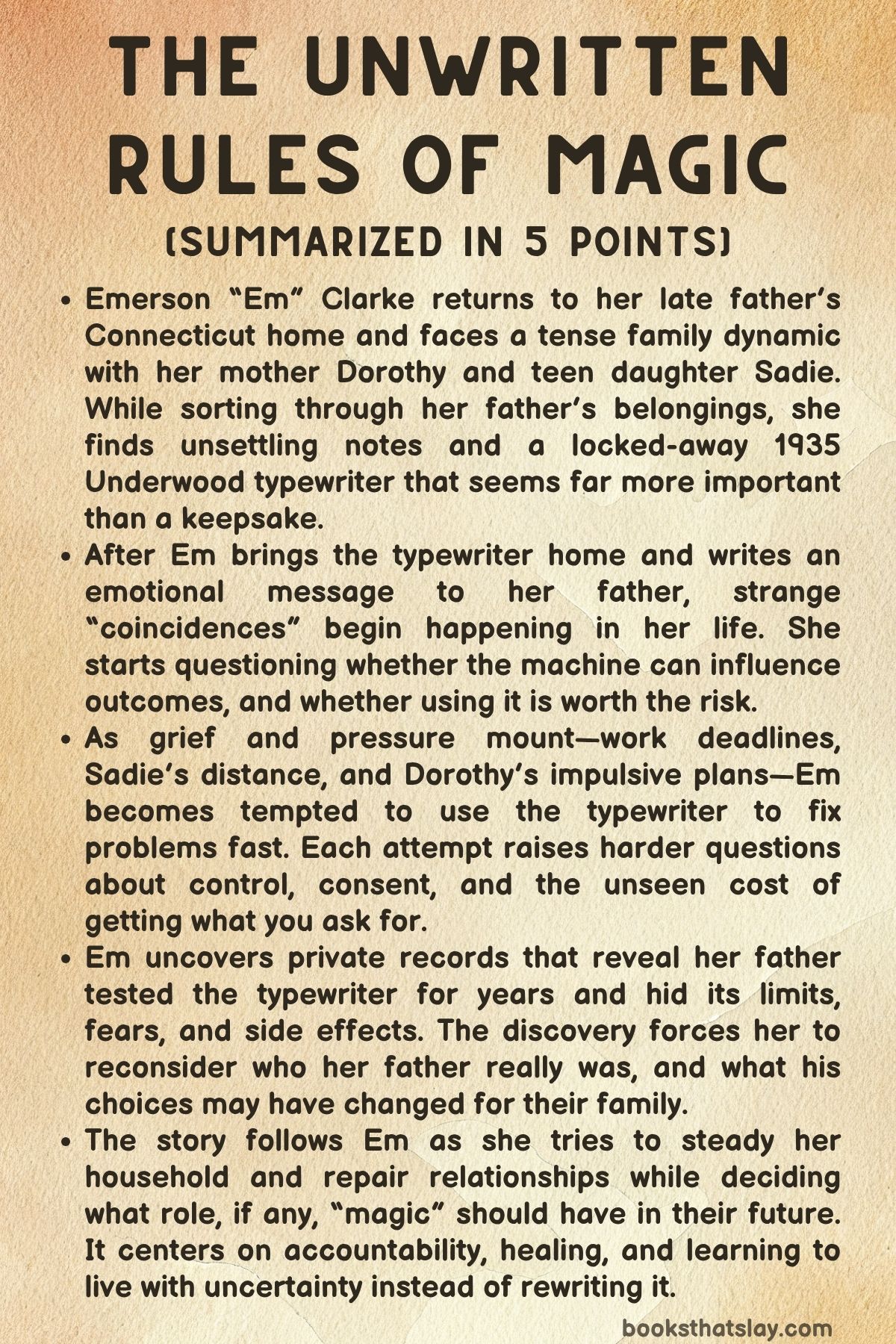
The Unwritten Rules of Magic by Harper Ross is a contemporary family story with a speculative twist: a mysterious 1935 Underwood typewriter that appears to make typed wishes come true, though never cleanly and never without consequences. After her famous fantasy-author father dies, Emerson “Em” Clarke returns to his Connecticut home carrying old wounds from his unpredictable moods and the unresolved silence between them.
With her teenage daughter grieving in her own way and her mother spiraling into alcohol-fueled reinvention, Em inherits more than possessions—she inherits a dangerous shortcut to control. The book follows Em as she tests power, faces fallout, and chooses what kind of life she wants to build without it.
Summary
Emerson “Em” Clarke comes back to her late father Jefferson’s house in Darien, Connecticut, for the aftermath of his funeral. The place is loaded with memories: his awards, his office, and the version of him who once read stories to her and made her feel like she belonged inside his imagination.
Grief for him is tangled with anger, because Jefferson could be loving one moment and emotionally destructive the next. Em’s mother, Dorothy, is drunk and blunt, and Em’s teenage daughter, Sadie, is openly upset that Em seems calm and dry-eyed.
When Dorothy announces she’s selling the house right away, Sadie is crushed. The argument escalates until Sadie storms out, accusing Em of not caring.
Alone in Jefferson’s office, Em’s attention fixes on a locked cabinet holding his prized possession: a glossy black 1935 Underwood portable typewriter. She can’t find a key.
Digging through drawers, she finds two papers that make her uneasy. One is a typed note that sounds like an apology from Jefferson—something Em rarely got in life.
The other is a handwritten list with cryptic items like “Call Henry about P No. 8,” “Track down Welles heir,” “Rectify DES,” and “Destroy evidence.” Em pockets both papers.
Acting on a mix of curiosity and resentment, she picks the cabinet lock and takes the typewriter. It feels strange in her hands, almost like it has a pulse.
She leaves Dorothy passed out on a chaise and goes home with the typewriter in its case.
At home, Sadie keeps her distance, still furious and grieving. Em sets the typewriter on her desk and, in a moment of exhaustion, types a letter to Jefferson as if he can read it.
She confesses what she never said aloud: that she’s sad, that she’s angry, that she regrets how little they resolved, and that she’s been drowning in everyday burdens too—her neglected garden, her body, her sense of being stuck. She tries searching online for clues about “Welles” and “DES,” but nothing useful comes up.
That night, she becomes violently sick, barely able to move between the tub and the toilet. Sadie, despite their fight, checks on her from the doorway, worried but unsure how to help.
The next morning Em is weak, but she gets Sadie to school. Stepping outside, she freezes.
Her garden beds, previously dead and weedy, are suddenly thriving with bright blooms. Even more unsettling, Em notices her body has changed overnight—she has lost weight.
The timing is too close to ignore. She tries to tell herself it’s coincidence, a neighbor’s help, or her imagination, but the typewriter sits in her office like an accusation.
Through entries from Jefferson’s journals, Em learns her father discovered the typewriter’s effects decades earlier. In 1995, he bought it at an estate sale and tested it with small wishes.
When he typed that Thanksgiving plans with Dorothy’s family would be canceled, Dorothy’s father suffered a serious injury that forced the plans to end. When Jefferson typed for a major book deal, he soon received a seven-figure offer.
Jefferson decided to keep the typewriter secret, afraid of what Dorothy would do with it and what outside forces might do if they learned it existed. He continued using it privately, building a career and a life that looked charmed from the outside.
Em returns to the house to check on Dorothy and finds Dorothy already moving fast: a Sotheby’s representative is present to appraise the property, and Dorothy is energized by the idea of downsizing and starting over in Manhattan. When Em asks about “Welles” and “DES,” Dorothy waves it off as Jefferson’s “research,” with the casual cruelty of someone who has trained herself to treat his mysteries as nonsense.
Em urges Dorothy to slow down and get sober before making huge decisions. Dorothy explodes, throws Em out, and refuses to listen.
Before leaving, Em takes Jefferson’s urn with the remaining ashes, half out of protectiveness and half out of a need to reclaim something. Back home, rattled and angry, she types a wish that something will delay Dorothy selling the house.
Almost immediately, the world shifts. Dorothy calls the next morning furious: the house is in a trust created years earlier, meaning Dorothy can’t sell without Em and Sadie’s consent.
Dorothy claims Jefferson tricked her into signing it. Em can’t tell whether the trust existed all along and Dorothy never paid attention, or whether Em’s wish rewrote reality.
The uncertainty is terrifying because either explanation is bad. Em also receives pressure from her ghostwriting boss, Rachel Moon, who suddenly moves up Em’s deadline and treats her like a machine.
Feeling cornered, Em types another wish—this time for a literary agent to reach out and offer representation for Em’s own novel, the one she’s been afraid to bring into the world.
Jefferson’s later journal entries add a darker edge to what Em is learning. The typewriter has limits.
Jefferson tried huge wishes—historical changes, miracles, cosmic answers—and nothing happened. He couldn’t directly force emotions either, which led him to manipulate events instead of people.
He admits he engineered Dorothy’s job loss and blocked her from rebuilding her career, believing he was protecting their family and keeping them close. The wealth that followed did not soften the damage; it sharpened it.
Dorothy became bitter and restless. Jefferson became controlling and paranoid.
He feared doing the same to Em, so he held back from changing her life too much, but he still watched her becoming quieter and more isolated. He also confesses to an affair and hints at using the typewriter again if he feels his family slipping away.
Then a call comes that feels like another wish answering itself. Henry Albright, Jefferson’s literary agent, contacts Em with two proposals: a reissue of Jefferson’s older books with bonus material, and a bigger, more loaded idea—Em could write the unfinished final book in Jefferson’s famous fantasy series using his outline and partial draft.
The money would be huge, and so would the scrutiny. Em is shaken because she knows the world of the series intimately from childhood, yet she fears pretending to be Jefferson and risking his legacy.
She asks Henry about “Welles” and “DES,” but he doesn’t recognize the names. Em’s suspicion grows: either her wishes are tugging on the world, or her father left behind a mess larger than she understands.
Em tries to steady herself by talking to her best friend Mel, a defense attorney. Mel pushes Em to consider that Jefferson may have wanted the series to end with him—or he may have trusted Em more than he ever said.
Meanwhile, Sadie is unraveling in quieter ways. She withdraws, admits she and her boyfriend Johnny are “on a break,” and refuses to explain.
Em feels her daughter slipping out of reach the same way Dorothy and Jefferson slipped away from each other, and she hates how familiar the pattern feels.
Temptation keeps returning. Em drafts a careful wish for a good partner—someone kind, honest, stable, and respectful of Sadie.
She panics at the idea of manipulating fate and hides the typewriter away, but she keeps the paper. The next day, life throws two men into her path.
At the grocery store, she meets Sawyer, an attentive, attractive man who invites her to a library talk and coffee afterward. Minutes later, she runs into Will Barnes, her first love from adolescence, who offers condolences and wants to catch up.
Em can’t tell whether these meetings are coincidence, her own changed openness, or the typewriter pushing her life into a different track.
While Em tries to manage the emotional chaos, Dorothy crashes into crisis. During the library event with Sawyer, Em gets pulled away by a call from Sadie: Dorothy has been arrested for DUI after hitting a tree.
Sawyer insists on helping and stays with Em through the police station and the aftermath. Dorothy is bruised and stubborn, refusing care, but Em forces her to go to the hospital.
The test result is clear—Dorothy was intoxicated. The consequences are real: a suspended license, a court date, and the possibility of an intervention program.
Sadie is shaken and suddenly affectionate toward Dorothy, hugging her, scared by how close it came to tragedy. Em locks away alcohol and breaks down, furious with herself and her mother and the invisible force she suspects she triggered.
Mel steps in to help Dorothy navigate Connecticut’s impaired driving diversion option. Dorothy agrees to treatment but resists anything that feels like losing control.
Withdrawal at home becomes brutal until a nurse arrives to monitor her. Em’s fear shifts from anger to exhaustion.
She can’t keep everyone safe with force of will, and the typewriter’s promise of control looks uglier each day.
Jefferson’s later journals reveal another source of dread: in 2018 he was diagnosed with early-stage Alzheimer’s. He suspected the typewriter contributed to his memory decline, and he wanted to get rid of it before his family found it.
Em, now experiencing her own unsettling memory lapses, reads that and feels cold fear settle in. The typewriter isn’t just risky; it might be corrosive.
As the house is emptied, Em finds a hidden compartment with decades of Jefferson’s notebooks, a note that says “Don’t hate me,” and a skeleton key. Reading the notebooks becomes a second funeral.
She learns her father used the typewriter to shape their lives for years, manipulating Dorothy’s work, nudging outcomes, and interfering in ways that blur the line between love and control. The more Em reads, the more she sees the cost: a family built on altered events, and a man who could not stop reaching for the next correction.
Then Sadie’s private crisis finally breaks into the open. After a panic attack, she hands Em a Planned Parenthood pamphlet and admits she was pregnant and had a medical abortion.
She found out while Jefferson was dying, kept it secret to avoid adding stress, broke up with Johnny, and never told him. A discussion at school about abortion restrictions triggered her fear and guilt, and she couldn’t hold it in anymore.
Em is devastated—not by Sadie’s choice, but by how alone Sadie carried it. Her first impulse is to use the typewriter to erase Sadie’s memory and pain.
She pulls it out, ready to type, ready to fix, ready to control.
But Jefferson’s final warnings stop her. Em sees the pattern clearly: every “fix” becomes another chain, another lie the world must carry.
She chooses not to type. Instead, she lets Sadie’s experience remain real, painful, and survivable.
She channels her panic into movement and work, then returns to her daughter with steadier hands. Sadie agrees to therapy.
Dorothy, still raw in sobriety, shares a rare tender moment with Em and even offers practical support with Em’s writing plans.
Finally, Em tells Dorothy the truth: the typewriter, the wishes, the journals, the changes. Dorothy doubts the magic, calling it coincidence, but she doesn’t ignore the larger message—trying to control life has nearly destroyed them.
Together they decide to eliminate the source of temptation and the record of what Jefferson did. In the garage, Em smashes the typewriter with a hammer until it breaks apart.
Dorothy shreds the journals, reducing decades of manipulations to scraps. It is messy, physical, and final in a way that a wish never is.
A month later, the household is calmer. Sadie is in therapy and slowly stabilizing.
Dorothy is making healthier choices and building routines that don’t revolve around drinking, even as the future remains uncertain. Em prepares for the next steps—house showings, summer plans, reconnecting with friends, and letting Sawyer meet Sadie in a setting that feels safe.
On her fortieth birthday, Dorothy gives Em a diamond pendant tied to Jefferson’s memory, not as a reward for obedience, but as a complicated gesture of family and survival. Em reflects on what she is choosing now: not certainty, not shortcuts, but presence.
Without magic, she will still face loss, fear, and change—but this time, the life she builds will be hers.
Characters
Emerson “Em” Clarke
Em is the emotional center of The Unwritten Rules of Magic—a woman pulled between grief, responsibility, and a lifelong habit of shrinking herself to survive other people’s storms. Her father’s death forces her back into a family system that trained her to manage volatility rather than express need, which is why her “lack of tears” reads to others as coldness but is more accurately emotional self-protection.
She carries competing identities that rarely align: daughter of a celebrated author, single mother of a grieving teenager, and professional writer who has built a career ghostwriting while quietly doubting whether she deserves a voice of her own. The typewriter’s power lands in her hands at the worst possible moment, tempting her to convert fear into control; she tries to use “small” wishes to stabilize life, only to learn that even the gentlest manipulation can create harm.
What makes Em compelling is how clearly she recognizes her own inheritance—not money or talent, but patterns: managing image, micromanaging relationships, swallowing anger until it leaks out sideways, and using productivity as a substitute for vulnerability. Her growth isn’t a sudden transformation into courage; it’s a series of refusals—refusing to keep policing Sadie’s pain with fixes, refusing to keep orbiting her father’s legacy as if it’s gravity, and finally refusing the seductive lie that power equals safety.
Jefferson William Clarke
Jefferson is both myth and wound: a famous fantasy author whose public imagination contrasts sharply with his private damage. To Em, he is simultaneously the father who once made her feel like a creative partner and the man whose volatile moods trained her nervous system to anticipate danger.
His journals reveal a person who rationalizes control as love—canceling obligations, engineering careers, smoothing conflict—until the distinction between caretaking and coercion disappears. The typewriter functions as an amplifier of his worst instincts: when he feels afraid of abandonment, he doesn’t risk honest intimacy; he alters circumstances to keep people near him.
That pattern helps explain why Dorothy becomes bitter and why Em grows quiet—both are living inside an environment where agency is subtly stolen. Jefferson’s later-life Alzheimer’s diagnosis reframes him again: the master storyteller losing narrative control of his own mind, terrified that the very tool he used to secure his life may have poisoned it.
Even his attempted “redemption wish” failing is telling—he wants absolution without facing the full moral weight of what he did, yet the journals also show self-awareness and dread, a man who knows he has become someone he doesn’t respect. His final legacy is not the magical object or the literary empire; it’s the question he leaves Em with—whether love can exist without manipulation, and whether people can choose differently even after inheriting the same temptations.
Dorothy Clarke
Dorothy arrives as a blunt force—drunk, unsentimental, impatient to sell the house and move on—yet over time she becomes one of the story’s most tragic portraits of thwarted selfhood. Her drinking is not treated as quirky dysfunction but as a coping mechanism that has calcified into identity: the buzz that dulls resentment, the nightly ritual that turns disappointment into something manageable.
She is also a woman whose autonomy has been repeatedly undermined, sometimes invisibly, and that violation fuels her rage; when she suspects Jefferson “tricked” her with the trust and later learns how much he engineered her life, her bitterness stops looking like mere cruelty and starts reading like the aftershock of long-term manipulation. Still, Dorothy isn’t only a victim—she can be cutting, dismissive, and emotionally unsafe, especially when she’s intoxicated, and she repeatedly asks Em to carry the burden of adult stability.
The DUI becomes a turning point not because it magically reforms her, but because it forces the family to stop pretending they can manage her addiction with politeness. Her gradual movement toward treatment and healthier routines doesn’t erase the harm she caused, but it shows a capacity for honesty when she’s not anesthetizing herself.
Dorothy’s most meaningful shift is relational: she begins, haltingly, to see Em not as Jefferson’s shadow or her own disappointment, but as a person with her own work and heart, and that recognition—small as it is—breaks the generational habit of using family as a mirror for private regret.
Sadie Clarke
Sadie is the emotional truth-teller of the story, even when she lacks the language to explain what’s happening inside her. Her anger at Em’s composure after Jefferson’s death isn’t just teenage volatility—it’s grief searching for proof that the adults are feeling what she feels.
She attaches herself to the Darien house as a symbol of continuity and belonging, so Dorothy’s decision to sell it lands like erasure: not simply a real-estate move, but the destruction of a place where Sadie imagined milestones could still be safe. As the story continues, her withdrawal, rigid self-judgment, and dramatic donation of expensive clothing reveal a deeper unraveling—she is trying to “clean” herself of worth, to punish herself, or to regain control through renunciation.
The pregnancy and abortion storyline clarifies the stakes of her silence: Sadie is not merely moody; she is carrying a private trauma that shaped her relationship and her self-image while the adults were absorbed in their own crises. Her panic attack after a school conversation shows how quickly political or cultural pressure can turn personal experience into existential fear, and how shame can isolate someone even within a loving home.
Sadie’s arc is not about being “fixed” by better parenting; it’s about being believed and supported without being managed. Therapy, honest conversation, and the decision not to erase her memory with magic all honor her agency—the story insists that her pain matters, that her choice is hers, and that healing comes from being held through reality rather than rewritten out of it.
Henry Albright
Henry functions as the polished face of the literary machine surrounding Jefferson’s legacy—warm enough to feel trustworthy, strategic enough to keep the business moving. His call to Em blends condolence with opportunity, offering a dazzling proposition that is also a moral trap: finish Jefferson’s unfinished series, inherit the financial reward, and risk becoming a ventriloquist for a man who hurt her.
Henry doesn’t read as villainous; he is pragmatic, representing a publisher’s appetite and a market that treats art like inventory. What he triggers in Em is crucial—her sense of impostorhood, the fear of damaging Jefferson’s legacy, and the suspicion that success might not be earned but “granted,” especially with the typewriter lurking nearby.
Henry’s presence also sharpens the theme that power doesn’t always look supernatural; sometimes it looks like a deadline moved up, a contract waved like salvation, or a polite voice suggesting what you “could” do. His role exposes how grief can be monetized and how family trauma can be repackaged as content, forcing Em to decide whether her future is authorship or permanent ghosthood.
Rachel Moon
Rachel is pressure personified: the boss who treats Em’s labor as endlessly elastic and whose demands arrive with the casual certainty of entitlement. She represents a world that rewards output, not humanity, and her acceleration of deadlines lands as a kind of non-magical curse—one more force making Em feel trapped.
Rachel’s character matters because she mirrors the same dynamic the typewriter tempts Em into: control through external manipulation. Rachel doesn’t need magic to distort Em’s life; professionalism and leverage are enough.
For Em, resisting Rachel’s grip becomes part of resisting her father’s legacy, because both relationships involve sacrificing selfhood to meet someone else’s vision. The narrative uses Rachel to show that the central conflict isn’t only supernatural ethics; it’s also the everyday exploitation of caretakers and creatives, especially women, who have been trained to accommodate.
Rachel is a reminder that Em’s battle for agency isn’t confined to family—it extends into work, identity, and the permission to prioritize her own creative life.
Mel
Mel is the story’s anchor of functional clarity: a friend who steps into chaos with competence, humor, and moral steadiness. As a defense attorney, she brings practical knowledge when Dorothy’s DUI turns the family’s crisis into legal reality, translating panic into next steps and options.
But her importance goes beyond the courtroom; she models what Em rarely experiences at home—support that doesn’t come with manipulation. Mel asks the questions Em avoids, challenges her romantic and professional spirals without shaming her, and offers a place for Sadie to land when the household becomes too volatile.
She also helps Em hold complexity: Jefferson may have loved Em and still harmed her; Dorothy may be struggling and still accountable; Sadie may be acting out and still deserving of privacy and dignity. In a story full of people trying to rewrite discomfort, Mel represents the alternative—face the truth, make the best choice available, and keep going.
Sawyer
Sawyer arrives with the suspicious timing of a “wish fulfilled,” which makes him an excellent test case for one of The Unwritten Rules of Magic’s central questions: can connection be real when the circumstances feel engineered? He is presented as emotionally attentive and deliberately sober, and his openness about alcoholism in his family gives him a grounded self-awareness that contrasts with Em’s secrecy and Dorothy’s denial.
Sawyer’s steadiness isn’t portrayed as a magical reward; it is portrayed as a choice—he listens, he shows up at the police station, he checks in afterward, and he keeps returning with patience rather than intensity. That consistency invites Em into a different relational pattern, one not based on chasing approval or predicting mood swings.
His “magic wand” conversation matters because it reframes the story’s temptation: he wouldn’t erase pain because pain shaped him, which nudges Em toward the difficult acceptance that grief and hardship are not glitches to be edited out. Whether or not he was “summoned” by a typed wish, Sawyer becomes meaningful because Em begins to engage him as a person rather than as proof—proof that she can still be wanted, proof that life can still offer good things, proof that she can outrun her father’s shadow.
Will Barnes
Will is nostalgia with consequences. As Em’s first love, he embodies the version of her life that might have been—before family patterns, before career compromises, before the long accumulation of guardedness.
His reappearance is emotionally destabilizing because he pulls Em toward a familiar romantic script: the comfort of history, the intoxicating idea of being seen as she once was, and the temptation to interpret coincidence as destiny. Will also intensifies Em’s fear that she is cheating reality—that she is no longer meeting people organically but attracting them through manipulation, even if she didn’t type his name.
In that way, he isn’t merely a love interest; he is a mirror for Em’s unresolved self: the part of her that wants to rewind, reclaim, and redo. The tension he creates helps push Em toward the story’s ultimate decision—stop chasing control through magic or fantasy, and start building a present that doesn’t depend on rewriting the past.
Johnny
Johnny is mostly offstage, but his absence is part of his narrative function: he represents the limits of teenage intimacy and the isolating reality of carrying a secret. Sadie’s breakup and decision not to tell him about the pregnancy and abortion show her belief that disclosure would destroy futures—his, hers, and perhaps the fragile stability around her grandfather’s decline.
Johnny becomes a symbol of the kind of “normal life” Sadie thinks she has endangered, which fuels her shame and self-punishment. The fact that he is not centered in the aftermath also subtly reinforces the book’s emphasis on bodily autonomy and emotional consequence: the experience belongs to Sadie, and the hardest work—grief, fear, moral sorting—does not automatically become communal just because a relationship exists.
Kathryn Voss
Kathryn Voss, the Sotheby’s representative, is a small but sharp presence that signals how quickly private life becomes property once death enters the room. Her appraisal work helps translate Jefferson’s creative empire into valuables to be priced, moved, and displayed, reinforcing the theme that legacy is both emotional and transactional.
She also amplifies Dorothy’s desire to “move on” through reinvention—downsizing, Manhattan, selling the past—by making that reinvention feel official and imminent. Kathryn’s role underscores the story’s atmosphere of liquidation: grief becomes logistics, memory becomes inventory, and a house full of history becomes something to market.
Nala
Nala, the private nurse, represents the sober counterweight to family chaos—professional care that doesn’t argue, bargain, or enable. Her presence highlights how dangerous withdrawal can be and how inadequate it is for Em to play nurse, parent, and crisis manager without support.
Nala’s role also reframes Dorothy’s recovery as something that requires structure and expertise, not merely promises or guilt, which helps Em step out of the rescuer role that has defined her relationships. In a story about magical shortcuts, Nala embodies the opposite principle: healing is physical, slow, monitored, and real.
Ruby
Ruby, Sawyer’s dog, may seem minor, but she functions as an emotional truth device. Animals in fiction often expose whether someone can be gentle without performance, and Ruby helps make Sawyer’s steadiness feel lived-in rather than scripted.
She also gives Em a moment of ordinary warmth—walking, talking, breathing—at a time when her life has been dominated by emergency and dread. In a narrative where “magic” threatens to distort reality, Ruby is a reminder of the unedited world: needs are simple, affection is direct, and presence matters more than control.
Themes
Inherited harm and the struggle to become a different parent
Emerson returns to her father’s house carrying two kinds of grief: the obvious grief of death and the quieter grief of what never felt safe or steady while he was alive. Her memories include warmth—being read to, being treated as a creative partner—but those bright moments sit next to years shaped by Jefferson’s volatility, secrecy, and the way his moods trained everyone around him to anticipate the next emotional weather change.
That training doesn’t disappear when he dies; it shows up in Emerson’s reflex to manage conflict, smooth over discomfort, and keep the family from splintering during the funeral aftermath. When Sadie accuses her of not caring because she hasn’t cried, Emerson’s restraint reads as indifference to her daughter, even though it is more like a survival skill built from childhood.
The story keeps returning to how a parent’s unresolved patterns become a child’s default settings, especially under stress.
That inheritance becomes sharper when Emerson realizes she is repeating the same controlling impulses she resents. Jefferson used the Underwood to steer outcomes and keep his family close, convincing himself it was love.
Emerson, facing Dorothy’s drinking, Sadie’s withdrawal, and her own job pressure, reaches toward the same shortcut: a typed sentence that replaces hard conversations and unpredictable healing. Even before the magic is fully understood, Emerson tries to regulate the household by force of will—monitoring Sadie, policing Dorothy, pushing decisions about the house, trying to contain everyone’s pain so it doesn’t spill onto her.
The theme lands hardest when she recognizes how easily “care” turns into coercion. Sadie calling her clingy and micromanaging is painful precisely because it reveals how control can wear the costume of protection.
The family’s turning point is not a big reconciliation speech; it is Emerson realizing that becoming a different parent requires tolerating discomfort rather than erasing it. She cannot rewrite Sadie’s grief or Dorothy’s addiction into neat, manageable shapes without repeating Jefferson’s harm in a new form.
Choosing therapy, choosing accountability, choosing to stay present during relapse and panic without trying to engineer a cleaner reality becomes the real break in the cycle. The final movement—more honest mornings, fewer secrets, and a calmer household—doesn’t suggest a perfect family.
It suggests something harder and more meaningful: a family learning to live without the old systems of fear, manipulation, and denial that once passed for stability.
Power as temptation: control, consent, and the ethics of getting what you want
The Underwood typewriter is not merely a magical object; it becomes a moral mirror that reflects what each person is willing to trade for relief. Emerson’s first letter to her dead father is intimate and human—she confesses sadness, insecurity, and small wishes that reveal how exhausted she is.
When those wishes come true overnight, the story frames power as seductive because it appears to reward harmless longing. A thriving garden and sudden weight loss feel like gifts, yet the speed and precision of the results make them unsettling.
The unease is important: even “good” outcomes can violate a person’s sense of agency when they arrive through forces she didn’t fully choose or understand. The typewriter’s effects blur the line between wish and theft, because reality is being altered without transparent costs.
Jefferson’s journals reveal the true ethical weight. He learns he cannot directly change emotions or perform grand miracles, so he starts nudging events—injuries, job losses, budget cuts—so people end up where he wants them.
The story is blunt about how easily love becomes justification for violating consent. Jefferson convinces himself he is preserving his marriage by forcing Dorothy into proximity, but the result is resentment, bitterness, and a household built on hidden coercion.
He is also honest enough to admit that once he began solving problems with the typewriter, he grew more frightened of ordinary life. The world became something to manage rather than engage with, and that shift hollowed out his writing and his relationships.
Power did not make him freer; it made him more trapped in a mindset where uncertainty felt intolerable.
Emerson’s ethical crisis follows the same slope. She tries to delay the house sale and receives a reality shift that might have manufactured a trust.
She wishes for professional validation and then faces suspiciously convenient opportunities. She drafts a romantic wish and then meets two compelling men almost immediately.
Each time, the story forces the question: if an outcome is desirable but engineered, does it still belong to you? The romantic tension is not just about choosing Sawyer or Will; it is about whether Emerson can trust her own life again, or whether every good moment has been purchased by invisible manipulation.
That paranoia is a consequence of power used without accountability.
The sharpest ethical test arrives with Sadie’s abortion and panic. Emerson’s impulse is understandable: erase the pain, remove the memory, protect her child.
But that protection would also erase Sadie’s autonomy and the meaning of her decision. In refusing to type the wish, Emerson accepts that love cannot be proven by control.
It has to be proven by presence, by making room for grief, and by allowing another person to remain the author of their own life. Destroying the typewriter becomes a practical choice, but also an ethical one: she rejects the fantasy that she can secure happiness by editing the world, and she chooses the slower work of consent-based care.
Addiction, denial, and the family economy of secrecy
Dorothy’s drinking functions as more than a personal struggle; it becomes the family’s shared system of avoidance. From the beginning, alcohol shapes communication: bluntness, sudden mood swings, and decisions made in a haze that everyone else has to clean up afterward.
Dorothy announces she will sell the house immediately, not in a calm discussion but in a tipsy moment that weaponizes finality. Emerson’s role becomes familiar: manage the aftermath, protect Sadie from emotional shrapnel, and keep the family moving without confronting the deeper wound.
That pattern is what addiction often creates in families—an informal economy where one person’s instability forces everyone else into roles: the caretaker, the peacekeeper, the angry truth-teller, the silent absorber.
The DUI shifts the theme from chronic mess to acute danger. The crash is frightening because it exposes how denial has been normalized.
Dorothy’s initial refusal of hospital care and her attempts to minimize the consequences echo the way she has minimized the impact of her drinking for years. The story then tracks the exhausting reality of early sobriety: vomiting, shaking, the brutality of withdrawal, and the constant vigilance Emerson adopts to prevent relapse.
Locking alcohol in a car trunk is not just a practical step; it’s an emblem of how the household reorganizes itself around addiction. Emerson starts measuring her freedom in small windows—whether she can leave the house without fear, whether she can keep a date without imagining catastrophe.
That is the psychological cost of loving someone who is not stable in their own choices.
At the same time, the theme is complicated by Jefferson’s behavior. His manipulation through the typewriter resembles addiction in structure: secretive actions, rationalizations, escalating interventions, and a growing inability to tolerate life without the tool.
Dorothy’s drinking and Jefferson’s magical control become parallel forms of avoidance, each undermining trust while claiming to protect the family. Emerson is caught between them, inheriting the burden of keeping the household functional while also questioning whether her own coping strategies are simply a more socially acceptable form of compulsion.
Even Sadie participates in the secrecy economy, hiding her pregnancy and abortion to avoid “adding stress,” which shows how thoroughly the family has learned to treat truth as dangerous.
The movement toward healing is not presented as one grand recovery moment. It’s gradual: the legal intervention program, therapy, the presence of a nurse, and the unglamorous routines that make relapse less likely.
Just as importantly, the family begins to change what they reward. Secrecy stops being treated as kindness.
Dorothy’s confession in group, Sadie’s admission to Emerson, and Emerson’s decision to reveal the truth about the typewriter all reject the old rule that silence keeps people safe. By the end, the household is calmer not because the pain is gone, but because reality is no longer being constantly edited—by alcohol, by magic, or by silence.
In The Unwritten Rules of Magic, recovery is as much about rebuilding honesty as it is about stopping a substance.
Grief, memory, and the fear of forgetting what mattered
Grief in this story is not a single event but a pressure that reshapes identity. Emerson’s lack of visible tears becomes a conflict point because grief is being measured by performance rather than experience.
Sadie’s anger reads as grief searching for a target, and Dorothy’s push to sell the house reads as grief disguised as escape. The house itself becomes a container for memory, which is why the decision to sell feels like a second death to Sadie.
For Emerson, walking through Jefferson’s office is not sentimental nostalgia; it is a collision of contradictory memories—being cherished as a creative partner and being harmed by his volatility. That contradiction is crucial because it shows how grief becomes complicated when love and damage live in the same person.
Mourning him means mourning the father she had and the father she wanted.
Memory becomes even more charged through Jefferson’s Alzheimer’s diagnosis and the suggestion that the typewriter may have contributed to his decline. The fear is not only of losing facts, but of losing the narrative that makes life coherent.
Jefferson’s journals show a man terrified that his purpose is slipping away, that his writing is drying up, and that his family will only remember the worst parts of him. His note—“Don’t hate me”—is a plea to be understood as more than his mistakes, even as the mistakes are undeniable.
Emerson, meanwhile, starts noticing her own memory lapses and is shaken when Dorothy raises the Alzheimer’s gene. That anxiety turns memory into a fragile resource, something that can be stolen by disease or by the side effects of control.
The story also explores how grief makes people want to rewrite the past, not just remember it. Emerson’s temptation to erase Sadie’s pain is grief-driven: she cannot bear another irreversible loss inside the family.
Jefferson’s “redemption wish” reflects the same instinct: undo what happened, restore what was broken, return to an earlier version of life. The refusal of these impulses is what gives the theme its weight.
The book suggests that trying to edit grief out of existence is another way of refusing reality, and it often creates new harm. Sadie’s “not anymore” confession is devastating because it contains both loss and agency, and Emerson’s choice to let Sadie keep her memories—however painful—honors her daughter’s personhood in a way Jefferson often failed to honor his family’s.
By the end, memory is treated less as a museum and more as a guide. Emerson keeps moving forward without trying to preserve the house as a shrine, without trying to preserve her father as a spotless legend, and without trying to preserve her daughter as a child who never makes hard choices.
Destroying the typewriter and shredding the journals might look like erasing history, but it functions more like choosing which memories get to shape the future. Emerson does not deny what happened; she denies the tool that encouraged rewriting.
That distinction matters. The story ultimately frames grief as something that should deepen presence rather than trigger control, and memory as something that should support love rather than be used as leverage against change.