Thirty Flirty and Forever Alone Summary, Characters and Themes
Thirty Flirty and Forever Alone by Christine Riccio is a fast, funny romantic comedy about a woman who thinks she can plan love like a deadline—and keeps being proven wrong in the most public ways. Rikki Romona is turning thirty, juggling a secret writing career as a relationship columnist, and trying to build a stable adult life while her family chaos follows her everywhere.
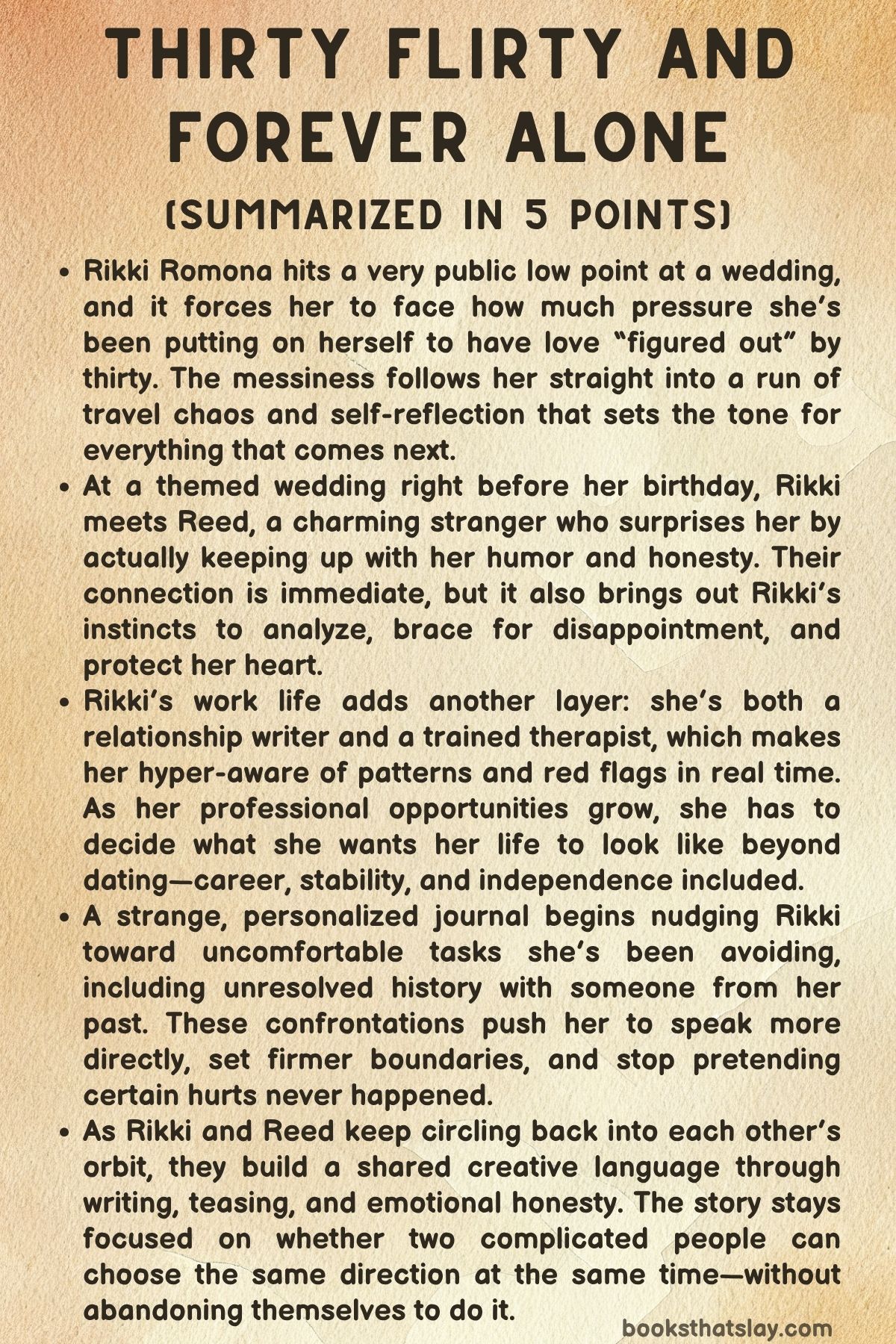
After a humiliating wedding disaster, a swapped suitcase, and one unexpected night with a charming stranger, Rikki’s careful rules start cracking. What follows is a messy, bold reset of her ideas about romance, work, and control.
Summary
Rikki Romona shows up to her cousin Whitney’s wedding in Palm Springs already stressed because she was supposed to bring a date and couldn’t. She’s the maid of honor, she’s running on nerves, and right before her speech she gets stuck in a nightmare: she can’t pull her satin dress back up because the zipper jams.
She tries to force it, hits her own forehead hard enough to leave a red mark, and rushes out to the reception holding the dress together with one hand. In front of the guests, her best friend Jordyn and Jordyn’s husband Micah attempt to fix the zipper, but it turns into a public circus.
The singer even announces the zipper problem into the microphone. A rotating cast of relatives and strangers tries tugging it up, but nothing works.
Rikki eventually gives her toast while the bride physically holds her dress closed, making the moment unforgettable for all the wrong reasons.
After the wedding, Rikki can’t stop replaying how hard she has been working toward her “by thirty” relationship goal. She’s been grinding through first dates, short-lived attempts at commitment, and frequent disappointment.
Men tend to vanish once they learn she writes a relationship column for The New York Minute under a pseudonym and is also a licensed therapist. Rikki starts to believe she’s cursed, especially since she keeps hitting a weird breaking point around “date five,” right when she starts to hope things might become real.
Jordyn tries to talk her down on a late-night flight, reminding her the missing plus-one wasn’t the headline—the zipper disaster was. Rikki admits the worst part was feeling alone during the slow songs.
The next day, they head straight to another wedding in New Jersey, timed right around Rikki’s thirtieth birthday. By the time Rikki reaches her new apartment, she discovers a fresh disaster: her suitcase has been swapped, and she’s stuck with someone else’s belongings.
The New Jersey wedding belongs to Babe Lozenge, a friend from book club, and it’s Disney-themed, requiring costumes. Rikki arrives dressed as Rapunzel and immediately feels ridiculous when she notices other Rapunzels paired with their Flynns.
She hides near a mirrored wall with a drink, watching the romance unfold from the sidelines, until a man dressed as Flynn steps beside her and starts chatting. His name is Reed, and he says he came alone too, borrowing the costume from the groom.
Rikki is suspicious because he seems too relaxed, too charming, and too normal to be unattended at a wedding.
At dinner, Reed sits beside her and announces, as if it’s obvious, that he’s her wedding date. Jordyn and Micah interrogate him, and Reed reveals he runs a podcast production company with his brother and produces the recap podcast for a reality dating show Jordyn loves.
Jordyn and Micah, in return, reveal Rikki’s entire professional life. Reed doesn’t flinch, which surprises her.
Later, he invites her to walk with him away from the crowd, and the conversation shifts into something more personal. Reed admits he once published two YA novels, but a poor reception to the second shattered his confidence, leaving him stuck.
The night goes off the rails in a way that fits Rikki’s life perfectly. She and Reed wander into a candlelit dessert room, laugh over chocolate fountain snacks, and then Rikki accidentally knocks over a candle and briefly sets the carpet on fire.
Reed stomps it out, but in the scramble, Rikki’s skirt ends up dunked into the chocolate. They retreat to a bathroom hallway to recover, only for Jordyn to find them and demand explanations.
Back in the ballroom, Babe forces a bouquet toss even though Rikki is the only single woman, making Rikki catch the bouquet on a second attempt for maximum audience participation. Then comes the garter toss, and Reed—one of the only single men—catches it.
The DJ calls them out as the “Rapunzel and Flynn” pair, and Rikki agrees to do the garter routine with him. Reed performs it like a stage number, the crowd loses their minds, and Rikki finds herself laughing and buzzing from the attention and the connection.
As midnight approaches, Rikki admits it’s her birthday. Reed offers to celebrate with a drink, and they end up outside on a balcony, then down near a lake.
Rikki talks about her trust issues and her fear that people rarely change, using her father as the example she can’t escape. She also admits she used to work directly as a therapist but stepped away because it spiked her anxiety.
In the middle of their conversation, Rikki realizes Reed might actually be Derek Roosevelt, the YA author she reviewed years ago—first positively, then more critically. The possibility makes her feel guilty, because she knows how much reviews can shape a writer’s career.
Their chemistry keeps building until Rikki tumbles down a slope and ends up in the lake. Reed follows, they surface laughing, and then the laughter turns into a kiss—private, intense, and reckless.
The moment breaks when Jordyn calls out in panic, convinced something terrible happened. Jordyn tosses them matching “Happily Ever After” sweatshirts so they can change, and in the quiet under the balcony, Reed and Rikki share small truths: the things they collect, the dreams they don’t say out loud, and the kind of future they secretly want.
They return to the party, but reality catches up fast. Reed reveals he was on the same red-eye flight from LAX, meaning he lives in Los Angeles while Rikki lives in New York.
Then the suitcase mystery clicks into place: Rikki has Reed’s limited edition suitcase, and he has been missing it. They do a late-night “hostage exchange” in her apartment lobby, trading bags, hugging, and sharing one more charged goodbye.
Inside her apartment, Rikki’s life looks less glamorous: she’s living in an apartment tied to her controlling father, who still monitors the place through a Ring camera he won’t transfer. Jordyn brings her a cupcake, and Rikki tries to focus on friendship instead of romance.
But Reed texts happy birthday, and soon he emails her a Google Drive document—a romance narrative written from his point of view—hinting that he knows she’s the reviewer who helped make his book explode and later hurt him with honesty. Rikki panics, then responds by writing the next section herself, turning the exchange into a co-written story that becomes their way of speaking safely.
Family trouble pulls Rikki to Los Angeles when Whitney calls in crisis: Whitney’s new husband Glenn has vanished after revealing he was previously married. In LA, Rikki gets nudged into seeing Reed again, and when she texts him, he replies with a pointed “Okay Renee,” letting her know he’s solved her identity.
Their second date turns into a nighttime mission as Reed offers to help search for Glenn, and they finally start addressing what her words meant to him and how deeply he carried that wound.
Back in New York, Rikki’s life escalates in a different direction. She receives a “dare” from a mysterious journal she keeps—one that pushes her to do things she avoids—and it tells her to confront her ex, Ted, who works near her office.
The confrontation happens in the most humiliating way possible when Rikki, in stomach-related crisis after too much espresso, ends up using Ted’s office trash can because she can’t make it to a bathroom. Ted walks in, and the awkwardness detonates into honesty.
Rikki finally tells him what his cruelty did to her self-esteem and how he made her feel unlovable. Ted breaks down, apologizes, and the moment becomes a strange kind of closure.
At work, Rikki’s career takes a massive turn: her boss Maya tells her that a Netflix producer wants her to pitch turning her Love Today podcast into a TV series. Rikki is thrilled, terrified, and suddenly forced to think bigger than her old survival mode.
Meanwhile, Reed shares his own complicated family history, including the discovery that the man who raised him wasn’t his biological father and the pain that followed before his dad died. Rikki responds with care, and their bond grows, even as distance and fear keep complicating everything.
Rikki and Reed spend time together in California, including a road trip to a celebrity wedding reception where they’re forced to perform to enter. Reed introduces Rikki publicly as his girlfriend without warning her, and Rikki panics at the label, afraid of how quickly things are moving.
They argue, then talk it through, trying to figure out what commitment means when they live on opposite coasts and both have unstable, demanding careers. During the night, Rikki loses essential belongings in a marina mishap, adding more chaos to an already overloaded emotional situation.
Rikki’s professional stakes rise sharply. After conflict with her workplace and a period of being sidelined, she storms back into the office on the day of the pitch with Micah as legal backup.
She asserts her rights to her work, delivers the pitch herself, and nails it. The producers love her materials and offer her the job, with plans to start quickly and shoot within months.
Rikki secures the future she’s been building toward, but her personal life collapses again when Reed goes silent after a breakup-style message. At the airport, she spots him boarding a flight to Newark, calls his name, and watches him disappear.
Later, Reed sends another chapter explaining his side: he had been planning to move to New York temporarily to make them workable, but fear and insecurity wrecked his execution. Rikki realizes she had her own secret plan too, and that their worst habit is hiding the truth to avoid rejection.
They set a formal date in Los Angeles and finally talk face-to-face at a movie premiere and after-party. They admit they love each other, but they also admit love isn’t the only variable.
Their careers, locations, and patterns make building a stable partnership nearly impossible in that moment. They agree to let go, with a promise that if they ever end up single and in the same state again, they’ll try again from the beginning.
On New Year’s Eve in Vegas during her mom’s bachelorette celebration, Rikki finally says the quiet part out loud about her father: the control, the humiliation, and the harassment. With her family’s support, she blocks him and chooses herself.
Shortly after, Reed emails that he has finished their manuscript and wants her edits. Rikki spends weeks editing while running Love Today and building her next independent project.
Their communication becomes steady, respectful, and hopeful again.
At a wildly themed “dog wedding,” Rikki gets pulled into another bouquet-and-garter spectacle—only to find Reed there. He asks her out directly and pushes for a real future, even suggesting they live together.
Rikki hesitates because of her filming schedule, until Reed reveals he’s also going to Atlanta, cast through the same production connections, and he’s reshaping his life to be with her. They also discover they’ve both been guided by the same strange journal that kept daring them into change.
Rikki agrees to move in, promising they’ll stop hiding.
Seventeen months later, Love Today is a Netflix success, Reed has joined the writers’ room, and their coauthored book is about to release. As they prepare for the tour, Reed proposes with a ring hidden inside a carved copy of their book, and Rikki says yes—finally choosing love that fits her real life, not the timeline she once tried to control.
Characters
Rikki Romona
Rikki is the emotional engine of Thirty Flirty and Forever Alone, and the story’s comedy, tension, and romance all come from the way she tries to control chaos while being inherently chaotic herself. She’s ambitious and highly self-aware on paper—licensed therapist, successful relationship columnist, podcast host, disciplined “rules” for dating—but her body and impulses keep betraying her at the worst moments: the zipper fiasco, the candle-and-chocolate disaster, the lake tumble, and the office emergency.
That mismatch is central to her character: she understands relationships intellectually, yet she struggles to live inside the uncertainty that real intimacy requires. Under the humor is a woman shaped by an unstable, frightening childhood and a father who still exerts power over her; her “screening” instincts and rigidity aren’t quirks so much as survival strategies.
Over time, Rikki’s growth isn’t about becoming calmer or less intense—it’s about letting herself be fully seen without translating everything into a professional framework, learning to ask for what she wants, and finally choosing partnership without making it another performance metric or defense mechanism. Her arc lands when she stops equating love with control and instead commits to honesty, shared risk, and a life built on her own choices rather than her father’s surveillance or her own self-imposed deadlines.
Reed
Reed functions as both romantic counterpart and mirror to Rikki: he’s charming, playful, and quick with banter, but he’s also carrying a quiet wreckage that explains his stops-and-starts in love and creativity. His early success as a YA author and the later “flop” didn’t just bruise his ego; it altered his identity, turning writing from joy into proof of worth, and that insecurity bleeds into how carefully he manages perception.
The reveal that he’s Derek Roosevelt reframes him as someone haunted by being judged—especially by Rikki’s earlier review—which makes his attraction to her more layered than a simple meet-cute: he’s drawn to her voice even when it hurt him, and he wants to rewrite the story with her rather than against her. Reed’s deepest wound is family-based—his father’s death compounded by the DNA revelation and the unspoken resentment before the accident—so he carries grief mixed with guilt, the kind that can make people either cling or flee.
When conflict hits, he runs, not because he doesn’t care, but because care feels dangerous and unbalanced to him. His later choices—rearranging his life, moving toward her career world, collaborating instead of competing, returning physically to the same spaces—show his maturation into someone who can stay present through discomfort.
By the end, Reed becomes the proof that vulnerability can be an action, not just a confession, and that love can be built through shared creative work as much as through romance.
Jordyn
Jordyn is the story’s stabilizer and truth-teller, the friend who can laugh at the mess while still protecting the person inside it. She’s practical in the way Rikki isn’t—she sees optics clearly, knows what matters and what doesn’t, and calls out spirals before they become identity-defining tragedies.
Yet she isn’t only the “responsible friend”; she has her own joyful chaos, and her marriage doesn’t make her smug—it makes her a kind of safe home base. Jordyn’s role becomes especially important when Rikki’s life starts splitting into compartments: career, father drama, Reed, and identity as “Rose Thyme.” Jordyn keeps insisting on wholeness, pushing Rikki to respond, own her feelings, and stop hiding behind rules.
She also represents the healthier version of commitment that Rikki fears is impossible—one that includes humor, teamwork, and a willingness to show up even when someone is wet, panicking, and making objectively terrible decisions near a lake at midnight.
Micah
Micah is both comic relief and quiet competence, often present when things are most humiliating or high-stakes, which makes him feel like a steady adult in a cast of emotional overthinkers. He helps in the wedding zipper disaster and later becomes crucial professionally as the lawyer who walks Rikki back into the office and protects her rights in the Netflix pitch confrontation.
What makes Micah interesting is that he doesn’t “take over” the narrative—he supports without dominating, backing Rikki’s autonomy while giving her the tools to defend herself. His presence also deepens Jordyn’s character by showing their partnership as functional and grounded; he’s not threatened by strong women or messy situations, and that normalcy subtly challenges Rikki’s expectations of men as fragile, avoidant, or opportunistic.
Whitney
Whitney is a contrast character: she begins in the glossy, socially “successful” position—the wedding, the life milestone—and then becomes the plot’s reminder that ceremonies don’t guarantee safety or honesty. Her crisis with Glenn exposes how quickly a fairytale can rot if it’s built on secrets, and her willingness to pull Rikki into the mess shows that she trusts Rikki’s competence even when Rikki doubts herself.
Whitney also acts as a catalyst for Rikki and Reed’s second-date shift into something more intimate and real; the urgency forces them into teamwork, and teamwork becomes a shortcut to emotional exposure. Over time, Whitney’s storyline undercuts Rikki’s fixation on timelines: Whitney “achieved” the goal, and it still didn’t protect her, which helps Rikki loosen her grip on the idea that love is a checklist.
Glenn
Glenn operates more as an instigator than a fully rounded presence, but what he represents is important: he’s the embodiment of hidden history and the damage caused by omission. His disappearance and the revelation of a prior marriage create a mini-mystery that drags characters out of their carefully curated identities—Whitney out of bride bliss, Rikki out of self-absorption, and Reed into protective action.
Glenn’s function is to show how trust fractures: it isn’t only betrayal that destroys people, it’s the destabilizing realization that you never knew what you thought you knew.
Babe Lozenge
Babe is maximalist celebration with a sharp edge, someone who turns weddings into theatre and uses tradition like a spotlight. Her Disney-themed event and insistence on “properly” forcing the bouquet moment reveal how she enjoys spectacle and control, but she isn’t written as malicious so much as socially powerful and oblivious to the cost of making someone else the entertainment.
Babe’s choices amplify Rikki’s vulnerability in public—singlehood framed as a communal joke—so she indirectly highlights the story’s theme of public shame versus private desire. At the same time, Babe’s world-building creates the surreal stage on which Rikki and Reed’s connection ignites; Babe’s wedding becomes the chaotic crucible that makes their bond feel fated.
Willem
Willem is a small but telling presence because he’s the connective tissue in Reed’s world, the friend whose borrowed costume helps Reed enter Rikki’s life. His function is less about personal arc and more about implication: Reed is not isolated, not a lone wolf romantic myth, but someone with friendships and community.
That detail matters because it subtly contradicts the suspicion Rikki carries—her assumption that a charming man alone must be a walking red flag. Willem’s generosity and normalcy help make Reed feel grounded rather than too perfect to trust.
Ted
Ted is Rikki’s unresolved past in human form, and his presence forces her to confront the difference between writing about pain and actually processing it. Their relationship ended long ago, but it’s still alive inside her because it shaped her self-esteem and fueled her public persona as a relationship commentator.
The office confrontation is grotesque and comedic, yet it strips away performance and makes the truth unavoidable: Ted’s words became a scar she kept rubbing into content instead of extracting. Ted’s breakdown and apology don’t magically redeem him, but they do give Rikki something she’s been denied—acknowledgment without argument—and that moment is pivotal because it shows her that closure can be messy, humiliating, and still healing.
Ted also clarifies what Rikki will no longer tolerate: contempt disguised as practicality, partners who shrink her intensity into a flaw, and love that requires her to be smaller to be manageable.
Maya
Maya represents the professional world’s sharp edge: opportunity wrapped in pressure, praise paired with expectations, and the constant demand for output even when a person is unraveling. She validates Rikki’s talent and impact, offering the Netflix pitch chance that becomes Rikki’s career turning point.
At the same time, Maya’s environment is unforgiving enough that Rikki’s anxiety manifests physically, turning work into a body-level emergency. Maya’s role is not villainous; she’s more like a gatekeeper of reality, proof that success is possible but not gentle.
She helps push Rikki toward claiming ownership—of her intellectual property, her voice, and her right to be the architect of her career rather than a replaceable contributor.
Victor
Victor becomes a key part of Rikki’s evolution from “employee with a platform” to “creator with a vision.” By partnering with her on an independent podcast, he embodies the shift toward self-determination and away from institutions that can suspend, silence, or exploit. His presence reinforces the theme that Rikki’s voice is valuable beyond any single publication, and that building something of her own is not only career ambition but also a form of safety—an exit from dependence on systems tied to her father’s control or corporate leverage.
Victor is also an emotional foil in a quieter way: he’s someone she can build with professionally without the romantic volatility that complicates her dynamic with Reed, which highlights how different kinds of partnership can coexist in her life.
Florence Leighton
Florence is the external validator who arrives at the moment Rikki most needs to believe in herself without romantic reinforcement. She listens, understands the pitch, and responds decisively, which gives Rikki a rare experience of being chosen for competence rather than tolerated for intensity.
Florence also symbolizes a new world where Rikki’s chaos can be translated into creative leadership; instead of punishing her for being “too much,” Florence effectively says that “too much” is exactly the point. Her quick offer and willingness to position Rikki as showrunner is a narrative pivot: it moves Rikki from reactive survival to proactive authorship of her future.
Dawn
Dawn functions as a pragmatic bridge between dreams and logistics, a person who makes the industry feel operational rather than mythical. She helps turn the pitch from “they liked it” into “here’s how it happens,” which grounds Rikki’s success in process and planning.
Later, Dawn’s connection that helps Reed land on the show becomes symbolically important: it merges Rikki’s and Reed’s worlds in a concrete way, transforming their relationship from a romantic fantasy strained by geography into a shared ecosystem where both can belong and contribute.
Aunt Teresa
Aunt Teresa is protective truth with family authority, someone who can name the unspoken and back it with action. In the New Year’s Eve confrontation, she helps shift the family from tiptoeing around the father’s harm to actively rejecting it.
Teresa’s support matters because Rikki’s father’s control thrives in isolation and disbelief; having an elder family member validate Rikki’s experience weakens his psychological grip. Teresa also represents the possibility of family that doesn’t demand endurance as proof of love—family that chooses boundaries, solidarity, and direct intervention when someone is being harmed.
Layla
Layla’s role carries a steady warmth that contrasts sharply with the father’s invasive dominance. As the mother’s partner, she embodies chosen family and healthier adult love—love that isn’t performative, isn’t coercive, and doesn’t require surveillance to feel secure.
Layla’s presence also expands Rikki’s understanding of commitment beyond the heteronormative, deadline-driven template Rikki has been chasing. Even when Layla isn’t driving plot, she changes the emotional weather of scenes by showing what calm partnership looks like from the outside: supportive, present, and not threatened by other people’s needs.
Rikki’s Mother
Rikki’s mother is both a comfort figure and a complicated reminder that survival can look like avoidance until it suddenly becomes confrontation. The bachelorette trip and truth-or-dare framing might seem playful, but it becomes the setting where the family finally acknowledges the depth of Rikki’s burnout and the father’s ongoing harm.
Her choice to block him alongside Rikki is emotionally significant because it breaks a long-standing pattern: instead of leaving Rikki to manage him alone, she aligns publicly and decisively. The mother also represents a softer form of resilience—she celebrates, remarries, builds joy—yet she still has to reckon with the cost of the past.
Her arc, even in the background, supports the story’s insistence that healing is not a solo sport; sometimes it takes a family finally choosing the same reality.
Rikki’s Father
Rikki’s father is the primary antagonist force, not through cartoonish villainy but through realistic, suffocating control. His power is financial, technological, and psychological: he owns the apartment, monitors her through the Ring camera, refuses to transfer access, and later escalates to eviction, workplace humiliation, and harassment.
What makes him frightening is how he turns “help” into leverage, keeping Rikki dependent while shaming her for needing anything. He also anchors Rikki’s deepest fears about people never changing, which is why she clings to rigid dating rules and assumes compliments are manipulation.
His presence explains why intimacy feels risky to her: she grew up learning that closeness can mean surveillance and punishment. The eventual blocking is not just a boundary; it is Rikki reclaiming adulthood, privacy, and the right to exist without being watched.
Reed’s Brother
Reed’s brother is mostly offstage, but he’s crucial to understanding Reed’s emotional wiring because the brother is part of Reed’s origin trauma and ongoing loyalty structure. The DNA discovery is shared between them, and the father’s death becomes a wound they carry in parallel, shaping Reed’s relationship to truth, secrecy, and responsibility.
The brother also becomes an accidental trigger later when the Ring-camera moment spirals Reed, suggesting that Reed’s family system still has the power to hijack his present. Even without heavy page time, the brother’s existence reinforces that Reed is not only a love interest—he’s a person entangled in history, family allegiance, and unresolved grief.
Themes
Public Performance, Private Shame, and the Pressure to Appear “Okay”
Rikki’s most humiliating moments happen in rooms full of people and, importantly, they become entertainment. At the Palm Springs wedding, a stuck zipper turns into a group activity where relatives, strangers, and even a child feel entitled to touch her body and “help,” while the microphone makes her discomfort part of the night’s program.
That scene isn’t just slapstick; it shows how quickly a woman’s vulnerability can become a spectacle, especially in a setting where appearances are treated like the point of the event. Rikki has arrived already stressed about not having a date, which means she’s primed to see herself as failing an unspoken social contract.
The dress malfunction becomes proof, in her mind, that she can’t meet the expectations placed on her—romantic, aesthetic, and emotional all at once. Even when Jordyn tries to reassure her that nobody cared about the missing plus-one, Rikki’s body tells another story: panic, sweating, frantic yanking, and a red mark on her forehead are physical expressions of pressure she’s been carrying for a long time.
The weddings continue to function like stages where relationship status is treated as a public identity rather than a private reality. At the Disney-themed reception, the costume theme literally pairs people up visually, so Rikki standing alone becomes unavoidable.
The bouquet toss, engineered to isolate her as the only single woman, puts her on display again—cheered at, chanted at, forced to repeat the catch until it looks “proper.” The message is that singlehood is not merely a fact but a narrative problem the crowd wants resolved in real time. What makes this theme sting is that Rikki isn’t simply embarrassed by accidents; she’s embarrassed by what the accidents “prove” about her.
She is competent, accomplished, and socially aware, yet she feels reduced to a punchline whenever a room decides her love life is communal property. The comedy lands because the situations are absurd, but the emotional core is serious: Rikki’s shame isn’t born from being imperfect; it’s born from the idea that imperfection makes her unworthy of love and belonging.
Trust, Control, and the Fear of Repeating Family Damage
Rikki’s approach to dating is shaped by a belief that people rarely change, and she builds her romantic rules as if they are safety equipment. Her father becomes the reference point for that belief: an example of someone whose harm is consistent and whose influence reaches into her adulthood through money, surveillance, and intimidation.
Living in his apartment with a Ring camera he won’t transfer is not a neutral detail; it is a daily reminder that affection can be conditional and that power can wear the mask of “support.” This history helps explain why Rikki tries to filter out toxic partners quickly and why she assumes compliments are manipulation. If love once came with volatility and control, then “nice” can feel suspicious, and intimacy can feel like a trap that closes later.
Reed asking why she’s single triggers her practiced explanation, but what she’s really explaining is why she fears being naive again.
Reed’s presence tests that system because he doesn’t match her expectations of danger, yet he carries his own unresolved hurt. His family story—infidelity, identity shock from a DNA test, and the death of the man he thought was his biological father—creates a different version of the same wound: the ground can disappear under you without warning.
Both of them have learned, in different ways, that closeness can come with betrayal or loss. That shared understanding is why their connection feels immediate, but it’s also why the relationship struggles.
Rikki’s “church and state” boundary around work and romance sounds rational, yet it also functions as emotional compartmentalization: if she keeps love in one box and career in another, she can avoid the chaos of overlap and the vulnerability of being fully known. Reed, meanwhile, wants clarity and reassurance, and when he feels unevenly invested, he reacts with distance and impulsive decisions.
Their conflict shows that control can look like rules, and fear can look like logic.
What makes this theme richer is that the story doesn’t present trust as a switch you flip once you meet the right person. Trust is shown as a daily practice that requires honesty, repair, and a willingness to be uncomfortable.
Rikki’s confrontation with Ted is pivotal because it forces her to stop outsourcing closure to avoidance. She finally names the specific ways he damaged her self-esteem, and she demands accountability.
That moment is messy and humiliating, but it’s also self-protective in a healthier way than her earlier patterns, because it turns her pain into spoken truth rather than private poison. By the end, the movement toward partnership with Reed is less about romance “saving” her and more about Rikki learning that safety can be built without surveillance, without constant testing, and without punishing herself for wanting closeness.
The story argues that trust is not the absence of fear; it’s the decision to act with integrity even while fear is present.
Authorship, Voice, and the Responsibility of Being Heard
Rikki’s professional life is built on language: she is a licensed therapist who writes a relationship column under a pseudonym and also hosts a successful podcast. That means she spends her days shaping stories about love, offering guidance, and interpreting other people’s behavior.
The irony is that she often struggles to apply that clarity to her own life, partly because being “the expert” can become a shield. When people learn what she does, dates ghost her, not necessarily because she is unlovable, but because her role threatens them.
To be with Rikki is to be seen, and some men don’t want to be seen clearly. This dynamic highlights a tension: her voice gives her power, but it also makes her a target for insecurity and judgment.
The story treats this not as a simple “men are intimidated” trope, but as a realistic occupational hazard of being publicly articulate about private matters.
The Reed connection deepens the theme because he embodies the other side of authorship: the fragile aftermath of being reviewed, interpreted, and publicly assessed. When Rikki realizes he might be Derek Roosevelt—the author whose work she once boosted and later criticized—her guilt is immediate because she understands how words can land as wounds.
Reed’s long silence as a writer and his shaken confidence after a book flop show how creative identity can become fused with external approval. Their relationship becomes a conversation about what it means to create in public and how easily feedback becomes destiny.
Reed’s decision to send her a Google Doc chapter instead of a normal text is telling: writing is the language he trusts, the place where he can be precise, brave, and vulnerable without interruption. For Rikki, responding in kind is both thrilling and terrifying because it collapses the boundary between her public voice and her private desire.
What’s especially interesting is how the co-writing becomes a form of intimacy that feels safer than direct conversation at first. They can reveal truths through fictionalized versions of themselves, admitting longing, anger, and regret under the cover of narrative.
But that safety also raises ethical and emotional questions: how much honesty is hidden inside “fiction,” and when does storytelling become avoidance? Rikki’s career opportunity—pitching and then running a Netflix adaptation—pushes this theme further by showing how institutions try to control voice and ownership.
The board attempts to sideline her while benefiting from her work, and Micah’s insistence that she owns the rights becomes a battle over who gets to tell the story and profit from it. In Thirty Flirty and Forever Alone, authorship is not just a job; it’s a fight for agency.
The story suggests that finding love is connected to finding voice: not the polished voice that performs competence, but the honest voice that admits needs, sets boundaries without hiding, and claims credit without apology. By ending with their coauthored book and shared creative life, the story frames partnership as a space where voice is amplified rather than managed.
Ambition, Reinvention, and Choosing a Life That Fits
Rikki’s romantic urgency is tied to a broader deadline mentality: the idea that life must be assembled by thirty according to a checklist. That’s why she frames dating like a project with milestones—thirteen first dates, multiple short attempts, and a recurring “date five” pattern that becomes a superstition.
But the narrative keeps showing that the real transformation in her life comes less from meeting a partner and more from building a self-directed future. Her pivot from direct therapy work to relationship media is not presented as shallow; it’s shown as a response to anxiety, burnout, and the mismatch between what she thought she “should” do and what her nervous system could tolerate.
She wants impact, but she also wants stability, and she is learning to stop calling her limits a flaw. The Netflix pitch plotline forces her to prove she can lead, not just advise.
She walks into that conference room with legal backup, asserts her ownership, and performs under pressure in a way that contrasts sharply with the wedding speech disaster. One scene is her body betraying her in public; the other is her choosing to be public on her own terms.
Reed mirrors this theme through his stalled career and his secret hopes. He has early success as a YA author, then a failure that freezes him creatively.
He also wants to act seriously, yet he’s cautious about risking more rejection. Their relationship works partly because each sees the other’s ambition without mocking it.
Rikki’s dreams—co-writing a book, even hosting a talk show—could easily sound unrealistic in a different context, but Reed treats them as plans, not fantasies. Their long-distance problem becomes a real-world test of whether ambition and love can coexist without one person shrinking.
The story doesn’t pretend it’s easy; their jobs pull them to different cities, their schedules create misunderstandings, and they both make choices that hurt each other. The turning point is not a grand romantic fix; it’s a mature acknowledgment that love can be real and still not fit the current shape of their lives.
That decision to let go “for now” is painful precisely because it is not dramatic; it’s practical.
The later reunion reframes reinvention as something ongoing rather than a one-time makeover. Rikki blocks her father with support from family, which is a concrete act of choosing a life with fewer open doors for harm.
She builds a new professional base, launches independent work, and learns to accept help without surrendering control. Reed rearranges his life, joins her world creatively, and shows commitment through sustained action rather than vows.
The mysterious journal that gives dares functions as a symbolic push toward risk, but the story’s real argument is grounded: reinvention happens when you repeatedly choose courage in small, embarrassing, inconvenient moments. The “forever alone” joke loses its power not because Rikki finally “wins” a relationship, but because she stops treating partnership as proof of worth and starts treating it as one part of a larger, intentionally built life.