This House Will Feed Summary, Characters and Themes
This House Will Feed by Maria Tureaud is a historical gothic novel set in famine-era Ireland, where survival is never just about food. Margaret “Maggie” O’Shaughnessy, reduced to a workhouse number, is offered an impossible bargain by the formidable Lady Catherine Browne: take on the identity of a dead daughter for six months, and earn a cottage and land of her own.
Maggie accepts for one reason that burns hotter than hunger—security. But once she enters Browne House, she learns the deal isn’t only social deception. Something in the estate watches, demands, and feeds.
Summary
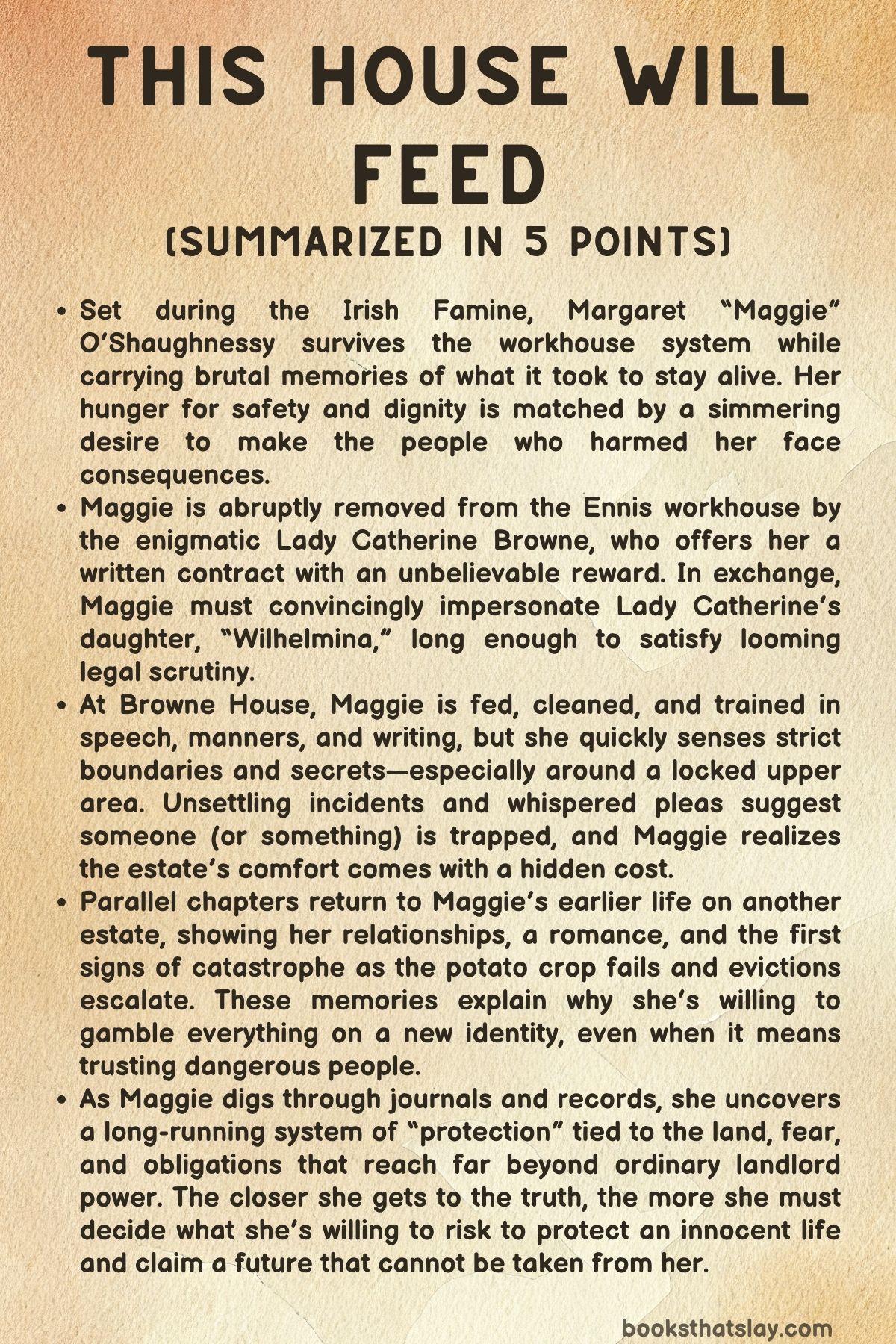
In February 1848, Margaret “Maggie” O’Shaughnessy lives in the Ennis Workhouse, known only as inmate 1-3-4-0. She works hard to avoid punishment because punishment means fewer rations, and fewer rations means death.
Maggie has already watched death take nearly everyone she loved. The famine carved her down to bone and memory, including the moment her dying brother Michael begged her to do the unthinkable so she might live.
Even inside the workhouse, she survives by staying quiet, moving quickly, and keeping her grief tucked away.
One day the matron summons her and orders her to bring only the personal things she values. Maggie gathers a small sack of keepsakes: her mother’s rosary beads, her father’s shoelaces, scraps of her sisters’ dresses, and tiny remnants of her brothers and baby Crofton.
Certain she is being removed for punishment or disposal, she is taken to the workhouse master, Mr. O’Brien. He questions her origin, age, and family—then turns to someone in the room and asks whether Maggie “will do.”
The person assessing her is Lady Catherine Browne, a striking woman who dresses in a blend of masculine and feminine clothing and carries a cane like a weapon. She ends Mr. O’Brien’s attempt to demand money and threatens him into silence.
Alone with Maggie, Lady Catherine asks what Maggie wants most if Ireland were not collapsing. Maggie answers with raw clarity: a house, land that cannot be taken, enough food to never fear hunger again.
Then she adds the truth she rarely says out loud—she wants revenge.
Lady Catherine offers a contract. If Maggie agrees to cooperate, she will receive a cottage and five acres on Browne land.
The soil is poor for crops but good for sheep, and the promise is made in writing, notarized in plain language. The task is simple to describe and dangerous to carry: Maggie must pose as Lady Catherine’s daughter, Wilhelmina.
Lawyers will arrive in six months to confirm Wilhelmina’s death. If Wilhelmina is declared dead, her inheritance will pass elsewhere and Lady Catherine will lose everything.
Lady Catherine claims she needs Maggie to keep the estate intact for the people who depend on it. Maggie is wary, but the legal formality and the thought of land that cannot be stripped from her outweigh the fear.
She signs.
Lady Catherine removes Maggie from the workhouse immediately. Wrapped in blankets, fed stew, and rocked by the carriage, Maggie sleeps hard and wakes to scenes that confirm Ireland’s ruin: starving people shuffling along roads, a mother grieving beside a small body, towns that feel like traps.
When Maggie speaks of God, it is with bitterness—faith has not fed anyone she buried.
Browne House sits in the Burren, tall and choking under ivy, a place that looks grand and sick at once. Maggie is given a lavish bedroom that feels like it once belonged to a child.
The housekeeper, Aggie Lynch, reacts to Maggie like she is a contagion. Aggie orders a harsh bath, strips Maggie, checks her for lice, scrubs her skin raw, and threatens to burn anything Maggie touched from the workhouse.
When Maggie is dressed in clean clothes and handed rich food, she eats carefully, still trained by hunger to expect it to be taken away. Aggie tells her bluntly: she is Lady Wilhelmina now, and everything depends on behaving like it.
As Maggie begins her new life, she notices the house’s locked places. There is a heavily bolted door in an upper corridor, guarded by multiple locks.
Lady Catherine emerges from behind it carrying a lamp, snaps the locks shut, and scolds Aggie for being too near. When Maggie picks up a dropped golden spiral charm, Lady Catherine snatches it back and warns her never to touch it again.
In the library, Lady Catherine lays out Maggie’s training—speech, handwriting, manners, and French—along with a rule: Maggie must call her “Mama.” Maggie is granted freedom to roam most of the house, except the attic area behind the locked door.
During tea, a book falls from a shelf on its own, startling Aggie into fleeing. Maggie returns it and discovers it is not a normal book at all but a hidden tenant registry ledger.
Instinctively, she lies about what she saw and pushes it back into its hiding place. Soon after, she feels a sudden chill and senses something near the stacks.
The air shifts, and Maggie collapses.
The narrative opens into Maggie’s earlier life, before everything burned down. In September 1845, Maggie works at Kilrush House, tasked with minding Lady Grace’s macaw, Lucy—beautiful, lonely, and vicious.
The bird bites and claws her, but Maggie talks to it in Irish, soothing it because she understands captivity. That same night she attends a céilí with her family.
Music fills the parish hall, and for a few hours life feels intact. Maggie shares blackberry cordial with her father, a land agent worried about their position, and she guards her secret: she is engaged to Teddy Moore-Vandeleur, the landlord’s son.
Teddy meets her privately, kisses her, calls her “wife,” and jokes about eloping. Maggie insists they reveal the engagement at the right time, believing careful planning can protect them from his father’s power.
Back at Browne House in 1848, Maggie wakes after fainting to Lady Catherine hovering over her. Lady Catherine speaks oddly, as if addressing someone unseen, then smooths her tone and leaves.
In the shadows Maggie hears a whisper—someone pleading to be fed and freed. She tries to dismiss it as weakness or fever, but the house has begun to press on her mind.
Months pass. Maggie gains weight and strength.
She practices being “Wilhelmina,” improves her English, rehearses polite conversation, and studies Lord Browne’s records. A maid named Beth brings tea and reveals she has feelings for Cormac O’Dea, the estate’s man-of-all-work.
When Cormac returns from selling Lady Catherine’s goods in Galway, the house stirs with nervous energy. Maggie, alone with a rich stew, thinks about the workhouse and the road and swears she will use this role as a bridge to land and independence.
Yet the house keeps answering her thoughts with sensations—cold drafts, shifting sounds, warnings that arrive like someone else’s voice inside her skull.
More memories surface. In October 1845, Maggie walks through fog toward Kilrush House and hears rumors of rot in the potato fields.
She meets Mary Leary, pregnant again, who describes a rotten-sweet smell in the air. Inside the big house, Maggie and Michael overhear Colonel Moore-Vandeleur raging about tenants and poor rates.
Maggie’s father calls the situation “disaster” and orders the family to lock down. On the road, Maggie and Michael witness the blight’s horror: potatoes collapse into black muck, and Mary Leary is found vomiting sludge, laughing in a way that signals her mind has broken under poison and fear.
Soon Mary dies, along with others, as famine spreads.
By January 1846, Maggie is pregnant. Teddy comes to her parents to ask permission to marry, but he admits he used the pregnancy to force his father’s approval.
Michael nearly attacks him, and Maggie’s father refuses to consent until Teddy speaks to his own father and proves he can protect Maggie from the family that holds the land and the law. Teddy insists it will work out because his father is fond of him and of the Irish tenants.
Maggie wants to believe him. She builds her future on that belief, because without it she has nothing.
At Browne House, Lady Catherine grows unpredictable. She speaks of “vengeance” as if it is medicine, then turns gentle, offering herbs and incense.
She takes the attic key and forbids questions. The pleading voice returns, begging for release.
Maggie finds herself drawn outside, into walled gardens crowded with flowers. There she meets Cormac and is shocked when he recognizes her as Maggie O’Shaughnessy.
She warns him to use the name Wilhelmina, but his recognition cracks her sense of safety. Cormac lends her a novel about betrayal and revenge and hints at rumors of a woman in white in the attic.
Maggie reads at night, trying to steady herself, but the house answers with fog-like incense and dreams that feel engineered.
One stormy night, Maggie awakens to an apparition: Michael’s likeness forms from smoke and warns her she must remember everything, because a trapped woman needs help. He tells her the smoke will guide her, and that she is not the first person to wear Wilhelmina’s identity.
Maggie loses consciousness and relives February 1846, when she was sent to Dublin to give birth in Lady Grace’s city house. She was isolated, watched, and kept compliant with food and comfort that felt like a cage.
Teddy never came. After the birth, Maggie was told her baby died, malformed, and was buried in an unconsecrated cillín without her knowing where.
She returned home months later to find hunger everywhere and her family thinning toward death.
The present becomes worse. Maggie sees the woman in white—solid, filthy, mutilated, with her eyes gouged out—moving toward the locked attic door.
A different voice, cold and demanding, whispers, “Feed me, Maggie.” Maggie flashes to an image of Lady Catherine asking multiple blond girls the same question Maggie was asked—what do you want most? Behind Lady Catherine stands something larger each time, until it becomes a queen-like figure in white and gold.
Maggie understands then that she was chosen not just for her ability to lie, but for what her hunger and rage could supply.
Maggie searches Lord Browne’s journals and finds the estate’s older rot. Browne writes of marrying “Cate,” a poor woman with uncanny influence.
After suspicious deaths in the family, Cate insists their daughter Wilhelmina must be named heir before anyone tells her the tragedy. Browne grows frightened, linking Cate to folk magic and to a force he calls the Cailleach.
He describes strange lights on the land, ruined livestock, a “hungry grass” curse, and a doctor—Brady—visiting weekly to prescribe a mixture burned daily to calm his nerves. Browne warns himself never to enter the attic, calls it “her domain,” and records that Cate hid an accounting ledger showing tenants paid a price for “protection.”
Maggie retrieves the hidden ledger and finds it lists names, loyalties, and whether families subscribed to protection—no sums, just a map of fear. When she presses for truth, Lady Catherine oscillates between confession and denial, at one point slipping and calling her “Maggie” as if the disguise no longer matters.
Maggie rides the land with Cormac and sees the triskele symbol carved into stone, matching Lady Catherine’s charm and marks Maggie has noticed in the house. Cormac suggests carving the sign for protection, but Maggie senses protection here always has a cost.
Determined to recover what she has blocked out, Maggie uses incense and demands Michael explain what she must remember. The memories break open: the eviction in November 1846.
Bailiffs beat Michael, burn the O’Shaughnessy home, and throw the family into the road. The man who orders it is not a stranger.
It is Teddy—now acting as land agent and heir—accusing Maggie’s father of fraud and threatening prison or deportation. The family is denied work and aid through Teddy’s influence.
One by one, children die. Crofton dies.
On the road toward Ennis, more losses follow, until only Maggie, her father, and Michael remain.
Near collapse, they are rescued briefly by Conor and Kitty O’Dea and their son Cormac—the same Cormac who now works at Browne House. The O’Deas feed them and offer help, but Maggie’s father refuses anything that might draw attention.
Later, he reveals he cannot enter the workhouse because he has been framed as a fugitive. He chooses to die so his children might reach Ennis.
In a final act of sacrifice, he bleeds himself to strengthen them, then dies with curses for the Moore-Vandeleurs on his lips. Michael and Maggie keep walking.
The present catches up with Maggie in a new shock: she is traveling at night with Cormac when the carriage snaps and injures her, and Lady Catherine appears, furious, revealing that no one can leave the estate while a pact is in place—except Cormac, who never agreed to it. Back in the library, Maggie holds a sleeping baby boy: Diarmuid, alive.
The truth is staggering. The child she was told died survived, hidden and preserved within the estate’s larger scheme.
Maggie demands the contract be broken; she will not trade her child for land. Lady Catherine admits they have only two nights until the new moon to satisfy the Cailleach, or both she and Maggie will die.
Diarmuid’s survival has disrupted what the force expects.
Lady Catherine finally confesses. Years ago, she used her Sight and summoned the Cailleach to protect the estate and village.
After Wilhelmina died and Lady Catherine killed Wilhelmina’s cruel husband, the bond hardened into something permanent, damaging Lady Catherine’s mind and demanding regular offerings of vengeance to keep the land flourishing. Rather than sacrifice villagers, she lured vulnerable young women—girls full of hardship and anger—promising them what they wanted most, then turning them into replacements for Wilhelmina.
Maggie is only the latest.
Lady Catherine insists the key is a missing memory from the night before the eviction. Maggie believes Teddy ruined her family, but Lady Catherine suggests the root is deeper and points toward Teddy’s father.
Then, exhausted and desperate to end it, Lady Catherine gives Maggie a small object and cuts her own throat, dying on the library floor.
At dawn Maggie is found covered in blood. She opens the object: inside are Lady Catherine’s triskele necklace, the attic key, and a letter with instructions.
Maggie orders the household and villagers taken to the parish hall for safety. Cormac rides to bring officials.
The letter explains the necklace binds the Cailleach and, with the incense, allows the wearer to enter memories and force truth into the open. Maggie must redirect vengeance toward its rightful target and save Diarmuid before the new moon.
Maggie puts on the necklace and uses the remembering smoke on Teddy, who is staying at the estate. She enters his room, takes his hand, and compels memory.
She relives Teddy’s recollection of the céilí night: Teddy’s father manipulated him into signing documents that framed Maggie’s father and set the family up for ruin. That same night, Maggie waited in the summerhouse for Teddy, but Colonel Crofton Moore-Vandeleur appeared instead, humiliated her, and tried to force her to drink wine she believes was meant to kill her.
Michael burst in and pulled her away, saving her life. Teddy was weak, controlled, and complicit.
In the present Teddy wakes, confused and frightened, and Maggie forces him to admit what he did in Dublin—how he planned to abandon Diarmuid to the church and never fought for Maggie or her family. Maggie names the true villain and claims her vengeance: she will take the heir from the father who destroyed hers.
Under the necklace’s force, Maggie kills Teddy, sealing the offering the Cailleach demands.
Then Maggie goes to the attic. There she discovers the villagers’ payment for protection: hundreds of labeled jars holding pieces of their souls.
She opens each jar and releases the sparks back toward the village, returning what was taken. Finally, she destroys the triskele charm that anchors the binding, breaking the Cailleach’s hold and ending the estate’s prison.
When officials arrive, Maggie fears discovery of Teddy’s body, but the guest-room door has vanished, as if the house itself has chosen what can be found. The investigation rules Lady Catherine’s death a suicide, and the doctor agrees to record it as an accident so she can be buried properly.
The will is executed: the estate and lands pass to Maggie as Wilhelmina, and Cormac receives a large inheritance. The doctor also notes that angel’s trumpet was found in the attic—its smoke hallucinogenic—raising the possibility that what looked like sorcery was amplified by drugged incense and fear.
With Diarmuid safe and the binding ended, Maggie chooses a future that isn’t rooted in Browne House. She decides to sell the estate and distribute the money so villagers can leave and rebuild elsewhere, keeping enough to raise her son in security.
Walking back through the house with Cormac, Maggie carries what she once begged for: a living child, a home that is hers to choose, and a name reclaimed on her own terms.
Characters
Margaret “Maggie” O’Shaughnessy
Maggie is the emotional and moral center of This House Will Feed, a survivor whose identity has been stripped down to a number in the Ennis Workhouse and then forcibly rebuilt into “Wilhelmina.” What defines her most is not just endurance but the terrible intelligence hunger teaches: she learns to measure risk, read power, and accept bargains that would once have been unthinkable because the alternative is annihilation. Her memories—of famine roads, family deaths, and the grotesque compromises survival demanded—aren’t just backstory; they shape her instincts in every present-tense choice, especially her distrust of comfort and her suspicion that gifts always have hidden costs.
Maggie’s desire for a house and land is not simple longing but a psychological necessity: stability becomes her antidote to a world that can evict, starve, and erase you on a landlord’s whim. At the same time, the story complicates her yearning for “revenge” by showing how easily rage can be harvested by others; her anger is both a fuel for liberation and a vulnerability predators exploit.
By the end, Maggie’s arc resolves into agency: she stops being a vessel for someone else’s plan—whether Lady Catherine’s deception or the Cailleach’s hunger—and turns remembering into a weapon, reclaiming her child, her truth, and the right to define what justice looks like.
Lady Catherine Browne
Lady Catherine is the novel’s most unsettling blend of protector, predator, and tragic architect of her own ruin, a woman who speaks like a savior while building systems that feed on the desperate. Her charisma is inseparable from her control: she arrives with a notarized contract, fine clothes, and a grand moral rationale, but she also knows exactly which people to target—those with nothing left to lose and enough rage to burn.
Her gender expression and commanding presence underscore her refusal to be confined by social scripts, yet her power is not freedom in the story’s moral sense; it becomes a kind of dependency, because every act of control she performs ties her tighter to the pact that keeps her land thriving. Lady Catherine’s volatility—tender one moment, cruel or dissociated the next—suggests both psychological fracture and the corrosive effect of living as the intermediary for a force that demands payment.
She frames her scheme as care for “hundreds under her protection,” but that protection is transactional, enforced, and literally extracted from tenants through the hidden registry. Her final act—forcing the truth into motion and then killing herself—reads as an attempt to end the cycle without the courage, time, or clarity to dismantle it properly; she dies leaving Maggie both a weapon and a burden, a successor forced to finish what Lady Catherine began and failed to complete.
Wilhelmina Browne (the “original” Wilhelmina)
Wilhelmina, though largely absent in direct scenes, functions as a haunting template rather than a fully present person: she is the identity Maggie must wear, the inheritance hinge the lawyers will test, and the symbol Lady Catherine can’t release. The narrative positions Wilhelmina as both daughter and instrument—someone whose death becomes the trigger for Lady Catherine’s escalation from protective pact into desperate substitution.
Because Maggie and other girls are repeatedly remade into “Wilhelmina,” the name becomes less a person and more a role created by wealth and patriarchy: a widow with legal standing, a body that can hold property, a signature that can preserve a fortune. That substitution also turns Wilhelmina into a commentary on how society values certain women’s lives as titles and estates rather than as selves.
Even without extensive “page time,” Wilhelmina’s presence permeates the house, especially the childlike bedroom and the rules about the attic, suggesting that her loss is the emotional wound Lady Catherine keeps reopening and disguising through impersonation.
Cormac O’Dea
Cormac is the story’s bridge between ordinary human loyalty and the novel’s larger machinery of secrets, boundaries, and bargains. He begins as the practical driver who facilitates Maggie’s removal from the workhouse, but his role deepens into witness, ally, and moral counterweight: he is close enough to the estate to know its wrongness, yet separate enough—because he never made the pact—to cross boundaries others cannot.
His steadiness contrasts with the house’s distortions; where Lady Catherine speaks in grand propositions, Cormac speaks in lived caution, rumor, and local knowledge. His recognition of Maggie punctures the performance of “Wilhelmina” and reminds her that identity is not only what you present but also what others remember about you, which becomes crucial in a story where memory is both battleground and key.
Cormac’s relationship to the promise of land is also revealing: he was offered the same dream and refused it, marking him as someone who senses the cost of “protection” even before Maggie understands it. By the end, his inheritance and his partnership with Maggie don’t read as a fairy-tale reward so much as a pragmatic alignment—two survivors choosing a future that rejects the house’s logic of extraction.
Aggie (Mistress Lynch)
Aggie is the household’s hard edge, enforcing class boundaries with soap, fire, and fear, and she embodies how institutions of “cleanliness” can become instruments of dehumanization. Her first actions toward Maggie—stripping her, scrubbing her raw, threatening to burn what she touched—aren’t simply about disease; they are rituals of purification meant to erase the workhouse and the famine from the body now expected to perform gentility.
Yet Aggie is more complicated than cruelty alone: she is also a cog who has survived by obeying, and her rigidity suggests terror—of infection, of disorder, of Lady Catherine’s wrath, and of whatever is locked above them. Her insistence that Maggie is “Lady Wilhelmina now” shows how identities in the house are policed into existence through repetition and discipline.
When Maggie later gives her orders to protect the household and village, Aggie’s compliance signals a shift: she is not incapable of loyalty to the vulnerable, but she needs a structure of authority to act, and Maggie’s assumption of command finally provides one that serves liberation rather than containment.
Beth
Beth represents the everyday human cost of living under an atmosphere of unspoken threat. Her nervousness around arrivals, her small confessions, and her attachment to Cormac show a person trying to build ordinary hope inside an abnormal world.
She functions as a barometer for the house’s fear: when Beth is jumpy, when she avoids certain topics, it signals that danger is not merely supernatural spectacle but a social reality everyone is trained to navigate quietly. Her presence also emphasizes what Maggie is fighting for beyond herself—because even if Maggie’s bargain is personal, the estate’s “protection” system entangles servants and tenants alike.
Beth’s youth and limited power make her one of the people Maggie’s final choices must account for, pushing Maggie’s revenge away from pure personal satisfaction and toward responsibility.
Michael O’Shaughnessy
Michael is Maggie’s deepest bond and her most persistent haunting, the sibling whose love follows her into starvation, eviction, and the psychological afterlife of trauma. In the past, he is both brother and guardian—teasing her at the céilí, dragging her away from danger, enduring beatings during the eviction, and sharing the collapsing road to Ennis.
The horror of his dying request during famine, and Maggie’s lifelong carry of that memory, turns him into the story’s emblem of what famine does to love: it doesn’t eliminate devotion, it weaponizes it, forcing intimacy into unbearable choices. In the present, Michael’s voice and appearances occupy an ambiguous space between spirit and remembered guilt, but narratively he operates as Maggie’s conscience and compass, pushing her toward truth when the house tries to drown her in performance.
He is the one who insists she must remember, which matters because remembering is the novel’s route to justice; without the recovered truth, Maggie’s vengeance would remain misdirected and therefore still “feeding” the wrong forces.
Teddy (Theodore Moore-Vandeleur)
Teddy begins as romance and refuge—youthful affection, flirtation, the promise of a future—only to curdle into a portrait of cowardice and complicity. What makes him particularly painful is that he is not introduced as a cartoon villain; he is charming, intimate, and familiar, which mirrors how betrayal often works in real life: it arrives through someone you trusted to keep you safe.
His confession that pregnancy was his “route of least resistance” exposes a core selfishness: he uses Maggie’s body and reputation as leverage in a conflict between men, underestimating the danger she faces and assuming his social cushion will hold. Later, his silence and abandonment in Dublin, and his failure to fight his father’s machinery, reveal the crucial truth that love without action is another kind of harm.
Teddy’s role also illustrates the novel’s critique of power inheritance: even when he suffers under his father’s manipulation, he still benefits from the system until the moment it threatens his comfort. When Maggie ultimately kills him, the act is framed less as impulsive rage and more as targeted vengeance aimed at the lineage and entitlement that destroyed her family—taking the “heir” becomes a symbolic severing of the pipeline through which cruelty reproduces itself.
Colonel Crofton Moore-Vandeleur
The Colonel is the story’s clearest embodiment of institutional violence: a man who can ruin families through paperwork, threats, and social networks that make refusal of aid seem “legal.” He weaponizes bureaucracy—account accusations, eviction authority, intimidation of tradespeople—to starve the O’Shaughnessys not only materially but socially, isolating them so even neighbors fear helping. His manipulation of Teddy on the céilí night shows how control operates through paternal authority as much as through law, turning a son into an instrument while keeping the father’s hands seemingly clean.
The cruelty here is strategic rather than hot-blooded; he understands that famine is not only a natural disaster but an opportunity to consolidate power, reduce “costs,” and break resistance. In the structure of Maggie’s vengeance, the Colonel matters because he represents the true source of her ruin—proof that the catastrophe was not merely blight and bad luck, but human choice amplified by status.
Maggie’s Father (the land agent)
Maggie’s father is a tragic figure caught between proximity to power and vulnerability to it, someone who knows how the system works but cannot ultimately protect his family from the landowner’s retaliation. His warnings to Maggie about timing, respectability, and the imbalance between her and Teddy show a man who reads class danger clearly, even as he hopes honesty and procedure might still matter.
When disaster strikes, his descent into fugitive status—accused of rent theft through doctored books—demonstrates how quickly “respectability” can be revoked when it inconveniences those above you. His final sacrifice on the road, bleeding himself so Maggie and Michael might live, is one of the novel’s starkest images of parental love under famine: it is both literal nourishment and symbolic indictment, because a father must turn his own body into food when society refuses to feed its people.
His death leaves Maggie with an inheritance of anger that is not abstract; it is rooted in seeing decency crushed by a system designed to protect property over lives.
Maggie’s Mother (Mam)
Mam is the emotional anchor of Maggie’s family history, representing home as warmth, continuity, and ordinary care—things famine dismantles piece by piece. Her presence in the memories of eviction and the road emphasizes how famine doesn’t kill only through hunger; it kills through prolonged humiliation, exhaustion, and the steady stripping away of choices.
Mam’s death in tall grass, without burial, underlines the story’s recurring wound of denied dignity: the dead cannot be honored properly because the living are barely allowed to remain alive. Even when she is not in the present timeline, Mam’s absence shapes Maggie’s fixation on a house and land; Maggie is chasing not just property, but the possibility of never again having home reduced to ash by strangers.
Diarmuid
Diarmuid is more than Maggie’s child; he is the narrative’s turning point, the living contradiction that exposes how thoroughly Maggie was controlled and lied to. Being told he died—then discovering he is alive—reframes Maggie’s entire understanding of her past and the limits of her agency, because motherhood becomes the line she will not allow any bargain to cross.
Diarmuid’s existence also disrupts the estate’s feeding cycle: he represents a future that is not meant to exist under the pact’s logic, which is why his survival becomes both threat and leverage. In a story obsessed with hunger, Diarmuid embodies a different kind of feeding—care, continuity, and the refusal to let the vulnerable be turned into payment.
Maggie’s final decisions are shaped around him, turning revenge away from endless consumption and toward the creation of a life that cannot be so easily taken.
Conor and Kitty O’Dea
Conor and Kitty appear as a rare pocket of humane intervention, the strangers who choose to feed rather than exploit, and their role highlights how extraordinary basic kindness becomes during systemic collapse. They rescue the family from the grass, give broth and shelter, and offer ongoing help, but the father’s fear of discovery shows the limits of charity under a regime of punishment.
Their willingness to help also contextualizes Cormac’s character: he comes from people who understand survival not as extraction but as mutual aid. In the moral landscape of This House Will Feed, the O’Deas represent the path not taken by the powerful—proof that famine does not automatically erase compassion, even if it makes compassion dangerous.
Mary Leary
Mary is a haunting early casualty whose arc dramatizes the blight’s horror and the way catastrophe first appears as rumor, smell, and disbelief before it becomes mass death. Her pregnancy, her fear about rent, and her desperate attention to the potato plants show the fragile calculus of tenant life, where one missed harvest can mean exile.
Her encounter with the rotting crop—black sludge, noxious gas, laughter tipping into madness—externalizes the story’s theme that famine is not only empty stomachs but poisoned air, broken minds, and a world turning grotesque. Mary’s death is a narrative alarm bell: it marks the moment when ordinary coping fails and the community enters a reality where the rules of survival are rewritten.
Mr. O’Brien (workhouse master)
Mr. O’Brien personifies bureaucratic cruelty as routine, the kind that doesn’t need hatred to do harm. He treats Maggie as a ledger entry and a “debt,” bargaining for compensation and silence while she stands before him barely alive.
His presence underscores how the workhouse system converts suffering into administration—punishment becomes ration reduction, trauma becomes paperwork, and a human being becomes a number that can be transferred like property. Even though he is not central later, his scene matters because it frames the starting point of Maggie’s bargain with Lady Catherine: a world where authority already assumes it owns her body and labor, making her leap into another form of captivity feel like the only available path.
Dr. Brady
Dr. Brady occupies the story’s boundary between superstition and explanation, a professional presence entangled with the estate’s secret practices. Historically tied to Lord Browne’s circle and later summoned during the crisis, he functions as both enabler and rationalizer, prescribing herbal mixtures and effectively giving medical cover to the house’s incense-driven control.
His later remark about angel’s trumpet being hallucinogenic reframes much of what seemed supernatural without fully erasing it, because the narrative has already shown how belief, fear, and manipulation can be as binding as any “old god.” Dr. Brady’s role is therefore unsettling: he represents how authority can launder coercion into “treatment,” and how explanations can arrive only after damage is done, when the powerful need a safer story for outsiders.
Lord Browne
Lord Browne is the estate’s earlier chronicler of dread, a man who documents the slow realization that he is no longer the dominant force in his own house. His journals trace a descent from mundane record-keeping into paranoia, fear of the attic, and recognition that “protection” has a hidden price extracted from tenants.
He is neither hero nor simple victim; he participates, benefits, and delays meaningful resistance until the cost becomes personal, which echoes the broader theme of landlords and gentry awakening too late to the suffering their systems require. Through his writing, the house gains a historical memory that parallels Maggie’s own: both are archives of harm, and both must be opened to understand what is truly being fed.
The Cailleach
The Cailleach functions as hunger given voice and will, whether understood as an Old God, a psychological projection intensified by drugs, or a force that exists in the overlap between folklore and lived trauma. She is defined by appetite—demanding payment, feeding on vengeance, binding people through bargains—and she turns emotion into currency, especially rage and desperation.
The genius of the character is that she mirrors the famine itself: an entity that consumes bodies and futures, that makes the living complicit in impossible choices, and that thrives on a world where people are cornered into transactions. Even when the story introduces the possibility that incense caused hallucinations, the Cailleach remains thematically real because the mechanisms of feeding—extraction, coercion, fear, and the conversion of human life into “cost”—are undeniably real.
When Maggie breaks the binding and returns what was taken, the defeat of the Cailleach reads as the rejection of an entire economy of hunger, not merely the silencing of a ghost.
Themes
Hunger, Bodily Survival, and the Ethics of Staying Alive
Margaret’s earliest memories inside This House Will Feed are shaped by hunger as a force that strips away choice and turns the body into a daily negotiation. In the workhouse she is reduced to a number, a system label that matches how famine has already tried to make her life interchangeable.
Food is never only food in her experience; it is power, punishment, and a measure of whether she is allowed to continue existing. That reality makes her cautious even when a full plate appears in Browne House.
The fear is not simply that the food will vanish again, but that accepting it will come with a cost she cannot yet name. Her mind returns to moments when survival demanded unbearable compromises, including the memory of Michael urging her to eat him.
The story treats that memory not as shock value, but as a permanent moral scar that Maggie carries into every later decision.
This theme deepens when survival shifts from scarcity to “protection.” Lady Catherine’s promise of land and steady food sounds like rescue, yet it is also a transaction built on desperation. Maggie’s hunger becomes a lever other people pull.
Even the estate’s prosperity is tied to a bargain that treats human need as fuel. When the villagers’ well-being depends on hidden payments stored away like inventory, the book asks what kind of community can be built on a system where someone must be diminished so others can eat.
Maggie’s later actions reclaim the meaning of survival by changing who pays the price. She refuses a future where her child becomes an offering, and she rejects the idea that her life must always be purchased through someone else’s control.
The narrative keeps returning to the body—starving, fed, drugged, injured—to show that survival is never abstract. It is intimate, humiliating, and often haunted.
Yet it can also become the foundation for a new ethic when Maggie decides that staying alive should not require sacrificing the vulnerable.
Identity as Property, Performance, and Theft
Maggie’s transformation into “Wilhelmina” presents identity as something that can be assigned, trained, and used like a legal instrument. The contract Lady Catherine brings is written plainly, notarized, and framed as fair, which is exactly what makes it frightening: it treats a person as a role that can be leased.
Maggie’s past has already shown her how easily institutions redefine people—workhouse rules reduce her to labor and rations, eviction orders redefine a family as disposable, and gossip turns them into criminals. The Browne House arrangement continues that pattern in a more polished form.
Maggie is cleaned, dressed, coached, and monitored until her body becomes a convincing document. The performance is not just social; it is enforced.
She is told what to call Lady Catherine, where she may walk, which rooms are forbidden, and which questions are dangerous.
At the same time, Maggie’s inner life refuses to cooperate with the mask. Her memories break through in nightmares, sudden collapses, and voices that demand recognition.
The story keeps pushing the tension between the identity others impose and the self she is trying to rebuild. When Cormac recognizes her and uses her real name, the moment lands as both comfort and threat.
Comfort, because it confirms she still exists under the costume; threat, because being known can destroy the fragile route to land and safety. The book also shows that identity theft is not only what Lady Catherine does to Maggie; it is what the landlord class does to tenants when it rewrites their lives with paperwork, accusations, and “respectability.” Maggie’s father becomes “fraudulent” because powerful people need him to be, and that label enables violence.
By the end, the struggle over identity becomes a struggle over who has the authority to define reality. The attic jars, the ledger marks of loyalty, and the shifting accounts of Wilhelmina’s existence all suggest that names and stories can be stored, traded, or erased.
Maggie’s final insistence on claiming her child, her property, and her name reads as more than personal victory. It is a refusal to remain a character in someone else’s script, and it exposes how much of social order depends on controlling who gets to be believed.
Vengeance, Moral Accounting, and the Price of Justice
Revenge enters the story early, not as a dramatic flourish but as a practical desire that grows out of deprivation. Maggie does not want chaos for its own sake; she wants consequences for people who created suffering and then walked away untouched.
The important detail is how clearly she distinguishes between destruction and recognition. What she craves is the certainty that those who ruined her will be forced to understand that she survived and will no longer accept their version of the world.
That longing makes her easy for Lady Catherine to recruit, because vengeance is exactly what the estate’s bargain requires. Rage becomes a resource, and the book shows how quickly righteous anger can be redirected into systems that do not serve the person feeling it.
Lady Catherine talks about “protecting” hundreds, yet the protection is sustained by repeatedly seeking out girls with hardship and anger, then shaping them into replacements and offerings.
This creates a moral economy where suffering is converted into stability for others. The ledger is chilling because it reads like bookkeeping for a community built on fear and dependence.
Names are categorized by loyalty and protection, implying that safety is not a right but a subscription. When Maggie learns the villagers paid with pieces of themselves, vengeance stops being only personal.
It becomes structural, something that can be distributed, misdirected, and institutionalized. The book forces a hard question: when the world has been engineered to harm you, what does justice look like without repeating the same logic of sacrifice?
Maggie’s eventual choice of target is shaped by truth rather than rumor. Her rage had attached itself to Teddy as the symbol of betrayal, but the remembered events reveal a wider machinery of power—family influence, paperwork, manipulation, and the convenience of blaming the victim.
When Maggie kills Teddy, the act is framed as vengeance with a specific meaning: it strikes at the inheritance line that benefited from her family’s destruction. That choice is morally violent, and the story does not pretend it is clean.
It treats vengeance as a form of accounting that always demands payment, and it shows how easily the need for payment can become a trap. The release of the villagers’ “payment” in the attic then becomes a different kind of justice—restoration rather than extraction.
In that moment, vengeance is redirected away from feeding a predatory system and toward undoing what was taken. The theme lands in the uneasy space where survival, justice, and harm overlap, and where a person who has been wronged must decide what they are willing to become in order to make the world answer for it.
Power, Land, and the Violence of Control
Land is the central promise that drives Maggie forward: a house, acres that cannot be taken, and enough food to end the fear of starvation. In famine-era Ireland, land is not just livelihood; it is belonging, protection, and status.
The story is relentless in showing that the loss of land is not a neutral economic event. Eviction is portrayed as bodily violence carried out through legal authority, where paperwork and clubs work together.
Maggie’s family is not simply displaced; they are made un-hirable, unhelpable, and socially toxic through threats that punish anyone who shows them kindness. Power is shown as something that spreads beyond the landlord’s hand into the choices of shopkeepers, neighbors, and officials who participate out of fear.
Browne House looks like a reversal of that violence, a place of abundance, rooms with curtains and warm meals. Yet the estate is another enclosure.
Maggie cannot leave the grounds once the pact is active, and the boundary becomes a physical expression of what landownership can mean: the owner decides who crosses, who stays, and what truth is allowed to circulate. Even Lady Catherine, who appears dominant, is also trapped by the bargain that keeps the land flourishing.
The estate’s prosperity depends on continuous compliance with a force that demands payment, and the “protection” offered to tenants turns them into clients rather than equals. The theme makes clear that control is most effective when it is presented as care.
A workhouse claims to provide relief while punishing need. A landlord claims to manage estates while engineering starvation.
Lady Catherine claims to safeguard villagers while hiding the real cost in locked rooms and labeled jars.
Maggie’s rise into property and title does not magically purify the system. It changes who holds the deed, but it also forces her to decide what kind of power she will practice.
Her choice to sell the estate and use the money so the villagers can leave is significant because it rejects the idea that security must be tied to a single controlling house. Instead of replacing Lady Catherine as the new gatekeeper, Maggie tries to convert concentrated power into mobility and options.
The ending suggests that freedom is not only a matter of owning land; it is also the ability to refuse the terms that landowners have historically imposed. By securing her child, breaking the binding mechanism, and planning a future away from the estate’s grip, Maggie turns land from a symbol of captivity into a tool for self-determination.