Tidespeaker by Sadie Turner Summary, Characters and Themes
Tidespeaker by Sadie Turner is a fantasy novel set in the Queendom of Nenamor, where young people called Orha are trained and assigned to noble houses as living tools of state power. Corith Fraine, a Floodmouth who can command water, is pushed through harsh exams and then dispatched to a remote coastal fortress to replace her friend Zennia, who supposedly died in an accident.
What begins as a fearful new posting becomes an undercover fight for answers. Corith must survive noble cruelty, political schemes, and rebel pressure, all while deciding who deserves her loyalty—and what justice should cost.
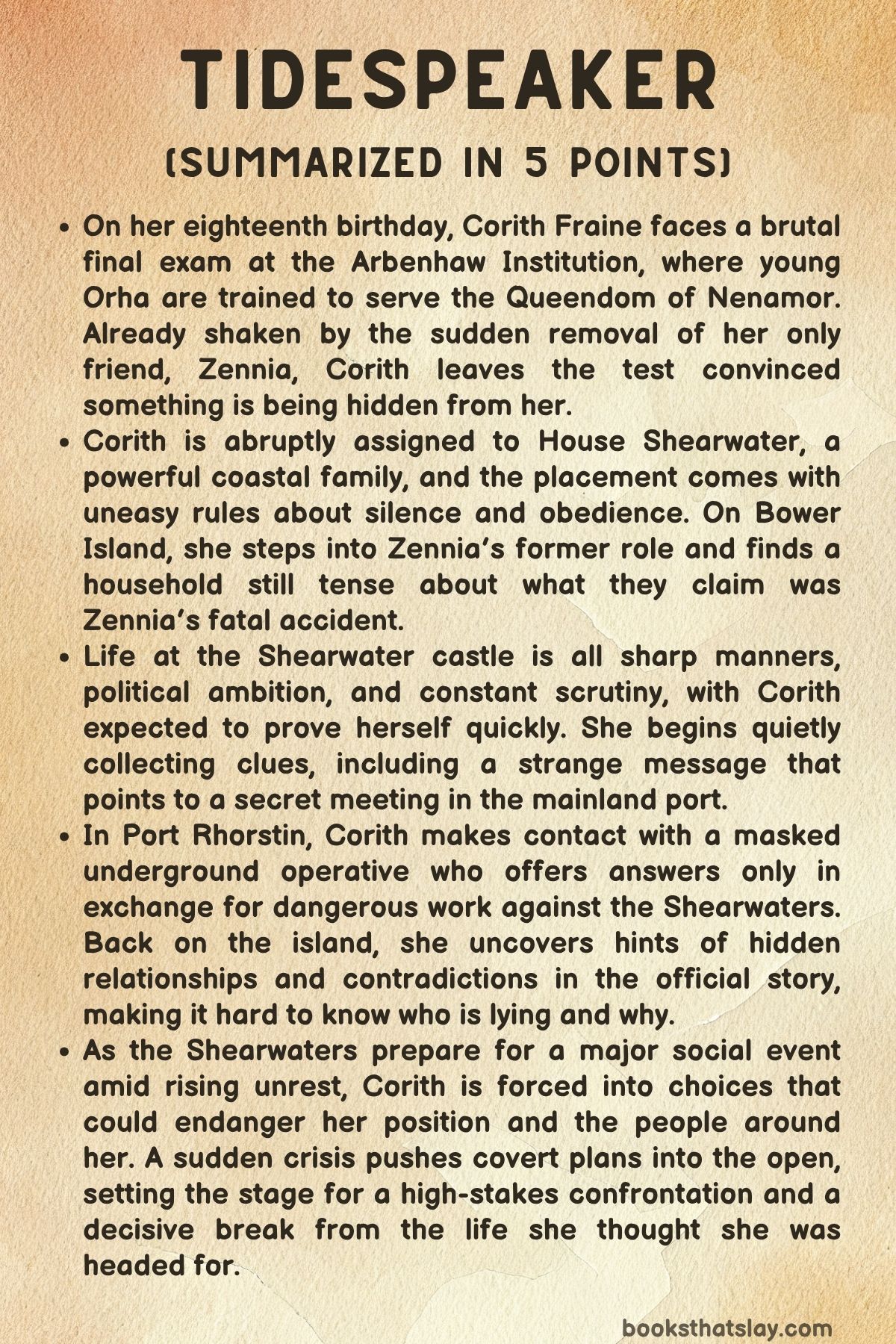
Summary
Corith Fraine turns eighteen on the last day of summer, and the Arbenhaw Institution marks the day with her final practical exam. The test is meant to prove she can keep control when terrified: she is strapped upside down in a tank of cold water while instructors and classmates watch, expected to part the water and make air for herself.
Corith is already frayed. Her only real friend, Zennia, was taken away a month earlier after Zennia’s own exam, and the loss has left Corith jumpy and alone.
She tries the calming technique Zennia taught her—imagining panic as a red ball and crushing it smaller—but the memory of Zennia being sent away hits too hard. Corith reaches for her power, and nothing answers.
Seconds stretch. Her lungs burn.
She starts to drown.
Then something shifts inside the tank: the air pocket drops and clears her face just long enough for her to gasp. Instructor Rhama hauls her out, irritated by her slow time and the spectacle she has made.
Humiliated, Corith is kept behind to scrub the exam room while her classmates leave.
That night, Corith is summoned to Instructor Caerig’s quarters. She expects punishment, but Caerig and Rhama have different news.
Rhama presents a sealed letter: Corith has been assigned an urgent placement with House Shearwater, one of the Coastal Dozen. The house needs a Floodmouth immediately.
Corith blurts out the question she cannot swallow—what happened to the previous Floodmouth—and Caerig confirms the replacement is for Zennia, who allegedly died in an “unfortunate accident” in the bay at Bower Island. Rhama’s tight, quiet apology makes Corith’s stomach drop.
Caerig takes her permission slip and posts a guard outside her door to make sure she does not run.
At dawn Corith is sent away under armed escort. Rhama hangs a laconite pendant around Corith’s neck to suppress her powers during travel, and two guards—Egard and Belamy—watch her every mile.
The trip to Port Rhorstin takes days of jolting roads and coaching inns. Corith keeps her head down, thinking about how quickly Orha can become disposable and about the stories of rebel Orha known as the Cage.
She remembers a boy who tried to escape training and vanished after being caught. She knows what happens to people who become inconvenient.
Near Tresteny, Corith finds a hidden note among her belongings. It promises answers about Zennia if Corith goes to “the Veil” in Port Rhorstin on the 14th of Tima at sunset, wearing a mask.
She hides the note from her guards and clings to it like a rope. When they reach Port Rhorstin, she confirms through an innkeeper that an Orha in Arbenhaw uniform passed through a month earlier, heading toward the bay.
The story of a simple drowning begins to feel rehearsed.
Corith continues to Bower Island across a causeway that appears only at low tide. Egard and Belamy refuse to cross with her.
Alone with a cart and mare, Corith struggles when the cart breaks mid-crossing and she is forced to drag her case through mud. Riders catch up: Brigant, Rexim Shearwater’s son, furious at the incompetence of leaving her unescorted, and Tigo, a servant in violet livery.
The tide begins racing back in. Corith cannot command the ocean under the pendant’s suppression and under sheer fear.
They push through rising water and reach the island just ahead of the surge.
Bower Island’s castle is old, grim, and ruled by routines that feel like threats. Tigo escorts Corith to the Orha quarters in a crumbling tower, where she is placed in Zennia’s old room.
Zennia’s belongings sit in a forlorn pile, as if someone wanted to prove she is gone and unimportant. Tigo warns Corith that the family is angry about Zennia’s death and will judge Corith harshly.
Corith hears fragments of tense conversations about payments and someone called Turnstone, and she realizes there are currents here she does not understand.
Miss Haney, the housekeeper, summons Corith to dinner with strict rules: speak only when questioned and never mention her predecessor. At the table Corith meets Rexim Shearwater and his children—Vercha, Catua, Llir, and the absent eldest, Emment.
Their questions are edged. Rexim makes cutting comments about the last Floodmouth and about nearly “losing” Corith on the causeway.
Corith notices the family’s laconite jewelry buzzing painfully in her presence. The dinner talk shifts into politics: Rexim wants a seat in the Chamber of Regents once Regent Dunlin dies, and there is unrest over Orha rights, war talk, and rival houses.
Late that night Corith crosses paths with Emment returning drunk. He is startled to find her, then turns cold when she introduces herself as the new Floodmouth.
Before dawn Corith is kidnapped from her room, bound and gagged, dragged to a rocky cove beneath high cliffs, and left with a small knife. When she cuts herself free, she sees Rexim and the siblings watching from above.
They call it a “test,” meant to see if she can face the Waking Tide after what happened to Zennia. The sea charges into the cove, violent enough to smash her into stone.
Corith fights panic the way Zennia taught her and begs the water to slow. For a brief moment, the wave hesitates.
She clings to rock and scrambles upward. A gust helps, and Emment pulls her over the edge.
Rexim declares she has passed. Corith calls them twisted; Vercha insists they would have rescued her if she failed, as if that excuses the terror.
Back in the Orha tower, the others—Tigo, Rhianne, and Mawre—are shaken but not surprised. Corith learns an important detail: Emment was with Zennia on the night she supposedly drowned and claims he saw it happen.
Corith later finds a coded letter hidden in her wall, written by Zennia before her “death.” Zennia says she feels trapped on the island, distrusts Rexim and Vercha, and has noticed strange lights and secret activity around unused towers. Corith’s grief changes shape into purpose.
Corith works hard to earn Miss Haney’s approval while quietly observing the family’s secrets. A confrontation arrives when Uirbrig Crake barges into the castle with his enormous son, Iovawn, pressuring Rexim to step aside in the coming regency vote.
Their argument exposes deeper fault lines: conflict with Breova, the lure of laconite mines, and the question of whether Orha should be forced into war. Corith also learns something disturbing—Crake’s son is a Mudmouth Orha while still part of the elite “Hundred,” proof that power can rewrite the rules when it suits.
Regent Dunlin dies, and Rexim tightens his plans. He announces a ball to gather allies.
Corith hears “the Veil” mentioned again and feels the clock ticking toward her meeting. On market day she travels to Port Rhorstin with Vercha, Llir, Debry, and Tigo, and uses what calm water she can to help push their boat along.
Vercha decides Corith must be dressed for the ball too, not as a guest with dignity but as a display of the house’s control.
Meanwhile, Corith is not only chasing Zennia’s truth. She has been pulled into work for the Cage: a contact demands tallies of Shearwater laconite and expects Corith to supply them.
When Corith finally sneaks into Llir’s rooms, she finds not only laconite but caches of “false laconite” made to look real while lacking its effect. She also senses something odd—an unexplained briny, wet-fur smell that makes her skin prickle, as if another presence has been there.
Corith secures permission to return to town at the right time and races to the Veil at sunset, masked. Led into wine cellars by a cheerful Sparkmouth servant, she meets the man behind the messages.
He burns her tally and refuses to give answers about Zennia unless Corith accepts a new task: find damaging secrets about the Shearwaters and sabotage their laconite so it fails just before a planned Cage strike. He shows her Zennia’s distinctive brooch as proof he holds the truth hostage, then hands her nabyrium tools—a hammer and chisel—meant to create tiny fractures.
Trapped by need, Corith agrees. The contact names himself Kielty and lets her keep the brooch as a warning and a promise.
Soon after, Corith accidentally witnesses Rhianne and Catua sharing a private kiss. Rhianne begs Corith not to expose them, explaining discovery could ruin them both.
The moment gives Corith leverage she does not want, but it also opens a door: Rhianne points out a fatal inconsistency in Emment’s story. The day Zennia “drowned” was pallwater and calm, not a sudden squall.
If Emment claims the sea turned violent, someone is lying.
Ball night arrives with worsening weather and rising tension. Corith is dressed in violet and forced into the first dance with the nobles, paired with Llir.
Emment corners her later, warning her to keep quiet about the night he nearly drowned. Corith presses him about Zennia, and his reaction reads like fear, not grief.
Corith slips away to begin the sabotage Kielty demanded. She tests the tools on a laconite piece in Vercha’s rooms and finds signs of burned correspondence.
In Catua’s room she discovers a forbidden Breovan Charter of Orha Rights, heavily annotated—evidence of private sympathy that could destroy Catua if revealed. Sickened by what she is becoming, Corith pockets it as proof anyway.
In Emment’s rooms she finds them ransacked and notices a brooch already cracked from sabotage, as if someone else has started the work. Avrix Cormorant attacks her, and in the struggle Corith reveals her tools.
Avrix recognizes them immediately and admits he, too, is a Cage agent planted among nobles. They patch the mess together and blame it on a minor quake.
Then disaster hits for real. An offshore quake triggers a tidal wave.
The sea withdraws, exposing mudflats, and a dark wall of water races toward the cliffs. Floodmouths are ordered into position to protect buildings.
The wave smashes over the island, tearing apart the Orha tower. Corith’s room and Zennia’s remaining things are swept away, and worse—her tools and the Charter pamphlet are ripped from her pockets.
She has lost both her means to complete the Cage’s orders and her evidence of Catua’s secret.
In the aftermath, the truth finally breaks open: Zennia is alive. She staged her drowning, using the sea’s noise to hide her voice from Emment, letting the boat appear to capsize and then disappearing to meet Kielty at the Veil.
Zennia reveals she pushed for Corith to be placed at Bower Island because Corith could stay controlled under pressure and keep a secret face.
Corith and Zennia return toward the castle and find it occupied by soldiers. A platform and chopping block stand in the inner ward.
Crake has taken the island by force, and the Shearwaters are prisoners. Rexim is dragged forward and executed despite Emment’s pleas.
Crake demands the location of the Shearwater laconite hoard. Under threat, Vercha reveals it lies beneath a collapsed old tower and will require a Mudmouth to reach.
Crake orders Iovawn to retrieve it and intends to kill the remaining siblings afterward. Llir is exposed as Orha by a laconite cuff, and Crake decides to take him to the mainland with the other Orha.
Zennia splits off to warn the Cage, while Corith disguises herself as a Cormorant Floodmouth named Ebba and moves through the chaos, slipping stolen laconite into the packs of Crake’s Orha to make them dangerous to control and difficult to manage. She is caught and thrown among bound prisoners: Tigo, Mawre, Rhianne, and Llir.
As Crake’s force marches across the causeway ahead of the morning tide, Corith fakes illness to slow the column and times an ambush.
The tide surges in unnaturally—shaped by Cage Mudmouths carving channels while Cage Floodmouths restrain and then release the water. A crushing wave hits the marching force, breaking wagons and dragging soldiers into mud.
Crake is swallowed and drowned. Corith and Llir rip off laconite pendants and fight their way free, battered by water and debris.
Corith forces her panic small, gathers her control, and stills the water into a calm “eye” that carries them back toward the island.
Half-drowned survivors stagger onto the beach. Morgen and Avrix Cormorant are dead; Mawre is missing.
Corith tells them the Cage caused the tide and that Zennia lives. They push back to the castle, where Tigo cracks stone with Mudmouth power and Llir kills a guard with a stolen sword.
They find Iovawn holding Vercha and the others. In a coordinated attack, Corith uses shattered water barrels as cover, Rhianne pulls fire from a brazier, Tigo fractures cobbles, and Llir drives wind.
Corith frees Emment and Catua, and together they injure Iovawn and restrain him. Kielty arrives with Cage fighters and rescued servants.
They recover the hoard and chain Iovawn beneath the gatehouse with laconite.
Afterward, the island lies ruined and burning. Corith chooses to leave with the Cage, and Catua chooses to go too; Rhianne follows.
Llir refuses, furious at Corith’s choices and condemning the Cage’s violence. The victory is incomplete: Iovawn escapes by tunneling through earth, and Vercha vanishes as well.
Corith realizes Vercha and Iovawn were secretly corresponding and likely fled together across the drained flats. As the Cage departs with boats on wheels toward a mainland rendezvous, Corith rides beside Zennia and Catua, while Emment and Llir watch from the smoking remains of their home, the tide racing behind the departing wheels.
Characters
Corith Fraine
Corith is the emotional and moral center of Tidespeaker, introduced at the moment her inner life most threatens her survival: a final exam designed to break composure and expose weakness. Her Floodmouth gift makes her powerful in principle, but the story repeatedly frames her ability as something that only works when her mind is disciplined, which turns her power into a psychological barometer.
Corith’s defining trait is not bravery in the swashbuckling sense; it is persistence under humiliation, fear, and pressure, and the narrative keeps tightening the vise to test whether she will adapt or collapse. Her grief over Zennia is the engine of her choices—first as a wound that destabilizes her control, then as a hunger for truth that makes her vulnerable to manipulation, and finally as a lens that forces her to evaluate what loyalty actually costs.
She becomes an undercover tool of the Cage not because she believes in sabotage at first, but because she is cornered by the promise of answers, and her arc tracks how that coercion corrodes her self-image. Over time, Corith grows from a trainee who expects authority to be absolute into someone who reads power as a network of incentives, secrets, and violence; she learns the Shearwaters’ cruelty, the Institution’s cold bureaucracy, and the Cage’s utilitarian demands are different masks of the same appetite.
Her maturation is visible in how she uses calm: early on, it is a coping trick taught by a friend; later, it becomes a weapon she deliberately wields to shape water into an “eye” in chaos, and to keep her face unreadable while moving through hostile rooms. By the end, Corith’s most consequential transformation is ethical: she accepts that neutrality is impossible, chooses a side, and carries the guilt of betrayal as a price she is willing to pay for agency and truth.
Zennia
Zennia functions as absence, catalyst, and revelation, and the story uses her to show how control can be both tenderness and strategy. In Corith’s memories, Zennia is the one person who offers a humane method for surviving Arbenhaw: the scarlet-ball visualization that externalizes emotion and makes calm feel achievable rather than innate.
That teaching becomes Zennia’s lasting imprint on Corith—proof that friendship can be practical in a world designed to isolate Orha. Yet Zennia’s later reappearance reframes everything: she is not merely a victim of the Shearwaters, but someone capable of staging a drowning, navigating the Veil, and negotiating with the Cage and institutional leadership.
This complicates her as a character because her care for Corith coexists with calculated risk; she advocates for Corith’s placement precisely because Corith can “hide her emotions better,” which is affectionate admiration and instrumental selection at once. Zennia’s arc exposes a central tension in the book’s politics: survival sometimes demands deception that harms the very people you love, even when done “for” them.
When she returns alive, she embodies the unsettling idea that the truth can be morally messy—her disappearance is not just a tragedy imposed on her, but also a narrative she helped create. Zennia therefore becomes the story’s most intimate example of how resistance movements recruit, leverage, and rationalize, making her both a lifeline for Corith and a mirror of what Corith might become.
Instructor Rhama
Rhama is the closest thing the early story offers to compassionate authority, but her compassion is bounded by obedience to the system. She intervenes in Corith’s exam aftermath, argues that Corith’s broader record matters, and offers a brief apology that lands precisely because it is rare and restrained.
Rhama’s decision to place a laconite pendant on Corith during transport is emblematic of her role: she protects Corith from the dangers of uncontrolled power and from the institution’s fear of flight, but she does so through suppression and surveillance rather than trust. The later revelation that the Cage informed Rhama and leadership after Zennia’s staged drowning positions Rhama as a figure who may be quietly entangled in a larger strategy, suggesting she is less naïve than she appears and possibly operating in a gray zone between duty and complicity.
Rhama’s character highlights how even “kind” guardians in authoritarian structures often become administrators of harm, offering soft words while tightening restraints.
Instructor Caerig
Caerig is the institution’s hard edge: punitive, image-conscious, and committed to control as a virtue in itself. Their response to Corith’s poor performance is not curiosity about what broke her, but disciplinary theater—public embarrassment, collective punishment, and the use of a guard to prevent escape.
Caerig represents the logic that Orha must be managed through fear, and that any wavering of ability is a moral flaw rather than a human response to loss. Even when acknowledging Corith’s strong record, Caerig’s framing treats her as an asset to be assigned, not a person to be helped.
This makes Caerig an early blueprint for the book’s recurring antagonist-type: leaders who insist they are maintaining order while engineering desperation that pushes people into rebellion.
Egard
Egard is one of the two escort guards during Corith’s transfer, and his presence illustrates how the state turns ordinary people into extensions of policy. He is not painted as a grand villain; instead, he is part of the mundane machinery that makes coercion feel routine.
His refusal to accompany Corith across the causeway, abandoning her to proceed alone, shows how institutional responsibility is often selectively applied—guards are strict when enforcing restraint but evasive when real danger appears. Through Egard, the book emphasizes that oppression often arrives not only through overt brutality, but through indifference, convenience, and the quiet decision to let someone else face the risk.
Belamy
Belamy mirrors Egard’s function and reinforces the same theme: the escort is about containment, not care. His role underscores Corith’s isolation and the precariousness of Orha lives outside the training walls.
The pair’s dynamic also helps the story establish that Corith cannot rely on official protection; she must become self-directed because the system’s representatives will not save her if saving her is inconvenient. Belamy’s significance is therefore structural—he is part of the corridor that funnels Corith from institutional captivity into noble captivity.
Rexim Shearwater
Rexim is a political predator wrapped in aristocratic certainty, and the narrative uses him to show how power justifies cruelty as prudence. He welcomes Corith not as a person but as a replacement for a “lost” tool, and his household’s laconite jewelry becomes a constant sensory reminder of dominance—painful, buzzing proof that even proximity to nobility is an engineered reminder of inferiority.
Rexim’s ambitions for the Chamber of Regents motivate much of the household’s tension; his worldview treats Orha as resources to be deployed in mines, war, and domestic service, and he reads any push for Orha rights as destabilization rather than justice. The staged “test” at the cove is Rexim’s character in miniature: he creates danger, watches from above, and calls survival proof of worthiness, claiming he would have intervened while ensuring intervention is not needed.
His eventual execution at Crake’s hands does not redeem him, but it does underline the book’s ruthless politics: predatory men can still be preyed upon by more brutal rivals, and the violence of the ruling class circulates inward as readily as it flows downward.
Brigant Shearwater
Brigant is the first Shearwater Corith meets, and he immediately embodies the family’s blend of entitlement and real-world competence. His fury at finding Corith stranded is partly practical—tide danger is genuine—and partly proprietary, as though Corith’s vulnerability is an affront to the household’s standards.
Brigant’s harshness reads less like sadism and more like the ingrained impatience of someone raised to expect systems to function for him, even when the system has clearly failed Corith. He serves as an early lens into Shearwater culture: urgency, command, and contempt for unpreparedness, regardless of who caused it.
Brigant’s role stays relatively contained compared to the siblings’ later moral fractures, but his presence helps establish the family’s internal hierarchy and the expectation that Orha must “perform” flawlessly to be tolerated.
Miss Haney
Miss Haney is managerial authority rather than political authority, and that distinction makes her particularly effective. She is visibly relieved to have a Floodmouth again, but her relief is operational: the household needs the function restored, and her kindness is closely aligned with efficiency.
Haney’s rules—speak only when questioned, never mention the predecessor, never be late—are not merely etiquette; they are survival protocols in a castle where information is dangerous and the wrong sentence can trigger punishment. She also represents a softer pathway of control: she advances wages, arranges clothing, and offers structured approval that tempts Corith into compliance.
Haney’s character shows how systems of domination are sustained not only by overt threats, but by the comfort of competence and the small rewards given for fitting neatly into the machine.
Vercha Shearwater
Vercha is one of the story’s sharpest portraits of weaponized refinement: she treats Corith as both a project and a possession, policing her presentation while exploiting her labor and precariousness. Her interest in dressing Corith for the ball, inspecting her appearance, and orchestrating blindfolded fittings with Madam Mora reads like aesthetic mentorship on the surface, but underneath it is dominance—the insistence that Corith’s body and time are subject to Vercha’s whims.
Vercha’s cruelty is also strategic; she understands optics, correspondence, and leverage, hinted at through the burned scraps of letters and the existence of sealed communication she does not want seen. Her eventual decision to surrender the hoard’s location to save the household is pragmatic self-preservation rather than moral collapse, and her later disappearance alongside Iovawn suggests she is capable of alliance with brutality if it secures her escape.
Vercha embodies the book’s theme that the most dangerous antagonists are not always the loudest; they are often the ones who smile, curate, and calculate, turning social power into a blade.
Catua Shearwater
Catua is framed as the household’s moral pressure point, someone whose tenderness makes her both sympathetic and endangered. Others insist she would not have supported the cove cruelty, and the discovery of her annotated Breovan Charter of Orha Rights reveals an interior life that recognizes Orha personhood in a way her family publicly rejects.
That pamphlet is not just rebellious reading; it is proof of conscience and curiosity, and its annotations imply sustained engagement rather than fashionable posturing. Catua’s secret relationship with Rhianne deepens her as someone who lives at odds with the rigid punishments of her class, making her simultaneously complicit in the household’s privileges and a victim of its norms.
Her final decision to join the Cage reads as both a political awakening and a flight from a family structure that would sooner destroy her than allow her freedom. Catua’s arc shows that sympathy alone is not safety; in this world, caring without power still makes you a target, and eventually forces a choice.
Llir Shearwater
Llir is the story’s most volatile mix of privilege and vulnerability, and his arc hinges on the revelation that he is Orha—proof that the social order’s categories are more fragile than they appear. Early on, he participates in the household’s scrutiny, yet he also feels like someone performing a role rather than comfortably inhabiting it, which becomes clearer once his secrecy emerges.
His hidden tower key, the strange lights, and the sense of a lingering presence in his rooms all build him as a person with private rituals and concealed stakes, and the stash of false laconite near his effects adds a layer of intrigue: he is connected to deception at the material level, not only emotional concealment. When Crake exposes him via the laconite cuff, Llir becomes instantly reclassified from noble to capturable, demonstrating how quickly identity can be rewritten by power.
His rage at Corith’s decision to leave with the Cage is not just political disagreement; it is personal betrayal sharpened by fear, because he has been dragged into the Orha world unwillingly and now sees Corith aligning with the force that engineered the catastrophe. Llir’s refusal to join the Cage is a tragic assertion of autonomy—he rejects being recruited into any side’s narrative, even after the system has already marked him.
Emment Shearwater
Emment is defined by recklessness, shame, and complicity, and the book uses him to keep the mystery of Zennia’s “death” emotionally charged. His drunken entrance and cold dismissal of Corith set him up as careless and cruel, but the deeper wound is that he is the person tethered to the night Zennia vanished, making every evasive reaction feel like guilt.
The household later reveals he was with Zennia and saw the drowning, which puts him in the narrative position of a witness whose version cannot be trusted—especially after Rhianne notes the supposed squall contradicts the calm pallwater conditions. Emment’s gambling debts, and the errand to address them, signal a man whose privileges do not protect him from consequence, only delay it until others must clean up the damage.
His panic at being confronted about Zennia, and his later beating under Crake, expose him as someone who is brave only within the shelter of rank. Yet he also shows capacity for decisive action in crisis—helping restrain Iovawn and prioritizing immediate survival over pride—making him neither a pure villain nor a redeemed hero.
Emment represents a common aristocratic failure in the book: the ability to harm casually, regret partially, and still expect the world to protect you.
Tigo
Tigo is one of the most quietly important stabilizers in the story, a Mudmouth Orha whose competence and caution provide Corith with her first real guidance inside the Shearwater estate. He operates as a bridge between worlds: he understands noble expectations and Orha danger, and he teaches survival through practicalities like tide tables rather than abstract reassurance.
His private conversations about payments and Turnstone suggest he is enmeshed in the household’s economic undercurrents, hinting that even servants are forced into bargaining with forces larger than themselves. Tigo’s later injury during the assault, and the urgency with which others dig him out alive, cement him as someone valued by the Orha community not because he is powerful, but because he is reliable and human.
He also illustrates a key political truth in Tidespeaker: the most effective resistance is often logistical—moving, hiding, digging, breaking stone—work that looks unglamorous until it saves lives.
Rhianne
Rhianne is a portrait of constrained desire under surveillance, and she becomes central once her secret relationship with Catua is exposed. Her fear of discovery is not melodramatic; it is grounded in real consequences the world would inflict, turning love into an actionable vulnerability.
When she points out the pallwater calm that contradicts Emment’s squall story, she shows herself as observant and willing to confront narrative lies, but only within limits—she is careful, because truth is dangerous in a household built on appearances. Rhianne’s fire abilities make her a literal source of destruction and protection, culminating in the keep burning during the final conflict, which symbolically matches her arc: the private life she has tried to keep contained finally spills outward into irreversible change.
Rhianne’s decision to leave with the Cage reads as a leap toward a life where she might not have to beg for secrecy, even if that life is violent and uncertain.
Mawre
Mawre, the Gustmouth of the Orha set, functions as a warning system and a measure of the household’s brutality. His sympathy toward Corith and his hints about dinner signal that he reads power dynamics acutely, likely because he has survived them longer than Corith.
During the cove ordeal, his presence with the set underscores communal helplessness: they can watch, worry, and comfort afterward, but cannot stop the nobility’s “tests.” Mawre’s disappearance after the tidal catastrophe carries emotional weight because it is the kind of loss the system produces routinely—Orha lives can vanish between scenes, and the story forces the reader to feel how quickly someone can become uncounted. In that way, Mawre is less a plot driver than a thematic anchor, representing the many who endure, advise, and then are erased by larger forces.
Uirbrig Crake
Crake is a rival predator to Rexim, and his arrival reframes the political world from social cruelty to outright conquest. He uses intimidation rather than etiquette, showing up uninvited, issuing threats, and treating the coming vote and laconite resources as spoils to be seized.
Crake’s execution of Rexim is not justice; it is domination theatre, designed to break the household psychologically and force the hoard’s location. His treatment of Orha—possessing an Orha son while still weaponizing Orha as captives and tools—exposes the hypocrisy of elite power: the rules exist until they interfere with personal advantage.
Crake’s death in the engineered tidal disaster is narratively fitting because he is swallowed by the same landscape he presumed to command, emphasizing that in this book, control is always temporary, especially when Orha shape the sea and earth against you.
Iovawn Crake
Iovawn is a chilling embodiment of weaponized Orha power under elite ownership, and his presence destabilizes assumptions about who holds agency. As an enormous Mudmouth tied to Crake’s authority, he represents how families can domesticate extraordinary abilities into instruments of coercion.
His orders to dig out the hoard, his brutality toward the Shearwater siblings, and his later counterattack that collapses stone onto Tigo show him as both physically dominant and tactically dangerous. His escape through tunneling even while chained highlights the limits of restraint technologies like laconite when the person restrained is determined and skilled.
Iovawn’s role deepens the book’s moral complexity because he is both oppressed and oppressor: an Orha exploited by a father’s agenda, yet also an active participant in terror.
Avrix Cormorant
Avrix is the story’s clearest example of how the Cage infiltrates society through multiple strata, and his reveal reshapes Corith’s understanding of her own recruitment. His attack on Corith in Emment’s rooms is a collision of paranoia and urgency—he acts violently first, then recognizes shared tools and shared mission, showing how secrecy turns allies into threats until proven otherwise.
As a “cuckoo,” he demonstrates that rebellion can mimic the cruelty of the system it fights, using sabotage and coercion while claiming a higher cause. His death in the tidal disaster is not mourned romantically; it reads as consequence, the price of playing with forces you cannot fully control—sea, politics, or revolutionary networks.
Morgen Cormorant
Morgen’s role amplifies the Cormorant pressure and the factional friction among nobles and rebels. Arriving angry at delays and injuries, he shows how even co-conspirators can be impatient and self-serving, treating violence as scheduling rather than tragedy.
His drowning alongside Avrix underscores the story’s refusal to grant plot armor to antagonists simply because they share the rebellion’s banner. Morgen is a reminder that the Cage’s cause may be framed as liberation, but many individuals within the broader conflict still operate with arrogance and disposable attitudes toward others.
Kielty
Kielty is the Cage’s face in Corith’s arc: charismatic, transactional, and relentlessly focused on outcomes. His first meaningful interaction with Corith—burning her tally and withholding Zennia’s truth until Corith agrees to further sabotage—defines him as someone who uses information as currency and loyalty as a negotiated contract.
Even when he provides proof through Zennia’s brooch, the gesture is less comfort than leverage, designed to ensure Corith cannot easily walk away. Kielty’s leadership during the final arrival at the burning castle shows tactical competence and readiness to capitalize on chaos, but it also raises the book’s central ethical question: if liberation is achieved through manipulation and engineered catastrophe, what kind of freedom is being built?
Kielty is not written as a simple villain; he is dangerous because he is persuasive, and because he can sincerely believe the ends justify the means.
Owyn
Owyn appears as a haunting reference point rather than a present actor, yet his impact is significant because he embodies what happens to Orha who try to escape the paths laid out for them. His disappearance after being caught creates a climate of fear that shapes Corith’s early psychology, making compliance feel like the only survivable option.
Owyn’s function in the narrative is to show that “running” is not a romantic possibility in this world; it is a story told in whispers, ending in erasure. That memory helps explain why Corith later complies with coercion from both nobles and rebels—she has been trained to believe there are no safe exits, only different captors.
Madam Mora
Madam Mora is a small but telling figure in the book’s anatomy of control, because she shows how ordinary trades can be folded into power games. Her blindfolded fittings for Corith are presented as Vercha’s idea, but Mora’s willingness to enact them demonstrates how service economies reinforce hierarchy: the seamstress participates in denying Corith information about her own appearance and schedule.
Mora is not depicted as malicious; she is compliant, and that compliance is precisely the point. Through her, the story highlights how domination is maintained by countless “minor” acts performed by people who consider themselves neutral.
Debry
Debry’s presence in the market-day travel party reinforces the castle’s social ecosystem: attendants and companions who fill space around nobles, smoothing logistics and providing audiences for status displays. Debry’s importance lies in what her inclusion signals about surveillance and access—Corith is rarely alone, and even mundane outings are structured to keep Orha within sightlines of someone loyal to the house.
Characters like Debry make the setting feel lived-in while underlining that Corith’s movements are never merely personal; they are always managed.
Nemaine
Nemaine’s act of catching Corith and throwing her among bound prisoners crystallizes the world’s readiness to reduce people to cargo. Nemaine is not developed as a fully rounded individual, but as an instrument of capture whose efficiency matters more than personality.
That functional portrayal serves the book’s tone: violence often arrives through faceless hands, and the terror is amplified by how routine it seems. Nemaine’s presence reinforces that, in moments of upheaval, the powerful default to restraints and roundups first, explanations later.
Themes
Power as Control, and Control as Violence
The institutions and noble houses in Tidespeaker treat power less as a responsibility and more as a technique for making people compliant. Corith’s upside-down drowning exam is framed as a professional assessment, but it functions like a public warning: your body is property, your panic is entertainment, and your survival depends on obedience.
The test’s design quietly teaches that failure will be interpreted as moral weakness rather than a predictable response to terror. That same logic follows her beyond Arbenhaw.
When Caerig posts a guard to prevent her from “running,” it signals that even a “prestigious placement” is not an opportunity; it is a transfer of custody. The pendant that suppresses Corith’s abilities is another layer of control that masquerades as safety.
In practice, it ensures that the state can move an Orha like a locked crate—useful, valuable, and not entitled to agency.
The Shearwaters repeat these patterns with a different vocabulary. Rexim’s “test” at the cove turns life-or-death danger into a ceremony of dominance.
The family insists it was controlled, but their need to stage a scenario where Corith is nearly killed reveals the point: to prove they can impose fear and still demand gratitude afterward. Even the laconite jewelry that buzzes painfully in Corith’s presence becomes symbolic of power worn casually, an everyday ornament that hurts others simply by being near them.
The political conversations at dinner show how smoothly cruelty becomes strategy; Orha bodies and abilities are discussed alongside votes, war, and mining interests, as if the people involved are resources like metal and shipping routes.
This theme becomes sharper once the Cage enters the story. The rebels oppose aristocratic domination, yet they also pressure Corith with coercion: information about Zennia becomes a leash, and sabotage becomes her assigned role.
Corith is cornered into agreeing, not persuaded. The result is a world where power is rarely offered with consent, no matter who holds it.
The book keeps forcing the reader to notice the same structure repeating: a superior claims necessity, hides choices behind procedure, and calls coercion “duty.” Corith’s struggle is not just to become stronger, but to recognize when “training,” “placement,” “service,” and “cause” are labels that excuse harm.
Emotional Discipline as Survival, and the Cost of Self-Erasure
Corith’s calming method—compressing her feelings into something smaller—starts as a private tool taught by a friend. Over time it becomes a survival technology, the difference between drowning and breathing, between panicking and acting.
In a setting where emotions can disrupt Orha abilities, the body itself becomes a liability: grief and fear are not only personal experiences, they are punishable risks. The story repeatedly places Corith in situations where she must manage her internal state under threat of humiliation or death.
Her first exam demonstrates this brutally, because the environment is engineered to produce panic while the institution pretends panic is a character flaw. That contradiction traps Corith: she is told to remain calm, while being terrorized for not being calm enough.
The same pattern appears at Bower Island. Corith learns that the household expects her to be quiet, agreeable, and strategically invisible—speak only when questioned, never mention her predecessor, accept suspicious “tests” with a steady face.
Emotional discipline becomes a type of enforced performance. When she obeys, she is “professional.” When she reacts, she is “unstable.” That double standard creates a pressure that is not only psychological but moral: she starts judging herself through the lens of her oppressors.
The book shows how quickly self-control can slide into self-erasure, where the safest way to exist is to be smaller, softer, less noticeable, and always prepared to swallow anger.
This theme complicates itself when Corith’s loyalty is tested. She wants truth about Zennia, and that desire becomes a handle others can grab.
Kielty’s use of the sailing-ship brooch is effective because it turns Corith’s grief into a bargaining chip. Corith’s forced agreement to sabotage laconite demonstrates that controlling emotions does not always lead to freedom; it can also make someone easier to deploy.
A person who can keep calm under pressure is useful to every side. Even Zennia’s later reveal—that she pushed for Corith’s placement because Corith can hide her emotions better—lands with mixed weight.
It is caring, but it also exposes how survival skills can be recruited into systems of secrecy and manipulation.
By the end, emotional discipline remains essential, especially when Corith creates an “eye” of still water during the chaos on the causeway. Yet the book also shows the cost: the more Corith relies on compressing feelings, the more she risks losing access to her own moral signals—disgust, fear, indignation—that warn her when something is wrong.
The story treats emotional control as both strength and wound. Corith’s growth is not only about mastering water; it is about deciding when calm is a tool she chooses and when calm is a cage built inside her.
Truth, Secrecy, and the Manufacture of Official Stories
The plot keeps returning to the idea that “truth” is often an engineered product, assembled by people with power and defended through intimidation. Zennia’s supposed death is the clearest example.
The language used—“unfortunate accident,” “foolhardiness,” “ineptitude”—is not neutral reporting; it is blame packaged as explanation. By attaching incompetence to Zennia’s end, the authorities close the case and discourage questions.
Corith is meant to accept the story because questioning it would imply that institutions lie, placements are dangerous by design, and the system might dispose of Orha when convenient. The secrecy is reinforced physically: guards, sealed letters, suppressed powers, and rules about what can be spoken aloud.
The result is a world where the official account is treated as reality even when the details do not match.
What makes this theme effective is how the book shows secrecy operating at multiple levels. The Shearwaters hide their vulnerabilities—Emment’s debts, their political schemes, the hoard, the false laconite, Llir’s concealed nature, and Vercha’s destroyed correspondence.
Each secret has a different purpose: protecting status, avoiding punishment, maintaining leverage, or hiding crime. Corith’s own covert tasks add another layer.
She becomes someone who collects secrets, counts resources, and hides evidence, even while insisting she is only trying to learn what happened to her friend. Secrecy stops being a backdrop and becomes a way of life that recruits everyone.
Even intimacy becomes dangerous information, as seen when Corith discovers Rhianne and Catua together and immediately recognizes the punitive consequences if it is exposed. The private becomes political because society treats it as a weapon.
The story also shows how truth is not merely uncovered; it is negotiated and often withheld. Kielty offers partial information to compel obedience.
Zennia withholds her survival and her role in arranging Corith’s placement until the moment it can no longer be hidden. Emment offers a version of events that falls apart under scrutiny—especially when Rhianne points out the calm pallwater conditions—yet the false story persists because it is convenient.
This is how manufactured narratives survive: they do not need to be believable to everyone, only to enough people who benefit from repeating them.
When the coup and executions occur, secrecy turns into speed. Events move too fast for careful investigation, and whoever controls the immediate story controls the moral interpretation.
Crake frames brutality as political necessity. The Shearwater siblings’ fates become bargaining counters for the hoard’s location.
In that chaos, “truth” becomes whatever can be enforced at sword point. Corith’s arc through these layers suggests that the most dangerous lies are the ones that feel procedural—sealed letters, official statements, polite warnings at dinner—because they train people to doubt their own perceptions.
The theme ultimately argues that secrecy is not just concealment; it is an organizing principle that decides who is safe, who is disposable, and whose reality will be believed.
Loyalty, Betrayal, and the Ethics of Choosing Sides Under Threat
Corith’s relationships are shaped by the harsh fact that loyalty is rarely rewarded cleanly. She begins with one anchor—Zennia—and when Zennia is removed, Corith’s world becomes a sequence of forced affiliations.
Arbenhaw expects loyalty to the institution that terrorizes its trainees. The Shearwaters demand loyalty to the household that “tests” her by nearly drowning her.
The Cage demands loyalty to a cause that uses her grief as leverage and asks her to sabotage people whose lives are intertwined with the same oppressive system. Corith is pushed into a moral maze where every side defines loyalty as obedience and betrayal as independence.
The book refuses to make betrayal simple. Corith’s agreement with the Cage can be read as betrayal of the Shearwaters, yet she is also someone placed there to replace a missing Orha under suspicious circumstances, kept under surveillance, and pressured to accept cruelty with gratitude.
Her later actions—stealing proof, cracking laconite, hiding information—are wrong in some ways, but they are also predictable in a society that offers her no legitimate route to justice. The story highlights how ethical choices warp under coercion.
Corith does not wake up wanting to harm strangers; she is driven by an emotional debt to Zennia and by the fear that silence will mean complicity in a lie. That does not absolve her, but it explains how the system manufactures “traitors” by denying people humane options.
Loyalty is also fractured within the Shearwater family. Emment’s behavior is unreliable, Llir’s secrecy isolates him, Vercha’s manipulations suggest strategic self-preservation, and Catua’s hidden sympathy for Orha rights complicates the household’s cruelty.
Corith’s discovery of Catua’s annotated rights charter is especially important because it forces a moral collision: the person who benefits from noble status may also oppose the violence that sustains it, while still participating in that violence through silence. Corith’s decision to pocket the pamphlet as evidence shows her sliding into the logic of leverage—collect proof, keep it hidden, use it when needed—which is the same logic that the Cage uses on her.
Loyalty becomes transactional because trust is dangerous.
The collapse of the Shearwaters’ power and Rexim’s execution intensify the theme by showing how quickly alliances become irrelevant when violence escalates. Corith witnesses a world where loyalty to a house does not protect its members from being treated as disposable, and where political rivals can rewrite the rules overnight.
Her later cooperation with the Cage to engineer the tidal strike saves lives on one side while costing lives on another, including people who may not have chosen their roles. That moral messiness is then reflected in Llir’s condemnation of Corith.
His anger reads as personal, but it is also philosophical: he sees the Cage as replacing one form of tyranny with another. Corith, in turn, sees survival and justice as inseparable because the system does not allow her to pursue one without risking the other.
By ending with Corith leaving with the Cage while Llir refuses, the book turns loyalty into an unresolved question rather than a solved problem. Corith’s “betrayal” is also an attempt to reclaim agency, yet it carries collateral damage and broken relationships.
The theme’s power lies in that discomfort: the story keeps asking what a “good” choice looks like when every available side uses pressure, when truth is rationed, and when refusing to choose is itself punished.