Very Slowly All at Once Summary, Characters and Themes
Very Slowly All at Once by Lauren Schott is a tense suburban thriller about a family that looks successful from the outside and is quietly coming apart on the inside. Mack and Hailey Evans have the kind of life people envy: money, careers, a lake view, and two young daughters.
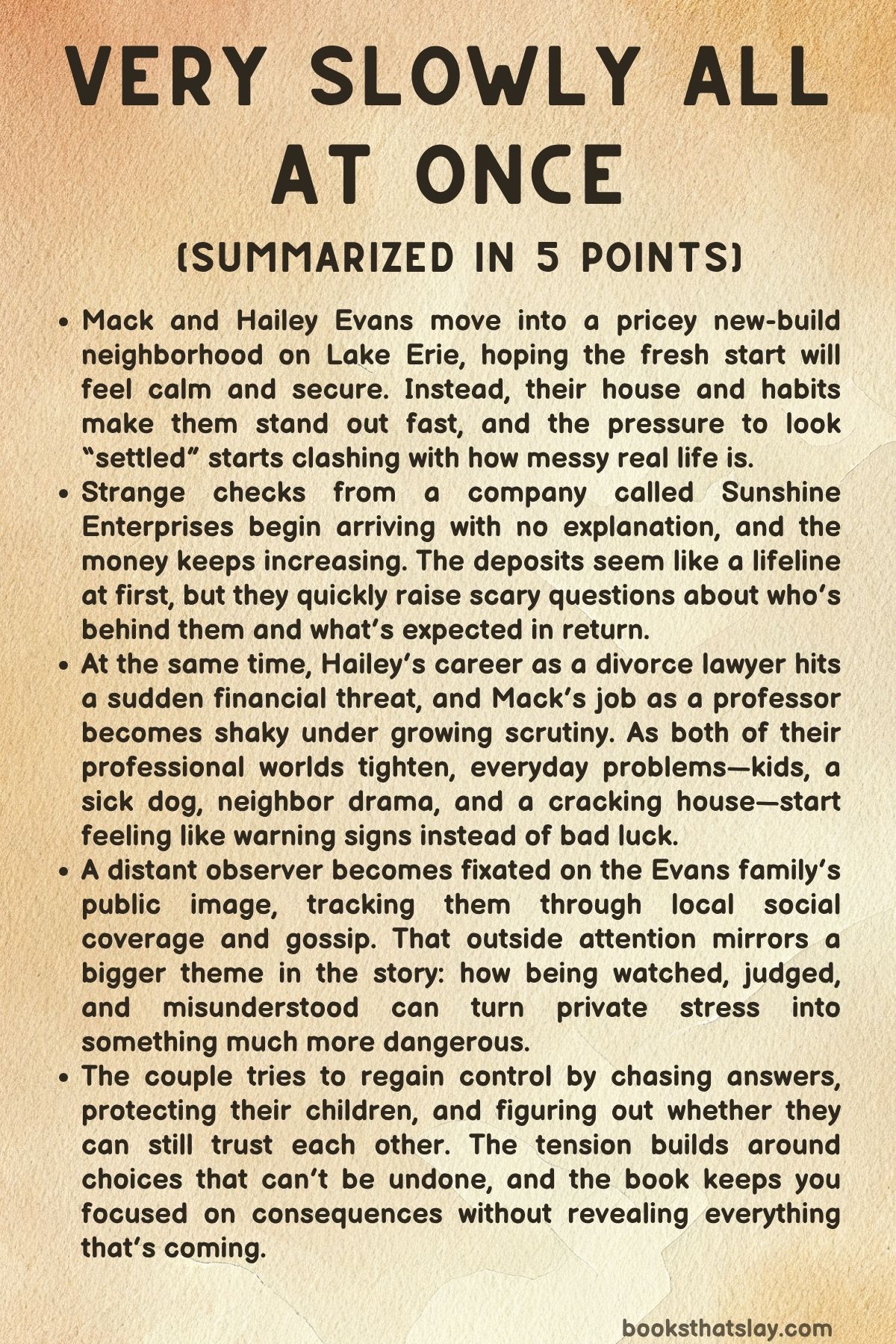
Then strange checks begin arriving, their new home starts showing alarming defects, and private mistakes become public leverage. As pressure mounts—from professional scandal, marriage strain, and a faceless observer who seems to know everything—the Evanses realize they aren’t just being watched. They’re being managed.
Summary
Mack and Hailey Evans move into a pricey new “cluster home” on Magpie Court in Bratenahl, Ohio, paying a premium for a corner lot overlooking Lake Erie and the sailboats at the Shoreby Club. The development is neat and uniform, but the Evans house stands out: shoes overflow the porch, and their yard is filled with clashing decorations—pinwheels, metal birds, and wind chimes—many supplied by Hailey’s well-meaning, boundary-blind mother.
The neighborhood is polished, watchful, and quick to judge, and the Evanses are learning that “fitting in” is another mortgage you pay every day.
One summer afternoon, Mack sorts mail and finds a bill from neighbor Betsy Wakefield demanding reimbursement for a shattered window—damage Mack caused when he hit a golf ball during a party that included cosmetic injections and too much casual boasting. In the same stack is something far stranger: a $5,000 check from “Sunshine Enterprises, Ltd.” with no explanation, no return address, and a New Jersey postmark.
Mack, already uneasy about money and family, suspects it might be connected to his estranged father, a man he hasn’t spoken to in decades. He deposits it anyway.
Mack’s day continues with the kind of domestic mess that feels small until it becomes symbolic. He has a marijuana plant hidden in his basement office, and he accidentally leaves their dachshund, Gulliver, shut inside.
The dog urinates under his desk. Mack ignores it because he’s late for a Zoom call with Tilda, a nurse at Sandy Hollow nursing home in Jupiter, Florida, where Mack’s mother Leonora has lived for years after an aneurysm left her almost entirely unresponsive.
Tilda reports small signs of life—Leonora smiling at old music—but also confirms that Leonora has no visitors beyond an elderly friend, Irene Weigand, who comes faithfully once a week. Mack hangs up anxious and distracted, waiting for news from his university about whether he will be trusted again after earlier concerns about his behavior with students.
Hailey’s day swings from competent control to sudden chaos. A seasoned divorce lawyer, she’s interviewing a potential hire over lunch when a man begins choking nearby.
Hailey rushes in, performs the Heimlich with such force that she breaks ribs, and is briefly knocked unconscious when the man collapses onto her. The restaurant applauds when both survive, but the physical aftermath is rough.
Worse, her work life turns ugly the same afternoon. Hailey meets with Rebekah Rainier, a wealthy client whose divorce was expected to generate a large fee for Hailey’s firm.
Rebekah announces she has decided not to divorce after all—only to separate “mentally and spiritually.” The shift vaporizes the anticipated payout and leaves a massive outstanding legal bill unpaid. Rebekah insults Hailey, storms out, and Hailey realizes the firm’s financial stability may be in danger.
At home, Hailey finds another Sunshine Enterprises check—this one for $7,000. Mack admits there have been multiple checks over six weeks, rising by $1,000 each time, and he’s been depositing them.
Before they can fully argue about it, their children create a fresh crisis: their daughter Mabel straps Gulliver into a toy stroller with a belt, twisting and injuring him. The vet visit is expensive and frightening, and it adds another layer of guilt and exhaustion to a household already running on fumes.
That night, Mack finally talks about his father, Warner Evans, a Florida construction figure who vanished after shady projects and rumors of defective buildings. Mack also mentions that Leonora’s long-term care has been covered by an anonymous trust for years—something he always assumed his father arranged.
Hailey worries the sudden checks mean Warner is nearby, watching, or trying to force contact. Mack dismisses her fear, but the unease sticks.
The pressure compounds as summer ends. Hailey tries to manage childcare, her injured dog, her sprained-ankle mother, and a call with David Rainier—Rebekah’s husband—hoping to salvage payment.
Rainier refuses, arguing the firm took a risk by extending credit. During the same stretch, Gulliver slips away and urinates in Betsy Wakefield’s shoe, causing another neighborhood embarrassment.
Hailey’s humiliation is constant: at the club, in the neighborhood, in her own house, where even the yard decorations feel like an accusation.
Mack travels to Florida searching for clarity. He visits Irene Weigand expecting information about Warner and the trust.
Irene delivers a shock: Warner is dead, and he never paid for Leonora’s care. Irene and her bridge friends have been covering the bill out of loyalty and pity—and they’re running out of willingness.
Irene wants Mack to take over, a cost of roughly $10,000 a month. Mack returns to Ohio and tells Hailey, who feels the floor drop out from under them.
If Warner didn’t fund anything, then the Sunshine checks are not a belated act of fatherly responsibility. They’re something else entirely.
In early fall, Mack’s professional life collapses. University leadership summons him: there are rumors about inappropriate gatherings with students—alcohol, marijuana, underage participation, blurred boundaries, and possible grade manipulation.
Text messages with a student, Mackenzie Ewing, become central evidence, and administrators treat even her casual nickname for him as suspicious. Mack insists his gatherings were meant to support isolated students during the pandemic, but the investigation is formal and escalating.
He leaves the meeting rattled, remembering how much he liked being admired by students and how easily admiration can slide into entitlement.
Then a new Sunshine check arrives for $25,000, and the payee is Hailey. It’s no longer something Mack can half-hide.
Hailey is now explicitly pulled into the mystery, and it lands at the exact moment she makes a catastrophic choice: she meets David Rainier for drinks to push him to pay. Rainier is charming, attentive, and practiced at making people feel singular.
The meeting turns flirtatious; Hailey, stressed, angry, and flattered, follows him to his building. They kiss in the elevator.
She sleeps with him. Afterward she walks home, panicked about being seen, already sensing that she has given someone a handle they can use to pull her apart.
Mack and Hailey go to Florida together, partly because of the check and partly to deal with Leonora’s situation. At Sandy Hollow, Hailey shows a tenderness that steadies Mack, speaking to Leonora as if the older woman can still hear and feel.
Mack learns Irene has been paying, and he collects Leonora’s paperwork. He breaks down by her bed, confessing the fantasy that he could somehow bring her home and revive her.
Hailey holds him together.
Instead of returning home responsibly, they detour into luxury, staying at the Breakers in Palm Beach and spending money they don’t truly have. In Leonora’s documents, Mack finds a letter suggesting his father never stopped tracking his life and wanted him cared for, and he finds an obituary that raises new questions about whether Warner’s death is real or useful fiction.
Back in Ohio, their household is a mess: the dog has urinated on the floors, Hailey’s parents have damaged the home trying to “help,” and Hailey learns her father deposited yet another Sunshine check. The money that once felt like a strange gift now looks like a trap closing.
A Sunshine Enterprises “statement” arrives listing the checks and showing their account as negative $47,000, implying repayment is expected. Hailey panics and tries to regain control through work.
Rebekah Rainier confronts her and accuses her of sleeping with David—claiming David himself disclosed it. Rebekah taunts Hailey with the idea that David set her up, either for revenge or leverage.
Hailey tasks a young researcher at the firm, Dennis, to quietly investigate Sunshine Enterprises and trace where the money is coming from.
The danger becomes undeniable when Mack receives a thick envelope labeled “PHOTOGRAPHS: DO NOT BEND.” Inside are images documenting Mack smoking in the woods and then a shed on fire with teenagers fleeing—one apparently burning. Mack and Hailey are forced to face what Mack has tried not to name: he set a fire, and someone may have been badly hurt.
A letter thanks them for their “cooperation,” treating the situation like a business arrangement with collateral and consequences. Their private shame is now evidence in someone else’s system.
Dennis reports he can’t connect Rainier financially to Sunshine Enterprises, but he reveals he’s using illegal spyware to access messages and accounts, and he warns that poking too hard could backfire legally. Meanwhile, the Evanses’ new home shows worsening structural damage.
Contractors discover severe corrosion on steel beams and signs of tampering, suggesting sabotage. Their house is not simply defective—it’s being pushed toward failure.
Their devices begin to show signs of intrusion: strange apps appear, their accounts are exposed, curated screenshots of their texts surface, and new photos of their daughters appear that no one in the family took. Even harmless features like weather forecasts are altered into mocking sunshine.
Someone wants them to feel watched in the most intimate way: not just observed, but edited.
Police respond to a break-in scare and a missing dog, but treat it as a minor domestic issue. The neighborhood, meanwhile, offers its own form of pressure: gossip at club parties, judgment disguised as concern, and the steady message that any mess they make will be turned into community entertainment.
Mack’s paranoia spikes. After witnessing a dramatic drunk-driving arrest of a neighbor, he becomes increasingly convinced powerful people can destroy lives casually.
He confronts a wealthy older man he suspects is involved and is met with calm menace.
Mack spirals further and drives into the night, following directions tied to a chilling “assignment” involving a jogger named Richard Ashman. While Mack is away, Hailey receives news from Florida: Leonora has died in her sleep.
When Mack returns, the car is damaged, salted, and battered. Hailey believes, for a moment, that he may have killed someone.
Mack insists he didn’t—he chased the jogger, panicked, and fled after a near confrontation. Still, the implication is clear: someone is trying to turn Mack into a tool, and if he refuses, the consequences will land elsewhere.
Contractors confirm the home’s destruction is accelerating and likely intentional. Then the bank calls: an enormous international wire has been blocked by anti-money-laundering rules, and the Evanses must explain the pattern of Sunshine payments.
As if to seal their fate, Mack discovers an email sent from his own account threatening Ashman’s family—something he claims he didn’t write. The frame is being built around them: money, threats, evidence, and a narrative that makes them look like the criminals.
With no safe authority to trust and no clean explanation to offer, Hailey and Mack decide to run. They gather documents, cash, and minimal belongings, craft a cover story about traveling to Florida for Leonora’s death, and arrange small details meant to seed the neighborhood with believable gossip.
They buy plane tickets and a pet passport to São Paulo, leaving behind the house, the careers, the friends, and the identity they spent years building.
Later revelations confirm the threat is personal and petty at its root: a rich man furious that the Evanses outbid him for the best lot has orchestrated their suffering as punishment and entertainment, using money and surveillance to force desperate people into violent roles. Far from Ohio, the Evanses try to build a quieter life in the tropics with their children and Gulliver.
A package arrives from Hailey’s mother—sweet, tacky relics of home—and a copy of a local society magazine. Inside is a final erasure: a mystery buyer has purchased much of Magpie Court and plans to tear down homes to build a massive compound, wiping away the neighborhood that once defined their status.
The Evanses escaped, but the world they fled is already being rebuilt as if they never lived there at all.
Characters
Malcolm “Mack” Evans
Mack is a man who has built his adult identity around being admired—first as a charismatic professor and later as the witty husband in a carefully branded, lake-view life—but he is also someone whose private decisions keep eroding the very stability he’s trying to perform. His attachment to being “the cool professor” reveals a deep need for validation, and it’s precisely that hunger that pushes him into blurred boundaries with students, risky self-soothing habits, and a stubborn insistence that he can control fallout after the fact.
The Sunshine checks expose a particular weakness in him: he is tempted by the idea that money can quietly fix what shame and avoidance have made messy, so he deposits the checks while telling himself it’s inheritance, justice, or a belated apology from his father—anything that lets him keep moving without asking hard questions. His relationship to Leonora also shows how he handles pain: he intellectualizes it, postpones it, fantasizes about impossible reversals, and then collapses when reality corners him.
Once the harassment becomes undeniable—photos, device intrusions, the manipulated tablet—Mack’s fear turns into compulsive action and paranoia, and his protective instincts become indistinguishable from volatility. He is not written as a simple villain; he’s a compromised person whose poor judgment is consistently motivated by insecurity, denial, and the craving to feel powerful again, and that makes him frighteningly easy to steer when a predator finally finds the right levers.
Hailey J. Evans
Hailey presents as competence incarnate: a high-powered divorce lawyer whose public persona, including the glossy magazine-world profile, implies she has mastered the art of managing crisis. Yet her life keeps forcing her into moments where control fails—she saves a choking stranger but at a bodily cost, she loses a major fee when Rebekah pivots to a “spiritual divorce,” and she discovers that professional confidence doesn’t protect her from being outmaneuvered by wealth.
What makes Hailey compelling is that she is both sharper than most people in the room and still emotionally vulnerable to being seen, desired, and briefly unburdened—qualities David Rainier exploits when their meeting slides from negotiation into intimacy. Her affair isn’t framed as romantic destiny; it reads as a pressure-release valve for humiliation, fear, and exhaustion, and it becomes a fault line Sunshine Enterprises can weaponize.
Even so, Hailey’s defining trait is not the mistake but her ability to switch from panic to strategy: she pushes for facts, presses Dennis to investigate, calculates optics with neighbors, and choreographs an escape plan that treats gossip as a tool rather than a nuisance. Her love for her daughters and her growing fear of Mack’s spirals create a constant tension: she wants partnership, but she also needs safety, and by the end she is operating less like a spouse smoothing conflict and more like the family’s crisis manager making triage decisions to keep everyone alive.
Leonora Evans
Leonora exists in the story as both a person and a haunting absence: physically alive for years in a near-vegetative state, yet emotionally present as the gravitational center of Mack’s unresolved grief. Because she cannot speak, other characters project onto her—Mack imagines redemption through caretaking, Tilda searches for small signs like a smile at music, and Irene turns her care into a moral ledger that must eventually be balanced.
Leonora’s long illness forces the Evanses into a slow financial and psychological bleed, and it also functions as a kind of time capsule: the paperwork Mack retrieves, the hints about who really paid, and the “Tommy” letter all suggest that the past has been actively managed by people Mack barely understands. Her death lands at the exact moment Sunshine’s coercion escalates toward murder, which makes Leonora’s passing feel like both natural closure and a trigger for Mack’s catastrophic interpretation of cause and effect.
In a novel full of surveillance and manipulation, Leonora is the one character completely outside agency—she cannot act, cannot consent, cannot defend herself—yet she drives some of the biggest choices, because everyone else’s guilt and longing orbit around her silence.
Tilda
Tilda, the nurse at Sandy Hollow, is a steadying presence whose warmth and routine contrast with the Evanses’ increasingly destabilized world. She treats Leonora as a person rather than a task, noticing small responses and sharing them with Mack in a way that offers him rare comfort without demanding anything from him.
Importantly, Tilda also functions as an inadvertent gatekeeper of truth: she confirms the visitor pattern, she delivers the news of Leonora’s death, and she becomes a tether to reality when Mack’s interpretations tilt toward conspiracy. In a narrative where many interactions are transactional or adversarial, Tilda is quietly radical—she represents ordinary care, ethical work, and human continuity, which highlights how far the Evanses are drifting from normal life as they slide into paranoia and coercion.
Irene Weigand
Irene appears at first like a convenient source of answers about Warner and the trust, but she ultimately embodies a harsher kind of love: devotion that becomes obligation. Her reveal—that she and her bridge friends funded Leonora’s care, not Warner—collapses Mack’s comforting mythology and replaces it with debt, shame, and urgency.
Irene’s insistence that Mack “take over” reframes charity as a baton pass, making her generosity feel both noble and coercive, even if she believes she’s being practical. She also complicates Mack’s understanding of family history by proving that his life has been sustained by a social web he neither earned nor fully noticed.
Irene is not malicious, but she accelerates the central tension of the book: the Evanses’ carefully maintained lifestyle is revealed as fragile, propped up by other people’s money, social performance, and denial.
Warner Evans
Warner is largely an offstage character, yet he dominates the narrative as a phantom explanation Mack keeps reaching for. To Mack, Warner is a story that can make contradictions disappear: if the checks are Warner’s, then the money is “family,” not danger; if Leonora’s care was Warner’s doing, then Mack can remain passive without being cruel.
The rumors about Warner—shady construction, defective condos, vanishing acts—paint him as the kind of man who could plausibly send mysterious payments, which is exactly why he works so well as a decoy inside Mack’s mind. When Irene says he is dead and later evidence makes death feel uncertain, Warner becomes less a father and more a symbol of how Mack relates to consequences: he would rather chase a puzzle about Warner’s identity than confront what the money is doing to his present.
Warner’s shadow is essential because it shows how generational narratives of fraud, disappearance, and moral collapse echo forward into Mack’s life.
Betsy Wakefield
Betsy is the neighbor who turns social order into pressure, embodying the polished, punitive etiquette of Magpie Court. Her window invoice after Mack’s golf-ball mishap is not just a bill; it’s an early sign that the Evanses’ “quirky” chaos is being measured, priced, and judged.
She thrives on the soft power of proximity—knowing who did what, who embarrassed themselves, who is “safe”—and she uses gossip as a currency that keeps her central. Yet Betsy is not only predatory; when Gulliver goes missing, she returns him, which suggests a baseline decency or at least a desire to remain the kind of neighbor who can claim moral high ground.
In Very Slowly All at Once, Betsy’s role is to externalize the Evanses’ fear of exposure: she is the face of the community that will notice, remember, and narrate their failures.
Allison Murdoch
Allison is a portrait of privilege in free fall, and her public unraveling becomes a warning mirror for Hailey. The spectacle of her arrest—drunk, humiliated, physically controlled by police in view of neighbors—turns Magpie Court’s curated safety into something brittle and violent.
Allison’s divorce and rumored DUIs also underline how quickly social status can become a story people tell about you, not a shield you wear. For Mack, witnessing Allison’s ruin spikes his terror: he sees how institutions respond when they decide someone is a problem, and he projects that machinery onto his own predicament.
Allison matters because she makes the threat feel physical and immediate; she is what happens when the neighborhood’s gloss cracks and the state shows up with flashing lights.
Rebekah Rainier
Rebekah wields wealth as both armor and weapon, and her decision to pursue a “mental and spiritual” divorce is a devastating demonstration of how power can rewrite the rules of accountability. She treats Hailey’s work like a service she can retroactively devalue, weaponizing the firm’s financial dependence by pulling away at the moment of expected payoff.
Her confrontation of Hailey later—accusing her of sleeping with David—turns shame into leverage, and it reveals Rebekah’s talent for making other people feel small even when she is the one destabilizing the system. Rebekah is not portrayed as merely cruel; she is a person who understands the social ecosystem and is willing to injure others to maintain her preferred arrangement.
In the moral landscape of the novel, she illustrates a particular kind of entitlement: the belief that the consequences of one’s choices belong to everyone else.
David Rainier
David is seductive not just because he is charming, but because he knows exactly where charm intersects with need. He offers Hailey the illusion of relief—cocktails, attention, adult conversation that isn’t about disaster—and he pairs that with the promise of solving her firm’s crisis, which makes intimacy feel like a negotiation even before anyone admits it.
His refusal to immediately clean up Rebekah’s unpaid bill is strategic; he positions himself as a man with principles while still benefiting from the chaos, and he keeps the Evanses uncertain about whether he is ally, adversary, or opportunist. When Rebekah later claims David told her about sleeping with Hailey, it reframes him as someone who can weaponize disclosure, either carelessly or intentionally, to control narratives.
He also represents the broader theme of development and conquest—his “Burning River” ambitions echo the predatory reshaping of the lakefront and, eventually, the erasure of Magpie Court itself. David’s danger lies in plausible deniability: he can be the villain in someone’s story without ever leaving fingerprints.
Ernest Favre
As dean of humanities, Favre embodies the institutional voice that turns ambiguity into procedure. He is less interested in Mack’s self-mythologizing explanations than in risk management: the university must protect itself, document everything, and follow “standard” referral pathways regardless of what Mack believes his intentions were.
Favre’s presence strips Mack of the ability to charm his way out; in that room, Mack is not “cool,” he is a liability. The investigation details—texts, nicknames, insinuations of misconduct, rumors of grade inflation—show how institutions assemble a narrative from fragments, and Favre functions as the person who calmly explains that the story will move forward with or without Mack’s consent.
He is not written as a monster, but he is an engine of consequence, and that makes him terrifying to someone like Mack who has relied on informality and admiration as protection.
Mackenzie Ewing
Mackenzie is both a real student and a symbol of Mack’s boundary collapse, and the ambiguity around her role is part of the book’s tension. The messaging—late-night texts, the “Big Mack” nickname, the blurred lines of mentorship and socializing—shows how quickly “supportive” can curdle into inappropriate when the adult in power wants to feel needed.
When Mackenzie tells police there was no sexual contact, it offers Mack a narrow escape from the worst accusation, but it does not absolve him of the environment he created, where underage students and substances were present and safety was compromised. Mackenzie’s significance is that she demonstrates how harm does not require a single definitive act; it can be built from atmosphere, access, and the adult’s self-serving interpretation of closeness.
She is also crucial because Sunshine’s later curation of text evidence suggests that the truth of Mackenzie’s relationship with Mack can be edited into whatever shape a blackmailer needs.
Dennis
Dennis, the young firm researcher, is a morally compromised helper whose usefulness is inseparable from his danger. He represents the modern temptation to solve fear with surveillance—dig into accounts, trace entities, pull threads—while quietly normalizing illegal tools and ethical shortcuts.
His admission about using spyware and his casual suggestion that he might keep wired money reveal a character who operates with opportunistic self-interest under the guise of being the smart kid in the back room. Dennis matters because he mirrors the book’s central dread: that once you accept intrusion as a tool, you become part of the same ecosystem as your attacker.
Even when he claims Rainier isn’t financially tied to Sunshine, he cannot offer true safety; he can only deepen the Evanses’ entanglement in secrecy, illegality, and mistrust.
Ben
Ben, the contractor, is a grounded, practical figure who introduces a different kind of horror: the physical collapse of the home itself. His inspection reframes the Evanses’ cracking floors and shifting beams as something measurable, accelerating, and possibly deliberate, which turns domestic discomfort into existential threat.
He is important because he translates paranoia into material reality—there really is corrosion, there really is failure coming—and that confirmation removes the comforting possibility that the Evanses are simply spiraling. Ben’s competence also highlights the Evanses’ helplessness: they can argue and strategize, but they cannot “lawyer” or “professor” their way out of structural sabotage.
Gulliver
Gulliver functions as more than a pet; he is a pressure gauge for the family’s dysfunction and a recurring casualty of their chaos. His injuries—being strapped into a stroller, suffering a hernia, getting used as a comic prop in neighbor conflicts—show how the children’s innocence and the parents’ distraction can translate into real harm.
When he goes missing, the panic is immediate and visceral, because unlike money or reputation, a living creature freezing outside can’t be rationalized away. Gulliver also becomes a symbol of surveillance’s intimacy: the intruders can destabilize accounts and devices, but they can also manipulate the simplest vulnerabilities—open doors, missing dog, household negligence—to amplify fear.
In the end, keeping Gulliver with them in flight underscores the Evanses’ last grasp at continuity: they may lose their house, careers, and social standing, but they refuse to abandon the small life that depends on them.
Mabel Evans
Mabel is portrayed as a child with intense imaginative energy and equally intense impulsivity, and her actions often trigger the plot’s domestic emergencies. The stroller incident with Gulliver reveals a child’s play logic colliding with adult consequences, and it also exposes how thin the parents’ supervision has become under stress.
Mabel’s distress at the Shoreby party—her dress ruined by another child’s cruelty—captures the book’s preoccupation with public performance: even children are drafted into the neighborhood’s status theater, where clothing and obedience become social proof. Mabel also becomes an emotional barometer; her sobs when Leonora’s death is mentioned show how adult terror leaks into the household and becomes part of the children’s inner world.
She is not simply “a kid character”; she is the innocent observer whose life is being reshaped by forces she cannot name.
Gigi Evans
Gigi is younger and often framed through physical moments—sneezing over cookies, being scooped up and carried, bundled against winter—making her the most overt emblem of vulnerability in the family. Her presence raises the stakes of Mack’s paranoia and Hailey’s calculations, because every threat becomes less abstract when there is a small child who can’t interpret danger or follow complex instructions.
Gigi’s relative quietness compared to Mabel also emphasizes how the family’s crisis is not evenly experienced; some members act out, some absorb, and some simply endure. In the narrative, Gigi’s innocence is a constant reminder that the Evanses are not only protecting reputations—they are trying to preserve childhood itself from becoming a long trauma story.
Pammy
Hailey’s mother, Pammy, brings an almost comic aesthetic of tacky ornaments and earnest gifts, but beneath the humor she represents a specific kind of parental love: intrusive, well-meant, and blind to nuance. Her decorations clash with the neighborhood’s curated uniformity, echoing how the Evanses themselves don’t quite fit Magpie Court’s expectations.
Pammy’s presence during the floor-ruining bleach fiasco also shows how family help can become collateral damage; when systems are fragile, even carelessness becomes catastrophe. Later, when she sends a package in the Evanses’ new tropical life, Pammy becomes a thread back to the old world, carrying not only comfort but also the reminder that Cleveland’s story machine—social magazines, gossip, property conquest—keeps running without them.
Hailey’s Father
Hailey’s father is less vividly drawn than Pammy but plays a crucial role in illustrating how denial spreads through families. By depositing the Sunshine check, he becomes another node in the chain of complicity, acting with the casual confidence of someone who believes money is simply money if it arrives in an envelope.
His involvement also intensifies Hailey’s sense that she cannot fully control her environment: even inside her home, other adults will make irreversible choices. He represents the generational divide between “handle it quietly” instincts and the newer reality that anonymous money can be a weapon, not a windfall.
Gerry Baptista
Gerry Baptista is the wealthy neighbor who becomes the most visible candidate for the unseen hand behind the harassment, and even before the reveal he operates as a figure of concentrated menace: calm, untouchable, and implicitly amused by Mack’s panic. His warning to Mack is chilling precisely because it is framed as certainty rather than threat—an assertion that power can act whenever it chooses and will be recognizable when it does.
The later revelation that an older rich man instigated the scheme out of fury over losing the best lot transforms Gerry from suspicious presence into thematic keystone: he represents entitlement so extreme it treats other families as disposable pieces in a private experiment. He also embodies the novel’s critique of wealth and development culture—the same impulse that can buy land, reshape neighborhoods, and erase histories can also manufacture terror as entertainment or leverage.
Gerry is not driven by need; he is driven by spite and the pleasure of control, which makes him the most frightening character in the book.
Richard Ashman
Richard Ashman is the intended target in the coercion plot and functions as the human proof of Sunshine’s escalation from financial manipulation to compelled violence. He is not developed through deep interiority; instead, he is presented through Mack’s dread and the ritualistic framing of the “assignment,” which is precisely the point—Sunshine wants Ashman to be a task, not a person, because personhood would make refusal easier.
The doctored threat email sent from Mack’s account to Ashman’s dental office weaponizes Ashman’s existence as both bait and future alibi, positioning him as the hinge between Mack’s private panic and the public machinery of law enforcement. Ashman’s role reveals the endgame of the harassment: not just to scare the Evanses, but to manufacture a narrative where Mack appears capable of escalating to murder, ensuring that even innocence would look like guilt.
Clarke and Straus
As Hailey’s firm partners, Clarke and Straus represent institutional pragmatism at its most self-protective. They are not interested in Hailey’s fear or the moral ugliness of being cornered; they care about liability, client relationships, and the firm’s survival.
When they reveal Rainier has paid and effectively instruct Hailey to stay away, they demonstrate how quickly a professional “family” will isolate an employee when a powerful man’s interests are involved. Their stance deepens Hailey’s isolation and reinforces one of the novel’s bleakest truths: formal systems often side with money, not with the person who is right.
Clarke and Straus are not dramatic villains, but they are the quiet reason victims feel they have nowhere to go.
Themes
The Cost of Safety in Places Built to Look Perfect
In Very Slowly All at Once, the Evans family chooses Magpie Court because it promises order: uniform new builds, prestige, and the calming illusion that money can purchase a protected life. But that “safety” is revealed as a performance, maintained by social policing more than actual security.
The neighbors notice shoes on the porch, mismatched lawn ornaments, and anything that reads as disorder, and those details matter because they threaten the neighborhood’s curated identity. The community’s judgment functions like an informal surveillance system: gossip at the Shoreby Club, side comments at parties, and the magazine coverage that turns Hailey into a glossy local symbol while making her feel exposed.
Even before the explicit harassment begins, the environment teaches everyone to watch and to be watched, to interpret small deviations as moral failures.
That pressure becomes terrifyingly literal once Sunshine Enterprises starts sending money and “statements,” and the family realizes their home, devices, finances, and routines can be entered without a broken window. The manipulated tablet home screen, the curated screenshots of private messages, and the photos that document Mack’s wrongdoing all demonstrate a modern form of control: the attacker doesn’t need to physically occupy the house to dominate it.
The house itself also becomes part of the menace. Cracking floors, shifting beams, and acid damage erase the comforting boundary between inside and outside; even the structure that was meant to anchor them becomes unreliable.
The result is a sharp critique of how privilege can attract predation rather than prevent it, because wealth creates leverage—assets to threaten, reputations to ruin, institutions to weaponize, and fears to exploit.
What makes this theme hit hard is that the Evanses can’t easily claim the role of innocent victims in a world gone wrong. Their social world trained them to value appearances and compliance, so when coercion arrives, it fits into channels they already recognize: paperwork, invoices, banking, “arrangements,” and club politics.
The neighborhood’s polished surface doesn’t just hide danger; it makes danger easier to deliver in forms that look official. Safety becomes something that can be revoked, and the story shows how quickly a prestigious address can turn into a trap once someone decides your life is a project.
Complicity as a Series of Convenient Decisions
The Evanses don’t wake up intending to become part of anything criminal, yet the novel makes it clear how wrongdoing often starts: with choices that feel temporary, manageable, and rational in the moment. Mack deposits a mysterious check because it solves immediate pressure and because the sender’s anonymity gives him room to pretend it’s harmless.
Hailey, drowning in professional risk after the Rainier bill collapses, is primed to accept help she doesn’t understand. Each step is small enough to justify: “We’ll figure it out later,” “It’s probably from family,” “We just need breathing room.” The story emphasizes how quickly “later” becomes impossible once money carries expectations, and how shame keeps people from seeking help early.
Mack’s university situation intensifies this pattern because it mirrors the same boundary issues: he insists he was supporting students, but the casual access—alcohol, marijuana, late-night messages, a hunger to be admired—creates conditions where harm is likely even if he never intended sexual misconduct. His nostalgia for being “cool” isn’t harmless; it reveals a need for validation that makes him reckless.
That recklessness matters when the photos arrive and the family is forced to face a more direct violation: the fire and the injured teenager. The theme isn’t simply “people make bad choices,” but that people often choose the version of events that lets them keep functioning.
Mack ignores the dog’s mess because he’s late for a Zoom call; he minimizes the checks because confronting them would mean confronting his father, his mother’s care, and his own instability. Hailey, who professionally handles other people’s betrayals, crosses her own ethical line with David Rainier in a moment that mixes stress relief, ego, and vulnerability.
It isn’t presented as an isolated scandal; it’s part of a broader portrait of how pressure can erode a person’s inner rules.
The coercion scheme works because it feeds on these already-compromised places. The antagonist doesn’t invent guilt; he collects it, documents it, and turns it into a tool.
“Cooperation” becomes a chilling word because it reframes their earlier choices as consent. By the time the bank flags a massive wire, the Evanses are no longer deciding from a clean slate.
The theme suggests that complicity is less about a single point of no return and more about how quickly people trade long-term integrity for short-term control—until control is the one thing they no longer have.
Reputation, Institutions, and the Violence of Public Storytelling
A striking tension in the story is how public narratives can harm as effectively as physical threats. Hailey’s fame in local circles—magazine mentions, the restaurant applause after the Heimlich—should be harmless social capital, yet it becomes a vulnerability.
The glossy family spread turns their private life into a consumable product, and the narrator’s fixation shows how easily admiration flips into contempt and entitlement. Being “known” doesn’t protect Hailey; it increases the number of eyes on her, the number of people who feel permitted to comment, speculate, and enjoy her discomfort.
The story treats reputation as a currency that can be inflated and crashed, often by people who have never spoken to you.
Institutions that should offer stability are shown as self-protective, transactional, and quick to distance themselves. The university frames its investigation as procedure, but the tone suggests risk management more than justice.
Mack becomes a liability to be managed, and the threat of police involvement functions as both deterrent and cover. The law firm operates the same way: when Hailey needs support against a powerful client’s orbit, the partners prioritize relationships and board ambitions.
The moment she expects solidarity, she learns the rules are not moral; they are strategic. Even the police responses are mixed—capable of overwhelming force against a wealthy neighbor’s drunk driving, yet skeptical and minimizing when Hailey reports harassment.
This unevenness creates a world where official systems do not necessarily respond to truth, but to what is legible, convenient, or reputationally safe.
The theme also highlights the cruelty of selective information. Sunshine Enterprises doesn’t just threaten; it edits reality by presenting curated evidence, planting messages, and shaping what any outsider might believe if the story went public.
The result is a form of narrative violence: the Evanses fear not only what will happen to them, but what will be said about them, what will be “proven,” and what will stick. That fear is realistic because their community already treats gossip as a verdict.
The narrator’s pleasure at Mack’s suspension underscores how scandal becomes entertainment, and how moral judgment can become a hobby for people insulated from consequences. In this world, being respectable is less about being good and more about controlling the story.
When the Evanses lose that control, every part of their life—career, finances, parenting, marriage—becomes available for other people to interpret, distort, and weaponize.
Care, Grief, and the Temptation to Escape Responsibility
Leonora’s long decline and sudden death are not background events; they expose what the Evanses owe to others and what they fear owing. Mack’s relationship to his mother is shaped by distance, guilt, and fantasy.
He imagines restoring her, bringing her home, being the son who finally makes things right, even as he avoids the daily reality of her care. Irene’s revelation—that ordinary friends funded Leonora’s life for years—forces a painful recognition: love can be practical and expensive, and Mack has benefited from other people’s moral labor without fully acknowledging it.
When the bill is placed in his hands, the cost becomes not just financial but existential. It asks whether he will show up for the life that remains, even if it isn’t redeemable or inspiring.
Hailey experiences a parallel pressure in her own roles. She is competent at managing other people’s breakups, but at home she is forced into caretaking that feels endless and thankless: children’s chaos, the dog’s injuries, parents who “help” by causing damage, and a spouse who swings between secrecy and panic.
Her affair with David Rainier is partly about desire, but it also reads as an attempt to step out of the caretaker role for one night and feel chosen rather than needed. The story does not excuse her, but it shows how caretaking can create a hunger for escape, especially when your competence becomes the reason everyone leans on you.
As external threats escalate, the family’s choices narrow into a brutal question: do they stay and face consequences, or do they run to protect the children? Their decision to flee is framed as both survival and surrender.
It protects their daughters from immediate danger, but it also confirms how thoroughly their lives have been captured—by coercion, by guilt, by systems that won’t reliably defend them. Even the final image of their old neighborhood being bought, torn down, and replaced by a giant compound reinforces the theme: wealth can erase inconvenient stories, and the people inside those stories may have to vanish to stay alive.
Care and grief remain unresolved not because the characters are shallow, but because the world around them rewards disappearance over repair. The ending leaves a lingering discomfort about what it means to “save” your family when saving them requires abandoning home, identity, and the possibility of accountability.