Vigil by George Saunders Summary, Characters and Themes
Vigil by George Saunders is a darkly comic, dreamlike story set in the final hours of a wealthy, powerful oil executive as he lies dying in his mansion. The book is told by a strange helper-spirit—once a human woman named Jill Blaine—whose job is to enter the minds of the dying and steady them as they pass.
But this death is crowded: other spirits arrive with their own agendas, pushing guilt, denial, memory, and consequence into the room. As Jill is pulled between her “comfort” assignment and the return of her own buried life, the night becomes a test of what mercy means when real harm can’t be undone.
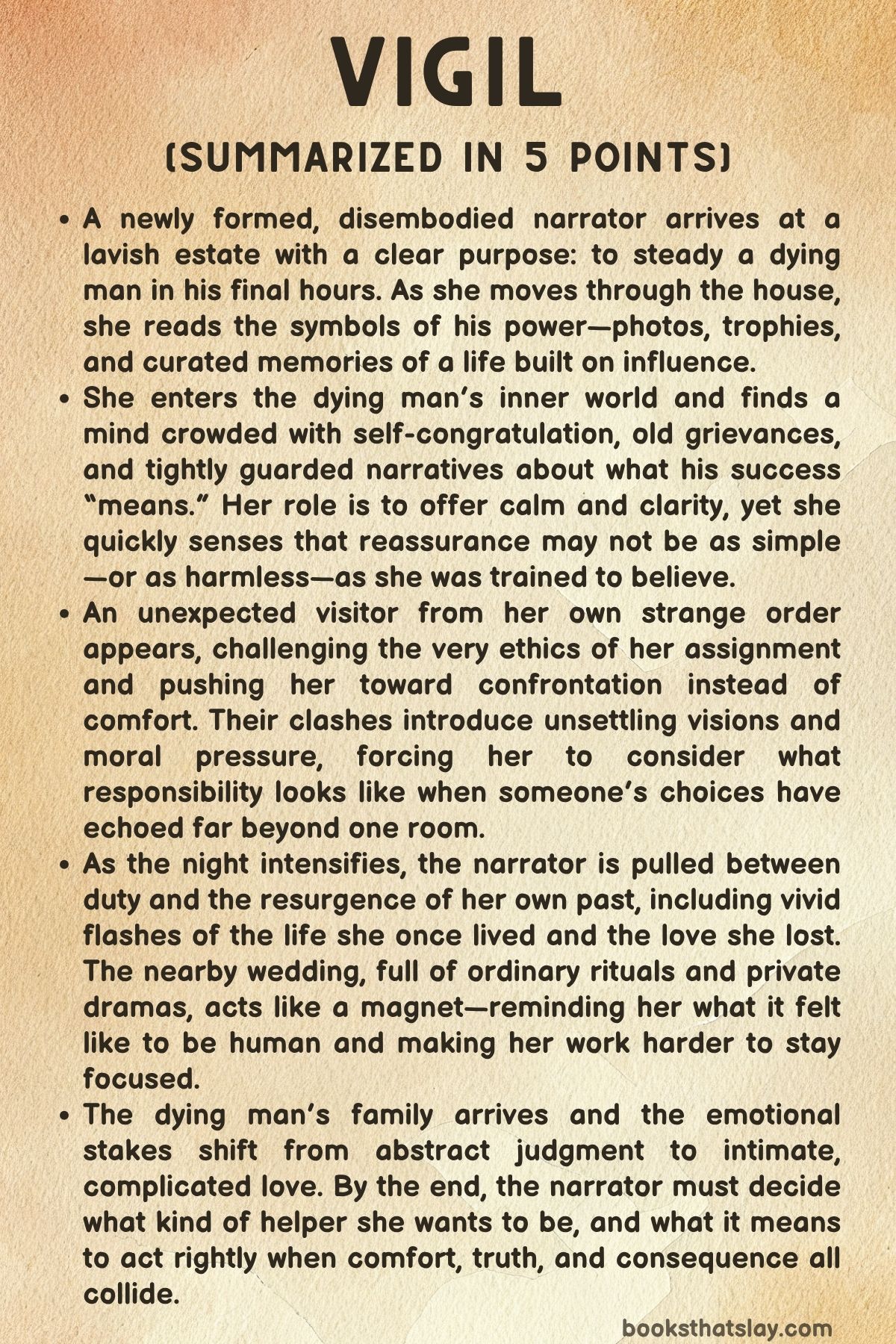
Summary
A voice without a body drops from nowhere toward a lavish estate, assembling itself mid-fall and hitting the ground in the semicircular drive. The new body flickers—clothes appearing, disappearing—until it stabilizes into ordinary office-like attire.
The narrator forces herself upright and heads for the mansion as if doors and locks are only suggestions. She is not alive in the usual way.
She belongs to a group of spirits who are sent to people at the edge of death. Their job is simple, drilled into them as an operating principle: comfort the dying so they can leave with less fear.
Inside, she climbs a grand staircase lined with photographs of her “charge,” K.J. Boone, a famous oil executive shown across decades of speeches, ceremonies, luxury properties, and triumphant public moments. Plaques and framed art turn the hallway into a private museum of status.
In the bedroom behind heavy double doors, Boone lies in an enormous bed, barely able to move. His wife sleeps in a chair nearby, fully dressed, exhausted by caregiving.
The narrator slips into Boone’s thought-space—an “orb” where she can sense and speak into his inner life. She expects panic.
Instead she finds satisfaction. Boone’s mind clings to his story of achievement and dominance.
He reviews his life like a highlight reel, confident that he earned everything and that the world’s criticism is either envy or ignorance. The narrator prepares her soothing “faculty,” trying to build the calm presence she uses with the dying.
Before she can begin, another spirit appears outside by a gold-plated fountain ornament: a filthy Frenchman carrying a precarious stack of papers. He can see her and insists he needs access to the death room.
Courtesy rules among their kind pressure her to allow it. She lets him go up alone and waits outside, uneasy.
While she waits, a parked car tugs loose memories she tries not to have. Her former human life begins leaking back: driving an old Chevelle, schoolrooms, childhood games, the texture of American everyday life.
She remembers her name—Jill Blaine, nicknamed “Jill ‘Doll’ Blaine.” These recollections are not neutral; they erode her focus and her ability to stay “elevated,” the professional, distant state required for her work.
She rushes upstairs. The Frenchman is standing on the bed, stepping on Boone’s feet and reading from his papers at speed.
The language is chaotic and brutal—images of animals, corpses, mud, wreckage—piled one atop another like a curse. The narrator tries to stop him, but her attention is hijacked by a wedding next door, glowing with torches and music.
She drifts to the ceremony and lands among the guests. The rituals—programs, small talk, the quartet’s sound, food smells—hit her with a rush of familiarity.
Joy and nostalgia swell, and she realizes that the warmth of ordinary life is pulling her away from her assignment.
Back in the bedroom, the Frenchman finishes and delivers his argument: comforting Boone is wrong. Boone should be driven toward shame, because comfort lets him leave without facing what he has done.
The Frenchman hints at his own role in creating the modern world’s machinery and poisons, then vanishes. In Boone’s mind, the earlier intrusion has rattled him.
He grabs for childhood memories to steady himself, then returns to old habits: contempt for underlings, pride in his rise, a belief that power is proof. When the narrator tries to soothe him, Boone rejects her violently.
He calls her Satan, tries to “strike” her within the mental space, and lashes out with the reflex of someone who has always controlled the room.
Shaken, she sinks into the ground outside and drifts again toward the wedding, where memories of her husband Lloyd flare. She forces herself back to Boone, only for the Frenchman to reappear—now clean, stylish, and forceful.
He presses himself into her, briefly pushing her into the mind of a fourteen-year-old girl in Pennsylvania noticing unseasonal weather swings. The message is clear: Boone’s world has consequences, and those consequences are already shaping children’s lives.
The Frenchman shows his own past—helping “invent the engine”—and claims the invention turned into poison. He orders the narrator to enter Boone fully and transmit what she has seen.
She refuses to do it all the way. Instead she thrusts only her forearms into Boone’s mind, giving him only a partial glimpse.
The Frenchman collapses into rapid aging and dies, flashing into an image of dust in a Paris graveyard, then dissolving. The narrator returns to Boone, trying to prompt simple human connection—asking his wife for water, for example—but Boone can’t speak, and his mind slides toward delirium.
The night fills with more visitors. Two dead men appear who present themselves as eminent scientists, R. and G., speaking in a taunting duet.
They brag that after wartime fame, they used their reputations to manufacture doubt and “broaden debate,” building networks of articles, symposia, and think tanks with respectable names. They credit Boone for secretly funding their operations.
Their bodies grotesquely “spawn” miniature replicas of themselves that multiply until the room is packed with identical R.s and G.s talking at once, then the originals pull the swarm back under control. They tell Boone he can “escape” cleanly if he never admits wrongdoing.
If he refuses doubt, he can step into death unrepentant. Boone drives them away, but they promise to collect him later.
The narrator flees the bedroom in distress and meets two other dead spirits, Clyda and William, who speak with weary humor about their deaths and their long, dull companionship. Their presence forces Jill to remember what she has tried to keep buried: she did not die gently.
She was blown apart instantly, and after death she was propelled into the mind of a violent man named Paul Bowman. Inside him she learned his resentments and self-justifications, and she received the directive that became her whole job: comfort the trapped and suffering, because everything else fails.
Realizing she has abandoned her duty, she races back.
Back in the room, Boone apologizes for insulting her. She tells him bluntly that he is dying and tries a different approach: he is an “inevitable occurrence,” shaped by forces larger than him.
The air shifts. Boone’s father appears, demanding honesty about “Aarhus.” Boone resists, then boasts about a 1997 keynote in Aarhus, Denmark—crafted with an aide named Ed Dell—that he believes helped justify policy reversals and intensified attacks on climate institutions.
He recalls Dell later regretting the work and confronting him. Boone remembers twisting that confrontation into a cruelty that wounded Dell deeply.
More emissaries arrive. A crude old spirit appears with a message about whether Boone is ready.
Then the Frenchman returns radiant and introduces himself as Mr. Bhuti, accompanied by a gaunt man in Rajasthani clothing. This man describes dying amid drought and social collapse and insists that Aarhus connects to that suffering.
Boone responds with obscene abuse and refuses blame. Mr. Bhuti gives the man water and has him enter Boone’s body so Boone can “know” the suffering firsthand.
The man staggers out and passes through the narrator, flooding her with vivid impressions of climate devastation—burned forests, floods, ruined libraries, stranded animals—until she is furious at Boone’s continued indifference. She bolts again toward the neighboring wedding reception, slipping into guests’ minds, chasing sensation as if it could drown out responsibility.
Overwhelmed by longing, Jill flies to Indiana and finds her hometown transformed and her old home erased. She finds her wedding dress stored away and summons a crowd of local dead.
In the cemetery she learns Lloyd died in 2023, remarried, and had children. She learns Paul Bowman was never caught and lived to old age after forgiving himself.
Standing among graves and the facts of time, Jill refuses to “go” onward, then scolds herself for abandoning her calling. She returns toward Boone’s estate, split between the comforter-spirit and the human self she can no longer fully suppress.
A taxi arrives with Boone’s adult daughter, Julia. She goes upstairs, kisses Boone, and whispers intensely to him, narrating memories of him as a father—playful moments, travel, wealth, and also his harshness.
She insists she is not a liberal and frames her worldview as toughness learned from him. Then she prays, thanking God for Boone’s achievements while asking forgiveness for his mistakes, including “questionable things” raised in a documentary.
Her certainty cracks. She asks Boone if the accusations are true.
Boone stirs and finally speaks aloud: “Devil” and “Lady.” Julia panics, tries to wet his lips, then runs downstairs crying and praying against the “devil lady.”
Boone’s inner defenses crumble under the shock of his daughter’s doubt. The room feels crowded with dead observers.
A curly-haired college student appears—a young man Boone once faced after a talk—who confronts him directly about climate denial and corporate knowledge. Boone tries to deny, then falters, implying he must have known.
He offers justifications: stewardship, strategy, political warfare. The dead crowd’s silence and the student’s clarity press him toward confession.
Boone admits in fragments that he was swept up in himself and power.
As Boone drifts closer to death, his mother appears and asks to speak privately. The narrator withdraws.
The mother comforts Boone with personal memories and tells him he did nothing wrong and should go to glory. Boone accepts the reassurance.
His mind closes. He dies.
Immediately, two harsh spirits—“the Mels,” revealed as the earlier R. and G. in another form—burst in, rope Boone’s rising spirit, and drag him away, declaring they will keep roaming, convincing themselves they were right, refusing doubt. Boone, suddenly less defensive, lunges into Jill’s mind and begs to be allowed to help fix the world he damaged, imagining clean seas and restored land.
Jill says it is too late, but when the Mels haul him out, she follows into the night.
Outside, near the waning wedding, Jill acts with surprising force. She slices the rope, immobilizes the Mels by imagining them filled with concrete and then water, and drives them off.
The Frenchman returns, furious, warning that freeing a “monster” and offering forgiveness without judgment is dangerous. Boone kneels and pleads to join the Frenchman in visiting other dying wrongdoers to urge repentance.
The Frenchman, recalling his own awakening, agrees. Boone runs into the forest at impossible speed while the Frenchman flies alongside.
With her charge gone, Jill begins to fade. She looks at the damaged forest and feels the raw fact of life’s cruelty, and she worries about her own use of punishment.
She decides she must abandon the lingering “Jill” part of herself and return to pure elevation. She bursts upward and returns to Paul Bowman, now a colossal spectral figure at a vast table, and receives the directive again: comfort.
She falls into a new winter place, emerging beneath a frozen pond near a cabin where another woman is dying, ready to begin the work all over again.
Characters
Jill Blaine
Jill is a disembodied “comforter” spirit whose identity is split between a trained, guild-coded function—entering the minds of the dying to “elevate” them—and the resurfacing residue of her human life as Jill “Doll” Blaine. Her opening fall into embodiment, with clothes flickering into place, limbs half-buried, and a body learning to stand, makes her feel both newly born and strangely programmed.
That tension defines her: she wants to be purely useful, yet sensory triggers such as a parked car, wedding rituals, and familiar smells yank her toward longing, grief, and selfhood. The more she remembers—Lloyd, Indiana, her death, and the indignity of having been propelled into Paul Bowman’s violent mind—the more her mission wobbles, and her compassion becomes complicated: comfort can become complicity, but judgment can become cruelty.
By the end of Vigil, Jill’s power has expanded beyond passive witnessing; she can harm, intervene, and choose, and that agency terrifies her because it threatens the clean simplicity of her directive. Her final decision to abandon “Jill” and return to pure comfort lands as both an act of humility and a surrender, suggesting that in a world shaped by vast systems of harm, the only action she fully trusts is to ease suffering one death at a time.
K. J. Boone
K. J. Boone is a dying oil executive whose inner life is built like a fortress: self-satisfaction, grievance, and a relentless narrative of earned greatness. Even as his body fails, his mind clings to hierarchy—underlings, enemies, “libs,” ungrateful accusers—and he treats moral inquiry as an attack on his identity rather than a summons to truth.
What makes him frightening is not cartoon villainy but fluency: he can logic-chop, reframe, and redirect responsibility until reality feels negotiable, and that skill has consequences far beyond his bedroom. Yet Boone is also genuinely terrified—of humiliation, weakness, and his daughter’s doubt—and his fear leaks out as rage and superstition, exposing how thin his control has become.
The story repeatedly offers him a doorway into shame and repair, but he tends to choose absolution without reckoning, especially when comfort arrives in the voice of family. Even his last-minute surge of apparent remorse, wanting to “fix” the world, reads as another attempt to stay grand and keep being the protagonist of history; still, once dead, his defensiveness loosens, and his pleading suggests a man finally feeling the scale of what he helped unleash.
Boone’s Wife
Boone’s wife is physically present but spiritually sidelined for much of the narrative, a quiet emblem of private labor inside public power. She sleeps fully dressed from exhaustion, adjusts medications, and moves through the room in pragmatic routines, highlighting how the intimate costs of Boone’s life—illness, caretaking, patience—fall on her without ceremony.
Her closeness to death is not philosophical but logistical; she is the person who keeps the machinery of dying working. That ordinariness becomes its own moral contrast: while Boone’s mind performs epic self-justifications and spectral visitors stage cosmic trials, she handles water, pills, schedules, and fatigue.
Her understated presence underscores a central irony: the people most responsible for maintaining life at the end often have the least power over how that life will be remembered.
Julia Boone
Julia arrives as a voice that tries to control reality through love, loyalty, and narrative. Her bedside monologue is both devotion and self-protection: she praises Boone as the “best father,” defends his harshness as character-building, and anchors her identity in his wealth and worldview, as if affirming him can stabilize her own position in a conflicted moral landscape.
Her insistence that she is “not a lib” reads less like politics than panic—an effort to keep doubt from cracking the family story she lives inside. The turning point is her prayer and the moment she asks if the accusations are true; that brief fracture is devastating precisely because it’s sincere, and her terror that she has “killed” him with disappointment shows how deeply she believes emotions can be lethal in a room already saturated with death.
Julia’s arc is not a conversion but an exposure: she reveals how denial replicates through love, how affection can become an instrument that shields power from accountability, and how a child can be trapped between genuine gratitude and the dawning knowledge that gratitude does not erase harm.
The Frenchman / Mr. Bhuti
The Frenchman begins as a filthy, exhausted intruder carrying a towering stack of papers—an embodiment of accusation, evidence, history, and unresolved grief—and he uses performance, surreal readings, escalating speed, and grotesque imagery to shock Boone’s self-satisfaction into awareness. He is antagonistic not because he lacks empathy but because he distrusts comfort; to him, soothing a man like Boone is moral anesthesia.
His evolving forms—ragged beggar, elegant figure, radiant being in white—suggest a spirit who can recompose himself around purpose, and his self-incrimination, tied to helping “invent the engine,” makes his anger morally tangled: he is prosecuting a system he also helped midwife. As Mr. Bhuti, he becomes less a heckler and more a messenger of lived catastrophe, organizing demonstrations that insist the losses are specific, numbered, and irrecoverable.
Yet his fury at Jill’s intervention also reveals his vulnerability: he fears that forgiveness without judgment recreates the conditions for harm, and he cannot tolerate any liberation of the “monster” unless it is yoked to repentance. He functions as the story’s moral pressure—an insistence that comfort must not become erasure.
The Mels
The two Mels arrive with smug familiarity and institutional confidence, presenting themselves as Boone’s “old colleagues” and claiming they are more welcome than Jill. Their power is social as much as supernatural: they speak like insiders, like men who have always belonged in rooms where outcomes are arranged.
Later, in their harsher form, they become enforcers who rope Boone’s spirit and drag him away into a future of self-justifying wandering, suggesting that the afterlife can preserve the same closed feedback loops as corporate and ideological life—circles where doubt is prohibited and righteousness is endlessly rehearsed. They are frightening because they do not need Boone to be innocent; they only need him to never admit guilt, and they offer him the seductive promise of consequence-free exit.
Jill’s violent immobilization of them is one of her most ethically ambiguous acts: it feels like justice and vengeance at once, and the fact that it troubles her afterward shows how easily punishment can start to resemble the same coercive certainty she despises in Boone.
R. and G.
R. and G. are dead men who wear the prestige of science like a costume while boasting about how they leveraged that prestige to manufacture doubt. Their chant-like back-and-forth, their delight in technique—press releases, articles, symposia, respectable-sounding think tanks—and their grotesque spawning of replicas turn misinformation into body horror: a self-replicating organism that fills a room until truth cannot breathe.
They embody the bureaucratic face of moral catastrophe, harm done not with a gun but with strategy, tone, and footnotes. What makes them especially corrosive is their insistence that Boone can “escape” without consequence if he never admits wrongdoing, framing denial as a kind of moral legalism.
In Vigil, they are less individuals than a mechanism: the voice of institutional evasion, the proof that a lie does not need to be believed to be useful—it only needs to be repeated.
Clyda
Clyda is one of the dead spirits Jill meets away from Boone’s house, and she functions as a blunt counterweight to Jill’s high-minded mission language. Her recounting of death and the long, tedious companionship afterward drags the afterlife down from metaphysical drama into endurance—time that stretches, personalities that rub, stories retold because there is nothing else to do.
Clyda’s presence forces Jill to confront what her “elevation” doctrine might be avoiding: that comfort is not an elegant solution but a coping tactic, and that even beyond death, people can be stuck in patterns of boredom, resentment, and need.
William
William, paired with Clyda, reinforces the sense of the dead as a community that can be petty, weary, and strangely domestic. His role is less to reveal plot than to widen the emotional ecology of the story: Jill’s kind are not angelic specialists floating above humanity; they are spirits with habits, irritations, and narratives, still craving meaning.
Through William, the story suggests that death does not automatically purify personality—it can freeze it, leaving people to loop their selves unless something disrupts them.
Lloyd
Lloyd is Jill’s late husband and the anchor of her returning humanity. He appears primarily through memory and longing, but those memories are not decorative; they actively threaten Jill’s composure as a comforter by reminding her what embodied love felt like—its small rituals, its sensory details, its sense of belonging in time.
The revelation that Lloyd died in 2023, remarried, and had children is emotionally brutal because it denies Jill the fantasy that grief preserves exclusivity; life continued without her, and love reorganized itself. That knowledge does not just hurt—it destabilizes Jill’s moral posture, because it makes her less a neutral helper and more a wounded person craving consolation herself.
Paul Bowman
Paul Bowman is the violent man into whose mind Jill was propelled after her death, and his presence is a dark origin point for her directive. Through him, Jill learns how rationalizations are built from resentment and self-pity, how a person can plan harm while feeling victimized, and how moral language can be inverted to excuse brutality.
The end return to Paul Bowman as a colossal spectral figure delivering the single-word directive “Comfort” makes him feel like both captor and cosmological authority: the place where her mission is issued is also the place tied to human violence. Paul Bowman embodies a chilling idea—that a moral vocation can be born inside atrocity, and that even sincere compassion might be shaped by the very structures it hopes to counter.
Ed Dell
Ed Dell is an aide tied to Boone’s 1997 Aarhus keynote, a detail that crystallizes how large-scale harm often travels through speechwriting, messaging, and institutional positioning rather than overt acts of sabotage. Dell’s later regret and confrontation with Boone matter because they show a fork in the road: someone close enough to the machinery to see what it does, and human enough to be sickened by it.
Boone’s ability to twist that confrontation to wound Dell, contributing to Dell’s spiral, reveals Boone’s talent for interpersonal domination—he does not only shape policy narratives; he can also destroy a person’s inner footing when that person threatens the story.
Boone’s Father
Boone’s father arrives as an accusing presence demanding honesty about “Aarhus,” shifting from familiar roughness into stern wrath. He represents the moral language Boone cannot fully control because it comes from inside the family myth Boone cherishes.
The father’s eventual shrinking shame and exit also exposes something bitter: even the voices that demand accountability can be bought off by the narrative of provision, showing how money and gratitude can neutralize judgment. He is less a stable judge than a test of Boone’s ability to bend even parental authority into validation.
Boone’s Mother
Boone’s mother appears near the end with intimate, personal comfort, requesting privacy and offering memories that soothe rather than indict. Her tenderness is powerful because it works; Boone feels absolved, encouraged toward “glory,” and the story shows how familial love can function like a sacrament that erases worldly harm.
Yet her comfort is also tragically limited: she can ease Boone’s fear, but she cannot undo what he helped cause, and her absolution sits uneasily beside the suffering invoked elsewhere. As a character, she embodies the most seductive version of comfort—unconditional, personalized, nostalgic—and the story uses that seduction to question whether comfort is always morally clean.
Themes
Comfort as Mercy vs Comfort as Evasion
In Vigil, the narrator’s role is defined by a single imperative—relieve fear at the edge of death—yet the story keeps testing whether easing someone’s final moments can become a kind of moral escape hatch. Her “comforting faculty” is framed as a practiced craft with rules, courtesy codes, and a professional identity, which makes her work feel principled rather than sentimental.
But the dying man she is assigned to is not simply afraid; he is proud, insulated, and committed to a self-portrait that excludes harm. When she enters his thought-space, she encounters satisfaction rather than remorse, and that mismatch forces the central question: what is comfort meant to do when the person approaching death refuses honest self-recognition?
The French spirit’s interventions sharpen the dilemma by arguing that kindness offered too easily becomes permission—an off-ramp from accountability at the exact moment consequences should be faced. The narrator resists this framing because she has seen panic, confusion, and raw human vulnerability before, and she believes care is the only useful response to suffering.
Yet each attempt to soothe Boone is met by hostility, suspicion, and a kind of reflexive violence: he labels her a devil, tries to strike her mentally, and clings harder to the story of himself as deservedly triumphant. That response suggests comfort cannot be neutral: it either challenges a person’s final defenses or reinforces them.
Even Boone’s later, partial movement toward confession is undercut by forms of consolation that restore his self-image—especially the mother’s gentle reassurance, which gives him the emotional outcome of forgiveness without the work of reckoning. By the end, the narrator’s own actions show how unstable her directive has become.
She frees Boone from punitive spirits and then feels troubled by her own judgment, not because judgment is always wrong, but because she senses that neither punishment nor soothing automatically produces moral clarity. The theme lands in a painful middle: compassion is necessary, but compassion that ignores real damage can become a tool that helps powerful people leave the world as they lived in it—protected from the truth.
Manufactured Doubt and the Machinery of Self-Justification
The story presents denial not as a simple lie but as a system that can be engineered, funded, repeated, and made to sound respectable. The chant-like visit from the two scientists is a grotesque dramatization of how public confusion is produced: reputations from real achievement are repurposed to create the appearance of “debate,” and that appearance is sold as intellectual responsibility while it functions as delay.
Their language is smug and procedural—press releases, symposia, think tanks—details that make the harm feel bureaucratic rather than dramatic, which is precisely the point. Boone’s interior monologue echoes this structure.
He does not need to believe a single clean falsehood; he only needs to keep shifting definitions of responsibility until the moral claim cannot land. When confronted, he reaches for familiar defenses: he was doing his job, he rose through merit, his opponents are just as strategic, his worldview is coherent, he provided for his family, he improved his parents’ lives.
These justifications are not random; they are a private version of the public doubt campaign—complexity offered as shelter. The repeated demonstrations of ecological loss challenge this shelter by translating abstraction into irretrievable absence.
The birds are not presented as “data”; they are named lives with distinct forms and behaviors, and the vision of heat, smoke, and failed hatchings forces the cost of denial into sensory experience. Later, Mr. Bhuti’s drought testimony intensifies that move by connecting policy maneuvers and rhetorical games to bodily suffering and social collapse.
Still, Boone tries to protect the story that keeps him intact, and the narrative shows how power makes that possible: he lives surrounded by wealth, art plaques, curated photographs of status, and caregivers who must manage his body while his mind insists on dignity. Even his daughter’s love becomes part of the machinery, because her praise lets him interpret himself as fundamentally good regardless of external harm.
What finally cracks him is not a spreadsheet of consequences but a human voice from his past—the student who states plainly that the company knew, adjusted infrastructure accordingly, and denied it anyway. The silence of the dead crowd behind the student functions like a jury that refuses to be distracted.
The theme is not that denial is ignorance; it is that denial can be manufactured into a stable identity, one that survives contradiction by converting every challenge into another reason to harden.
Identity, Memory, and the Struggle to Stay “Assigned”
The narrator’s crisis is not only ethical; it is existential. Her work requires a controlled self—an instrument meant to enter dying minds, stabilize fear, and keep personal history from contaminating the task.
Yet ordinary objects and scenes keep pulling her toward the person she used to be. A parked car opens the door to a flood of remembered textures: school, games, a drive-in, the feel of a particular life in motion.
The wedding next door becomes an even stronger trigger because its rituals are socially scripted in the same way her “elevation” is scripted; programs, music, food, and laughter activate belonging, and belonging threatens her professional detachment. The more she remembers Jill Blaine, the more her focus fractures, and the story treats that fracture as dangerous—not because memory is bad, but because her role depends on emotional precision.
This makes her identity feel like a contested space rather than a stable core. She can be “of our ilk,” following rules and codes, and she can be Jill—widow, daughter, victim of sudden death—each self carrying a different moral instinct.
The French spirit exploits this instability by forcing her into other lives and catastrophes, as if to argue that identity should expand to include the consequences of one’s actions and not merely one’s intentions. That expansion, however, overwhelms her; she becomes flooded by images of devastation, then tries to escape into sensation by slipping into wedding guests’ minds.
The attempt is telling: she uses the very skill meant for care as a way to avoid pain, which mirrors how Boone uses rhetoric to avoid truth. Her trip back to Indiana turns the identity question into grief.
She finds her town altered, her home gone, her wedding dress stored like a relic, and learns that Lloyd died in 2023, remarried, and had children. The discovery is not framed as betrayal so much as the brutal continuity of time that excludes her.
She also learns her killer lived to old age after forgiving himself, which turns “forgiveness” into a frightening word. By the end, her struggle becomes a choice between selves: stay human enough to feel outrage, longing, and moral urgency, or return to the pure directive of comfort and surrender the parts of her that make comfort complicated.
The theme argues that identity is not preserved by death; it is pressured, re-formed, and sometimes weaponized—by memory, by duty, and by the world’s refusal to pause for someone’s private loss.
Wealth as a Protective Stage and the Return of the Witnessing Crowd
The setting is not just decorative; it is a moral technology. Boone’s estate functions like a curated narrative designed to keep certain realities out: the grand staircase lined with photos of accomplishment, the framed art labeled with travel plaques, the sense that every object is there to certify a life as significant.
Even Boone’s final room feels like part of that stage—massive bed, controlled environment, a spouse exhausted by care but still embedded in luxury. This environment supports his inner certainty.
It gives his mind continuous props: he sees himself as a figure who toured landmarks, stood at oil rigs, gave speeches, and moved through the world as an owner of outcomes. Against that stage, the story introduces counter-stages that expose what the wealth tries to hide.
The wedding next door, torchlit and ornate, repeats the logic of privilege as celebration: people perform happiness while carrying private humiliations, affairs, and little cruelties, suggesting that social ritual can distract from moral accounting. The narrator is drawn to it because it feels alive, familiar, and safe, but it also shows how easily comfort becomes numbness when pleasure is available on demand.
The most disruptive counter-stage is the crowd of the dead that gathers as Boone nears death. Their presence turns the private deathbed into a public event, not for spectacle but for witnessing.
These are not polished portraits on a wall; they are regional dead, ordinary and varied, arriving with the weight of shared consequence. The college student’s confrontation gains force because it occurs before that silent crowd, a collective that refuses Boone’s preferred story.
Later, the punitive spirits who rope Boone represent a different kind of public response: punishment that risks becoming its own closed loop, a roaming certainty that never doubts itself. The narrator’s decision to break that rope is not framed as a triumphant rescue; it is a dangerous interruption of a simplistic moral ending.
The theme here is that wealth attempts to control narrative even at death, but narrative control breaks when witnesses arrive—whether those witnesses are the dead, the memories of victims, or the material world itself: damaged forests, altered seasons, vanished homes. The story keeps returning to the idea that accountability requires an audience that cannot be bought or managed.
At the same time, it warns that the audience can become vengeful, self-satisfied, or performative. What remains unresolved—intentionally—is how a society moves from witnessing to repair without turning either comfort or punishment into another protective stage.