We Who Have No Gods Summary, Characters and Themes
We Who Have No Gods by Liza Anderson is a dark fantasy about power, coercion, and the price of belonging. It follows Vic Wood, a sharp-edged Austin bartender who has spent years protecting her younger brother Henry after their mother vanished under impossible circumstances.
When a stranger forces Vic to relive that disappearance, the siblings are pushed into the Acheron Order, a secret society that trains witches and polices the boundary between worlds. Inside its fortresslike Avalon Castle, Vic discovers political rot, brutal traditions, and monsters that are very real. The story tracks her fight to keep Henry safe while deciding what she’s willing to become.
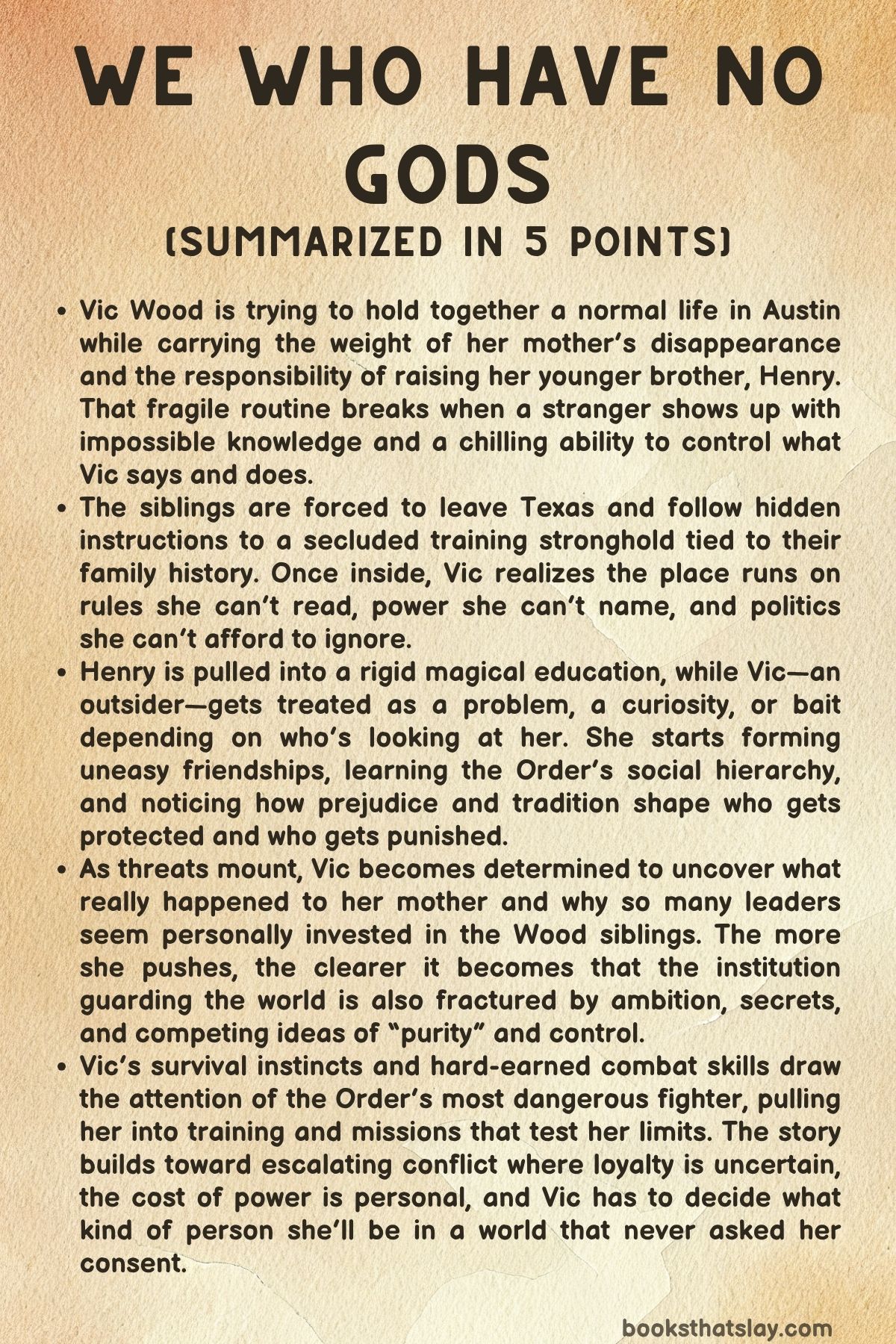
Summary
Vic Wood is working a shift at Le Curieux in Austin when an older, wealthy-looking man sits at the bar and fixes her with a stare that feels wrong in a way she can’t explain. He speaks with a careful, almost featureless accent, and when Vic approaches, his questions turn personal fast.
Worse, she can’t look away, can’t move, and can’t stop answering. He asks about her plans, her education, and why she never went to college.
Against her will, Vic admits the truth: she stayed home to raise her brother Henry after their mother, Meredith, disappeared.
That memory hits like a bruise. Eight years earlier, Meredith left for a hospital shift and never came back.
When Vic called, the hospital claimed no one by that name worked there. Soon after, ten-year-old Henry confessed what their mother had told him in secret: if anything happened, he had to run, because “witches” were coming for him.
Back at the bar, the stranger reveals he knows Meredith and compares Vic to her with casual cruelty. When he finally breaks eye contact, Vic collapses as if a pressure inside her skull suddenly releases.
As he leaves, she notices a bloodstain on his cuff and catches sight of a circular mark carved into his skin—an inhuman-looking ring of letters that still hasn’t healed. Terrified, she runs.
Vic rushes home and tells Henry they have to flee. But when they reach their apartment, the same man is already inside, seated in the dark as if he belongs there.
Henry insists he didn’t let him in. The man introduces himself as Nathaniel Carver, an Elder of the Acheron Order, and announces that Henry is a witch from Meredith’s line.
He says Henry must come to Avalon Castle in New York for training. Vic refuses immediately, but Nathaniel stays calm, explaining that untrained witches are dangerous—not only for exposing magic to ordinary people, but for tearing holes in the boundary that keeps worse things out.
He hints that the Order prevents disasters most humans never even learn about. Then he produces proof: with a casual motion, an envelope appears, thick with instructions and information meant only for Henry.
When Vic tries to read it, the pages look blank.
Henry, shaken but steady, argues that going might be the safest option. He remembers their mother mentioning a castle and insists they can’t outrun people who can appear inside locked apartments.
Since Vic can’t read the packet, Henry copies the directions by hand so she can follow them. Vic decides they’ll go—together.
If the Order wants Henry, it will have to deal with her too.
They drive through winter weather toward upstate New York, exhausted and tense. Near the destination, Henry sees a hidden turn Vic cannot.
He directs the car straight toward what looks like a wall of trees, and the illusion peels away to reveal a concealed road lined with lanterns. At the end stands Avalon Castle: vast, turreted, and lit from within like a watchful organism.
Inside, they’re greeted by Max Shepherd, another Elder, polished and welcoming. He calls Henry by name and tells them the Order owes Meredith a debt.
He even allows Vic to stay, brushing aside objections about rules, and gives them rooms that function like a private apartment. As Max tours them through the castle, he explains the Order’s purpose: maintaining the Veil between the living world and the realm of the dead.
If the Veil fails, the dead cross over and kill freely. When Vic demands to know what happened to Meredith, Max tells her to stay and learn for herself.
That night, Vic can’t sleep. The castle feels too quiet, too sure of itself.
She wanders despite warnings not to go out alone after dark. Corridors shift and reroute until she can’t find her way back.
She reaches a landing with a stained-glass window showing a cloaked woman releasing a black shadow, and outside she sees a massive, unnatural shadow-creature racing toward the castle from the forest. Panicking, Vic stumbles into an octagonal supply room stocked with weapons and strange materials.
She hides when she hears voices.
A filthy, giant man with pale blue eyes arrives with Nathaniel. The giant removes a harness of blades, one still dripping thick black blood, and speaks about worsening threats and “the source of the problem.” Vic makes a sound.
The giant snaps his attention to her and demands her name. She gives it, explains she’s Henry’s sister, and repeats that Max said she was welcome.
The giant warns her the castle is dangerous at night and bluntly recommends she leave by morning, claiming Max lied. He exits, with Nathaniel trailing behind.
Shaken, Vic eventually finds her room again.
The next day, Vic slips into a lecture where Elder Thompson teaches recruits about the “Universal Language,” a magical tongue witches are born able to understand. Hooded servants stand at the back holding trays of spell books.
When recruits practice dissolving rocks, Vic discovers her book is unreadable: only symbols, no meaning. A recruit named Sarah sits with her and explains that the Universal Language can’t be taught to someone not born with it.
Vic also learns those shrouded servants are ordinary humans forced into humiliating uniforms for secrecy and control. Thompson humiliates Sarah as well, calling her “Made” and punishing her for unstable magic, while also suggesting Vic should be wearing a servant’s shroud—until Henry speaks up and cites Max’s permission.
Sarah becomes Vic’s guide to the castle’s social map. She tells Vic the Order hunts monsters called Orcans from the Other World and that the Order’s leadership has a history of excluding Made witches, women, and anyone they consider inconvenient.
She shows Vic the Arena used by Sentinels and elite recruits and warns her away from the lift to the cages below—where captured Orcans are kept.
In the Arena, Vic sees the giant from the night before: Alexandros “Xan” Galanis, Chief Sentinel. He trains fighters to survive without magic, taking down larger opponents with efficient control.
When a sparring lesson goes wrong, Vic blurts out a correction from the stands. Xan confronts her for being in a restricted area.
A Sentinel named May Lin challenges Vic to spar. Under rules of no magic, Vic outmaneuvers May and pins her, then explains what May did wrong.
Humiliated, May cheats and blasts Vic with magic, blooding her nose. Vic erupts—at May for cheating and at Xan for allowing it.
The hostility sticks.
Back in their apartment, Henry admits he came to Avalon early because people whisper the Order is heading toward war. He’s drawn to the place’s influence and believes he has a destined role, tied to what their mother once hinted.
Vic wants to run. Henry refuses.
That night, Vic goes to the weapon room to vent. Xan finds her practicing.
Instead of throwing her out, he tests her, agreeing to spar with real swords. Their fight is intense, and Vic pushes him verbally until his restraint cracks and he finally attacks in earnest.
After he disarms her, he warns her again to leave. He says Meredith officially died on a hunt, but rumors claim she fought something worse than the Order’s enemies.
He also reveals Max is trying to prove a human can learn enough to use magic—using Vic as the example. Xan thinks that experiment will get her killed.
Vic refuses to abandon Henry, so Xan offers her a job: train Sentinels under his authority and help sharpen their combat skills.
Vic throws herself into the work, drilling squads and forcing discipline. That makes her enemies.
May and others lure Vic into a room and threaten her, trying to scare her into leaving. Max interrupts in spectacular fashion, appearing with a raven familiar and dismissing them.
He gives Vic a brass key and access to Meredith’s old rooms, offering privacy in a closed wing. Vic admits she’s staying because she needs answers—about her mother, about Henry, and about what the Order is hiding.
When Vic finally opens Meredith’s warded apartment, she finds evidence her mother truly lived at Avalon for years: books, art, personal touches, and a photo of Meredith with Max and a powerful mage named Aren Mann. Then Vic finds the real trap: a horrific winged creature hiding inside.
It attacks, and Vic can’t escape because the ward seals the door. As she fights desperately, Xan bursts in cloaked in living darkness, kills the Orcan with fluent Universal Language, and uses his own blood to help knit Vic’s wounds.
He drags her straight to Max, furious that she entered alone.
Soon after, violence escalates outside the castle as a large Orcan assault hits a nearby area. Xan realizes the battle is a distraction meant to pull Sentinels away from Avalon.
He races back, but the castle is already compromised. Vic experiences a terrifying fall into a gray void full of voices and suffocation, then wakes in the snow, unharmed, near the burned remains of a mimic-like attacker.
She drives back to a dark, mostly emptied Avalon as if guided by an instinct that wasn’t hers before.
Inside, Nathaniel confronts her, enraged that she’s alive. He admits she was supposed to die and reveals his alliance with Aren Mann.
He drags Vic toward the Arena while laying explosive powder through the corridors, ranting about “cleansing” the Order. Vic fights back clumsily, then with sudden, frightening strength.
Xan arrives and demands answers. Nathaniel uses a conduit weapon that forces Xan out of shadow form and draws blood.
That sight triggers something in Vic. Her wrist bears a dark bind-mark like a sigil, and her power moves without permission.
Nathaniel’s throat splits open from within, and he dies mid-sentence. The conduit fires as he falls, igniting the powder.
Explosions tear through the training wing down into the cages. Orcans roar and climb upward, trapped inside the castle by outer wards that still hold.
Vic and Xan run through collapsing corridors, fighting and escaping as monsters flood the halls. Vic’s new abilities lash out as threadlike force, crushing Orcans and ripping open the floor to swallow them.
Outside the front doors, they stumble into the snow as the castle seethes behind them.
Max arrives with returning forces and confirms Henry is safe at a recruits’ safe house. Vic tells Max what happened: the mimic attack, Nathaniel’s betrayal, and her transformation into a witch—newly Made, healing fast, power surging without training.
Max concludes the Order is at war and that Aren Mann likely engineered Vic’s making because of Meredith. When offered a choice about leaving, Vic chooses to stay.
She wants revenge, and she wants Henry back from whatever influence is closing around him.
In the safe house afterward, Vic stares at her changed eyes and hears Aren’s voice inside her mind, praising her and promising greater power. Determined to cut the connection, she carves around the bind-mark on her wrist and peels away the marked skin, bleeding into a sink while her uncontrolled magic kills the lights.
Xan pounds on the door, but Vic forces herself to sound cold and sends him away. Alone in the dark, she cries—because she’s terrified, because she’s furious, and because she knows the truth: she belongs to Avalon now, whether she likes what that makes her or not.
Elsewhere, Aren addresses his followers, celebrating the damage done to Avalon and condemning the Order’s “weakness.” As he rallies them for open war, the final sting lands: Henry Wood is among the chanting crowd, and Aren watches him with satisfaction, confident he has already laid claim to Vic’s brother.
Characters
Vic Wood
Vic is the emotional and moral center of We Who Have No Gods—a working-class survivor whose life has been shaped by abandonment, vigilance, and the burden of raising her brother after their mother vanished. She begins as someone fiercely practical and deeply distrustful, used to swallowing discomfort to get through a shift, but the bar encounter reveals how much of her “strength” is actually practiced containment: when Nathaniel traps her with eye contact, her helplessness is both supernatural and painfully familiar, echoing how power has always been taken from her.
Vic’s defining trait is refusal—refusal to be controlled, refused education because she chose Henry over herself, refusal to leave him behind, refusal to accept the Order’s categories for who belongs. That defiance becomes combustible once she’s Made; what used to be protective aggression turns into literal reality-warping force, and the story makes her rage feel less like a flaw and more like a fuel source that finally has an outlet.
At the same time, Vic’s arc is not simple empowerment: her transformation costs her innocence, privacy, and bodily autonomy, and her self-harm at the end—cutting away the bind-mark—shows that even victory leaves her desperate to reclaim ownership of her own mind. Her attraction to Xan complicates her agency rather than replacing it; she uses provocation and desire as tools to feel in control, but she’s also terrified of needing anyone.
By choosing to stay with the Order after the castle’s collapse, Vic isn’t choosing safety—she’s choosing meaning, revenge, and identity on her own terms, even if it means stepping into the same war that swallowed her mother.
Henry Wood
Henry is positioned as both the story’s apparent “chosen” figure and its most unsettling uncertainty, because his optimism reads as coping until it becomes something darker. He is gentle with Vic in small, intimate ways—copying the directions because she can’t see them, trying to soothe her panic, pushing for the choice that seems strategically safest—yet he also carries a quiet hunger for destiny that makes him vulnerable to exploitation.
Henry’s belief that the Order “controls reality” and that he has a role to play reveals a teenage-to-young-adult impulse to turn trauma into narrative: if his mother disappeared for a reason and he is “chosen,” then their suffering becomes purposeful instead of random. That longing makes him a mirror to Vic: where she translates fear into flight and resistance, he translates fear into belonging and initiation.
His late start in training and his fragmented memories suggest suppressed conditioning and a life lived under invisible influence; he doesn’t feel like a naïve recruit so much as someone whose past has been edited, with the missing pieces tugging him toward the castle like a magnet. The final reveal—Henry chanting with Aren’s Brotherhood—reframes him as the book’s most dangerous hinge: not simply a hostage or a prize, but a person whose need to matter can be turned into allegiance.
Henry is tragic because he genuinely loves Vic, and yet the story implies love may not be enough to compete with the seduction of being told you were born for something.
Meredith Wood
Meredith functions like a haunting more than a memory: she is the absent parent who nonetheless dictates everyone’s choices, and the story steadily reveals she was never simply a nurse who vanished. In Vic’s recollections, Meredith is both protector and terror—someone who loved her children, but whose life was filled with secrets, alarms, and monsters at the edge of the kitchen light.
That duality shapes Vic’s adult psychology: Meredith taught her that safety is temporary and that adulthood is vigilance. The revelation that Meredith was a Sentinel and kept rooms at Avalon for decades expands her from “missing mother” into a political figure inside the Order’s history, someone important enough that Elders invoke debts and kinship.
The photo with Max Shepherd and Aren Mann hints at intimacy and proximity to power, raising uncomfortable questions about whether Meredith was used, whether she used others, or whether she tried to play rival factions against each other. Characters repeatedly weaponize Meredith’s legacy—Nathaniel compares Vic to her to destabilize her, Xan uses Meredith’s history to warn Vic away from the Order, Max frames Meredith as the reason Vic is protected—turning Meredith into a contested symbol rather than a person allowed to rest.
Even absent, she represents the theme of inheritance: bloodlines, chosen roles, and the way a mother’s secrets can become a child’s prison.
Nathaniel Carver
Nathaniel is introduced as controlled menace—an Elder with the poise of old money and the casual certainty of someone who believes compliance is inevitable. His method is intimate domination: questions that pry at identity, eye contact that becomes restraint, a calm voice that makes coercion feel like conversation.
He embodies the Order’s authoritarian core, the belief that institutions have the right to seize children “for their own good,” and he treats Vic’s humanity as an inconvenience rather than a boundary. Yet Nathaniel is also a study in hypocrisy and obsession: he seeks Vic out at her workplace not because it’s necessary, but because he wants to evaluate Meredith’s daughter like property from a bloodline he feels entitled to appraise.
The carved circular marking on his skin signals willingness to inscribe power into flesh, suggesting a man who has crossed lines repeatedly while pretending to uphold them. His later betrayal—working with Aren Mann, orchestrating traps, planning to release caged Orcans to “cleanse” the Order—shows that his loyalty is not to balance or protection, but to a purist fantasy of hierarchy.
Nathaniel’s disgustingly personal insults about Meredith reveal the real driver beneath ideology: resentment, envy, and the desire to punish women and outsiders who disrupt the story he tells himself about worth. His death at Vic’s hands is pivotal because it’s not framed as heroic necessity; it’s framed as the moment her new power answers emotional truth—rage, violation, years of being cornered—with irreversible violence.
Max Shepherd
Max is the story’s most charming political operator, an Elder who performs warmth while moving pieces across a board only he can see. From the moment he welcomes Vic and Henry, he positions himself as the reasonable face of the Order—flexible about rules, generous with rooms and food, protective in public conflicts—yet his kindness always carries strategy.
He uses permission as leverage: by allowing Vic to stay, he makes her feel seen; by giving her the key to Meredith’s rooms, he makes her dependent on him for access to the truth. Max’s ideology is reformist in a way that can be genuinely compassionate—he believes humans might learn enough to matter, he intervenes when Sentinels threaten Vic, he insists Meredith’s kin is their kin—but the book also paints his influence as dangerous precisely because it is subtle.
His raven familiar, Augustus, filled with accumulated memories, symbolizes his long-game thinking: Max collects information the way others collect weapons. His battlefield magic is immense and almost casual, which makes his “good guy” aura complicated; power like that is never neutral, and Max knows it.
Ultimately he functions as a patron figure to Vic—offering protection, access, and a place in the Order—but also as someone who may be shaping her into evidence for his political project, whether or not that project will get her killed.
Alexandros “Xan” Galanis
Xan is written as disciplined violence given a human face: the Chief Sentinel who survives by control, who teaches through bluntness, and who treats emotions as liabilities until they erupt anyway. His first impressions are intimidating—filthy from the field, cold-eyed, assessing Vic like an intruder—but the story gradually reveals that this harshness is partly protective instinct and partly self-loathing for being the Order’s blade.
Xan’s relationship with power is bodily rather than theoretical; he believes in weapons, leverage, and competence, and he distrusts magic’s seductions, which is why Vic’s emergence as a Made witch reads to him like a death sentence. That protective cynicism becomes his defining contradiction: he tells Vic to leave because he doesn’t want her to die, yet he also trains her, hires her, watches her, and repeatedly shows up at the exact moments she’s most vulnerable, as if he can’t stop orbiting the danger she represents.
His shadow abilities make him both guardian and intruder—the same darkness Vic sees near her, the same presence that saves her in Meredith’s apartment—so even his protection feels like surveillance, and Vic’s accusations aren’t entirely wrong. The intimacy between them is charged because it’s built from mutual recognition: both are shaped by fear, both use anger as clarity, both feel most alive when fighting.
When Xan heals Vic with his blood, the act is both tender and unsettling, binding them through bodily exchange in a world obsessed with bloodlines. His fury after battles, his insistence on focus, and his disgust at distraction reveal a man who knows war is coming and believes softness will kill everyone.
In the castle’s collapse, Xan is forced to accept that Vic’s uncontrolled power can save him—an inversion of his worldview—and that inversion threatens his identity as protector, which is why his anger at her disobedience is inseparable from fear and awe.
Sarah
Sarah is the story’s sharp-tongued truth-teller, a character who weaponizes humor because sincerity would expose wounds the Order loves to exploit. As a Made witch, she occupies a liminal social position—useful enough to keep around, stigmatized enough to scapegoat—and Elder Thompson’s contempt for her makes that institutional cruelty explicit.
Sarah’s function is partly educational—she explains the Universal Language’s exclusivity, the humiliating shrouds forced on servants, the Order’s history of prejudice—but she never feels like a mere guide because her bitterness has texture. She carries the sting of someone who has been told she is inherently lesser and has learned to survive by mocking the system before it can name her.
Her friendship with Vic is immediate because Vic is another outsider who refuses shame, and Sarah recognizes a fellow fighter even before Vic has any magic. Yet Sarah is not only defiance; in combat she is reckless, emotional, and sometimes self-destructive, suggesting the cost of living in a place where your worth is constantly debated.
Her presence also complicates the Order’s moral framing: she is proof that “Made” people exist and can fight, and therefore proof that exclusion is not about safety—it’s about maintaining power.
May Lin
May begins as an antagonist in the training pit—competitive, rule-breaking, willing to cheat with magic to put Vic in her place—but her later scenes reveal a woman shaped by bloodline politics and institutional pressure. She is a Born witch from a family that treats marriage and reproduction as strategy, which means her body and future have been framed as assets since childhood.
That background helps explain her aggression: in a world where lineage equals value, she has learned to defend her status with dominance and to treat vulnerability as weakness that others will exploit. May’s hostility toward Vic is partly about boundary policing—humans aren’t supposed to be there, and Vic’s presence threatens the hierarchy May benefits from—but it’s also personal insecurity: Vic’s competence in physical combat undermines the idea that magic alone determines superiority.
Her relationship with Sarah, including their kiss in the middle of chaos, shows how intensity and fear can collide into impulsive tenderness, and it hints at how little private space these women have for softness. May is most interesting when the story lets her be both cruel and constrained, both privileged and trapped by expectations she did not fully choose.
Elder Thompson
Thompson represents the Order’s bureaucratic cruelty: the kind of authority that hides prejudice behind pedagogy and rules. He performs the role of lecturer and disciplinarian, but his real function is social sorting—deciding who is respectable, who is dangerous, and who is disposable.
His treatment of Sarah as a “Made” with “no control” frames difference as defect, and his insistence that Vic should be wearing a servant’s shroud reveals how quickly he assigns people to caste positions. Thompson’s worldview is hierarchical and self-protective; he fears instability, not because it harms others, but because it threatens the institution that gives him power.
In this sense, he is less a villain with personal ambition and more a machine of tradition—someone who will keep producing harm simply by doing his job exactly the way it has always been done.
Aren Mann
Aren is the central architect of corruption in We Who Have No Gods: charismatic, patient, and terrifying precisely because his victories are psychological before they are physical. His confession of becoming Made after years of secret study frames him as a transgressor of boundaries, but unlike Sarah—who bears stigma—Aren turns transgression into dominance, suggesting that in this world rule-breaking is punished or rewarded based on who does it.
The archived note warning that his power may exceed even the Elders’ positions him as a threat the Order chose to tolerate for convenience, and that choice reads as institutional rot. Aren’s most intimate cruelty is his voice inside Vic’s mind: he does not merely want to defeat her; he wants to narrate her, to claim her identity, to turn her rage into his instrument.
His ideology, expressed through the Brotherhood, is purification through exclusion—blaming the Order’s “weakness” and “inclusion” for catastrophe—yet his actual methods are manipulation, informants, betrayal, and engineered transformations, which exposes the hypocrisy of purist rhetoric. The final image of Aren smiling at Henry among the chanters confirms his true weapon is belonging: he recruits by offering wounded people a story where their pain means they were meant to be powerful.
Augustus
Augustus, Max’s raven familiar, functions as an emblem of memory as power. The idea that Augustus contains the collected memories of previous “Ravens” makes the familiar less a pet and more an archive—an ongoing consciousness that turns history into leverage.
In a story obsessed with inherited roles and hidden truths, Augustus symbolizes how the Order’s longevity is maintained: knowledge is stored, curated, and deployed strategically. The raven form also ties to surveillance and omen; when Max appears as raven and then as man, the transformation feels like a reminder that what looks like magic spectacle is often simply control wearing a different shape.
Rachel
Rachel’s death is less about her as a fully developed individual and more about what her absence does to the living: she becomes the event that hardens suspicion around Vic and confirms that the Order’s internal crisis is no longer theoretical. Her role is to mark the shift from uneasy training politics into real wartime stakes, and to force Vic into a moral corner—stay and fight or flee and survive.
The lingering tension after Rachel’s death shows how quickly institutions seek scapegoats when afraid, and how easily Vic’s outsider status can be turned into implied guilt.
Lily and Claire
Lily and Claire operate as the social immune system of the recruit group—quick to confront Vic, quick to enforce the idea of who “belongs,” and quick to echo the Order’s assumptions without needing direct orders. They are not major antagonists in terms of plot, but they are important thematically because they show how prejudice reproduces itself horizontally, not only from Elders downward.
Their hostility underscores the castle’s culture of surveillance and sorting: even students internalize the institution’s caste logic and treat an outsider’s presence as contamination.
Em and Michael
Em and Michael are instruments of Sentinel insularity, channeling the resentment of fighters who believe their space is being invaded by someone unearned. Their attempt to trap and intimidate Vic—using symbolism, threats, and group pressure—shows how violence in the Order isn’t limited to monsters or official missions; it thrives in private rooms where hierarchy is enforced socially.
They also reveal an important truth about Xan’s authority: he can command Sentinels in training, but he cannot fully control the culture that made them, which is why rebellion and cruelty can fester right under leadership.
Matthews
Matthews functions as a practical benchmark in the Arena: a competent body used to demonstrate Xan’s principles and May’s tactical mistakes. He is less a character with independent motives and more a narrative tool that makes the castle’s combat culture feel concrete—fighting here is not abstract heroism, it’s mechanics, advantage, and controlled brutality.
E. Thomas Stanley
Stanley appears only through an archived note, but that note matters because it captures institutional foresight and institutional cowardice in the same breath. By recording fear that Aren may be uncontrollable, Stanley becomes the ghost of accountability—proof that someone saw the danger coming and that the Order still chose to proceed.
In a story about history repeating through bloodlines and power, Stanley represents the paper trail of ignored warnings that later become tragedies.
Themes
Compulsion, Consent, and the Weaponization of Attention
Vic’s first encounter with Nathaniel Carver establishes control as something that can be imposed quietly, almost politely, while still being violent. In We Who Have No Gods, the force in that bar scene is not only magical; it is social and psychological.
He watches, selects, and then turns a simple service interaction into an interrogation where Vic’s body betrays her—she cannot look away, cannot move, cannot stop answering. That dynamic returns in different forms throughout the story: rules that appear “for safety” become tools for obedience, warnings become threats, and protection becomes a leash.
What makes this theme unsettling is how often the controlling party insists they are being reasonable. Nathaniel frames compliance as inevitable, claiming he “won’t hurt them unless forced,” as if coercion is a neutral middle ground.
The Order’s practices reinforce the same logic. Vic is told where she may walk, what she may witness, and what she may be, and when she resists, the institution doesn’t simply argue—it tries to reclassify her as a servant, stripping her of status to make her easier to manage.
Even the architecture joins in: corridors shift, doors refuse, and wards decide who is allowed access, turning space itself into an enforcement mechanism.
Vic’s arc keeps returning to one question: what counts as a choice when the alternatives are fear, death, or the disappearance of the people you love? Henry’s decision to go to Avalon is presented as rational, but it’s a decision made under the shadow of pursuit and the memory of their mother’s warning.
Vic’s eventual transformation into a witch does not automatically free her from control; it changes the terms of it. Once she has power, the pressure shifts from being trapped by others’ magic to being trapped by her own surges of rage and grief, which can act like an internal coercer.
The bind-mark on her wrist becomes an emblem of this theme: it is both a key and a brand. It grants access, but it also announces ownership, a visible reminder that someone else’s plan has entered her skin.
The story’s tension comes from Vic repeatedly refusing to accept “inevitable” as a moral argument, even when her refusal makes her dangerous to the Order and to herself.
Belonging, Gatekeeping, and the Cost of Being “Allowed”
From the moment Vic arrives at Avalon Castle, belonging is treated as a privilege dispensed by people who already have power. Max can welcome her, bend rules for her, and declare her protected, but his welcome still positions her as an exception rather than an equal.
That difference matters because exceptions can be revoked. The castle’s recruits stare at Vic as if her presence is a contamination, and Elder Thompson’s reaction exposes the institution’s default assumptions: if she is not born into the Universal Language, then her proper role must be humiliation and labor.
The shrouded servants provide the clearest image of belonging enforced through shame. They are humans physically marked by restrictive clothing that signals silence, secrecy, and inferiority, and the Order treats that arrangement as normal.
Vic’s discomfort is not only empathy; it’s recognition. She sees that “not belonging” is not a personal failure in this world—it is a condition imposed and maintained.
The Universal Language becomes more than a magical system; it becomes a gate. Those who possess it do not merely have skills, they have access to meaning itself.
Vic opens spellbooks and sees nothing she can use, not because she lacks intelligence, but because the system is designed so that some people simply cannot read the world. This is why her later ability to perceive wards and “brush” threads away is so charged: she is not merely learning; she is crossing a boundary that others insist should be fixed.
Max’s belief that a human can become magical looks progressive on the surface, but it also carries a harsh implication: if acceptance requires transformation, then the institution is still refusing to value the human as they are. Vic is invited to stay, but often the invitation comes with an unspoken price—silence, caution, gratitude, compliance.
Belonging is also tangled with violence. Vic earns a kind of recognition in the Arena not through credentials or language but through combat competence.
Her body becomes her proof of worth, and the story shows how quickly that proof can be used against her. May’s cheating with magic during a “no magic” spar is not just personal cruelty; it is a reminder that the insiders can rewrite the terms whenever it benefits them.
Vic’s later role training Sentinels looks like inclusion, yet it also places her in the middle of internal hostility, where other members try to force her out through intimidation. Even intimacy becomes complicated by belonging.
Xan wants her gone “for her own good,” which turns affection into another attempt to decide her place. By the end, Vic’s declaration that she belongs to Avalon is not a comforting resolution.
It is a hard-edged commitment formed in grief and anger, suggesting that belonging here is won through survival and hardened purpose, not simple acceptance.
Power, Tradition, and Institutional Self-Justification
The Acheron Order presents itself as a necessary force that “maintains the balance,” strengthening the Veil to keep the dead from crossing over and killing freely. That mission gives it moral leverage: if the stakes are apocalyptic, then almost any internal cruelty can be reframed as unfortunate but required.
The story repeatedly tests that claim by showing how tradition and hierarchy protect the institution more than they protect people. Elders can decide who counts as kin, who is allowed exceptions, and who is expendable.
The servants’ enforced secrecy and humiliation are justified as “preventing exposure,” but the method reveals an organization comfortable with dehumanization. The Order also polices knowledge and movement—warnings about the castle at night, restricted wings, forbidden cages—creating a culture where safety and obedience are indistinguishable.
Aren Mann’s confession is a turning point for this theme because it exposes how power reshapes accountability. He admits he has made himself “Made,” escalating his capabilities beyond the normal limits, and the Elders vote to absolve him by a narrow margin because of his value.
The logic is chillingly practical: utility overrides risk, and risk overrides principle only when it threatens the institution’s control. The archived concern that no one may be able to control him is not treated as a reason to act decisively; it reads like bureaucratic dread—an awareness of danger paired with paralysis.
This helps explain how betrayal can thrive inside the Order. Nathaniel is an Elder, a guardian by title, yet he collaborates with Aren and frames his treachery as purification.
He speaks of “cleansing” the Order and returning to “true” traditions, revealing how tradition can be used as a moral mask for violence. What he wants is not balance but dominance: an Order rebuilt with the “deserving” on top and everyone else removed.
The larger conflict with the Brotherhood sharpens the theme rather than simplifying it. Aren rallies followers by blaming inclusion and weakness for the ruin at Avalon, turning catastrophe into propaganda.
In that framing, the deaths of servants and the castle’s collapse become proof that the institution’s limited compassion was a mistake. The story refuses to make this merely an external threat; it shows the Brotherhood’s ideology echoing fears already present inside the Order—fear of change, fear of “outsiders,” fear of losing status.
Even Max’s apparent compassion can be read as political, because he wants Vic as evidence for reform, and that desire places her in danger. The institution’s self-justification is therefore never neutral.
Every argument about duty and balance is also an argument about who gets to define reality, who gets to enforce it, and whose bodies are treated as acceptable collateral.
Family Legacy, Survival Roles, and the Inheritance of Trauma
Vic’s life is shaped by an absence that never becomes past tense: Meredith leaves for a hospital shift and vanishes, and the world’s refusal to even acknowledge Meredith’s existence fractures Vic’s sense of reality. That early erasure forces Vic into a survival role—guardian, provider, and emotional shield for Henry.
The story shows how that role becomes identity. Vic’s choices are rarely about what she wants; they are about keeping Henry alive, keeping him calm, keeping movement possible.
Even before Avalon, she lives with readiness to flee, which limits intimacy and future planning. Her anger at Henry’s optimism is not simple irritation; it is the rage of someone who has carried the cost of fear for so long that hope feels like negligence.
When Henry embraces the idea that he is “chosen,” Vic hears the same kind of seductive narrative that once lured Meredith into danger: destiny as a substitute for safety, importance as a substitute for care.
Once at Avalon, family legacy becomes a weapon used by others. Nathaniel compares Vic to Meredith as a taunt, implying heredity is a trap she cannot escape.
Max’s kindness is tied to debt: the Order owes Meredith, therefore Meredith’s kin is “their kin.” That sounds supportive, but it also means Vic is never only Vic; she is an extension of a past the Order owns and interprets. Xan’s warnings, too, are saturated with Meredith’s shadow.
He knew her, he carries rumors about her, and he uses that knowledge to argue that Vic should leave. In this way, Meredith’s legacy becomes a contested object—claimed by Elders, Sentinels, enemies, and even by the castle rooms she kept for decades.
When Vic finally opens Meredith’s apartment, she finds evidence of close ties among Meredith, Max, and Aren, and the discovery turns legacy into suspicion. Family history is not comforting; it is destabilizing, because it suggests the people offering protection may have been involved in the very forces that destroyed her childhood.
Trauma also appears as inheritance through the body. Vic’s transformation into a witch is not framed as a clean empowerment; it arrives through suffocation, a gray void, memory fragments, and a violent return to the world with a dead creature nearby.
Her rage becomes a trigger that makes stone crack and throats split, and this new capacity terrifies precisely because it feels both foreign and deeply hers. The bind-mark and the voice in her mind make that inheritance explicit: she carries something inside that speaks with someone else’s intention.
Her final act of carving away the marked skin is therefore not only self-harm or desperation; it is a symbolic refusal to let legacy be ownership. It is an attempt to separate her body from someone else’s claim, even if the attempt is crude and costly.
The ending twist that Henry is among Aren’s followers turns the family theme into tragedy and threat at once: the siblings’ bond, built on survival, is now a battlefield. Vic’s vow of revenge is fueled by institutional war, but underneath it is the oldest conflict in her life—the need to rescue Henry, and the fear that the person she protected has been claimed by the same forces that erased their mother.