All the Broken Pieces Summary, Characters and Themes
All the Broken Pieces by Ann E. Burg is a verse novel about a boy named Matt Pin, who was airlifted from Vietnam and adopted by an American family after the Vietnam War. Now living in the United States, Matt carries memories he cannot easily explain: his mother, his injured younger brother, the war, and the guilt he feels for surviving.
Through baseball, piano, family, and meetings with Vietnam veterans, Matt slowly begins to face his past. The book explores trauma, prejudice, guilt, healing, and the difficult work of learning that love can remain even after terrible loss.
Summary
Matt Pin is a seventh-grade boy living in America with his adoptive parents and his younger adoptive brother, Tommy. He was born in Vietnam during the war and came to the United States through an airlift when he was almost ten.
Though he now has a safe home, loving parents, and a brother who adores him, Matt does not feel fully at peace. Inside him, he carries memories of his birth mother, Phang My, his injured younger brother, and the violence that surrounded his childhood.
Matt remembers leaving Vietnam in confusion and fear. His mother told him he had to survive, even though she would not send his younger brother with him.
Matt’s brother had been badly hurt, with missing fingers and damaged legs, and Matt believes this is one reason he was left behind. Matt does not understand why he was chosen to go and his brother was not.
He feels guilty for leaving, and he fears that love can disappear without warning. His birth mother loved him, yet she gave him away.
The American man connected to his mother said he loved her, yet he never returned. Matt loved his brother, yet he left him behind.
In America, Matt’s adoptive parents try hard to help him feel safe. His mother comforts him when nightmares wake him, and his father takes him to the park to play baseball.
Matt notices the differences between himself and Tommy. Tommy seems bright, open, and free, while Matt feels darker and burdened.
When he sees American parks, school, games, and ordinary family life, he thinks of his brother in Vietnam and wonders what his brother would have thought of such places.
Matt’s parents also try to connect him to Vietnamese culture through adoption agency events, but these gatherings do not match the Vietnam Matt remembers. The celebrations show costumes, holidays, and stories, while Matt’s Vietnam is made of fear, loss, mud, noise, and broken memories.
These events leave him sad rather than comforted. His parents worry about him and wonder what might help.
His mother thinks music may soothe him, and his father believes baseball may give him confidence.
Matt begins piano lessons with Jeff Harding, a man who works with Matt’s father and served as a medic in Vietnam. At first, Matt plays timidly, but he begins to enjoy the piano because music has order.
Notes and scales make sense to him in a way his memories do not. Piano becomes a place where he can feel steady.
At the same time, Matt finally tries out for the school baseball team. He is a strong pitcher, and his father is proud of him.
Baseball, however, brings new pain. Some boys on the team mock Matt because he is Vietnamese and because his face shows both Vietnamese and American heritage.
Rob Brennan, another boy, is especially cruel. Rob calls Matt names and says his brother died because of Matt.
Matt does not tell anyone at first. He is afraid that speaking up will make things worse, and he also does not want his father to think he should quit.
When Matt makes the team, the bullying continues, though Coach Robeson warns the players that prejudice will not be tolerated.
Matt succeeds as a pitcher, and his team wins games, but Rob resents him. Matt’s life remains divided between success on the outside and fear on the inside.
He tries to be perfect at school, baseball, piano, and home because he worries his adoptive parents might send him away. When he overhears them talking about what he needs, he misunderstands and believes they are thinking of giving him up.
His fear comes from his past: he has already been separated from one family and does not trust that love will last.
Matt’s parents and Jeff eventually encourage him to attend a group called Veteran Voices, where Vietnam veterans gather to talk. Matt is terrified at first.
He imagines soldiers as dangerous figures, but the men he sees are damaged, tired, and ordinary. Some carry visible injuries, while others carry memories they cannot forget.
Matt meets Christopher Williams, called Chris, a former pitcher who lost an arm and uses a wheelchair. Chris had once been a gifted athlete, but the war changed his life.
Matt learns that the war damaged many people, including soldiers who returned home to anger, pain, and broken relationships.
These meetings force Matt to see the war in a wider way. At first, he blames himself for everything: his brother’s injuries, his birth mother’s suffering, the veterans’ wounds, Rob’s brother’s death, and even his adoptive father’s guilt over not going to Vietnam.
But slowly, he begins to understand that the war harmed everyone around it. Jeff helps the veterans see Matt not as an enemy, but as a child who also suffered because of the war.
Jeff explains that Matt’s mother gave him to American soldiers not because she rejected him, but because she loved him and wanted him to live. This idea changes something in Matt.
For the first time, he considers that being sent away may have been an act of love.
Meanwhile, Coach Robeson becomes ill with cancer and has to stop coaching. The team holds a dinner for him, where he speaks about illness, war, sacrifice, and teamwork.
He wants the boys to support each other and keep playing with commitment. When he chooses Chris Williams as the new coach, many players resist because Chris is in a wheelchair.
Matt also feels unsure at first, but he speaks up and tells the others to give Chris a chance.
Chris begins coaching with an exercise that pairs Matt with Rob. Rob is blindfolded and must collect sports equipment with Matt’s help.
Rob refuses to speak to Matt and continues to insult him. As the exercise drags on, Rob repeats that his brother died because of Matt.
This time, Matt finally answers. He tells Rob that he lost his brother too and that he believes it was his fault.
Matt then shares the memory he has been carrying. In Vietnam, his mother told him to keep his little brother safe inside while she checked on a neighbor.
Matt disobeyed because he wanted to search outside for small things soldiers might have dropped. His brother followed him, became separated, and was injured by a hidden explosive.
Matt carried him home, bleeding and badly hurt. His mother told Matt it was not his fault, but Matt never believed her.
He has spent years blaming himself.
After telling Rob the truth, Matt begins to feel the memory shift. He can hear his birth mother’s words more clearly: it was not his fault.
Rob also softens. He gives Matt his bandanna to wipe his tears, and the two boys finish the challenge together.
Their relationship does not become perfect at once, but the hatred between them begins to weaken.
Matt then tells his adoptive parents the truth about his brother. He expects them to hate him or send him away, but they do not.
They tell him their love will not change. His father says the real blame belongs to war, not to a child.
Matt asks whether they can try to find his birth mother and brother, and his parents agree. His mother also tells him that loving his Vietnamese family does not mean he loves his American family less.
A heart can hold more love than Matt thought possible.
By the end, Matt becomes more willing to speak. He thanks Coach Robeson in the hospital, understanding that words may be imperfect but still necessary.
He grows stronger at piano, learning not to rush and to allow silence to matter too. At a veterans’ meeting, he chooses to share not a painful memory but a beautiful one from Vietnam: the color of the sky and his mother’s shawl.
This helps both Matt and the veterans remember that Vietnam was not only a place of war.
Matt’s friendships also improve. Rob begins treating him with respect, and the team grows closer.
Coach Robeson shows signs of recovery, giving everyone hope. In the final scene, Matt plays outside with Tommy and finally speaks his Vietnamese brother’s name: Huu Hein.
He understands that his brother is still part of him, not only as guilt, but as memory and love. Matt believes that one day, with his family’s help, he will try to find him.
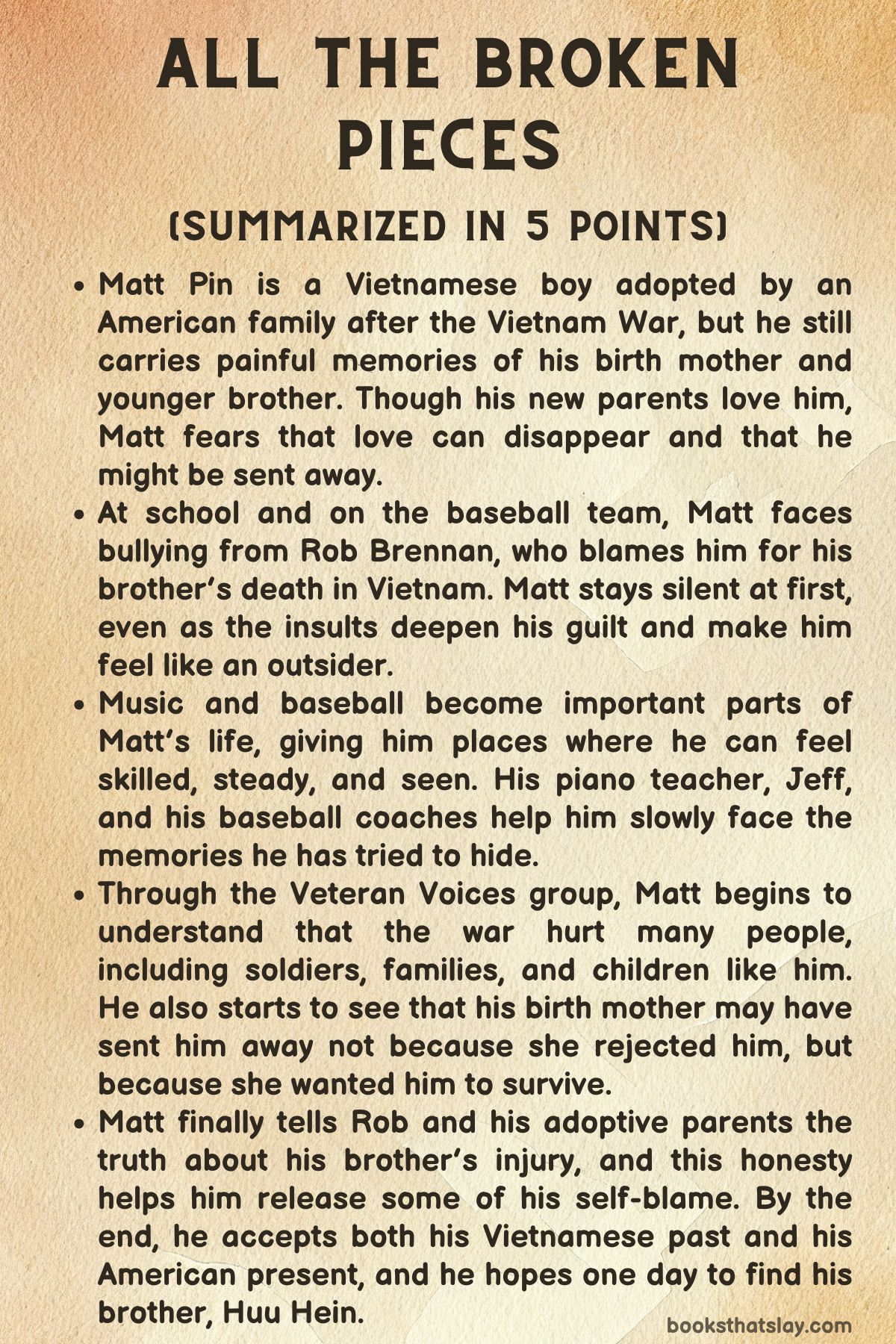
Characters
Matt Pin
Matt Pin is the central character and narrator of All the Broken Pieces. He is a Vietnamese boy adopted by an American family after the Vietnam War, and his life is shaped by memories he does not know how to carry.
On the outside, Matt is trying to live like an ordinary seventh grader: he goes to school, plays baseball, takes piano lessons, and spends time with his younger adoptive brother. Inside, however, he feels divided between two families, two countries, and two versions of himself.
He is haunted by the memory of his birth mother sending him away and by the injury of his younger brother, Huu Hein, which Matt believes was his fault. This guilt makes him afraid that love is temporary and conditional.
He thinks that if people learn the truth about him, they may reject him.
Matt’s emotional growth comes through learning to speak. At first, he hides everything: the bullying at school, his fear of being sent away, his memories of Vietnam, and the guilt he carries about his brother.
His silence protects him, but it also traps him. Baseball gives him a place where he can succeed physically, while piano gives him a sense of order and control.
Yet neither activity heals him fully until he begins to trust other people with his pain. When he tells Rob what happened to his brother, Matt finally stops carrying the memory alone.
When he tells his adoptive parents, he learns that their love does not depend on his perfection. By the end, Matt does not forget the past, but he begins to understand it differently.
He accepts that he was a child caught in a war, not the cause of the damage around him.
Phang My
Phang My, Matt’s birth mother, is one of the most powerful figures in Matt’s memory, even though she is not present in his American life. Matt first sees her decision to send him away as abandonment.
Because he was separated from her and from his younger brother, he believes she may have given him up because he failed to protect Huu Hein. This misunderstanding shapes much of his fear.
To Matt, Phang My becomes connected with loss, confusion, and the painful idea that love can disappear.
As the story develops, Matt’s understanding of her changes. Through Jeff’s explanation at the veterans’ meeting, Matt begins to see that Phang My’s choice may have been an act of desperate love.
She did not send him away because he was unwanted; she sent him away because she wanted him to survive. This realization is crucial because it helps Matt reframe his whole past.
Phang My represents the terrible choices forced on parents during war. She loves both her sons, but she lives in a world where love cannot protect them from bombs, hunger, injury, and separation.
Her voice remains with Matt, especially when he remembers her telling him that what happened to his brother was not his fault. By the end, her memory becomes less a source of abandonment and more a source of love that endured even through separation.
Huu Hein
Huu Hein is Matt’s younger brother in Vietnam, and his presence shapes Matt’s deepest guilt. For most of the story, Matt does not speak his brother’s name, which shows how painful the memory is.
Huu Hein is not simply a person Matt misses; he is also the center of Matt’s self-blame. Matt remembers being responsible for watching him, leaving the house, and then realizing that his brother had followed him and been terribly injured.
Because Matt was older, he believes he should have prevented the accident. This belief becomes one of the main wounds in his life.
Huu Hein also represents everything Matt feels he left behind. When Matt sees parks, toys, safety, and Tommy’s freedom in America, he thinks of the brother who did not get those things.
His love for Huu Hein is mixed with shame, and that is why he cannot easily speak about him. At the end, when Matt finally says Huu Hein’s name, the moment shows a major change in Matt.
His brother is no longer only a symbol of guilt. He becomes a loved person whose memory Matt can carry openly.
Matt’s hope of finding him suggests that healing does not mean cutting off the past. It means facing the past with enough courage to seek connection again.
Matt’s Adoptive Mother
Matt’s adoptive mother is gentle, patient, and emotionally perceptive. She understands that Matt’s pain cannot be solved quickly, and she tries to comfort him without forcing him to speak before he is ready.
Her lullabies, her concern after his nightmares, and her constant reassurance create a sense of safety around him. She is not perfect, and Matt sometimes misreads her concern as rejection, but her actions consistently show commitment.
She wants Matt to stop running from his memories, not because she wants to expose him, but because she wants him to stop suffering alone.
Her love is important because it challenges Matt’s belief that love fades or disappears. When Matt finally confesses what happened to Huu Hein, he expects judgment.
Instead, she tells him that nothing will change the way she feels about him. This response gives Matt what he has feared he would never receive: unconditional acceptance.
She also helps him understand that love is not limited. Matt can love his birth mother and brother while also loving his adoptive family.
Her view of love gives Matt a healthier way to understand family, belonging, and memory.
Matt’s Adoptive Father
Matt’s adoptive father is loving, proud, and quietly burdened by his own connection to the Vietnam War. He did not serve in Vietnam because he went to medical school, and this leaves him with guilt, especially when he sees men like Jeff and Chris carrying the visible and invisible effects of war.
His decision to adopt Matt may be partly connected to that guilt, but the story makes clear that his love for Matt is real. He supports Matt through baseball, encourages his talent, and tries to give him confidence.
His relationship with Matt is built through ordinary acts of care. Taking Matt to the park, cheering him on, calling him valuable whether or not he wins, and helping him attend Veteran Voices all show his steady presence.
Matt sometimes worries that his father’s love depends on baseball or good behavior, but this fear comes more from Matt’s trauma than from his father’s actions. When Matt reveals the truth about Huu Hein, his father responds with compassion and clarity.
He tells Matt that war is the real monster, not Matt. This matters because Matt needs an adult to place blame where it belongs.
His father helps him see that a child’s mistake inside a war zone is not the same as moral guilt.
Tommy
Tommy is Matt’s younger adoptive brother and a symbol of innocence, safety, and the childhood Matt never had. He is energetic, playful, and full of trust.
Matt often compares Tommy’s bright American life with his own darker memories. Tommy has toys, parks, sneakers, games, and freedom, and Matt connects these things with the idea of safety.
Through Tommy, Matt sees what childhood can look like when it is not ruled by war.
Tommy also reminds Matt of Huu Hein. At times, this makes Matt’s love for Tommy painful because Tommy’s freedom highlights Huu Hein’s suffering.
Yet Tommy is not only a reminder of loss; he is also part of Matt’s healing. When Matt plays with him, protects him, and receives his affection, he experiences brotherhood again.
Tommy’s presence helps Matt realize that loving one brother does not erase the other. In the final scene, Tommy’s joy opens the way for Matt to remember Huu Hein more fully.
This makes Tommy an important emotional bridge between Matt’s American present and Vietnamese past.
Rob Brennan
Rob Brennan begins as Matt’s main antagonist among the boys at school and on the baseball team. He bullies Matt, calls him cruel names, and blames him for the death of his brother in Vietnam.
Rob’s hatred is personal, but it is also inherited. He carries his family’s grief and directs it at Matt because Matt is Vietnamese.
In Rob’s mind, Matt becomes a stand-in for the war that killed his brother. This is unfair and cruel, but the story also shows that Rob is a grieving child who does not know what to do with his pain.
Rob’s change begins when he is forced to depend on Matt during Coach Williams’s blindfold exercise. At first, he refuses to cooperate, but when he says again that his brother died because of Matt, Matt finally answers with his own story.
This moment breaks through Rob’s simple view of Matt as an enemy. Rob learns that Matt also lost a brother and also lives with guilt.
His anger does not vanish instantly, but he begins to see Matt as a person rather than a target. By the end, Rob treats Matt with more respect, and their shared visit to Coach Robeson suggests that both boys have started moving away from inherited blame.
Jeff Harding
Jeff Harding is Matt’s piano teacher and one of the adults who understands both music and war. As a Vietnam veteran and former medic, Jeff knows the emotional damage carried by those who lived through the conflict.
He also knows that silence can become dangerous when people are trapped inside their memories. Through piano, he teaches Matt discipline, control, and expression.
Music becomes one of the first safe languages Matt can use before he is ready to speak directly.
Jeff is especially important because he connects Matt with the Veteran Voices group. He understands that Matt’s presence may be difficult for some veterans, but he also believes Matt can help them and be helped by them.
His speech to the group is a turning point. By explaining that Matt’s mother entrusted him to American soldiers out of love, Jeff gives both Matt and the veterans a new way to think about the past.
He reminds the veterans that amid destruction, some children were saved. He helps Matt see that his survival was not a betrayal.
Jeff’s role in All the Broken Pieces is that of a guide who does not force healing, but creates spaces where it can begin.
Coach Robeson
Coach Robeson is Matt’s baseball coach and one of the story’s strongest moral voices. He notices the prejudice on the team and confronts it directly.
He refuses to let the boys treat Matt as an outsider or an enemy. His lessons about baseball often carry larger meanings.
When he has the boys open up a baseball to find its hidden center, he is teaching them to look beneath surfaces. This lesson applies to Matt, Rob, Chris, the veterans, and the war itself.
People cannot be understood by what is visible first.
Coach Robeson’s illness adds another layer to his character. His cancer makes him physically weaker, but his words become even more meaningful.
He speaks to the boys about teamwork, courage, and the damage caused by war. By choosing Chris Williams as his replacement, he challenges the team to respect someone whose body has been changed by war but whose knowledge and strength remain.
Coach Robeson helps the boys mature. He teaches that sports are not only about winning; they are also about character, fairness, and learning to stand beside others.
Christopher Williams
Christopher Williams, also called Chris or Coach Williams, is a Vietnam veteran and former baseball player whose life was permanently changed by the war. Before Vietnam, he was a gifted pitcher with a promising future.
After the war, he returns with severe injuries, uses a wheelchair, and has lost much of the life he expected to have. His scars and missing arm make the boys uncomfortable at first, and some assume he cannot coach because he cannot walk.
Their reaction shows how easily people mistake physical disability for weakness.
Chris proves that authority and skill are not erased by injury. As a coach, he is creative, direct, and wise.
His blindfold exercise forces the boys to experience trust, dependence, and communication. By pairing Matt with Rob, he creates the conditions for their conflict to finally be spoken aloud.
Chris understands that the team’s real problem is not only athletic; it is emotional and moral. His presence challenges the boys to rethink strength.
He has suffered deeply, but he still teaches, leads, and helps others grow. Through him, the story shows that wounded people are not broken beyond use or dignity.
Mr. Brennan
Mr. Brennan is Rob’s father, and his grief over his older son’s death shapes Rob’s anger. He is not as openly cruel to Matt as Rob is, but his pain fills the family atmosphere.
At the dinner for Coach Robeson, Mr. Brennan tries to speak about the son he lost in Vietnam and cannot fully control his emotions. This moment shows that Rob’s hostility comes from a home where sorrow has never healed.
Mr. Brennan’s grief is understandable, but it has also contributed to Rob’s belief that someone must be blamed.
His character shows how war continues inside families long after the fighting ends. The death of his son has not remained in the past; it affects how he speaks, how his family lives, and how Rob sees Matt.
Mr. Brennan represents parents who lost children to war and were left with pain that had nowhere healthy to go. His sorrow helps explain Rob, though it does not excuse Rob’s cruelty.
Through Mr. Brennan, the story shows that grief can become destructive when it hardens into blame.
Coach Louis and Mr. Chambers
Coach Louis and Mr. Chambers are secondary figures who temporarily help with the baseball team after Coach Robeson becomes ill. They do not have the same moral force as Coach Robeson, and under their watch, Rob finds room to continue bothering Matt.
Their presence shows how important strong adult leadership is in a group of young people. Without someone clearly setting expectations and confronting prejudice, cruelty can continue in small, hidden ways.
Though they are not deeply developed characters, they serve a useful role in the story’s structure. They show the gap left by Coach Robeson’s absence and prepare the way for Chris Williams’s arrival.
The team needs more than someone to organize practice. It needs someone who can address the conflict beneath the surface.
Coach Louis and Mr. Chambers keep the team going, but they do not transform it. That transformation comes through Coach Robeson’s values and Chris’s more challenging methods.
Themes
Trauma and the Burden of Memory
Matt’s life is shaped by memories that return through nightmares, fear, silence, and sudden emotional reactions. His trauma is not presented as one clear memory at first.
It appears in broken images: mud, blood, helicopters, his mother’s voice, his brother’s injured body, and the feeling that he should have done something differently. This reflects how painful memories often work.
Matt does not simply remember the past; he lives with it inside ordinary moments. A baseball game, a conversation about Vietnam, or the sound of adults whispering can bring fear rushing back.
The story also shows that trauma is not limited to Matt. The veterans carry their own memories of death, injury, guilt, and confusion.
Chris’s body shows the damage of war, while Jeff and the other veterans reveal emotional wounds. Rob’s family carries trauma through grief, and Rob turns that grief into anger.
In this way, All the Broken Pieces presents war as something that continues long after the battlefield is gone. Healing begins when characters stop hiding from memory and start speaking honestly.
Matt does not erase his past by the end. Instead, he learns to hold it with more truth, less self-blame, and more support from others.
Guilt, Blame, and Forgiveness
Guilt controls much of Matt’s behavior. He believes he caused his brother’s injuries because he disobeyed his mother and failed to keep Huu Hein safe.
This belief becomes the secret center of his suffering. Because he thinks he is guilty, he expects punishment.
He fears his adoptive parents will send him away if they discover the truth. He tries to be perfect at school, baseball, piano, and home, as though good behavior can make him worthy of being kept.
His guilt also makes Rob’s accusation hurt more deeply. When Rob says his brother died because of Matt, it echoes what Matt already believes about himself.
The theme becomes more complex because many characters are looking for someone to blame. Rob blames Matt for his brother’s death.
Matt blames himself for Huu Hein’s injuries. Matt’s father feels guilt for not serving in Vietnam.
The veterans blame themselves for things they saw or did not stop. The story gradually pushes blame away from children, survivors, and wounded people, and toward war itself.
Forgiveness comes through understanding the difference between responsibility and impossible circumstances. Matt did make a childish choice, but he did not plant the explosive or create the war.
When his parents tell him this, and when he finally hears his birth mother’s words clearly, he begins to forgive himself.
The Meaning of Family and Belonging
Matt belongs to two families, but for much of the story he feels secure in neither. His Vietnamese family is far away and filled with unanswered questions.
His American family loves him, but he fears that love might not last. Because he has already been separated from his birth mother and brother, he believes family can be taken away suddenly.
This fear makes him alert to every whisper and every sign that his parents might be disappointed in him. He misunderstands their concern as possible rejection because his past has taught him that separation can follow love.
The story expands the meaning of family beyond blood, adoption papers, or shared appearance. Matt’s adoptive parents become his family through patience, protection, and steady love.
Tommy becomes his brother through daily affection and trust. At the same time, Matt’s bond with Phang My and Huu Hein remains real.
The novel does not ask Matt to choose between one family and another. Instead, it shows that belonging can include more than one home and more than one history.
Matt’s adoptive mother expresses this clearly when she tells him that the heart has room for more love. By accepting both his past and present families, Matt begins to feel less divided.
Prejudice, War, and Seeing Beneath the Surface
Matt is treated unfairly by some of the boys because he is Vietnamese. They reduce him to the war their families remember and make him responsible for losses he did not cause.
Rob’s cruelty shows how prejudice can grow from pain when grief is not understood. Instead of seeing Matt as another child who suffered because of the war, Rob sees him as a symbol of the enemy.
This is one of the story’s clearest warnings: when people refuse to look closely, they turn others into labels.
Several adults challenge this shallow way of seeing. Coach Robeson warns the team against prejudice and teaches them to look beneath the surface, just as they look beneath the layers of a baseball.
Chris’s role as coach also tests the boys’ assumptions. At first, they see his wheelchair and scars and doubt him.
They must learn that his experience, intelligence, and strength are not erased by disability. The same is true for Matt.
His quietness is not weakness, and his Vietnamese identity is not guilt. The story argues that people must be understood through their histories, choices, and pain, not through appearance, nationality, injury, or inherited anger.