All The Lovely Bad Ones Summary, Characters and Themes
All The Lovely Bad Ones by Mary Downing Hahn is a middle-grade ghost story about two mischievous siblings whose summer prank goes far beyond anything they expect. Travis and Corey arrive at their grandmother’s Vermont inn ready to stir up fake hauntings and bring excitement to the quiet place.
But their games awaken real spirits tied to the inn’s dark past as a poor farm. The book blends spooky fun with a serious story about cruelty, guilt, justice, and responsibility. It is a fast-moving tale where childish troublemaking turns into a dangerous mission to help the dead find peace.
Summary
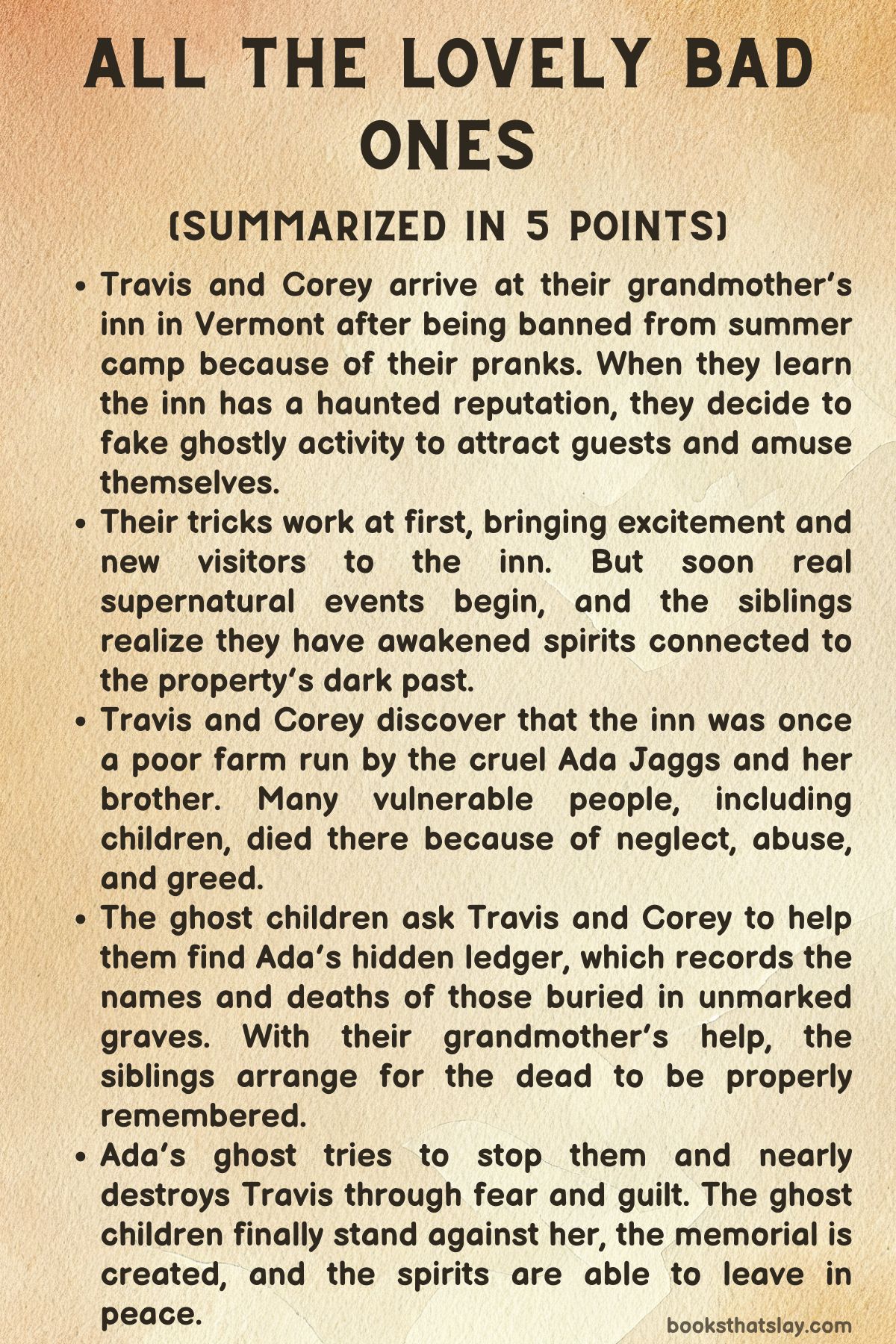
Travis and Corey are spending the summer with their grandmother at the Inn at Fox Hill in rural Vermont. Their parents think the visit will keep them out of trouble, especially after the siblings caused so much mischief at camp that they were not allowed to return.
Their grandmother does not know the full reason they chose her inn over camp, and the children are eager for a summer with fewer rules. At first, the inn seems peaceful, even dull.
It is a large old building with a wide lawn, a grove of trees, and only a few guests. But Travis and Corey soon learn that the inn has a ghostly reputation.
A book about haunted inns claims that Fox Hill has been the site of many strange events. Guests once reported seeing a woman in white, hearing children running through the halls, and losing small items to unseen hands.
Their grandmother insists that none of it is true. She has never seen a ghost, though she admits that a real haunting might help business.
Travis and Corey immediately see an opportunity. They love pranks, and they decide to pretend to be ghosts in order to scare guests and make the inn famous again.
Their plan begins when a couple interested in hauntings arrives at the inn. Corey tells a convincing ghost story, and the guests believe her.
Travis and Corey then buy makeup and props in town, and Corey dresses in white to appear as a ghostly figure in the grove at night. She screams and moans while Travis helps her sneak around.
Their trick works. Guests become excited, rumors spread, and more people come to the inn hoping to see something supernatural.
At first, the siblings are delighted. They think they are helping their grandmother by attracting business.
But Travis begins to feel uneasy. When he and Corey go into the grove, he senses that something is watching them.
The atmosphere changes from playful to threatening. Their fake haunting seems to stir up something real.
More strange events follow. Guests hear noises, doors are rapped on, lights appear, and Tracy, the young waitress, has a frightening experience in the grove.
She says she saw a face and felt an evil presence. Travis and Corey know they caused some of the disturbances, but not all of them.
Soon they begin to hear giggling, feel cold air, and experience things they cannot explain. Corey’s room is attacked by unseen forces: furniture shakes, clothes fly, and invisible hands pinch them.
Their grandmother still tries to blame the children, but even she struggles to explain what is happening.
The inn’s workers, Martha and Henry Brewster, know more than they say. They warn the children to stay away from the grove and blame them for waking the ghosts.
Travis and Corey discover small numbered stones near the trees and slowly realize they have found a graveyard. The land around the inn hides a terrible history.
In the library, the siblings find a pamphlet that reveals the truth. Long before the building became an inn, it was a poor farm run by Ada Jaggs and her brother.
Instead of caring for the poor, sick, and homeless people sent there, the Jaggs siblings stole money meant for them. The residents were starved, beaten, frozen, and neglected.
Many died, including children. Ada was especially cruel.
After an investigation exposed the wrongdoing, her brother abandoned her, and she hanged herself in the grove.
The ghosts Travis and Corey awakened are the spirits of children who died at the poor farm. Caleb, Seth, Ira, and others appear to the siblings.
They call themselves the shadow children. Though they can be playful and troublesome, they are also frightened.
Miss Ada’s ghost still rules over them. She punishes them by forcing them to remember the pain, hunger, fear, and grief they suffered while alive.
The children explain that Travis and Corey woke Ada as well as them, and now they must help put everything right.
The ghost children show Travis and Corey visions of the past. The siblings see families arriving at the poor farm, only to be separated and mistreated.
They watch Caleb punished for speaking up. They see people freezing, starving, and working in terrible conditions while Ada and her brother live comfortably on stolen money.
They witness the deaths of children locked outside in the cold. The numbered stones in the yard mark the graves of those victims.
Travis and Corey are horrified. Their prank has forced them to face real suffering.
They no longer think of the ghosts as entertainment. The children are trapped because their deaths were hidden, their graves were unnamed, and Ada’s crimes were never fully known.
The ghost children want proper remembrance. They ask Travis and Corey to find Ada’s secret account book, which lists the names, ages, deaths, and burial numbers of the people who died at the poor farm.
Their grandmother finally believes in the haunting after objects move by themselves in front of her. Once she accepts the truth, she can see the ghost children too.
Mrs. Brewster also admits that her family has known about the spirits for generations. She has a family connection to Seth and has quietly tried to care for the children’s memory.
Travis and Corey learn that Ada’s account book may be buried with her. Though terrified, they agree to dig up her grave in the grove.
At night, with help from the ghost children, they uncover Ada’s coffin and find a rusty box clutched by her skeleton. Inside is the ledger.
Travis copies the names of all sixty-seven people listed in the book. The discovery gives the children a way to restore dignity to the dead.
Their grandmother takes action. She arranges for a memorial stone to be made for all those buried on the property.
She also gives the ledger to the historical society so the truth about the poor farm can be preserved and shared. The ghost children are grateful, but the danger is not over.
Ada wants her ledger back, and she is furious that her crimes will be exposed.
Ada attacks Travis and Corey. She forces Travis to see himself through her cruel eyes, making him feel worthless and guilty for every bad thing he has done.
She tries to convince him that he deserves punishment. Under her power, Travis nearly hangs himself from the same tree where Ada died.
Corey is also in danger, and Travis manages to resist because he wants to protect his sister.
The ghost children come to help. They stand against Ada and realize that she can only control them if they fear her.
Together, they confront her. They demand that she admit what she did and apologize, but Ada refuses.
A dark figure appears, and Ada believes it is her brother coming for her. Instead, it is a force of punishment.
Even then, she tries to bargain and sacrifice Travis and Corey to save herself. Her selfishness seals her fate, and she is taken away forever.
With Ada gone, the inn becomes peaceful. The memorial stone arrives, and the ghost children gather to see their names and the names of their families honored at last.
Mrs. Brewster says goodbye to Seth and tells him that her family kept its promise to remember him. Ira gives Grandmother gold coins stolen long ago from the poor farm.
She decides to donate the money to help people in need, returning it in spirit to those it was meant to serve.
That night, the ghost children say farewell. They are no longer trapped by fear, hidden graves, or Ada’s cruelty.
They rise into the sky, guided by the stars. Travis and Corey’s summer began with a selfish prank, but it ends with courage, truth, and restitution.
By facing what they awakened, they help the forgotten dead finally go home.
Characters
Travis
Travis is the central viewpoint character and the older of the two siblings. At the beginning of All The Lovely Bad Ones, he is clever, restless, and drawn to trouble.
He enjoys pranks not only because they are funny to him, but because they give him a sense of control and excitement. His decision to fake a haunting at his grandmother’s inn shows both imagination and immaturity.
He tells himself that he and Corey are helping their grandmother’s business, but he is also chasing the thrill of getting away with something. This makes him a believable young protagonist: he is not cruel, but he is careless, and he does not think deeply about consequences until those consequences become impossible to ignore.
Travis’s growth comes through fear, guilt, and responsibility. Once the real ghosts appear, he is forced to admit that his game has awakened pain that is far older and more serious than he understood.
His attitude toward the ghost children changes from curiosity to sympathy. He begins to see them not as a spooky adventure, but as children who were neglected, abused, and forgotten.
This shift is important because Travis must move from being a troublemaker to being someone who repairs harm. His confrontation with Miss Ada also exposes his insecurity.
When she makes him see his worst traits, he almost believes her. His strength lies in his love for Corey, which helps him resist Ada’s control.
By the end, Travis has not become perfect, but he has become more thoughtful, braver, and more aware of the moral weight of his actions.
Corey
Corey is Travis’s younger sister, and she is just as mischievous as he is, though her personality is more theatrical. She loves ghost stories, enjoys attention, and has a talent for convincing lies.
Her fake stories about seeing spirits show how easily she can perform for an audience. Corey is often the more dramatic of the siblings, especially when she dresses as the woman in white and acts out the haunting in the grove.
At first, she treats ghosts as entertainment, something exciting and harmless. Her confidence depends on the belief that she and Travis are the ones creating the fear.
As the haunting becomes real, Corey’s fear appears more openly than Travis’s, but that does not make her weak. In many ways, she is more emotionally honest than her brother.
She admits when she is scared, and she is quicker to understand that the ghost children deserve compassion. Corey’s sympathy becomes especially clear when she tries to stand up to Miss Ada and defend the children.
She feels the seriousness of what they have done and wants to make it right, even when the solution is frightening. Corey also helps reveal Travis’s softer side because his protective feelings for her become essential during the final confrontation.
Her character balances mischief with sensitivity. She begins as a child looking for thrills and ends as someone who understands that real suffering should never be treated as a game.
Grandmother
Grandmother owns the Inn at Fox Hill and represents practicality, order, and disbelief. She is loving toward Travis and Corey, but she is also firm, especially when she suspects them of causing trouble.
Her refusal to believe in ghosts is not simply stubbornness; it is also tied to her need to keep the inn running. She wants rational explanations because the alternative would mean accepting that her business, her home, and her guests are all under threat.
Even when strange things happen, she tries to explain them away as pranks, accidents, or the work of attention-seeking ghost hunters.
Her character changes when the evidence becomes undeniable. Once she sees objects moving by themselves, she finally accepts the truth and becomes able to see the ghost children.
This moment marks a turning point for her. Grandmother moves from denial to action.
She listens to the children, supports Travis and Corey, arranges for the memorial, and takes the account book to the historical society. Her practical nature becomes useful once she stops rejecting the supernatural.
She does not merely feel sorry for the dead; she helps create a public record and a lasting memorial. Grandmother’s role shows that adults may fail when they refuse to see what is uncomfortable, but they can also help restore justice once they accept the truth.
Miss Ada Jaggs
Miss Ada is the main antagonist and the darkest figure in All The Lovely Bad Ones. In life, she helped run the poor farm with cruelty and greed.
She and her brother accepted money meant to care for vulnerable people, then kept much of it for themselves while the residents suffered from hunger, cold, overwork, and abuse. Ada’s evil is not abstract.
It is shown through her treatment of children, families, and the powerless. She separates loved ones, punishes resistance, and uses fear to keep control.
Even after death, she remains attached to power rather than remorse.
As a ghost, Ada continues the same pattern of domination. She terrifies the shadow children and forces them to relive the pain of their lives.
She cannot accept guilt, and she hates the possibility that her crimes will be exposed. Her ledger represents the truth she tried to bury.
When Travis and Corey find it, they threaten the false silence that has protected her reputation. Ada’s attack on Travis is psychological as much as physical.
She tries to make him believe he is worthless, showing that her power depends on shame and fear. Her downfall comes because she refuses to apologize or change.
Even when given a chance to show remorse, she clings to selfishness. Ada is frightening because she embodies cruelty without repentance.
Caleb
Caleb is one of the main ghost children and often acts as a leader among them. He is serious, direct, and more mature than many of the others.
His experiences at the poor farm have made him wary, but he is not without hope. When he tells Travis and Corey that they woke the spirits and must help put them back to sleep, he places responsibility on them without treating them as enemies.
Caleb understands that the siblings made a foolish mistake, but he also sees that they can help repair it.
His past makes him one of the most sympathetic characters. Through him, the reader sees the cruelty of the poor farm in personal terms.
He was punished for speaking up, separated from his family, and forced to endure terrible conditions. Yet Caleb does not become cruel in return.
He wants proper remembrance for the dead and freedom from Ada’s power. He also helps guide Travis and Corey toward the account book.
Caleb’s strength lies in his moral clarity. He remembers what happened, wants the truth known, and refuses to let fear of Ada last forever.
During the final confrontation, his question to Ada about her own guilt strikes at the center of her denial. Caleb represents wounded innocence, courage, and the need for justice.
Seth
Seth is another important ghost child, and his connection to Mrs. Brewster gives him a special place in the story. He is part of the group of shadow children, but he is also tied to a living family that has remembered him across generations.
This connection gives his character a sense of continuity. He is not only a ghost from the past; he is someone whose memory has been carried quietly by the Brewsters.
Mrs. Brewster’s promise that her family watched over him shows that remembrance can survive even when official history fails.
Seth shares the other ghost children’s playfulness and fear. Like them, he sometimes enjoys mischief, but he also wants rest.
His suffering under Ada’s control has made him long for peace rather than endless haunting. Seth’s character helps show that the ghosts are still children.
They may make noise, frighten guests, and behave badly at times, but beneath that behavior is trauma. They are trapped between childhood energy and the pain of unjust death.
His farewell is especially meaningful because it closes a family duty that has lasted for generations. Through Seth, the story shows how private memory can preserve what public records erase.
Ira
Ira is one of the livelier ghost children and often brings humor and mischief into the story. He swings from chandeliers, plays tricks, and seems to enjoy the chaos that ghosts can create.
Yet Ira is not simply comic relief. His playfulness exists beside deep suffering.
Like the other children, he has endured Ada’s cruelty and fears the pain she can force him to feel. His behavior reminds the reader that the shadow children were denied ordinary childhood.
Their pranks are sometimes childish fun, but they also come from years of being trapped without peace.
Ira also has insight into the supernatural world. He explains that many exorcisms fail because people do not take time to understand the spirits involved.
This comment is important because it separates true help from performance. Ira knows that the ghost children do not need spectacle; they need recognition, truth, and freedom from Ada.
His final gift of the stolen gold coins also reveals his moral sense. He wants the money returned to its proper purpose, helping the poor rather than benefiting those who stole from them.
Ira’s character combines humor, wisdom, and a strong sense of justice.
Martha Brewster
Martha Brewster is the inn’s cook, and at first she seems stern, unfriendly, and difficult to approach. She does not welcome Travis and Corey’s questions, and she often speaks sharply.
As the story develops, however, her behavior becomes easier to understand. Martha knows that the ghosts are real, and she recognizes the danger of disturbing them.
Her harshness comes from fear, grief, and the burden of knowledge. She has lived with the inn’s secret longer than Travis, Corey, or Grandmother, and she understands that the past has not truly passed.
Martha’s connection to Seth gives her character emotional depth. Her family has remembered him and watched over his spirit for generations.
This makes her a guardian of memory, even if she cannot solve the problem alone. She also understands the difference between the playful ghost children and the evil force of Miss Ada.
When she scolds the spirits or warns the siblings, she is trying to protect both the living and the dead. Martha’s role shows how people can carry inherited responsibility.
She may appear cold, but her actions reveal loyalty, sorrow, and a quiet commitment to those who were wronged.
Henry Brewster
Henry Brewster is quiet, watchful, and cautious. Like Martha, he knows more about the inn than he initially reveals.
His warnings to Travis and Corey are serious because he understands that the grove and the numbered stones are connected to real danger. He is not interested in entertaining ghost hunters or encouraging stories.
Instead, he believes some places should have been left undisturbed. His attitude suggests that the inn’s transformation into a business has covered over a history that deserved respect.
Henry’s silence can seem frustrating, especially when Travis wants answers. Yet his reluctance also reflects the difficulty of speaking about painful history.
He knows that the ghosts are not a harmless attraction. He has likely seen earlier disturbances and understands how easily curiosity can become danger.
Henry functions as a warning figure in the story. He cannot stop the haunting by himself, but he recognizes its seriousness before most others do.
His character adds weight to the idea that some secrets are not hidden because they are meaningless, but because they are painful and powerful.
Tracy
Tracy is the young waitress and maid at the inn. At first, she is curious about ghosts and claims that she has never had any luck seeing one.
Her attitude is casual compared with the Brewsters’ fear and Grandmother’s disbelief. But after her experience in the grove, Tracy changes quickly.
She sees or senses something evil, and the encounter leaves her shaken. Her reaction helps confirm that the haunting is no longer just Travis and Corey’s prank.
Tracy’s fear is important because she is not part of the siblings’ game. Her terror shows that the supernatural events are reaching innocent people who had nothing to do with waking the spirits.
She also becomes a measure of how dangerous the inn has become. When she considers leaving, Grandmother is forced to confront the practical consequences of the haunting.
Tracy is not a deeply developed character compared with Travis, Corey, or the ghost children, but she plays an important role in shifting the tone. Through her, the story shows how easily careless actions can affect bystanders.
Miss Eleanor Duvall
Miss Eleanor Duvall is a self-proclaimed psychic and ghost hunter. She enters the story as someone eager to interpret the events at the inn as evidence of paranormal activity.
Grandmother distrusts her and sees her as a fraud, and the ghost children later confirm that she and Chester are not truly gifted. Still, Miss Duvall is not entirely useless to the story.
Her presence increases the pressure around the haunting and gives the guests someone who validates their fear.
Miss Duvall also serves as a contrast to the real work of helping the ghosts. She is interested in signs, performances, and dramatic claims, but she does not understand the spirits as suffering individuals.
Her approach treats the haunting as an investigation or spectacle. The story eventually shows that this is not enough.
The dead cannot be helped by attention alone. They need truth, names, memory, and courage.
Miss Duvall’s character helps criticize the shallow fascination with ghosts when it ignores the human pain behind them.
Chester Coakley
Chester Coakley is Miss Duvall’s assistant, and he brings equipment, photographs, and the manner of a paranormal investigator. Like Miss Duvall, he is more interested in proving a haunting than understanding its cause.
His arrival makes the inn feel even more chaotic, especially because Grandmother already resents the ghost hunters. Chester’s presence increases conflict between belief and disbelief, performance and reality.
Although Chester is not the source of the haunting, he is part of the group that turns the inn’s suffering history into an attraction. His tools and investigations seem impressive, but they do not solve the real problem.
The story uses him to show the limits of curiosity without compassion. He can document strange events, but he cannot free the ghost children.
The actual solution comes from listening to the spirits, finding the ledger, honoring the dead, and confronting Ada. Chester’s character therefore supports one of the story’s central contrasts: witnessing a haunting is not the same as understanding it.
Mr. and Mrs. Jennings
Mr. and Mrs. Jennings are guests who arrive at the inn already interested in ghosts. Their copy of the haunted inns book shows that they want a supernatural experience, and Corey’s false story easily convinces them.
They help spread excitement about the haunting, bringing more attention and more guests to Fox Hill. In the early part of the story, they are part of the comic side of the plot because they are so eager to believe.
Their role becomes more serious as the fake haunting turns real. The Jenningses show how public fascination can feed a situation before anyone understands the danger.
They are not malicious, but their excitement encourages Travis and Corey to continue. They want to see ghosts, but they are not prepared for the reality of the inn’s past.
As supporting characters, they help move the plot from a private prank to a public disturbance. They also show how people can be drawn to haunted places for entertainment while knowing nothing about the suffering that created the haunting.
Mr. Nelson
Mr. Nelson is a longtime guest at the inn and a skeptic. He dislikes the fuss caused by ghost hunters and does not believe in the supernatural.
His attitude contrasts with guests like the Jenningses, who arrive hoping for a haunting. Mr. Nelson values the inn as a place to stay rather than as a spooky attraction.
Because of this, he helps show how the haunting affects different kinds of guests.
His role is small but useful. He represents ordinary irritation in the face of sensationalism.
While some people are thrilled by ghost stories, he finds them disruptive. His skepticism also supports Grandmother’s early position, though the story later proves both of them wrong.
Mr. Nelson reminds the reader that not everyone wants mystery or fear. Some people simply want peace, and Travis and Corey’s actions disturb that peace before they understand what they have awakened.
Mr. Jaggs
Mr. Jaggs, Ada’s brother, is one of the villains of the past. Though Ada is the more active ghostly threat, her brother shares responsibility for the suffering at the poor farm.
He helped steal money meant for the residents and lived comfortably while vulnerable people starved and froze. His abandonment of Ada after the investigation reveals his cowardice.
He benefits from cruelty but flees when consequences approach.
His character matters because he shows that evil in the story is not limited to one person’s temper or harshness. The poor farm’s horror was built on greed, neglect, and a system that allowed people like the Jaggs siblings to control the lives of the powerless.
Mr. Jaggs may not haunt the inn in the same direct way Ada does, but his actions helped create the tragedy. He represents corruption without loyalty, someone willing to exploit others and then save himself.
Joseph
Joseph is Miss Ada’s helper at the poor farm, and his role shows how cruelty is often carried out by people who obey orders. He locks the boys outside in the cold when Ada demands punishment, and their deaths follow from that act.
Joseph may not hold the same authority as Ada or her brother, but he still participates in the abuse. His later fear of the ghost children suggests that he understands, at least partly, the horror of what he helped do.
Joseph’s character raises questions about responsibility. He is not the main villain, but he cannot be treated as innocent.
By carrying out Ada’s commands, he becomes part of the system that kills the children. The fact that the ghost children scare him away gives them a small form of justice, though it cannot undo their deaths.
Joseph represents the danger of obedience without conscience. His actions show that harm is often made possible not only by powerful abusers, but also by those who assist them.
Themes
Responsibility for One’s Actions
Travis and Corey begin with a prank that seems harmless to them. They want to scare guests, create excitement, and perhaps help their grandmother’s struggling inn.
Their mistake lies in treating fear as a toy and the inn’s haunted reputation as a stage for their own amusement. Once real spirits appear, the siblings cannot simply say they did not mean any harm.
The story makes them face the difference between intention and consequence. They did not create the suffering at Fox Hill, but they did disturb it.
That means they have a duty to help repair what they have awakened.
Their responsibility grows throughout the novel. At first, they hide, deny, and argue, behaving like children who want to escape punishment.
Later, they listen to the ghost children, search for the ledger, dig up Ada’s grave, copy the names of the dead, and help arrange a memorial. These actions are difficult and frightening, but they show maturity.
Responsibility is not presented as a simple apology. It requires courage, effort, and a willingness to face uncomfortable truths.
All The Lovely Bad Ones uses the siblings’ journey to show that growing up means accepting the results of one’s choices and working to make things right.
The Need to Remember the Forgotten
The ghosts at Fox Hill are trapped not only because they died unjustly, but because their lives and deaths were hidden. The numbered stones are one of the strongest symbols in the story.
They mark graves without names, reducing people to figures in the ground. This reflects the way the poor farm treated its residents while they were alive.
They were not valued as full human beings. They were neglected, abused, and then buried without proper public memory.
Their suffering remained present, but unacknowledged.
The search for Ada’s ledger becomes a search for identity. The book contains names, ages, dates, and burial numbers, turning the dead from anonymous victims into people who can be remembered.
The memorial stone serves a similar purpose. It gives the lost a visible place in history.
The story suggests that memory is a form of justice. It cannot bring the dead back, but it can correct the silence that allowed their suffering to disappear.
The historical society’s role also matters because private knowledge becomes public record. The truth is no longer a secret held by ghosts and a few frightened people.
By naming the dead, the living restore dignity to those who were denied it.
Cruelty, Power, and the Abuse of the Vulnerable
The poor farm’s history reveals a harsh abuse of power. Ada and her brother were trusted to care for people who had nowhere else to go, including children, the sick, the poor, and the elderly.
Instead, they used that power for profit. They stole money, withheld food, separated families, and punished anyone who resisted.
Their cruelty is especially disturbing because their victims depended on them for survival. The story shows that power becomes dangerous when there is no compassion, accountability, or respect for human dignity.
Miss Ada’s ghost continues the same pattern after death. She cannot give up control.
She frightens the ghost children, forces them to relive pain, and tries to dominate Travis by filling him with shame. Her power depends on making others feel small, helpless, and afraid.
This is why the final confrontation matters. The ghost children weaken her by refusing to fear her.
When they stand together, Ada’s control breaks. The story does not excuse cruelty by giving Ada a sympathetic reason for her behavior.
Instead, it shows that some people choose selfishness again and again. Her refusal to apologize proves that her punishment comes not only from what she did, but from what she still refuses to become.
Fear, Courage, and Moral Growth
Fear appears in many forms throughout the story. There is the fun fear that Travis and Corey try to create with costumes, makeup, screams, and fake ghostly tricks.
Then there is real fear: the sense of being watched in the grove, the terror Tracy feels, the chaos in Corey’s room, and the threat of Miss Ada’s power. The story carefully separates these two kinds of fear.
Fake fear is entertainment. Real fear carries danger, pain, and consequence.
Travis and Corey must learn the difference before they can grow.
Courage in the novel does not mean the absence of fear. Corey is often openly frightened, and Travis tries to hide his fear until he can no longer deny it.
Yet both of them act despite being scared. They search for the truth, help the ghost children, and face Ada when running away would be easier.
Travis’s greatest moment of courage comes when he resists Ada’s attempt to make him destroy himself. He does so because he loves Corey and understands that he must protect her.
The ghost children also show courage when they stand against Ada together. Their bravery comes from unity and from the realization that fear has helped keep them trapped.
Moral growth happens when fear no longer controls their choices.