All the President’s Men Summary and Analysis
All the President’s Men is a landmark nonfiction account of investigative journalism at its most persistent and consequential. Written by Bob Woodward and Carl Bernstein, the book follows their reporting for The Washington Post after the 1972 break-in at the Democratic National Committee offices in the Watergate complex.
What begins as a strange burglary becomes a trail of secret funds, political spying, intimidation, and cover-up reaching into President Richard Nixon’s White House. The book is not only about scandal; it is about verification, pressure, mistakes, sources, editors, and the difficult work of proving the truth when powerful people want it buried.
Summary
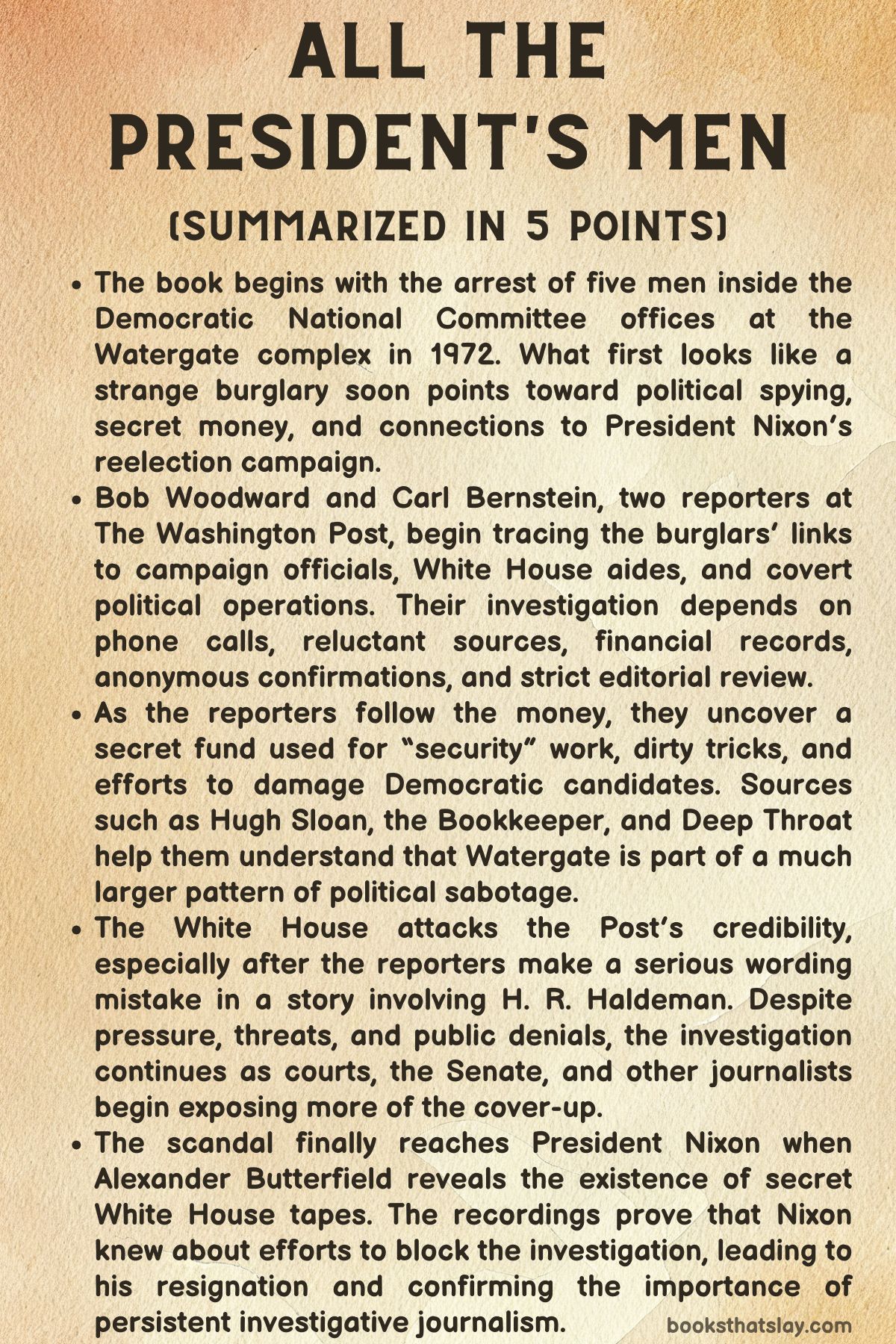
All the President’s Men begins with what appears to be a minor police story. In the early hours of June 17, 1972, five men are arrested inside the Democratic National Committee offices at the Watergate complex in Washington, D.C. They are carrying cameras, film, lock picks, listening devices, tear-gas guns, and large amounts of cash.
Their clothing, equipment, and false names suggest that this is not an ordinary burglary. Bob Woodward, then a young Washington Post reporter, attends the first hearing and learns that one of the men, James McCord, has ties to the CIA and works as a security consultant.
Woodward and Carl Bernstein begin digging into the burglars’ backgrounds. Their reporting quickly points beyond the men arrested in the building.
Address books and phone records lead them to Howard Hunt, a White House consultant, and then to Charles Colson, a special counsel to President Nixon. The break-in starts to look connected to the Committee to Reelect the President, known as CRP.
McCord’s recent work for the committee and the presence of campaign money around the burglars raise a central question: who ordered the operation, and how high did approval go?
The reporters follow the money. Bernstein travels to Florida and traces checks that passed through banks in Mexico and the United States before landing in accounts connected to Bernard Barker, one of the burglars.
The financial trail leads toward CRP officials and suggests the existence of a secret cash fund. As Woodward and Bernstein press sources inside campaign finance offices, they learn of large amounts of unaccounted cash used for “security” work.
A reluctant source they call the Bookkeeper helps confirm that the fund paid several people, including G. Gordon Liddy, who had been linked to the Watergate operation.
Inside The Washington Post, the reporting is handled with extreme care. Editors Barry Sussman and Ben Bradlee demand that every claim be checked, challenged, and supported.
Woodward and Bernstein develop a tense but effective partnership. They divide sources, make endless phone calls, compare notes, draft stories, and argue over wording.
They agree that if either reporter is unsure about a story, they will not publish it. This rule becomes essential as the investigation grows more dangerous and politically explosive.
A crucial source emerges: Deep Throat, a high-level informant known only to Woodward. He confirms parts of the reporters’ findings and pushes them to look beyond isolated facts.
He warns that the Watergate break-in is part of something much larger. Through secret meetings in parking garages, he indicates that senior campaign and White House figures are involved.
His information rarely gives the reporters enough to print on its own, but it helps them understand where to look and when they are on the right track.
The investigation reaches John Mitchell, former attorney general and head of CRP. Hugh Sloan, a former CRP treasurer, confirms the existence of secret funds and says Mitchell had control over them.
The reporters learn that documents were destroyed after the break-in, making proof difficult. When Bernstein reads a proposed story to Mitchell, Mitchell reacts with anger and threats, including a vulgar warning aimed at Post publisher Katharine Graham.
The Post publishes anyway, marking a major escalation in the confrontation between the newspaper and Nixon’s circle.
The story broadens when Woodward and Bernstein uncover “dirty tricks” operations designed to sabotage Democratic candidates. A lawyer named Alex Shipley tells them that Donald Segretti tried to recruit him into a campaign of deception, fake communications, planted confusion, and political sabotage.
The goal was to damage Democratic primary campaigns and leave the eventual nominee weakened. Further reporting connects these operations to money and authority from Nixon’s campaign structure.
Another lead involves Ken Clawson, a former Post reporter who joined the White House. He is said to have boasted about forging the “Canuck letter,” a damaging fake document that helped ruin Edmund Muskie’s presidential campaign.
The Post handles the story cautiously because the source is another reporter, Marilyn Berger, and the paper is alert to any sign that it could be accused of personal or political bias. The reporters also learn that the FBI had uncovered many leads but had not fully pursued them, suggesting that the official investigation may have been restricted.
The White House strikes back. Press secretary Ronald Ziegler attacks the Post’s Watergate coverage as unreliable and politically motivated.
Nixon allies claim the paper is trying to help George McGovern and damage the president before the election. The attacks are designed not only to refute specific stories but to destroy public trust in the Post’s reporting.
This pressure increases after Woodward and Bernstein try to connect White House chief of staff H. R. Haldeman to the secret fund. Their story contains a serious wording error: it implies that Sloan testified under oath about Haldeman’s direct access to the fund, which Sloan’s lawyer denies.
The broader suspicion about Haldeman may be correct, but the published detail is not solid enough. The White House seizes on the mistake to discredit the investigation.
After Nixon’s reelection, the reporters struggle to regain momentum. They question sources, follow Segretti, and even risk angering Judge John Sirica by approaching grand jurors.
Their work is slow and often frustrating. A new source, called Source Z, advises them to stop trying to prove everything at once and instead document the many separate dirty tricks operations.
That approach helps them show a larger pattern of misconduct.
The trial of the Watergate burglars and their handlers opens, but the prosecution presents a narrow version of events that protects senior officials. Several defendants plead guilty.
Soon, reports emerge that Howard Hunt pressured the burglars to keep quiet and that some were promised money while in prison. Judge Sirica becomes suspicious and questions the defendants sharply.
Their evasive answers expose how much remains hidden.
The Senate then enters the story. Senator Sam Ervin launches a select committee investigation, giving Watergate a powerful public forum.
At the same time, Patrick Gray, acting FBI director, testifies during confirmation hearings and admits that FBI materials were turned over to White House counsel John Dean. He also reveals information about Donald Segretti’s recruitment by Herbert Kalmbach, Nixon’s personal lawyer.
These admissions validate months of reporting and show that the dirty tricks operation reached into Nixon’s inner circle.
A major break comes when James McCord writes to Judge Sirica, claiming that defendants lied under oath and were pressured to plead guilty. McCord’s claims lead to more leaks, more testimony, and growing pressure on the White House.
Jeb Magruder, John Dean, John Mitchell, Haldeman, Ehrlichman, and others begin appearing in competing accounts as insiders try to protect themselves by shifting blame. The unity of the Nixon operation collapses into accusation and self-preservation.
Nixon responds publicly by accepting limited responsibility while presenting himself as misled by subordinates. Ziegler apologizes to the Post for earlier attacks.
Yet the scandal keeps expanding. Reports reveal years of wiretaps against officials and reporters.
Deep Throat warns Woodward that the reporters themselves may be targeted, increasing their fear of surveillance and retaliation.
The final decisive revelation comes from Alexander Butterfield, a White House aide who tells Senate investigators that Nixon secretly recorded conversations in the Oval Office and elsewhere. The tapes transform Watergate from a battle of testimony into a battle over evidence.
Nixon fights to keep the recordings private, but the legal pressure grows. Some tapes are missing or damaged, including one with a famous eighteen-and-a-half-minute gap.
The most damaging tape records Nixon and Haldeman discussing how to use the CIA to block the FBI investigation soon after the break-in. It proves that Nixon knew far more than he had admitted and took part in the cover-up.
Facing impeachment and political ruin, Nixon resigns on August 9, 1974.
All the President’s Men ends as both a record of scandal and a portrait of reporting under pressure. Woodward and Bernstein are not shown as heroes without flaws; they make mistakes, argue, doubt themselves, and depend on editors who force discipline on their work.
The book’s power lies in its attention to process: the calls, denials, anonymous sources, late-night meetings, cautious wording, and repeated effort required to move from suspicion to proof.
Key People
Bob Woodward
Bob Woodward is presented as a disciplined, persistent, and cautious reporter whose strength lies in methodical investigation. He is often the one who works through official channels, legal sources, police contacts, and government insiders.
His reporting style depends on patience, repetition, and careful confirmation. He is not portrayed as a glamorous figure but as someone willing to make call after call, revisit hesitant sources, and sit with uncertainty until the facts become strong enough to print.
His relationship with Deep Throat shows both his access and his restraint. He receives valuable guidance, but he cannot simply publish what he is told; he must convert hints and confirmations into verifiable journalism.
Woodward’s caution also creates tension with Bernstein, especially when a story seems powerful but not fully proven. In All the President’s Men, Woodward represents the controlled side of investigative reporting: the need to listen carefully, protect sources, check language, and resist the excitement of a big revelation until the evidence can carry it.
Carl Bernstein
Carl Bernstein is more instinctive, aggressive, and improvisational than Woodward. He often follows leads through human pressure, persuasion, and emotional intelligence.
His reporting in Florida, where he traces financial records and pushes reluctant people to speak, shows his ability to work outside formal systems. Bernstein has a strong feel for people, and he often senses when a source wants to talk but needs to be guided toward disclosure.
He can be bold, even reckless, but his boldness is one reason the investigation keeps moving. His partnership with Woodward works because their differences become useful rather than destructive.
Bernstein brings urgency, imagination, and nerve, while Woodward brings discipline and restraint. He is also deeply committed to the story, sometimes to the point of obsession.
His character shows how investigative journalism is not only about documents and facts but also about reading fear, guilt, pride, and hesitation in the people who hold pieces of the truth.
Ben Bradlee
Ben Bradlee, the executive editor of The Washington Post, serves as the powerful editorial conscience behind the investigation. He is tough, skeptical, demanding, and protective of the paper’s credibility.
Bradlee understands that the Watergate story is politically explosive and that any major error can be used to destroy the entire investigation. For that reason, he pushes Woodward and Bernstein to prove what they know, sharpen their wording, and separate suspicion from fact.
He does not simply cheer them on; he challenges them, cuts weak material, and forces them to defend every claim. His role becomes especially important after the Haldeman mistake, when the Post’s reputation is attacked by the White House.
Bradlee’s leadership shows that journalism is a collective act. Reporters may gather the facts, but editors decide whether those facts are strong enough to face public, legal, and political pressure.
He embodies courage, but his courage is tied to standards rather than impulse.
Barry Sussman
Barry Sussman is one of the key newsroom figures who manages the day-to-day Watergate coverage. He is practical, detail-oriented, and deeply involved in shaping the investigation into publishable stories.
At first, he nearly pulls Woodward and Bernstein away from the story, which shows his concern about newsroom priorities and the uncertainty of the early leads. As the evidence grows, however, he becomes one of the investigation’s crucial supporters.
Sussman helps organize the reporting, questions weak claims, and recognizes the scale of what the reporters are uncovering. He is less publicly famous than Bradlee, Woodward, or Bernstein, but his presence matters because he represents the editorial machinery that turns scattered facts into a sustained investigation.
His character also highlights the pressure inside the newspaper itself. The reporters do not only have to fight official secrecy; they also have to convince their own editors that the story is real, important, and ready for publication.
Katharine Graham
Katharine Graham, the publisher of The Washington Post, stands in the background for much of the story, but her importance is enormous. As publisher, she carries the financial, legal, and institutional risk of the paper’s reporting.
When John Mitchell threatens the Post and makes a vulgar remark about her, the threat is not merely personal; it is meant to intimidate the entire organization. Graham’s position shows the vulnerability of a newspaper taking on the presidency.
The White House can attack credibility, restrict access, encourage investigations into business dealings, and damage stock value. Graham’s strength lies in allowing the newsroom to continue despite those dangers.
Her character represents institutional courage: not the dramatic act of chasing a source, but the harder decision to stand behind reporters and editors when the cost could be severe. Her presence reminds the reader that press freedom depends not only on brave reporting but also on owners willing to protect editorial independence.
Deep Throat
Deep Throat is the most mysterious and symbolically powerful source in the narrative. He does not hand Woodward complete stories; instead, he confirms, warns, redirects, and occasionally frightens.
His secrecy shapes the atmosphere around the investigation. Meetings in parking garages, coded signals, and guarded conversations reveal how dangerous the political environment has become.
Deep Throat understands the structure of the conspiracy better than most sources, but he also protects himself by refusing to give too much. This makes him both invaluable and frustrating.
His role is not to replace reporting but to keep the reporters from losing direction. He confirms that they are not chasing isolated misconduct but a larger system of political sabotage and cover-up.
Deep Throat also reveals the moral complexity of sources. He may be helping the truth come out, but he is also managing his own risk, access, and motives.
In All the President’s Men, he represents hidden knowledge inside a government that is publicly denying everything.
Hugh Sloan
Hugh Sloan is one of the most important official sources because he connects the reporters to the secret financial operations of CRP. As a former treasurer, he has access to the money trail, but he is also cautious, frightened, and morally troubled.
Sloan is not portrayed as a hardened political operative. He and his wife are Republicans who believed in Nixon’s cause and wanted to contribute to a campaign they saw as good for the country.
That idealism makes his disillusionment more meaningful. When he sees secret accounts, cash payments, and destroyed records, he becomes a witness to corruption within an organization he had trusted.
His hesitation is understandable because speaking openly could damage his career and place him under enormous pressure. Sloan’s character shows how institutions depend on ordinary insiders who may not design wrongdoing but still become responsible for what they witness.
His struggle is between loyalty to a cause and loyalty to the truth.
The Bookkeeper
The Bookkeeper is a reluctant but vital figure because she helps expose the inner financial structure of CRP. She is not a public power player, yet she has access to records that reveal how money moved through secret channels.
Her importance comes from proximity to paperwork rather than political status. She knows enough to confirm that the slush fund exists and that payments were made to several people involved in campaign operations.
At the same time, she is afraid, cautious, and unwilling to become openly identified. Her character reflects the fear that surrounds the investigation.
Many people inside CRP understand that something is wrong, but they are bound by loyalty, secrecy, workplace pressure, and fear of retaliation. The Bookkeeper shows how major political scandals often become visible through the quiet testimony of people who handle routine administrative work.
Her knowledge is not dramatic in style, but it is essential because it turns rumor into a financial pattern.
H. R. Haldeman
H. R. Haldeman is portrayed as one of the most powerful and feared figures in Nixon’s White House. As chief of staff, he controls access to the President and oversees the execution of presidential priorities.
His reputation is severe, disciplined, and intimidating. Connecting him to Watergate matters because he stands so close to Nixon that his involvement would imply the scandal is not merely a campaign problem but a presidential one.
The reporters struggle to prove his role, and their mistake in wording a story about him becomes one of the most damaging moments in the investigation. Haldeman’s character represents the hard wall of executive power: controlled, silent, and protected by hierarchy.
Even when sources suggest his involvement, they hesitate to speak clearly because they fear his reach. Later revelations show that the suspicion surrounding him was justified.
He becomes a symbol of how power can operate through command, insulation, and deniability.
John Mitchell
John Mitchell is central because he links the campaign, the Justice Department, and the President’s circle. As former attorney general and later head of CRP, he occupies a position that makes the scandal especially serious.
If he authorized or controlled secret funds while still connected to law enforcement authority, then the boundary between government power and campaign misconduct collapses. Mitchell is portrayed as aggressive and threatening when confronted by reporters.
His reaction to Bernstein’s call reveals not only anger but an expectation that power should protect him from exposure. He denies wrongdoing and tries to distance himself from illegal acts, but the reporting repeatedly returns to his role in funding and approving operations.
Mitchell’s character shows how legal authority can become morally compromised when loyalty to political victory overtakes duty to law. He stands at the point where official responsibility and campaign ambition meet.
John Dean
John Dean is one of the most complicated figures in the scandal. As White House counsel, he is supposed to protect legal order inside the administration, yet he becomes deeply associated with the cover-up and the handling of sensitive information.
He appears at first as part of the system trying to manage or contain the investigation. Later, as pressure grows, he refuses to become the sole scapegoat and begins pointing upward toward Haldeman, Ehrlichman, Mitchell, and Nixon himself.
Dean’s character is shaped by self-preservation, legal awareness, and eventual disclosure. He is neither simply a villain nor a pure truth-teller.
His decision to speak comes after he realizes others may sacrifice him to protect themselves. That does not erase his earlier role, but it makes him essential to exposing the larger structure.
Dean shows how a cover-up can turn inward when participants begin to fear that loyalty will not save them.
John Ehrlichman
John Ehrlichman is one of the senior White House figures whose authority gives the scandal a direct connection to Nixon’s inner circle. Along with Haldeman, he forms part of the feared power structure surrounding the President.
His name appears in relation to Howard Hunt, the Plumbers, and the handling of politically dangerous materials. Ehrlichman’s importance lies in the way he helps show that the scandal was not limited to campaign workers acting independently.
He represents the administrative side of political control, where operations can be approved, redirected, buried, or denied. When evidence suggests that he and Dean gave Patrick Gray sensitive files to destroy, Ehrlichman becomes tied not just to political sabotage but to obstruction and concealment.
His character reflects the danger of loyal officials who treat the protection of a president as more important than the law. He is powerful because he operates close to the center while remaining shielded by bureaucracy and hierarchy.
Charles Colson
Charles Colson is presented as a fierce Nixon loyalist and a key link between the White House and some of the darker political operations surrounding Watergate. His connection to Howard Hunt gives the reporters an early path from the burglars toward the President’s staff.
Colson is associated with hardball tactics and intense loyalty to Nixon, making him a figure who embodies the administration’s combative political culture. He is not always shown acting directly in the open; instead, his significance often comes through associations, conversations, and the work of people connected to him.
That indirectness is part of what makes the investigation difficult. Colson’s character helps reveal a world where political loyalty justifies extreme methods and where damaging opponents is treated as part of normal strategy.
He stands for the aggressive mentality that made dirty tricks seem acceptable to those inside the operation.
G. Gordon Liddy
G. Gordon Liddy is one of the clearest operational figures in the Watergate affair. He is tied to the planning and execution of intelligence activities and becomes one of the people most easily cast as a fall guy.
The official version presented at trial tries to place much of the blame on Liddy and Howard Hunt, suggesting that they acted beyond proper authority. Yet the reporters’ work shows that this explanation is too narrow.
Liddy’s role matters because he handles the practical side of covert action: money, plans, surveillance, and coordination. He represents the point where political strategy becomes criminal action.
At the same time, his usefulness as a scapegoat reveals how larger systems protect themselves. By blaming someone like Liddy, senior figures can pretend the scandal was the result of rogue behavior rather than an operation encouraged and funded from above.
Howard Hunt
Howard Hunt is a shadowy and important figure because he connects the burglars, the Plumbers, CRP, and the White House. His intelligence background gives the operation an atmosphere of secrecy and covert technique.
He is involved with the men arrested at Watergate and later appears as someone who pressures them to plead guilty and remain loyal. Hunt’s role extends beyond the break-in.
He is connected to efforts to gather damaging information, influence witnesses, and handle politically explosive materials. He often refers vaguely to his bosses as “they,” which captures the structure of deniability around the operation.
Hunt’s character shows how skills associated with intelligence work can be redirected into domestic political sabotage. He is both an operator and a liability: useful to powerful people when hidden, dangerous to them when exposed.
James McCord
James McCord begins as one of the arrested burglars, but he later becomes one of the figures who cracks the cover-up open. His background as a security consultant and former CIA-linked figure makes him immediately suspicious to Woodward.
At first, he is part of the silence surrounding the case. Later, his letter to Judge Sirica changes the direction of the investigation.
By claiming that defendants committed perjury and were pressured to plead guilty, McCord turns the case from a burglary trial into a broader inquiry into obstruction. His fear for himself and his family shows the pressure placed on participants to stay quiet.
McCord’s character is important because he demonstrates how a conspiracy can begin to fail when one participant decides that silence is more dangerous than disclosure. His shift from defendant to witness helps bring hidden names and hidden payments into public view.
Donald Segretti
Donald Segretti represents the dirty tricks side of the Nixon campaign operation. He recruits people to disrupt Democratic campaigns through deception, false communications, planted confusion, and staged incidents.
His work is not focused on one dramatic crime but on many smaller acts designed to damage trust among political opponents. Segretti’s character is disturbing because he treats sabotage as a clever game.
His language and methods show a political culture that rewards manipulation over honest competition. Yet he also becomes vulnerable after exposure.
Friends distance themselves, his family reacts with shame, and he becomes another damaged participant in a system that used people and then left them exposed. Segretti’s role widens the meaning of Watergate.
The scandal is not just about entering an office illegally; it is about a larger campaign to corrupt democratic competition.
Jeb Magruder
Jeb Magruder is a significant CRP official whose role becomes more important as insiders begin turning on one another. Early on, sources point to him as deeply involved, but he tries to protect himself and others by controlling what is said.
His phone conversation with the reporters shows anxiety and a desire to avoid public ruin. Later, when pressure increases, he becomes one of the figures expected to provide evidence against Dean and Mitchell.
Magruder’s character reflects the unstable loyalty of people inside a collapsing cover-up. While the system appears disciplined when it is powerful, it begins to fracture once legal danger becomes personal.
Magruder’s movement toward cooperation shows how self-protection can become a route to truth, even when moral courage is not the original motive.
Richard Nixon
Richard Nixon is the central absent presence for much of the narrative. He does not dominate the action directly at first, but every lead moves closer to him.
His campaign, aides, lawyers, and loyalists act in his name, and the major question is whether their actions can be traced to the President himself. Nixon’s public posture is one of denial, distance, and later limited responsibility.
He presents himself as misled by subordinates, but the discovery of the White House tapes destroys that defense. The tapes reveal knowledge, calculation, and participation in efforts to block the investigation.
Nixon’s character is defined by control, suspicion, and a belief that political survival can justify extraordinary measures. His resignation is the final result of a system built to protect him but ultimately undone by its own records.
He represents the danger of executive power when loyalty, secrecy, and fear replace accountability.
Ronald Ziegler
Ronald Ziegler, Nixon’s press secretary, is the public voice of the White House’s attack on the Post. His role is not to explain the truth but to manage perception, discredit reporting, and frame the newspaper as politically biased.
He attacks anonymous sourcing, dismisses revelations as gossip, and tries to shift attention toward alleged misconduct by Nixon’s opponents. Ziegler’s character shows how official communication can become a tool of pressure rather than transparency.
His later apology to the Post is significant because it marks a reversal in power. The same spokesperson who once tried to shame the paper is forced to acknowledge that the attacks were wrong.
Ziegler represents the machinery of public denial, and his collapse in confidence mirrors the administration’s weakening position.
Judge John Sirica
Judge John Sirica is one of the key institutional figures who refuses to accept the narrow version of Watergate presented in court. His skepticism is direct and forceful.
When defendants give evasive answers, he presses them. When money appears without explanation, he refuses to pretend the answers are credible.
Sirica’s importance lies in his unwillingness to let the case remain a simple burglary matter. His courtroom becomes one of the first official places where the cover-up begins to crack.
He also disciplines Woodward and Bernstein when they approach grand jurors, showing that his commitment to truth does not mean disregard for legal boundaries. Sirica represents the judiciary’s role in forcing hidden facts into the open.
His pressure on the defendants helps create the conditions for McCord’s letter and the later unraveling of the conspiracy.
Senator Sam Ervin
Senator Sam Ervin becomes central when the Senate begins its Watergate investigation. He brings institutional authority to questions that reporters had been pursuing under pressure and uncertainty.
His committee gives the scandal a public stage and the power to compel testimony. Ervin’s interest in speaking with reporters shows that journalism and formal investigation can reinforce each other, even while remaining separate.
Woodward’s caution about protecting sources during his conversation with Ervin also shows the ethical limits of that relationship. Ervin’s character represents constitutional accountability.
He is not simply chasing scandal; he is part of a process that asks whether executive power has violated democratic law. Through the Senate hearings, the hidden structure of Watergate becomes visible to the country.
Patrick Gray
Patrick Gray, acting director of the FBI, is a revealing figure because his testimony exposes the compromised condition of official investigation. He insists that the FBI pursued Watergate aggressively, yet he also admits turning over sensitive materials to John Dean.
That contradiction damages his credibility and raises serious questions about whether the investigation was truly independent. Gray’s later connection to destroyed files from Howard Hunt’s safe makes his position even more troubling.
He is powerful in title, but his actions suggest dependence on the White House figures he should have been able to investigate without interference. Gray’s character shows how institutions can be weakened when their leaders yield to political pressure.
His failed nomination becomes a turning point because the attempt to formalize his authority instead reveals the depth of the cover-up.
Alexander Butterfield
Alexander Butterfield appears late but changes everything. As a White House aide, he is not one of the most famous or powerful figures in the administration, yet he reveals the existence of Nixon’s secret recording system.
His testimony transforms Watergate from a dispute over memory, denial, and testimony into a fight over recorded evidence. Butterfield’s importance lies in the accidental nature of his role.
He is not shown as a major conspirator or political warrior; he is a witness to a hidden system that Nixon created for control and record-keeping. By revealing the tapes, Butterfield makes it possible to prove what Nixon knew and when he knew it.
His character shows that in a complex scandal, a seemingly secondary figure may hold the fact that changes history.
Themes
Investigative Journalism and the Burden of Proof
The reporting in All the President’s Men is built around a demanding idea: suspicion is not enough. Woodward and Bernstein often know more than they can print, and that gap defines the pressure of their work.
They hear claims from sources, receive hints from insiders, and see patterns forming across money, people, and political operations, but each story still has to meet a standard that can survive attack. This theme is especially clear in the newsroom process.
Editors question every detail, cut unsupported claims, and force the reporters to distinguish between what they believe and what they can prove. The Haldeman error shows why this burden matters.
A small weakness in wording gives the White House a chance to attack the paper’s whole investigation. The book treats journalism not as the easy exposure of secrets but as a disciplined struggle against uncertainty.
Anonymous sources may guide the reporters, but verification gives the reporting its force. The truth emerges through repetition, cross-checking, caution, and the willingness to hold back even when a story feels important.
Journalism here is not only a profession; it is a public responsibility that depends on accuracy under pressure.
Power, Secrecy, and Political Corruption
Political corruption in the book is not limited to one burglary or one illegal payment. It appears as a system of secrecy, loyalty, and controlled information.
The Watergate break-in is only the visible edge of a larger operation involving secret funds, campaign sabotage, surveillance, hush money, and intimidation. What makes the corruption so serious is its closeness to legitimate power.
Former law enforcement officials, presidential aides, campaign leaders, lawyers, and intelligence-linked operatives all appear around the scandal. Their authority gives them access, protection, and the confidence to act as though ordinary rules do not apply.
The repeated use of vague phrases like “security” or “intelligence-gathering” shows how language can hide misconduct. Money is moved through secret channels; documents are destroyed; witnesses are pressured; investigations are narrowed.
This theme shows corruption as a gradual moral collapse rather than a single shocking act. People who believe they are serving a political cause begin accepting deception as strategy, then illegality as necessity, then cover-up as survival.
The closer the investigation moves toward Nixon, the clearer it becomes that unchecked power does not merely hide wrongdoing after it happens. It can create the conditions in which wrongdoing becomes normal.
Fear, Pressure, and the Cost of Speaking
Many of the most important people in the narrative are not eager heroes. They are frightened employees, former officials, lawyers, bookkeepers, and insiders who know pieces of the truth but understand the danger of revealing them.
The atmosphere surrounding the investigation is filled with anxiety: sources fear surveillance, job loss, public disgrace, legal trouble, and retaliation from powerful people. This fear shapes how information comes out.
Some sources speak only at night, some refuse to be quoted, some answer indirectly, and some confirm facts through silence rather than direct statements. Deep Throat’s elaborate secrecy makes this pressure visible in dramatic form, but he is not the only one affected by it.
Hugh Sloan, the Bookkeeper, CRP employees, and others all show the human cost of telling the truth inside a system built on loyalty and punishment. The reporters also face pressure.
The White House attacks their credibility, the Post’s business interests are threatened, and Woodward and Bernstein become afraid of being watched. This theme gives the story much of its tension because truth does not come forward cleanly.
It has to pass through fear, hesitation, self-protection, and moral doubt before it can become public.
Institutional Accountability and the Limits of Denial
The scandal grows because different institutions eventually begin to test the official story. At first, the White House depends on denial, deflection, and public attack.
It presents the break-in as isolated, treats reporting as partisan, and tries to contain legal proceedings within a narrow frame. That strategy works for a time because power can slow the truth by controlling access and shaping public language.
Yet the book shows that denial has limits when institutions begin acting with independence. The press keeps reporting.
Judge Sirica refuses to accept evasive courtroom answers. The Senate creates a public investigation.
FBI testimony, though compromised, exposes contradictions. The courts eventually force the release of tapes.
Each institution has flaws, and none alone uncovers everything, but together they create pressure that the cover-up cannot survive. This theme is not naïve about accountability.
The FBI investigation is limited, the Justice Department is compromised, and political actors often protect themselves first. Still, the final outcome shows why democratic systems need multiple centers of scrutiny.
A president can deny, delay, and attack, but recorded evidence, public hearings, legal pressure, and persistent reporting can make denial collapse.