Alone by Megan E. Freeman Summary, Characters and Themes
Alone by Megan E. Freeman is a middle-grade survival novel told through the voice of Maddie, a girl who is accidentally left behind when her Colorado town is evacuated. The story begins with an ordinary mistake: Maddie lies to her parents so she can enjoy an unsupervised night with friends.
But when an unexplained emergency empties the town, that lie leaves her stranded. With no power, no running water, no working phones, and no human company, Maddie must grow up fast. The book is about survival, loneliness, fear, memory, hope, and the strange strength a person can find when no one is there to help.
Summary
Maddie’s life before the evacuation is ordinary, busy, and full of the small frustrations of family. She moves between two homes because her parents are divorced.
At her mother’s house, she lives with her mom, her stepfather Paul, her baby half-brother Trevor, and her twin stepbrothers, Elliot and James. At her father’s house, she lives with her dad and stepmother Jennifer.
Maddie loves her family, but she is also a middle schooler who gets annoyed by rules, babysitting, chores, and the constant switching between homes.
She is especially tired of being responsible for younger children. She wants freedom, privacy, snacks, movies, and a weekend without adults.
So Maddie and her friends Ashanti and Emma plan a secret sleepover at Maddie’s grandparents’ empty apartment. The plan depends on lies.
Maddie tells her mother she is going to her father’s house, and she tells her father she is staying longer at her mother’s house. Her friends make similar excuses.
Maddie steals the key, buys junk food, and heads to the apartment, thrilled by the idea of being independent for one night.
But the plan falls apart. Ashanti gets sick, and Emma cannot come either.
Maddie decides to enjoy the apartment alone. During the night, she wakes to the sounds of trucks, voices, and people moving through the building.
Frightened, she hides. The strangers seem to believe the apartment is empty.
After they leave, Maddie falls asleep again, unaware that everything outside has changed.
The next morning, Maddie wakes to missed calls and emergency messages. An automated alert warns of an “imminent threat” and orders people to follow local authorities.
Her parents have left voicemails, each still assuming she is with the other parent. Her friends have texted asking which transport she is on.
Maddie calls everyone she knows, but no one answers. She watches the news and learns only that people in the western United States are being evacuated to shelters elsewhere.
The details are vague, and no one explains what the danger is.
Maddie goes outside and finds her town empty. Doors hang open.
Belongings are scattered in the streets. At the bus station, she sees bins full of abandoned phones.
When she calls her family members and friends, their phones ring from the bins. That is when she understands how completely cut off she is.
Her family has no phones. They do not know she was left behind.
She has no way to tell anyone where she is.
At first, Maddie believes people will return soon. She goes to her mother’s house, cleans it, and waits.
She finds the family’s minivan, half-packed suitcases, and signs of a hurried departure. The power still works for a short time, but then it goes out.
The television, internet, phones, electricity, and eventually the running water all fail. Maddie is forced to figure out how to live without the systems she has always depended on.
Her only real companion becomes George, the neighbor’s dog. She finds him alone in a nearby house and brings him home.
George gives her comfort, routine, and a reason to keep going. Together they search the town, looking for other people and useful supplies.
Maddie releases trapped pets when she can, leaves a sign at the bus stop asking for help, and follows her father’s old advice to stay put when lost.
Days become weeks, and weeks become months. Maddie learns to scavenge food, collect water, cook with a camp stove, wash clothes in the lake, use solar lights, and listen to a hand-cranked radio.
She hears distant radio broadcasts from parts of the country that still seem normal, but she learns nothing useful about the evacuation. The voices on the radio make the rest of the world feel both near and impossible to reach.
Maddie’s greatest struggle is not only physical survival. It is loneliness.
She misses her mother’s routines, her father’s knowledge, her stepmother, Paul, Trevor, the twins, her friends, and even the ordinary annoyances of family life. She begins to understand how much she had taken for granted.
She looks through family photographs, smells Emma’s perfume at her friend’s empty house, reads old books, talks aloud, sings to George, and tries to keep herself steady.
As winter approaches, Maddie realizes she cannot stay at her mother’s house because it has no heat. She teaches herself to drive the minivan and moves to her father’s house, where there is a woodstove.
She breaks into the library to find books about building fires and borrows fiction to pass the time. She gathers firewood, stores food, and survives her first winter with George.
She makes a strange Christmas for herself, wrapping library books and a bone for George. She learns the ukulele, makes art, reads constantly, and watches the seasons for signs of hope.
Spring brings danger. Maddie sees a group of men looting the town.
At first, she wonders whether they might help her, but their cruelty terrifies her, especially when their leader kills a helpless kitten. Maddie hides from them and later arms herself with a handgun she finds.
She teaches herself gun safety from a library book and practices shooting, not because she wants violence, but because she now knows people can be as dangerous as storms, hunger, or wild animals.
More hardships follow. Maddie gets her first period alone and aches for her mother’s guidance.
A tornado injures her leg, and she has to treat the wound herself when it becomes infected. She survives fever and pain with George beside her.
She makes trips to nearby towns, faces aggressive dogs, and continues gathering supplies. Each close call teaches her that one mistake could kill her.
Time continues to pass. Maddie turns fifteen.
Her mother’s house burns after lightning starts a fire, destroying many of Maddie’s remaining connections to that part of her life. She saves only a few things and later treasures a postcard from her mother and Elliot’s old school report.
That report helps her understand a truth she had missed earlier: food and shelter matter, but isolation is the harder enemy. Maddie realizes she must care for her mind as carefully as she cares for her body.
She tries gardening, hoping for fresh food, and celebrates tiny successes like radishes sprouting. Then floods destroy much of her work and nearly drown her.
Snakes, storms, ruined supplies, and fear keep testing her. At times, Maddie wonders whether her family must be dead.
If they were alive, why have they not come back? Slowly, she begins to accept that she may have to live without rescue.
Poetry helps her. Emily Dickinson and Mary Oliver give her language for hope, nature, and the value of life.
Maddie begins to see that even her lonely life is still precious.
Near the end of the story, after more than three years alone, Maddie hears and sees a helicopter. She is cautious.
After surviving looters and so many dangers, she does not immediately trust the people who have arrived. She follows from a distance until she sees one figure standing near the burned remains of her mother’s house.
The person is crying. Maddie realizes it is her mother.
Her father is there too.
Maddie runs to them, and they reunite. Her parents tell her the rest of the family is safe.
The evacuation had been caused by a false threat connected to a corrupt land grab and fraud, but the government has changed, and people are returning. Maddie does not care much about the explanation in that moment.
What matters is that her family came back for her.
The town that kept Maddie alive also hurt her, frightened her, and nearly killed her many times. As she leaves in the helicopter with her parents and George, Maddie knows part of her will always remain connected to that empty place.
But she is no longer waiting alone. The story ends with rescue, reunion, and the overwhelming force of love after years of silence.
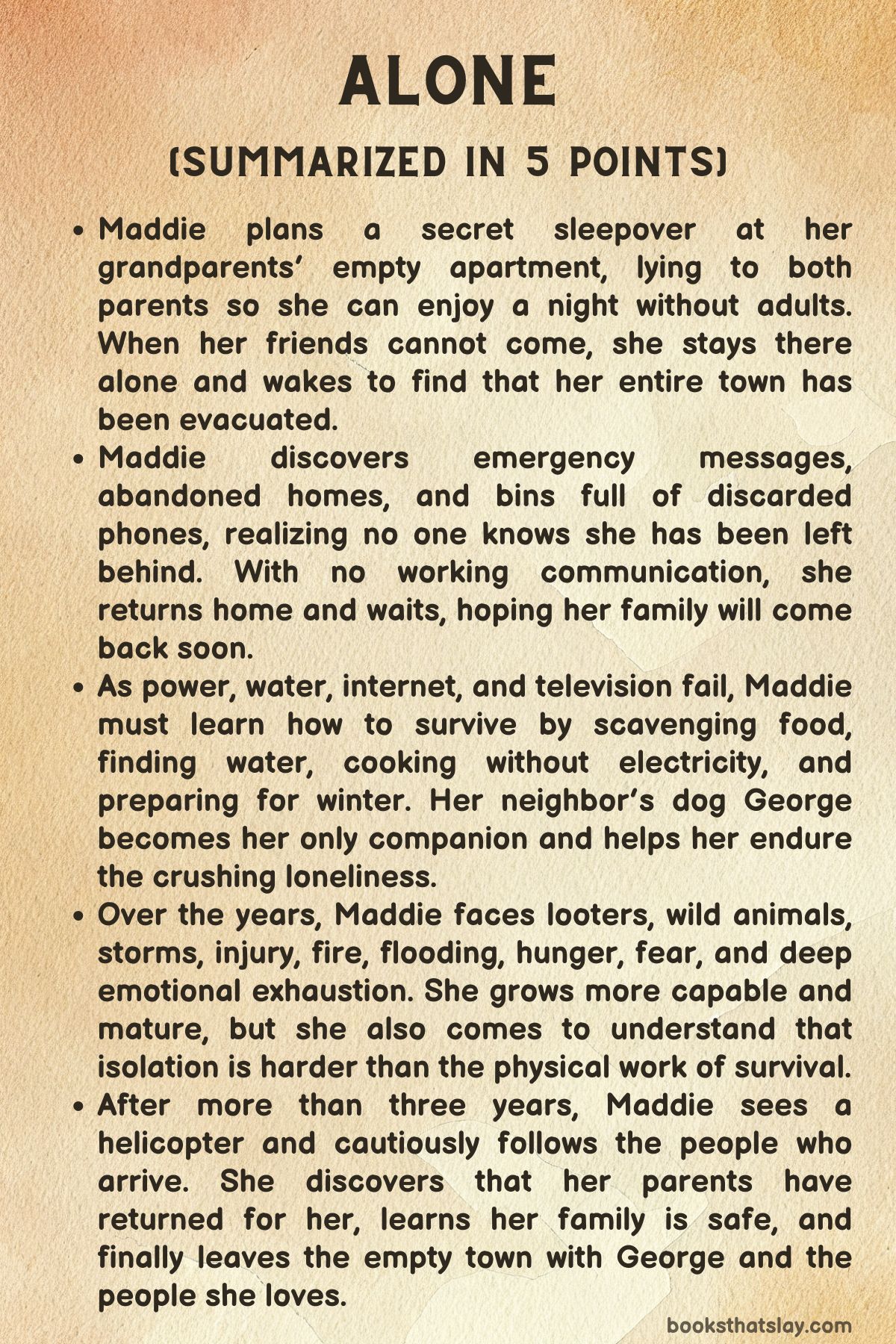
Characters
Maddie
Maddie is the central character and narrator of Alone, and her growth shapes the entire story. At the beginning, she is a typical middle school girl who wants privacy, freedom, snacks, movies, and time with her friends.
She is not cruel or careless by nature, but she is impatient with family rules and frustrated by the demands placed on her in a blended household. Her secret sleepover plan shows her desire to escape responsibility, but it also becomes the mistake that separates her from everyone she loves.
Once the town is evacuated, Maddie’s childish complaints are replaced by urgent questions of survival. She learns how to find food, conserve water, use tools, drive, build fires, treat injuries, and prepare for winter.
Yet her real transformation is emotional. Loneliness forces her to reexamine her family, her past behavior, and her need for connection.
She misses the very people she once avoided and comes to understand that ordinary family life, with all its noise and inconvenience, was a form of safety. Maddie becomes resourceful, cautious, brave, and deeply self-aware, but she never becomes unrealistically invincible.
She cries, panics, gets angry, makes mistakes, and doubts herself. This makes her survival feel human rather than heroic in a simple way.
By the end, Maddie has matured far beyond her age, but she has also held on to her need for love, family, and hope.
George
George, the neighbor’s dog, becomes Maddie’s companion, emotional anchor, and reason to keep going. His importance is not limited to practical companionship; he protects Maddie from total psychological collapse.
In an empty town where every human voice is gone, George gives Maddie someone to speak to, care for, feed, shelter, and comfort. His presence turns survival from a purely individual struggle into a shared life.
He also represents loyalty and trust. Unlike the vanished adults, the dangerous looters, or the uncertain world outside town, George is steady.
He stays with Maddie through hunger, winter, storms, injury, illness, fear, and grief. He warns her, follows her, sleeps near her, and helps her feel less invisible.
At times, Maddie’s love for George is almost parental; at other times, he feels like her only friend. The bond between them reveals how deeply humans need attachment.
George cannot solve Maddie’s problems, explain the evacuation, or rescue her, but he gives her emotional survival. His character also sharpens the fear of loss.
Maddie knows dogs do not live forever, and the thought of existing without him terrifies her. In that way, George is both comfort and vulnerability, because loving him gives Maddie strength while also giving her something precious to lose.
Maddie’s Mother
Maddie’s mother represents warmth, routine, discipline, and the everyday care that Maddie does not fully appreciate until it disappears. Before the evacuation, Maddie often sees her mother as annoying or embarrassing.
She dislikes her rules, her healthy snacks, her meditation clothes, and her expectations. Yet once Maddie is alone, her mother becomes one of the strongest emotional presences in the story.
Maddie remembers her mother’s voice, her habits, her breathing exercises, her belongings, and the feeling of being cared for by her. The absence of her mother is especially painful during moments when Maddie needs maternal comfort, such as illness, fear, her first period, and emotional breakdowns.
Maddie’s mother is also tied to the idea of home. Her house is not just a building but a place full of routines, memories, and physical traces of family life.
When that house burns, Maddie loses one of her last connections to her mother’s daily presence. The postcard Maddie later treasures becomes important because it preserves a small piece of her mother’s love and imagination.
Her return at the end gives Maddie the reunion she has longed for, but it also confirms how powerful her unseen role has been throughout the story.
Maddie’s Father
Maddie’s father is important because many of Maddie’s survival choices come from things he taught her, even when he is not physically present. His advice to stay put when lost becomes one of Maddie’s guiding rules after the evacuation.
She repeatedly returns to that lesson when deciding whether to remain in town or risk leaving. His knowledge of nature, constellations, snakes, camping, tools, and outdoor safety shapes the way Maddie interprets the world around her.
Even when she does not know what to do, she often thinks about what her father might have said. His house also becomes essential to her survival because of the woodstove, which allows her to endure winter.
Emotionally, Maddie’s father represents stability and practical wisdom. She misses him not only as a parent but as a teacher and guide.
His absence makes her realize how many quiet forms of knowledge adults pass on to children without making a lesson feel formal. By remembering him, Maddie continues to receive help from him indirectly.
His reunion with Maddie restores the protective relationship that survival had forced her to live without, but the story also shows that his influence helped keep her alive long before he returned.
Paul
Paul, Maddie’s stepfather, is part of the blended family Maddie sometimes resists. Before the evacuation, she is not openly hostile to him in a dramatic way, but she can be distant, dismissive, and rude.
He tries to speak with her and shows appreciation for her help with the younger children, yet Maddie does not always respond kindly. His role highlights Maddie’s emotional confusion about stepparents.
She does not necessarily dislike him, but she has not fully accepted the shape of her expanded family. After everyone disappears, her regrets about ignoring or avoiding family members include Paul.
His absence helps Maddie understand that family love is not limited to biological ties or ideal household arrangements. Paul’s character also reflects the ordinary adult care that Maddie once found irritating.
He expects her to help, thanks her, checks on the baby, and participates in the family structure that Maddie wants a break from. When that structure vanishes, Maddie sees its value more clearly.
Paul may not occupy as much narrative space as Maddie’s parents, but he matters because he is part of the larger family Maddie learns to miss, value, and claim as her own.
Jennifer
Jennifer, Maddie’s stepmother, is another figure whose importance grows through absence. At first, she is part of Maddie’s second home, the quieter household without younger siblings.
Maddie’s relationship with Jennifer is not presented as deeply conflicted, but Jennifer still belongs to the complicated world of divorce, remarriage, and shared custody. Her abandoned flutes become an important sign of the evacuation’s suddenness because Maddie knows Jennifer would normally take them when traveling.
This detail gives Jennifer emotional weight: her belongings reveal personality, routine, and the panic of departure. Later, Maddie wears Jennifer’s clothing and uses the space of her father’s house to survive winter, which makes Jennifer part of Maddie’s practical survival even while she is gone.
Jennifer also complicates Maddie’s understanding of family. Maddie rejects the idea that divorce has made her family broken; Jennifer is one reason Maddie’s family has become larger rather than simply damaged.
Through Jennifer, the story shows that stepfamily relationships may be quiet, imperfect, or still developing, but they can still carry meaning. Her absence becomes one more reminder that Maddie has lost not just one household but a whole network of people.
Trevor
Trevor, Maddie’s baby half-brother, represents innocence, dependence, and the family responsibilities Maddie initially wants to escape. Before the evacuation, Maddie loves him but also resents the practical demands of caring for him.
He cries, needs feeding, shares space, and interrupts the freedom she wants. This makes him part of the ordinary family pressure that leads Maddie to desire a night away.
After the evacuation, however, Trevor becomes one of the people Maddie misses most painfully. Because he is a baby, his absence carries special fear.
Maddie wonders where he is, whether he is safe, and whether he is growing up without her. When she thinks about a future in which years pass, Trevor’s possible adulthood becomes a measure of how much life she might miss.
Trevor also reminds Maddie that family love is often mixed with inconvenience. She once wanted relief from babysitting, but later she would give anything to hold him again.
His character helps show Maddie’s emotional growth from irritation toward gratitude. Through Trevor, the story captures how children can resent responsibility in the moment and still love deeply.
Elliot
Elliot, one of Maddie’s twin stepbrothers, has a quiet but important role because his schoolwork helps Maddie understand her own experience. Before the evacuation, Maddie helps him think through a report on a story about a girl surviving alone.
At that point, Maddie believes food and shelter are the greatest survival challenges. This belief makes sense to her because she has never known extreme isolation.
Later, after living alone for many months, she finds Elliot’s report and discovers that he had identified loneliness as the greater challenge. This becomes a painful moment of recognition for Maddie.
Elliot’s insight gives language to something she has been living but not fully naming. He becomes, indirectly, one of her teachers.
His bond with James also matters because Maddie envies the twins’ closeness before the evacuation. In her isolation, that envy becomes more meaningful, since she now understands the value of having someone who belongs with you completely.
Elliot’s character is not developed through many actions, but his presence carries emotional force. He represents family connection, childhood insight, and the painful truth that Maddie’s hardest battle is not hunger or cold but being alone.
James
James, Elliot’s twin brother, is less individually developed than Elliot, but his role is still significant within Maddie’s family world. He helps establish the crowded, demanding, blended household that Maddie finds frustrating before the evacuation.
His connection with Elliot gives Maddie a sense of being slightly outside a bond she cannot share. The twins have a closeness that seems natural and deep, and Maddie notices it with both envy and admiration.
James therefore helps highlight Maddie’s longing for belonging even before she is physically isolated. She is surrounded by family, but she does not always feel fully settled in either home.
After the evacuation, James becomes part of the larger absence that haunts Maddie. She misses not only her parents and friends but also the younger siblings whose needs once annoyed her.
His character helps show how ordinary family life becomes precious only after it is lost. James also contributes to the story’s view of blended families.
He is not presented as an obstacle or rival; he is one more person in Maddie’s expanded family, one more connection she did not value enough while she had it.
Ashanti
Ashanti is one of Maddie’s closest friends and part of the secret sleepover plan that changes Maddie’s life. Her illness prevents her from attending, which saves her from being stranded but leaves Maddie alone.
Ashanti’s role shows how random chance can alter everything. If she had not become sick, Maddie would have had company during the evacuation.
Maddie later wishes the original plan had worked because even one friend would have made her situation less unbearable. Ashanti represents Maddie’s lost social life: school, friendship, texting, secrets, shared snacks, and ordinary teenage fun.
Her messages after the evacuation reveal that she believes Maddie must be on a transport too, which adds to the tragedy because nobody realizes the truth. Ashanti also reflects the life Maddie expected to have: sleepovers, classes, growing up alongside friends, and normal adolescence.
Once Maddie is cut off, friendship becomes one of the many forms of human connection she is forced to live without. Ashanti is not present for most of the survival story, but her absence deepens Maddie’s loneliness and reminds readers that Maddie has lost a whole peer world, not just her family.
Emma
Emma is Maddie’s other close friend and another key part of the failed sleepover plan. When Ashanti cannot come, Emma’s cover story collapses, and she also stays away.
Like Ashanti, Emma survives because she is not with Maddie, but Maddie’s solitude becomes more painful because of it. Emma’s house later becomes a place where Maddie seeks comfort.
Maddie smells Emma’s perfume and pillow, trying to feel close to her friend through objects. This moment shows how desperate Maddie is for human presence, even in traces.
Emma also becomes important when Maddie discovers private family documents in her house and realizes that Emma’s apparently perfect family may not have been as perfect as Maddie believed. This discovery changes Maddie’s understanding of other people’s lives.
Before the evacuation, she compares families from the outside and assumes some are easier or happier than hers. Alone in empty homes, she begins to understand that every family has private struggles.
Emma’s character therefore represents friendship, comparison, and the hidden complexity of other households. Through Emma, Maddie learns that longing for someone else’s life can be based on an incomplete picture.
Themes
Survival and Self-Reliance
Survival in Alone is shown as a long, practical education rather than a single dramatic act. Maddie is not prepared for the evacuation, and her first responses are panic, confusion, and denial.
She expects adults to return and systems to start working again. When that does not happen, she has to learn through memory, trial, observation, books, and mistakes.
Her survival depends on ordinary skills that become extraordinary in an abandoned town: finding canned food, conserving water, washing clothes without plumbing, using a camp stove, locating batteries, reading safety manuals, building fires, gathering wood, driving, treating wounds, preparing for winter, and recognizing threats from animals and weather. The story respects the slow labor of staying alive.
It does not make survival look clean or glamorous. Maddie deals with spoiled food, dead pets, infected wounds, smoke, floodwater, snakes, broken glass, cold, fear, and exhaustion.
Her self-reliance grows because it has to, but the novel also shows the cost of that growth. Maddie becomes capable, yet she should not have had to become so capable so young.
Her independence is impressive, but it is born from abandonment, danger, and necessity.
Loneliness and the Need for Connection
Maddie’s hardest struggle is not simply finding food or shelter; it is enduring life without human company. At first, she treats solitude as freedom.
The secret sleepover is appealing because it promises a night without parents, chores, siblings, or rules. After the evacuation, that same freedom becomes terrifying.
The silence of the town presses on her more heavily as time passes. She talks aloud, sings, reads, sleeps beside George, studies photographs, visits empty homes, and tries to preserve traces of the people she loves.
Her loneliness changes her understanding of family. The baby brother who once interrupted her life becomes someone she aches to hold.
The stepparents she sometimes avoided become part of the home she longs for. Her friends, once reachable by text, become unreachable memories.
George eases her isolation, but he cannot replace human conversation, guidance, or touch. The story also shows that loneliness can damage the mind.
Maddie’s grief, fear, anger, and hopelessness become as dangerous as physical threats. Her discovery that isolation is the real test of survival marks one of her deepest moments of self-understanding.
Connection is not presented as a luxury. It is a basic human need.
Growing Up Under Pressure
Maddie’s coming-of-age is harsh because it happens without the support usually given to a child. Before the evacuation, she is caught between childhood and adolescence.
She wants independence but still depends on adults for safety, structure, and care. Once abandoned, she has to take on adult responsibilities immediately.
She manages food, shelter, health, transportation, safety, and long-term planning. She makes decisions no child should have to make, including whether to trust strangers, whether to arm herself, whether to leave town, and how to prepare for another winter.
Her physical growth continues too: she outgrows clothes, cuts her hair for practical reasons, and gets her first period alone. These milestones would normally be shared with family, especially her mother, but Maddie must face them privately.
This makes growing up feel less like celebration and more like loss. Still, she does mature emotionally.
She becomes less self-centered, more grateful, more reflective, and more aware of how much love existed in her ordinary life. The story suggests that maturity is not just independence.
It is also the ability to recognize dependence, regret selfishness, value others, and continue living after fear changes you.
Hope, Acceptance, and Emotional Endurance
Hope changes shape throughout Maddie’s time alone. At first, hope is simple: she believes her family will come back soon.
Then it becomes a rule: stay put because someone may come looking. Later, it becomes fragile and painful, especially when months and years pass without rescue.
Maddie tries prayer, routines, cleaning, reading, art, gardening, and memories to keep herself from giving up. Sometimes hope feels foolish to her, especially when she begins to believe her family may be dead.
Yet the story does not treat acceptance as the same thing as defeat. When Maddie starts to accept that she may never be rescued, she also begins to notice the value of the life she still has.
Nature, poetry, George, food from trees, flowers after snow, and the rhythm of seasons help her keep living in the present. This emotional endurance is different from optimism.
Maddie is not cheerful all the time, and she does not deny her suffering. Instead, she learns to exist with grief and still find moments of meaning.
Her final rescue matters because she never fully stops responding to life. She survives not only by waiting, but by continuing to live.