Along Came a Spider Summary, Characters and Themes
Along Came a Spider is a crime thriller by James Patterson and the first novel to feature Alex Cross, a Washington, DC detective and psychologist. The book introduces Cross as a sharp investigator, a grieving widower, and a devoted father trying to balance police work with family life.
The case begins with a brutal murder in a poor neighborhood, but it quickly shifts to the high-profile kidnapping of two children from an elite private school. Patterson builds a fast, tense story about fame, ambition, corruption, race, class, and betrayal, with Cross forced to question both the evidence and the people closest to him.
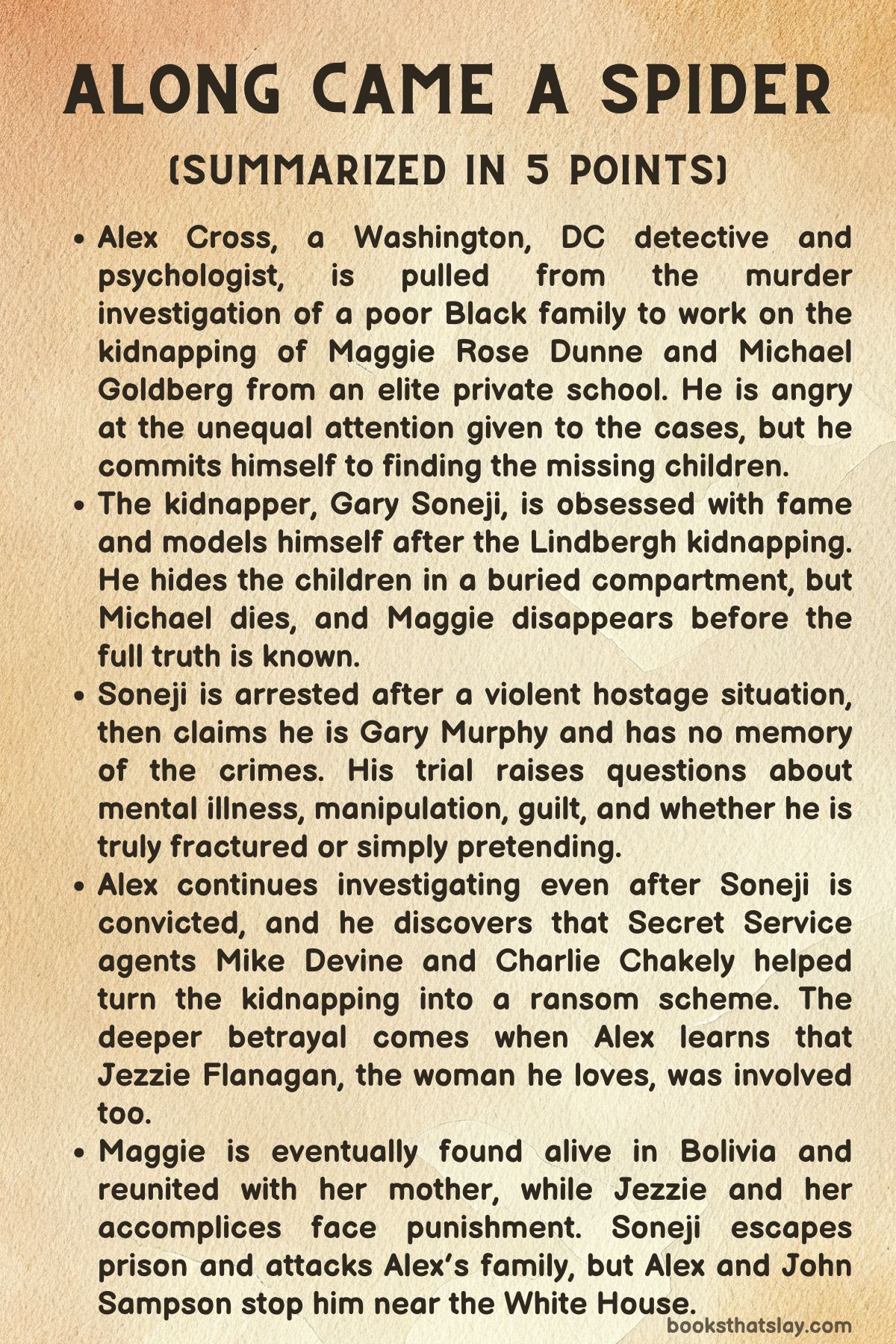
Summary
Along Came a Spider follows Alex Cross, a Black detective and psychologist in Washington, DC, as he becomes involved in a case that begins with the murder of a poor Black family and turns into a national kidnapping investigation. Cross lives with his grandmother, Nana Mama, and his two young children, Damon and Janelle.
His wife, Maria, was killed three years earlier, and her death still shapes his life. His closest professional partner is John Sampson, a childhood friend and fellow detective.
The story opens with a disturbing echo of the Lindbergh kidnapping. A boy obsessed with fame steals the Lindbergh baby and buries him alive.
Decades later, that same hunger for notoriety appears in Gary Soneji, a teacher at Washington Day School, an elite private school in Georgetown. Soneji disguises himself as a staff member and abducts two children: Maggie Rose Dunne, daughter of a famous actress and a prominent Red Cross official, and Michael Goldberg, son of the secretary of the treasury.
Michael, known as Shrimpie, is fragile because of a heart condition, while Maggie is bright, independent, and tired of living under her mother’s celebrity.
At first, Cross is investigating the killing of Jean Sanders, her teenage daughter Suzette, and her young son Mustaf. The crime scene is horrific, and Cross believes the mother and daughter were the main targets.
He is angry when his superiors pull him away from this case to focus on the kidnapping of two wealthy white children. To him, the decision reflects a familiar injustice: violence against poor Black people receives less urgency than crimes involving powerful families.
Still, he joins the kidnapping investigation because two children are in danger.
Soneji hides Maggie and Michael in a buried wooden compartment beneath a barn. He drugs them and carefully monitors the air supply, believing he has designed a perfect crime.
He sees himself as the “Son of Lindbergh” and wants the world to recognize him as a criminal genius. He has studied famous kidnappings and murders, and his apartment reveals his obsession with killers, celebrity, and the need to “be somebody.” He also murders FBI agent Roger Graham, leaving behind a message that threatens the investigators.
Cross works alongside the FBI and the Secret Service, including Jezzie Flanagan, the Secret Service supervisor assigned to the case. Jezzie is smart, driven, and under heavy pressure because her agents failed to protect the children.
Cross is drawn to her, and their connection grows during the investigation. Meanwhile, Michael’s body is found in Maryland.
His death appears to have been caused by the drugs Soneji gave him, though his body has also been abused after death. Maggie remains missing.
Soneji demands a ransom of ten million dollars and insists that Cross deliver it at Disney World. Cross meets a man who does not seem to be Soneji, and the ransom handoff becomes a confusing chase involving a plane, an island, and an attack that leaves Cross unconscious.
The money disappears, but Maggie is not returned. Soon afterward, police discover one of Maggie’s pink shoes in the buried chamber, proving she had been held there.
The investigation begins to expose Soneji’s other life. His real name is Gary Murphy, a married man living in Delaware with his wife, Missy, and daughter, Roni.
He has a poor work record, a history of instability, and a traumatic childhood marked by abuse and confinement. Cross and Sampson connect him to the earlier murders in Washington Southeast after a witness reports seeing an Atlantic Heating salesman near the victims’ homes.
When police raid Murphy’s house during his daughter’s birthday party, he escapes through a plan he had prepared in advance.
Soneji resurfaces in Pennsylvania, where he takes hostages at a McDonald’s and kills a police officer. Cross negotiates with him, hoping to keep him alive because he may know where Maggie is.
Soneji is shot and arrested. In prison, however, he begins claiming that he is Gary Murphy, not Gary Soneji, and that he has no memory of the crimes.
Doctors and officials debate whether he has dissociative identity disorder or is pretending in order to avoid punishment. Cross is unsure.
Some of Gary’s symptoms seem real, but Soneji is also manipulative, arrogant, and hungry for attention.
Cross pushes to hypnotize Gary in prison, hoping to bring out Soneji and learn what happened to Maggie. During hypnosis, Gary shifts into a colder personality and attacks Cross.
Later, at trial, Cross is called as a hostile witness by Gary’s defense lawyer. In a dramatic courtroom scene, Cross hypnotizes Gary again.
Gary says Michael died by accident and that Maggie was alive when Soneji last saw her. He claims she was gone when he returned to the barn.
This statement suggests that someone else took Maggie.
The trial ends with Gary being convicted, but Cross cannot let go of the case. He and Sampson keep investigating.
A young witness from the Sanders neighborhood tells them that Gary had been watched by another man, not working with him but following him. Cross begins to suspect that the kidnapping was not only Soneji’s crime.
He questions former Secret Service agents Mike Devine and Charlie Chakely, who had been assigned to protect Michael. Their answers feel incomplete.
Cross’s relationship with Jezzie deepens, but his grandmother distrusts her. Nana Mama senses that Jezzie is not fully supportive of Cross’s work or his responsibilities.
Cross tries to ignore those doubts, though he begins to notice that Jezzie often discourages him from continuing the Maggie investigation. Then the FBI reveals that Devine and Chakely had been under suspicion because of altered security logs.
They likely noticed Soneji watching the children before the kidnapping and later followed him to the barn. The FBI also reveals that Jezzie had a long affair with Devine and may have been part of the scheme.
Cross is devastated. He realizes Jezzie, Devine, and Chakely used Soneji’s kidnapping to steal the ransom.
They found Maggie alive after Michael died, but instead of returning her, they hid her and took the money. Cross takes Jezzie to Virgin Gorda, pretending to be on a romantic trip while secretly working with Sampson and the FBI.
On a private island, he confronts her. Jezzie admits that Devine first noticed Soneji watching the children.
She says they originally thought he was a child predator, but after he kidnapped Maggie and Michael, they saw a chance to profit. She insists she did not expect Michael to die and claims she later fell in love with Cross.
Her confession is recorded, and she is arrested.
Jezzie and Chakely eventually reveal where Maggie was taken. Cross, Sampson, and Maggie’s parents travel to Bolivia, where Maggie has been living in a remote village and working in fields with other children.
When she sees her mother, she runs to her, ending the long search.
Soneji, however, is not finished. He escapes prison by manipulating a guard with promises of hidden ransom money, then kills him.
He targets Cross’s family, breaking into Cross’s home and attacking him. Cross fights him off with Nana Mama’s help, but Soneji flees.
Cross understands that Soneji wants one final public moment. Police soon find him near the White House with a weapon and two children as hostages.
Cross confronts him, telling him the cameras are watching and that Cross has become the star. Soneji turns his weapon toward Cross, and Sampson shoots him.
In the ending, Jezzie is executed for her role in the kidnapping and ransom plot. Cross visits her before her death, still burdened by what happened between them.
Gary avoids another trial by appearing mentally unstable, but he leaves Cross a message that proves he remains dangerous and aware. Cross returns home, choosing ordinary service and family life over fame, still committed to justice even after betrayal, loss, and violence.
Characters
Alex Cross
Alex Cross is the moral and emotional center of Along Came a Spider. He is both a detective and a psychologist, which makes him unusually suited to cases that require not only evidence but also an understanding of fear, obsession, trauma, and manipulation.
His work is shaped by his identity as a Black police detective in Washington, DC, and he is sharply aware of how race and class influence which crimes receive attention. His anger over being pulled away from the Sanders murders to work on the kidnapping of Maggie Rose and Michael Goldberg shows his deep frustration with unequal justice.
Cross is not indifferent to the kidnapped children; he cares about them intensely. But he also refuses to accept a world where murdered poor Black victims become secondary because they lack wealth, fame, or political importance.
Cross’s personal life gives him depth beyond the role of investigator. He is a widower still grieving Maria, and his memories of her reveal a man who has been wounded but not hardened.
He is devoted to Damon and Janelle, and his relationship with Nana Mama keeps him grounded. His family scenes show tenderness, humor, and vulnerability, balancing the violence of his work.
Cross’s romance with Jezzie Flanagan exposes another side of him: his need for intimacy, his loneliness, and his willingness to trust someone who appears to understand the pressure of public service. That trust makes her betrayal especially damaging.
As an investigator, Cross is persistent, intuitive, and principled. He refuses to accept easy explanations, even after Gary Soneji is arrested and convicted.
His continued pursuit of Maggie’s fate shows that his loyalty is not to institutions or reputations but to truth. He is willing to challenge the FBI, the courts, his superiors, and even his own emotions.
By the end, Cross emerges as someone who has faced professional failure, public humiliation, romantic betrayal, physical danger, and moral exhaustion, yet still returns to ordinary acts of service. His strength lies not in being untouched by pain, but in continuing despite it.
Gary Soneji / Gary Murphy
Gary Soneji, also known as Gary Murphy, is driven by a consuming desire to become famous. His crimes are not only acts of violence but performances designed to force the world to notice him.
He models himself after the Lindbergh kidnapping and calls himself the Son of Lindbergh, showing that he thinks of crime as a route to historical importance. His obsession with notorious criminals and celebrities reveals a distorted sense of identity: he does not simply want money or revenge; he wants recognition.
He wants to be remembered.
His double life as Gary Murphy complicates his character. In his home life, he is a husband and father who appears strange, unsuccessful, and emotionally unstable.
He is awkward around his family, resentful of his brother-in-law, and ashamed of his failures as a salesman. Yet beneath that ordinary surface is a violent planner who has prepared escape routes, disguises, hidden money, and future crimes.
His calmness in some moments and explosive rage in others make him unpredictable. He can seem weak, even pathetic, but that appearance often hides calculation.
The question of whether Gary truly has dissociative identity disorder or is pretending remains central to his character. His childhood abuse, confinement, insomnia, and memory gaps suggest psychological damage, but his intelligence and manipulative behavior make his claims suspect.
He uses uncertainty as a weapon. Whether he is ill, dishonest, or both, he understands that confusion can protect him.
His final actions show that his hunger for fame overrides every other part of his life, including family, survival, and any possibility of remorse. He is frightening because he combines theatrical ambition with cruelty and patience.
Jezzie Flanagan
Jezzie Flanagan is one of the most complex characters in the novel because she presents herself as disciplined, competent, and emotionally guarded while hiding a deep capacity for deceit. As a Secret Service supervisor, she has fought her way into a powerful position in a male-dominated profession.
Her confidence, motorcycle-riding independence, and sharp command presence make her appear strong and admirable. She seems to understand the pressures Cross faces, and their bond grows from a shared sense of professional isolation.
Her background helps explain her hunger for success, though it does not excuse her choices. Jezzie’s family history, especially her father’s death by suicide and her parents’ alcoholism, leaves her determined not to be weak or powerless.
She builds her identity around control, achievement, and survival. This need for control becomes dangerous when she sees the kidnapping as an opportunity rather than only a crisis.
Her decision to exploit Soneji’s crime for ransom money reveals a chilling moral collapse. She can speak of love, regret, and pressure, but she still chooses profit over a child’s safety.
Jezzie’s relationship with Cross is emotionally significant because it is not presented as entirely fake. She seems to develop real feelings for him, which makes her betrayal more painful.
Her love, however, is selfish and compromised. She uses Cross’s trust, his integrity, and his concern for Maggie to protect herself and complete the ransom scheme.
Her downfall shows how ambition without moral limits can become destructive. In Along Came a Spider, Jezzie is not merely a corrupt agent; she is a person who wants to be seen as strong and exceptional but proves willing to sacrifice others to protect that image.
John Sampson
John Sampson is Alex Cross’s partner, childhood friend, and emotional anchor. He is loyal without being passive and supportive without losing his own judgment.
His bond with Cross has the ease of long history, allowing him to understand Cross’s moods, doubts, and moral instincts without needing long explanations. Sampson often acts as the person who steadies Cross when the case becomes overwhelming.
He respects Cross’s intelligence but also challenges and protects him when necessary.
Sampson’s importance is especially clear during the second investigation, when Cross begins to suspect that the official version of events is incomplete. Sampson stays beside him even when institutions seem ready to move on.
He helps with interviews, follows new leads, and offers emotional support when Cross learns of Jezzie’s involvement. His reaction to Jezzie’s betrayal is compassionate: he admits that he also liked her and did not suspect her, which helps Cross feel less alone in his misjudgment.
Sampson is also vital in the climactic confrontation with Soneji. When Soneji threatens Cross and the hostage children, Sampson acts decisively.
His shooting of Soneji saves lives and shows the trust between him and Cross in its most urgent form. While Cross is the central investigator, Sampson represents loyalty, courage, and practical steadiness.
He is not merely a sidekick; he is the partner who helps Cross survive both the case and its emotional cost.
Nana Mama
Nana Mama, whose full name is Regina Hope, is the heart of the Cross household. She is Alex’s grandmother, but she functions as much more than a family elder.
She is a caretaker, moral guide, truth-teller, and stabilizing force. A retired school principal, she carries authority naturally.
Her intelligence and discipline are clear in the way she manages the home, cares for Damon and Janelle, and speaks to Alex with direct honesty.
Her relationship with Alex is marked by affection and firmness. She loves him deeply, but she does not flatter him or allow him to hide from uncomfortable truths.
Her suspicion of Jezzie is an important example of her insight. While Alex is emotionally drawn to Jezzie, Nana Mama notices what he is unwilling to see: that Jezzie does not fully fit into his life, his values, or his responsibilities.
Her warning is not based on prejudice or possessiveness but on careful observation.
Nana Mama also represents continuity and moral order. In a story filled with violence, deception, and institutional failure, she stands for home, memory, and responsibility.
When Soneji invades the Cross house, her courage becomes physical as well as emotional. She helps distract him and protects the family in a moment of danger.
Her presence reminds readers that Cross’s strength does not come only from professional skill; it also comes from the family and values that raised him.
Maggie Rose Dunne
Maggie Rose Dunne is both a victim and a survivor. As the daughter of a famous actress and a powerful father, she lives within privilege, but she is still a child with ordinary fears, attachments, and desires.
Her rebellious clothing and close friendship with Michael suggest a girl trying to define herself outside her mother’s fame. She is not merely “the missing child” in symbolic terms; the narrative gives her moments of fear, confusion, endurance, and longing.
Her captivity is terrifying because she is forced into darkness, isolation, and uncertainty. She does not fully understand what has happened to her, and her memories blur under fear and exhaustion.
Yet Maggie continues to think, observe, hope, and imagine escape. Her survival depends not on dramatic heroics but on endurance.
She holds onto memories of home, her parents, her friends, and her mother’s songs. These memories help preserve her identity while she is trapped in conditions meant to erase it.
Maggie’s recovery in Bolivia gives the investigation its emotional resolution. Her reunion with her mother confirms that she has survived both Soneji’s original crime and the later betrayal by the people who should have saved her.
Maggie represents the human cost behind the public spectacle of the case. While adults seek fame, money, career advancement, and control, she is the child who suffers the consequences of their choices.
Michael “Shrimpie” Goldberg
Michael Goldberg, nicknamed Shrimpie, is Maggie’s closest friend and the son of the secretary of the treasury. His nickname comes from his physical fragility, connected to his health problems as an infant and his ongoing heart condition.
He is intelligent, fond of electronics, and close to Maggie. His friendship with her gives both children a sense of normalcy within lives shaped by powerful parents and public attention.
Michael’s death is one of the story’s most tragic events because he is caught in a crime far beyond his understanding. Soneji does not see him as a child with a life, fears, and family; he sees him as part of a plan.
Michael’s medical vulnerability makes the drugging especially dangerous, and his death exposes the failure of Soneji’s belief that he can control every detail. Soneji’s reaction to Michael’s death further reveals his brutality and lack of true remorse.
Michael’s parents’ grief, especially his father’s influence on the prosecution, shows how his death continues to shape the legal and emotional course of the story. He also serves as a contrast to Maggie’s survival.
The two children begin as companions, but their fates separate sharply: Maggie becomes the child who must be found, while Michael becomes the proof of how deadly the crime has already become.
Katherine Rose
Katherine Rose, Maggie’s mother, is a famous actress, but her role in the story is defined less by celebrity than by motherhood. Cross’s assessment of her reveals that she is more genuine and grounded than he might have expected.
Despite her fame, she appears emotionally open and sincerely attached to Maggie. Her grief is not theatrical; it is personal, raw, and persistent.
Katherine’s celebrity status helps explain why Maggie’s kidnapping becomes a national obsession. The media and authorities respond not only to the crime but also to the public importance of the family.
Yet Katherine herself is not portrayed as simply privileged or distant. She is a mother whose child has vanished, and her suffering cuts through the spectacle around the case.
Her apology to Cross after Thomas Dunne lashes out shows grace and emotional intelligence. She recognizes that pain can distort people’s reactions and that Cross is trying to help.
Her reunion with Maggie is one of the few moments of genuine relief in the story. Katherine’s character helps keep Maggie’s disappearance rooted in parental love rather than only media attention or political pressure.
Thomas Dunne
Thomas Dunne, Maggie’s father, is powerful, controlling, and deeply shaken by his daughter’s kidnapping. As head of the Red Cross, he is accustomed to authority and public responsibility, but Maggie’s disappearance places him in a situation where his influence cannot guarantee safety.
His tendency to speak for Katherine Rose suggests a need to manage situations, even emotional ones. This trait becomes more pronounced as the investigation fails to produce answers.
Thomas’s grief often turns into anger. He blames Cross and the police after the failed ransom exchange and later accuses Cross of helping Gary’s defense when courtroom testimony suggests Maggie may have been taken by someone else.
These reactions are unfair, but they are also rooted in desperation. Thomas cannot bear uncertainty, and Cross becomes a visible target for his helplessness.
His character shows how power can become useless in the face of personal loss. Thomas has status, connections, and influence, yet he cannot bring Maggie home through force of will.
His emotional journey is less subtle than Katherine’s, but it reflects the rage and fear of a parent trapped between hope and dread.
Mike Devine and Charlie Chakely
Mike Devine and Charlie Chakely begin as failed protectors and are later revealed as corrupt participants in the ransom scheme. As Secret Service agents assigned to Michael Goldberg, they should represent vigilance and duty.
Instead, their altered logs and hidden knowledge show that they noticed Soneji’s surveillance but failed to act honestly. Their first failure may be negligence, but their later choices become deliberate betrayal.
Devine is especially important because of his long relationship with Jezzie. His jealousy of Cross reveals possessiveness and insecurity, and his connection to the ransom pilot suggests that he had a practical role in turning Soneji’s kidnapping into a money-making operation.
Chakely appears less developed emotionally, but he is equally implicated in the decision to hide evidence and profit from Maggie’s captivity.
Together, Devine and Chakely show that corruption inside trusted institutions can be as dangerous as open criminality. Soneji commits the original kidnapping, but these agents extend the harm by choosing money over rescue.
Their betrayal is especially severe because they were assigned to protect children. They do not merely fail at their jobs; they transform their authority into a tool for exploitation.
Damon and Janelle Cross
Damon and Janelle give Alex Cross’s character emotional weight and vulnerability. Damon, the older child, is observant enough to worry that his father might leave the family, especially as Alex’s relationship with Jezzie grows.
Janelle is younger and more sheltered, often shown in moments of innocence that contrast sharply with Cross’s violent professional world. Together, they remind readers that Cross is not only a detective solving public crimes but also a father responsible for private lives.
Their presence raises the stakes of the story. Cross’s involvement in child abduction cases is not abstract; he understands parental terror because he loves his own children fiercely.
When Soneji invades the Cross home and threatens the family, the danger that Cross investigates professionally enters his domestic space. Damon and Janelle become potential targets because of their father’s work.
They also represent hope and continuity. Cross’s ability to return to them after trauma shows his commitment to life beyond crime scenes, trials, and betrayals.
His children are part of what keeps him human.
Maria Cross
Maria Cross is dead before the main action begins, but her presence remains powerful. She is remembered as Alex’s wife and the mother of his children, and her death still shapes the emotional structure of his life.
Her killing left Alex with grief, anger, and unfinished pain. Because he never had a full goodbye, her memory remains especially tender and unresolved.
Maria’s influence is seen in Alex’s service at St. Anthony’s Church, a practice she encouraged. This detail shows that her values continue to guide him.
She represents compassion, community, and moral responsibility. Alex’s grief over Maria also helps explain why Jezzie’s arrival affects him so strongly.
Jezzie offers companionship after years of loneliness, making Cross more emotionally vulnerable than he realizes.
Though Maria does not act in the present timeline, she helps define what Cross has lost and what he continues to protect. Her memory deepens his role as a widower, father, and public servant.
Chief Pittman
Chief Pittman represents bureaucratic pressure, ego, and institutional politics. He is Cross’s superior, but their relationship is tense.
Pittman resents Cross’s reputation and often seems more concerned with control than justice. His anger when Cross and Sampson pursue leads independently shows that he views authority as something to defend, even when the investigation might benefit from initiative.
Pittman’s handling of the kidnapping case reveals how public pressure shapes police priorities. He is quick to redirect Cross from the Sanders murders to the high-profile abduction, and though the mayor’s office influences the decision, Pittman still becomes part of a system that values some victims more visibly than others.
He is not portrayed as evil, but he is compromised by ambition, resentment, and political caution.
His removal of Cross from the kidnapping case reflects the broader institutional desire to simplify the narrative once Gary is arrested. Pittman’s character helps show why Cross often has to work around official channels to reach the truth.
Mayor Carl Monroe
Mayor Carl Monroe is a political figure who understands the symbolic importance of the kidnapping case. As a Black mayor, he speaks to Cross about change and patience, suggesting that progress for the Black community is underway.
Yet Cross suspects that Monroe is more interested in career advantage than justice. This tension makes Monroe a complicated figure: he speaks the language of public progress while participating in the political machinery that sidelines less visible victims.
Monroe sees the kidnapping case as a career-maker, which reveals how public tragedy can become political opportunity. His attitude contrasts with Cross’s deeper concern for all victims, including the Sanders and Turner families.
Monroe’s presence also sharpens the book’s treatment of race, power, and public image. He is not disconnected from the Black community, but he is shaped by political ambition in ways Cross distrusts.
Roger Graham
Roger Graham is an FBI agent whose fame mirrors one of the story’s central concerns: the relationship between crime, media, and reputation. He is already celebrated because of a previous case and a book that became a film.
This makes him a professional version of the recognition Soneji craves through violence. Graham’s prominence irritates Soneji, who wants attention for himself.
Graham’s murder serves several purposes in the story. It proves Soneji’s boldness, escalates the case, and removes a figure who had been dominating public attention.
The killing also shows that Soneji’s need for fame is not passive envy; he actively destroys anyone who threatens his spotlight. Graham’s character is brief but important because he reflects the glamour that can attach itself even to law enforcement in major criminal cases.
Missy Murphy
Missy Murphy is Gary’s wife and one of the people trapped inside his ordinary disguise. She once believed Gary was brilliant, despite warnings that he was strange, and her marriage now leaves her embarrassed, worried, and financially insecure.
Her concern over Gary’s job failures shows the domestic side of his collapse. She sees him as troubled and unsuccessful, not as the criminal mastermind he imagines himself to be.
Missy’s role emphasizes how Gary’s double life harms those closest to him. She does not understand the full extent of his violence, but she lives with its shadows: instability, anxiety, and social embarrassment.
Her presence also makes Gary more disturbing because he is not isolated from normal life. He has a wife, a child, a home, and community ties, yet he remains capable of extreme violence.
Roni Murphy
Roni Murphy, Gary and Missy’s daughter, represents the innocence inside Gary’s household. Her birthday party becomes the setting for the attempted raid, placing ordinary childhood celebration beside criminal pursuit.
Gary’s thoughts about harming his family and the party guests make Roni’s presence especially unsettling. She is someone he should protect, yet he is capable of imagining her death as part of his violent fantasies.
Roni also complicates the reader’s view of Gary’s public image. To some neighbors and coworkers, he can appear like a strange but ordinary family man.
Roni’s affection for her uncle and her presence in family scenes expose the gap between domestic appearance and hidden brutality.
Vivian Kim
Vivian Kim is a teacher at Washington Day School and one of the people caught in Soneji’s need for recognition. She first appears as an educator engaged with her students, presenting history in an active and memorable way.
Her classroom is part of the normal school environment that Soneji violates when he abducts Maggie and Michael.
Her murder later becomes a key link between the kidnapping and the earlier killings. By killing her and leaving Maggie’s shoe, Soneji sends a message to investigators and claims ownership of the larger crime pattern.
Vivian’s death also shows that people connected to the children are not safe simply because the kidnapping has already happened. She becomes another victim of Soneji’s need to control the narrative.
Nina Cerisier
Nina Cerisier is a young witness whose courage helps reopen the truth of the case. She saw something important near the Sanders house, but her delay in coming forward reflects the distrust many people in Washington Southeast feel toward police.
Her silence is not simple dishonesty; it is shaped by fear, community experience, and the belief that authorities may not protect people like her.
Nina’s testimony is crucial because it shifts Cross’s thinking. Her observation that someone was watching Gary, rather than working openly with him, points toward a second layer of the crime.
She represents the value of listening to overlooked voices. In a case dominated by federal agencies, wealthy families, and media attention, a young girl from a neglected neighborhood provides one of the most important clues.
Anthony Nathan
Anthony Nathan, Gary’s defense lawyer, is skilled, theatrical, and determined to win. He frames Gary as a mentally ill man rather than a criminal mastermind, and he uses the uncertainty around Gary’s identity to challenge the prosecution.
His courtroom strategy is bold, especially when he asks Cross to hypnotize Gary in front of the jury.
Nathan’s role raises questions about legal performance and truth. He may sincerely believe in defending his client’s rights, but he also understands spectacle.
Like others in the story, he operates in a public arena where attention matters. His defense forces the court to confront the possibility that Gary’s mind is fractured, but it also risks turning suffering into strategy.
Mary Warner
Mary Warner, the prosecutor, represents the state’s effort to impose order and accountability after chaos. She argues that Gary is responsible for the kidnappings and Michael’s death, and she presents expert testimony to counter the defense’s claim of dissociative identity disorder.
Her role is shaped by the pressure surrounding the case, including the influence of Michael Goldberg’s powerful father.
Mary’s challenge is that the evidence is strong, but Gary’s mental state complicates the moral and legal picture. Her cross-examination of Cross shows her need to protect the prosecution’s case from anything that might create reasonable doubt.
She is not as emotionally explored as Cross or Jezzie, but she is important to the legal conflict between guilt, illness, and public demand for punishment.
Jerry Goldberg and Laurie Goldberg
Jerry and Laurie Goldberg are Michael’s parents, and their grief gives Michael’s death lasting weight. Jerry’s position as secretary of the treasury brings political attention and federal protection into the story, while Laurie’s memories of Michael emphasize how precious he was to his family.
She was once told she could not have children, making Michael’s birth and life especially cherished.
Jerry’s influence on the prosecution reflects both grief and power. He wants justice for his son, but his status also shows how some families can command institutional attention more easily than others.
The Goldbergs’ suffering is real, yet their access to protection and influence contrasts sharply with the neglected victims in Washington Southeast.
Themes
Fame, Recognition, and the Desire to Be Seen
Gary Soneji’s crimes are fueled by a desire to become famous, and this desire shapes the structure of the entire case. He does not commit violence only to gain money, escape his life, or express anger.
He wants to force himself into history. His fixation on the Lindbergh kidnapping shows that he measures importance through public memory.
To him, being feared is better than being ordinary, and being remembered as a monster is better than not being remembered at all. This hunger for recognition is not limited to Soneji.
The novel repeatedly shows a society where fame changes the value of events. Maggie’s kidnapping becomes a national crisis partly because her mother is famous and Michael’s father is politically powerful.
Roger Graham’s celebrity as an FBI agent also reflects how crime can create careers, books, films, and public reputations. Even officials such as Mayor Monroe and Chief Pittman understand that a high-profile case can shape careers.
Along Came a Spider presents fame as morally dangerous when it becomes detached from human suffering. Soneji wants the spotlight, the media feeds the spectacle, and institutions respond more quickly when victims are socially important.
Against this, Alex Cross stands as a man who wants truth rather than attention, even when attention damages him.
Race, Class, and Unequal Justice
The contrast between the Sanders murders and the kidnapping of Maggie and Michael exposes a sharp imbalance in public concern. Cross is furious because the brutal deaths of poor Black victims in Washington Southeast are pushed aside once two wealthy white children disappear from an elite school.
His anger is not indifference to Maggie and Michael; it is anger at a system that ranks victims by race, class, wealth, and political usefulness. The murdered Sanders family and the earlier Turner victims matter deeply to Cross, but they do not command the same media frenzy or institutional urgency.
This imbalance also affects witnesses. Nina Cerisier’s hesitation to speak is rooted in distrust of the police, a distrust formed by the way her community has been treated.
The novel uses Cross’s perspective to show how justice can be shaped by visibility. Wealthy families receive immediate federal attention, while poorer neighborhoods are expected to wait, endure, or accept partial answers.
Mayor Monroe’s comments about patience sharpen this issue because they suggest political progress while avoiding the immediate pain of neglected communities. Cross’s work challenges this hierarchy.
He insists that every victim matters, whether the victim is a celebrity’s child, a cabinet official’s son, a teacher, or a poor Black mother and daughter. His moral authority comes from refusing to separate justice from dignity.
Trust, Betrayal, and Hidden Corruption
The investigation repeatedly depends on trust, and the most damaging betrayals come from people whose roles are built on protection. Jezzie Flanagan, Mike Devine, and Charlie Chakely are not outsiders to law enforcement; they are insiders trusted with children’s safety.
Their betrayal is therefore more disturbing than ordinary criminal greed. Soneji is openly monstrous once his identity is revealed, but Jezzie and the agents hide behind badges, procedures, and professional authority.
They know how investigations work, how evidence is handled, and how people in power protect themselves. This makes their corruption especially hard to detect.
Cross’s relationship with Jezzie makes the betrayal personal as well as professional. He trusts her judgment, shares his thoughts with her, and allows himself to love her after years of grief.
Her deception wounds him because it uses his best qualities against him: his compassion, his honesty, and his desire to believe in connection. The theme also reaches into institutions.
The FBI, Secret Service, police leadership, courts, and political offices all struggle with reputation, blame, and control. The case shows that corruption does not always announce itself through obvious villainy.
Sometimes it appears as careerism, silence, altered records, delayed action, and the willingness to let others suffer while preserving one’s own position.
Identity, Trauma, and Moral Responsibility
Gary Soneji’s claim that he is also Gary Murphy raises difficult questions about identity and responsibility. His childhood abuse, confinement, insomnia, and possible dissociative symptoms suggest a mind shaped by severe trauma.
The novel does not ignore the damage done to him as a child. His past helps explain his fractured behavior, his fantasies, and his obsession with power.
Yet explanation does not become absolution. Gary’s careful planning, disguises, manipulation, hidden money, and repeated violence show that he understands enough to pursue his desires with intent.
This creates tension between psychological injury and moral accountability. Cross, as both detective and psychologist, is uniquely positioned to confront that tension.
He does not dismiss mental illness, but he also refuses to let diagnosis erase victims. The courtroom scenes force society to ask whether a damaged person can still be guilty, and whether legal categories can fully capture human complexity.
The theme also applies to Jezzie, though differently. Her childhood pain and ambition explain her hunger for control, but they do not excuse her decision to exploit a kidnapping.
Both Gary and Jezzie have past wounds, yet both make choices that harm children. The novel suggests that trauma may shape identity, but responsibility remains essential when actions destroy other lives.