Always Remember Summary, Characters and Themes
Always Remember: The Boy, the Mole, the Fox, the Horse and the Storm by Charlie Mackesy is a tender illustrated book about friendship, courage, fear, hope, and the quiet work of learning to care for oneself. It follows the boy, the mole, the fox, and the horse as they travel through wild landscapes and emotional storms together.
Like Mackesy’s earlier work, the book speaks in simple exchanges that carry a deep emotional weight. Its focus is not on action in the usual sense, but on small moments of comfort, honesty, and reassurance. Always Remember is a book about staying kind, especially when life feels uncertain.
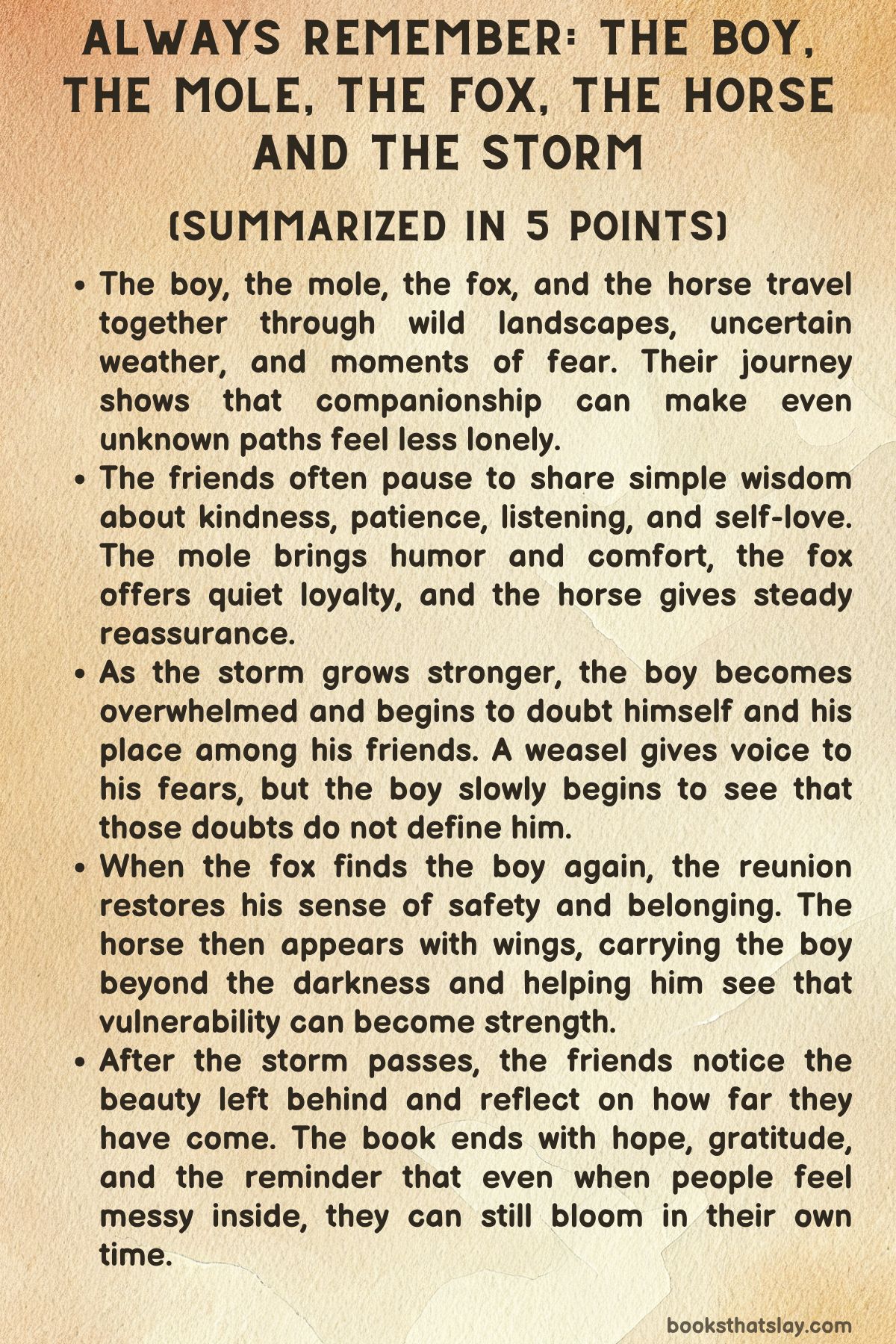
Summary
Always Remember begins with Charles Mackesy reflecting on the unexpected arrival of the book itself. He suggests that the book came out of disorder, uncertainty, and the strange beauty of making something without fully knowing where it is going.
He hopes that readers will leave it feeling a little lighter. The story then introduces the familiar four friends: the boy, the mole, the fox, and the horse.
Each one carries a different kind of wisdom. The horse is steady and protective, the boy is questioning and sensitive, the fox is quiet and observant, and the mole offers warmth, humor, and a love of cake.
Together they face a wide wilderness, not because they know the path ahead, but because they have each other.
The friends begin by standing before a great storm. They do not know where their journey will lead, and the landscape around them feels large and uncertain.
Yet the fact that they are together gives them strength. They cross a stony river that is still making its way toward the sea.
The river becomes a reminder that movement can matter even when the destination is far away. The mole tells the boy that kindness is his greatest skill, helping him see that gentleness is not weakness but a real form of strength.
They pause to look at a flower, and the moment teaches them that some things need time before they can bloom.
As they continue, the mole brings humor into the journey. He claims he was attacked by a cake and had no choice but to eat it in self-defense.
His joke lightens the mood and shows how joy can appear even during difficult travel. The friends move among tall trees, and the fox reminds the boy that loving himself is important.
The horse adds to this by encouraging the boy to be kind to himself. These lessons matter because the boy often looks outward for comfort, while his friends keep guiding him toward the care he also needs to offer himself.
The group moves through snow and sunrise, through forests and leafy paths. The mole reminds the boy to celebrate every step forward, not only the large victories.
Progress, in this world, is measured in moments of courage, not in speed. When fear rises, the horse tells the boy to breathe.
This simple advice becomes a way of staying present when the mind begins to race. At one point, swirling lines suggest the feeling of anxiety and inner spinning.
The boy is moving through darkness, and the horse acknowledges how much effort that takes. The friends pause before a beautiful view, and the wilderness seems both vast and full of possibility.
Beauty continues to appear in unexpected places. The friends look out over colorful trees and water, and the mole compares the sight to finding a cake shop on a snowy night.
The comparison is funny, but it also shows how the mole understands beauty through delight. Later, the boy and the mole stand in a pink sunset and wonder about the taste of snow.
The mole then tells the boy to eat his cake today rather than saving it for tomorrow. His point is that joy should not always be delayed.
Life asks for patience, but it also asks people to accept small pleasures when they arrive.
The horse, who often seems strong and certain, admits something vulnerable: he worries because he does not have all the answers. This confession matters to the boy, because it shows that even the reliable ones can feel unsure.
The fox, too, offers quiet wisdom by showing that listening is a form of kindness. When the boy notices dark clouds, the horse reminds him that clouds pass.
Yet the book also recognizes that not every storm is outside. Some storms happen inside a person.
When those inner storms come, the friends become shelter for one another. The horse promises that they will always be together.
The emotional storm grows stronger. The horse tells the boy that honesty is brave, and the boy admits that he does not feel brave.
Instead of correcting him, the horse reminds him that he is loved. The friends cross through a violent storm, with wind and darkness surrounding them.
The boy becomes overwhelmed and sits down, wondering whether he should give up. In that moment, his friends continue onward, and the boy is left behind.
His loneliness becomes one of the most important parts of the story, because it brings his doubts to the surface.
Alone near a large forest, the boy begins to wonder whether he is to blame. A weasel appears and tells him that his friends must not really love him.
The weasel gives voice to the boy’s fear, insecurity, and self-doubt. For a while, those thoughts seem powerful.
But the boy slowly begins to see through them. He remembers that he can be his own friend.
He recognizes that he has something to offer the world. He warms himself by a small fire and looks at his reflection in a pond, beginning to face himself with more compassion.
The fox finds the boy, and the reunion brings relief. Soon the mole is there too, and the friends play together.
Their joy shows that the boy was not abandoned in the way he feared. The horse then appears with large white wings, a sign of wonder and renewed strength.
He kneels to greet the boy, and the boy feels at home again. This home is not a place; it is the safety he feels with those who love him.
The boy learns that vulnerability can be a source of strength. He climbs onto the horse, and they fly through the remaining darkness of the storm.
They pass through it and reach a wide blue sky, resting on a cloud high above the world. The journey upward does not erase what happened, but it gives the boy a new view.
He has survived the fear, the loneliness, and the doubt.
After the storm, the mole describes hope as a song in the heart. The friends see that the storm has ended, and a bright rainbow appears.
They rest beneath a tree and value their time together. The mole regrets that he ate the cake he meant to bring for everyone, joking that it was too heavy to carry.
The friends keep walking and notice how far they have come. Their progress has been emotional as much as physical.
The landscape after the storm is beautiful. The friends look across a valley and see that the storm has left behind something meaningful.
They continue through snow and light, and the boy is reminded that it takes courage to love others and to love oneself. Near the end, the boy admits that he feels messy inside.
The mole gently tells him that everyone does. He explains that hope often appears most clearly during messy times, and that some flowers take longer than others to bloom.
The friends finish in a meadow, grateful for one another and for the awe that still exists in the world.
Characters
The Boy
The boy is the emotional center of the story and represents the part of every person that feels uncertain, afraid, hopeful, and in need of reassurance. He is not presented as a hero who always knows what to do, but as someone who is still learning how to live with his fears.
His questions reveal his sensitivity, and his silences show how easily doubt can grow inside him. The boy often looks to his friends for comfort, but his journey also teaches him that he must learn to become a friend to himself.
This is especially clear when he is separated from the others and begins to wonder whether he has been forgotten or rejected. In that lonely moment, he faces the harsh voice of self-doubt and slowly begins to resist it.
His growth comes from recognizing that he is loved, but also from understanding that his worth does not disappear when he feels lost. The boy’s vulnerability is not treated as a flaw.
Instead, it becomes one of his greatest strengths, because it allows him to be honest, open, and receptive to kindness. By the end of Always Remember, he has not become fearless, but he has learned that fear can be carried with the help of love, patience, and self-compassion.
The Mole
The mole brings warmth, humor, and gentle wisdom to the group. He often speaks through simple images, especially his love of cake, but beneath his playful manner is a deep understanding of joy, patience, and survival.
His jokes are never just comic relief; they are a way of making difficult moments feel less heavy. When the friends face uncertainty, the mole reminds the boy to notice beauty, to enjoy what can be enjoyed today, and to celebrate each step forward.
He teaches that happiness does not have to wait for perfect conditions. A cake, a flower, a sunrise, or a quiet moment with friends can become meaningful even when life feels unsettled.
The mole also understands that people are often messy inside, and he does not shame the boy for feeling that way. Instead, he normalizes emotional confusion and suggests that hope can still shine through it.
His kindness is practical and immediate. He does not try to solve every problem with grand answers; he offers comfort through presence, humor, food, and small truths.
The mole’s role is to remind the group that tenderness and delight are not minor things. They are part of what helps people keep going.
The Fox
The fox is quiet, watchful, and deeply loyal. Unlike the mole, who often speaks freely, the fox expresses care through attention and presence.
His character shows that love does not always need many words. Listening, staying close, and noticing when someone is in pain can be just as meaningful as giving advice.
The fox’s reminder that the boy should love himself is especially important because it comes from a character who often communicates sparingly. His words carry weight because he does not waste them.
The fox also plays a key role when the boy is separated from the group. He is the one who finds the boy, bringing relief and restoring the feeling of safety.
This moment shows the fox’s quiet devotion. He may not always be the loudest source of comfort, but he is steady in his care.
His character also balances the group’s emotional range. The mole brings humor, the horse brings steadiness, the boy brings vulnerability, and the fox brings attentive silence.
Through him, the story honors the kind of friend who may not always know what to say, but who knows how to stay, listen, and return.
The Horse
The horse is the figure of strength, protection, and reassurance, but he is not portrayed as invulnerable. At first, he seems like the most dependable member of the group, someone who offers guidance when the boy is afraid and reminds him to breathe through difficult moments.
The horse often gives the boy the emotional support he needs to continue, especially when fear and darkness become overwhelming. Yet one of the most meaningful parts of his characterization is his admission that he does not have all the answers.
This makes him more than a symbol of strength; it makes him honest and emotionally real. He shows that being strong does not mean being certain all the time.
It can mean staying present even while feeling unsure. When he later appears with wings, this change gives his character a sense of wonder and spiritual lift.
The wings suggest that love, trust, and courage can help carry someone beyond the worst part of a storm. In Always Remember, the horse represents the kind of support that steadies without controlling, protects without denying fear, and reminds others that they are loved even when they cannot feel brave.
The Weasel
The weasel is a minor character in terms of appearance, but he has an important symbolic role. He represents the voice of insecurity, suspicion, and self-blame.
When the boy is alone and vulnerable, the weasel tells him that his friends must not love him. This moment gives shape to the cruel thoughts that can appear when someone feels abandoned or afraid.
The weasel does not create the boy’s doubts from nothing; instead, he speaks to fears that are already beginning to form inside him. That makes him dangerous, because his words sound believable in a moment of loneliness.
His role is not to tempt the boy toward evil in a traditional sense, but to push him toward despair and mistrust. The boy’s response to the weasel marks a key moment in his emotional development.
Rather than accepting the weasel’s claim, he begins to see through it. He learns that not every thought deserves belief, especially thoughts born from fear.
The weasel therefore helps reveal the boy’s inner conflict and makes his movement toward self-kindness more meaningful.
The Friends as a Group
The four friends together form a model of emotional support. Each character gives something different, and their differences are what make the group feel whole.
The boy brings openness and need, the mole brings humor and comfort, the fox brings listening and loyalty, and the horse brings steadiness and protection. Their journey is not only through wilderness and weather, but through fear, doubt, sadness, hope, and recovery.
The group shows that friendship is not about having perfect answers. It is about staying close, offering shelter, and reminding one another of truths that are easy to forget.
At times, they comfort the boy directly; at other times, their absence forces him to discover strength within himself. This balance is important because the story does not suggest that friendship replaces self-love.
Instead, it shows that the two can support each other. Being loved by others can help a person learn how to love themselves, and learning self-kindness can make companionship even stronger.
As a group, the friends represent the emotional home people build through trust, patience, forgiveness, and shared wonder.
Themes
Self-Kindness and Inner Worth
The story gives great attention to the difficulty of being kind to oneself. The boy is surrounded by friends who love him, yet he still struggles with doubt, fear, and the feeling that he may not be enough.
This shows how inner pain can survive even in the presence of care. The reminders he receives from the fox and the horse are not shallow encouragements; they are attempts to help him see himself with the same gentleness he gives to others.
The boy’s greatest challenge is not only crossing storms or moving through wild landscapes, but learning not to turn against himself when he feels lost. His encounter with the weasel makes this struggle clearer.
The weasel gives voice to the fear that the boy is unloved, unwanted, or at fault. The boy’s slow resistance to that voice becomes one of the story’s most important moments.
He begins to understand that he can be his own friend and that his value does not depend on constant confidence. Always Remember treats self-kindness as a brave act, especially for someone who feels messy inside.
It suggests that loving oneself is not pride or selfishness, but a necessary form of survival.
Friendship as Shelter
Friendship in the story is shown as a shelter against both outer and inner storms. The four friends do not control the weather, remove every fear, or prevent every moment of loneliness.
What they do offer is presence. They stand together before uncertainty, cross difficult places together, and remind one another of hope when the world feels dark.
This makes their friendship feel active rather than decorative. It is built through listening, reassurance, humor, patience, and return.
The fox’s quiet loyalty, the mole’s warmth, and the horse’s steadiness all help the boy feel less alone. Yet the story also allows for a painful moment when the boy becomes separated from them.
This separation does not weaken the theme of friendship; it deepens it. The boy’s fear of being unloved becomes believable because separation can make doubt louder.
When the fox finds him and the others reunite with him, the comfort is powerful because it answers that fear. Friendship here is not perfect protection from pain.
It is the promise that even after fear, confusion, or distance, love can return and remain. The friends become a kind of emotional home, one that the boy can carry within himself.
Hope During Emotional Storms
Hope appears most strongly when the characters are surrounded by darkness, weather, uncertainty, and fear. The storm is not only a physical event; it reflects the emotional storms people carry inside themselves.
The boy’s anxiety, loneliness, and temptation to give up are treated with seriousness. The story does not rush him out of these feelings or pretend that hope is easy.
Instead, hope arrives in small forms: a reminder to breathe, a kind word, a flower that takes time to bloom, a friend who returns, a song in the heart, a rainbow after the storm. These images suggest that hope is often quiet and gradual.
It may not remove suffering immediately, but it gives a person a reason to continue through it. The horse’s guidance is especially important because he does not promise that storms will never come.
He simply reminds the boy that clouds pass and that love can remain during the hardest moments. This makes hope feel grounded rather than unrealistic.
The story understands that people may feel overwhelmed, messy, or unsure, but it insists that these states are not final. Even after darkness, there can be beauty, rest, and renewed courage.
Vulnerability and Courage
Courage in the story is not shown as fearlessness. It is shown as honesty, openness, and the willingness to continue even when one feels afraid.
The boy admits that he does not feel brave, and this admission becomes a brave act in itself. The horse helps him understand that honesty requires strength because it means allowing others to see what is really happening inside.
This view of courage is gentle but demanding. It asks the characters to stop pretending that they are always certain, always strong, or always fine.
Even the horse, who seems steady and protective, admits that he worries about not having all the answers. This moment expands the theme beyond the boy and shows that vulnerability belongs to everyone.
The story respects emotional truth. It suggests that people become closer when they are willing to share uncertainty rather than hide it.
The boy’s later discovery of strength through vulnerability gives his journey emotional depth. He does not overcome fear by denying it.
He grows by naming it, accepting help, and learning that being open does not make him weak. In this way, courage becomes connected to trust, love, and the ability to keep moving while still feeling afraid.