Amal Unbound Summary, Characters and Themes
Amal Unbound by Aisha Saeed is a middle-grade novel about Amal, a bright Pakistani girl whose dreams of becoming a teacher are threatened by poverty, gender expectations, and the power of a cruel landlord family. Set in a village in Punjab, Pakistan, the book follows Amal as she is forced into servitude after standing up to Jawad Sahib, a wealthy and dangerous man.
Through Amal’s courage, love of learning, and refusal to accept injustice as normal, the story explores education, freedom, class, and the quiet strength it takes to resist oppression.
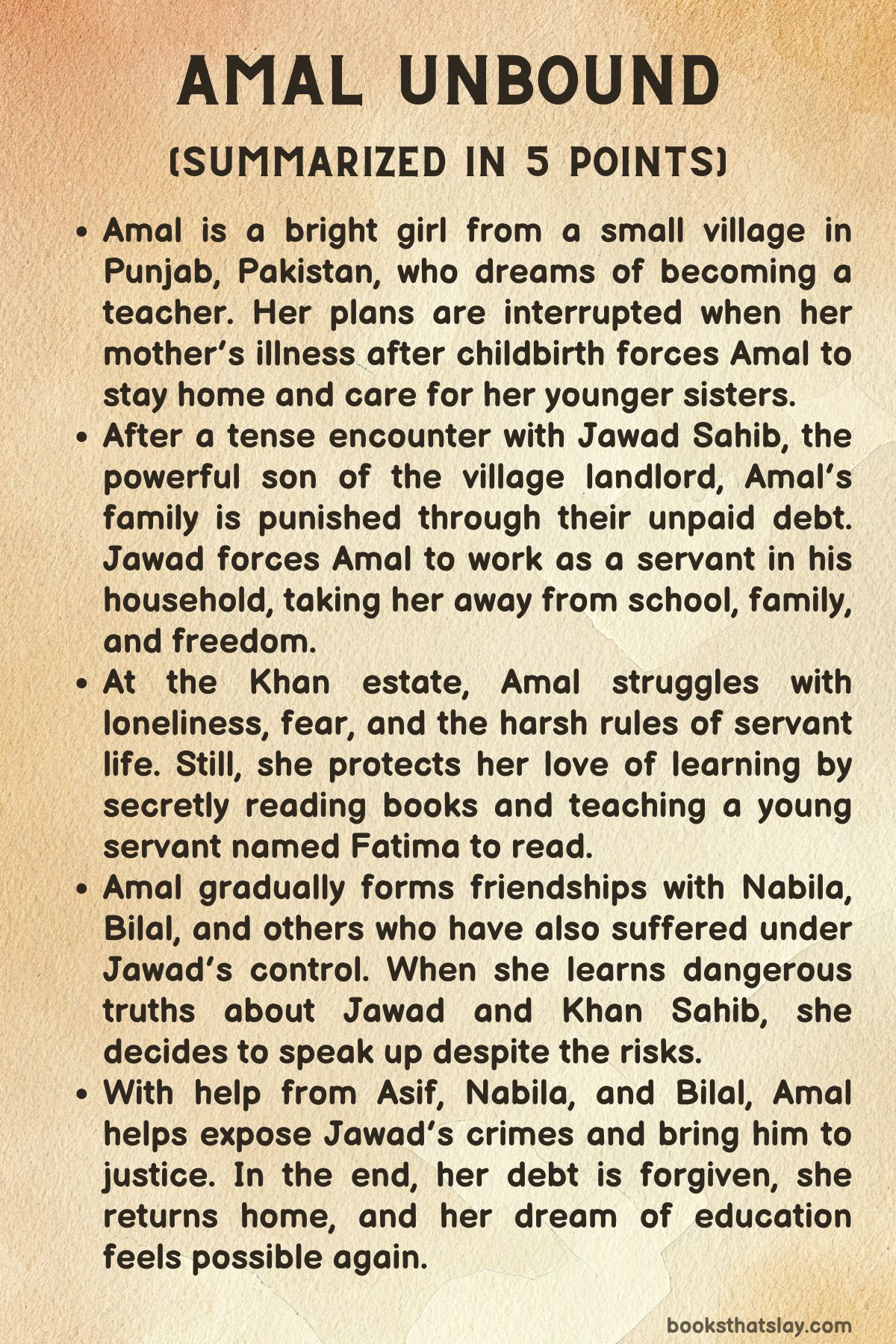
Summary
Amal is a young girl living in a small village in Punjab, Pakistan, with her parents and younger sisters. She is curious, hardworking, and deeply committed to school.
More than anything, she wants to become a teacher like Miss Sadia, the teacher she admires. Helping Miss Sadia after class gives Amal a sense of purpose and lets her imagine the future she wants for herself.
Her life is simple, but it is filled with school, family, books, and dreams.
Amal’s plans begin to change when her mother, Amma, gives birth to another baby girl. The delivery comes early, and the family is worried, but both mother and child survive.
Amal loves the baby at once, yet she notices her parents’ sadness that the child is not a boy. This hurts Amal, because it makes her wonder whether they felt disappointed when she and her sisters were born too.
After the birth, Amma becomes withdrawn and unable to care for the household. Amal, as the eldest daughter, is expected to take on the chores and look after her younger sisters.
Because of this, Amal is kept home from school. She is upset, especially because education means so much to her, but her father insists that her duty is to the family.
Seema, Amal’s sister, continues attending school and brings Amal assignments from Miss Sadia, who agrees to keep Amal on the class roster as long as she completes the work at home. This gives Amal hope, though she still longs to return to the classroom.
The village lives under the shadow of the Khan family, powerful landlords who control much of the area through debt and fear. Jawad Sahib, the son who has taken over much of the family business, is especially feared.
Many villagers owe the Khans money, and few believe they can challenge them without facing severe punishment. Amal knows the villagers are afraid, but she does not yet understand how deeply the Khans’ power can affect her own life.
One day, frustrated by being trapped at home, Amal goes alone to the market. There, she buys a pomegranate as a small treat.
As she leaves, a car hits her and knocks her purchases into the road. A young man steps out and offers to buy the pomegranate from her.
Amal, angry and shaken, refuses. She does not know at first that the man is Jawad Sahib.
When her father learns what happened, he is terrified. Amal believes Jawad was the one at fault, but Abu knows that Jawad’s pride and power make the situation dangerous.
Jawad soon comes to Amal’s home. Because Abu owes him money, Jawad demands that Amal come to work as a servant in his household to repay the family debt.
Abu and Amma are horrified, but Jawad gives them little choice. Abu hopes the arrangement will be temporary and that he can repay the money quickly.
Amal says goodbye to her family and friends, taking with her a small amount of money, an old phone from Amma, and the pain of leaving everything she knows.
At Jawad’s estate, Amal is overwhelmed by the size and luxury of the house. She is introduced to other servants, including Mumtaz, Hamid, Fatima, Bilal, and Nabila.
Nabila, who is about Amal’s age, is sharp and unfriendly at first. Amal learns that she will serve Nasreen Baji, Jawad’s mother, rather than live in the worst servant quarters.
Nasreen is kinder than Amal expected and gives Amal a better room near her own suite. Still, Amal is not free.
Jawad takes her phone, insults her, and reminds her of her position whenever he can.
Life at the estate is difficult. Amal misses her family, her village, and school.
She struggles with Nabila, who resents Amal because Amal has taken her place as Nasreen’s personal servant. Nabila tricks Amal and makes her work harder, but over time Amal learns more about her.
Nabila was sent to the estate because of her family’s debts, and the charges added by Jawad make it nearly impossible for her to leave. Fatima, another young servant, was unwanted by her family and taken in by Hamid.
Amal realizes that many servants are trapped by the same unjust system.
Despite her situation, Amal keeps looking for ways to learn. She discovers Jawad’s library and begins secretly borrowing books.
Reading becomes a lifeline for her. When Jawad catches her, he is surprised that she can read and write, but he bans her from the library.
Later, Bilal and Nabila help Amal borrow books again by hiding the missing books from view. Amal also begins teaching Fatima to read, giving the younger girl confidence and a small path toward a different future.
Amal’s relationship with Nasreen grows more complicated. Nasreen can be kind, and she protects Amal from some of Jawad’s anger, but she also accepts the social order that keeps people like Amal beneath her.
When Nasreen’s friend makes cruel comments about poor people and literacy, Amal waits for Nasreen to object, but Nasreen stays silent. Amal begins to understand that kindness from powerful people does not always mean justice.
Nasreen later takes Amal to Lahore. On the way, they pass through Amal’s village, which makes Amal feel the distance between her old life and her new one.
Nasreen learns that Amal has not been allowed to call home and gives her three days off to attend the wedding of Hafsa’s sister. Amal returns home joyfully, but the visit is painful too.
Her family is glad to see her, yet life has moved on without her. Seema has taken on Amal’s old role as eldest daughter, Hafsa feels distant, and Amal sees that her mother has sold her gold bangles to try to raise money for Amal’s freedom.
Amal realizes her family cannot repay the debt. She also learns that other villagers, including Hafsa’s family, are trapped by loans from Jawad.
Back at the estate, Amal is allowed to attend the new literacy center once a week because Khan Sahib wants villagers to use it for political reasons. There she meets Asif, a teacher who recognizes that Amal is already educated.
He teaches her computer basics and encourages her to keep learning. Amal tells him that villagers avoid the center because they fear the Khans.
Asif also shows Amal news about an investigation into Jawad’s possible connection to the disappearance of a diplomat’s son. Amal doubts anything will happen, but the news plants a seed.
Soon after, Amal overhears Jawad and Khan Sahib discussing the missing boy. Jawad admits that he had the boy killed because the boy disrespected him.
Amal is horrified. Nabila and Bilal also become involved, and Bilal knows where the body was buried.
Nabila gives Amal access to Jawad’s debt records, where Amal learns that Nabila’s cousin, who once tried to help her, was also likely killed by Jawad. Amal understands that Jawad’s cruelty is not just rumor; it has destroyed many lives.
Amal decides to tell Asif everything. She knows she is risking her safety, but she also knows silence will protect Jawad and Khan Sahib.
Asif agrees to help through his father, who is a lawyer. For several days, Amal waits nervously, unsure whether anything will come of it.
Then the police arrive at the estate and arrest Jawad. Khan Sahib has also been taken in for questioning.
The powerful men who seemed untouchable are finally facing justice.
Even after Jawad’s arrest, Amal’s future is uncertain. The estate changes, and the servants worry about what will happen to them.
Amal feels proud that she, Nabila, and Bilal helped expose the truth, but she also sees that even good change can bring fear and confusion. Nasreen grieves for her son and prepares to move to Islamabad.
Amal fears she will be taken even farther from home.
Instead, Nasreen releases many of the servants, including Amal, and forgives Amal’s family debt. Fatima will go live with Hamid’s family, and Nabila plans to return to her village.
Amal encourages them to keep learning and to use the literacy center. Free at last, Amal walks home with hope.
Her life has been changed by pain and injustice, but her dreams are still alive. She returns to her family with a stronger understanding of courage, education, and the possibility of standing up to power.
Characters
Amal
Amal is the central character of Amal Unbound, and her personality is built around curiosity, courage, and a deep love of learning. She begins as a village girl whose greatest dream is to become a teacher, not because she wants status, but because education gives her a sense of purpose and possibility.
Amal is responsible and loving toward her sisters, yet she also feels the unfairness of being expected to sacrifice her own future simply because she is the eldest daughter. Her anger at Jawad in the market shows that she has a strong sense of dignity; she cannot quietly accept disrespect, even when silence would be safer.
This same quality leads to her punishment, but it also becomes the reason she is eventually able to challenge the Khan family’s power. During her time as a servant, Amal suffers homesickness, fear, humiliation, and loneliness, but she does not lose herself.
She reads in secret, teaches Fatima, forms alliances with other servants, and finally takes the risk of reporting Jawad’s crime. Amal’s growth is not about becoming brave all at once; it is about learning that courage can exist even when a person is afraid.
By the end, she understands that education is not only a personal dream but also a form of resistance against people who depend on others remaining powerless.
Jawad Sahib
Jawad Sahib is the main antagonist, and he represents the abuse of inherited power. He is wealthy, feared, and used to getting obedience from everyone around him.
His cruelty is not impulsive alone; it is connected to his belief that his status gives him the right to control other people’s lives. When Amal refuses to give him the pomegranate, he treats her defiance as an insult that must be punished, even though he is the one who hit her with his car.
This shows how deeply entitled he is. Jawad’s decision to take Amal as a servant is not simply about debt; it is about restoring his pride and warning the village not to challenge him.
In the estate, he continues to insult and intimidate Amal, reminding her that he sees servants as property rather than people. His violence extends far beyond Amal’s situation, as he is connected to the deaths of those who cross him.
Yet Jawad is not shown as invincible. His dependence on fear makes him powerful for a time, but it also creates enemies and witnesses.
His arrest proves that power built on cruelty can collapse when those he has harmed find a way to speak.
Nasreen Baji
Nasreen Baji is one of the more complex characters because she is both kind to Amal and part of the system that imprisons her. She protects Amal from some of Jawad’s worst anger, gives her a better room, speaks to her with warmth, and eventually allows her to attend the literacy center.
Amal feels safer around her, and Nasreen often behaves with gentleness that contrasts sharply with Jawad’s cruelty. However, Nasreen’s kindness has limits.
She does not fully question the injustice that gives her comfort while keeping others trapped. She tells Amal not to forget her place, and she remains silent when others insult poor people or assume they do not value education.
Her own life also reveals the restrictions placed on women, even wealthy women. She has been cut off from her village family and is expected to behave according to her station.
Nasreen is not powerless in the same way Amal is, but she is still controlled by the expectations of her class and household. Her final decision to release Amal and forgive the debt suggests moral growth, though it does not erase her earlier participation in an unjust order.
Abu
Abu is Amal’s father, and his character shows the pain and weakness of a parent trapped by poverty, debt, and social pressure. He loves Amal, but his love is not enough to protect her when Jawad demands repayment.
Abu’s decision to borrow from the Khan family comes from desperation after failed crops, yet he keeps the loans from Amma and underestimates the danger of owing money to such powerful people. When Jawad demands Amal’s labor, Abu is devastated, but he still submits because he fears losing the family farm and facing worse punishment.
His actions hurt Amal deeply because he chooses survival over her freedom. At the same time, he is not presented as uncaring.
His grief, guilt, and silent farewell show that he knows he has failed her. Abu reflects how oppressive systems force ordinary people into impossible choices.
He is responsible for his decisions, but he is also a victim of a structure that gives men like Jawad the ability to turn debt into control over families.
Amma
Amma is Amal’s mother, and her character reflects the pressures placed on women within family and society. After giving birth to another daughter, she falls into depression and becomes unable to care for the household.
Amal initially believes Amma’s sadness may come from disappointment over having another girl, but Amma later explains that the situation is more complicated. She and Abu had hoped for a son because sons are seen as future protectors and providers, especially in a society where daughters are often expected to marry and leave.
Amma loves her daughters, but she lives in a world that teaches families to fear a future without sons. Her depression places a heavy burden on Amal, yet Amma is not careless or cold.
Once she recovers, she shows fierce love for Amal, gives her a phone and money before she leaves, and sells her bangles to try to free her. Amma’s character shows how women can be both shaped by harmful traditions and deeply resistant to the suffering those traditions cause.
Seema
Seema is Amal’s younger sister, and she represents both loyalty and the painful way life continues when someone is forced away. At first, Seema helps Amal stay connected to school by bringing assignments from Miss Sadia and sharing lessons with her.
This makes Seema an important source of hope during Amal’s first separation from formal education. She is affectionate, supportive, and aware of how much school means to Amal.
After Amal is taken to the Khan estate, Seema gradually steps into Amal’s old role at home. When Amal returns for the wedding, she notices that Seema has new clothes and has become more central in the household.
This hurts Amal, not because Seema has done anything wrong, but because it proves that Amal’s absence has changed the family. Seema’s character shows the quiet adjustments families make under pressure.
She loves Amal, but she also grows into responsibilities that once belonged to her sister.
Omar
Omar is Amal’s childhood friend, and he represents companionship, possibility, and the unfair limits placed on relationships because of gender expectations. Amal and Omar care about each other and share a natural friendship, but they must meet secretly because Amal’s mother believes it is inappropriate for a girl of Amal’s age to be seen with a boy.
Omar is thoughtful and supportive, bringing Amal poetry and encouraging her. His scholarship to Ghalib Academy offers a contrast to Amal’s interrupted education.
Like Amal, he comes from a less privileged background, yet he receives a chance to continue learning while Amal is pulled into household labor and later servitude. This contrast highlights how gender shapes opportunity.
Omar’s guilt when Amal is taken shows that he wants to help but lacks the power to change her situation. He is important not because he rescues Amal, but because his friendship reminds readers of the life and dreams Amal had before Jawad’s control entered her world.
Hafsa
Hafsa is Amal’s friend from the village, and her character shows how friendship can be strained by separation, fear, and unequal suffering. Early in the story, Hafsa seems less curious about school and the wider world than Amal, but she is still part of Amal’s everyday life and community.
She encourages Amal to stand up to her father when Amal wants to return to school, and later suggests that Amal run away rather than go to Jawad’s estate. These moments show that Hafsa cares about Amal, even if she does not fully understand what Amal is facing.
When Amal returns home for the wedding, their friendship feels awkward. Hafsa is happy to see Amal, but Amal’s temporary visit reminds both girls that their lives have moved in different directions.
Hafsa’s family also owes money to Jawad, which shows that the Khans’ control reaches many homes. Through Hafsa, the story presents friendship as something real but vulnerable when injustice separates people.
Nabila
Nabila begins as Amal’s rival but becomes one of her most important allies. At first, she is hostile because Amal has replaced her as Nasreen’s personal servant, a position that gave Nabila slightly better status within a life she did not choose.
Her jealousy leads her to trick Amal and make her feel unwelcome. However, once Amal learns Nabila’s history, Nabila becomes much more understandable.
She was traded into service because of family debt, and the system keeps adding costs so she can never realistically repay what is owed. Her bitterness comes from years of disappointment and powerlessness.
As the story progresses, Nabila recognizes that Amal is not her enemy. Both girls are trapped by the same cruel structure.
Nabila’s decision to help Amal access the library and later provide the key to Jawad’s files shows her courage and trust. Her character development is one of the strongest examples of how shared suffering can turn rivalry into solidarity.
Fatima
Fatima is a young servant at the estate, and she represents innocence, neglect, and the life-changing value of education. She was unwanted by her family and left in service at a very young age, yet she remains eager for affection and learning.
Her desire to read is deeply important because it shows that even the most marginalized children have dreams and intelligence, despite being told otherwise. When Fatima says she may not be smart, Amal immediately rejects that idea and begins teaching her.
Their lessons are tender and meaningful because Amal, who has lost access to school herself, becomes a teacher in the only way available to her. Fatima’s progress gives Amal hope and reminds her of her original dream.
Fatima is not merely a symbol of suffering; she is creative, determined, and capable of imagining a future through books. Her plan to write and illustrate her own story shows how literacy can help a child claim her own voice.
Bilal
Bilal is a young male servant at the estate who gradually becomes a trusted ally to Amal. At first, he teases her and seems somewhat detached, but he also gives practical advice about surviving the estate.
He understands that weakness can make a person a target, so he encourages Amal to stand up for herself. Bilal’s attitude reflects someone who has learned to live carefully under Jawad’s control.
He does not begin as openly rebellious, but he is observant and knows more than he first reveals. When Amal stands up to the police to protect the servants from blame, Bilal respects her courage.
Later, he helps her return to the library and provides crucial information about where the diplomat’s son was buried. Bilal’s role proves that resistance often requires more than one person.
His knowledge, Nabila’s access to the records, and Amal’s willingness to speak work together to bring Jawad down.
Mumtaz
Mumtaz is an older servant who provides guidance, order, and emotional steadiness within the estate. She understands the dangers of Jawad’s household and tries to help the younger servants survive without attracting punishment.
She comforts Amal when she first arrives and later advises Amal and Nabila to let go of their anger toward each other because they may have to live together for a long time. Her advice is practical rather than idealistic.
Mumtaz knows that servants have limited control over their circumstances, so she values peace, cooperation, and endurance. At the same time, her acceptance of the system can feel painful because it suggests how long she has lived under such conditions.
Mumtaz is not a rebel in the same way Amal becomes, but she plays an important role in helping others manage daily life. She represents the older generation of servants who have survived by learning when to speak, when to stay silent, and how to protect one another in small ways.
Ghulam
Ghulam is Jawad’s driver, and his character connects Amal’s present suffering to the older social order of the village. He once worked for Amal’s grandfather, which reminds Amal that class and status can shift across generations, especially when debt and power are involved.
As a driver, Ghulam moves between spaces: the village, the estate, and the outside world. He sees much but must remain cautious.
He advises Amal not to let others take advantage of her, showing that he understands how people survive around the Khans. Ghulam is not central to the rebellion against Jawad, but he adds depth to the world of the servants.
His worry about the future after Jawad and Khan are arrested also shows that the fall of a powerful employer can create uncertainty for those who depended on the estate for shelter and work, even when that employer was cruel.
Hamid
Hamid is the cook at the estate and a quiet example of compassion in a harsh environment. His most important role is his care for Fatima, whom he treats like a daughter even though she is not his biological child.
In a story where many adults fail children because of fear, poverty, or selfishness, Hamid’s protection of Fatima stands out. He cannot free her from the estate, but he gives her a form of family and safety.
His presence also shows that kindness can exist among people with very little power. Hamid’s plan to take Fatima home after the servants are released suggests that his care for her is lasting, not merely convenient.
He represents everyday decency, the kind that may not overturn injustice by itself but still matters deeply to those who receive it.
Asif
Asif is the teacher at the literacy center and becomes a key figure in Amal’s path toward justice. At first, he misunderstands Amal’s reason for attending, assuming she needs basic literacy lessons.
Once he realizes she is educated, he treats her as capable and introduces her to computers and online learning. This matters because he sees Amal not as a servant or a symbol for Khan Sahib’s political project, but as a student with intelligence and potential.
Asif also challenges Amal’s belief that powerful people always win. He does not dismiss her anger; instead, he shows her that resistance is possible and that people in other places are standing up to abuse.
When Amal tells him the truth about Jawad, Asif takes her seriously and helps pass the information through legal channels. His character represents education connected to action.
He is not only teaching reading and technology; he helps Amal use knowledge to challenge injustice.
Khan Sahib
Khan Sahib is the older power behind Jawad and the larger system of control in Amal Unbound. While Jawad is openly cruel and violent, Khan Sahib represents political influence, wealth, and the polished face of oppression.
He cares about the literacy center not because he values villagers’ education, but because it supports his public image and reelection campaign. This makes him especially dangerous: he understands how to use charity and development as tools of control.
His conversations with Jawad reveal that he is willing to hide crimes and protect the family’s power at any cost. Khan Sahib’s authority depends on fear, debt, and reputation.
He shows how injustice can be built into institutions, not just individual actions. His arrest alongside Jawad is important because it means the story does not treat Jawad as the only problem.
The system that allowed him to act with impunity is also exposed.
Miss Sadia
Miss Sadia is Amal’s teacher and one of the earliest influences on her dream of becoming an educator. She recognizes Amal’s talent and ambition, and she encourages her even when Amal is forced to leave school.
By keeping Amal on the class roster and sending assignments through Seema, Miss Sadia gives Amal a connection to education when her family circumstances threaten to cut her off completely. She also encourages Amal to write about her life and dreams, suggesting that Amal’s experiences matter even if Amal thinks they are ordinary.
Miss Sadia’s role may be smaller than some others, but her influence is lasting. She represents the kind of teacher Amal hopes to become: patient, observant, and committed to helping a student see her own worth.
Parvin
Parvin, Omar’s mother, is a supportive neighbor who helps Amal’s family during Amma’s illness and after the baby’s birth. Her quiet assistance shows the importance of women’s support networks in the village.
While Amal’s household struggles, Parvin steps in without demanding attention or praise. She helps with chores, supports Amal emotionally, and reassures her during a period when Amal feels overwhelmed and abandoned by the adults who should protect her dreams.
Parvin’s character reflects practical kindness. She cannot solve the larger problems of debt, patriarchy, or Jawad’s power, but she helps hold the family together in a moment of crisis.
Her presence also shows that care within the community often comes from women who understand one another’s burdens.
Fozia
Fozia is Hafsa’s mother, and she shows the fear and desperation of villagers trapped by the Khan family’s debt system. Early on, she repeats the common belief that it is a pity Amma’s baby is not a boy, which reveals how deeply gender expectations are accepted in the village.
Later, however, her own suffering becomes clear when she asks Amal to speak to Nasreen on her family’s behalf. Fozia’s request is unfair to Amal, who has very little power, but it also shows how desperate Fozia has become.
She sees Amal’s closeness to Nasreen as a possible lifeline because the usual paths have failed her. Through Fozia, the story shows how oppression can make people place impossible hopes on someone only slightly closer to power than they are.
Themes
Education as Freedom
Education gives the characters a way to imagine lives beyond the limits others place on them. For Amal, school is not just a place to memorize lessons; it is where she feels most herself.
Her dream of becoming a teacher gives her direction, and when she is forced to stay home, the loss feels like part of her identity has been taken away. Later, at the estate, books become a private form of survival.
By secretly reading from Jawad’s library, Amal protects her mind from being fully controlled by her circumstances. Her teaching of Fatima deepens this theme because Amal begins to understand education as something that can be shared, even in captivity.
Fatima’s first steps toward reading are small, but they matter because they challenge the belief that servant children are meant only to obey. The literacy center also shows the mixed nature of education under power.
Khan Sahib wants to use it for political image, but Asif wants it to genuinely help villagers. In Amal Unbound, education becomes both a personal dream and a social force, giving people language, confidence, and tools to question injustice.
Power, Fear, and Control
Jawad and Khan Sahib maintain control not only through money, but through fear. The villagers know that challenging the Khan family can lead to punishment, debt, public humiliation, or violence.
This fear shapes nearly every decision. Abu gives up Amal because he believes refusing Jawad could destroy the entire family.
Villagers avoid helping Amal after the car incident because they know who Jawad is. Servants at the estate follow rules carefully because one mistake could cost them their safety or livelihood.
The Khan family’s power also works through debt, which turns ordinary financial hardship into long-term bondage. People borrow money because they have no better option, and then the Khans use repayment as a way to claim labor, obedience, and silence.
Jawad’s cruelty is personal, but the system supporting him is larger than one man. Khan Sahib’s political ambitions, the police’s uneven behavior, and the villagers’ helplessness all show how power becomes strongest when it is accepted as untouchable.
The story challenges that idea by showing that even feared men can be exposed when those beneath them gather evidence and speak.
Gender and the Value of Girls
The treatment of girls shapes Amal’s life from the beginning. Her parents’ sadness after the birth of another daughter shows how society teaches families to see sons as security and daughters as burdens.
Amal knows she is loved, but she also feels the pain of realizing that being a girl changes what others expect from her. She is the one pulled out of school to care for her sisters, even though her education matters deeply to her.
Her responsibilities are treated as natural because she is the eldest daughter. This expectation limits her future before Jawad ever enters her life.
Nabila and Fatima’s stories show even harsher forms of the same belief. Nabila is traded into servitude to support a sister’s wedding expenses, and Fatima is unwanted because she is another daughter in a family with too many girls.
Even Nasreen, despite her wealth, is restricted by ideas about how a woman of her status should behave and whom she may see. The novel presents gender inequality not as one single act of cruelty, but as a pattern that affects girls across class lines in different ways.
Courage and Collective Resistance
Amal’s courage grows through action, fear, mistakes, and support from others. She does not begin as someone who knows how to defeat powerful men.
Her first act of resistance is personal and emotional: refusing to hand over the pomegranate after Jawad hits her. That moment costs her freedom, but it also reveals her unwillingness to accept humiliation as normal.
At the estate, her courage becomes quieter. She reads in secret, teaches Fatima, speaks up to the police, and learns to trust Nabila and Bilal.
The final challenge to Jawad does not happen because Amal acts alone. Nabila provides access to records, Bilal shares what he knows, and Asif helps carry the truth beyond the estate.
This matters because the story does not present resistance as a single heroic act by one person. It shows that people with limited power can become stronger when they share knowledge and trust one another.
Courage is also shown as risky. Amal knows she may be punished if Jawad learns she spoke against him, but she decides that silence would allow more harm.
Her bravery comes from fear, not the absence of it.